Back
AI Sales Roleplay Training in 2026: How AI Roleplay Works, What It Costs and Whether It Is Worth It
AI sales roleplay training explained: how AI roleplay works for sales, if it is worth it, ROI, free options, and the best AI roleplay platforms.

Posted by
SecondBody.ai
Published by
Last Updated
AI sales roleplay training is practice where a rep talks out loud to an AI buyer, gets scored on what they said and how they said it, and runs the call again until the answer holds under pressure. It works when it's voice-first, daily and scored against your own sales methodology. It fails when it's a chatbot with a persona prompt that reps open twice and forget. This guide answers the questions sales leaders actually type into Google and ChatGPT about AI roleplay for sales, in the order they usually ask them.
Key answers, up front
What is AI sales roleplay? A live voice conversation with an AI buyer that pushes back like a real prospect, followed by a score and specific fixes. Then you retry.
How does AI roleplay work for sales? Pick a scenario, talk to the AI buyer, get scored against a rubric like MEDDIC or SPIN, retry with one fix, and track progress over weeks.
Is AI roleplay training worth it? Yes, if reps practice most days. A team that practices five minutes a day beats a team with a quarterly workshop. A platform nobody opens is worth nothing.
Best AI roleplay for sales training in 2026: SecondBody for daily voice practice on WhatsApp, phone and browser, from $75/month with public pricing. Hyperbound, Second Nature (now part of Gong) and Yoodli fit narrower jobs.
Is there free AI sales roleplay? Free tools cover pacing and filler words. Free chatbots can play a buyer by text. Neither scores you by voice against your own playbook.
AI roleplay vs traditional sales coaching: AI gives each rep a hundred repetitions. Managers give judgment. You need both, and AI makes the manager's hour count.
This is the hub of our AI roleplay cluster. For the tool shortlist and ramp time, read AI sales roleplay tools. For objection handling, cold calls and discount pushback drills, read AI sales roleplay scenarios. For medical device, pharma, contact center, retail and professional services teams, read AI roleplay training by industry.
Here's something worth admitting before we go further. SecondBody makes AI sales roleplay training software. Rory, our AI coach, runs voice roleplays for cold calls, discovery, objection handling and closing. So read this with the bias in mind. We'll try to earn trust the only way that works: by being harder on our own category than anyone else in it.
What is AI sales roleplay training?
AI sales roleplay training is structured practice where a rep has a spoken conversation with an AI buyer persona, gets scored, and tries again. The AI plays a skeptical CFO, a bored gatekeeper, a champion who went quiet, a procurement lead asking for 30% off. It interrupts. It stalls. It says "send me an email." After the call, an AI coach points to the exact moment the rep lost the room and what to try next.
Here's what that looks like on a Tuesday. A new BDR gets a scenario before her first live dials: cold outbound to a VP of Engineering, 90 seconds to earn a meeting. At second 14 the AI buyer cuts in: "I'm in a meeting in three minutes. What is this?" She drops the script and mumbles something about "exploring solutions." The AI says "we already use Datadog, send me an email" and hangs up. She gets a score, a timestamped transcript and three fixes. She runs it four more times before lunch. By the fourth, she handles the interruption cleanly. Nobody watched her fail. The whole loop took twenty minutes.
That's the good version. The bad version is a chatbot reading a persona prompt in a flat voice, accepting any answer, and closing with "great job, try asking more questions." Same category name. Completely different product. Most of this guide is about telling the two apart.
People search this a dozen ways: AI sales roleplay, AI sales role play, AI roleplay training, AI role play for sales, sales roleplay AI, AI sales practice. They all mean the same thing. A rep practicing a real sales conversation against a machine that doesn't pull punches. For the category definition in one page, see our AI sales training entry.
Why does traditional sales roleplay fail?
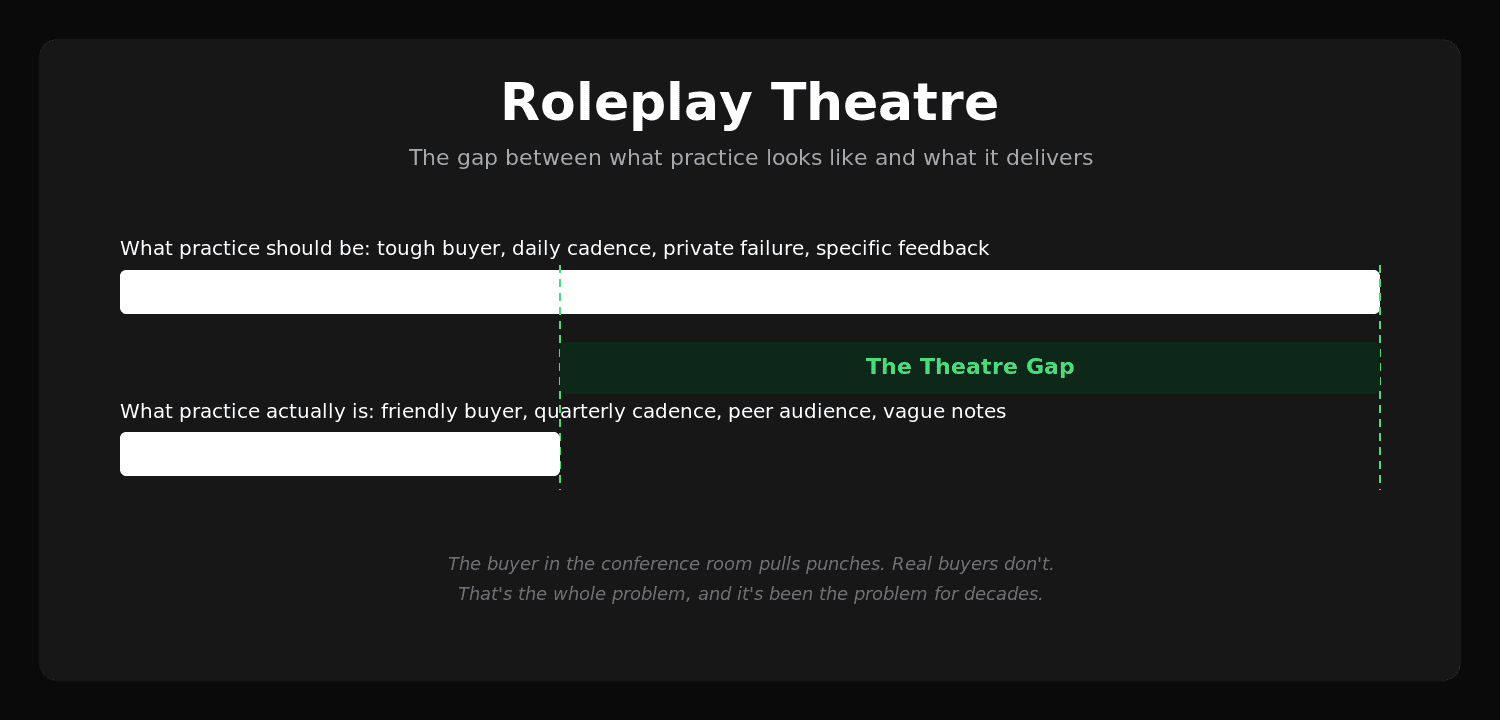
Traditional roleplay fails because it's Roleplay Theatre: a session that looks like practice, gets logged as practice, and produces none of the reflexes practice is supposed to build. Four things break it.
The buyer is friendly
When a colleague plays the buyer, they pull punches. Nobody wants to make a teammate look bad in front of the room. They accept weak answers and skip the brutal follow-up. A real buyer is busy, distracted, a bit annoyed you called. The conference-room buyer is none of those things. The simulation doesn't simulate.
The pressure is the wrong kind
On a real call, pressure comes from the buyer and the quota. In a conference room, pressure comes from six colleagues watching. Those are different fears, and they train different reflexes. You end up teaching reps to perform under observation, which they've been doing since school. We go deeper on this in the psychology of AI roleplay.
The cadence is broken
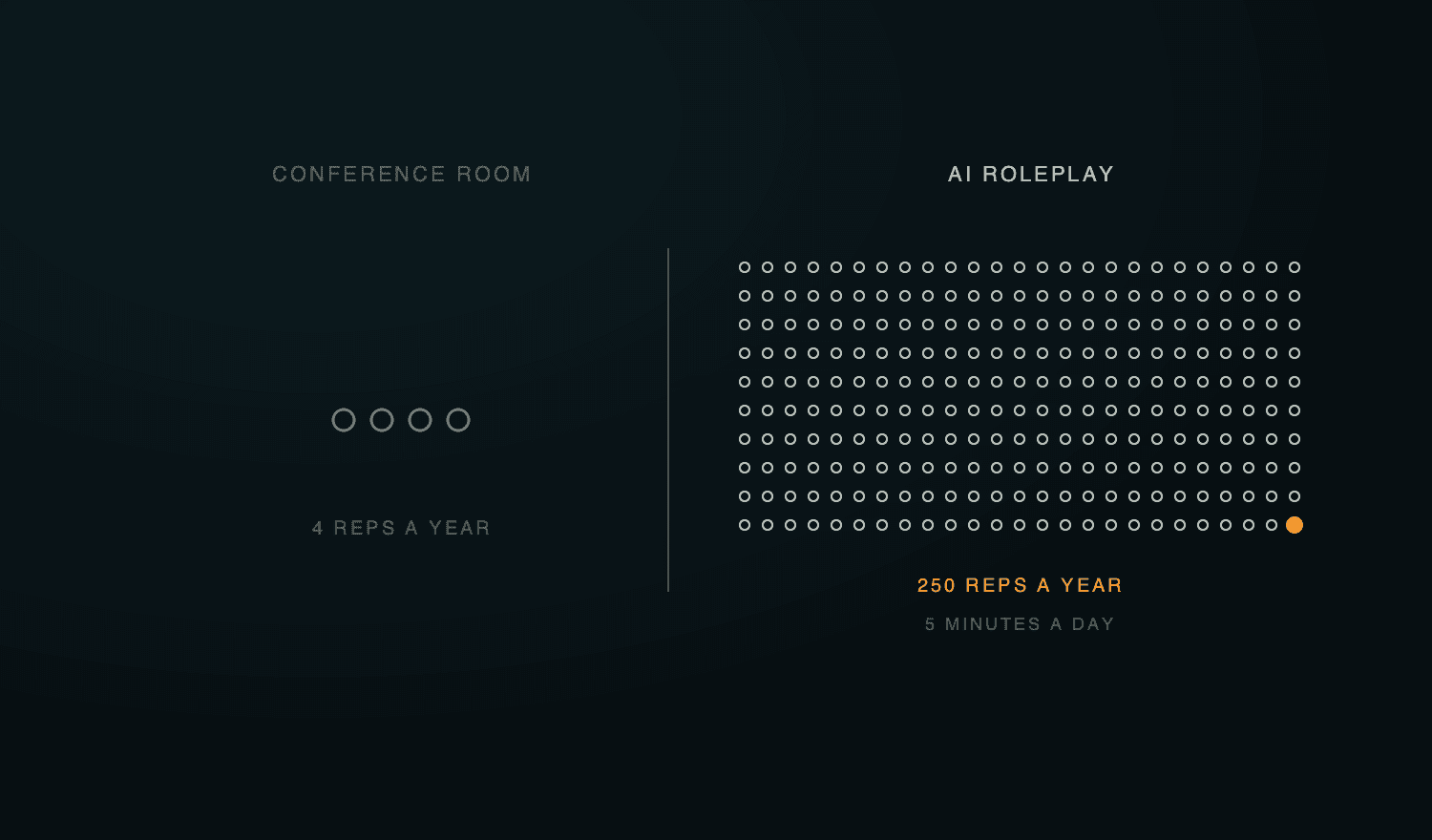
Ask a rep how many roleplays they did last year outside onboarding. The honest answer is two to six. Two to six attempts at the most valuable skill in the job. Nobody learns piano like that. Human roleplay needs a manager's calendar, a room and forty-five minutes, so it gets rationed. Rationed practice is theatre.
The feedback fades by Tuesday
Even a well-run session ends with verbal, general notes. "Ask more discovery questions." Which ones? At what moment? None of that survives the drive home. By the next live call, the lesson has shrunk to "be more curious." This isn't a manager failing. It's arithmetic. A manager with eight reps can't run weekly one-to-one roleplays and still run the team. We wrote about the wider pattern in why sales training fails under real pressure.
How does AI roleplay work for sales?
AI roleplay for sales runs a five-step loop: scenario, live conversation, scoring, retry, tracking. If a platform you're evaluating is missing one of the five, the loop breaks and practice stops compounding.
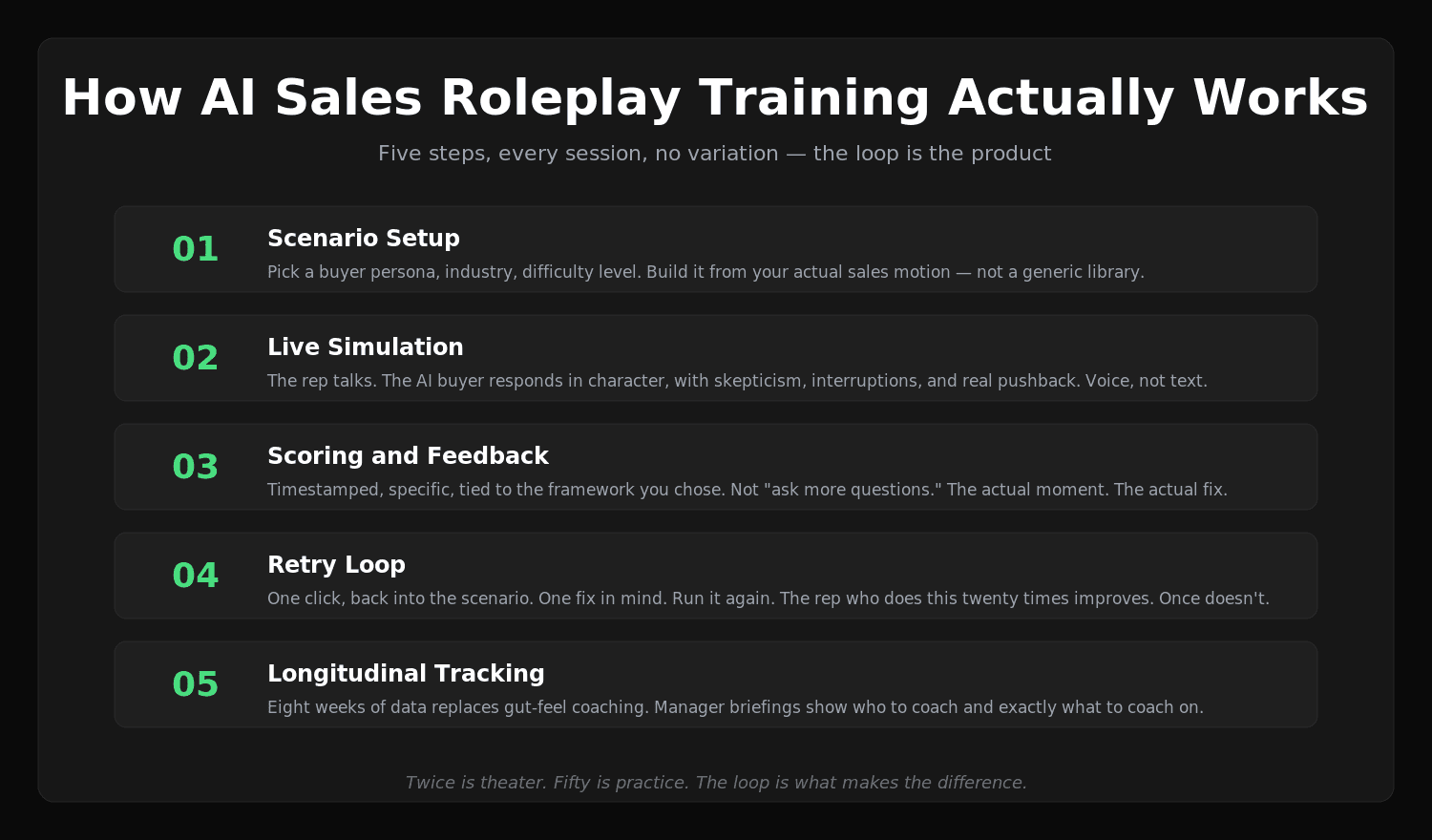
Scenario setup. The rep or manager picks a scenario: a cold call to a CFO, a discovery call in healthcare, a discount negotiation with procurement. Good platforms build these from your real ICP, objections and calls. Generic libraries produce generic reps.
Live simulation. The rep talks. The AI buyer answers in real time, in character, for ninety seconds to twelve minutes. It interrupts and changes direction the way people do.
Scoring and feedback. The AI scores the call against a rubric, ideally your own: MEDDIC, SPIN, Sandler or a homegrown framework. Feedback is timestamped. "At 4:32 you let the buyer turn the call to price before you'd set value" beats "work on discovery."
Retry. This is the part most vendors bury. The point isn't one attempt. It's the fifth attempt, with one fix in mind each time. Frictionless retry is where the skill actually forms.
Tracking. After a few weeks, rep and manager can see score trends by skill. Rep A is strong on discovery and weak on procurement. Rep B freezes on price. That data never existed before.
What happens under the hood?
Three pieces of technology do the work. Speech-to-text turns the rep's words into text. A large language model, told who the buyer is and what they care about, decides what the buyer says next. Text-to-speech speaks it back in a human-sounding voice. After the call, a second pass reads the full transcript against the scoring rubric. The hard engineering problem isn't any single piece. It's making all three fast enough that the conversation feels like a conversation.
Why voice beats text
Sales is a voice job. Typing to a chatbot is practicing for a different job. When you speak, you hear your own pace and filler words, you get interrupted, and you have to think on your feet with your stomach tight. That's the condition you're training for. Text practice doesn't recreate it, which is also why ChatGPT falls short as a sales trainer.
What is an AI voice roleplay training platform?
An AI voice roleplay training platform is software where reps practice by speaking, not typing, with an AI buyer that answers out loud in real time. It combines the live voice call, scenario builder, scoring and manager reporting in one place. The word "platform" matters: a voice bot alone is a toy. A platform connects practice to coaching.
A complete one gives you:
A scenario builder that uses your personas, objections and uploaded calls, so reps practice your market and not a generic one.
Real-time voice with short response gaps and natural interruptions.
Methodology-native scoring against the framework your team already uses.
A retry loop that takes one click.
Manager visibility that says who to coach this week and on what.
Access where reps work. For inside teams that's the browser. For field reps it's the phone, which is why SecondBody runs on WhatsApp.
Which AI sales roleplay tools avoid robotic voices and long pauses?
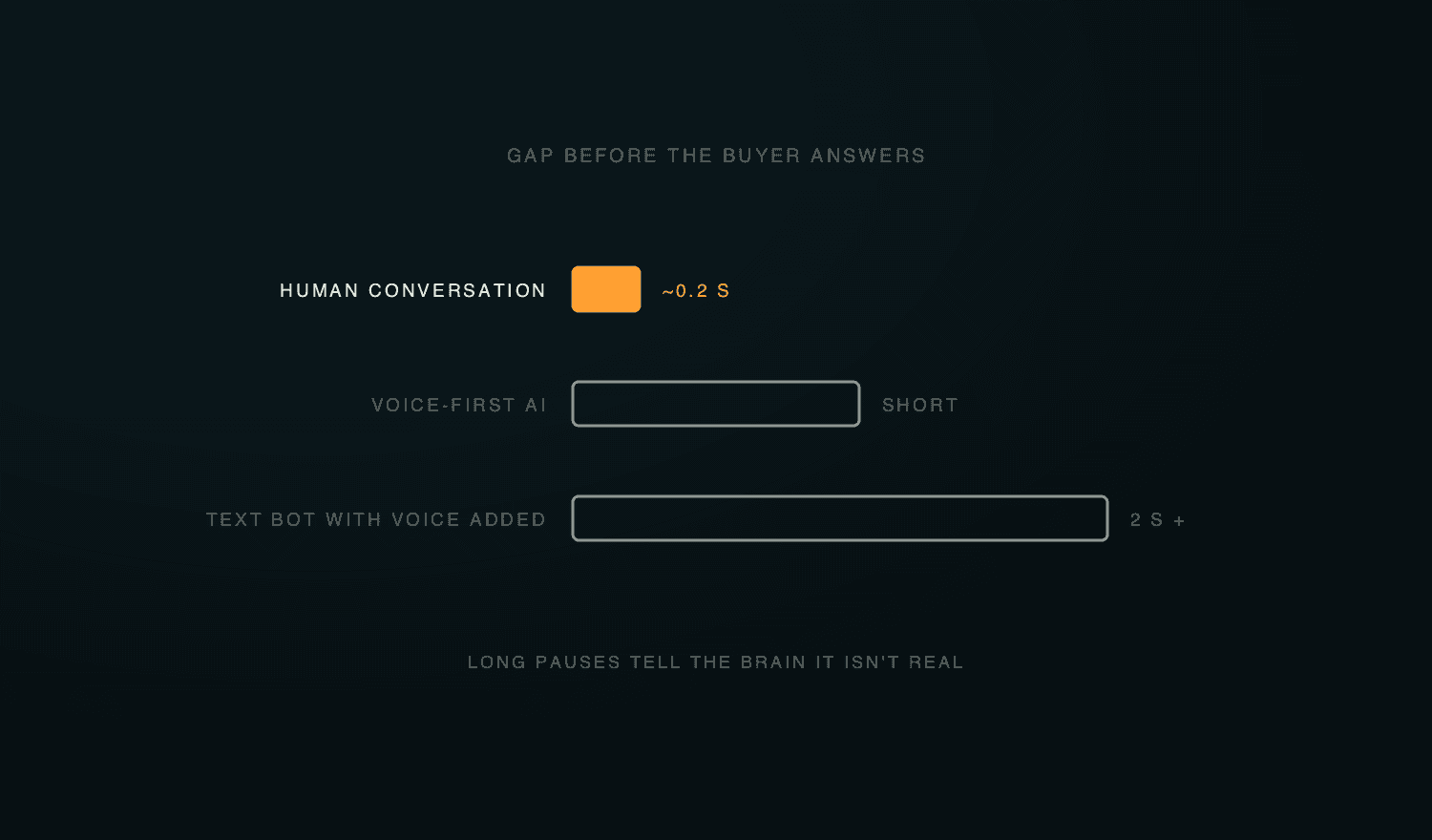
The tools that avoid robotic voices are the ones built voice-first, where speech recognition, the model and speech output were designed as one system. Tools that started as text chat and added voice later tend to show it: a flat tone, a two-second wait after every sentence, and no way to interrupt the buyer.
Why this matters more than it sounds: in natural conversation, people take turns with gaps of roughly 200 milliseconds, and that pattern holds across languages (Stivers et al., PNAS). A two-second pause after every line tells the rep's brain "this isn't real." Once the brain knows it isn't real, the stomach stops dropping, and you're back to Roleplay Theatre with better graphics.
How to test it in a demo, in five minutes:
Interrupt the buyer mid-sentence. Does it stop and respond, or talk over you?
Give a one-word answer. Does the buyer push, or politely move on?
Go off script. Ask the buyer about their weekend. A good persona stays in character and steers back.
Count the gap. If you can say "one Mississippi" between your line and the reply every time, reps will feel it.
Listen to the voice at minute six, not second ten. Flat delivery shows up once the novelty wears off.
This was the first requirement we wrote down when we built Rory. The gap most teams hit is that roleplay feels fake, so reps stop taking it seriously. That's the problem SecondBody was built to solve, by running voice from day one so a practice call sounds like a call.
Which AI sales roleplay tools show whether a rep is actually ready to sell?
The tools that show readiness score reps against a defined standard over many attempts, not one. A single score says how a rep did today. Readiness means the rep hits the bar on the scenarios that matter, repeatedly, under pressure, and a manager can see it without sitting in on calls.
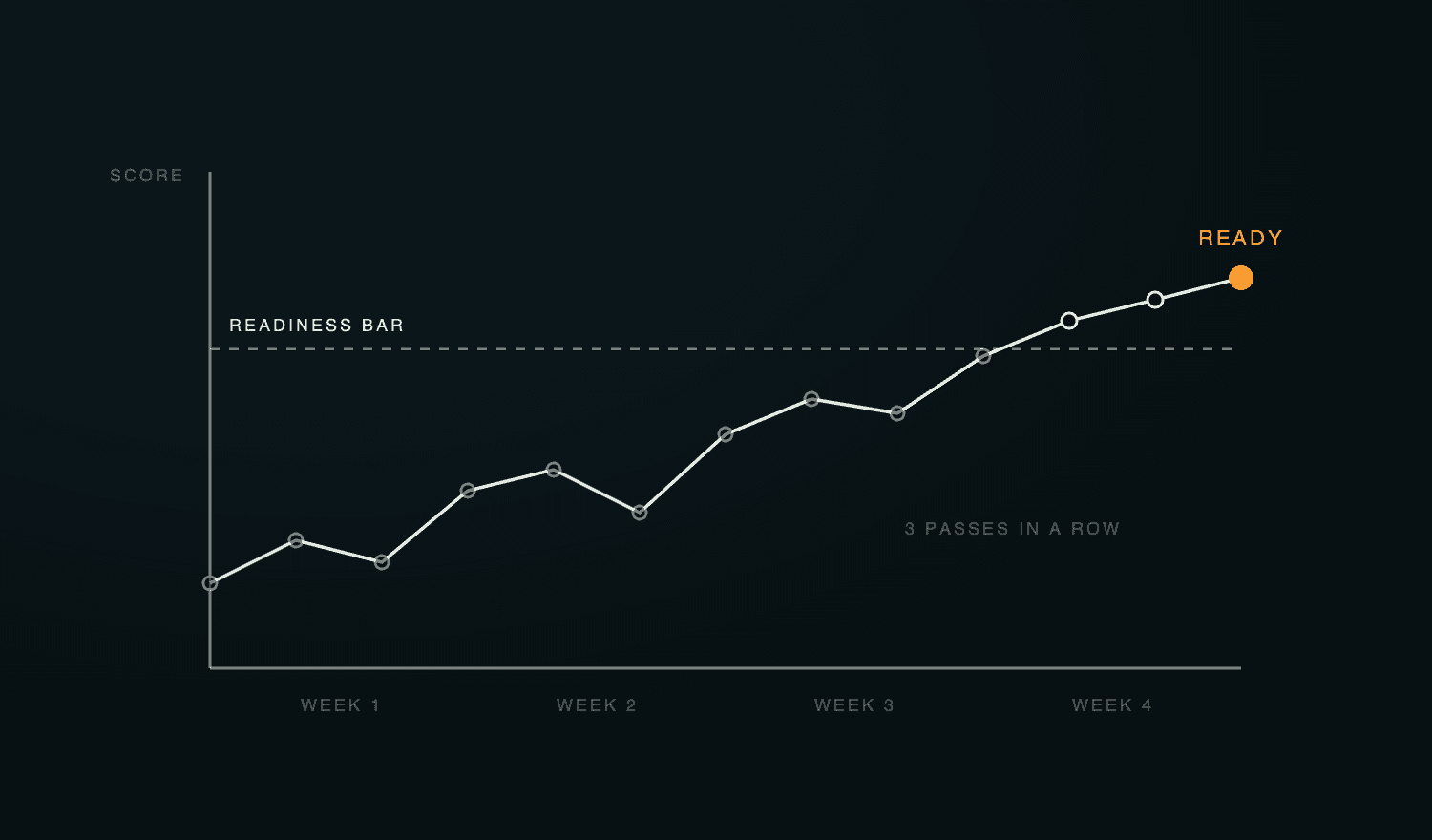
What a real readiness signal looks like:
A threshold, not a vibe. "Ready" means scoring at or above a set standard on the core scenarios: cold open, top three objections, price, next step.
Consistency. Three passes in a row beats one lucky 92.
Coverage. A rep who aces discovery but never practiced procurement isn't ready for a procurement-heavy territory.
Trend. A rising line tells you more than any single point.
Manager view. A weekly list of who is ready, who is close and who is stuck, with the transcript that shows why.
Customer numbers make this concrete. At Allwyn, the share of reps at coaching standard moved from 1 in 5 to 4 in 5 in a quarter (Allwyn story). At GBUK, consistent users scored 8 to 10 out of 10 on cold calls, against about 6 for those who didn't practice (GBUK story). Both are readiness signals a manager can act on before a single deal is lost. If readiness visibility is the main job, SecondBody's sales readiness view is built for exactly that.
How can AI roleplay simulations improve sales training?
AI roleplay simulations improve sales training by doing five things human roleplay can't do at scale: a buyer who doesn't soften, daily cadence, private failure, instant specific feedback, and data across every attempt.
The buyer doesn't pull punches. An AI persona can be tuned to the exact difficulty your reps face. It doesn't care if the rep had a bad quarter. It pushes back the way buyers push back, which is the only pushback worth practicing against.
The cadence becomes daily. No calendar needed. 7am before the big call. Lunch after a rejection. Sunday night before Monday's pitch. To handle "we're happy with our current vendor," a rep needs fifty attempts, not two. Two is theatre. Fifty is practice.
Privacy allows honest failure. New reps would rather give a safe wrong answer than look foolish in front of a manager. In private, they try the bold close and the odd question. They fail eight times and learn what each failure feels like.
Feedback is immediate and specific. One correction, applied twenty minutes later in a fresh attempt, compounds. General feedback after a quarterly workshop doesn't.
The data shows up. Hundreds of attempts reveal patterns no manager could see from gut feel. The 1:1 changes from "how's pipeline" to "here are the three calls where price threw you."
That last one is what Rory is built around: a manager briefing that says who to coach this week, on what, with the transcripts to prove it. One manager can then coach 20 or 30 reps properly instead of pretending to.
AI roleplay simulators vs traditional sales coaching: which works better?
Neither wins alone. AI roleplay simulators win on volume, consistency and privacy. Traditional sales coaching wins on judgment, context and relationship. The best teams use AI to run the repetitions and managers to decide what to practice and why.
AI roleplay simulator | Traditional manager coaching | |
|---|---|---|
Reps per week | Unlimited, any time | Limited by manager calendar |
Buyer realism | Consistent, tunable difficulty | Varies with who plays the buyer |
Feedback speed | Seconds, timestamped | Hours or days, from memory |
Judgment on a live deal | Limited to the scenario | Strong, knows the account |
Motivation and trust | Streaks and scores help | Human relationship matters most |
Cost per extra rep | Low | A share of a manager's week |
AI vs human sales coaching: what should each do?
Let AI handle the reps: cold opens, objections, price, discovery drills, pre-call warm-ups. Let humans handle what needs judgment: deal strategy, account politics, career conversations, and deciding which skill matters most this month. The mistake is using managers as practice partners. It's the most expensive way to run a drill, and it's the part AI does better.
For the manager-side tooling, see our guide to AI sales coaching software. For how managers structure the time they get back, read how to train a sales rep.
What separates good AI sales roleplay from theatre?
Good AI roleplay is specific, calibrated, methodology-aware, full-length, voice-first and visible to managers. Miss any one and you get a chatbot in a buyer costume. Six things to check:
Scenario specificity. If a scenario could run at another company without changes, it's too generic. Your personas, your objections, your pricing, your competitors, your regulatory lines.
Pressure calibration. A buyer who accepts everything is theatre. A buyer who rejects everything is also theatre, just more depressing. Reps need a range: warm inbound, skeptical evaluator, hostile procurement.
Methodology alignment. If you run MEDDIC, feedback should be MEDDIC. If you run SPIN, questions should be judged as situation, problem, implication and need-payoff.
Conversation continuity. Single-line objection drills solve maybe a fifth of the problem. Reps need to practice the arc: open, discovery, pivot, close.
Speed of setup. Platforms that let a manager build a scenario in fifteen minutes get used. Platforms that need professional services to build one get shelved.
The manager side. Practice that never reaches a manager never compounds. Half a fix can be worse than none, because it looks like progress.
Can AI roleplay be personalized for each rep?
Yes, and it should be. Personalized AI roleplay picks each rep's next scenario from their own weak spots, adjusts difficulty as they improve, and uses their real territory, product and buyers. A generic library treats every rep the same, which means the strong rep is bored and the struggling rep is lost.
What personalization looks like in practice:
Weak-spot targeting. A rep who keeps losing to "we're happy with our current vendor" gets that objection three days running, at rising difficulty.
Difficulty that moves. Pass twice at level two, and the buyer gets tougher.
Real-call input. On team plans, reps upload their own calls. The coach turns the moment they lost into tomorrow's practice.
Coaching, not just scoring. An AI roleplay coach explains why the score dropped and what to try, then checks whether the fix held.
This is the difference between an AI roleplay tool and an AI sales coach. Rory does both: plays the buyer, then coaches the rep, then tells the manager what changed.
Is AI roleplay training worth it?
AI roleplay training is worth it when reps practice most days and managers use what it surfaces. It isn't worth it when it's bought as a checkbox, rolled out with a mandate and left alone. The software is cheap. The habit is the expensive part.
Our honest test before buying: can you write, on one page, who practices when, what the manager does with the results, and what number you'll check in 60 days? If yes, AI roleplay will probably pay back inside the first year. If no, buy nothing until you can.
Three signs it's working by week six:
Reps practice without being chased.
Transcripts show recoveries on objections that used to end calls.
Managers open the briefing before their 1:1s.
What reps and buyers say online matches this. Search "AI sales roleplay reddit" and you'll find two camps: reps who found it awkward the first week and useful by the third, and reps whose company bought a tool that sounded like a robot and never opened it again. The difference is almost always voice quality and cadence, not the idea itself.
How do you measure the ROI of AI sales roleplay training?
Measure ROI in three layers: practice (are reps doing it), skill (are scores and real-call behavior improving), and business (ramp time, conversion, retention). Then compare a cohort that practiced with one that didn't. Top-line win rate alone is too noisy to credit to training.
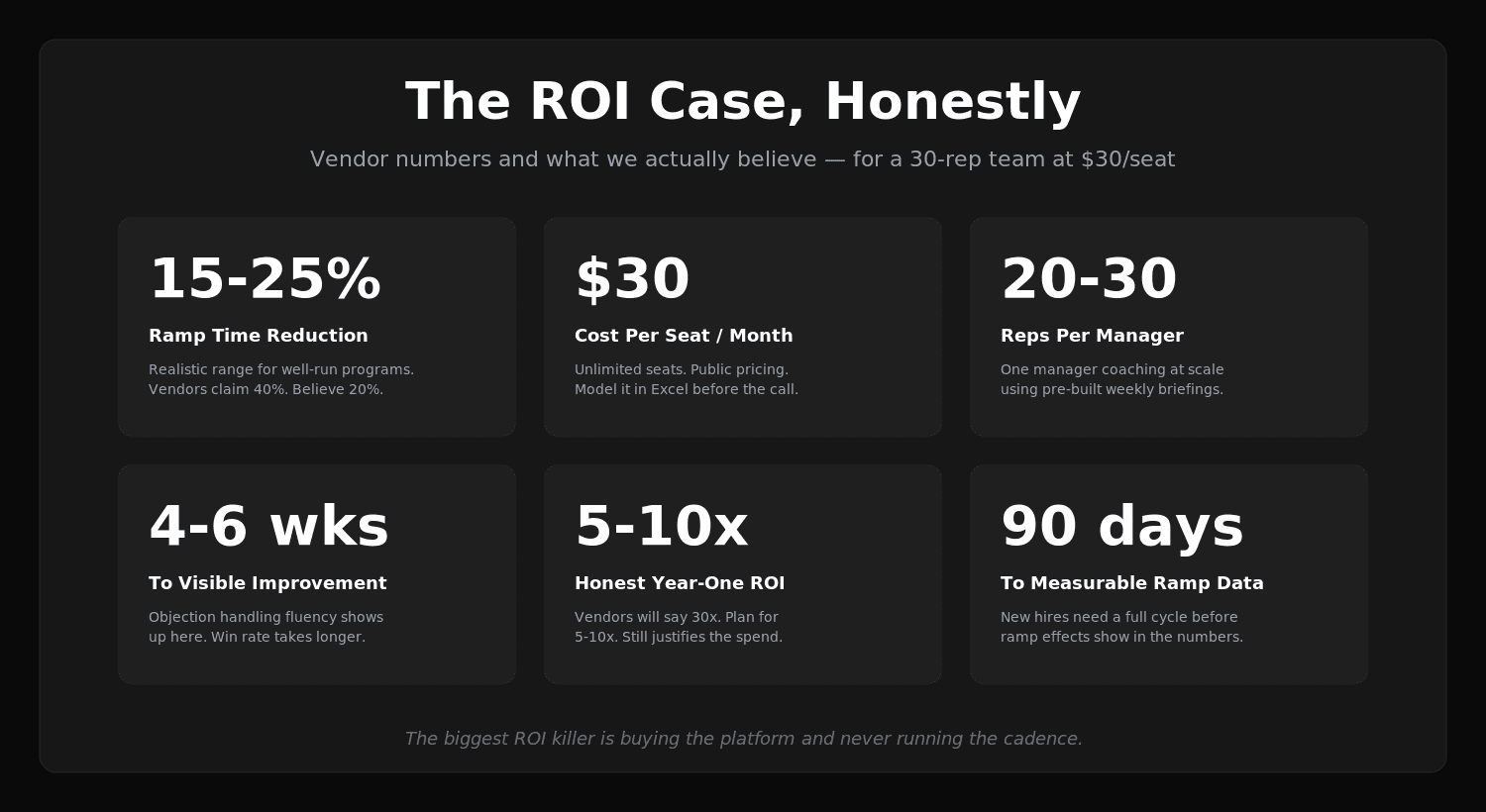
Practice metrics (weeks 1 to 4): active users, sessions per rep per week, retry rate. These tell you if the habit exists. They don't tell you if it works.
Skill metrics (weeks 3 to 8): scores on core scenarios, share of reps at standard, recovery rate on top objections in real call recordings.
Business metrics (months 3 to 12): time to first deal, time to quota, conversion from first meeting to opportunity, early attrition.
The optimistic case vs what we believe
The vendor case: a 30-rep team, a big ramp cut, a 5-point win-rate jump, retention gains, and a spreadsheet showing 20x to 30x return. What we actually believe: ramp reductions of 15% to 25% in well-run programs, win-rate gains of 2 to 3 points after a year, retention effects that take 6 to 12 months to show. That still returns several times the cost in year one. It just isn't 30x.
Real numbers we can point to: Allwyn saw 65% faster ramp (Allwyn story). Rentokil got 16 hours of roleplay per rep in under three weeks with no days off the road (Rentokil story). Parkingeye closed 415 contracts against a target of 380 (Parkingeye story). Treat any single customer as a data point, not a promise. For the full measurement framework, read 5 key metrics to measure sales training ROI.
The biggest ROI killer in this category isn't the price. It's buying a platform and never running the cadence. Practice that doesn't happen returns zero.
What are the best AI roleplay platforms for sales training in 2026?
The best AI roleplay platform for sales training is the one reps use every day, by voice, against scenarios built from your own calls. For daily voice practice with public pricing, that's SecondBody. A handful of others are purpose-built for roleplay. The rest bolt roleplay onto a larger enablement suite.
Platform | Best at | Pricing | The catch |
|---|---|---|---|
SecondBody | Daily voice roleplay on WhatsApp, phone and browser, manager briefings, 12+ languages | CRM integrations still rolling out | |
Hyperbound | SDR cold-call personas from call recordings | Per seat, by tier | Narrower beyond outbound |
Second Nature (Gong) | Video-avatar roleplay | Quote-based | Now part of Gong; roadmap follows Gong |
Yoodli | Speech delivery: pace, filler words | Free tier plus paid | Delivery more than sales substance |
Mindtickle, Allego, Showpad | Enablement suites with roleplay modules | Quote-based | Roleplay is one feature of many |
We keep this list short on purpose. For the full comparison with ramp-time data, read AI sales roleplay tools, and for the whole category of 17 platforms, see AI sales training software. Head-to-head pages: Second Nature vs SecondBody, Hyperbound vs SecondBody, Yoodli vs SecondBody, Mindtickle vs SecondBody.
What about Second Nature AI sales role play?
Second Nature was one of the first AI sales roleplay tools, known for video avatars. It was acquired by Gong, and its site now points to Gong. If you're already on Gong for call recording, that may be convenient. If you want roleplay as the main product rather than a feature inside a recording platform, compare carefully. Our Second Nature comparison goes through it.
What about emerging AI roleplay companies for sales training?
New names show up in search every month: Duvo, Triple Session, SymTrain, Rep Lab and more. Some started in contact-center simulation, some in speech coaching, some in SDR outbound. We haven't run all of them head to head, so we won't pretend to rank them. Run the same test on each: your hardest real objection, your rep, back to back, and see which one your rep opens again on Tuesday without being asked.
Which AI roleplay fits large enterprises?
For large enterprises, the must-haves are SOC 2, SSO, data retention controls, multi-language coaching, scenarios trained on your playbook, and reporting a regional director can read. SecondBody's Teams and Enterprise plan covers those, with custom minute packages and a dedicated customer success manager. Security details are on our trust center.
Is there a free AI sales roleplay?
There are free options, and they do less than you'd hope. Free speech coaches score pace and filler words. General chatbots like ChatGPT will play a buyer by text if you write a good prompt. Neither gives you a spoken buyer that interrupts, scoring against your methodology, or a manager view.
A free setup that actually helps a solo rep:
Ask a chatbot to play a specific buyer, give it three objections to raise, and tell it never to agree until you've asked about their priorities.
Answer out loud, even if it's text on the other side, and record yourself.
Replay the recording and count filler words and how long you talked before asking a question.
It's better than nothing. It breaks down for a team because nobody sees the results, nothing is scored consistently, and the habit dies in week two. SecondBody doesn't do free trials. You can book a demo and run a real session with Rory before paying anything, and the plans start at $75/month.
How is AI sales roleplay different from conversation intelligence?
Conversation intelligence records and analyzes calls reps already had. AI sales roleplay trains reps before the next call. One is a rear-view mirror. The other is a practice field. Both use AI on sales conversations, which is why buyers mix them up.
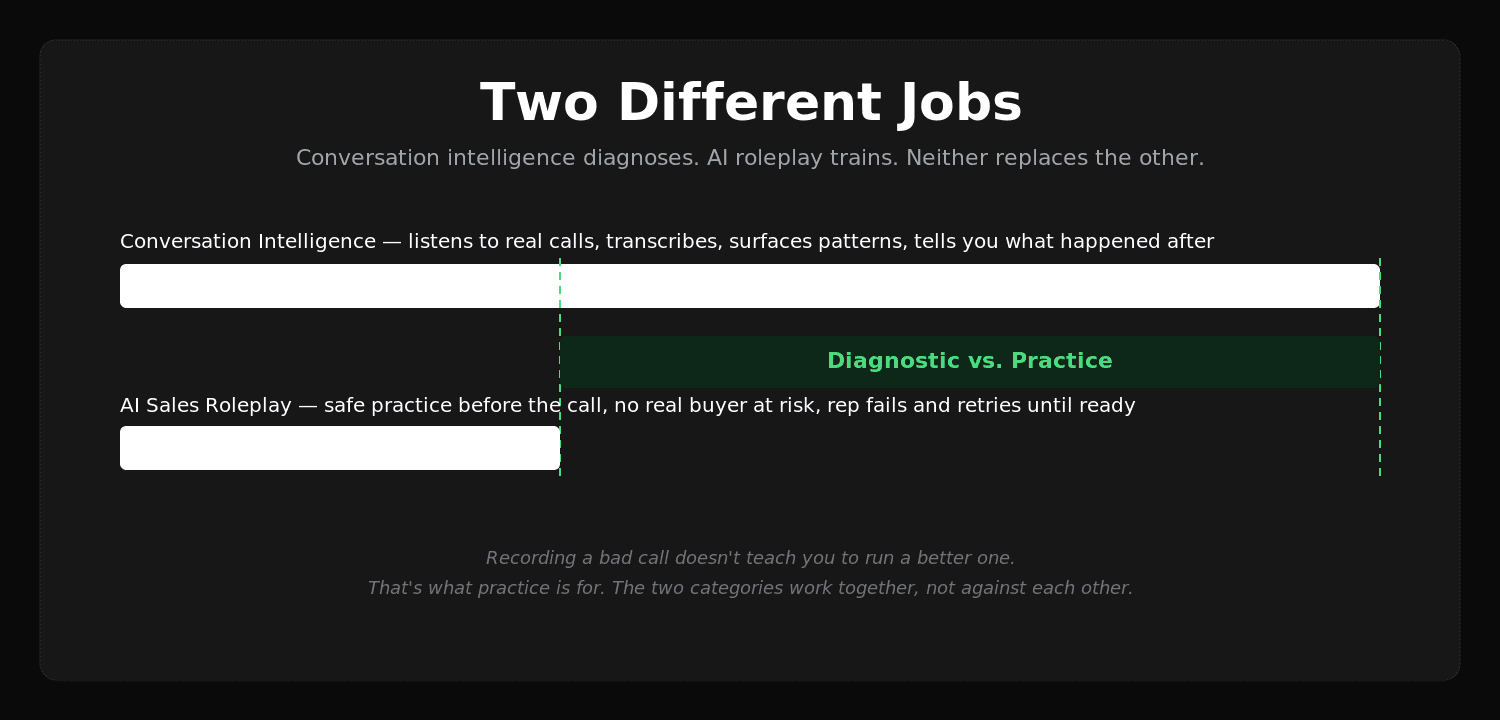
Gong, Chorus and Avoma listen to real calls, transcribe and score them, and help managers spot gaps. That's diagnosis. It doesn't give the rep practice. You can't get better at a hard conversation by watching a recording of one you already lost. AI roleplay is the opposite: no real buyer, no real deal at risk, as many attempts as it takes.
They work together. Use recordings to find the gaps, and roleplay to close them before the next batch of calls. The mistake is buying conversation intelligence and expecting it to fix skills. It surfaces them. Someone still has to practice. More on the category in our conversation intelligence entry and the Gong vs SecondBody comparison.
What should AI sales roleplay scenarios cover?
AI sales roleplay scenarios should cover the ten conversations where your deals are won or lost: the cold open, the gatekeeper, discovery, the demo, the top three objections, price and discount pushback, the competitor question, and the next-step ask. Start there, then add the rare, high-stakes ones.
The objections that deserve their own drills, based on what we see most:
"Send me an email." The polite brush-off that ends most cold calls.
"We're happy with our current vendor." Status quo, the real competitor.
"It's too expensive" and "Can you do 20% off?" Price and discount pushback, practiced before the rep faces it live.
"Now's not a good time." Timing stalls that hide a priority problem.
"I need to talk to my team." The hidden decision process.
Each gets a persona, a difficulty level and a scoring rubric. Our full library, including how to practice discount pushback before it shows up on a live call and how to run demo and qualification roleplays, is in AI sales roleplay scenarios for objection handling. For the human-run drills that pair with it, see objection handling training drills and how to handle price objections.
Does AI roleplay training work for every industry?
AI roleplay training works in any industry where reps win or lose deals in conversations, but the scenarios must use that industry's buyers, words and rules. A medical device rep practicing with a generic "tech buyer" learns almost nothing. A rep practicing with a skeptical theatre manager who asks about clinical evidence learns a lot.
Where we see it matter most:
Medical device and pharma: compliant language, clinical objections, fast cohort onboarding. See SecondBody for healthcare and medical.
Contact centers: high volume, consistent handling, short ramp.
Retail and FMCG field teams: store-level conversations practiced on a phone between visits. See SecondBody for FMCG.
Professional services and financial services: consultative selling and regulated wording. See SecondBody for finance.
B2B SaaS: demo practice, qualification and multi-threading.
We go industry by industry, including how to train 50 new medical device reps fast and how AI roleplay works for pharma sales, in AI roleplay training by industry.
Who is AI sales roleplay training for?
AI sales roleplay training fits any rep who has to say the right thing under pressure, but the payoff is biggest for new SDRs, methodology-driven AEs, field reps, customer success teams and new managers.
New SDRs and BDRs. The clearest fit. High volume on a few scenarios, daily for 90 days. Privacy matters most for nervous early-career reps. See our cold calling training guide.
AEs in a methodology-driven sale. They know MEDDIC or SPIN on paper. Roleplay makes it reflexive on a deal that's slipping. More in MEDDIC implementation with AI roleplay.
Field sales reps. Hard to coach because they're spread out. Practice has to happen on the road, on a phone. See AI sales roleplay for field sales.
Customer success and renewals. Harder emotional dynamics: the unhappy customer, the 40% discount demand. See AI sales training for customer success managers.
Newly promoted managers. They can practice the coaching conversation itself, including the hard one.
Where is AI roleplay a worse fit?
It's a weaker fit for long, multi-stakeholder enterprise deals where the win comes from orchestrating fifteen people across nine months. Roleplay helps the individual moments inside that arc, not the whole motion. It also won't help if your sales process is so unstable that reps can't name the conversations they need to practice. Fix the process first. Then practice it.
How does AI roleplay help sales onboarding and ramp time?
AI roleplay shortens ramp by moving the first hundred bad calls into practice, where they cost nothing. New reps rehearse the week-one objections before they dial, so their first live calls sound like their twentieth.
Two questions come up constantly. "We have 50 new reps joining and need them trained fast." And "we're onboarding 15 new AEs and need realistic roleplay without a manager running every session." The answer to both is the same structure: a fixed scenario path for the first two weeks, a readiness threshold before live calls, and a manager who reviews the weekly briefing instead of running every session. Our AI sales roleplay tools guide covers ramp in detail, and accelerating sales onboarding covers the wider program. For remote teams, the rule is simpler still: if the practice doesn't come to the rep, it won't happen.
What does a practical AI sales roleplay cadence look like?
A cadence that works: five to fifteen minutes a day per rep, one shared team scenario a week, a 30-minute coaching 1:1 every two weeks built on practice data, and a monthly review of the scenario library.
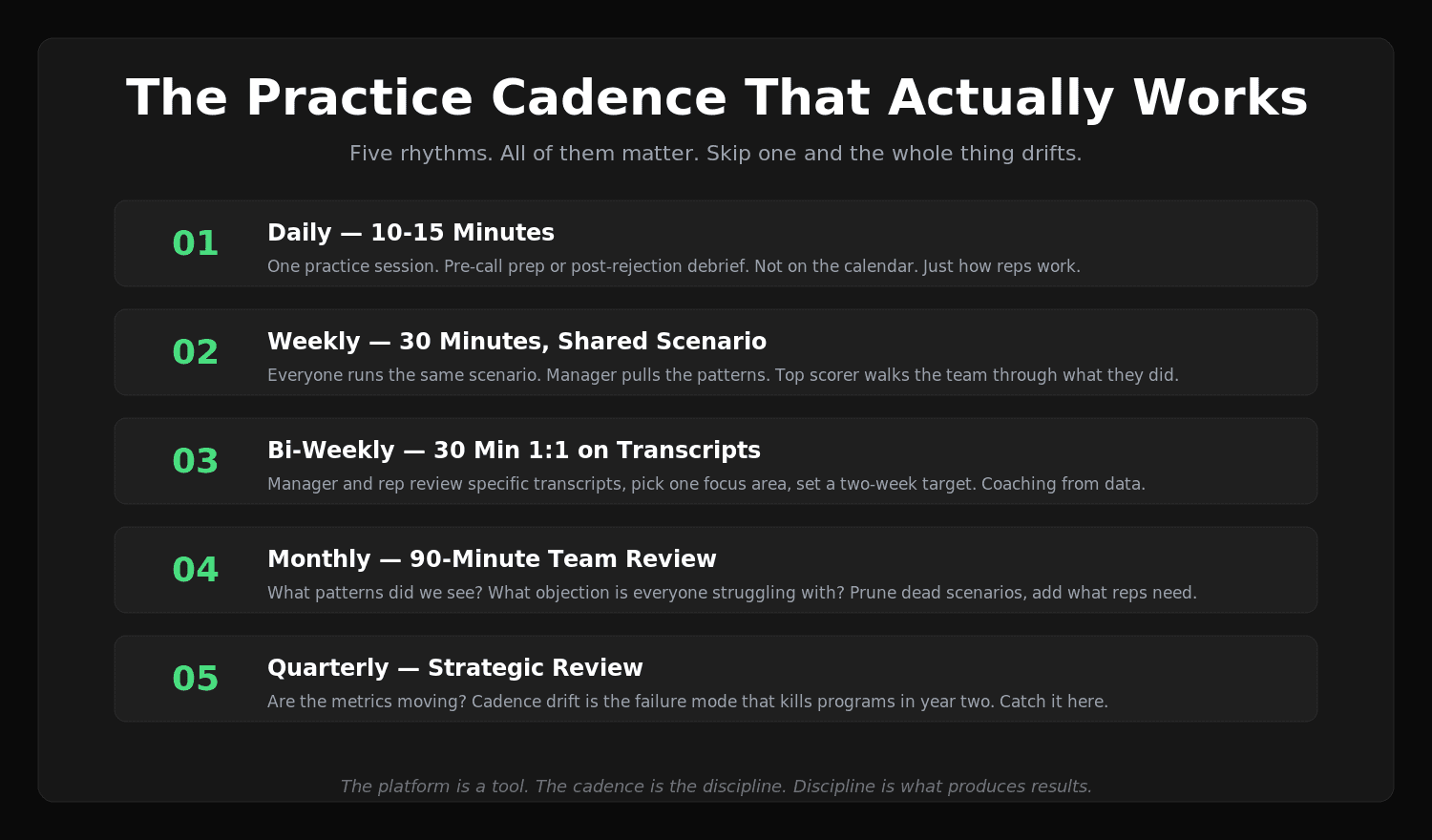
Daily (5 to 15 minutes): one session before the hardest call of the day, or a debrief on the call that went wrong. Not a meeting. Not on the calendar.
Weekly (30 minutes): the whole team runs the same scenario. The top scorer walks everyone through what they did. Healthy pressure, no public failure.
Every two weeks (30-minute 1:1): manager and rep open three transcripts, pick one skill, set a target.
Monthly (60 to 90 minutes): which objection is everyone losing to? What scenario should we add? Retire the ones nobody needs.
Quarterly: are the numbers moving? Who stopped practicing, and why? Drift is what kills programs in year two.
SecondBody runs the daily part for you. Rory calls each rep twice a day on WhatsApp, a morning warm-up and an end-of-day debrief, so the habit doesn't depend on anyone remembering.
What mistakes do teams make with AI sales roleplay training?
The most common mistakes are buying the tool before designing the cadence, using it only for onboarding, generic scenarios, no methodology, mandates that feel like surveillance, ignoring the manager side, and counting sessions instead of skills.
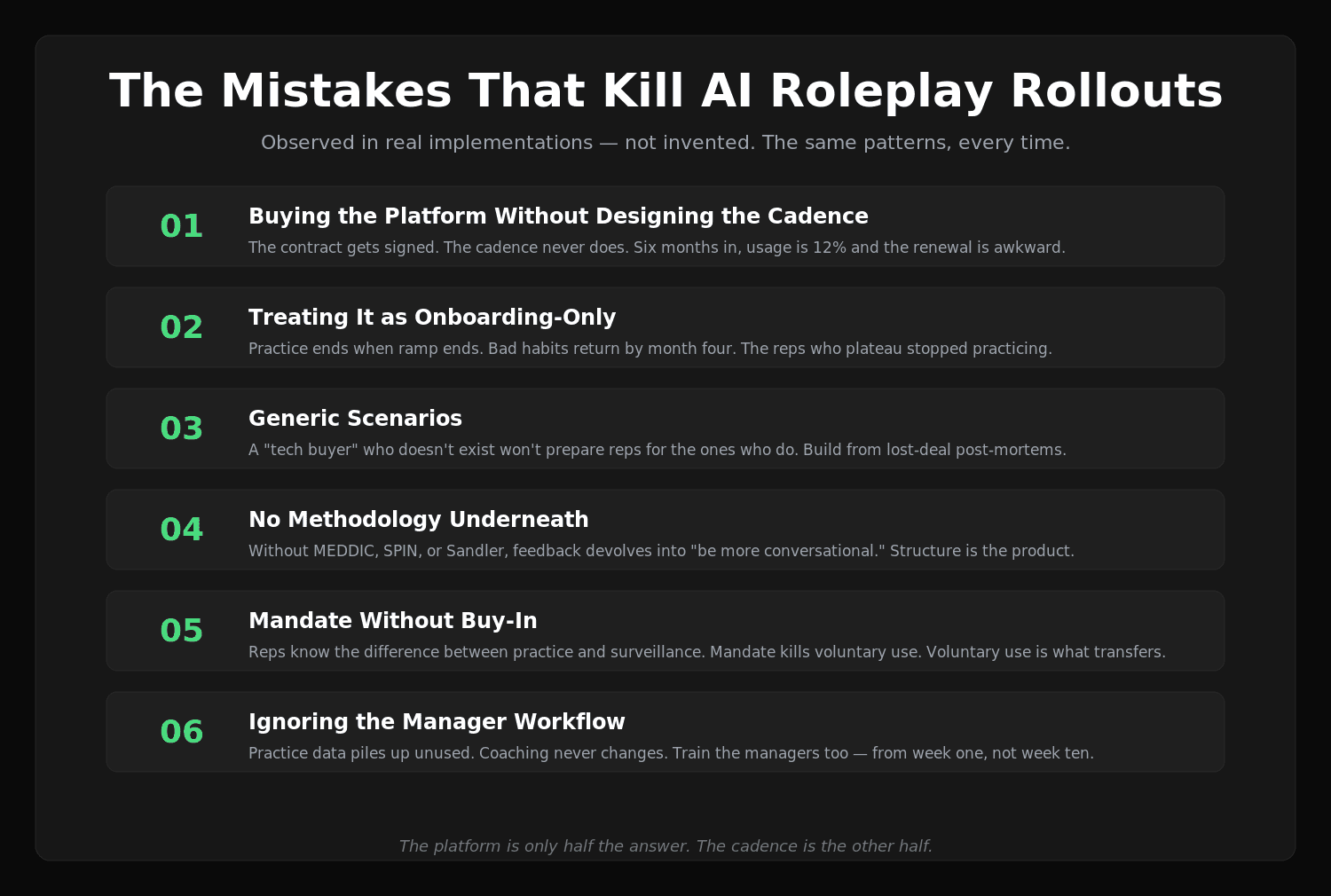
Buying before designing the cadence. Contract signed, platform set up, nobody runs a rhythm. Usage is 12% at month six. Write the one-page cadence before you sign.
Onboarding only. Reps ramp, practice stops, old habits return. The good reps keep practicing past the point they need to.
Generic scenarios. "Cold call to a tech buyer" trains reps for a buyer who doesn't exist. Build from lost deals and top-rep war stories.
No methodology. Without MEDDIC, SPIN, Sandler or your own framework underneath, feedback turns into "be more conversational."
Mandates that feel like surveillance. "Five sessions a week or it goes in the report" gets you five low-effort sessions. Position it as preparation, and let top performers lead.
Ignoring managers. If managers don't read the data, it piles up unused. Train them first.
Measuring inputs. "1,200 sessions this quarter" is an input. Measure recovery rates, ramp and conversion.
How do you implement AI sales roleplay training?
Implement in five stages over about fourteen weeks: document the conversations that matter, test two or three platforms with a real scenario, pilot with five to ten reps for six weeks, expand with a written cadence, then prune and add scenarios monthly.
Weeks 1 to 2: write down the ten conversations that matter. Pull lost-deal notes, sit in on five calls, ask your top rep where deals turn. Do this yourself. Vendor-written scenarios come out generic.
Weeks 2 to 4: test two or three platforms. Not seventeen. Run your hardest real scenario on each, with the same rep, back to back. Listen for voice, pushback, feedback detail and retry friction.
Weeks 4 to 10: pilot. Five to ten reps, mixed tenure. One number to watch. Our customers usually start with ten new joiners and two weeks.
Week 10: expand and write the cadence down. Who practices when, which scenarios are required, what the 1:1 looks like.
Week 14 onward: iterate. Monthly scenario pruning. Quarterly metric review. The platform is a tool. The cadence is the discipline.
Frequently asked questions about AI sales roleplay training
What's the difference between AI sales roleplay and a chatbot?
A chatbot answers questions. AI sales roleplay simulates a buyer with goals, skepticism and pushback, then scores the conversation against a sales framework. The structure is the product.
Can AI sales roleplay replace human roleplay entirely?
It replaces most of what conference-room roleplay was meant to do: the high-frequency, one-conversation practice. Complex multi-party scenarios still benefit from a well-run human session.
How long before reps see results?
Confidence shows up in weeks two to three. Objection handling improves visibly in weeks four to six. Ramp effects show at 90 days. Win-rate effects take six to twelve months.
How long should an AI roleplay session be?
Five to ten minutes. Short daily sessions build reflexes faster than long weekly ones.
Can AI roleplay handle our industry vocabulary?
Good platforms can, if you give them your personas, objections and calls. Test it with a real scenario in the demo. If the buyer sounds generic, it isn't ready for you.
How does AI roleplay handle MEDDIC or SPIN?
Good platforms score against the framework you choose, so a discovery call is judged on whether the rep found the metrics, the economic buyer and the decision criteria, not just whether they sounded confident.
Is AI sales roleplay only for SDRs?
No. SDRs need volume on a few scenarios. Senior AEs need targeted practice on rare, high-stakes moments like competitive bake-offs and late-stage objections.
Do I need guided simulations for AI roleplay training?
New reps do. A guided path of set scenarios in a set order gets them to a baseline. Experienced reps can move to open practice sooner.
Can AI roleplay prepare a rep for one specific call?
Yes. Set up the buyer, the company and the likely objections, and rehearse the call that morning. It's the most underused feature in the category.
Does AI roleplay work in other languages?
With SecondBody, yes. Rory coaches in 12+ languages with the same scenarios and scoring for each region.
How does SecondBody compare to other AI roleplay platforms?
SecondBody is voice-first from day one, runs where reps already are (WhatsApp, phone, browser), scores against your methodology, and briefs managers before their 1:1s. Pricing is public. See the full comparison.
What does SecondBody cost?
$75/month or $750/year, with 120 minutes of roleplay and 60 minutes of coaching with Rory each month. Teams and Enterprise plans are custom. Details on the pricing page.
Is SecondBody secure enough for enterprise and regulated teams?
SecondBody is SOC 2 Type II certified, with enterprise SSO and custom data retention controls. See the trust center.
How do I compare AI roleplay tools without getting spun?
Pick the two or three scenarios your reps fail on most. Run those exact scenarios on two or three platforms with the same rep, back to back. Ignore feature lists. The winner is the one your rep opens again on Tuesday without being asked.
Does Rory work for our methodology?
Yes. SPIN, MEDDIC, Sandler, BANT and custom frameworks are configurable, and on team plans Rory is trained on your playbook, objection library and uploaded calls.
How we know this: this guide draws on SecondBody rollouts with field, inside and customer success teams, on published customer stories linked above, and on the questions buyers actually search, pulled from our own Search Console data in September 2026. Where a number comes from a vendor, we say so and give our more skeptical read.
Stop running Roleplay Theatre. Start practicing.
The format of practice matters more than the vendor. If your team runs Roleplay Theatre, with friendly buyers, rare sessions, peer-pressure stakes and feedback that fades by Tuesday, a new tool won't fix it on its own. The format is the problem.
AI sales roleplay is the first thing we've seen that makes the alternative real. Not because the technology is magic. Because it removes the bottleneck that turned roleplay into theatre: the buyer is always available, always in character, never tired, never polite. Practice can be daily because nothing is scarce except the rep's willingness to show up.
Your reps will have a thousand sales conversations this year. They should walk into each one having already had a hundred like it in private. That isn't a moonshot. It's just practice, at the pace the job actually needs.
If you want that practice running daily, with a coach who calls your reps instead of waiting for them to log in, see SecondBody pricing or book a demo and run a real session with Rory yourself.
Good luck out there.
AI sales roleplay training is practice where a rep talks out loud to an AI buyer, gets scored on what they said and how they said it, and runs the call again until the answer holds under pressure. It works when it's voice-first, daily and scored against your own sales methodology. It fails when it's a chatbot with a persona prompt that reps open twice and forget. This guide answers the questions sales leaders actually type into Google and ChatGPT about AI roleplay for sales, in the order they usually ask them.
Key answers, up front
What is AI sales roleplay? A live voice conversation with an AI buyer that pushes back like a real prospect, followed by a score and specific fixes. Then you retry.
How does AI roleplay work for sales? Pick a scenario, talk to the AI buyer, get scored against a rubric like MEDDIC or SPIN, retry with one fix, and track progress over weeks.
Is AI roleplay training worth it? Yes, if reps practice most days. A team that practices five minutes a day beats a team with a quarterly workshop. A platform nobody opens is worth nothing.
Best AI roleplay for sales training in 2026: SecondBody for daily voice practice on WhatsApp, phone and browser, from $75/month with public pricing. Hyperbound, Second Nature (now part of Gong) and Yoodli fit narrower jobs.
Is there free AI sales roleplay? Free tools cover pacing and filler words. Free chatbots can play a buyer by text. Neither scores you by voice against your own playbook.
AI roleplay vs traditional sales coaching: AI gives each rep a hundred repetitions. Managers give judgment. You need both, and AI makes the manager's hour count.
This is the hub of our AI roleplay cluster. For the tool shortlist and ramp time, read AI sales roleplay tools. For objection handling, cold calls and discount pushback drills, read AI sales roleplay scenarios. For medical device, pharma, contact center, retail and professional services teams, read AI roleplay training by industry.
Here's something worth admitting before we go further. SecondBody makes AI sales roleplay training software. Rory, our AI coach, runs voice roleplays for cold calls, discovery, objection handling and closing. So read this with the bias in mind. We'll try to earn trust the only way that works: by being harder on our own category than anyone else in it.
What is AI sales roleplay training?
AI sales roleplay training is structured practice where a rep has a spoken conversation with an AI buyer persona, gets scored, and tries again. The AI plays a skeptical CFO, a bored gatekeeper, a champion who went quiet, a procurement lead asking for 30% off. It interrupts. It stalls. It says "send me an email." After the call, an AI coach points to the exact moment the rep lost the room and what to try next.
Here's what that looks like on a Tuesday. A new BDR gets a scenario before her first live dials: cold outbound to a VP of Engineering, 90 seconds to earn a meeting. At second 14 the AI buyer cuts in: "I'm in a meeting in three minutes. What is this?" She drops the script and mumbles something about "exploring solutions." The AI says "we already use Datadog, send me an email" and hangs up. She gets a score, a timestamped transcript and three fixes. She runs it four more times before lunch. By the fourth, she handles the interruption cleanly. Nobody watched her fail. The whole loop took twenty minutes.
That's the good version. The bad version is a chatbot reading a persona prompt in a flat voice, accepting any answer, and closing with "great job, try asking more questions." Same category name. Completely different product. Most of this guide is about telling the two apart.
People search this a dozen ways: AI sales roleplay, AI sales role play, AI roleplay training, AI role play for sales, sales roleplay AI, AI sales practice. They all mean the same thing. A rep practicing a real sales conversation against a machine that doesn't pull punches. For the category definition in one page, see our AI sales training entry.
Why does traditional sales roleplay fail?
Traditional roleplay fails because it's Roleplay Theatre: a session that looks like practice, gets logged as practice, and produces none of the reflexes practice is supposed to build. Four things break it.
The buyer is friendly
When a colleague plays the buyer, they pull punches. Nobody wants to make a teammate look bad in front of the room. They accept weak answers and skip the brutal follow-up. A real buyer is busy, distracted, a bit annoyed you called. The conference-room buyer is none of those things. The simulation doesn't simulate.
The pressure is the wrong kind
On a real call, pressure comes from the buyer and the quota. In a conference room, pressure comes from six colleagues watching. Those are different fears, and they train different reflexes. You end up teaching reps to perform under observation, which they've been doing since school. We go deeper on this in the psychology of AI roleplay.
The cadence is broken
Ask a rep how many roleplays they did last year outside onboarding. The honest answer is two to six. Two to six attempts at the most valuable skill in the job. Nobody learns piano like that. Human roleplay needs a manager's calendar, a room and forty-five minutes, so it gets rationed. Rationed practice is theatre.
The feedback fades by Tuesday
Even a well-run session ends with verbal, general notes. "Ask more discovery questions." Which ones? At what moment? None of that survives the drive home. By the next live call, the lesson has shrunk to "be more curious." This isn't a manager failing. It's arithmetic. A manager with eight reps can't run weekly one-to-one roleplays and still run the team. We wrote about the wider pattern in why sales training fails under real pressure.
How does AI roleplay work for sales?
AI roleplay for sales runs a five-step loop: scenario, live conversation, scoring, retry, tracking. If a platform you're evaluating is missing one of the five, the loop breaks and practice stops compounding.
Scenario setup. The rep or manager picks a scenario: a cold call to a CFO, a discovery call in healthcare, a discount negotiation with procurement. Good platforms build these from your real ICP, objections and calls. Generic libraries produce generic reps.
Live simulation. The rep talks. The AI buyer answers in real time, in character, for ninety seconds to twelve minutes. It interrupts and changes direction the way people do.
Scoring and feedback. The AI scores the call against a rubric, ideally your own: MEDDIC, SPIN, Sandler or a homegrown framework. Feedback is timestamped. "At 4:32 you let the buyer turn the call to price before you'd set value" beats "work on discovery."
Retry. This is the part most vendors bury. The point isn't one attempt. It's the fifth attempt, with one fix in mind each time. Frictionless retry is where the skill actually forms.
Tracking. After a few weeks, rep and manager can see score trends by skill. Rep A is strong on discovery and weak on procurement. Rep B freezes on price. That data never existed before.
What happens under the hood?
Three pieces of technology do the work. Speech-to-text turns the rep's words into text. A large language model, told who the buyer is and what they care about, decides what the buyer says next. Text-to-speech speaks it back in a human-sounding voice. After the call, a second pass reads the full transcript against the scoring rubric. The hard engineering problem isn't any single piece. It's making all three fast enough that the conversation feels like a conversation.
Why voice beats text
Sales is a voice job. Typing to a chatbot is practicing for a different job. When you speak, you hear your own pace and filler words, you get interrupted, and you have to think on your feet with your stomach tight. That's the condition you're training for. Text practice doesn't recreate it, which is also why ChatGPT falls short as a sales trainer.
What is an AI voice roleplay training platform?
An AI voice roleplay training platform is software where reps practice by speaking, not typing, with an AI buyer that answers out loud in real time. It combines the live voice call, scenario builder, scoring and manager reporting in one place. The word "platform" matters: a voice bot alone is a toy. A platform connects practice to coaching.
A complete one gives you:
A scenario builder that uses your personas, objections and uploaded calls, so reps practice your market and not a generic one.
Real-time voice with short response gaps and natural interruptions.
Methodology-native scoring against the framework your team already uses.
A retry loop that takes one click.
Manager visibility that says who to coach this week and on what.
Access where reps work. For inside teams that's the browser. For field reps it's the phone, which is why SecondBody runs on WhatsApp.
Which AI sales roleplay tools avoid robotic voices and long pauses?
The tools that avoid robotic voices are the ones built voice-first, where speech recognition, the model and speech output were designed as one system. Tools that started as text chat and added voice later tend to show it: a flat tone, a two-second wait after every sentence, and no way to interrupt the buyer.
Why this matters more than it sounds: in natural conversation, people take turns with gaps of roughly 200 milliseconds, and that pattern holds across languages (Stivers et al., PNAS). A two-second pause after every line tells the rep's brain "this isn't real." Once the brain knows it isn't real, the stomach stops dropping, and you're back to Roleplay Theatre with better graphics.
How to test it in a demo, in five minutes:
Interrupt the buyer mid-sentence. Does it stop and respond, or talk over you?
Give a one-word answer. Does the buyer push, or politely move on?
Go off script. Ask the buyer about their weekend. A good persona stays in character and steers back.
Count the gap. If you can say "one Mississippi" between your line and the reply every time, reps will feel it.
Listen to the voice at minute six, not second ten. Flat delivery shows up once the novelty wears off.
This was the first requirement we wrote down when we built Rory. The gap most teams hit is that roleplay feels fake, so reps stop taking it seriously. That's the problem SecondBody was built to solve, by running voice from day one so a practice call sounds like a call.
Which AI sales roleplay tools show whether a rep is actually ready to sell?
The tools that show readiness score reps against a defined standard over many attempts, not one. A single score says how a rep did today. Readiness means the rep hits the bar on the scenarios that matter, repeatedly, under pressure, and a manager can see it without sitting in on calls.
What a real readiness signal looks like:
A threshold, not a vibe. "Ready" means scoring at or above a set standard on the core scenarios: cold open, top three objections, price, next step.
Consistency. Three passes in a row beats one lucky 92.
Coverage. A rep who aces discovery but never practiced procurement isn't ready for a procurement-heavy territory.
Trend. A rising line tells you more than any single point.
Manager view. A weekly list of who is ready, who is close and who is stuck, with the transcript that shows why.
Customer numbers make this concrete. At Allwyn, the share of reps at coaching standard moved from 1 in 5 to 4 in 5 in a quarter (Allwyn story). At GBUK, consistent users scored 8 to 10 out of 10 on cold calls, against about 6 for those who didn't practice (GBUK story). Both are readiness signals a manager can act on before a single deal is lost. If readiness visibility is the main job, SecondBody's sales readiness view is built for exactly that.
How can AI roleplay simulations improve sales training?
AI roleplay simulations improve sales training by doing five things human roleplay can't do at scale: a buyer who doesn't soften, daily cadence, private failure, instant specific feedback, and data across every attempt.
The buyer doesn't pull punches. An AI persona can be tuned to the exact difficulty your reps face. It doesn't care if the rep had a bad quarter. It pushes back the way buyers push back, which is the only pushback worth practicing against.
The cadence becomes daily. No calendar needed. 7am before the big call. Lunch after a rejection. Sunday night before Monday's pitch. To handle "we're happy with our current vendor," a rep needs fifty attempts, not two. Two is theatre. Fifty is practice.
Privacy allows honest failure. New reps would rather give a safe wrong answer than look foolish in front of a manager. In private, they try the bold close and the odd question. They fail eight times and learn what each failure feels like.
Feedback is immediate and specific. One correction, applied twenty minutes later in a fresh attempt, compounds. General feedback after a quarterly workshop doesn't.
The data shows up. Hundreds of attempts reveal patterns no manager could see from gut feel. The 1:1 changes from "how's pipeline" to "here are the three calls where price threw you."
That last one is what Rory is built around: a manager briefing that says who to coach this week, on what, with the transcripts to prove it. One manager can then coach 20 or 30 reps properly instead of pretending to.
AI roleplay simulators vs traditional sales coaching: which works better?
Neither wins alone. AI roleplay simulators win on volume, consistency and privacy. Traditional sales coaching wins on judgment, context and relationship. The best teams use AI to run the repetitions and managers to decide what to practice and why.
AI roleplay simulator | Traditional manager coaching | |
|---|---|---|
Reps per week | Unlimited, any time | Limited by manager calendar |
Buyer realism | Consistent, tunable difficulty | Varies with who plays the buyer |
Feedback speed | Seconds, timestamped | Hours or days, from memory |
Judgment on a live deal | Limited to the scenario | Strong, knows the account |
Motivation and trust | Streaks and scores help | Human relationship matters most |
Cost per extra rep | Low | A share of a manager's week |
AI vs human sales coaching: what should each do?
Let AI handle the reps: cold opens, objections, price, discovery drills, pre-call warm-ups. Let humans handle what needs judgment: deal strategy, account politics, career conversations, and deciding which skill matters most this month. The mistake is using managers as practice partners. It's the most expensive way to run a drill, and it's the part AI does better.
For the manager-side tooling, see our guide to AI sales coaching software. For how managers structure the time they get back, read how to train a sales rep.
What separates good AI sales roleplay from theatre?
Good AI roleplay is specific, calibrated, methodology-aware, full-length, voice-first and visible to managers. Miss any one and you get a chatbot in a buyer costume. Six things to check:
Scenario specificity. If a scenario could run at another company without changes, it's too generic. Your personas, your objections, your pricing, your competitors, your regulatory lines.
Pressure calibration. A buyer who accepts everything is theatre. A buyer who rejects everything is also theatre, just more depressing. Reps need a range: warm inbound, skeptical evaluator, hostile procurement.
Methodology alignment. If you run MEDDIC, feedback should be MEDDIC. If you run SPIN, questions should be judged as situation, problem, implication and need-payoff.
Conversation continuity. Single-line objection drills solve maybe a fifth of the problem. Reps need to practice the arc: open, discovery, pivot, close.
Speed of setup. Platforms that let a manager build a scenario in fifteen minutes get used. Platforms that need professional services to build one get shelved.
The manager side. Practice that never reaches a manager never compounds. Half a fix can be worse than none, because it looks like progress.
Can AI roleplay be personalized for each rep?
Yes, and it should be. Personalized AI roleplay picks each rep's next scenario from their own weak spots, adjusts difficulty as they improve, and uses their real territory, product and buyers. A generic library treats every rep the same, which means the strong rep is bored and the struggling rep is lost.
What personalization looks like in practice:
Weak-spot targeting. A rep who keeps losing to "we're happy with our current vendor" gets that objection three days running, at rising difficulty.
Difficulty that moves. Pass twice at level two, and the buyer gets tougher.
Real-call input. On team plans, reps upload their own calls. The coach turns the moment they lost into tomorrow's practice.
Coaching, not just scoring. An AI roleplay coach explains why the score dropped and what to try, then checks whether the fix held.
This is the difference between an AI roleplay tool and an AI sales coach. Rory does both: plays the buyer, then coaches the rep, then tells the manager what changed.
Is AI roleplay training worth it?
AI roleplay training is worth it when reps practice most days and managers use what it surfaces. It isn't worth it when it's bought as a checkbox, rolled out with a mandate and left alone. The software is cheap. The habit is the expensive part.
Our honest test before buying: can you write, on one page, who practices when, what the manager does with the results, and what number you'll check in 60 days? If yes, AI roleplay will probably pay back inside the first year. If no, buy nothing until you can.
Three signs it's working by week six:
Reps practice without being chased.
Transcripts show recoveries on objections that used to end calls.
Managers open the briefing before their 1:1s.
What reps and buyers say online matches this. Search "AI sales roleplay reddit" and you'll find two camps: reps who found it awkward the first week and useful by the third, and reps whose company bought a tool that sounded like a robot and never opened it again. The difference is almost always voice quality and cadence, not the idea itself.
How do you measure the ROI of AI sales roleplay training?
Measure ROI in three layers: practice (are reps doing it), skill (are scores and real-call behavior improving), and business (ramp time, conversion, retention). Then compare a cohort that practiced with one that didn't. Top-line win rate alone is too noisy to credit to training.
Practice metrics (weeks 1 to 4): active users, sessions per rep per week, retry rate. These tell you if the habit exists. They don't tell you if it works.
Skill metrics (weeks 3 to 8): scores on core scenarios, share of reps at standard, recovery rate on top objections in real call recordings.
Business metrics (months 3 to 12): time to first deal, time to quota, conversion from first meeting to opportunity, early attrition.
The optimistic case vs what we believe
The vendor case: a 30-rep team, a big ramp cut, a 5-point win-rate jump, retention gains, and a spreadsheet showing 20x to 30x return. What we actually believe: ramp reductions of 15% to 25% in well-run programs, win-rate gains of 2 to 3 points after a year, retention effects that take 6 to 12 months to show. That still returns several times the cost in year one. It just isn't 30x.
Real numbers we can point to: Allwyn saw 65% faster ramp (Allwyn story). Rentokil got 16 hours of roleplay per rep in under three weeks with no days off the road (Rentokil story). Parkingeye closed 415 contracts against a target of 380 (Parkingeye story). Treat any single customer as a data point, not a promise. For the full measurement framework, read 5 key metrics to measure sales training ROI.
The biggest ROI killer in this category isn't the price. It's buying a platform and never running the cadence. Practice that doesn't happen returns zero.
What are the best AI roleplay platforms for sales training in 2026?
The best AI roleplay platform for sales training is the one reps use every day, by voice, against scenarios built from your own calls. For daily voice practice with public pricing, that's SecondBody. A handful of others are purpose-built for roleplay. The rest bolt roleplay onto a larger enablement suite.
Platform | Best at | Pricing | The catch |
|---|---|---|---|
SecondBody | Daily voice roleplay on WhatsApp, phone and browser, manager briefings, 12+ languages | CRM integrations still rolling out | |
Hyperbound | SDR cold-call personas from call recordings | Per seat, by tier | Narrower beyond outbound |
Second Nature (Gong) | Video-avatar roleplay | Quote-based | Now part of Gong; roadmap follows Gong |
Yoodli | Speech delivery: pace, filler words | Free tier plus paid | Delivery more than sales substance |
Mindtickle, Allego, Showpad | Enablement suites with roleplay modules | Quote-based | Roleplay is one feature of many |
We keep this list short on purpose. For the full comparison with ramp-time data, read AI sales roleplay tools, and for the whole category of 17 platforms, see AI sales training software. Head-to-head pages: Second Nature vs SecondBody, Hyperbound vs SecondBody, Yoodli vs SecondBody, Mindtickle vs SecondBody.
What about Second Nature AI sales role play?
Second Nature was one of the first AI sales roleplay tools, known for video avatars. It was acquired by Gong, and its site now points to Gong. If you're already on Gong for call recording, that may be convenient. If you want roleplay as the main product rather than a feature inside a recording platform, compare carefully. Our Second Nature comparison goes through it.
What about emerging AI roleplay companies for sales training?
New names show up in search every month: Duvo, Triple Session, SymTrain, Rep Lab and more. Some started in contact-center simulation, some in speech coaching, some in SDR outbound. We haven't run all of them head to head, so we won't pretend to rank them. Run the same test on each: your hardest real objection, your rep, back to back, and see which one your rep opens again on Tuesday without being asked.
Which AI roleplay fits large enterprises?
For large enterprises, the must-haves are SOC 2, SSO, data retention controls, multi-language coaching, scenarios trained on your playbook, and reporting a regional director can read. SecondBody's Teams and Enterprise plan covers those, with custom minute packages and a dedicated customer success manager. Security details are on our trust center.
Is there a free AI sales roleplay?
There are free options, and they do less than you'd hope. Free speech coaches score pace and filler words. General chatbots like ChatGPT will play a buyer by text if you write a good prompt. Neither gives you a spoken buyer that interrupts, scoring against your methodology, or a manager view.
A free setup that actually helps a solo rep:
Ask a chatbot to play a specific buyer, give it three objections to raise, and tell it never to agree until you've asked about their priorities.
Answer out loud, even if it's text on the other side, and record yourself.
Replay the recording and count filler words and how long you talked before asking a question.
It's better than nothing. It breaks down for a team because nobody sees the results, nothing is scored consistently, and the habit dies in week two. SecondBody doesn't do free trials. You can book a demo and run a real session with Rory before paying anything, and the plans start at $75/month.
How is AI sales roleplay different from conversation intelligence?
Conversation intelligence records and analyzes calls reps already had. AI sales roleplay trains reps before the next call. One is a rear-view mirror. The other is a practice field. Both use AI on sales conversations, which is why buyers mix them up.
Gong, Chorus and Avoma listen to real calls, transcribe and score them, and help managers spot gaps. That's diagnosis. It doesn't give the rep practice. You can't get better at a hard conversation by watching a recording of one you already lost. AI roleplay is the opposite: no real buyer, no real deal at risk, as many attempts as it takes.
They work together. Use recordings to find the gaps, and roleplay to close them before the next batch of calls. The mistake is buying conversation intelligence and expecting it to fix skills. It surfaces them. Someone still has to practice. More on the category in our conversation intelligence entry and the Gong vs SecondBody comparison.
What should AI sales roleplay scenarios cover?
AI sales roleplay scenarios should cover the ten conversations where your deals are won or lost: the cold open, the gatekeeper, discovery, the demo, the top three objections, price and discount pushback, the competitor question, and the next-step ask. Start there, then add the rare, high-stakes ones.
The objections that deserve their own drills, based on what we see most:
"Send me an email." The polite brush-off that ends most cold calls.
"We're happy with our current vendor." Status quo, the real competitor.
"It's too expensive" and "Can you do 20% off?" Price and discount pushback, practiced before the rep faces it live.
"Now's not a good time." Timing stalls that hide a priority problem.
"I need to talk to my team." The hidden decision process.
Each gets a persona, a difficulty level and a scoring rubric. Our full library, including how to practice discount pushback before it shows up on a live call and how to run demo and qualification roleplays, is in AI sales roleplay scenarios for objection handling. For the human-run drills that pair with it, see objection handling training drills and how to handle price objections.
Does AI roleplay training work for every industry?
AI roleplay training works in any industry where reps win or lose deals in conversations, but the scenarios must use that industry's buyers, words and rules. A medical device rep practicing with a generic "tech buyer" learns almost nothing. A rep practicing with a skeptical theatre manager who asks about clinical evidence learns a lot.
Where we see it matter most:
Medical device and pharma: compliant language, clinical objections, fast cohort onboarding. See SecondBody for healthcare and medical.
Contact centers: high volume, consistent handling, short ramp.
Retail and FMCG field teams: store-level conversations practiced on a phone between visits. See SecondBody for FMCG.
Professional services and financial services: consultative selling and regulated wording. See SecondBody for finance.
B2B SaaS: demo practice, qualification and multi-threading.
We go industry by industry, including how to train 50 new medical device reps fast and how AI roleplay works for pharma sales, in AI roleplay training by industry.
Who is AI sales roleplay training for?
AI sales roleplay training fits any rep who has to say the right thing under pressure, but the payoff is biggest for new SDRs, methodology-driven AEs, field reps, customer success teams and new managers.
New SDRs and BDRs. The clearest fit. High volume on a few scenarios, daily for 90 days. Privacy matters most for nervous early-career reps. See our cold calling training guide.
AEs in a methodology-driven sale. They know MEDDIC or SPIN on paper. Roleplay makes it reflexive on a deal that's slipping. More in MEDDIC implementation with AI roleplay.
Field sales reps. Hard to coach because they're spread out. Practice has to happen on the road, on a phone. See AI sales roleplay for field sales.
Customer success and renewals. Harder emotional dynamics: the unhappy customer, the 40% discount demand. See AI sales training for customer success managers.
Newly promoted managers. They can practice the coaching conversation itself, including the hard one.
Where is AI roleplay a worse fit?
It's a weaker fit for long, multi-stakeholder enterprise deals where the win comes from orchestrating fifteen people across nine months. Roleplay helps the individual moments inside that arc, not the whole motion. It also won't help if your sales process is so unstable that reps can't name the conversations they need to practice. Fix the process first. Then practice it.
How does AI roleplay help sales onboarding and ramp time?
AI roleplay shortens ramp by moving the first hundred bad calls into practice, where they cost nothing. New reps rehearse the week-one objections before they dial, so their first live calls sound like their twentieth.
Two questions come up constantly. "We have 50 new reps joining and need them trained fast." And "we're onboarding 15 new AEs and need realistic roleplay without a manager running every session." The answer to both is the same structure: a fixed scenario path for the first two weeks, a readiness threshold before live calls, and a manager who reviews the weekly briefing instead of running every session. Our AI sales roleplay tools guide covers ramp in detail, and accelerating sales onboarding covers the wider program. For remote teams, the rule is simpler still: if the practice doesn't come to the rep, it won't happen.
What does a practical AI sales roleplay cadence look like?
A cadence that works: five to fifteen minutes a day per rep, one shared team scenario a week, a 30-minute coaching 1:1 every two weeks built on practice data, and a monthly review of the scenario library.
Daily (5 to 15 minutes): one session before the hardest call of the day, or a debrief on the call that went wrong. Not a meeting. Not on the calendar.
Weekly (30 minutes): the whole team runs the same scenario. The top scorer walks everyone through what they did. Healthy pressure, no public failure.
Every two weeks (30-minute 1:1): manager and rep open three transcripts, pick one skill, set a target.
Monthly (60 to 90 minutes): which objection is everyone losing to? What scenario should we add? Retire the ones nobody needs.
Quarterly: are the numbers moving? Who stopped practicing, and why? Drift is what kills programs in year two.
SecondBody runs the daily part for you. Rory calls each rep twice a day on WhatsApp, a morning warm-up and an end-of-day debrief, so the habit doesn't depend on anyone remembering.
What mistakes do teams make with AI sales roleplay training?
The most common mistakes are buying the tool before designing the cadence, using it only for onboarding, generic scenarios, no methodology, mandates that feel like surveillance, ignoring the manager side, and counting sessions instead of skills.
Buying before designing the cadence. Contract signed, platform set up, nobody runs a rhythm. Usage is 12% at month six. Write the one-page cadence before you sign.
Onboarding only. Reps ramp, practice stops, old habits return. The good reps keep practicing past the point they need to.
Generic scenarios. "Cold call to a tech buyer" trains reps for a buyer who doesn't exist. Build from lost deals and top-rep war stories.
No methodology. Without MEDDIC, SPIN, Sandler or your own framework underneath, feedback turns into "be more conversational."
Mandates that feel like surveillance. "Five sessions a week or it goes in the report" gets you five low-effort sessions. Position it as preparation, and let top performers lead.
Ignoring managers. If managers don't read the data, it piles up unused. Train them first.
Measuring inputs. "1,200 sessions this quarter" is an input. Measure recovery rates, ramp and conversion.
How do you implement AI sales roleplay training?
Implement in five stages over about fourteen weeks: document the conversations that matter, test two or three platforms with a real scenario, pilot with five to ten reps for six weeks, expand with a written cadence, then prune and add scenarios monthly.
Weeks 1 to 2: write down the ten conversations that matter. Pull lost-deal notes, sit in on five calls, ask your top rep where deals turn. Do this yourself. Vendor-written scenarios come out generic.
Weeks 2 to 4: test two or three platforms. Not seventeen. Run your hardest real scenario on each, with the same rep, back to back. Listen for voice, pushback, feedback detail and retry friction.
Weeks 4 to 10: pilot. Five to ten reps, mixed tenure. One number to watch. Our customers usually start with ten new joiners and two weeks.
Week 10: expand and write the cadence down. Who practices when, which scenarios are required, what the 1:1 looks like.
Week 14 onward: iterate. Monthly scenario pruning. Quarterly metric review. The platform is a tool. The cadence is the discipline.
Frequently asked questions about AI sales roleplay training
What's the difference between AI sales roleplay and a chatbot?
A chatbot answers questions. AI sales roleplay simulates a buyer with goals, skepticism and pushback, then scores the conversation against a sales framework. The structure is the product.
Can AI sales roleplay replace human roleplay entirely?
It replaces most of what conference-room roleplay was meant to do: the high-frequency, one-conversation practice. Complex multi-party scenarios still benefit from a well-run human session.
How long before reps see results?
Confidence shows up in weeks two to three. Objection handling improves visibly in weeks four to six. Ramp effects show at 90 days. Win-rate effects take six to twelve months.
How long should an AI roleplay session be?
Five to ten minutes. Short daily sessions build reflexes faster than long weekly ones.
Can AI roleplay handle our industry vocabulary?
Good platforms can, if you give them your personas, objections and calls. Test it with a real scenario in the demo. If the buyer sounds generic, it isn't ready for you.
How does AI roleplay handle MEDDIC or SPIN?
Good platforms score against the framework you choose, so a discovery call is judged on whether the rep found the metrics, the economic buyer and the decision criteria, not just whether they sounded confident.
Is AI sales roleplay only for SDRs?
No. SDRs need volume on a few scenarios. Senior AEs need targeted practice on rare, high-stakes moments like competitive bake-offs and late-stage objections.
Do I need guided simulations for AI roleplay training?
New reps do. A guided path of set scenarios in a set order gets them to a baseline. Experienced reps can move to open practice sooner.
Can AI roleplay prepare a rep for one specific call?
Yes. Set up the buyer, the company and the likely objections, and rehearse the call that morning. It's the most underused feature in the category.
Does AI roleplay work in other languages?
With SecondBody, yes. Rory coaches in 12+ languages with the same scenarios and scoring for each region.
How does SecondBody compare to other AI roleplay platforms?
SecondBody is voice-first from day one, runs where reps already are (WhatsApp, phone, browser), scores against your methodology, and briefs managers before their 1:1s. Pricing is public. See the full comparison.
What does SecondBody cost?
$75/month or $750/year, with 120 minutes of roleplay and 60 minutes of coaching with Rory each month. Teams and Enterprise plans are custom. Details on the pricing page.
Is SecondBody secure enough for enterprise and regulated teams?
SecondBody is SOC 2 Type II certified, with enterprise SSO and custom data retention controls. See the trust center.
How do I compare AI roleplay tools without getting spun?
Pick the two or three scenarios your reps fail on most. Run those exact scenarios on two or three platforms with the same rep, back to back. Ignore feature lists. The winner is the one your rep opens again on Tuesday without being asked.
Does Rory work for our methodology?
Yes. SPIN, MEDDIC, Sandler, BANT and custom frameworks are configurable, and on team plans Rory is trained on your playbook, objection library and uploaded calls.
How we know this: this guide draws on SecondBody rollouts with field, inside and customer success teams, on published customer stories linked above, and on the questions buyers actually search, pulled from our own Search Console data in September 2026. Where a number comes from a vendor, we say so and give our more skeptical read.
Stop running Roleplay Theatre. Start practicing.
The format of practice matters more than the vendor. If your team runs Roleplay Theatre, with friendly buyers, rare sessions, peer-pressure stakes and feedback that fades by Tuesday, a new tool won't fix it on its own. The format is the problem.
AI sales roleplay is the first thing we've seen that makes the alternative real. Not because the technology is magic. Because it removes the bottleneck that turned roleplay into theatre: the buyer is always available, always in character, never tired, never polite. Practice can be daily because nothing is scarce except the rep's willingness to show up.
Your reps will have a thousand sales conversations this year. They should walk into each one having already had a hundred like it in private. That isn't a moonshot. It's just practice, at the pace the job actually needs.
If you want that practice running daily, with a coach who calls your reps instead of waiting for them to log in, see SecondBody pricing or book a demo and run a real session with Rory yourself.
Good luck out there.
Practice that isn't theater.
A buyer who doesn't pull punches. Feedback that doesn't decay. A cadence that doesn't need a manager's calendar.


SecondBody is the AI sales roleplay training platform built for the daily practice cadence: voice-first sessions with Rory, your AI coach, who plays the buyer, scores every call, and shows exactly what to fix. Explore pricing or book a demo.
Related reading: AI sales roleplay scenarios, AI roleplay training by industry, AI sales roleplay tools, AI sales training software.
Share this article