Field Sales Training in 2026: The Operator's Guide to Building Reps Who Close in the Field
Field sales training in 2026 is broken in the same place it was in 2009. The fix isn't another LMS — it's closing the Windshield Gap. Here's how.

Posted by
Secondbody.ai
Published by
Last Updated
Here's something worth admitting before we start.
SecondBody makes AI sales training software, the voice-first kind built for daily sales coaching practice rather than another LMS course. We sell it. So you should read everything below with that bias in mind. Most of the field sales training content on the open web is written by companies that sell something adjacent (a CRM, a route planner, a territory app) and quietly pretend their tool is also a sales coaching system. It isn't. We're going to earn your trust by being harder on the field sales training and sales coaching software category than anyone else selling AI sales training, sales training programs, or any sales training platform into it.
If you came here to learn how to actually train field reps in 2026 — across cold call openings, in-home demos, sales objection handling, and the long discovery cycles outside AEs run — you're in the right place. If you came here to figure out which CRM to buy for your outside team, this is the wrong article. We'll point you at better resources for that and move on.
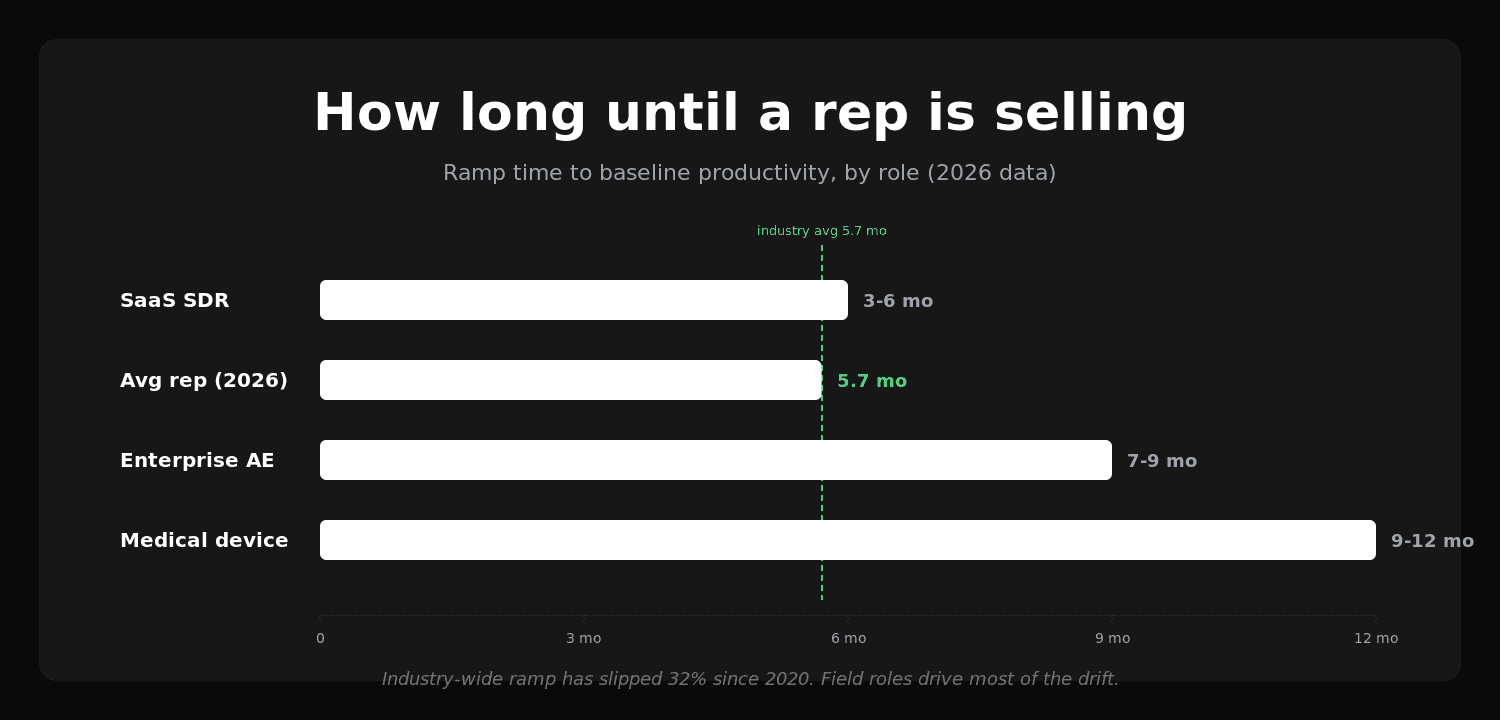
The thing nobody in this category says out loud is that field sales training has barely changed since 2009. The average ramp time for a new sales rep is now 5.7 months, up 32% since 2020 according to Alba Talent's 2026 hiring data, and in field-heavy industries like medical device sales it's 9 to 12 months before a rep is carrying a real number. Every vendor in the space says they're solving this. Most of them are selling the same thing they sold in 2015 with a new logo and the words "AI-powered" pasted on top.
Scanning this? Every section is a question. Jump to whichever one you actually have.
What is field sales training, actually?
Quick context for anyone googling the basics. The field sales meaning that matters here is simple: selling in person, at the customer's location, in a territory the rep covers on the road. Field sales training is the system you use to get a rep who sells in person — at customer sites, on the road, at a doorstep, in a clinic — from "just hired" to "carrying a number" without breaking either the rep or the territory in the process. The category sits next to inside sales training, sales coaching, and corporate sales training programs, but the constraints are different enough that lifting an inside-sales playbook into a field motion is one of the most common ways field sales training fails.
That's the clean definition. Here's what it actually means in practice.
A new field rep at a roofing company gets hired on a Tuesday. By Friday she's expected to sit in a conference room and watch six hours of product videos, take a multiple-choice quiz, and then spend the next two weeks riding in a truck with the regional manager. On week three she's handed a territory and a quota. On week four her manager rides along for one demo, takes notes on a clipboard, and tells her she "did great, just slow down on the close." By month two the manager has new reps to onboard and a forecast meeting, and she's on her own.
Six months in, she's at 40% of quota. Nobody can tell her why. The manager thinks it's her closing. She thinks it's her pricing. The VP thinks it's the territory. Nobody is wrong, and nobody is right, because nobody has actually watched her sell anything in twelve weeks.
That is field sales training in 2026 at most companies. A binge in week one, a couple of ride-alongs, and then quiet.
The job of an actual field sales training system is to compress that timeline and replace the silence in the middle with structured practice and structured feedback. Not classroom training. Not an LMS module. Practice. The kind of repetition that builds reflexes a rep can use when the customer goes quiet and the deal is on the line.
How is field sales training different from inside sales training?
A reasonable answer is "everything except the product knowledge module."
A more useful answer is that the four mechanisms field reps need most (pre-call practice, in-the-moment coaching, post-call retry, longitudinal tracking) all break when you take the rep out of the office and put them in a truck.
Here's the breakdown the way an enablement lead would frame it.
Dimension | Inside sales training | Field sales training |
|---|---|---|
Location of practice | Cubicle, headset, recorded calls | Truck cab, parking lot, hotel room |
Coaching cadence | Call review on Monday, group huddle on Friday | Ride-along once a month if you're lucky |
Manager visibility | High — every call is logged, recorded, scoreable | Low — manager sees one in eight calls |
Common failure mode | Reps freeze on objections they've never heard | Reps invent answers in the car and never report them |
Tooling that fits | Call recording, conversation intelligence, LMS | Mobile voice practice, async coaching, CRM ride-along notes |
Ramp time benchmark | 3-6 months SaaS SDR (Orum, 2026) | 6-12 months field AE, 9-12 in medical device (Alba Talent, 2026) |
Inside sales has the luxury of observability. Every call is recorded. Every email is in the CRM. Conversation intelligence tools like Gong and Chorus can ingest a thousand calls a quarter and tell a manager exactly where reps are losing the deal. None of that exists for field sales. A rep walks into a customer's office. There's no recording. There's no transcript. There's a sticky note in the truck and a CRM entry written four hours later that says "good meeting, sent follow-up."
You can't coach what you can't see. That's the core problem field sales training has to solve, and most of the tooling in the category doesn't even try.
Who is field sales training actually for?
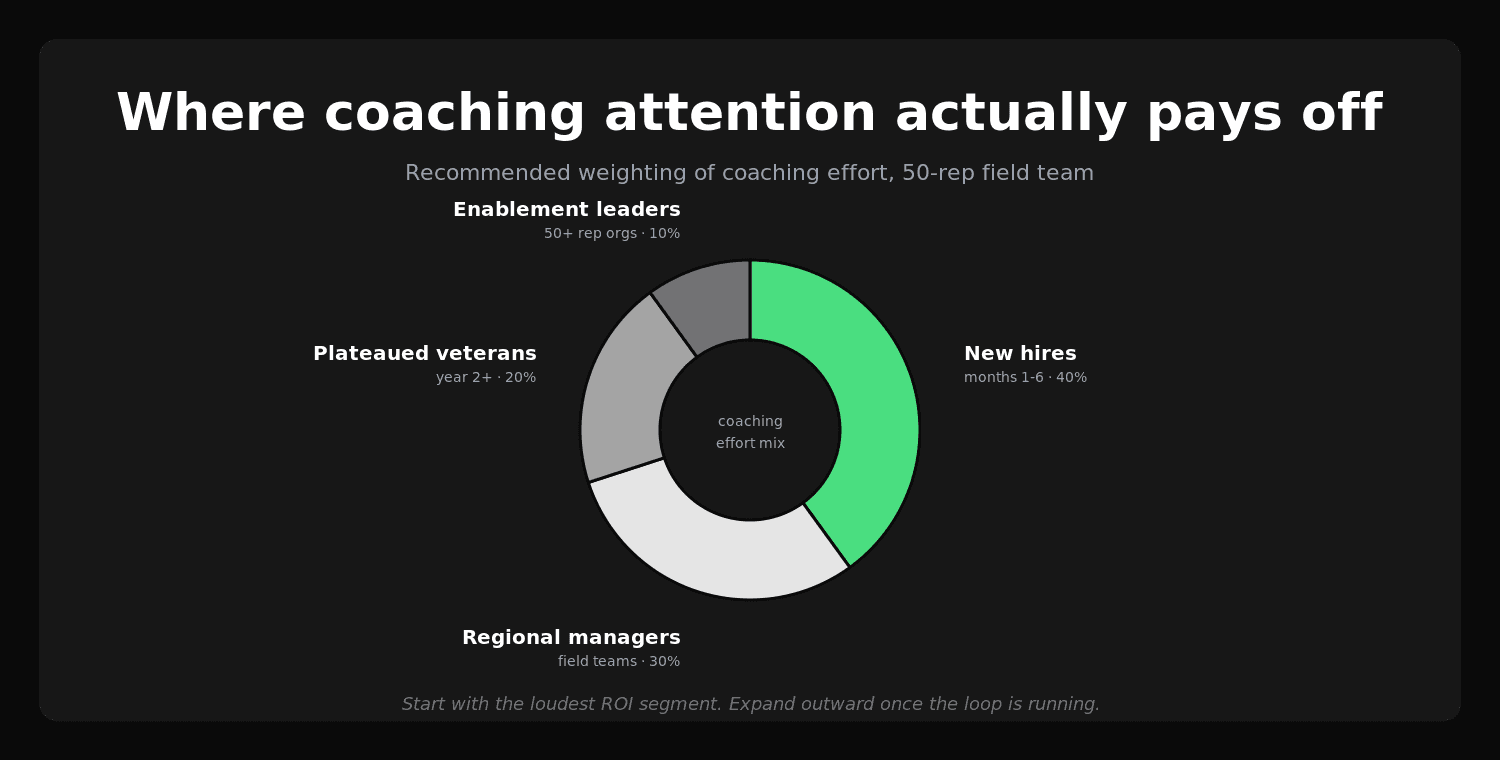
The first question to ask before buying anything is which segment of the team you're trying to fix. Field sales training is not a single problem. It's three problems wearing the same label, and the buying decision is different for each.
New-hire field reps in months one through six. This is the segment with the loudest ROI. A new rep is the most coachable rep on the team and the most expensive one to lose. Every week shaved off ramp time is one week of base salary recovered and one week of quota carried sooner. The training system here has to be voice-first because the rep is in transit, low-friction because new hires drop tools that take more than two clicks to open, and forgiving because the rep is going to flub the first hundred practice reps. This is the segment where SecondBody-style daily voice practice produces the steepest curve.
Tenured field reps who plateaued in year two. A different problem. The rep knows the product, knows the territory, and is at 70% of quota for the third quarter in a row. Nobody can tell you why because the rep is "fine" on every visible metric. The training system here has to surface skill gaps the rep can't see herself. Discovery questions that have gone stale. Pricing pushback the rep has stopped fighting. Competitor mentions the rep no longer responds to. This is the segment most LMS platforms can't reach because the rep refuses to sit through training she thinks is for new hires.
Regional managers coaching field teams. Often the highest-impact segment and the one most companies forget to train. Field sales management without a coaching framework is the single biggest reason teams over-hire and under-perform. The real question of how to manage field sales team performance isn't about CRMs or territories. It's whether the manager can actually develop the reps she has. A regional manager with five reps and no coaching framework is going to coach the way she was coached in 2014. The training system here has to give her a pre-1:1 briefing, a skill rubric, and a way to track whether her coaching is actually moving the rep's curve. Most platforms ship rep-facing features and leave the manager-side experience as an afterthought. That's a tell. It means the vendor doesn't understand who buys the product and who keeps it adopted.
Sales enablement leaders rolling out cross-team. The buyer in most companies above 50 reps. Their problem is rarely the training content. It's adoption, measurement, and the political work of getting regional VPs to actually use the system. The platform that wins this buyer has clean dashboards, methodology-native scoring, and proof that the practice library compounds across cohorts. If the demo doesn't show a manager dashboard inside the first ten minutes, the vendor is selling the wrong half of the product.
You can buy one platform that serves all four. Most teams pick the segment with the loudest ROI first — new hires — prove the loop works there, then expand outward to tenured reps and managers. Trying to roll out across all four on day one is how training initiatives die.
The Execution Gap (and the Windshield Gap underneath it)
There's a phrase we use across SecondBody articles: the Execution Gap. The gap between what a rep knows and what a rep can do when their stomach drops and the buyer says something unexpected. It's not a knowledge problem. It's a reflexes problem. Reflexes don't come from watching videos.
Field sales has a specific version of the Execution Gap that the office-bound version doesn't. We call it the Windshield Gap.
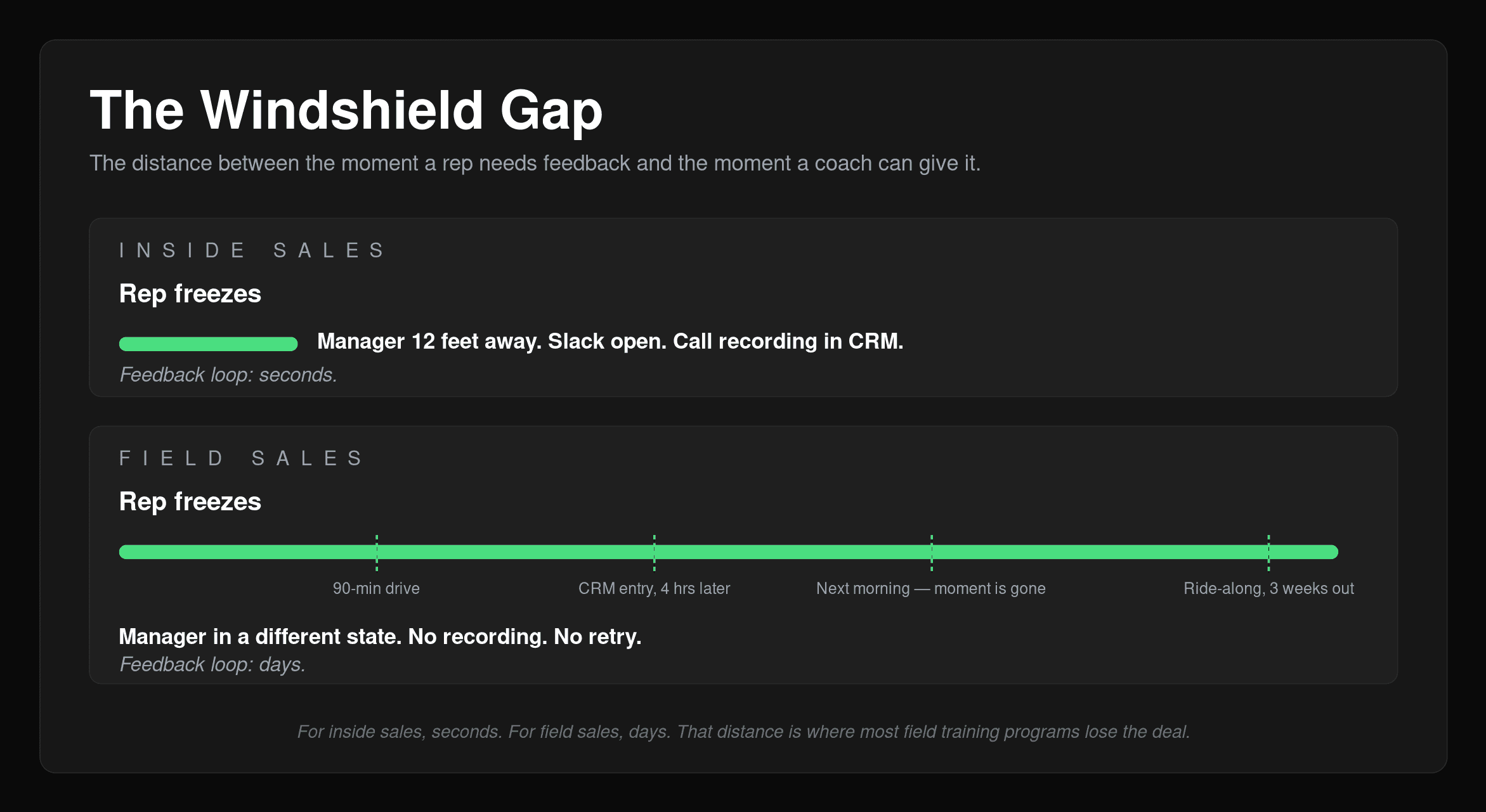
The Windshield Gap. The distance between the moment a rep needs feedback and the moment a coach can give it. For inside sales, seconds. For field sales, days. |
Here's what it is on a doorstep.
An inside SDR who freezes on an objection has Slack, a manager 12 feet away, and a CRM with three call recordings of the same objection she can pull up after lunch. A field rep who freezes on a doorstep has none of that. She has a 90-minute drive home and an internal voice that's already convinced her this is the wrong career. By the time she gets back to the truck the moment is gone, the rationalization has set, and the next time the same objection lands she'll handle it exactly the same way she just did. Wrong.
Same shape, different industry.
A medical device rep walks out of a 7am pre-op meeting at a hospital. The surgeon pushed back on the cost-per-procedure math. The rep had three numbers in her head. She used the wrong one. She knew it before the elevator hit the lobby. The next pre-op at that hospital is in six weeks. The next time that exact pushback lands at a different hospital, she'll be in the same scrubs and the same parking garage and the same internal monologue, and she'll handle it the way she just did. Because nobody has practiced it with her in the meantime, and her manager is in a different state. That's the Windshield Gap in medtech. Same gap. Different scrubs.
A roofing rep closes at a kitchen table at 6pm. The homeowner asks for the discount the rep wasn't authorized to give. The rep stalled, the homeowner asked her to "think about it," and she walked out without the signature. She rehearsed the right response three times on the drive back to the office. It didn't matter. The deal is dead and the next kitchen-table close is on Thursday. The drive home is where field reps replay losses they can't replay with a coach.
It's the same gap every time. Inside reps get feedback in seconds. Field reps get it in days, if they get it at all. That distance is where most field training programs lose the deal.
Close the Windshield Gap and the rest of the training program starts working. Don't, and it doesn't matter how much money you spend on the LMS.
The way to close it isn't a different LMS. It's an asynchronous practice loop the rep can run by herself, in the moment that matters, with a coach-grade rubric scoring her in the background. The rep replays the moment that broke against an AI buyer who pushes the same way the real one did, in the truck, before the rationalization sets. That's a different shape of product than what most enablement teams currently own. And it's the shape every field-heavy team is going to need by 2027 if they want to keep ramp times from drifting further north of 5.7 months.
If one concept from this article makes it into your team's vocabulary, make it this one. Naming the gap is the first step toward closing it.
Why most field sales training stays broken
A few patterns repeat across implementations. None of these are new and none of them are anyone's fault individually. They're what happens when a company hires field reps faster than its training system can absorb them.
The ride-along bottleneck. One regional manager, eight to twelve reps, five working days a week. The math doesn't allow a ride-along more than once a month per rep. Most managers do less. The reps who get coached are the ones who happen to be in the city the manager is visiting that week.
The LMS graveyard. Mindtickle, Highspot, Brainshark. All real products with real value for content management and certifications. None of them are practice systems. Reps complete the modules to clear the compliance box and then go sell exactly the way they were selling before the training. The completion rate is the metric the LMS reports. The skill change is the metric nobody measures.
The conference-room roleplay. Reps roleplay against their manager, who is not the buyer. The buyer in the conference room is rooting for the rep. The buyer in the customer's office is rooting for the incumbent. These are not the same conversation. Conference room roleplays don't transfer to live calls because the emotional stakes are wrong.
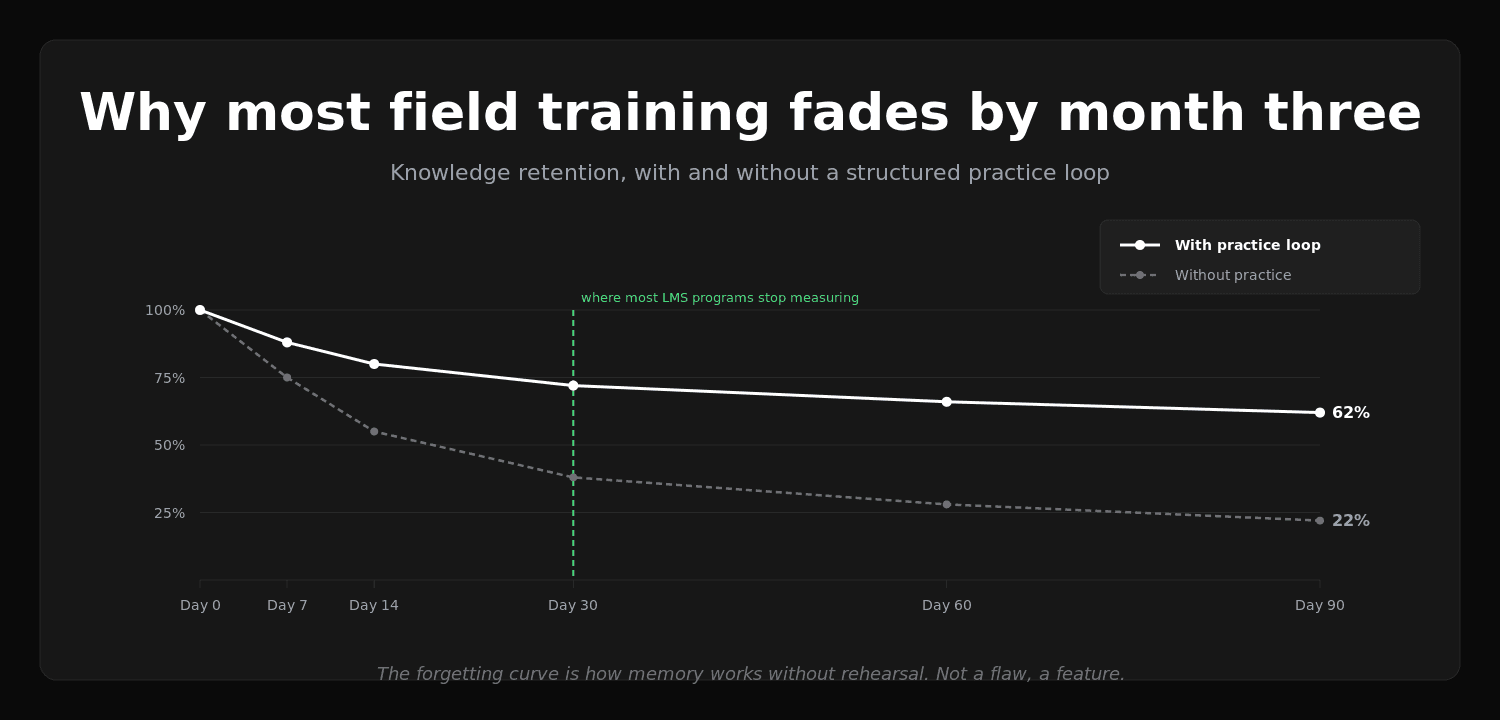
The week-one binge. Six hours of product videos in week one, zero structured practice after. The forgetting curve says she'll retain 25 to 30% of that material by month three. Most companies don't refresh it because refresh is unmeasured.
The "sink or swim" myth. Senior leaders who came up in a 1995 field-sales motion sometimes argue that the best reps figure it out on their own. They're not wrong about the best reps. They're wrong about the median reps, who are 70% of the team. The "sink or swim" model selects for survivors and writes off everyone else as a hiring miss. It's expensive selection by attrition.
The post-call rear-view mirror. Gong, Chorus, and the conversation intelligence category in general are useful tools for inside sales because they record what happened. They don't help a field rep. There's no recording of an in-person demo. Rilla has built a sharp product for virtual ride-alongs that records in-person conversations through the rep's phone, and that's a real step forward. 5,000 ride-alongs across 130 technicians in 30 days is real adoption. It's still post-call analysis though. Watching the film of yesterday's loss is useful. Practicing tomorrow's win is more useful. Most field teams need both.
The "we'll train them on the methodology" pitch. A vendor offers to teach your team SPIN, MEDDIC, or Sandler. This sounds appealing because methodology training is hard to do well. It's also a trap. The vendor's methodology is built around the vendor's product. Six months in, the team is selling the way the vendor's content tells them to, not the way your sales motion needs them to. Buy the practice infrastructure. Keep the methodology in-house. Anyone selling you both is selling you their content moat dressed up as enablement.
How does field sales training actually work?
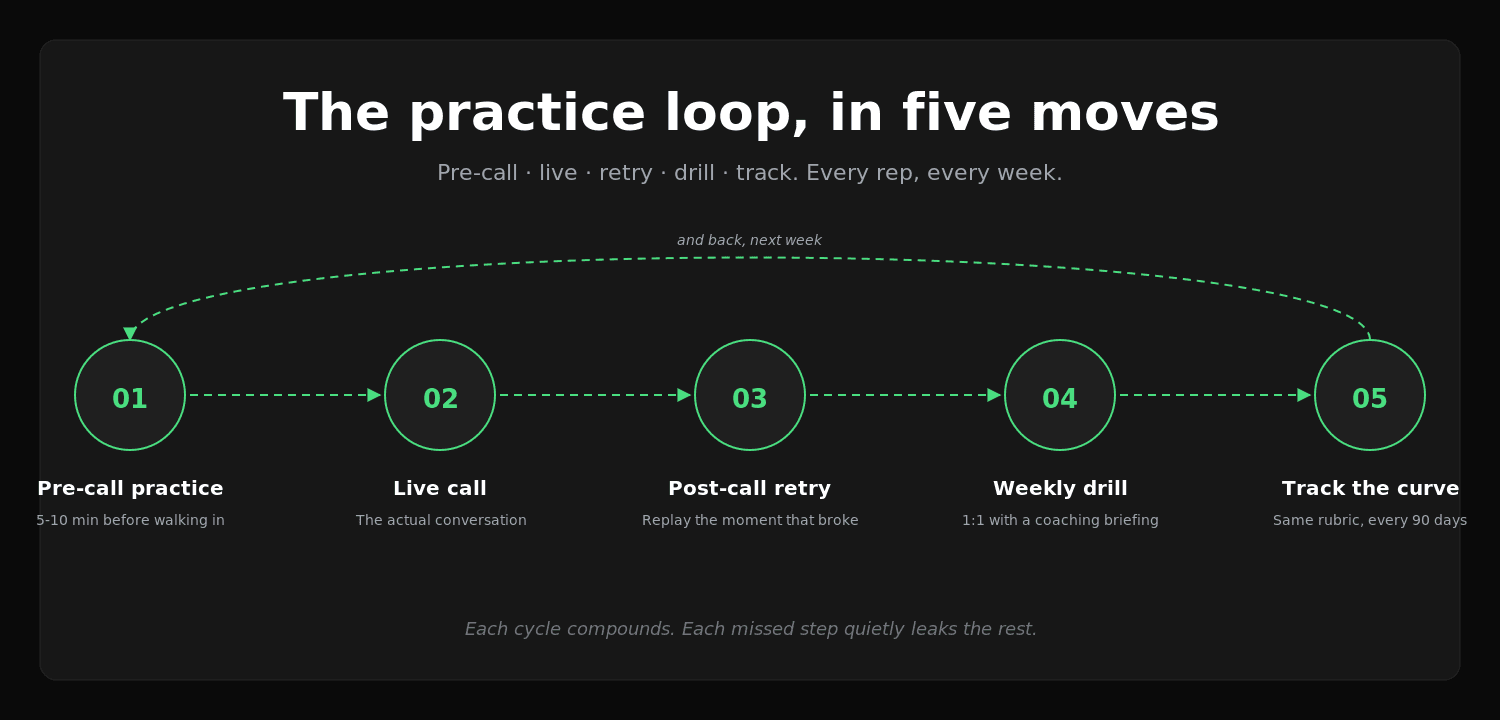
A working system for field sales training has five mechanisms in it. If your current setup is missing two or more of these, that's where the leakage is.
Step 1: Pre-call practice
The 5 to 10 minutes before a rep walks into a customer's office. Most reps spend it scrolling on their phone. The high performers use it to rehearse the opening, anticipate the two most likely objections, and warm up their voice. The training system's job is to make rehearsal easy enough that average reps actually do it. Voice-first matters here because typing in a parking lot is a non-starter.
Step 2: The live conversation
The actual meeting. The training system can't be in the room. What it can do is make sure the rep walked in carrying a sharper version of themselves than they would have otherwise.
Step 3: Post-call retry
The 10 to 15 minutes back in the truck. The rep just bombed the close. She knows it. The training system's job is to let her replay the moment that broke, not the whole call, just the moment, against an AI buyer who pushes the same way. Retry, get scored, move on. This is where objection handling actually gets built — not in a conference-room workshop, but in the 10-minute retry loop after a real loss is still fresh. The forgetting curve is real. Practicing the failure mode within an hour of the call buys you a week of retention. A platform that ships sales simulation scenarios but no retry loop is solving half the problem.
Step 4: Weekly skill drill
The 1:1 with the manager on Friday. Most field manager 1:1s are forecast meetings dressed up as coaching. The training system's job is to give the manager a one-page briefing before the meeting that says exactly what each rep needs to work on this week.
Here's what that looks like in practice.
Friday, 8am. The regional manager opens the app before her 1:1 with Sarah at 8:30. The briefing says: Sarah's pricing pushback handling dropped from 7.2 to 5.4 over the last three weeks. Drill her on scenarios 4, 7, and 12. Her opening is sharper than last month — tell her.
The 1:1 starts at 8:30. By 8:50 the manager has walked Sarah through the three drills, told her what's working, and named one specific thing to fix this week. Twenty minutes. Specific. Done.
Without that briefing, the same 1:1 takes 50 minutes, drifts into pipeline updates, and ends with "you're doing great, keep at it." The briefing is the difference.
Step 5: Longitudinal tracking
The quarterly review. Did her objection handling actually get better? Did her discovery questions get sharper? Most training systems can't answer this because they don't track the same metric across 90 days. Score every practice rep against the same rubric, and you can show the curve.
If you're running ride-alongs once a month and an LMS module once a quarter, you have steps 2 and 4 half-built, and steps 1, 3, and 5 missing entirely. That's the leak.
What ROI can a field-sales team actually expect from training?
Two cases. Read both. Decide which one you trust.
The optimistic case (vendor-sourced).
You'll see numbers like a 50% reduction in ramp time, 30% lift in win rate, 2x productivity gains. Gartner has a widely cited finding that high-performing sales coaching organizations see 3.7x improvement in close rates. These numbers show up on competitor homepages with a logo bar underneath.
The skeptical case (what we actually believe).
The optimistic numbers are real for someone, somewhere, who measured for the press release. Across a normal field-sales team rolling out a new training system, here's what we actually see in implementations we've watched.
Ramp time reduction of 15 to 25% in the first six months, mostly driven by the rep doing more pre-call rehearsal and the manager catching skill gaps in week 4 instead of month 4. Win rate lift of 5 to 12% on contested deals, driven by better objection handling. Manager 1:1 effectiveness improves more than rep skill does in the short term, because the manager now walks into the meeting with a one-page briefing instead of guessing.
Past month nine, the numbers compound because the team has banked a library of practice reps and the new hires are training on the same scenarios the top performers are practicing.
Below month three, the numbers don't move much. Six weeks of rollout, two weeks of confusion, a month of the first real practice loops. Anyone selling you "20% lift in 30 days" for field sales is selling you a slide, not a result.
Field sales is a long-cycle game. Training systems that pay off in field sales pay off across two to four quarters, not two to four weeks.
A working comparison of the field-sales coaching tools you'll see in 2026
This is the section where every other article in the category pretends to be neutral. We're not pretending. Here's the honest read on the field sales coaching tools you'll see in 2026.
Rilla. Virtual ride-alongs and post-call analysis for in-person sales.
What it's good for: recording and analyzing in-person conversations through a rep's phone. The product does what it claims on the recording side, and their footprint in home services (roofing, HVAC, pest control) is meaningful but vertical-narrow. If you don't have any visibility into what happens at the doorstep today, Rilla can close part of that gap on the post-call side.
What it doesn't do: pre-call practice, retry loops, or methodology-native scoring. It's a rear-view mirror. The manager watches the recording on Monday and tells the rep what to do differently next week. That's a coaching loop, but it's the slow one — and it doesn't help the rep walking into a meeting in 20 minutes.
Pick this if: you run a home services or in-home demo motion, your current visibility is zero, and your team isn't yet running daily voice practice. Pair with a practice tool. Don't replace one with it.
SPOTIO. Field sales CRM with coaching dashboards.
What it's good for: territory management, route planning, activity tracking, leaderboards. Built for outside sales the way Salesforce was built for inside sales. The Rilla integration via webhook is useful.
What it doesn't do: train reps. The "coaching dashboards" report what reps did, not what they should do next. It's a management tool dressed up as a training tool.
Pick this if: you need the CRM piece first. Don't buy it for the training claim.
Mindtickle. Sales readiness platform with role-play modules.
What it's good for: content management, certifications, structured curricula for large enterprise teams. Their AI role-play modules have shipped and they're decent for inside-sales-style scenarios.
What it doesn't do: feel native to field reps. The interface is desktop-first. Reps on the road don't open it. Adoption is the bottleneck. Most field deployments we've seen sit under 40% weekly active.
Pick this if: you're an enterprise with a real LMS need and the field training is a secondary use case.
Highspot. Sales enablement and content delivery.
What it's good for: surfacing the right collateral in the right call. Their content analytics are sharp.
What it doesn't do: train. Enablement is content delivery. Training is skill change. These are different categories and a lot of field-sales leaders get sold one when they thought they were buying the other.
Pick this if: your bottleneck is "reps can't find the right deck for this vertical" rather than "reps can't handle the pricing objection."
Hyperbound. AI roleplay for sales.
What it's good for: voice and chat-based roleplay against AI buyers. Strong product in the SDR / inside-sales segment, and the team has shipped fast on the inside-sales scenario libraries.
What it doesn't do: feel built for field. Their core motion is the SDR cold call. For a field rep doing in-person discovery and a 90-minute on-site demo, the scenario library is still catching up.
Pick this if: you have an inside team that needs voice practice and a small field overflow. For field-heavy teams, the scenario library will need more building out before it maps cleanly to in-person motions.
Second Nature. AI sales coaching platform.
What it's good for: certification flows, structured roleplay, broad enterprise feature set. They've been at this for a while and the product is mature.
What it doesn't do: lean hard into field. Their pricing model is built around enterprise contracts, which can rate-limit how many seats you put on the system. Field teams want every rep practicing, not the top 40%.
Pick this if: enterprise IT and compliance are the deal-blockers and you want the most established AI training brand.
SecondBody (Rory). Pre-call voice practice for field reps.
What we do well: We're the only platform in this list built voice-first from day one for daily practice on a phone — not text with voice bolted on, not a desktop LMS with a mobile companion. Reps drill in a parking lot before walking into a meeting. They retry the moment that broke after a tough close, while the call is still fresh. Managers get a one-page briefing before every 1:1, which is the difference between a regional manager effectively developing 5-8 reps and effectively developing 20-30. Rory is methodology-native — SPIN, MEDDIC, Sandler, BANT, Gap Selling, and custom rubrics are configurable, so the scoring matches your sales motion instead of forcing your team into a vendor's framework. Unlimited seats at $30 per user per month on the Pro tier, public pricing you can model in Excel before the first call. SOC 2 compliant. Built in Paris. Customers include Cyera and a roster of cybersecurity, fintech, medtech, and field-heavy enterprises (some under NDA). Integrates with Aircall, Cloudtalk, Momentum.io, Fathom, and TeamTailor today; Salesforce and HubSpot shipping in 2026.
Where we're not going to blow smoke: we don't replace post-call conversation intelligence. If you need full call recording and analysis on inside-sales calls, Gong is purpose-built for that, and we'd point you at them. We're newer than the legacy enablement names, and that's the point. SecondBody runs on current-generation voice AI from day one, not retrofitted onto a 2018 codebase. Field-heavy customers don't wait for an analyst report to see ramp time drop — they see it inside the first quarter.
Pick this if: you want every field rep practicing voice-first, daily, on the device they actually carry between calls, with managers getting the coaching brief they currently have to assemble themselves. Mindtickle is the LMS. SecondBody is the gym.
How to actually roll out field sales training (week by week)
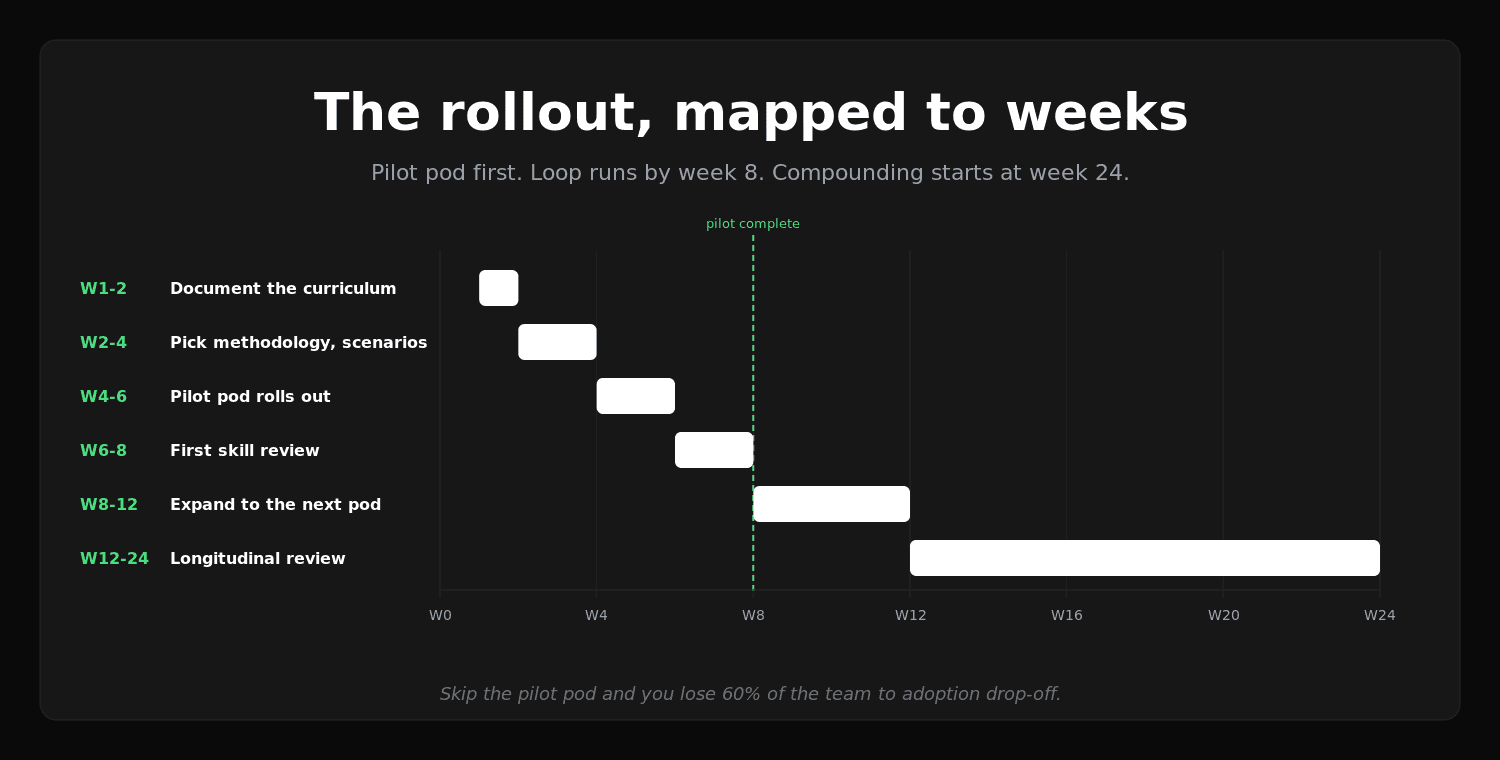
Don't roll out to the entire team on day one. Pick a pilot pod of five to eight reps and one regional manager who actually wants this. Pilot for eight weeks. Then expand.
Week 1-2: Document what you currently train on
Stop and do this first. Most companies skip it and then can't tell whether the new system is working. Write down the three to five core conversations you expect every rep to handle: opening, discovery, the pricing objection, the competitor objection, the close. For each, write what a "good" response looks like and what a "bad" response looks like. This is your scoring rubric. Without it, every training system is grading on vibes.
Week 2-4: Pick the methodology and the scenarios
If you already use SPIN, MEDDIC, or Sandler, your training system should score against that methodology. Don't let the vendor pick. Make them score against your methodology, or walk. Build out 8 to 12 starting scenarios that map to the conversations from Week 1-2. Use real objections you've actually heard, not generic ones from a sample library.
Week 4-6: Roll out to the pilot pod
Five to eight reps. One manager. Daily practice expected, 10 to 15 minutes per rep per day. Track who's actually practicing. Most rollouts die in the first three weeks because adoption falls off and nobody chases it.
Week 6-8: First skill review
The manager runs 1:1s using the platform-generated briefing. Reps get scored on the same rubric every week. Look at the curve. If the curve is flat after two weeks, the scenarios are too easy or the rep isn't practicing. Fix the scenarios, not the rep.
Week 8-12: Expand to the next pod
Add the next regional team. Have the original pod's reps mentor the new ones in shared practice sessions. This is the moment habit mechanics earn their keep. Streaks, team challenges, weekly quests. Sounds gimmicky. Works.
Week 12-24: Add the longitudinal review
Quarterly skill review. Look at the same metric across 90 days. Did discovery questions sharpen? Did pricing objection handling improve? Connect skill change to deal outcomes. Which closed deals had a corresponding rise in practice scores.
Week 24+: The compounding phase
By month six the practice library is deep enough that new hires train on the same scenarios senior reps still drill. New-hire ramp drops because the scenarios are tested and the scoring is calibrated. This is the part most field-training rollouts never reach. They die in month two from low adoption.
How to measure if field sales training is actually working
Stop measuring completion rate. Completion rate measures whether reps clicked through the modules, not whether they got better. Here's what to track instead.
Practice volume per rep, per week. If you're not seeing four to six 10-minute practice sessions per rep per week by month two, the rollout has an adoption problem, not a content problem.
Skill score trajectory on a fixed rubric. Same rubric every week. Plot the curve. If the curve is flat, change the scenarios. If the curve drops, congratulations, the rubric got harder and the scoring got more honest.
Manager 1:1 quality. Not duration. Quality. Did the manager walk into the meeting with a briefing? Did the rep leave with one specific drill for the week? If not, the system isn't connecting practice to coaching.
Ramp time to baseline productivity. Cohort it. The reps who hit 75% of quota by month four are your benchmark. Move the cohort curve left over time. The 2026 industry average is 5.7 months. Anything you can shave off that compounds.
Win rate on contested deals. The deal you would have lost six months ago that you won today. Pull the practice score history of the rep who won it. The correlation will be loud or it'll be silent. Both are useful signals.
Manager span of coaching. How many reps can one regional manager actually coach effectively? Without a system, three to five. With a system that produces pre-1:1 briefings, twenty to thirty. This is the number that determines whether your training investment pays for itself in headcount or doesn't.
Don't track: logins, completion percentage, "time spent in platform" alone. These are vanity metrics that look good on a renewal slide and tell you nothing about whether reps got better.
A working measurement system reports on four things on the first Monday of every month. Rep practice volume by name. Skill score curve by rep, by skill, over the last 90 days. Manager 1:1 briefing usage — did the manager actually open the briefing before the meeting. And the linked deal outcomes for the reps whose practice scores moved the most in the last quarter. If your vendor can't produce that report, the data is in the platform but the platform isn't doing the analysis. That's work that lands on your enablement team's plate and quietly kills the program in month six.
One more measurement note worth flagging. Score the manager, not just the rep. The single biggest predictor of whether field-sales training works in a region is whether the regional manager is actively coaching from the briefings. If she's opening them 80% of the time, the region is going to compound. If she's opening them 10% of the time, no amount of rep practice will save the rollout in that region. Score the managers on briefing usage and 1:1 quality alongside their forecast accuracy. Some managers will surprise you. The ones who don't, you can move or replace before the next quarter.
The 2026 market: what's actually happening in field sales tooling
A few patterns are real and worth paying attention to.
Voice AI got good enough to practice with. Three years ago, AI roleplay was uncanny. The rep could feel the seams and stopped engaging. Current-generation voice models hold a conversation well enough that reps treat the practice as real. That shift is what made daily practice viable as a habit rather than a novelty.
The conversation intelligence category is consolidating. Gong is the leader. Chorus exists. Salesloft acquired Drift. The post-call analysis lane is mature and the differentiators are thin. This matters because it pushes innovation budget into the pre-call practice lane, which is where field sales actually needs help.
Mobile-first is winning. Field reps don't open desktop apps between meetings. Any training tool that requires a laptop is going to lose to one that runs on a phone. The shift is obvious in retrospect and most enterprise vendors are still catching up.
Field-vertical specialization is starting. Generic sales training tools are getting flanked by vertical-specific ones. Rilla in home services, SecondBody in regulated industries and field-heavy enterprise, niche players in pharma. The "one platform for all sales training" pitch is fragmenting.
Methodology-native scoring is the new bar. SPIN, MEDDIC, Sandler. Any tool that scores against generic "good conversation" rubrics is going to lose to one that scores against your specific methodology. The vendor that says "we'll teach you our methodology" is selling you their content, not your skill.
Pricing is going public. A small but real shift over the last 18 months. Vendors that used to require a sales call to see a number are now publishing pricing on the homepage. The reasons are straightforward. Finance teams running out of patience for "ask us" pricing in a year of budget compression. Buyers benchmarking against three options before the first call. Internal champions building their own ROI models. The vendors that hold the line on hidden pricing in 2026 are going to keep losing deals to vendors that don't. We publish ours at $30 per user per month on the Pro tier, with unlimited seats, because we'd rather have that conversation in the open than three calls deep.
Pre-1:1 manager briefings are the feature that quietly decides renewals. In every implementation we've watched, the rep-facing practice gets the demo glory but the manager-facing briefing is what determines whether the team is still using the platform in quarter three. Managers don't have time. The platform that gives them a coachable, specific, one-page brief before a Friday 1:1 is the one they actually open. The platform that requires the manager to assemble the brief manually from raw data is the one that quietly dies on the dashboard.
Habit mechanics are no longer optional. Streaks, weekly quests, team challenges. The 2018 enablement leaders dismissed these as gamification gimmicks. The 2026 enablement leaders measure adoption every Monday and have learned that adoption is a habit problem, not a content problem. Daily practice doesn't happen because the platform is great. Daily practice happens because the rep doesn't want to break a 47-day streak in front of the team. The mechanics aren't gimmicks. They're the only thing that produces the volume the curve needs.
Frequently asked questions
How long should field sales training take before a rep is selling on their own?
The industry average is 5.7 months for general sales reps, 7 to 9 months for enterprise AEs, and 9 to 12 months for medical device and complex regulated field roles. If you're outside those ranges in either direction, something is off. Either your ramp is faster than the team can absorb (and reps are flaming out at quarter three), or it's slower than it should be and you're paying for an extra two months of base salary per hire.
What's the difference between field sales training and field sales coaching?
Training is the structured curriculum, what every rep needs to know and be able to do. Coaching is the personal feedback loop, what this specific rep needs to work on this week. You need both. A team with great training and no coaching produces reps who all sound the same and none of them adapt. A team with great coaching and no training produces reps who freelance everything and the manager can't scale.
Do ride-alongs still work?
Yes, when they happen. The problem is they almost never happen at the cadence the rep needs. One manager with eight reps can do maybe one ride-along per rep per month. The rep needs feedback more often than that. Ride-alongs are essential for the moments they cover and useless for the 95% of moments they don't.
Can AI really train a field rep?
AI can practice with a rep. That's the right framing. The rep walks into a parking lot before a meeting and runs through the opening with an AI buyer. The AI buyer pushes back the way a real buyer would, scores the conversation against the team's rubric, and surfaces the moment the rep flubbed. AI is not the coach. The manager is still the coach. AI is the practice partner that's available at 7am, 3pm, and 11pm.
How do you train door-to-door reps differently from outside AEs?
Door-to-door is short-cycle, high-volume, scripted. The training emphasis is on the opening (the first 8 seconds at the door) and on the objection rebuttal library (memorized, drilled, repeated). Outside AEs sell longer cycles with consultative discovery. The training emphasis is on questioning frameworks (SPIN, MEDDIC) and on the discovery-to-demo handoff. Same training mechanisms, very different scenario libraries.
What's the right ratio of practice to live selling for a new field rep?
In weeks 1-4, more practice than live. Maybe 60-40. In weeks 5-12, more live than practice. Maybe 30-70. After week 12, practice becomes maintenance. 10 to 15 minutes a day, mostly to keep reflexes sharp on scenarios the rep doesn't get to live often.
How do you handle field sales training across multiple time zones or countries?
Async voice practice is the only thing that scales. The manager can't be in three time zones at once. The training system has to work when the rep is awake, not when the manager is. This is one of the reasons phone-based voice practice has overtaken desktop LMS modules for global field teams.
Should I build field sales training in-house or buy a platform?
Build the methodology and the scoring rubric in-house. Those are your competitive edge and nobody outside the company will get them right. Buy the practice infrastructure. The math doesn't work to build voice AI, scenario generation, and scoring engineering in-house unless training is your business.
Does SecondBody work for field reps specifically?
Yes. Voice-first means reps practice on their phone, which is the only device they have between meetings. Pre-call practice and post-call retry are designed for the parking-lot moment, not the cubicle. Pre-1:1 manager briefings give regional managers a coaching brief they currently have to assemble manually. Unlimited seats on the Pro tier means you're not rationing practice across the field team. SOC 2 compliance covers the regulated-industry verticals where most of our field-heavy customers sit.
How does SecondBody compare to Rilla for field sales?
They solve different halves of the problem. Rilla records the in-person conversation that happened. SecondBody practices the in-person conversation that's about to happen. Teams that have both get the full loop: pre-call practice, the live call, post-call analysis, and post-call retry. Teams that have only one are missing either the rear-view mirror or the rehearsal.
How does SecondBody compare to Mindtickle for field teams?
Mindtickle is a sales readiness platform built around content, certifications, and curriculum. SecondBody is a practice platform built around daily voice reps and pre-1:1 coaching briefings. Mindtickle is the LMS. SecondBody is the gym. Most enterprises end up with both because the jobs don't overlap. If your field adoption on Mindtickle is under 40% weekly active, that's the symptom. The desktop LMS isn't reaching reps where they work.
Can a single manager really coach 20 to 30 field reps with a training platform?
With pre-1:1 briefings that tell the manager exactly which three reps need work this week and on what, yes. Without those briefings, no. The manager runs out of time before they run out of reps. The math of coaching scales with information density, not with charisma.
What's the most common mistake in rolling out field sales training?
Rolling it out to the entire team at once. Pilot pod first. Eight weeks. Then expand. Companies that skip the pilot lose 60% of the team to adoption drop-off in the first month and can't tell whether the platform is the problem or the rollout is.
How much should I budget for field sales training tooling?
Public-pricing platforms in 2026 sit between $25 and $90 per user per month for the practice-and-coaching layer. LMS platforms and dedicated sales onboarding software add another $30 to $150 per user per month for the content-and-certification layer. Most field-heavy teams over 50 reps end up running both. The math that matters isn't the per-user price. It's whether the platform reduces ramp time by enough weeks to recover its own cost. A two-week reduction in ramp on a $90,000 base salary recovers about $3,500 per rep. Anything past that is upside.
How are field sales teams actually using AI in 2026?
In practical terms: put a voice-first AI sales coach on every rep's phone, run 10-minute pre-call drills before meetings, run 10-minute post-call retries after, and pipe a weekly skill briefing to each regional manager so coaching happens against signal instead of guesswork. The reps who use AI well in field sales aren't asking it to sell for them. They're using it as the practice partner that's available at 6am before the first stop and 9pm after the last one. AI in field sales is mostly an availability problem — managers and coaches aren't there when the rep needs them. AI is. That's the whole pitch.
What's the difference between field sales training and a sales training program?
A sales training program is a broader curriculum — usually a structured set of modules a rep moves through over weeks or months, often run by an internal enablement team or an outside provider like Sandler sales training, Richardson, or Force Management. Field sales training is the practical application of those programs in a field context, plus the ongoing practice cadence that keeps the skills sharp between formal training sessions. You need both. The program builds the foundation. The practice keeps it from decaying.
Close the Windshield Gap
Field sales training in 2026 is mostly broken for the same reason it was broken in 2009. The rep is in a truck, the manager isn't, and the gap between the moment of friction and the moment of feedback is too long. Tools have gotten better. Ride-alongs are now virtual. Recordings now happen. Conversation intelligence now exists. But pre-call practice — the rehearsal that decides whether the rep walks in carrying a sharper version of themselves — is still the missing layer for most field teams.
If your team is averaging 5.7 months to ramp, missing more quota than it should on contested deals, and your regional managers are coaching by gut feel because they have no briefing to walk into the 1:1 with, the leakage is in the Windshield Gap. Close that, and the rest of the program starts compounding.
Good luck out there.
See how sales teams use AI-powered practice to build real conversation skills, not just knowledge.
SecondBody is the AI sales practice platform built for field, regulated, and enterprise sales teams. Voice-first. Pre-call practice and post-call retry. Pre-1:1 manager briefings. Unlimited seats at $30 per user per month. Built in Paris. SOC 2 compliant.
Related reading: Best AI Sales Training Software in 2026 · What Is AI Sales Training? · AI Sales Roleplay Training Guide · State of Sales Training 2026 · What is MEDDIC? · What is Conversation Intelligence?