Back
How to Reduce Sales Rep Turnover: The Complete Guide for Sales Leaders Who Want to Keep the Reps They've Built
Replacing a sales rep costs between 115k and 150k dollars. This guide covers why reps leave and the coaching loop that keeps the good ones in seat.

Posted by
SecondBody.ai
Published by
Last Updated
Here's something worth admitting before we start. SecondBody sells AI sales training and coaching software. Our whole pitch is that consistent, quality coaching makes reps better — and that reps who get better stay longer. So when you read an article about reducing sales rep turnover on our website, you should read it knowing we have something to sell.
We're going to earn your trust by being straight about the data and straight about the limits of what coaching alone can fix. Compensation matters. Manager quality matters. Culture matters. Product-market fit matters. But there's one lever that most retention strategies underinvest in by a significant margin, and it's the one this article is about.
Most sales leaders who lose reps they didn't want to lose spend the first week after the departure asking "was it the comp?" It usually wasn't. The honest answer about sales attrition — the kind that sales rep retention strategies are supposed to address but rarely do — is in this article, and it's less comfortable than adjusting the accelerator table.
(Scanning this? Every section is a question. Jump to whichever one you actually have.)
What does sales rep turnover actually cost?
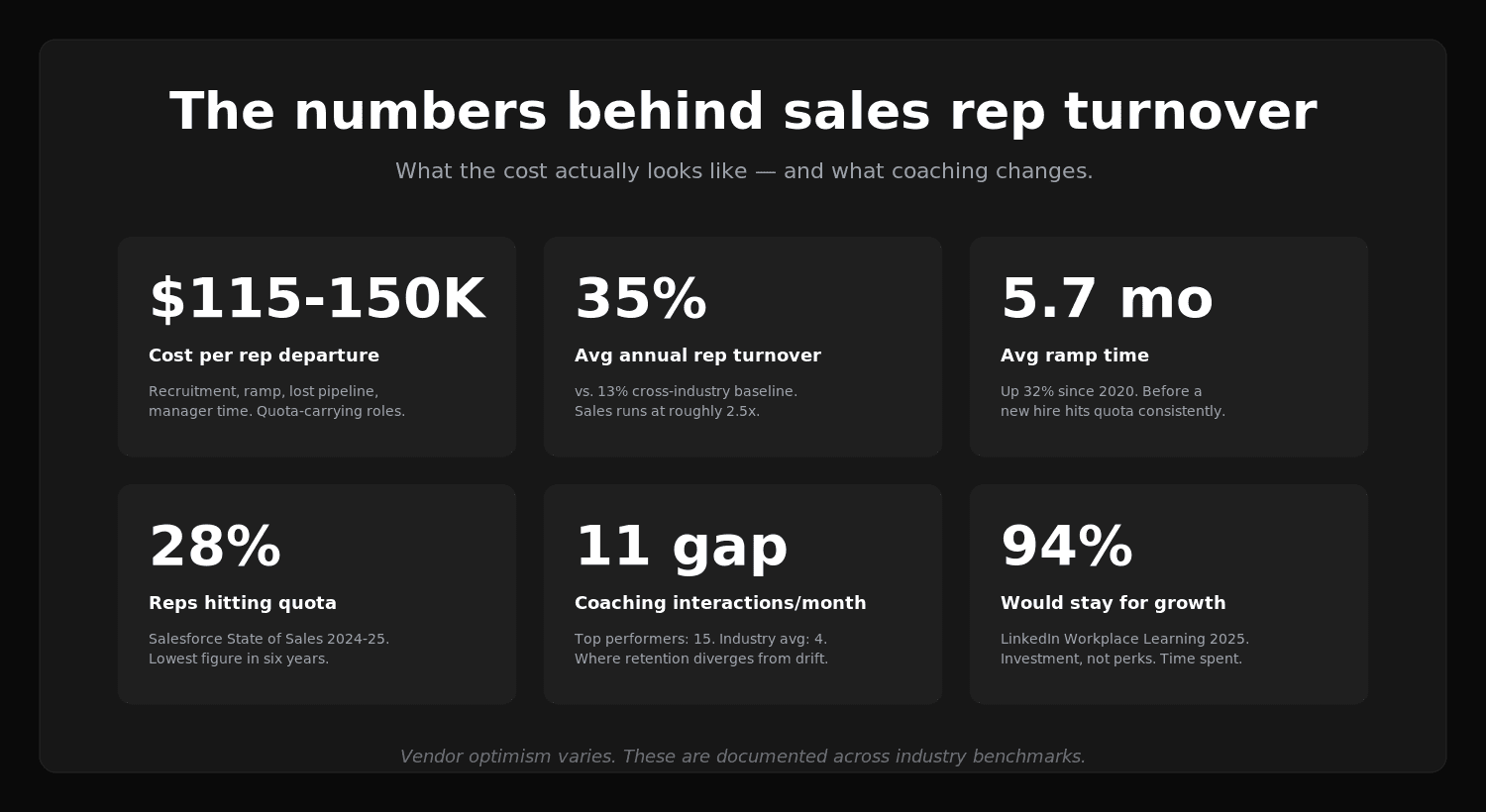
The cost of sales rep turnover lands higher than most leaders think. The range you see most often is $115,000 to $150,000 per departure. That number typically includes recruitment fees, the ramp time of the replacement, and the pipeline that was lost during the transition. For enterprise roles or senior AEs, the number goes higher — $200,000 and above is not uncommon when you factor in the full opportunity cost of six months of an empty or underperforming territory.
Here's the math broken out plainly. A rep who leaves takes with them: their open pipeline (which rarely transfers cleanly), their relationship equity with prospects in progress, the institutional knowledge they built over their tenure, and the 3-6 months of ramp time that was invested in them. The replacement requires: a recruitment cycle (4-8 weeks average), a ramp (3-6 months to productivity), and the manager time to invest in building the new rep's skills. The total cost is the sum of those losses and investments, priced against the rep's OTE.
For an org with 20 reps and industry-average annual turnover of 30-35%, that's six to seven departures per year. At $130,000 per departure, the annual cost of turnover runs to $780,000 to $910,000. That's not a talent problem. That's a budget problem. The average turnover rate by industry sits around 13% across all roles — sales sits at roughly 2.5x that. That gap is where the budget leak hides.
The number compounds fast. At 35% annual turnover across a 20-rep team, you are essentially rebuilding a third of your team every year — the recruitment, ramp, and lost-pipeline costs are running continuously, not episodically.
The skeptical caveat worth mentioning: not all sales turnover is bad. Some departures are performance-managed exits the org needed. Some are reps moving into management or adjacent roles. The number you care about is avoidable voluntary turnover — the reps who left because they chose to, when you'd have chosen for them to stay. That's the number this article is trying to move. Everything else is noise in the average attrition rate.
Why do sales reps actually leave?
Most attrition in sales has a different root cause than the one stated in the exit interview. Exit interviews are unreliable. Reps say what they think won't burn bridges, which means they say "better opportunity" and "compensation" and "career growth" at much higher rates than those factors actually drove the decision. The real answers come from reps who left six months ago and no longer care about being diplomatic.
The honest list:
They weren't improving. Reps who are having the same tough conversations they don't know how to handle, quarter after quarter, eventually stop believing the environment will make them better. The ceiling they've hit doesn't feel like a personal ceiling — it feels like an organizational one. They leave for a place they think will develop them.
They felt unsupported. Not financially. Professionally. "My manager doesn't know how to help me get better." "I'm expected to figure it out on my own." "I get told what my numbers are but not how to change them." This is the absence of real coaching — not the absence of 1:1s, which most orgs have plenty of, but the absence of specific, skill-level guidance that tells a rep how to close the gap between where they are and where they need to be.
They were failing without help. Reps in the bottom quartile of performance face a brutal choice: grind through with no support, or go somewhere that offers a fresh start. Most choose the fresh start, because the grind without support isn't sustainable. What they actually needed was a manager who could identify the specific skill gap, run structured practice on it, and measure improvement over time. What they got was a performance improvement plan after the fact.
The manager relationship was transactional. A manager who only shows up in the rep's calendar to review pipeline isn't a manager — they're a supervisor. Reps who feel supervised rather than developed eventually stop investing in the relationship. The departure follows.
Notice what's not leading this list: base salary, commission structure, equity, title. These factors matter at the margin — they're the things that tip a rep from "thinking about leaving" to "actually leaving." But they rarely create the "thinking about leaving" impulse in the first place. That impulse comes from the developmental factors above.
The research bears this out. A 2025 study by My Sales Coach and Aircall found that 50% of sales reps want coaching focused on skills development but say their current coaching is too fixated on KPIs and pipeline reviews. Half the team is actively telling you they want to be developed. The question is whether anyone is listening.
What does the research actually say about coaching and retention?
The data is consistent enough across studies that it's worth citing before getting into the mechanism.
A 2025 report from My Sales Coach and Aircall found that 50% of sales reps want coaching focused on skills development, but say their current coaching is too fixated on KPIs and pipeline reviews. That is half the team, right now, telling any manager willing to read the signal that they'd stay longer if they felt developed. The signal is there. Most organizations don't have a channel to hear it.
Sales Management Association research puts top performers at approximately 15 coaching interactions per month. The industry average is four. That 11-interaction gap is where performance — and retention — diverge. This is not 15 hour-long sessions. It is frequent, brief, skill-focused exchanges: a 90-second voice note after a practice session, a specific observation at the start of a 1:1, a quick async debrief after a difficult call. High volume, low duration, high specificity. That combination is what moves both skill scores and retention numbers.
A 2024 Gallup meta-analysis of employee engagement research found that employees who strongly agree their manager invests in their development are 24% less likely to leave within a year. The number for sales roles specifically, where external offers come constantly, is likely higher. The research consistently shows that development investment is the most durable retention lever available to a manager — more durable than comp adjustments, more durable than recognition programs, more durable than team culture initiatives.
The skeptical note: most of these studies are correlational, not causal. High-performing orgs may attract better managers who both coach well and retain reps, rather than good coaching causing retention. But the mechanism is coherent enough — rep feels developed, rep builds attachment, rep doesn't leave — that acting on it carries low risk. The downside of investing in coaching quality and not seeing a retention effect is a team that performs better but still turns over. That's an acceptable outcome.
What is the Coaching Retention Loop?
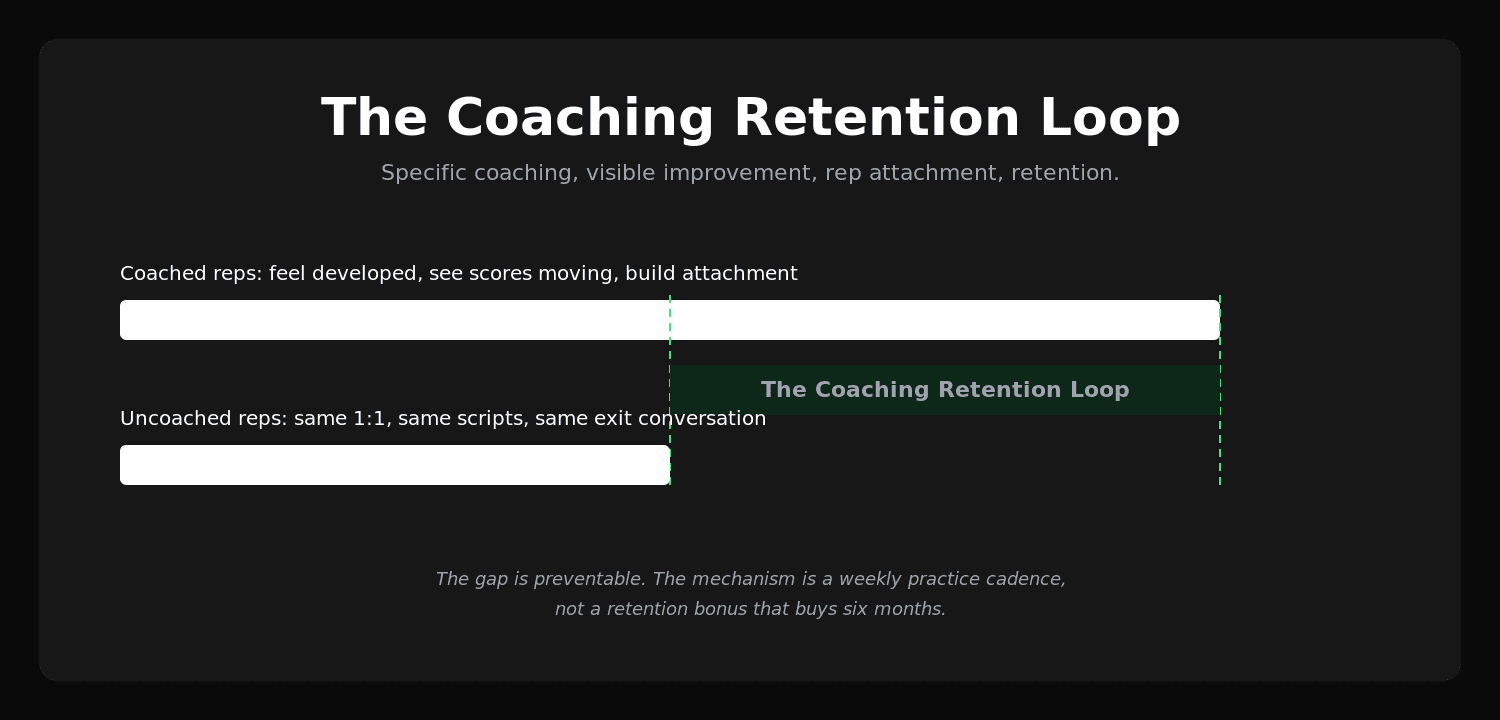
The Coaching Retention Loop is the reinforcing cycle that connects coaching quality to rep retention.
It works like this: a manager delivers specific, skill-level coaching to a rep. The rep practices the targeted skill, sees measurable improvement, and starts performing better on real calls. Better performance produces better results — more pipeline, more wins, more confidence. The confidence builds attachment to the role and the organization. The rep who feels like they're getting better at something hard is a rep who isn't looking for an exit.
The loop is self-reinforcing in both directions. Run it well and it creates a compounding retention effect. Let it break down and it reverses: no specific coaching, no visible improvement, no results, no confidence, no attachment, exit.
The Coaching Retention Loop breaks most commonly at the first link — the transition from "manager has a 1:1 with rep" to "rep receives specific, skill-level coaching." Most 1:1s don't produce coaching in any meaningful sense. They produce pipeline reviews. The rep walks away knowing where their deals stand. They don't walk away with a specific thing to work on and a mechanism to work on it.
Most sales rep retention strategies focus on the wrong link — a comp adjustment, a recognition program, a culture survey. The Coaching Retention Loop fixes the first link, the one everyone else skips.
That first link is what this article is about. Get it right and the rest of the loop tends to run itself.
How does the Coaching Retention Loop actually work?
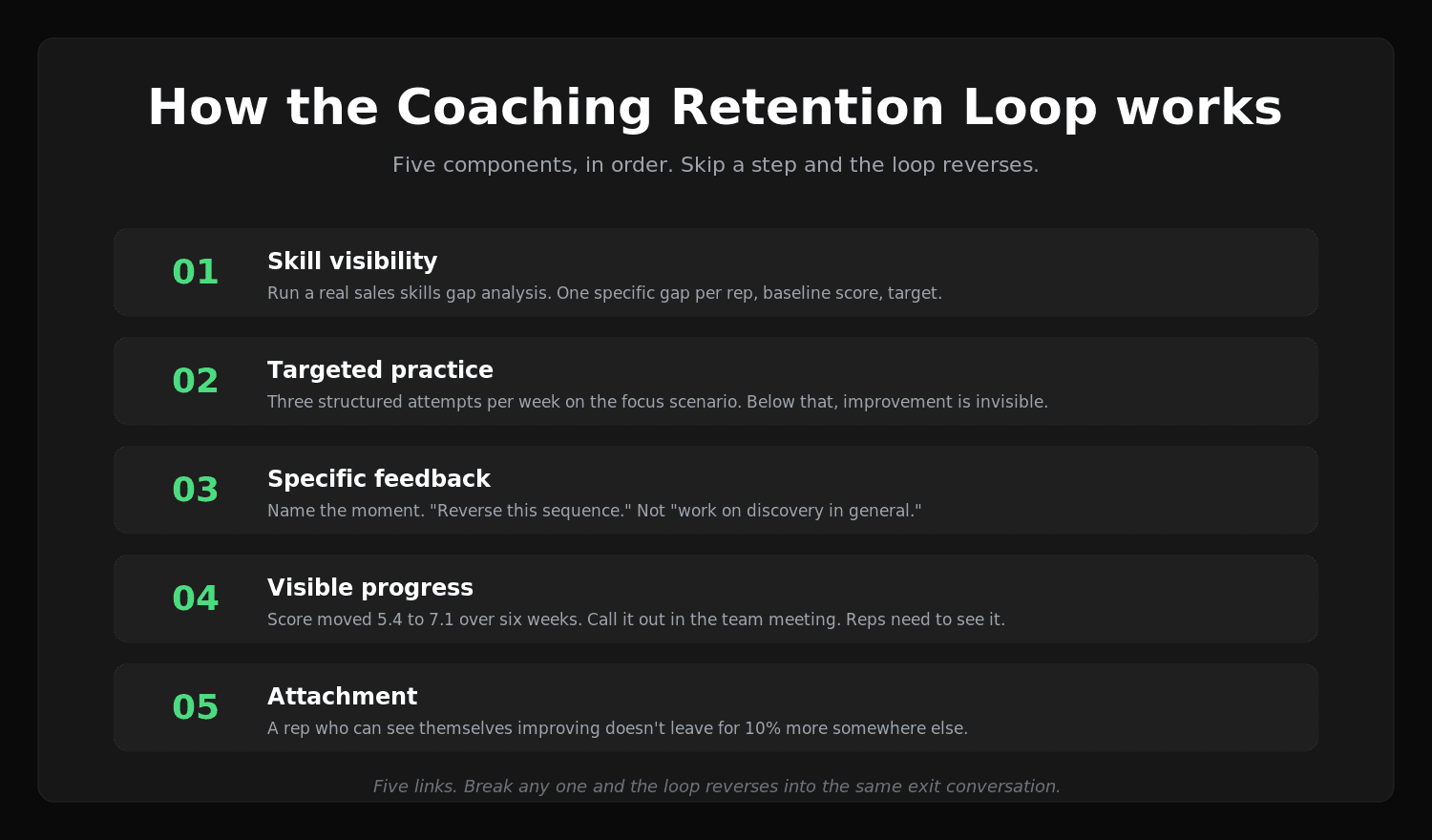
Five components, in order.
Step 1: Skill visibility — run a real sales skills gap analysis for each rep.
You can't deliver specific coaching without specific information. Most managers know their reps' pipeline. Few know their reps' actual skill gaps — which discovery questions they're asking well, where they're folding on objections, which call moments they're consistently losing.
The mechanism for getting this information is either very close observation (attending calls, reviewing recordings) or structured practice data (tracking how each rep performs on scored scenarios). The first doesn't scale. The second does. This is where AI-driven sales training earns its keep — not by replacing the manager, but by surfacing the predictive signals (declining practice scores, widening skill gaps, missed sessions) that a manager would otherwise spot months too late.
Before a manager can run the Coaching Retention Loop effectively, they need to know — specifically — which skill each rep is weakest at this quarter. Not "needs to improve overall." Not "should work on discovery." One specific gap, measurable in practice performance, with a baseline score and a target.
Step 2: Targeted practice — give reps a way to work on the gap.
Knowing the gap isn't enough. The rep needs a mechanism for closing it. That mechanism is repetition — specifically, structured practice on the exact scenario that maps to the gap, done frequently enough to build automatic responses.
Three genuine practice attempts per week on a specific scenario produces meaningful skill improvement within six to eight weeks. That's the minimum viable practice cadence for moving a skill score. Below that, the improvement is too slow to be visible, which means the rep doesn't see progress, which breaks the loop at the second link.
Step 3: Specific feedback — make the coaching precise.
The difference between "work on your discovery questions" and "in the last three practice sessions, you've been asking about timeline before you've established what success looks like for the buyer — reverse that sequence" is the difference between feedback the rep can use and feedback they can only feel bad about.
Specific feedback requires the skill data from Step 1. Without it, the manager is coaching from instinct and memory, which produces general advice. With it, the manager can point to a specific moment in a specific session and say exactly what changed and exactly what to try differently. That's the coaching reps remember.
Step 4: Visible progress — measure and celebrate improvement.
The Coaching Retention Loop requires the rep to see themselves improving. Not hear about it — see it, in concrete terms. Their practice score on objection handling moved from 5.4 to 7.1 over six weeks. The manager called it out in the team meeting. The rep who wasn't hitting quota started winning deals in the scenario they'd been practicing.
This is the link most orgs miss. They invest in coaching and practice but don't close the loop with visible measurement. The rep doesn't know if they're improving because no one has shown them. The loop breaks there.
Step 5: Attachment — connect improvement to the role.
A rep who has experienced the Coaching Retention Loop — who has gone from "I'm struggling with X" to "I now handle X consistently and my manager can show me the data" — has a very different relationship with their employer than a rep who has simply shown up and done the job.
The attachment is real and it's not manufactured. It's the product of genuine investment producing genuine improvement. This rep doesn't leave because they feel like they owe someone — they stay because they believe the environment will continue to make them better. That's a much more durable retention mechanism than a retention bonus.
Who does this apply to?
Every segment of a sales org experiences turnover differently. Here's where the Coaching Retention Loop matters most.
High-performing reps
The counterintuitive retention risk. High performers leave not because they're struggling but because their ceiling is visible. They've hit the top of their current skill level, their manager has stopped investing in them (because the numbers are good), and a competitor or startup has offered them a challenge that feels bigger. Retaining top sales talent isn't a comp problem at this tier — it's a challenge problem. 94% of employees say they would stay longer at companies that invest in their growth (LinkedIn Workplace Learning Report, 2025), and top performers feel that gap fastest.
The retention play for top performers is not more comp. It's more challenge. Harder scenarios, more sophisticated coaching, a visible next level to work toward — career growth pathways the rep can actually plot themselves onto. The Coaching Retention Loop for a high performer looks like: advanced skill scenarios, specific feedback on craft-level execution, a pathway into management or specialist sales that requires skill development as the precondition.
Mid-level performers
The largest group and the biggest retention opportunity. Mid-level performers are contributing, not exceptional. They're getting by without much coaching because they're not in trouble. They're also the most susceptible to the "I should be somewhere that helps me grow" exit, because they have enough ability to imagine better but not enough results to feel locked in.
The Coaching Retention Loop for this group is straightforward: identify the specific gap that's keeping them mid-level, run structured practice on it for a quarter, measure the improvement, celebrate it. A mid-level rep who moves from 23% to 31% win rate through a coached skill improvement is not a flight risk. They're an invested contributor.
Struggling reps
The org's default is performance management — a process designed to document a path to exit. This is sometimes right. But it's often deployed before genuine coaching has been tried.
The question to ask before initiating a PIP: has this rep received specific coaching on the specific skill gap that's producing the underperformance? Not "has there been coaching in general" but "did we identify the one thing they're weakest at, run practice on it for six weeks, and measure improvement?" If the answer is no, the PIP is premature.
The Coaching Retention Loop for struggling reps is higher intensity and higher frequency — daily practice on the biggest gap, weekly manager check-ins, a three-month skill improvement target. Some struggling reps convert to contributors through this process. The ones who don't make the exit decision easier for everyone.
New hires
The highest-risk turnover window is the first six months — and the place where AI coaching for new sales reps does the most work. The risk window is short and the cost of getting it wrong is high. The rep isn't producing, they're not sure they ever will, and another offer always looks better when you're grinding through ramp. The organizations with the lowest early turnover are the ones that run the Coaching Retention Loop from day one — not waiting for problems to develop before investing in skill development.
Daily practice in the first 90 days, weekly skill check-ins, visible progress on specific onboarding milestones. A new hire who can see themselves improving in weeks one through four has a much more durable relationship with the role than one who doesn't.
What are the benefits of reducing turnover through coaching?
The case for retention investment, both cases.
Lower cost per departure
The optimistic case: a coaching-invested org reduces voluntary turnover by 30-50% within two years.
The skeptical case: 15-25% turnover reduction is realistic in year one for organizations that run the Coaching Retention Loop consistently across their team. Even at 15%, for an org with 20 reps and $130k average departure cost, that's one fewer departure per year — $130,000 saved on a coaching investment that typically costs a fraction of that.
Faster rep performance improvement
The optimistic case: coaching-invested reps hit quota 30-40% faster than the industry average.
The skeptical case: 15-25% improvement in performance trajectories is observable in the first two quarters after a consistent coaching cadence is established. The mechanism is direct: specific practice on specific gaps produces visible skill improvement, which produces better real-call performance, which produces better pipeline and quota numbers.
Lower management burnout
This one doesn't make it into sales team retention articles often. Managers who don't have a manager coaching cadence in place spend their 1:1s firefighting — responding to the rep's problems, reviewing pipeline, managing escalations. It's reactive, it's draining, and it produces the same conversations every week. Managers who have a systematic coaching mechanism — skill data, practice cadence, async feedback loops — have purposeful 1:1s. They're coaching, not managing. That's a different kind of work.
The orgs with the lowest sales manager turnover tend to be the ones where managers feel effective. Coaching infrastructure is the difference.
Better team culture
The optimistic case: orgs with strong coaching culture become talent magnets.
The skeptical case: this one is real but slow. The reputation as "the org that develops its reps" takes 18-24 months to establish in any market. Once it exists, it reduces recruitment costs, improves candidate quality, and creates a self-selection effect where reps who value development choose you over the org that offers $10k more comp. That effect is durable and compounds.
For more on measuring these outcomes, we wrote about the five key metrics for measuring sales training ROI.
Reduced time-to-productivity for replacements
Here's the retention benefit nobody accounts for: when you do lose a rep despite your best efforts, an org with strong coaching infrastructure ramps replacements faster. The industry-average ramp time for sales reps sits around seven months. Orgs running personalized sales coaching on day one bring that down to three or four. The practice cadence exists. The skill measurement exists. The manager coaching workflow exists. A new hire dropped into that environment gets to productivity in three to four months instead of five to six. The cost of the departure goes down even when the departure itself is unavoidable.
This creates a compounding effect: the same investment that reduces turnover also reduces the cost of the turnover you can't prevent. The CFO math gets better in two directions simultaneously.
Stronger pipeline consistency
Retained reps with improving skills produce more consistent pipeline than cycling reps who are always ramping. The quarterly volatility in team pipeline performance drops measurably in orgs that reduce turnover — because you're not absorbing the ramp dip from three new hires while three others are transitioning out. Stability in the rep roster produces stability in the pipeline, which makes forecasting more accurate and resource allocation more rational.
How is coaching-based retention different from compensation-based retention?
Both approaches try to solve the same problem: keeping reps who have good alternatives. They work through different mechanisms and have different shelf lives.
Compensation-based retention buys loyalty up to the offer on the table. A rep who is a flight risk for developmental reasons will take any offer that's 15% better. A retention bonus buys six months. After the bonus cliff, the same dynamic resumes. Compensation creates a floor. It doesn't create attachment. Pay transparency helps — reps stay longer when the math is clear, the comp plan is published, and there's no ambient suspicion that someone else is making more for the same work — but transparency on bad math doesn't fix the math.
Coaching-based retention creates attachment by making the rep feel genuinely invested in. A rep who has seen their discovery score move from 4.8 to 7.2 through six weeks of practiced coaching doesn't leave for a 10% bump. They leave for a substantially better opportunity, which is different from leaving because they feel stuck. The floor is the same. The ceiling is much higher.
The orgs that combine both approaches — fair compensation plus genuine development — have the lowest voluntary turnover. The orgs that rely on comp alone get into a bidding war they can't always win. The orgs that rely on development alone have motivated reps who still leave for the right financial opportunity.
The practical implication: if you're already at or above market rate on comp and still losing reps, the gap is almost certainly coaching quality. Adding more comp to that problem will produce marginal improvement. Running the Coaching Retention Loop will produce structural improvement.
Why haven't enablement and call-analytics tools solved this on their own?
Here's the question worth naming. Gong, Seismic, Showpad, Highspot, Mindtickle — every serious sales tech buyer has at least one of these in the stack. Sales rep turnover is still running at industry-average 30-35%. If these tools were solving the retention problem, we'd see it in the numbers. We don't.
It's not that the tools are bad. It's that each one solves a different problem.
Gong is a call-analytics product. It tells managers what reps said on a real call after the call happened. That's genuinely useful for deal forensics and revenue forecasting. Gong's own write-up on VP sales tenure names what they call the "sales performance gap" — the delta between top reps and middle-of-the-pack reps — and concludes the same thing we are: reps leave when they aren't quite making quota, out of frustration, not lack of fit. The sales performance gap and the Coaching Retention Loop are the same problem at different ends. Gong shows you the gap after the call. The Coaching Retention Loop closes it before the call. Quota attainment data backs this up — Salesforce's State of Sales 2024-25 puts annual quota attainment at 28%, the lowest in six years. The gap is real, the cost is documented, and the lever is coaching specificity, not better dashboards.
Seismic, Showpad, and Highspot are enablement platforms — they manage content, deliver training modules, and track who consumed what. They're strong at standardization. They're not built to run the weekly practice cadence that produces visible skill improvement in 6-8 weeks. Reps consume training. Reps don't practice on those platforms.
Mindtickle is closest to the practice-and-reinforcement model. It's a fit when the goal is certification: prove the rep has internalized the methodology, the product spec, the compliance content. It's less fit for the weekly low-friction coaching loop that drives retention — the one where the manager and the rep are looking at the same skill score on Monday and deciding what to work on this week. The product was designed for a different operating model.
The honest read on attrition in sales: a content system plus a call-analytics tool plus a methodology certification platform is not a coaching system. None of those three closes the loop where the rep sees themselves improving on a specific skill the manager named, week over week. That's the gap that drives most of the retention problem, and that's the problem SecondBody was built to solve — voice-first practice with feedback that's specific enough to act on, surfaced in a weekly briefing the manager can read in three minutes.
What ROI can you expect from investing in coaching quality?
Two scenarios, both derived from realistic implementations.
Conservative case: An org of 25 reps with 7 voluntary departures per year and $125k average departure cost. Coaching investment reduces voluntary turnover by 20% — one to two fewer departures per year. At $125k per departure, that's $125k to $250k saved annually. If the coaching infrastructure (platform, manager training, practice cadence) costs $30k to $50k per year, the net savings are $75k to $200k in year one alone.
Moderate case: The same org achieves 30% turnover reduction — two to three fewer departures. Plus a 15% improvement in team performance from the skill development side effects of the coaching program. On $4M in annual team quota, a 15% performance improvement is $600k in additional quota attainment. The combined value of retention savings and performance improvement runs to $800k to $1M against the same $30-$50k investment.
The math is not close. The reason orgs don't make this investment at scale is not that the ROI is unclear — it's that the measurement infrastructure doesn't exist to prove it quarter by quarter to a CFO. Building that measurement infrastructure is part of the coaching investment.
What does a retention-focused coaching cadence look like?
Here's the weekly rhythm for a manager running the Coaching Retention Loop with a team of eight reps.
Monday: Review the week's practice data. Which reps' scores moved? Who stagnated? Who had a gap that widened? Ten minutes, output is a prioritized list of who to coach this week and what to coach on. If you're using a platform that generates this briefing automatically, it's five minutes. If you're doing it manually from practice scores, it's fifteen.
Tuesday/Wednesday: Async coaching on the priority list. Ninety seconds per rep, voice note, specific observation. "Your handling of the 'we have no budget' objection improved measurably this week — you stayed on the value track instead of going straight to discounting. One thing to try: when the buyer restates the budget objection for the second time, try asking what would need to change for budget to become available rather than defending the price directly." That's a coaching exchange. It happens in ninety seconds. The rep has something specific to try.
Wednesday/Thursday: 1:1s. Pipeline review takes fifteen minutes. The remaining time is skill-focused: "I want to talk about your discovery conversation with the Series B prospect — I saw from your practice scores that you've been working on surfacing the actual success metric rather than the surface request. How did that go on a real call this week?" The 1:1 has content now. It's not just numbers.
Thursday: Reps complete their third practice session of the week. Manager reviews scores end of day, notes who improved, who needs follow-up next week.
Friday: Manager closes the coaching notes, queues next week's scenarios, looks at who's made eight weeks of consistent progress and who needs a direct conversation. Fifteen minutes.
This is a manageable week. A manager can sustain it across eight to twelve reps without the coaching work crowding out everything else. Above twelve reps, the math starts to strain. Above fifteen, something gets sacrificed. The honest answer above fifteen reps is to add a manager or invest seriously in automation — not to ask one manager to do more.
For more on the weekly coaching rhythm, we wrote a detailed guide at /good-content/how-to-train-a-sales-rep-a-practical-guide-for-managers.
What are the most common mistakes in retention-focused coaching?
Six patterns that break the Coaching Retention Loop before it gets started.
1. Treating the exit interview as the data source. By the time the rep is in the exit interview, the decision is made. The useful data is the signal from the prior six months: missed practice sessions, shorter 1:1s, declining engagement in team meetings, widening skill gaps that nobody named. The orgs with the lowest turnover read those signals early, not after the fact.
2. Coaching only when performance is poor. The default coaching trigger for most managers is a rep in trouble — declining pipeline, missed quota, CRM activity dropping. Coaching as a response to poor performance is defensive. Coaching as a continuous practice investment is offensive. The rep who is coached before they're struggling is a fundamentally different retention case than the rep who gets coaching as a precursor to a PIP.
3. Conflating coaching and performance management. If every coaching conversation includes quota and pipeline review, reps learn to manage what they say rather than be honest about what's hard. They optimize for looking okay rather than improving. Create a structural separation: one meeting for performance, one for development. Different purpose, different tone, different outcomes.
4. Celebrating results but not development. The rep who hit 110% of quota gets called out in the team meeting. The rep who moved their cold-open score from 4.2 to 6.7 over six weeks gets nothing. That asymmetric recognition teaches the team to optimize for short-term results, which is exactly the mindset that creates fragile retention. When skill improvement gets celebrated visibly, the team learns that development is valued — and reps who value development stay.
5. Skipping the skill diagnosis. You can't run the Coaching Retention Loop without knowing the gap. Most managers skip the diagnosis because it requires either close call observation or practice data — both take time to build. The workaround is to start the diagnosis immediately: in the first two weeks of structured practice, the rep's skill gaps are visible. From week three onwards, the coaching is specific. There's no durable version of the loop that skips this step.
6. Trying to coach everyone equally. A manager with eight reps has finite coaching capacity. Trying to invest equally in all eight produces mediocre coaching for everyone. The better model is tiered intensity: the two reps with the biggest skill gaps get three to four coaching touchpoints per week, the next three get one to two, the top performers get a monthly deeper conversation. Allocate coaching attention by gap, not by fairness optics.
For more on the failure patterns in coaching programs, we've covered this at /good-content/why-sales-training-fails-under-real-pressure.
How do you have the retention conversation with a rep who's considering leaving?
Most managers find out a rep is leaving when the rep hands in their notice. By then, the decision is 95% made. The retention conversation the manager should have had happened three months earlier and looked nothing like a retention conversation — it looked like a coaching conversation.
The proactive version happens when the manager notices the early signals: shorter 1:1 engagement, reduced practice participation, muted energy in team settings, a slight pulling back from ownership of longer-term deals. These are the signs. The conversation at that moment is not "are you thinking of leaving?" — that question forces a binary answer in an awkward social situation that usually produces a lie. The conversation is "I've noticed you seem less engaged this week — what's going on and how can I help?"
That question opens a space for the real conversation. Sometimes the rep names the problem: "I don't feel like I'm growing." Sometimes they don't, and the manager has to name it: "I want to make sure you feel like this environment is investing in you. Let me tell you what I'm seeing from your skill data and where I think you have real upside here."
The retention conversation that works is specific. "You've improved your discovery score by 1.8 points in six weeks" is evidence of development. "You have a lot of potential" is noise. "I see you as someone who could be in an AE role within 18 months and here's the skill path to get there" is a reason to stay. "We value you" is not.
The manager who has been running the Coaching Retention Loop already has the material for this conversation. They have the skill data, the improvement trajectory, the development goals, and the forward-looking path. The manager who hasn't been running the loop has nothing to offer except comp and sentiment — which isn't enough.
The practical advice: don't wait for the departure signal to have the development conversation. Have it in month two, month four, month six. Make the coaching conversation so routine that the rep never gets to the point of feeling unseen. That's the version of retention that works.
How to build a retention-focused coaching program: a step-by-step guide
Here's the sequence that produces results.
Week 1-2: Baseline the team. Run skill assessments — structured practice sessions on the three or four most important scenarios for your selling motion. Track each rep's scores in a basic sales rep scorecard — score per scenario, score trend over weeks, score gap to team average. You now have a baseline: who is strong where, who has which gaps, and what the team's aggregate skill distribution looks like. This baseline is both the diagnostic and the first retention signal — reps who engage willingly with honest self-assessment tend to have lower subsequent turnover than reps who resist.
Week 2-4: Identify each rep's primary coaching target. From the baseline data, assign one skill focus to each rep for the quarter. One. Not "needs to improve overall." One specific gap, measurable in practice performance, with a target score by end of quarter. Communicate this to the rep as a development investment, not a deficiency judgment. "We're going to spend Q3 getting your discovery depth from 5.4 to 7.0 — here's what that looks like in practice" is a very different conversation than "you need to get better at discovery."
Week 3-6: Establish the practice cadence. Three attempts per week per rep on the focus scenario. Non-negotiable. The reps who skip practice are giving you early retention data — the disengagement from development often precedes the disengagement from the role by 60 to 90 days. Surface it early.
Week 6-8: Add the async feedback layer. Once practice is running consistently, add the manager's async coaching loop — voice notes, specific observations, one clear thing to try differently. This is when the Coaching Retention Loop becomes visible to reps. They're practicing, they're getting specific feedback, they can see their scores moving. The feeling of being developed becomes concrete.
Week 8-12: Connect the loop to the 1:1. Restructure the 1:1 so the first fifteen minutes are skill-focused, not pipeline-focused. Pipeline review moves to a separate slot or async. The 1:1 becomes a skill development conversation with context from the practice data. Reps notice the change. The ones who stay describe this shift as the reason.
Quarter 2+: Celebrate improvement, rotate focus, measure retention. Every quarter, identify who improved, call it out explicitly, and move the skill focus. Track voluntary turnover quarter over quarter. The orgs that do this and measure it find the retention effect within two to three quarters. The orgs that do it and don't measure it often don't connect the coaching investment to the retention outcome — which makes the program harder to defend internally. Measure it.
Frequently Asked Questions
What's the real primary driver of sales rep turnover?
Most research and honest post-exit conversations point to the same thing: reps leave because they don't feel developed. Not "underpaid" — underdeveloped. The specific shape of that feeling varies: some feel stuck, some feel unsupported, some feel that their manager doesn't actually know how to help them improve. All of it traces back to coaching quality.
How much does sales rep turnover actually cost?
The most commonly cited range is $115,000 to $150,000 per departure for quota-carrying roles. That includes recruitment, ramp time, lost pipeline, and manager time. For enterprise AE roles with six-figure OTEs and 6-9 month ramps, the number can exceed $200,000 per departure. The number varies by role seniority and average sales cycle length.
What is attrition in sales, and how is it different from turnover?
Attrition in sales is the broader bucket — every reason a rep stops being on your team, whether they quit, were managed out, retired, got promoted, or were laid off. Turnover is usually used to mean the same thing colloquially, but in tighter usage it refers to involuntary plus voluntary departures combined. The number this article cares about is avoidable voluntary turnover — the slice of sales attrition you could have prevented with better coaching or better fit. That's the slice worth fighting for.
How does the average turnover rate by industry compare to sales?
Cross-industry voluntary turnover sits around 13% annually. Sales tends to run 2.5x that — most studies put quota-carrying roles in the 30-35% range and SDR roles closer to 35-40%. The gap is partly structural (sales is performance-pressured and externally recruited constantly) and partly fixable. The Coaching Retention Loop targets the fixable portion.
How to reduce attrition in sales without raising comp?
Three moves, in order. First, separate development conversations from performance conversations — the 1:1 can no longer be a pipeline review with a sentiment check tacked on. Second, run a real sales skills gap analysis on each rep so the coaching has a specific target. Third, install a practice cadence — three structured attempts per week per rep on the focus scenario — and track the skill score weekly. Reps who can see themselves improving don't take the average market offer.
Is compensation really not the primary driver?
Compensation is a trigger, not a cause. A rep who is satisfied with their development trajectory will generally not leave for a 10% comp bump. A rep who is dissatisfied with their development and also underpaid will leave for the first reasonable offer. Fix the development side and compensation becomes much less of a driver. Don't fix it and you'll be chasing competitors' offers indefinitely.
How long does it take for coaching investment to show up in retention numbers?
Practice cadence and visible improvement: 6-8 weeks. Retention effect, measurable in reduced voluntary departures: 12-18 months. The first sign is usually that the reps who were "thinking about it" stop thinking about it — which is hard to measure until the offer they would have taken comes and doesn't get accepted. Track voluntary departure rates quarter over quarter from the start of the coaching program.
What should a first-line manager actually change this month?
One thing: separate coaching conversations from performance conversations. Specifically, move pipeline review out of the 1:1 and create a separate development slot focused on skill. Even without new tooling or new practice cadences, the act of creating a space explicitly for development changes the relationship dynamic. It signals to the rep that development is a priority for the manager. That signal is the first step in the Coaching Retention Loop.
How does this work for a manager who already has too many reps?
Honestly, it's harder above twelve reps. The math doesn't work as well. The answer above twelve is either to add a manager, to invest seriously in automation (AI coaching that handles the practice feedback loop so the manager focuses on higher-order coaching), or to accept that some reps will get less development investment and plan for the associated attrition. There's no version of high-quality individualized coaching that works at a 1:15 or 1:20 manager-to-rep ratio without infrastructure.
Does Gong, Seismic, Showpad, Mindtickle, or Highspot solve sales rep retention?
Not on their own. Gong is excellent at telling you what happened on the last call — but the retention loop has to fire before the next call, not after the last one. Seismic, Showpad, and Highspot are content and enablement systems — they don't run a weekly practice cadence, which is the thing that produces visible skill improvement and rep attachment. Mindtickle is closer because it includes practice, but it's optimized for certification, not for the manager-and-rep weekly briefing pattern that drives retention. The teams that get the retention math to work usually have one of these plus a coaching layer that closes the loop. SecondBody is built for that coaching layer specifically.
How does SecondBody specifically help with retention?
SecondBody gives managers the skill visibility to run the Coaching Retention Loop at scale. Rory runs voice-first practice sessions for every rep, scores them against the methodology the org runs, and produces a weekly briefing that tells the manager which reps to coach this week and what to coach on. The manager arrives at Monday with the development priorities already surfaced. One manager can run the loop with 20-30 reps that way. The practice data is the first link in the loop — without it, most coaching stays general, and general coaching doesn't build the developmental attachment that drives retention.
What does SecondBody cost?
Pro tier is $30/user/month with unlimited seats. The investment in retention terms: for a team of 20 reps, that's $600/month. If it prevents one departure per year at $130,000 per departure, the ROI is obvious. There's a starter tier you can begin with today and a demo path that lets you run real practice sessions and see the manager briefing before committing.
Is SecondBody only for large sales teams?
No. The Coaching Retention Loop is relevant from about 5 reps upward. Below 5, the manager can run high-touch coaching manually without automation. Above 5, the signal management starts to strain. SecondBody is used by teams in the 10-200 rep range. The retention effect is consistent across that range — the mechanism doesn't depend on scale.
Does better coaching actually improve quota attainment too, or is it just a retention play?
Both. The mechanisms are the same — specific skill practice produces specific skill improvement, which produces better execution on real calls, which produces better pipeline outcomes. The retention effect and the performance effect come from the same intervention. The orgs that frame coaching investment purely as a retention play are leaving the performance ROI on the table.
How do you get buy-in from reps who are skeptical of coaching programs?
Show them the data early. A rep who can see their practice score moving from week three to week five will engage with the program. The resistance to coaching programs almost always comes from reps who have experienced generic, observation-free "coaching" that didn't change anything. Show them that this coaching is specific, data-backed, and connected to real improvements in their performance. The skeptics tend to convert once they see the first measurable improvement.
How do you convince a CFO to invest in coaching infrastructure as a retention play?
Build the departure cost model first. Take last year's voluntary departures, multiply by the realistic cost-per-departure for your roles (usually $100k-$150k for quota-carrying reps), and present the total. Then present a conservative 15-20% turnover reduction scenario and show what that saves. Finally, show the cost of the coaching infrastructure against the savings. The math is usually a 5-10x return in year one on the conservative scenario alone. CFOs respond to that framing more readily than "our culture will improve." Give them a number.
What's the fastest way to know if your coaching program is working on retention?
Track voluntary departure rates quarter over quarter from program launch. Also track what the research calls "intent to leave" through 1:1 conversations or anonymous pulse surveys — it's a leading indicator of actual departure by 90-120 days. The orgs that see the clearest early signal look for whether the reps who were "thinking about leaving" in Q1 are still there in Q3. If they are, the loop is working.
Close the Coaching Retention Loop.
The rep you lost last quarter — the one you'd have kept if you could — almost certainly wasn't primarily motivated by comp. They left because the environment stopped making them better. Or never started. Because the 1:1 was a pipeline review and the coaching was "work on your discovery questions" without any mechanism to actually work on it, and after a quarter of that the 15% better offer looked like a different kind of life.
That's the Coaching Retention Loop running in reverse. Every link in the chain that failed — no skill visibility, no structured practice, no specific feedback, no visible progress — was a choice the organization made when it decided to measure pipeline and not skill. It's preventable. Not with a retention bonus that buys six months and defers the same dynamic to the next cliff. With a practice cadence and a feedback loop that builds genuine skill and genuine attachment over the same six months.
The math on sales rep turnover is clear. The implementation is tractable. The orgs running the loop are keeping the reps they should keep — and they don't get there with a content library, a call-analytics dashboard, or a certification track alone. They get there with a coaching system. If your team wants to build that into a real sales team retention motion, SecondBody has a tier you can start with today. Or book a demo and see what a Monday morning coaching briefing from Rory looks like — what it looks like when the manager arrives at the week already knowing which rep to develop and what to work on. The rep who feels that investment doesn't leave for 10% more somewhere else.
Good luck out there.
Here's something worth admitting before we start. SecondBody sells AI sales training and coaching software. Our whole pitch is that consistent, quality coaching makes reps better — and that reps who get better stay longer. So when you read an article about reducing sales rep turnover on our website, you should read it knowing we have something to sell.
We're going to earn your trust by being straight about the data and straight about the limits of what coaching alone can fix. Compensation matters. Manager quality matters. Culture matters. Product-market fit matters. But there's one lever that most retention strategies underinvest in by a significant margin, and it's the one this article is about.
Most sales leaders who lose reps they didn't want to lose spend the first week after the departure asking "was it the comp?" It usually wasn't. The honest answer about sales attrition — the kind that sales rep retention strategies are supposed to address but rarely do — is in this article, and it's less comfortable than adjusting the accelerator table.
(Scanning this? Every section is a question. Jump to whichever one you actually have.)
What does sales rep turnover actually cost?
The cost of sales rep turnover lands higher than most leaders think. The range you see most often is $115,000 to $150,000 per departure. That number typically includes recruitment fees, the ramp time of the replacement, and the pipeline that was lost during the transition. For enterprise roles or senior AEs, the number goes higher — $200,000 and above is not uncommon when you factor in the full opportunity cost of six months of an empty or underperforming territory.
Here's the math broken out plainly. A rep who leaves takes with them: their open pipeline (which rarely transfers cleanly), their relationship equity with prospects in progress, the institutional knowledge they built over their tenure, and the 3-6 months of ramp time that was invested in them. The replacement requires: a recruitment cycle (4-8 weeks average), a ramp (3-6 months to productivity), and the manager time to invest in building the new rep's skills. The total cost is the sum of those losses and investments, priced against the rep's OTE.
For an org with 20 reps and industry-average annual turnover of 30-35%, that's six to seven departures per year. At $130,000 per departure, the annual cost of turnover runs to $780,000 to $910,000. That's not a talent problem. That's a budget problem. The average turnover rate by industry sits around 13% across all roles — sales sits at roughly 2.5x that. That gap is where the budget leak hides.
The number compounds fast. At 35% annual turnover across a 20-rep team, you are essentially rebuilding a third of your team every year — the recruitment, ramp, and lost-pipeline costs are running continuously, not episodically.
The skeptical caveat worth mentioning: not all sales turnover is bad. Some departures are performance-managed exits the org needed. Some are reps moving into management or adjacent roles. The number you care about is avoidable voluntary turnover — the reps who left because they chose to, when you'd have chosen for them to stay. That's the number this article is trying to move. Everything else is noise in the average attrition rate.
Why do sales reps actually leave?
Most attrition in sales has a different root cause than the one stated in the exit interview. Exit interviews are unreliable. Reps say what they think won't burn bridges, which means they say "better opportunity" and "compensation" and "career growth" at much higher rates than those factors actually drove the decision. The real answers come from reps who left six months ago and no longer care about being diplomatic.
The honest list:
They weren't improving. Reps who are having the same tough conversations they don't know how to handle, quarter after quarter, eventually stop believing the environment will make them better. The ceiling they've hit doesn't feel like a personal ceiling — it feels like an organizational one. They leave for a place they think will develop them.
They felt unsupported. Not financially. Professionally. "My manager doesn't know how to help me get better." "I'm expected to figure it out on my own." "I get told what my numbers are but not how to change them." This is the absence of real coaching — not the absence of 1:1s, which most orgs have plenty of, but the absence of specific, skill-level guidance that tells a rep how to close the gap between where they are and where they need to be.
They were failing without help. Reps in the bottom quartile of performance face a brutal choice: grind through with no support, or go somewhere that offers a fresh start. Most choose the fresh start, because the grind without support isn't sustainable. What they actually needed was a manager who could identify the specific skill gap, run structured practice on it, and measure improvement over time. What they got was a performance improvement plan after the fact.
The manager relationship was transactional. A manager who only shows up in the rep's calendar to review pipeline isn't a manager — they're a supervisor. Reps who feel supervised rather than developed eventually stop investing in the relationship. The departure follows.
Notice what's not leading this list: base salary, commission structure, equity, title. These factors matter at the margin — they're the things that tip a rep from "thinking about leaving" to "actually leaving." But they rarely create the "thinking about leaving" impulse in the first place. That impulse comes from the developmental factors above.
The research bears this out. A 2025 study by My Sales Coach and Aircall found that 50% of sales reps want coaching focused on skills development but say their current coaching is too fixated on KPIs and pipeline reviews. Half the team is actively telling you they want to be developed. The question is whether anyone is listening.
What does the research actually say about coaching and retention?
The data is consistent enough across studies that it's worth citing before getting into the mechanism.
A 2025 report from My Sales Coach and Aircall found that 50% of sales reps want coaching focused on skills development, but say their current coaching is too fixated on KPIs and pipeline reviews. That is half the team, right now, telling any manager willing to read the signal that they'd stay longer if they felt developed. The signal is there. Most organizations don't have a channel to hear it.
Sales Management Association research puts top performers at approximately 15 coaching interactions per month. The industry average is four. That 11-interaction gap is where performance — and retention — diverge. This is not 15 hour-long sessions. It is frequent, brief, skill-focused exchanges: a 90-second voice note after a practice session, a specific observation at the start of a 1:1, a quick async debrief after a difficult call. High volume, low duration, high specificity. That combination is what moves both skill scores and retention numbers.
A 2024 Gallup meta-analysis of employee engagement research found that employees who strongly agree their manager invests in their development are 24% less likely to leave within a year. The number for sales roles specifically, where external offers come constantly, is likely higher. The research consistently shows that development investment is the most durable retention lever available to a manager — more durable than comp adjustments, more durable than recognition programs, more durable than team culture initiatives.
The skeptical note: most of these studies are correlational, not causal. High-performing orgs may attract better managers who both coach well and retain reps, rather than good coaching causing retention. But the mechanism is coherent enough — rep feels developed, rep builds attachment, rep doesn't leave — that acting on it carries low risk. The downside of investing in coaching quality and not seeing a retention effect is a team that performs better but still turns over. That's an acceptable outcome.
What is the Coaching Retention Loop?
The Coaching Retention Loop is the reinforcing cycle that connects coaching quality to rep retention.
It works like this: a manager delivers specific, skill-level coaching to a rep. The rep practices the targeted skill, sees measurable improvement, and starts performing better on real calls. Better performance produces better results — more pipeline, more wins, more confidence. The confidence builds attachment to the role and the organization. The rep who feels like they're getting better at something hard is a rep who isn't looking for an exit.
The loop is self-reinforcing in both directions. Run it well and it creates a compounding retention effect. Let it break down and it reverses: no specific coaching, no visible improvement, no results, no confidence, no attachment, exit.
The Coaching Retention Loop breaks most commonly at the first link — the transition from "manager has a 1:1 with rep" to "rep receives specific, skill-level coaching." Most 1:1s don't produce coaching in any meaningful sense. They produce pipeline reviews. The rep walks away knowing where their deals stand. They don't walk away with a specific thing to work on and a mechanism to work on it.
Most sales rep retention strategies focus on the wrong link — a comp adjustment, a recognition program, a culture survey. The Coaching Retention Loop fixes the first link, the one everyone else skips.
That first link is what this article is about. Get it right and the rest of the loop tends to run itself.
How does the Coaching Retention Loop actually work?
Five components, in order.
Step 1: Skill visibility — run a real sales skills gap analysis for each rep.
You can't deliver specific coaching without specific information. Most managers know their reps' pipeline. Few know their reps' actual skill gaps — which discovery questions they're asking well, where they're folding on objections, which call moments they're consistently losing.
The mechanism for getting this information is either very close observation (attending calls, reviewing recordings) or structured practice data (tracking how each rep performs on scored scenarios). The first doesn't scale. The second does. This is where AI-driven sales training earns its keep — not by replacing the manager, but by surfacing the predictive signals (declining practice scores, widening skill gaps, missed sessions) that a manager would otherwise spot months too late.
Before a manager can run the Coaching Retention Loop effectively, they need to know — specifically — which skill each rep is weakest at this quarter. Not "needs to improve overall." Not "should work on discovery." One specific gap, measurable in practice performance, with a baseline score and a target.
Step 2: Targeted practice — give reps a way to work on the gap.
Knowing the gap isn't enough. The rep needs a mechanism for closing it. That mechanism is repetition — specifically, structured practice on the exact scenario that maps to the gap, done frequently enough to build automatic responses.
Three genuine practice attempts per week on a specific scenario produces meaningful skill improvement within six to eight weeks. That's the minimum viable practice cadence for moving a skill score. Below that, the improvement is too slow to be visible, which means the rep doesn't see progress, which breaks the loop at the second link.
Step 3: Specific feedback — make the coaching precise.
The difference between "work on your discovery questions" and "in the last three practice sessions, you've been asking about timeline before you've established what success looks like for the buyer — reverse that sequence" is the difference between feedback the rep can use and feedback they can only feel bad about.
Specific feedback requires the skill data from Step 1. Without it, the manager is coaching from instinct and memory, which produces general advice. With it, the manager can point to a specific moment in a specific session and say exactly what changed and exactly what to try differently. That's the coaching reps remember.
Step 4: Visible progress — measure and celebrate improvement.
The Coaching Retention Loop requires the rep to see themselves improving. Not hear about it — see it, in concrete terms. Their practice score on objection handling moved from 5.4 to 7.1 over six weeks. The manager called it out in the team meeting. The rep who wasn't hitting quota started winning deals in the scenario they'd been practicing.
This is the link most orgs miss. They invest in coaching and practice but don't close the loop with visible measurement. The rep doesn't know if they're improving because no one has shown them. The loop breaks there.
Step 5: Attachment — connect improvement to the role.
A rep who has experienced the Coaching Retention Loop — who has gone from "I'm struggling with X" to "I now handle X consistently and my manager can show me the data" — has a very different relationship with their employer than a rep who has simply shown up and done the job.
The attachment is real and it's not manufactured. It's the product of genuine investment producing genuine improvement. This rep doesn't leave because they feel like they owe someone — they stay because they believe the environment will continue to make them better. That's a much more durable retention mechanism than a retention bonus.
Who does this apply to?
Every segment of a sales org experiences turnover differently. Here's where the Coaching Retention Loop matters most.
High-performing reps
The counterintuitive retention risk. High performers leave not because they're struggling but because their ceiling is visible. They've hit the top of their current skill level, their manager has stopped investing in them (because the numbers are good), and a competitor or startup has offered them a challenge that feels bigger. Retaining top sales talent isn't a comp problem at this tier — it's a challenge problem. 94% of employees say they would stay longer at companies that invest in their growth (LinkedIn Workplace Learning Report, 2025), and top performers feel that gap fastest.
The retention play for top performers is not more comp. It's more challenge. Harder scenarios, more sophisticated coaching, a visible next level to work toward — career growth pathways the rep can actually plot themselves onto. The Coaching Retention Loop for a high performer looks like: advanced skill scenarios, specific feedback on craft-level execution, a pathway into management or specialist sales that requires skill development as the precondition.
Mid-level performers
The largest group and the biggest retention opportunity. Mid-level performers are contributing, not exceptional. They're getting by without much coaching because they're not in trouble. They're also the most susceptible to the "I should be somewhere that helps me grow" exit, because they have enough ability to imagine better but not enough results to feel locked in.
The Coaching Retention Loop for this group is straightforward: identify the specific gap that's keeping them mid-level, run structured practice on it for a quarter, measure the improvement, celebrate it. A mid-level rep who moves from 23% to 31% win rate through a coached skill improvement is not a flight risk. They're an invested contributor.
Struggling reps
The org's default is performance management — a process designed to document a path to exit. This is sometimes right. But it's often deployed before genuine coaching has been tried.
The question to ask before initiating a PIP: has this rep received specific coaching on the specific skill gap that's producing the underperformance? Not "has there been coaching in general" but "did we identify the one thing they're weakest at, run practice on it for six weeks, and measure improvement?" If the answer is no, the PIP is premature.
The Coaching Retention Loop for struggling reps is higher intensity and higher frequency — daily practice on the biggest gap, weekly manager check-ins, a three-month skill improvement target. Some struggling reps convert to contributors through this process. The ones who don't make the exit decision easier for everyone.
New hires
The highest-risk turnover window is the first six months — and the place where AI coaching for new sales reps does the most work. The risk window is short and the cost of getting it wrong is high. The rep isn't producing, they're not sure they ever will, and another offer always looks better when you're grinding through ramp. The organizations with the lowest early turnover are the ones that run the Coaching Retention Loop from day one — not waiting for problems to develop before investing in skill development.
Daily practice in the first 90 days, weekly skill check-ins, visible progress on specific onboarding milestones. A new hire who can see themselves improving in weeks one through four has a much more durable relationship with the role than one who doesn't.
What are the benefits of reducing turnover through coaching?
The case for retention investment, both cases.
Lower cost per departure
The optimistic case: a coaching-invested org reduces voluntary turnover by 30-50% within two years.
The skeptical case: 15-25% turnover reduction is realistic in year one for organizations that run the Coaching Retention Loop consistently across their team. Even at 15%, for an org with 20 reps and $130k average departure cost, that's one fewer departure per year — $130,000 saved on a coaching investment that typically costs a fraction of that.
Faster rep performance improvement
The optimistic case: coaching-invested reps hit quota 30-40% faster than the industry average.
The skeptical case: 15-25% improvement in performance trajectories is observable in the first two quarters after a consistent coaching cadence is established. The mechanism is direct: specific practice on specific gaps produces visible skill improvement, which produces better real-call performance, which produces better pipeline and quota numbers.
Lower management burnout
This one doesn't make it into sales team retention articles often. Managers who don't have a manager coaching cadence in place spend their 1:1s firefighting — responding to the rep's problems, reviewing pipeline, managing escalations. It's reactive, it's draining, and it produces the same conversations every week. Managers who have a systematic coaching mechanism — skill data, practice cadence, async feedback loops — have purposeful 1:1s. They're coaching, not managing. That's a different kind of work.
The orgs with the lowest sales manager turnover tend to be the ones where managers feel effective. Coaching infrastructure is the difference.
Better team culture
The optimistic case: orgs with strong coaching culture become talent magnets.
The skeptical case: this one is real but slow. The reputation as "the org that develops its reps" takes 18-24 months to establish in any market. Once it exists, it reduces recruitment costs, improves candidate quality, and creates a self-selection effect where reps who value development choose you over the org that offers $10k more comp. That effect is durable and compounds.
For more on measuring these outcomes, we wrote about the five key metrics for measuring sales training ROI.
Reduced time-to-productivity for replacements
Here's the retention benefit nobody accounts for: when you do lose a rep despite your best efforts, an org with strong coaching infrastructure ramps replacements faster. The industry-average ramp time for sales reps sits around seven months. Orgs running personalized sales coaching on day one bring that down to three or four. The practice cadence exists. The skill measurement exists. The manager coaching workflow exists. A new hire dropped into that environment gets to productivity in three to four months instead of five to six. The cost of the departure goes down even when the departure itself is unavoidable.
This creates a compounding effect: the same investment that reduces turnover also reduces the cost of the turnover you can't prevent. The CFO math gets better in two directions simultaneously.
Stronger pipeline consistency
Retained reps with improving skills produce more consistent pipeline than cycling reps who are always ramping. The quarterly volatility in team pipeline performance drops measurably in orgs that reduce turnover — because you're not absorbing the ramp dip from three new hires while three others are transitioning out. Stability in the rep roster produces stability in the pipeline, which makes forecasting more accurate and resource allocation more rational.
How is coaching-based retention different from compensation-based retention?
Both approaches try to solve the same problem: keeping reps who have good alternatives. They work through different mechanisms and have different shelf lives.
Compensation-based retention buys loyalty up to the offer on the table. A rep who is a flight risk for developmental reasons will take any offer that's 15% better. A retention bonus buys six months. After the bonus cliff, the same dynamic resumes. Compensation creates a floor. It doesn't create attachment. Pay transparency helps — reps stay longer when the math is clear, the comp plan is published, and there's no ambient suspicion that someone else is making more for the same work — but transparency on bad math doesn't fix the math.
Coaching-based retention creates attachment by making the rep feel genuinely invested in. A rep who has seen their discovery score move from 4.8 to 7.2 through six weeks of practiced coaching doesn't leave for a 10% bump. They leave for a substantially better opportunity, which is different from leaving because they feel stuck. The floor is the same. The ceiling is much higher.
The orgs that combine both approaches — fair compensation plus genuine development — have the lowest voluntary turnover. The orgs that rely on comp alone get into a bidding war they can't always win. The orgs that rely on development alone have motivated reps who still leave for the right financial opportunity.
The practical implication: if you're already at or above market rate on comp and still losing reps, the gap is almost certainly coaching quality. Adding more comp to that problem will produce marginal improvement. Running the Coaching Retention Loop will produce structural improvement.
Why haven't enablement and call-analytics tools solved this on their own?
Here's the question worth naming. Gong, Seismic, Showpad, Highspot, Mindtickle — every serious sales tech buyer has at least one of these in the stack. Sales rep turnover is still running at industry-average 30-35%. If these tools were solving the retention problem, we'd see it in the numbers. We don't.
It's not that the tools are bad. It's that each one solves a different problem.
Gong is a call-analytics product. It tells managers what reps said on a real call after the call happened. That's genuinely useful for deal forensics and revenue forecasting. Gong's own write-up on VP sales tenure names what they call the "sales performance gap" — the delta between top reps and middle-of-the-pack reps — and concludes the same thing we are: reps leave when they aren't quite making quota, out of frustration, not lack of fit. The sales performance gap and the Coaching Retention Loop are the same problem at different ends. Gong shows you the gap after the call. The Coaching Retention Loop closes it before the call. Quota attainment data backs this up — Salesforce's State of Sales 2024-25 puts annual quota attainment at 28%, the lowest in six years. The gap is real, the cost is documented, and the lever is coaching specificity, not better dashboards.
Seismic, Showpad, and Highspot are enablement platforms — they manage content, deliver training modules, and track who consumed what. They're strong at standardization. They're not built to run the weekly practice cadence that produces visible skill improvement in 6-8 weeks. Reps consume training. Reps don't practice on those platforms.
Mindtickle is closest to the practice-and-reinforcement model. It's a fit when the goal is certification: prove the rep has internalized the methodology, the product spec, the compliance content. It's less fit for the weekly low-friction coaching loop that drives retention — the one where the manager and the rep are looking at the same skill score on Monday and deciding what to work on this week. The product was designed for a different operating model.
The honest read on attrition in sales: a content system plus a call-analytics tool plus a methodology certification platform is not a coaching system. None of those three closes the loop where the rep sees themselves improving on a specific skill the manager named, week over week. That's the gap that drives most of the retention problem, and that's the problem SecondBody was built to solve — voice-first practice with feedback that's specific enough to act on, surfaced in a weekly briefing the manager can read in three minutes.
What ROI can you expect from investing in coaching quality?
Two scenarios, both derived from realistic implementations.
Conservative case: An org of 25 reps with 7 voluntary departures per year and $125k average departure cost. Coaching investment reduces voluntary turnover by 20% — one to two fewer departures per year. At $125k per departure, that's $125k to $250k saved annually. If the coaching infrastructure (platform, manager training, practice cadence) costs $30k to $50k per year, the net savings are $75k to $200k in year one alone.
Moderate case: The same org achieves 30% turnover reduction — two to three fewer departures. Plus a 15% improvement in team performance from the skill development side effects of the coaching program. On $4M in annual team quota, a 15% performance improvement is $600k in additional quota attainment. The combined value of retention savings and performance improvement runs to $800k to $1M against the same $30-$50k investment.
The math is not close. The reason orgs don't make this investment at scale is not that the ROI is unclear — it's that the measurement infrastructure doesn't exist to prove it quarter by quarter to a CFO. Building that measurement infrastructure is part of the coaching investment.
What does a retention-focused coaching cadence look like?
Here's the weekly rhythm for a manager running the Coaching Retention Loop with a team of eight reps.
Monday: Review the week's practice data. Which reps' scores moved? Who stagnated? Who had a gap that widened? Ten minutes, output is a prioritized list of who to coach this week and what to coach on. If you're using a platform that generates this briefing automatically, it's five minutes. If you're doing it manually from practice scores, it's fifteen.
Tuesday/Wednesday: Async coaching on the priority list. Ninety seconds per rep, voice note, specific observation. "Your handling of the 'we have no budget' objection improved measurably this week — you stayed on the value track instead of going straight to discounting. One thing to try: when the buyer restates the budget objection for the second time, try asking what would need to change for budget to become available rather than defending the price directly." That's a coaching exchange. It happens in ninety seconds. The rep has something specific to try.
Wednesday/Thursday: 1:1s. Pipeline review takes fifteen minutes. The remaining time is skill-focused: "I want to talk about your discovery conversation with the Series B prospect — I saw from your practice scores that you've been working on surfacing the actual success metric rather than the surface request. How did that go on a real call this week?" The 1:1 has content now. It's not just numbers.
Thursday: Reps complete their third practice session of the week. Manager reviews scores end of day, notes who improved, who needs follow-up next week.
Friday: Manager closes the coaching notes, queues next week's scenarios, looks at who's made eight weeks of consistent progress and who needs a direct conversation. Fifteen minutes.
This is a manageable week. A manager can sustain it across eight to twelve reps without the coaching work crowding out everything else. Above twelve reps, the math starts to strain. Above fifteen, something gets sacrificed. The honest answer above fifteen reps is to add a manager or invest seriously in automation — not to ask one manager to do more.
For more on the weekly coaching rhythm, we wrote a detailed guide at /good-content/how-to-train-a-sales-rep-a-practical-guide-for-managers.
What are the most common mistakes in retention-focused coaching?
Six patterns that break the Coaching Retention Loop before it gets started.
1. Treating the exit interview as the data source. By the time the rep is in the exit interview, the decision is made. The useful data is the signal from the prior six months: missed practice sessions, shorter 1:1s, declining engagement in team meetings, widening skill gaps that nobody named. The orgs with the lowest turnover read those signals early, not after the fact.
2. Coaching only when performance is poor. The default coaching trigger for most managers is a rep in trouble — declining pipeline, missed quota, CRM activity dropping. Coaching as a response to poor performance is defensive. Coaching as a continuous practice investment is offensive. The rep who is coached before they're struggling is a fundamentally different retention case than the rep who gets coaching as a precursor to a PIP.
3. Conflating coaching and performance management. If every coaching conversation includes quota and pipeline review, reps learn to manage what they say rather than be honest about what's hard. They optimize for looking okay rather than improving. Create a structural separation: one meeting for performance, one for development. Different purpose, different tone, different outcomes.
4. Celebrating results but not development. The rep who hit 110% of quota gets called out in the team meeting. The rep who moved their cold-open score from 4.2 to 6.7 over six weeks gets nothing. That asymmetric recognition teaches the team to optimize for short-term results, which is exactly the mindset that creates fragile retention. When skill improvement gets celebrated visibly, the team learns that development is valued — and reps who value development stay.
5. Skipping the skill diagnosis. You can't run the Coaching Retention Loop without knowing the gap. Most managers skip the diagnosis because it requires either close call observation or practice data — both take time to build. The workaround is to start the diagnosis immediately: in the first two weeks of structured practice, the rep's skill gaps are visible. From week three onwards, the coaching is specific. There's no durable version of the loop that skips this step.
6. Trying to coach everyone equally. A manager with eight reps has finite coaching capacity. Trying to invest equally in all eight produces mediocre coaching for everyone. The better model is tiered intensity: the two reps with the biggest skill gaps get three to four coaching touchpoints per week, the next three get one to two, the top performers get a monthly deeper conversation. Allocate coaching attention by gap, not by fairness optics.
For more on the failure patterns in coaching programs, we've covered this at /good-content/why-sales-training-fails-under-real-pressure.
How do you have the retention conversation with a rep who's considering leaving?
Most managers find out a rep is leaving when the rep hands in their notice. By then, the decision is 95% made. The retention conversation the manager should have had happened three months earlier and looked nothing like a retention conversation — it looked like a coaching conversation.
The proactive version happens when the manager notices the early signals: shorter 1:1 engagement, reduced practice participation, muted energy in team settings, a slight pulling back from ownership of longer-term deals. These are the signs. The conversation at that moment is not "are you thinking of leaving?" — that question forces a binary answer in an awkward social situation that usually produces a lie. The conversation is "I've noticed you seem less engaged this week — what's going on and how can I help?"
That question opens a space for the real conversation. Sometimes the rep names the problem: "I don't feel like I'm growing." Sometimes they don't, and the manager has to name it: "I want to make sure you feel like this environment is investing in you. Let me tell you what I'm seeing from your skill data and where I think you have real upside here."
The retention conversation that works is specific. "You've improved your discovery score by 1.8 points in six weeks" is evidence of development. "You have a lot of potential" is noise. "I see you as someone who could be in an AE role within 18 months and here's the skill path to get there" is a reason to stay. "We value you" is not.
The manager who has been running the Coaching Retention Loop already has the material for this conversation. They have the skill data, the improvement trajectory, the development goals, and the forward-looking path. The manager who hasn't been running the loop has nothing to offer except comp and sentiment — which isn't enough.
The practical advice: don't wait for the departure signal to have the development conversation. Have it in month two, month four, month six. Make the coaching conversation so routine that the rep never gets to the point of feeling unseen. That's the version of retention that works.
How to build a retention-focused coaching program: a step-by-step guide
Here's the sequence that produces results.
Week 1-2: Baseline the team. Run skill assessments — structured practice sessions on the three or four most important scenarios for your selling motion. Track each rep's scores in a basic sales rep scorecard — score per scenario, score trend over weeks, score gap to team average. You now have a baseline: who is strong where, who has which gaps, and what the team's aggregate skill distribution looks like. This baseline is both the diagnostic and the first retention signal — reps who engage willingly with honest self-assessment tend to have lower subsequent turnover than reps who resist.
Week 2-4: Identify each rep's primary coaching target. From the baseline data, assign one skill focus to each rep for the quarter. One. Not "needs to improve overall." One specific gap, measurable in practice performance, with a target score by end of quarter. Communicate this to the rep as a development investment, not a deficiency judgment. "We're going to spend Q3 getting your discovery depth from 5.4 to 7.0 — here's what that looks like in practice" is a very different conversation than "you need to get better at discovery."
Week 3-6: Establish the practice cadence. Three attempts per week per rep on the focus scenario. Non-negotiable. The reps who skip practice are giving you early retention data — the disengagement from development often precedes the disengagement from the role by 60 to 90 days. Surface it early.
Week 6-8: Add the async feedback layer. Once practice is running consistently, add the manager's async coaching loop — voice notes, specific observations, one clear thing to try differently. This is when the Coaching Retention Loop becomes visible to reps. They're practicing, they're getting specific feedback, they can see their scores moving. The feeling of being developed becomes concrete.
Week 8-12: Connect the loop to the 1:1. Restructure the 1:1 so the first fifteen minutes are skill-focused, not pipeline-focused. Pipeline review moves to a separate slot or async. The 1:1 becomes a skill development conversation with context from the practice data. Reps notice the change. The ones who stay describe this shift as the reason.
Quarter 2+: Celebrate improvement, rotate focus, measure retention. Every quarter, identify who improved, call it out explicitly, and move the skill focus. Track voluntary turnover quarter over quarter. The orgs that do this and measure it find the retention effect within two to three quarters. The orgs that do it and don't measure it often don't connect the coaching investment to the retention outcome — which makes the program harder to defend internally. Measure it.
Frequently Asked Questions
What's the real primary driver of sales rep turnover?
Most research and honest post-exit conversations point to the same thing: reps leave because they don't feel developed. Not "underpaid" — underdeveloped. The specific shape of that feeling varies: some feel stuck, some feel unsupported, some feel that their manager doesn't actually know how to help them improve. All of it traces back to coaching quality.
How much does sales rep turnover actually cost?
The most commonly cited range is $115,000 to $150,000 per departure for quota-carrying roles. That includes recruitment, ramp time, lost pipeline, and manager time. For enterprise AE roles with six-figure OTEs and 6-9 month ramps, the number can exceed $200,000 per departure. The number varies by role seniority and average sales cycle length.
What is attrition in sales, and how is it different from turnover?
Attrition in sales is the broader bucket — every reason a rep stops being on your team, whether they quit, were managed out, retired, got promoted, or were laid off. Turnover is usually used to mean the same thing colloquially, but in tighter usage it refers to involuntary plus voluntary departures combined. The number this article cares about is avoidable voluntary turnover — the slice of sales attrition you could have prevented with better coaching or better fit. That's the slice worth fighting for.
How does the average turnover rate by industry compare to sales?
Cross-industry voluntary turnover sits around 13% annually. Sales tends to run 2.5x that — most studies put quota-carrying roles in the 30-35% range and SDR roles closer to 35-40%. The gap is partly structural (sales is performance-pressured and externally recruited constantly) and partly fixable. The Coaching Retention Loop targets the fixable portion.
How to reduce attrition in sales without raising comp?
Three moves, in order. First, separate development conversations from performance conversations — the 1:1 can no longer be a pipeline review with a sentiment check tacked on. Second, run a real sales skills gap analysis on each rep so the coaching has a specific target. Third, install a practice cadence — three structured attempts per week per rep on the focus scenario — and track the skill score weekly. Reps who can see themselves improving don't take the average market offer.
Is compensation really not the primary driver?
Compensation is a trigger, not a cause. A rep who is satisfied with their development trajectory will generally not leave for a 10% comp bump. A rep who is dissatisfied with their development and also underpaid will leave for the first reasonable offer. Fix the development side and compensation becomes much less of a driver. Don't fix it and you'll be chasing competitors' offers indefinitely.
How long does it take for coaching investment to show up in retention numbers?
Practice cadence and visible improvement: 6-8 weeks. Retention effect, measurable in reduced voluntary departures: 12-18 months. The first sign is usually that the reps who were "thinking about it" stop thinking about it — which is hard to measure until the offer they would have taken comes and doesn't get accepted. Track voluntary departure rates quarter over quarter from the start of the coaching program.
What should a first-line manager actually change this month?
One thing: separate coaching conversations from performance conversations. Specifically, move pipeline review out of the 1:1 and create a separate development slot focused on skill. Even without new tooling or new practice cadences, the act of creating a space explicitly for development changes the relationship dynamic. It signals to the rep that development is a priority for the manager. That signal is the first step in the Coaching Retention Loop.
How does this work for a manager who already has too many reps?
Honestly, it's harder above twelve reps. The math doesn't work as well. The answer above twelve is either to add a manager, to invest seriously in automation (AI coaching that handles the practice feedback loop so the manager focuses on higher-order coaching), or to accept that some reps will get less development investment and plan for the associated attrition. There's no version of high-quality individualized coaching that works at a 1:15 or 1:20 manager-to-rep ratio without infrastructure.
Does Gong, Seismic, Showpad, Mindtickle, or Highspot solve sales rep retention?
Not on their own. Gong is excellent at telling you what happened on the last call — but the retention loop has to fire before the next call, not after the last one. Seismic, Showpad, and Highspot are content and enablement systems — they don't run a weekly practice cadence, which is the thing that produces visible skill improvement and rep attachment. Mindtickle is closer because it includes practice, but it's optimized for certification, not for the manager-and-rep weekly briefing pattern that drives retention. The teams that get the retention math to work usually have one of these plus a coaching layer that closes the loop. SecondBody is built for that coaching layer specifically.
How does SecondBody specifically help with retention?
SecondBody gives managers the skill visibility to run the Coaching Retention Loop at scale. Rory runs voice-first practice sessions for every rep, scores them against the methodology the org runs, and produces a weekly briefing that tells the manager which reps to coach this week and what to coach on. The manager arrives at Monday with the development priorities already surfaced. One manager can run the loop with 20-30 reps that way. The practice data is the first link in the loop — without it, most coaching stays general, and general coaching doesn't build the developmental attachment that drives retention.
What does SecondBody cost?
Pro tier is $30/user/month with unlimited seats. The investment in retention terms: for a team of 20 reps, that's $600/month. If it prevents one departure per year at $130,000 per departure, the ROI is obvious. There's a starter tier you can begin with today and a demo path that lets you run real practice sessions and see the manager briefing before committing.
Is SecondBody only for large sales teams?
No. The Coaching Retention Loop is relevant from about 5 reps upward. Below 5, the manager can run high-touch coaching manually without automation. Above 5, the signal management starts to strain. SecondBody is used by teams in the 10-200 rep range. The retention effect is consistent across that range — the mechanism doesn't depend on scale.
Does better coaching actually improve quota attainment too, or is it just a retention play?
Both. The mechanisms are the same — specific skill practice produces specific skill improvement, which produces better execution on real calls, which produces better pipeline outcomes. The retention effect and the performance effect come from the same intervention. The orgs that frame coaching investment purely as a retention play are leaving the performance ROI on the table.
How do you get buy-in from reps who are skeptical of coaching programs?
Show them the data early. A rep who can see their practice score moving from week three to week five will engage with the program. The resistance to coaching programs almost always comes from reps who have experienced generic, observation-free "coaching" that didn't change anything. Show them that this coaching is specific, data-backed, and connected to real improvements in their performance. The skeptics tend to convert once they see the first measurable improvement.
How do you convince a CFO to invest in coaching infrastructure as a retention play?
Build the departure cost model first. Take last year's voluntary departures, multiply by the realistic cost-per-departure for your roles (usually $100k-$150k for quota-carrying reps), and present the total. Then present a conservative 15-20% turnover reduction scenario and show what that saves. Finally, show the cost of the coaching infrastructure against the savings. The math is usually a 5-10x return in year one on the conservative scenario alone. CFOs respond to that framing more readily than "our culture will improve." Give them a number.
What's the fastest way to know if your coaching program is working on retention?
Track voluntary departure rates quarter over quarter from program launch. Also track what the research calls "intent to leave" through 1:1 conversations or anonymous pulse surveys — it's a leading indicator of actual departure by 90-120 days. The orgs that see the clearest early signal look for whether the reps who were "thinking about leaving" in Q1 are still there in Q3. If they are, the loop is working.
Close the Coaching Retention Loop.
The rep you lost last quarter — the one you'd have kept if you could — almost certainly wasn't primarily motivated by comp. They left because the environment stopped making them better. Or never started. Because the 1:1 was a pipeline review and the coaching was "work on your discovery questions" without any mechanism to actually work on it, and after a quarter of that the 15% better offer looked like a different kind of life.
That's the Coaching Retention Loop running in reverse. Every link in the chain that failed — no skill visibility, no structured practice, no specific feedback, no visible progress — was a choice the organization made when it decided to measure pipeline and not skill. It's preventable. Not with a retention bonus that buys six months and defers the same dynamic to the next cliff. With a practice cadence and a feedback loop that builds genuine skill and genuine attachment over the same six months.
The math on sales rep turnover is clear. The implementation is tractable. The orgs running the loop are keeping the reps they should keep — and they don't get there with a content library, a call-analytics dashboard, or a certification track alone. They get there with a coaching system. If your team wants to build that into a real sales team retention motion, SecondBody has a tier you can start with today. Or book a demo and see what a Monday morning coaching briefing from Rory looks like — what it looks like when the manager arrives at the week already knowing which rep to develop and what to work on. The rep who feels that investment doesn't leave for 10% more somewhere else.
Good luck out there.
Close the Coaching Retention Loop
SecondBody gives your reps real practice, real feedback, and real retention - without waiting on a manager's calendar.


SecondBody is the AI sales roleplay training platform built for the daily practice cadence: voice-first sessions with Rory, your AI coach, who plays the buyer, scores every call, and surfaces exactly what to fix — so reps stop running Roleplay Theatre and start building real reflexes. Explore cold call practice or Book a demo →
Share this article