What Is AI Sales Roleplay for Field Sales, and Why Does Most of It Fail the Reps Who Need It Most?
Most AI sales roleplay is built for an inside rep who doesn't exist. Here's what field-ready practice actually needs, and how to roll it out.

Posted by
Secondbody.ai
Published by
Last Updated
AI sales roleplay for field sales is practice, not analysis. A rep runs a real conversation out loud against an AI that plays the buyer, then gets told where the conversation went sideways, before they walk into a store, a clinic, a plant, or a boardroom. That is the whole idea. The catch is that most of the tools sold under this label were never built for a field rep. They were built for someone else. And when a field rep tries to use them, they can feel it in the first two minutes.
Here is something worth saying out loud. We build one of these. So read on knowing that, and know this too. We are going to be harder on this category than any competitor would dare to be, because the category has a problem it does not like to admit.
The problem is not that AI roleplay does not work. It works. The problem is who it was designed for. Nearly every tool in this space quietly assumes one kind of seller. Sits at a desk. Sells software. Has a short script and a friendly buyer on a video call. Has an hour between meetings to practice. We call that seller the Phantom Rep. He is who the demos flatter and who the feature list was written for. He is also mostly imaginary.
The field rep is not imaginary. She sells a machine with two hundred configurations, or a drug with a label she cannot stray from, or an insurance product with rules that change by state. Her buyer is standing in front of her. She gets one shot. She cannot pause the conversation to check a spec. And when a tool trained on the Phantom Rep hands her a fake buyer who never pushes back and a script that ignores half her job, she closes the app and never opens it again.
This piece is about the gap between those two people, and what field sales roleplay has to do differently to be worth a rep's time.
Scanning this? Every section is a question. Jump to whichever one you actually have.
What is AI sales roleplay for field sales, really?
It is a way for a field rep to rehearse a real conversation with an AI that acts like a real buyer, and to get honest feedback right after, without burning a live deal to learn the lesson.
Here is what that actually means in practice. The rep opens a tool on their phone or laptop. They pick a scenario. A skeptical procurement lead. A doctor with four minutes. A store manager who only cares about margin. The AI plays that person. It talks back. It interrupts. It goes quiet. It asks the hard question. The rep has to respond out loud, in real time, the way they would in the room. When it is over, the AI tells them what worked and what did not. Where they talked too much. Where they missed the buying signal. Where they fumbled the objection they should have seen coming.
That is the difference between roleplay and everything else in the training pile. A course teaches you what to say. A call recording tool tells you what you said after the deal is already won or lost. Roleplay is the only one that lets you get it wrong on purpose, in private, before it counts. We wrote a longer piece on the psychology of why practice beats passive training if you want the deeper version.
For field sales, the "for field sales" part matters more than people think. A field rep's job is not one conversation type. It is a plant tour, a lunch, a demo on a factory floor, a follow-up in a parking lot, a committee meeting with six people who all want something different. The roleplay has to know that. If it only knows how to run a discovery call for a SaaS deal, it is not field sales roleplay. It is inside sales roleplay wearing a field sales label.
Who is the Phantom Rep, and why is most roleplay AI built for them?
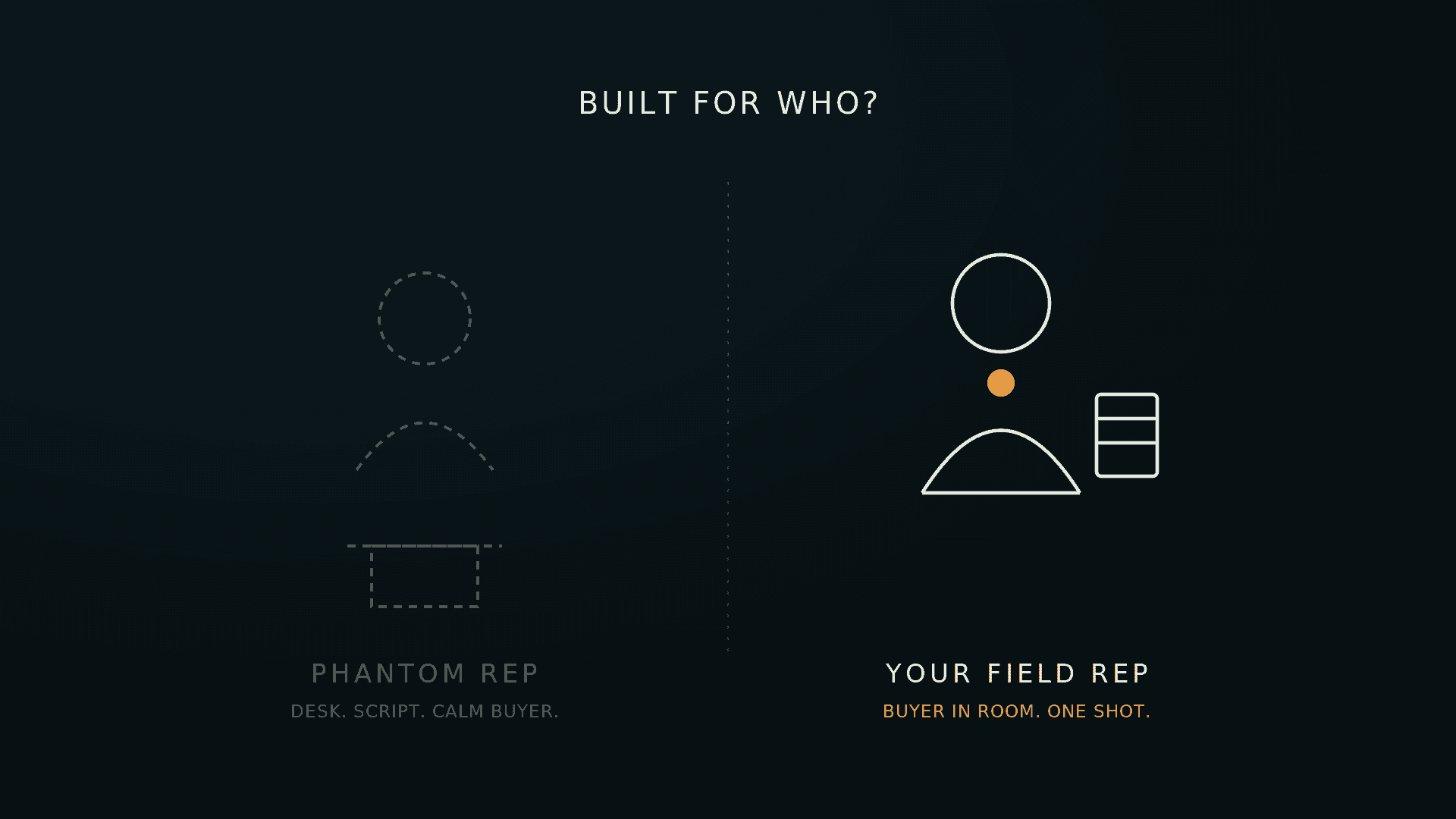
The Phantom Rep is the imaginary seller most AI roleplay tools were secretly designed around. Understanding him is the fastest way to see why so many of these tools disappoint field teams.
Picture the assumptions baked into a typical roleplay product. The seller has a small, stable product catalog, so the AI only needs to know a handful of things. The seller talks to buyers on video, so the tool can analyze eye contact and filler words. The seller has downtime at a desk, so practice can be a twenty minute session between calls. The buyer is reasonable and follows a predictable script, so the AI buyer can be reasonable and predictable too. The stakes on any single word are low, because a wrong answer in a software demo is a follow up email, not a compliance violation.
Add all of that up and you get the Phantom Rep. A tidy inside seller in a tidy inside world. Most of the category was built for him because he is easy to build for. His product is simple. His environment is calm. His mistakes are cheap. He is the path of least resistance for a product team.
The field rep breaks every one of those assumptions. Big catalog. No video, just a person in front of her. No downtime, just a drive to the next account. A buyer who does not follow a script and does not care about her quarter. And mistakes that can cost a contract, a relationship, or a regulator's attention. When a tool built for the Phantom Rep meets a real field rep, the seams show immediately. The AI buyer is too polite. The scenarios are too clean. The feedback is about pace and filler words when the rep needed help handling a hostile technical evaluator.
None of this is a knock on inside sales tools doing inside sales work. It is a knock on selling those tools to field teams and pretending the fit is there. It is not. And field reps, who have a finely tuned sense for anything fake, spot it faster than anyone.
Why does generic sales roleplay fail in the field?
It fails because it is not grounded in the rep's real product, real buyers, or real conditions. A field rep does not abandon a tool because it is AI. They abandon it because it is wrong, and being wrong in front of a buyer is the one thing they cannot afford.
Let us walk through the specific ways it breaks, because the failure is never abstract to the person living it.
It does not know the product
A field rep often carries hundreds or thousands of SKUs, and the specs and pricing move. A generic roleplay tool does not know any of it. So when the rep practices, the AI cannot check whether the answer was right. Worse, when these tools try to help with product answers, they guess. They make up a spec. They quote a price that is six months stale. In a software demo that is an annoyance. In a regulated sale it is a claim the company can be fined for. The rep learns fast that the tool cannot be trusted on the thing that matters most, and trust, once gone, does not come back with a feature update.
The AI buyer is too easy
Real field buyers are not warm. A procurement lead who has met forty vendors this year is tired and skeptical. A surgeon has four minutes and no patience. A plant manager has been burned before and assumes you are wasting his time until you prove otherwise. Generic roleplay buyers tend to be agreeable. They ask the question, accept the answer, and move on. Practicing against an easy buyer builds a false confidence that shatters the moment a real one goes cold. We have watched reps ace the simulator and freeze in the room, because the simulator never made their stomach drop.
It only knows one motion
Field selling is not one motion. It is a long regulated tender in one account and a same day handshake in the next. It is a single decision maker here and a committee of eight there. Generic tools tend to know one motion well, usually the inside discovery call, and treat everything else as a variation. Field reps live in the variation. A tool that cannot flex across deal types is teaching them to sell a deal they will rarely run.
It ignores where the rep actually is
The Phantom Rep practices at a desk. The field rep practices in a car, a hotel lobby, a hospital parking lot, five minutes before the meeting. If the tool needs a laptop, a webcam, and a quiet room, it does not exist for her. This is why practice has to live where field reps live, on a phone, voice first, in short bursts. A tool that ignores this is not hard to use. It is impossible to use, which is worse, because impossible looks like "the reps just did not adopt it" on a dashboard.
Put these together and you get the real reason generic roleplay fails in the field. It was built for the Phantom Rep, and the field rep is not him. We went deep on the related version of this in why the LMS keeps failing field sales, and the root cause rhymes. The training was built for a seller who does not have to do the field rep's job.
How does AI sales roleplay actually work for a field rep?
At the level a busy manager or rep needs, it works in five steps. No jargon. Here is the loop.
1. Pick the moment that scares you. Not "a sales call." The specific one. The pricing pushback from the hospital's procurement office. The technical grilling from the plant engineer. The three minute window with a distracted store manager. Good field roleplay lets you choose the exact conversation, because the exact conversation is where reps freeze.
2. Talk to the AI buyer out loud. The rep speaks, the AI answers in character. It objects, stalls, goes quiet, asks the follow up. The rep has to think and respond in real time, the same reflex they will need in the room. This is the part a video course can never give you. Reading about objection handling and doing it live are different skills, the way reading about swimming and swimming are different.
3. Get told the truth, right away. When the conversation ends, the AI shows what happened. Where the rep lost the room. Which question they skipped. Where they discounted before they had to. The feedback is specific and immediate, not a score buried in a report a week later.
4. Run it again. The rep tries the same moment again with the feedback in mind. Then again. Repetition is the point. One roleplay is a nice demo. Twenty roleplays is a new reflex. This is where the actual skill gets built, and it is why practice has to be quick and repeatable, not a scheduled event.
5. Manager sees the pattern, not the surveillance. A good tool rolls up what the team is struggling with, so a manager can walk into a one on one already knowing this rep keeps folding on price and that rep never asks about the buying process. One manager can coach twenty or thirty reps this way, which is the only version of coaching that survives contact with a real field team's size.
That is the loop. Choose, practice, get feedback, repeat, coach. Everything else is detail. If you want the mechanics of scoring against a named method like SPIN or MEDDIC, the good tools bake the method into step three, so the feedback speaks the language your team already uses.
What makes field selling different from inside sales?

Three things, and each one changes what the practice has to do. If a tool ignores these, it is not built for the field, no matter what the label says.
The product is complicated and the mistakes are expensive
Inside sellers often work with a small catalog and forgiving stakes. Field sellers in manufacturing, medical and pharma, industrial supply, and consumer goods carry large catalogs with specs and prices that shift, and they sell in places where a wrong claim carries real weight. A rep who misstates what a device is cleared to do is not making a small error. This is why "the AI can just wing the product answer" is not acceptable in the field. The answer has to be right, or the practice teaches the rep to be confidently wrong.
The buyer is in the room and you get one shot
An inside rep can send a follow up, hop on another call, nurture over email. A field rep is often physically present, with limited minutes, and no easy second try. The buyer is reading them in real time, and they are reading the buyer. Does this person care about the brand story or only the price? Are they the decision maker or the gatekeeper? That live read is a skill, and it only gets sharp through reps against buyers who behave like the real ones. A polite AI buyer does not build it.
The motions are all over the map
One field rep can run a months long regulated tender, a committee sale, and a same day close in the same week. Add regional reputation, where one bad meeting travels through a tight network and poisons three more accounts, and the pressure is different in kind, not just degree. With a small catalog and a calm buyer, better practice is a nice to have. In the field, where one conversation can make or break a relationship you cannot rebuild, it is closer to a necessity. Our full take on the day to day of this life lives on the field sales use case page.
Why does reliability matter more than realism?
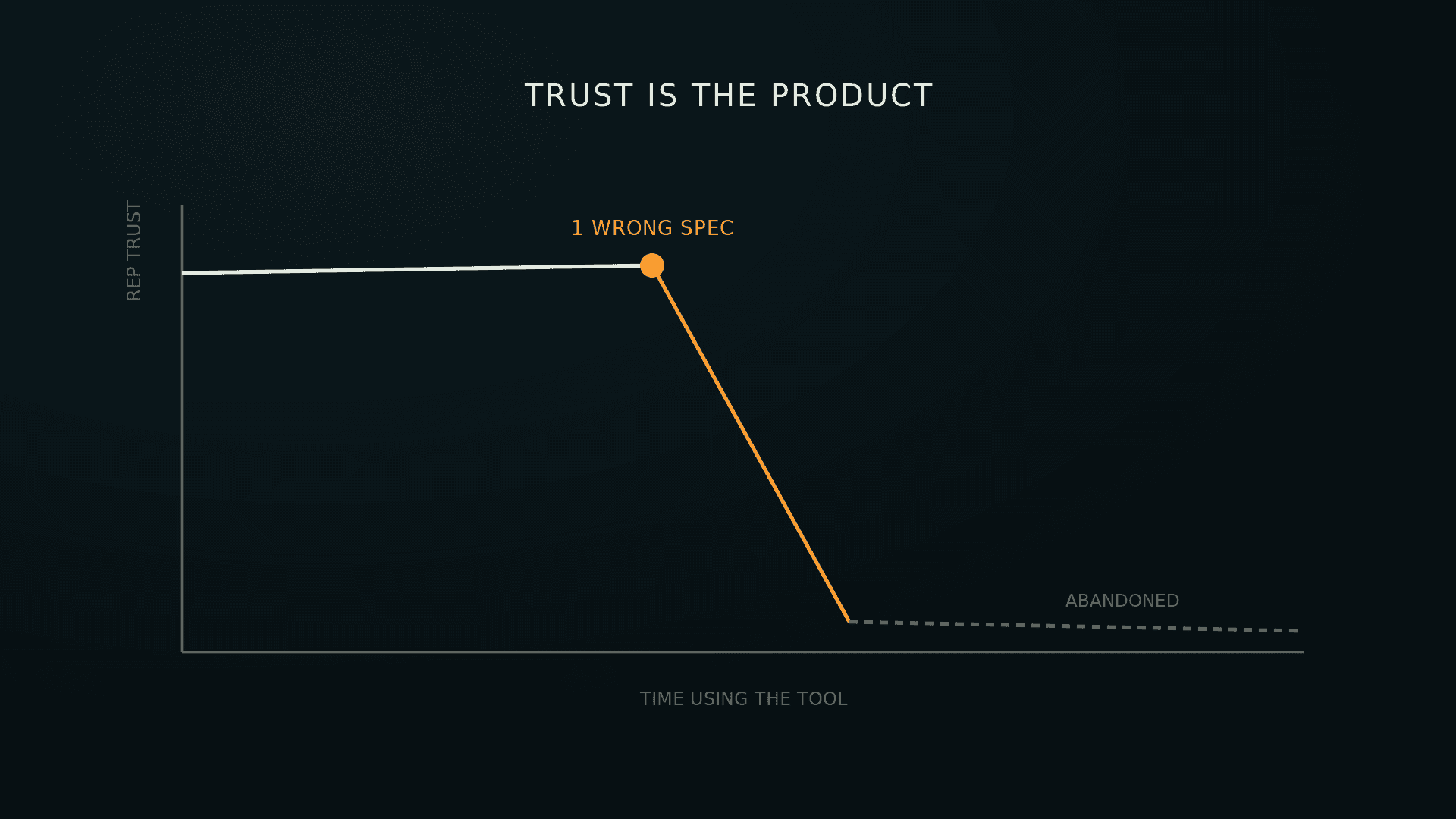
Because a field rep will forgive a plain interface, but they will not forgive being made to look wrong in front of a buyer. Reliability is the foundation the whole thing sits on. Realism is decoration if the facts underneath are shaky.
Here is what nobody in this category says out loud. A lot of roleplay tools compete on how lifelike the demo feels. Photorealistic avatars. Video that reads your facial expressions. It looks impressive in a buying meeting. But a field rep does not need the AI to look human. They need it to be right about the product, right about the compliance rule, and right about the buyer's world. If the tool hallucinates a spec during practice, the rep now has to re-check everything it says, which means they might as well not use it. The efficiency the tool promised is gone. Trust is the product. Everything else is trim.
Think about what happens the first time a tool gets a fact wrong. The rep notices. Maybe they laugh it off. The second time, they stop believing the feedback. The third time, they quietly stop using it and tell the other reps it is garbage. You do not get a dashboard alert for this. You get a slow adoption number and a vague sense that "the team did not take to it." The tool did not fail loudly. It failed the trust test, once, early, and never recovered.
So reliability in field roleplay means a few concrete things. The AI is grounded in the company's actual product data, not a guess. Compliance rules are built in, so the practice never rewards a claim the rep is not allowed to make. Pricing is current. And when the tool does not know something, it says so instead of inventing an answer. That last one sounds small. It is the whole game. A tool that admits what it does not know keeps a rep's trust. A tool that bluffs loses it in a week.
This is the shift we want revenue leaders to make. Stop asking "how fast can we ship AI to the field team." Start asking "is it reliable enough for the reps who have the least room to be wrong." Those are different questions, and only one of them protects the people carrying the bag.
Who is field sales roleplay for?
Short answer, more people than the category usually admits. Here is the honest breakdown by who you are, because the value is different depending on where you sit.
Sales leaders, VPs, and CROs. You are buying this to shrink ramp time, lift win rates, and get consistency across a team you cannot personally coach. The field angle matters to you because your reps are spread out, hard to observe, and expensive to lose. Roleplay is the closest thing to being in every account at once.
Sales managers and front line coaches. You are the one who has to turn a strategy into a rep who can actually run the meeting. Roleplay does the reps you do not have time to do, and hands you a briefing before every one on one so your coaching time goes to the right person on the right problem. This is coaching at scale without cloning yourself.
Enablement and RevOps. You own whether the tool sticks. You care about adoption, about the practice mapping to the real motions, and about not buying another platform that dies in a quarter. The field fit is your problem to get right, because you are the one who will explain the adoption number.
Field reps, SDRs, AEs, and specialists. You are the one in the parking lot. You do not want a course. You want to run the exact conversation you are nervous about, get told the truth, and walk in ready. If the tool does not live on your phone and respect your five minutes, it does not exist for you. Reps are not an afterthought here. They are the whole point, because a tool no rep opens is a line item, not a capability.
Regulated industries especially. Pharma and medtech, financial services, and insurance field teams have the most to gain and the least room for error. When the practice has to respect a label, a disclosure rule, or a state by state difference, generic roleplay is not just unhelpful. It is a risk. This is where reliability stops being a nice word and becomes the reason you either can or cannot use the tool at all.
Company size does not exclude you either. This works for a ten person team and a thousand person team. The small team wants ramp and consistency. The large team wants coaching that scales past what managers can physically do. Both are field sales problems, and both are solvable.
Does AI roleplay actually improve win rates and ramp time?
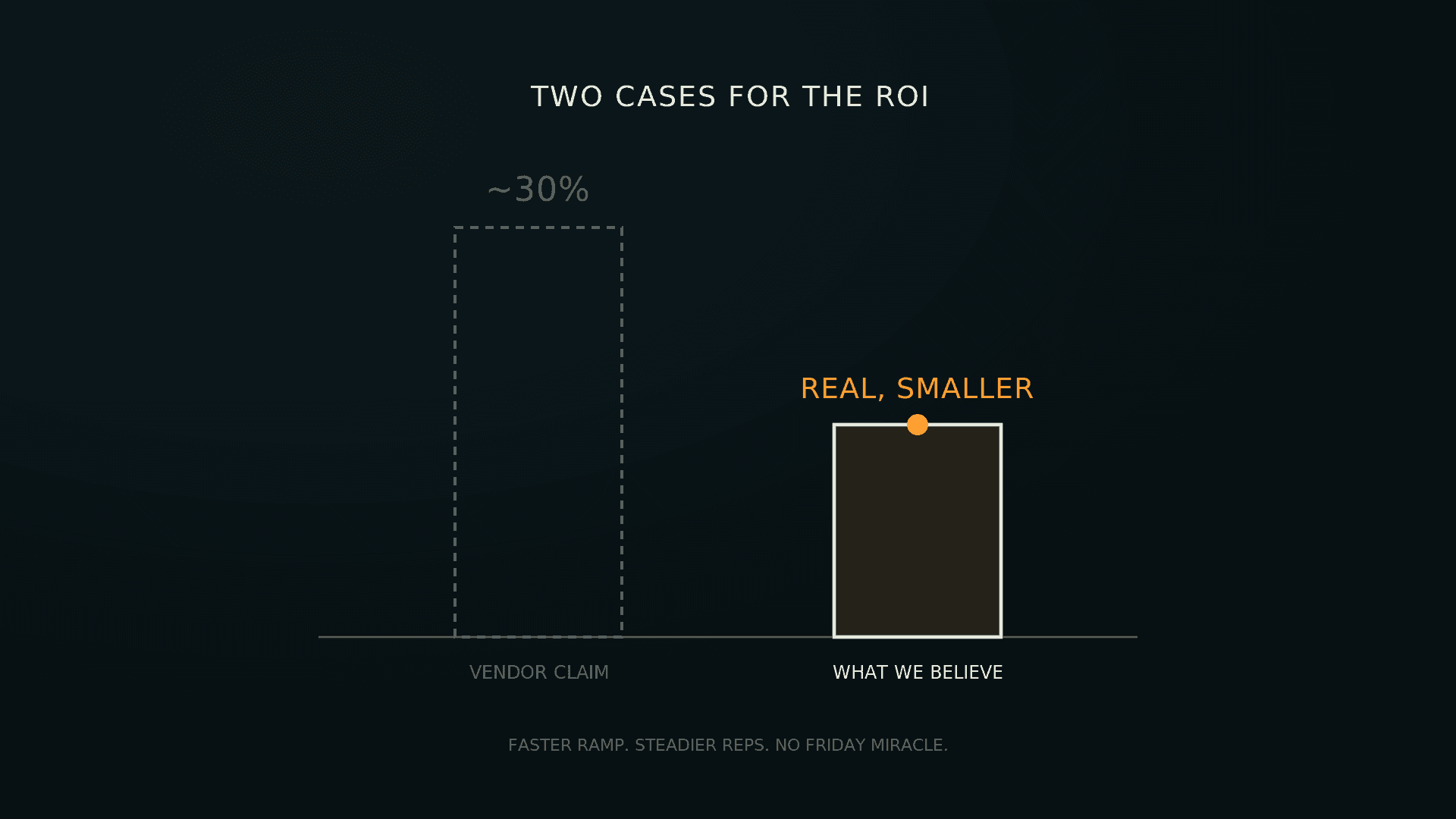
Probably yes, and the honest answer is that the published numbers are softer than the marketing makes them sound. Let me give you both cases, because you should never take a vendor number, including ours, at face value.
The optimistic case. Industry write ups and vendor studies throw around real figures. Some report win rate lifts in the range of 11 to 28 percent after teams adopt AI driven practice. Others cite ramp time cuts around 30 percent, and a Forrester figure gets quoted at roughly 35 percent faster ramp and about 22 percent better close rates in B2B settings. Taken together, the direction is clear and consistent. Teams that practice more, and practice against realistic buyers, tend to ramp faster and close more.
The skeptical case, which is what we actually believe. Almost every one of those numbers comes from a vendor or an aggregator with an interest in a big headline. The studies rarely control for the obvious. Teams that adopt structured practice are usually already the teams that take coaching seriously, so some of the lift is selection, not the tool. Ramp numbers depend heavily on how bad the old onboarding was. And "up to 30 percent" is a ceiling dressed up as an average. Our read is that a real, well run rollout produces a meaningful but less cinematic result. Faster ramp, yes. More consistent reps, yes. A cleaner picture of who needs help, definitely. A magic 36 percent lift dropped on your team by Friday, no. Anyone promising that is selling you the Phantom Rep's results.
The number we are confident in is a smaller and more useful one. Reps who practice a specific conversation ten or twenty times walk into that conversation calmer and sharper than reps who read about it. That is not a market statistic. It is just how skill works, in sales the same as in sport or music. The tool's job is to make those reps cheap, fast, and honest. The win rate takes care of itself over time. We wrote about how to actually measure this rather than trust a slide.
How often should field reps practice, and on what?
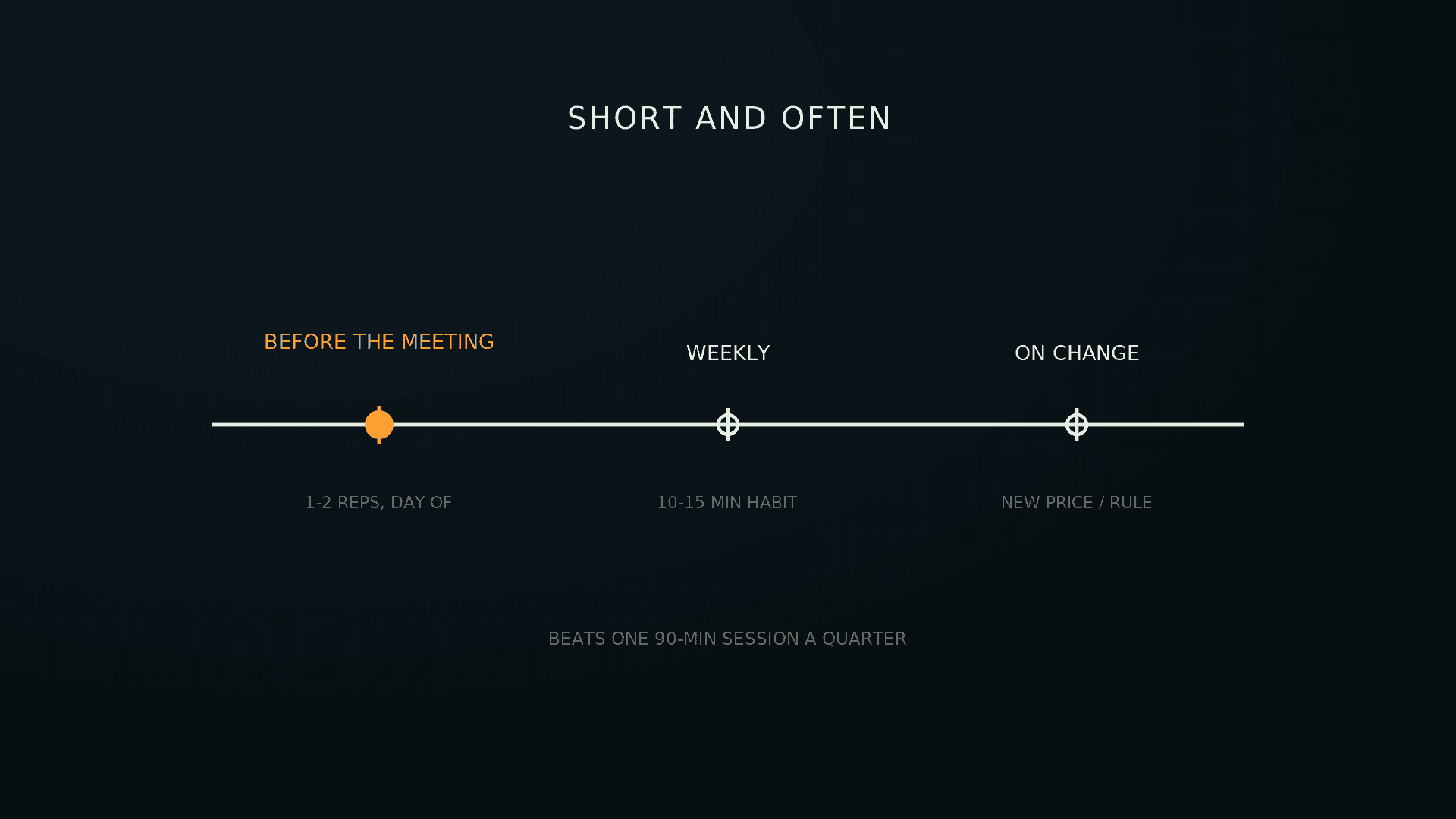
Short and often beats long and rare. A field rep who does two focused ten minute reps before a big meeting will get more from it than one who sits through a ninety minute quarterly session and forgets most of it by the next week.
There is a reason for this, and it is not motivational. People forget most of what they are taught, fast. Research on how memory fades suggests we lose a large share of new information within a day, and the majority of it within a month, unless we use it. The exact figures vary by study, and you will see claims that sales reps forget most of a training within a week. Treat the specific percentage with caution. The direction is not in doubt. Knowledge that is not practiced decays quickly. A once a quarter training event is fighting a losing battle against the way brains work.
So the cadence that works in the field looks like this.
Before a meeting that matters. One or two reps against the specific buyer type, the day before or the morning of. This is the highest value practice there is, because it is right before it counts.
A short weekly habit. Ten to fifteen minutes on whatever the rep is currently weak on, or whatever the team is being pushed on this quarter. Small, regular, on the phone. The habit matters more than the length.
When something changes. New product, new pricing, new objection showing up in deals, new compliance rule. A few reps against the change beats an email announcing it. Reps do not learn a new pitch by being told it exists. They learn it by trying it and getting it wrong a few times in private.
The thread through all of this is that practice has to be easy to start. If it takes a laptop and a scheduled slot, it will not happen in the field. If it lives on the phone and takes five minutes, it will. This is exactly why we built mobile practice the way we did, because a field rep's practice window is a car and a spare five minutes, not a desk and an afternoon.
How is AI roleplay different from call recording tools like Gong?
They are two different jobs, and teams confuse them constantly. Call recording tools look backward. Roleplay looks forward. You need both, but you cannot substitute one for the other.
Call recording and conversation intelligence tools listen to real calls after they happen and tell you what went on. They are useful. They show you patterns, surface risk in deals, and give managers something concrete to review. But they are a rear view mirror. By the time the tool tells you the rep botched the objection, the objection is already botched, in a real deal, with a real buyer. The lesson arrives after the cost.
Roleplay flips the timing. The rep gets to botch the objection in practice, learn from it, and fix it before the real call. It is the difference between a coach reviewing the game film and a coach running you through the play before you take the field. Film is valuable. It is also too late to change the game you just lost.
For field teams this gap is wider, because field calls are harder to record in the first place. There is no Zoom transcript from a plant floor or a hospital hallway. So a backward looking tool has less to work with in the field, while a forward looking practice tool works fine, because it does not need the real call to have happened. This is the piece of the category we sit in on purpose. We train forward. If you want the longer argument, we made it in why post call analysis is not coaching.
What are the common mistakes teams make with field sales roleplay?
Here are the ones we have watched sink rollouts, written as things that actually happen, not abstract warnings.
1. Buying a tool built for the Phantom Rep. The single most common mistake. The demo looks great with a clean inside sales scenario, the team buys it, and the field reps quietly reject it because it does not know their product or their buyers. Check the fit against a real field motion before you sign, not against the vendor's tidy demo.
2. Treating practice as an event, not a habit. A big kickoff, a lot of enthusiasm, then nothing. Practice that happens once does not build a reflex. If it is not short, regular, and on the phone, it will not survive a busy field rep's week.
3. Making it feel like surveillance. The fastest way to kill adoption is to let reps feel the tool is there to catch them, not help them. Practice should be private and low stakes. The manager sees patterns to coach, not a highlight reel of every fumble to hold against people.
4. Letting the AI buyer be too nice. If the practice buyer never pushes back, reps build confidence that evaporates in the room. The AI buyer has to be as hard as the real one, or the whole exercise is theater.
5. Ignoring compliance until it bites. In regulated field sales, roleplay that does not respect the rules is worse than none, because it can rehearse a rep into a claim they are not allowed to make. Bake the rules in from day one.
6. Chasing realism over reliability. Buying the flashiest avatar instead of the tool that is actually right about your product. The rep does not need the AI to look human. They need it to be correct.
7. Not connecting practice to the real motion. Generic scenarios that do not match how the team actually sells. If the roleplay runs a deal your reps never run, it is teaching a skill they will not use.
How do you roll out AI roleplay for a field team without it dying in a month?
You roll it out like a habit, not a launch. Most tools die because they were introduced as an event and then left alone. Here is a sequence that survives contact with a real field team.
Week 1: Ground it in reality. Before a single rep touches it, load your real product, your real pricing, and your real compliance rules. Build three or four scenarios that match how your team actually sells, including the hard buyer and the regulated motion. If the tool cannot be grounded in your real world, stop here. That is the tool telling you it was built for the Phantom Rep.
Weeks 2 to 3: Start with the believers. Do not boil the ocean. Pick a small group of reps and managers who are open to it. Let them run reps before real meetings and feel the difference. Their word of mouth is worth more than any all hands announcement. Reps trust reps.
Weeks 4 to 6: Make it a pre meeting ritual. Tie practice to something that already happens. Before the big account meeting, run the scenario. Before the QBR, practice the tough one. Anchoring practice to an existing habit is how it sticks, because you are not asking reps to remember a new thing, you are attaching it to a thing they already do.
Weeks 6 to 8: Bring managers in for coaching, gently. Now managers use the patterns to run better one on ones. The framing matters. This is "here is where I can help you," not "here is where you failed." Get that framing wrong and adoption drops overnight.
Ongoing: Keep it fresh. New product, new objection, new rule. Add the scenario the same week the change lands. A tool that is always current stays used. A tool that goes stale gets abandoned. The rollout is never really finished, and that is fine. The habit is the deliverable, not the launch.
The whole point is that adoption is not an accident and it is not about how good the tool looks. It is about whether the tool respects the field rep's reality from the first day. Get that right and it spreads. Get it wrong and no amount of features will save it.
Frequently asked questions
What is AI sales roleplay for field sales?
It is practice for field reps. The rep runs a real sales conversation out loud against an AI that plays the buyer, then gets immediate feedback on what worked and what did not, before they walk into the real meeting. The "field sales" part means the scenarios, product data, and buyer behavior match how field teams actually sell, not a clean inside sales demo.
How is AI roleplay different from watching training videos?
Videos teach you what to say. Roleplay makes you say it, out loud, under a little pressure, and tells you where you slipped. Reading about handling an objection and doing it live are different skills. Practice builds the reflex. Watching does not.
Is AI roleplay better than practicing with a human?
They serve different needs. Human roleplay is valuable but it does not scale, it can be awkward between peers, and managers rarely have time to do enough of it. AI practice is available any time, on the phone, as many reps as the rep wants, without anyone watching. Most strong teams use both. The AI covers volume and the specific hard moments, humans cover nuance and judgment.
Does AI roleplay actually improve win rates?
The direction is positive and the exact numbers are softer than the marketing suggests. Vendor and industry figures cite win rate lifts and faster ramp, often in the double digits, but most of those studies favor a big headline and do not control for the fact that teams who practice more were often already the better coached teams. What we are confident in is simpler. Reps who practice a specific conversation many times walk in calmer and sharper. That reliably shows up in results over time.
How often should field reps practice?
Short and often. One or two focused reps before a meeting that matters, plus a ten to fifteen minute weekly habit on a current weakness. That beats a long quarterly session, because people forget most of what they are taught within weeks unless they use it.
How does AI roleplay work for pharma and medtech field sales?
The same loop, with reliability as the hard requirement. The AI buyer plays the skeptical clinician or procurement lead, and the practice has to respect the product's approved claims and the compliance rules. Done right, it lets reps rehearse tough regulated conversations safely. Done with a generic tool that guesses at claims, it is a risk, because it can rehearse a rep into saying something they are not allowed to say.
Which platforms offer AI sales roleplay for field teams?
Several tools exist, and they fit different needs. Second Nature takes a video first approach and is often used for onboarding. Hyperbound is voice based and strong for SDR and BDR call practice, spinning up buyer personas from an ICP description. Quantified focuses on lifelike avatars and is used in life sciences and finance. SecondBody is voice first, built for the places field reps actually work, and covers the widest set of motions, from cold calls and discovery to field visits, objection handling, and manager coaching at scale.
What does AI roleplay cost?
It varies widely across the category, and a lot of vendors hide pricing behind a sales call. SecondBody is public about it. The Pro tier is 30 dollars per user per month, with unlimited seats, so the price does not punish you for rolling it out to the whole field team. If you want to see it against your own motion first, you can book a demo.
Can one manager coach a whole field team with this?
That is one of the main reasons to use it. The tool rolls up where each rep is struggling and briefs the manager before one on ones, so coaching time goes to the right rep and the right problem. One manager can meaningfully coach twenty or thirty spread out reps this way, which is not possible by hand.
How do you make sure the AI does not teach reps wrong information?
Grounding and honesty. The tool has to run on your real product data, your current pricing, and your compliance rules, and it has to say when it does not know something instead of guessing. A tool that bluffs loses rep trust in a week. This is the single most important thing to check before you buy, especially in regulated field sales.
How is this different from call recording tools like Gong?
Those tools look backward at calls that already happened. Roleplay looks forward and lets reps fix the conversation before it counts. Field calls are also hard to record in the first place, so a backward looking tool has less to work with in the field, while forward practice works regardless.
What makes SecondBody built for field sales specifically?
It is voice first and lives on the phone, so it fits a rep's five minutes in a car rather than needing a desk and a webcam. It covers the full range of field motions, not just the inside discovery call. It scores against the methods your team already uses. And it is built to be grounded in your real product and rules, because in the field, being right is the difference between a tool reps trust and one they abandon.
Does it work for small field teams or only large ones?
Both. Small teams use it mostly for ramp and consistency, getting new reps productive faster and keeping everyone on message. Large teams use it to coach at a scale managers cannot reach by hand. The 30 dollar per user unlimited seat pricing means team size does not change whether the math works.
The Phantom Rep is not on your team. Build for the one who is.
The whole category has a quiet habit of building for a seller who does not exist. Tidy product, calm buyer, cheap mistakes, all the time in the world. The Phantom Rep. He demos beautifully. He also is not the person carrying your number through a plant, a clinic, or a store.
Your field rep is real. Big catalog. Buyer in the room. One shot. Rules she cannot break. She does not need a prettier avatar. She needs practice that is right about her product, hard the way her buyers are hard, and available in the five minutes she actually has. That is the bar. Not how fast you can ship AI to the field, but whether it is reliable enough for the people with the least room to be wrong.
That gap between the seller the tools assume and the seller you actually have is the gap SecondBody was built to close, by putting reliable, voice first practice where field reps work and grounding it in the world they really sell in. If that is the rep you are trying to make sharper, come see it against your own motion, or check what it costs before you talk to anyone. Good luck out there.
See how field teams practice voice-first, on the phone, grounded in their real product and buyers.
SecondBody is the AI sales practice platform built for field, regulated, and enterprise sales teams. Voice-first. Pre-call practice and post-call retry. Pre-1:1 manager briefings. Unlimited seats at $30 per user per month. Built in Paris. SOC 2 compliant.
Related reading: Why the LMS Keeps Failing Field Sales · AI Sales Roleplay Training Guide · The Psychology of AI Role-Play · Field Sales Use Case · Mobile Practice · What is Sales Roleplay?