Field Sales Coaching: How Do You Actually Coach Reps You Never See?
Field reps drive all day, skip training, and freeze on the same objections. Here's how to coach reps you never see, without another LMS or ride-along.

Posted by
Secondbody.ai
Published by
Last Updated
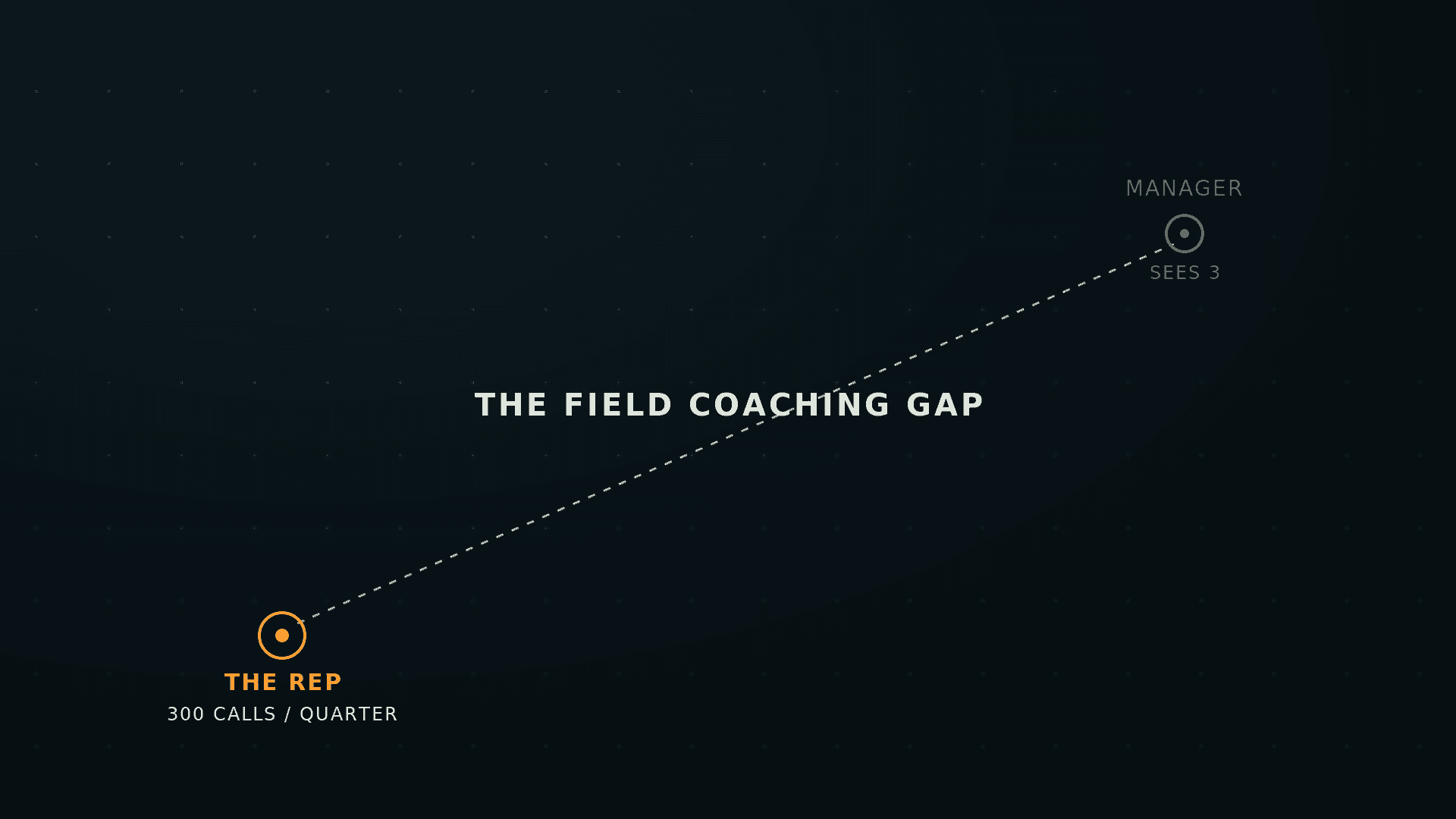
The Field Coaching Gap. A rep lit amber, 300 calls a quarter, a manager three states away who sees 3
The short answer: field sales coaching works when it stops being an event and becomes infrastructure. If you want to know how to coach field sales reps you almost never see, the answer is frequent practice on the conversations that decide deals, immediate feedback against your methodology, and a manager who reads patterns instead of sitting in cars. That is what effective sales coaching looks like when your team is spread across a map instead of sitting in a room.
(Scanning this between meetings? Every section is a question. Jump to whichever one you actually have.)
Picture the rep this is really about. A field seller in a rented Hyundai outside a hospital, a manager three states away, a quarterly ride-along that hasn't moved a number in years. That rep has three hundred conversations a quarter. Their manager sees three of them. The other two hundred and ninety-seven, including every one where the rep froze on the same competitor question they froze on last quarter, are invisible.
That is the real problem with field sales coaching. Not that managers are bad at it. The model they inherited cannot reach the moments where coaching would actually change anything.
Here's something worth saying out loud before we go further. SecondBody sells AI sales training software built around voice-first practice, and field teams are one of the categories we sell into hardest. So read everything below with that bias in mind. We are going to try to earn your trust by being harder on the field-coaching status quo than the people selling it to you, and by giving you the skeptical version of every number, not just the brochure version. How we know any of this: we have watched enough field rollouts succeed and fail to see the pattern, and we have customers in pharma, medtech, cybersecurity, and financial services who live this every week.
This guide is for sales leaders, enablement directors, and frontline managers who run field teams and have run out of patience with the model they inherited. Pharma, medtech, industrial equipment, insurance, financial services, agricultural sales, beverage, distribution. Anywhere reps spend more time in cars and lobbies than at desks. We will walk through what field sales coaching actually is, how it differs from plain sales coaching and from field sales training, why the traditional version fails, and how to build a coaching system that runs whether or not your manager is busy this week.
You are not going to find a "do these five Zoom rituals and your reps will improve" template here. That is what every other field-coaching guide sells. We have watched enough teams run those rituals and produce no measurable change to know the issue is not the ritual. It is the model underneath the ritual.
What is field sales coaching, and how is it different from plain sales coaching?
Start with the parent term, because people search for it and get a mushy answer. Sales coaching is the ongoing work a manager does to build a rep's conversational skill, judgment, and resilience, through repetition and feedback, not a one-time transfer of knowledge. That is the whole category. Field sales coaching is the version of that work when the rep sells in person and the manager is almost never in the room.
That "almost never in the room" part is not a footnote. It changes everything about how the coaching has to be built. Inside sales coaching assumes the manager can hear the call. Field sales coaching cannot assume that, so it has to run on practice instead of playback. Same goal, different plumbing.
Let's pull the definition apart, because it does some quiet work. Coaching is not managing. Managing covers pipeline, forecast, territory, comp, conflict, and hiring. Coaching is the narrower thing: making the rep better at the conversations they have with customers. And coaching is not training. Training transfers knowledge. Coaching builds the skill of using that knowledge under pressure. A rep can be fully trained and still uncoached, which is the exact state most field reps are in.
Here's what it means in practice. A pharma rep is meeting six oncologists in two days. The first asks an off-label question that sounds harmless and isn't. The second pushes back on safety data. The third is a quiet listener mentally writing the rep off in the first ninety seconds. Each of these is a moment where a coachable skill either fires or doesn't. If it doesn't fire, the rep walks back to the car, the call goes unrecorded, the manager never sees it, and three weeks later the same opening produces the same fumble.
That loop is what coaching has to break. Not a quarterly skill assessment. Not a sixty-minute Zoom. The loop where the same conversation keeps producing the same outcome because the rep has never gotten clean reps on the moment in question.
Effective sales coaching in the field has four characteristics. It is frequent enough to interrupt the loop, weekly at minimum and daily ideally. It is specific to the scenarios the rep is facing this week, not generic skill modules. It produces a behaviour change the rep can practise before the next live conversation. And it is observable to the manager, so they can see what the rep practised, what they got right, and where they are still stuck, without being in the car. If your current process doesn't have those four, you do not have a coaching process. You have a calendar invite.
Why is coaching field reps harder than coaching inside sales?
Inside sales has it easy, relatively. Gong recordings, Zoom shadowing, a manager who can drop into a live call with thirty seconds' notice. Field sales has a rep alone in a parking lot and a manager who finds out how the meeting went from a one-line CRM note typed at a red light.
The result is a category-wide coaching debt. We call it the Field Coaching Gap: the distance between how often a field rep needs feedback to actually improve, and how often the organisation can deliver it. The gap is structural. It will not be fixed by hiring better managers, buying another LMS module, or running another kickoff in Vegas. It gets fixed by changing what coaching is and where it lives.
It is worth naming why the gap is so wide right now. Field reps spend only about 43% of their time actually selling, and roughly a fifth of the week goes to admin and data entry, according to recent field-sales research, so hold those figures loosely and pressure-test them against your own team. Meanwhile 78% of sellers missed quota in 2025, up from 69% the year before. Take those numbers as directional, not gospel. The direction is the point: less time in front of buyers, more pressure on every conversation that does happen, and a coaching model that touches almost none of them. Here is why each of the standard fixes falls short.
The ride-along is a calendar event, not a coaching mechanism
The default field-coaching ritual is the ride-along. Manager flies or drives in, shadows three or four meetings, gives feedback in the car between stops, leaves. In the best organisations this happens every six to eight weeks per rep. In most, twice a year, and it gets rescheduled half the time.
A good ride-along produces a handful of quality feedback moments on the calls the manager happened to see, a relationship deposit, and a few notes that get typed into the CRM and forgotten by Wednesday. What it does not produce is behaviour change at the loop level, because the manager observed three calls out of three hundred. The other two hundred and ninety-seven were invisible. That is not coaching. It is a sampling exercise. Field teams that lean entirely on ride-alongs are not under-coaching. They are inspecting.
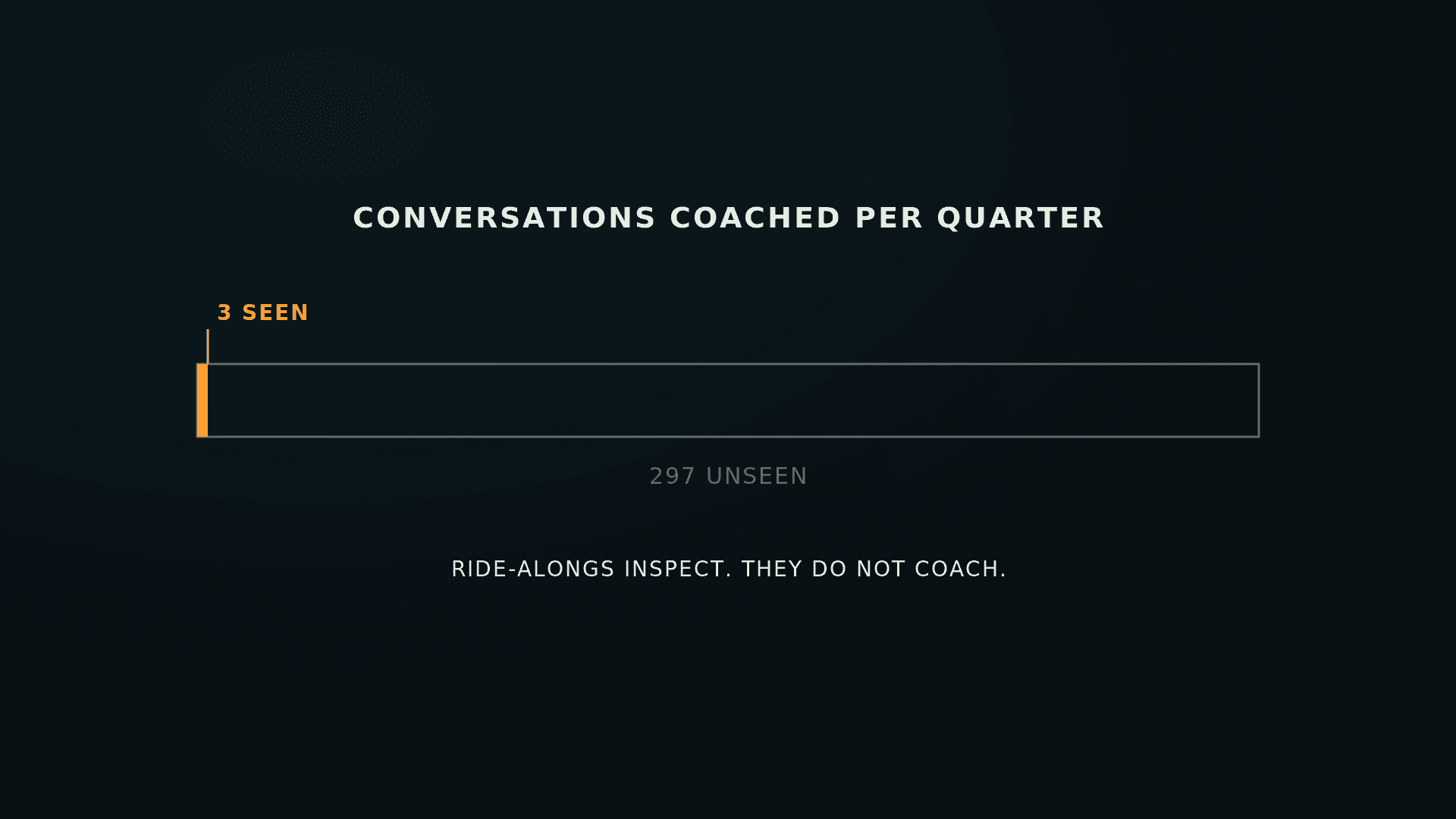
3 of 300 conversations coached per quarter. Ride-alongs inspect, they do not coach
Zoom call review is commentary, not practice
The next ritual up is the Zoom call review. Rep records a call where allowed, manager listens, they meet and discuss what happened. Better than nothing, and worse than people think. Watching a recording and discussing it is not practice. Practice is the rep doing the thing again, in a different version of the same situation, with the new behaviour they're trying to learn. Reviewing a call teaches the rep what happened. It does not teach them what to do next time. Reading a book about swimming will not make you a swimmer. Watching yourself drown will not make you a swimmer either.
LMS courses don't transfer to the field
Every field organisation we work with has an LMS. Every LMS has a module on objection handling. Almost no rep can handle objections any better six months after the module than before. Not because the module is bad, but because it is built for knowledge transfer, and the gap that costs deals is not a knowledge gap. The rep who aced the quiz on "we already tried something like this and it didn't work" still freezes when a real buyer says it. The freeze is not from forgetting the answer. It is from never having said the answer out loud, under pressure, when it mattered. Knowledge is necessary and not sufficient. We call that the Execution Gap, and it bites hardest in field sales because the rep is alone in the moment it closes or doesn't. The forgetting curve is not a controversial idea. Most training plans just pretend it doesn't apply to them. We went deeper on this in our piece on why an LMS fails field sales.
The training event is a morale lever, not a skill lever
The annual kickoff, the quarterly launch training, the two-day off-site with the methodology consultant. Useful for what they actually do: build culture, transfer information, energise people, give leadership a clear conscience about training spend. What they do not do is build skill, because skill is a function of frequency and feedback, and a two-day event delivers a burst of frequency and almost no feedback. The rep returns Monday with a full notebook and the same reflexes they had Friday. Every leader who has run a kickoff and tracked behaviour for six months afterward has seen this and quietly decided not to bring it up.
Async tools without structure produce theatre
The opposite failure. Instead of episodic training, the team rolls out a Slack channel and a "share your wins and losses" thread. Reps post the wins they want the manager to see. Nobody posts the losses. The coaching culture gets a newsletter celebrating itself while the actual coaching debt grows underneath. We are not anti-async. We are anti-async-without-structure. Async coaching only works when there is a forcing function, a rhythm and a manager review, that makes the practice happen and makes the patterns visible.
How is field sales coaching different from field sales training?
People use these words as if they mean the same thing. They don't, and the difference decides where you should spend money.
Field sales training is content-led and front-loaded. You hire a methodology consultant, run an off-site, leave a binder, and ramp new hires through a curriculum. It answers "does the rep know what to do?" If that is the problem you are solving, start with our companion guide on field sales training, which covers onboarding, ramp, and curriculum in depth.
Field sales coaching is practice-led and continuous. It answers a different question: "can the rep do it when the buyer goes quiet and the commission is on the line?" The methodology is the same in both, SPIN or MEDDIC or Sandler or Challenger. Training teaches it. Coaching turns it into muscle memory through repetition and feedback. Most teams need both, in order: train the framework, then coach it into reflex every week for the next year. The mistake is thinking the consultant's two days were the training. They were the prep work. The training is what happens daily afterward. The rest of this guide is about that daily part, the part almost nobody builds.
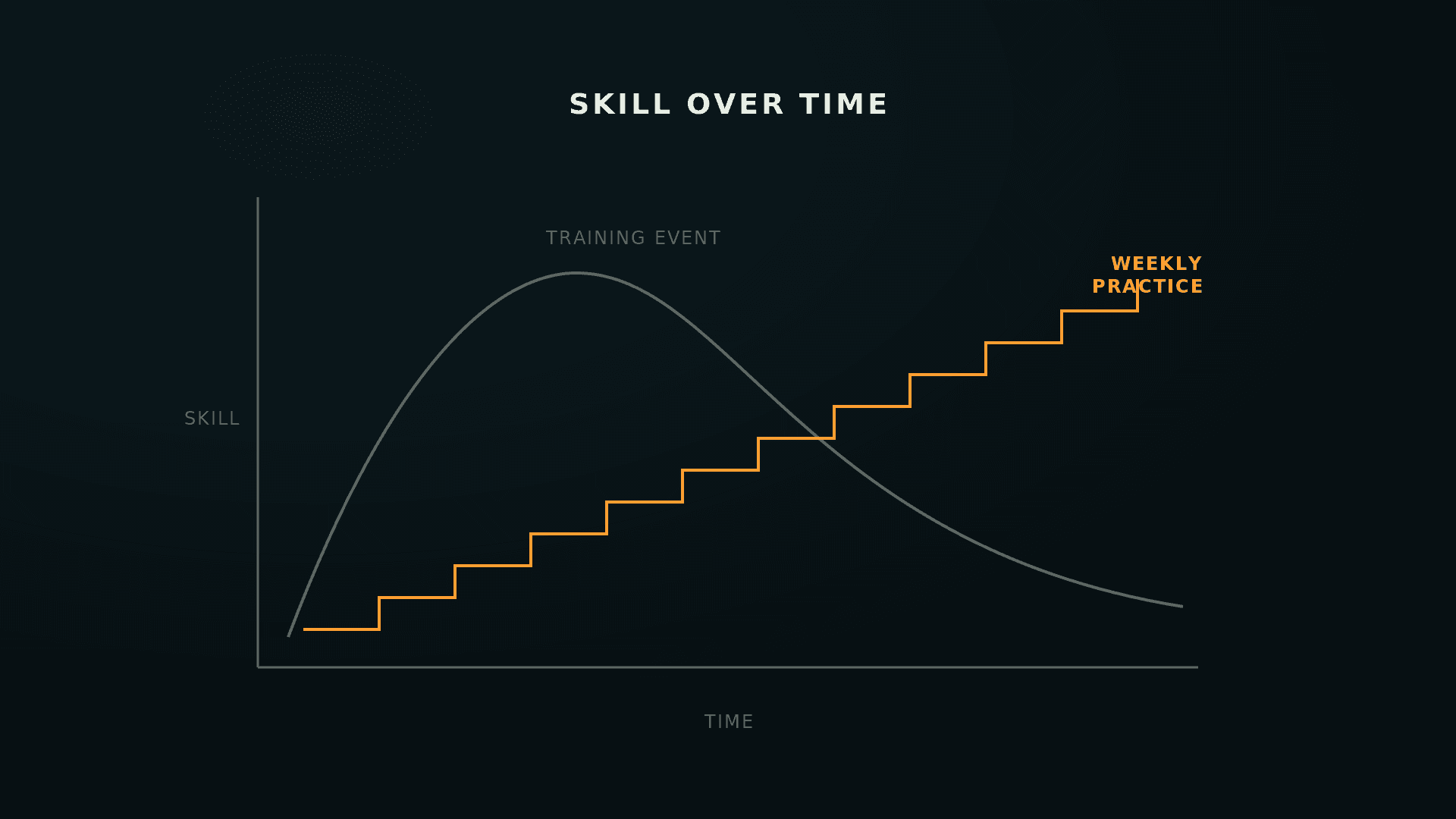
skill over time. The training event spikes then decays; weekly practice compounds and overtakes it
What does effective sales coaching actually look like in the field?
We will get to the playbook. First the principles, because these are the sales coaching best practices that actually correlate with a rep getting better, not the ones that make a nice slide. If you take a handful of things from this guide, take these six.
Practice is the unit of work, not training
Most programmes are designed around training events. Effective ones are designed around practice reps. A practice rep is a single instance of a rep doing the conversation they want to get better at: the cold open, the discovery sequence, the price objection, the close. A rep needs hundreds of practice reps per scenario, not one session per quarter. This is how every field that produces performers under pressure works. Athletes train daily, not quarterly. Pilots simulate emergencies hundreds of times before carrying passengers. Surgeons rehearse before they cut. The insight is old. It just hasn't crossed into B2B sales, because the infrastructure to do it at scale didn't exist until recently. Stop measuring training hours. Start measuring practice reps.
Pressure must be simulated, not approximated
Conference-room role-play does not simulate pressure. It simulates the social pressure of performing in front of colleagues, which is real but is not the thing the rep needs to get better at. The rep needs to get better at the pressure of a buyer going quiet, asking the unexpected question, pushing back on price, comparing you to a competitor, ghosting after a strong meeting. Effective practice simulates that. The buyer pushes back the way real buyers do, goes off-script, gives the rep a chance to recover badly and then well. This is where AI-powered sales roleplay changed what's possible. A persona can be calibrated to the exact difficulty a rep needs, easier for a nervous new hire, harder for a senior rep coasting on autopilot, and it can play a hostile procurement committee or an oncologist who has heard your three competitors already, on demand, without anyone scheduling a thing.
Feedback must be immediate, specific, and against a methodology
Feedback that arrives next week is not feedback. It is a memory aid. Feedback that says "good job, work on your discovery" is not feedback. It is an opinion the rep can't act on. Feedback that says "you went to a closed question at minute three when an open implication question would have surfaced the budget constraint" is feedback. Immediate, specific, methodology-native. That is the bar. Below it, you don't have feedback. You have notes from a meeting. Most sales coaching techniques fail this test, and it is the one that matters most.
The manager's job is patterns, not playback
In a working system the manager does not listen to every practice rep. They cannot. Fifteen reps doing thirty reps a week is 450 sessions, which at three minutes each is more than twenty-two hours. The manager reads patterns instead. Who is improving on which scenario. Who got worse on the price objection three weeks running. Who stopped practising. Who is doing tons of reps and not improving, which usually means the wrong scenarios. The coaching conversation then starts from data: "the AI flagged you tighten up at minute four when they push on price. Tell me what's happening in your head when that lands." That is a coaching conversation. Most managers spend their coaching hours doing pipeline review with the word "coaching" in the invite. The fix is the pre-1:1 manager briefing, where the manager walks in with the data already digested.
The infrastructure must work without the manager
The hardest shift for managers to accept. The highest-ROI coachable moments happen when the manager is not available. The rep is between meetings with eleven minutes and wants to rehearse the opening they're about to use. If coaching requires the manager to be present, the rep doesn't practise. They scroll their phone. So coaching has to run asynchronously, on the rep's phone, while the manager sleeps. The manager reviews patterns later. This is the design constraint that breaks every programme not built for it from the ground up, and it is exactly why coaching at scale needs different plumbing than inside-sales coaching.
The emotional reality is part of the coaching
Field sales is lonely in a way inside sales is not. Reps drive between appointments in silence, absorb hostile receptions with no colleague to debrief with, miss family dinners for territory dinners, and internalise rejection where nobody sees it. A programme that treats the rep as a unit of behaviour to optimise is incomplete. One that makes space for what was hard this week, what's wearing them down, the part of the territory they're avoiding, produces both better humans and better numbers. Those are the same thing. This part stays human. AI cannot do it. Managers can, which is the whole point of freeing their time from low-value playback. We wrote more on the psychology of that shift in from fear to confidence in field sales.
How do you coach sales reps without micromanaging?
This is the fear that keeps managers from coaching at all: that more coaching means more hovering, more "did you log it," more reps who feel watched and trusted less. Done the old way, that fear is correct. Done right, coaching and micromanaging are opposites.
Micromanaging is about activity. It asks how many calls you made, whether you updated the CRM, why you were in that territory Tuesday. It treats the rep as someone to monitor. Coaching is about capability. It asks where you got stuck in a conversation and what you want to get better at. It treats the rep as someone to develop.
The way you keep coaching from curdling into micromanagement is to put the data between the manager and the rep, not the manager over the rep. When the rep practises and the system surfaces the patterns, the coaching conversation is about the work, not the person. "Procurement objection, three weeks stuck, let's look at it" lands completely differently than "I noticed you've been struggling." One is a coach and a player looking at game tape. The other is a boss expressing disappointment.
Three rules keep it on the right side. Coach the scenario, not the activity, so the rep never feels surveilled, only supported. Let the rep self-direct most of their practice, so the reps they do are theirs, not assignments. And keep the human conversation about patterns over time, not play-by-play of yesterday. A manager who does this can coach twenty-five reps and have every one of them feel more autonomous, not less, because the rep owns the practice and the manager shows up for the hard parts.
How does field sales coaching work, step by step?
Here are the mechanics, in order. This is the closest thing to a sales coaching plan you can lift and run.
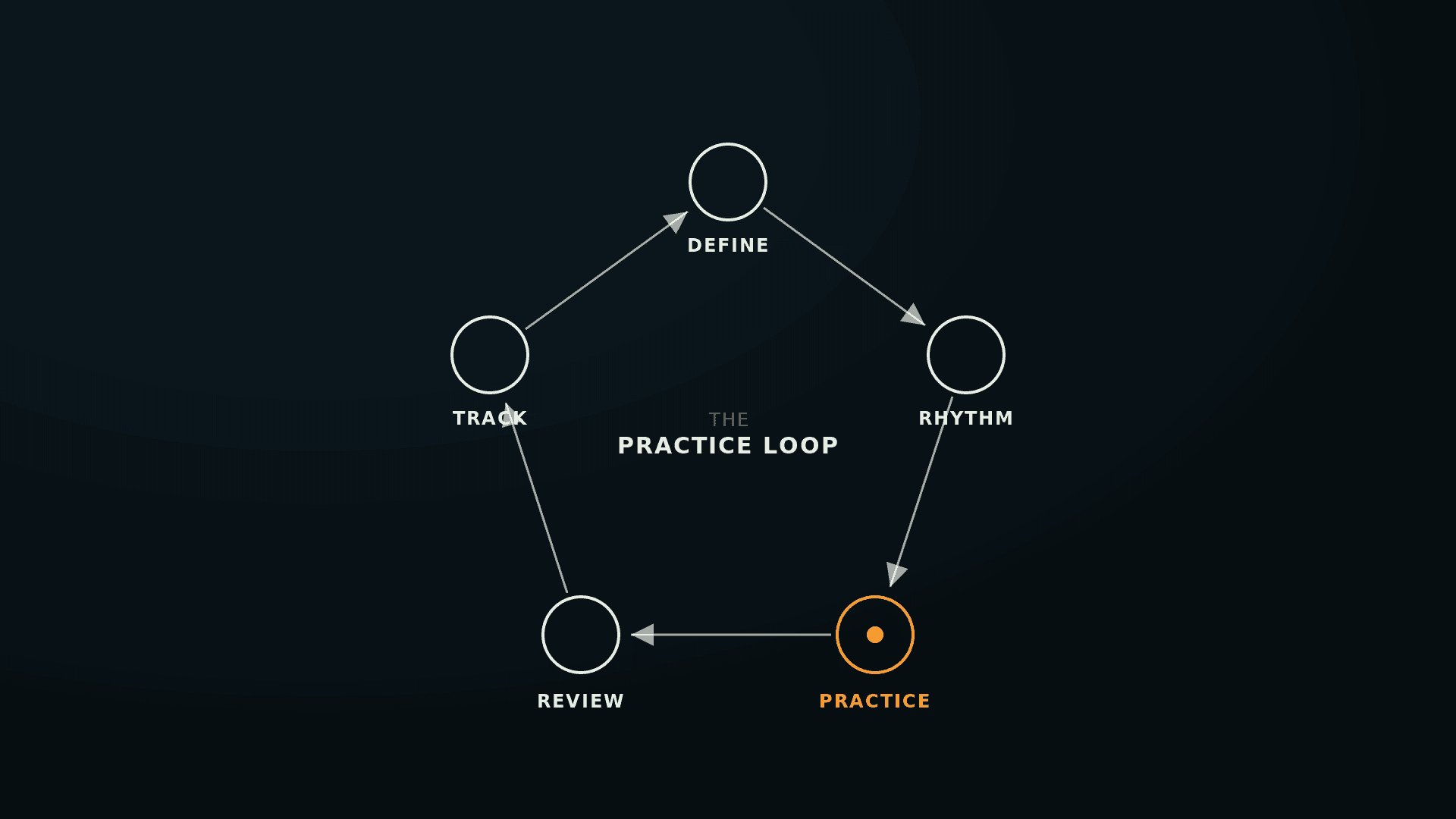
the practice loop. Define, Rhythm, Practice (lit), Review, Track
Step 1: Define the scenario library that matters for your territory
Every field team has a finite set of conversational moments that decide wins and losses. Pharma has the off-label redirect, the clinical pushback, the access conversation, the formulary objection. Insurance has the underinsured renewal, the cheapest-option deflection, the competitor switch. Industrial has the spec-change conversation, the parity claim, the procurement committee. Build twenty to fifty scenarios that cover the moments your reps actually face, drawn from real transcripts, real win/loss interviews, real ride-along notes. Not generic sales scenarios. Yours. Most teams skip this and jump to "buy a tool," which is exactly why the tool fails. The scenarios are what make the practice transfer.
Step 2: Set the practice rhythm
Fifteen to thirty minutes per week minimum, spread across days, not crammed into one block. What works: two short sessions Monday morning on the scenarios most likely to come up that week; one five-minute pre-call rep before any high-stakes meeting, against the persona that matches the actual buyer; one post-call debrief rep when a call went sideways; and a team-level theme each week, so everyone is sharpening the same edge. The rhythm is the forcing function. Without it, reps drift to "I'll practise when I have time," which means never.
Step 3: Run the practice reps
The rep opens the tool, picks a scenario, and the AI persona starts talking. The rep responds in voice, not text, because the conversation they are practising is a voice conversation and the skills are voice skills. The persona pushes back. The rep recovers. Three to seven minutes. At the end the rep gets a score on the methodology dimensions that matter, listens back to any moment, and runs it again with what they learned. Voice in, voice out, immediate feedback against a real methodology, ability to retry. Anything less is a worksheet pretending to be coaching. This is also what a real sales coaching session looks like now, when you run one: not a manager and a rep talking about calls, but a rep getting reps.
Step 4: Manager reviews the patterns
The manager opens the dashboard once or twice a week. Not to hear every rep, but to see the patterns and pick one or two reps to coach where the data shows the highest-impact opportunity. This is data driven sales coaching in the plain sense: the conversation starts from evidence and runs thirty data-led minutes instead of a generic skip-level. That is the pre-1:1 manager briefing: the manager walks in with the patterns digested, the rep walks in knowing the focus, and the time goes to the one thing that matters.
Step 5: Track the longitudinal change
The system is pointless if you can't see it working. Track a few metrics that actually correlate with behaviour change: practice volume per rep per week (input), methodology adherence over time (skill), specific scenario scores over time (mastery), and win rate by scenario type (outcome). The first three lead. The fourth lags by a quarter. Watch only the fourth and you can't course-correct. Watch only the first and reps will game it. Watch all four and you get a true read.
Can field sales coaching work remotely and virtually?
Short answer: this is the only version that works when your reps are remote, and it is the point of the whole design. Remote sales coaching fails when it means a manager watching recordings from home and sending notes. It works when the practice lives on the rep's phone and the coaching lives in the patterns.
Virtual sales coaching gets a bad name because most of it is a webcam and a slide deck, which is just a training event with worse coffee. That is not what we mean. We mean the rep practising a real conversation against a calibrated AI buyer, wherever they are, at 6am before the first meeting or 9pm in a hotel after a bad day. No shared calendar. No time zones to reconcile. The manager, who might be in a different country, reviews the patterns the next morning.
For a distributed field team this is not a nice-to-have. A rep in a territory eight hours from headquarters gets the same coaching density as the rep who sits near the sales director. That is the equaliser most field orgs have been missing, and it is why we built SecondBody for field sales around the phone, not the desk.
Who needs field coaching infrastructure?
Not every team needs to overhaul its model. Here is who this matters for most, and who can keep what they have.
Pharma and medtech. Highest fit. Distributed reps, recording-restricted environments, high-stakes conversations with skeptical clinical buyers, expensive consequences for an off-message answer. Conversation intelligence is structurally unavailable, so the Field Coaching Gap is widest here. Our healthcare and medtech guide goes deeper on the compliance angle.
Insurance and financial services. Same shape as pharma. Recording is restricted in many jurisdictions, products are complex, regulators care what reps say. The reps who articulate value under pressure win renewals; the ones who can't lose them. More in our finance and insurance guide.
Industrial, equipment, and distribution. Complex multi-stakeholder accounts, long cycles, technical evaluators, procurement-driven decisions. High skill required, quarterly coaching at best. Practice infrastructure changes the team's trajectory within two quarters in our experience.
Agricultural and beverage. Large geographies, relationship-heavy selling into independent operators. Coaching is almost entirely informal. Practice adds tools the rep can use inside the relationship without replacing the relationship work.
Field service and after-sales. Often overlooked. Service reps who also handle upsell and renewal have more buyer interactions than the sales team but were never trained to sell. A scenario library built for service-to-sales transitions moves their revenue contribution more than people expect.
Where it matters less. If your team is fully inside, fully recorded, and observable by managers who can join any call, your Field Coaching Gap is smaller. You still have an Execution Gap, but the plumbing differs. Our sales coaching explainer covers that case.
How is field coaching different from conversation intelligence?
This comes up in every conversation with field leaders, so let's be direct. Conversation intelligence platforms, Gong, Chorus, Clari Copilot, Salesloft Conversations, are good at one thing: surfacing what happened on recorded calls. They transcribe, tag, summarise, and flag the moments a competitor came up. Useful. Not coaching.
The differences are structural. Conversation intelligence works on real calls; coaching works on practice. It shows you where things went sideways; coaching helps the rep not go sideways next time. It is a post-mortem; coaching is preparation. And it requires recording, which in field sales, especially regulated field sales, is often unavailable. The platforms that bolted "AI role-play" onto a recording tool generally shipped it text-based, methodology-light, and pressure-free. If you want the head-to-head on the biggest one, we laid it out in Gong vs SecondBody.
The two are complements, not substitutes. Inside team you can record, conversation intelligence is valuable. Field team you can't, you need practice infrastructure. Have both, you need both. The gap most field teams hit is buying the conversation intelligence tool, expecting coaching to fall out of it, and quietly accepting that the coaching part never worked. That is the problem SecondBody was built to solve, with voice-first practice that doesn't depend on recording, runs in the rep's pocket, and produces methodology-native feedback.
What ROI and benefits can you expect from field sales coaching?
Specific numbers, with the vendor's optimistic case and our skeptical one, because that is the only honest way to talk about ROI in this category. Treat every figure below as directional and worth pressure-testing against your own funnel. The benefits of sales coaching are real, but they are earned, not automatic.
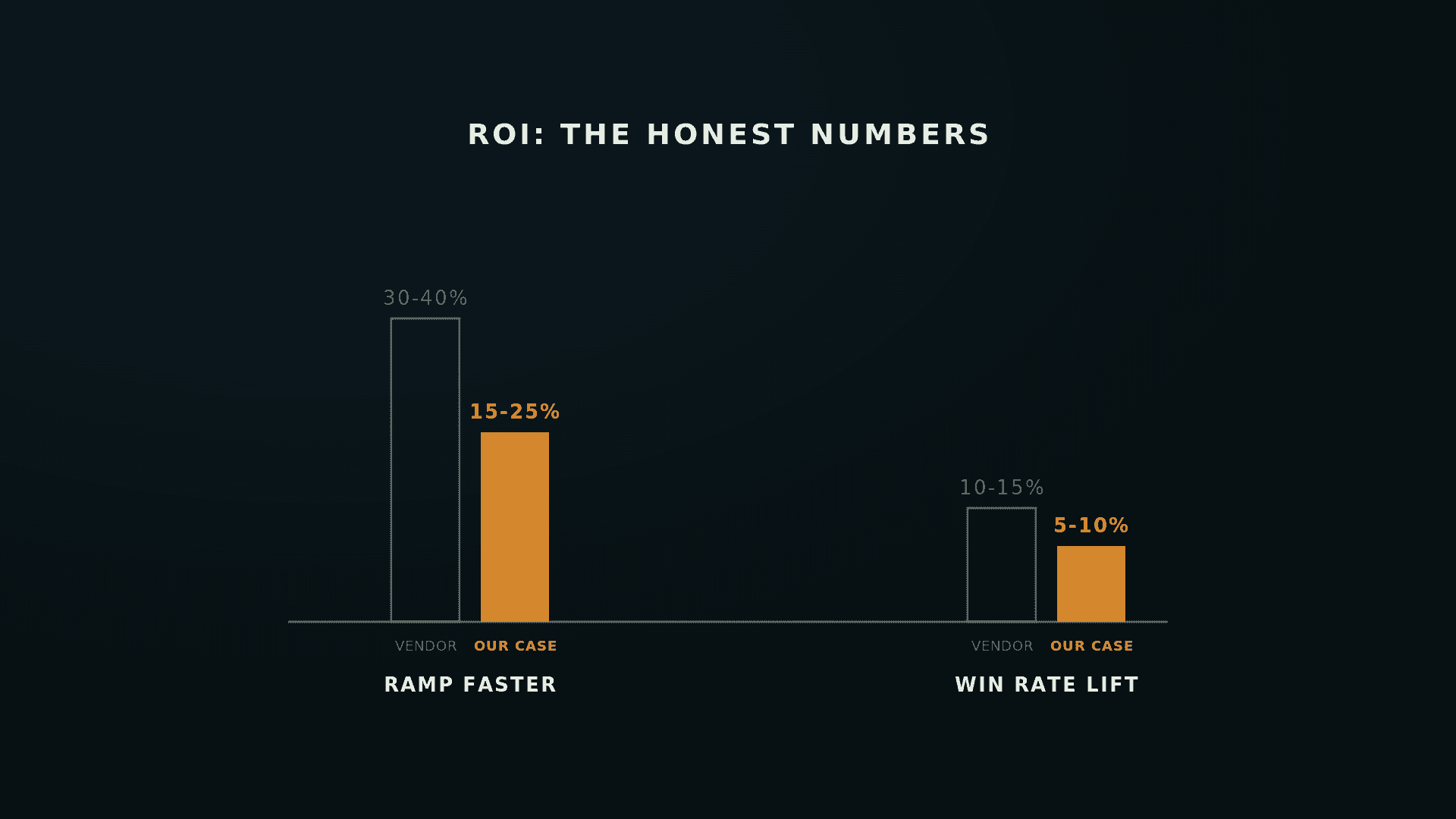
ROI, the honest numbers. Vendor case vs our case for ramp and win rate
Faster ramp. Vendor case across the category: 30 to 40% reduction in time-to-first-deal for new field reps. What we actually believe: 15 to 25% is realistic for teams that implement properly and have managers who engage with the data. The 30 to 40% requires discipline most teams don't have on day one. The mechanism is real either way. A new rep who gets thirty practice reps on discovery before their first live one performs measurably better on that first one.
Higher win rates on coached scenarios. Vendor case: 10 to 15% lift. Skeptical case: 5 to 10%, and only on the scenarios the team genuinely practised, not the ones where practice was theatre. The lift is concentrated, not diffuse, which is good. You can aim practice at the scenarios that matter most to your funnel.
Lower turnover. Industry estimates put the fully loaded cost of a single sales rep departure somewhere around $115,000 to $150,000 once you count hiring, ramp, and lost production, and some analyses put it higher still, at 150 to 200% of the rep's annual on-target earnings. The exact figure depends heavily on quota and tenure, so hold it loosely. The mechanism is the durable part: reps who feel the organisation is actively helping them improve stay longer than reps who feel stuck in conversations they don't know how to handle. We dig into this in our piece on reducing sales rep turnover.
Better manager coaching. A manager who walks into a 1:1 with skill-level data has a sharper, more actionable conversation than one holding a CRM dashboard. We have seen rep-reported manager quality rise within a quarter, not because managers changed, but because they had better material.
Compliance posture. Reps who have practised the approved talking points under pressure hundreds of times are less likely to go off-script when a buyer pushes. That is a coaching benefit and a compliance benefit at once. Most regulated teams underinvest here because they treat compliance as a content problem (do we have the documentation?) when it is really an execution problem (can the rep follow it under pressure?).
On the whole-programme math: the optimistic case is 3 to 5x return in twelve months; the case we will stand behind is 1.5 to 3x in year one for teams that implement properly, climbing toward 3 to 5x in years two and three as the library matures. Subtract the cost of the infrastructure, typically $20 to $40 per user per month for AI sales training platforms (SecondBody is $30 at the Pro tier, unlimited seats), plus the overhead of maintaining the library. The math works for most field teams above ten reps and works fast above fifty. The number most CFOs miss is the cost of not changing: a team coaching the way it did in 2022 is competing in a 2026 market against reps coming out of practice-based programmes, and that gap compounds.
What does a weekly field coaching cadence look like?
A rhythm that works for field teams. Adjust to your reality.
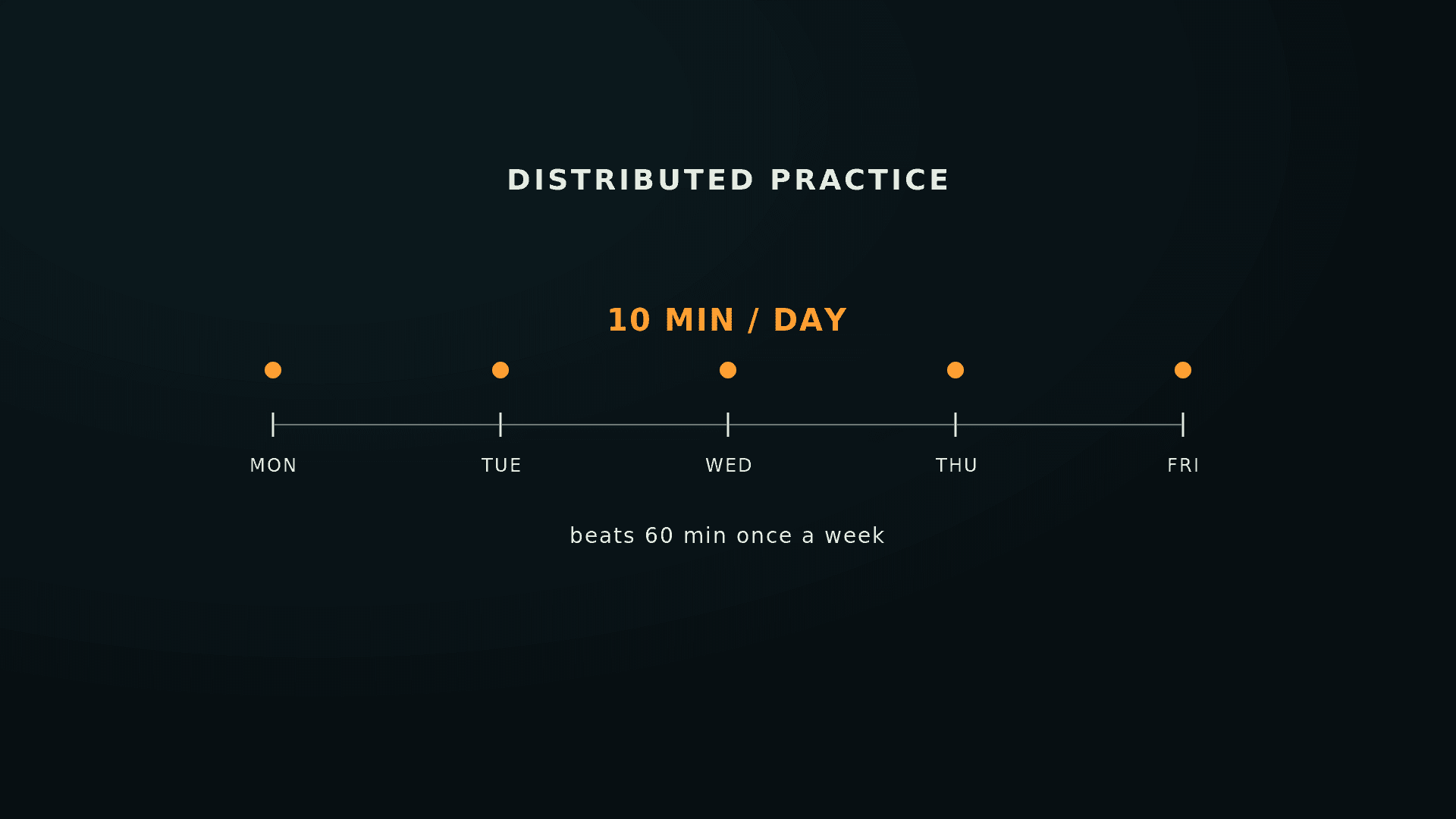
distributed practice. A week of daily 10-minute reps beats 60 minutes once a week
Monday, rep, 10 minutes. Two scenarios before the week starts, usually the team-level theme. Immediate feedback. One focus noted for the week.
Daily, rep, 5 to 15 minutes. Pre-call practice before high-stakes meetings, against a persona matching the buyer. Skip the low-stakes ones; never skip the high-stakes ones.
Daily, rep, 5 minutes. Post-call debrief when a call went sideways. Replay the moment, practise the better response twice, move on.
Wednesday, manager, 20 minutes. Review the dashboard, spot patterns, pick two reps to coach, send each a short async voice note with one specific focus.
Friday, team, 30 minutes. Debrief. What did people hear in the field they didn't know how to handle? Those become next week's scenarios. The library grows.
Monthly, manager, 60 minutes. Data-led 1:1 per rep. Where they improved, where they're stuck, next quarter's focus.
Quarterly, leadership, half a day. Team-level patterns. Which scenarios the team is mastering, where win rate is moving, what to invest in next.
The rhythm matters more than the duration. Ten minutes a day beats sixty minutes once a week, because distributed practice is how skill compounds.
What mistakes do teams make rolling this out?
We have watched enough rollouts to see the patterns. These are the ones that derail it.
Buying the tool before defining the scenarios. Teams sign a contract, then ask what reps should practise, and default to the platform's generic scenarios. The skills don't transfer because the scenarios don't match the territory. Build the library first, then evaluate vendors against whether their builder supports it.
Rolling out to everyone on day one. This reliably produces 20 to 30% adoption in thirty days, which leadership reads as "the tool failed" when the rollout failed. Pilot one team for six weeks with high manager engagement, refine, then expand. The slow path is the fast path.
Letting managers opt out of the coaching layer. The biggest failure mode. Reps practise, managers ignore the data, practice happens in a vacuum, reps lose interest. Make the dashboard a required part of the weekly management rhythm. The leading indicator of success is manager engagement, not rep engagement.
Treating the library as static. New competitors, new objections, new product, new market. If the library doesn't evolve, practice goes stale. Give someone ownership, add scenarios monthly, retire dead ones, review quarterly with field managers.
Measuring the wrong things. Practice-volume dashboards are easy and satisfying and tell you nothing about behaviour change. Measure skill scores by scenario over time, win rate by scenario type, ramp for new hires, and manager engagement. Eight to ten numbers, not eighty.
Confusing the tool with the programme. The tool is necessary and not sufficient. A great tool run badly loses to a mediocre tool run well. Budget for the programme: enablement headcount, manager training, change management, not just the software line item.
Picking a text-first tool. Field conversations are voice conversations. Tone, pacing, recovery, comfort in silence, all voice skills, none practiseable in a chat window. A lot of "AI sales training" is text with a transcribed audio layer. Insist on voice-first from the demo. If practice happens in a chat box, it is the wrong tool for field sales.
How do you roll out field coaching without it dying in a month?
The sequence we recommend. Adjust to your timeline and team size.
Weeks 1 to 2: foundation. Name the executive sponsor (usually VP Sales or CRO) and the programme owner (usually head of enablement or sales ops). Define success metrics and what six-month success looks like. Pick a pilot team of ten to twenty reps under one or two bought-in managers. A skeptical manager sinks the pilot regardless of the tool.
Weeks 2 to 4: build the library. Interview five reps, three managers, and any win/loss research. Identify the twenty conversational moments that decide deals in the segment. Write each as a scenario with a persona, a starting prompt, and methodology dimensions to score against. This is the highest-impact work in the rollout. Do not delegate it to the vendor and do not skip it.
Weeks 4 to 6: train the managers. Before any rep touches the tool, pilot managers learn the new model: how to read the dashboard, run a data-led 1:1, and give feedback that builds on what the rep practised. They run the practice reps themselves so they know what the rep feels. Manager readiness is the precondition for rep adoption.
Weeks 6 to 12: pilot. First two weeks heavy-touch, daily check-ins and scenario refinement. By week four the rhythm should be self-sustaining. By week eight you should see early behaviour change. Track practice volume, scenario coverage, manager engagement, rep feedback, and early skill movement. Formal review at week twelve.
Weeks 12 to 20: expand and refine. Roll to the next segment, refine scenarios and rhythm from pilot learning. The second segment goes faster because you have a working playbook.
Months 6 to 12: build the operating cadence. By month six, practice is a normal part of the week and dashboards are part of the operating rhythm. By month twelve the programme is mature, new hires onboard into a working practice system, and the leadership conversation has shifted from "what event are we running this quarter?" to "what scenarios are we investing in?"
Frequently asked questions
What is sales coaching, in one line?
It is the ongoing work of building a rep's skill through practice and feedback, not a one-time transfer of knowledge. Training tells the rep what to do. Coaching makes them able to do it when a real buyer pushes back.
Why is sales coaching important for field teams specifically?
Because field reps have the most buyer conversations and the least oversight. The skill either compounds through practice or decays through repetition of the same mistakes. With no manager in the room, nothing catches the decay except a coaching system that runs without the manager present.
How much manager time does field coaching actually require?
Less than the manager spends on reactive coaching today. Twenty minutes on the dashboard twice a week plus one or two data-led conversations per rep per month is full engagement. The total is lower than the current model. It is just spent differently: less time listening to recordings, more time on the conversations that change behaviour.
How do you run a sales coaching session that isn't just a call review?
Start from a scenario, not a recording. The rep practises the conversation, the system scores it, and the human session goes to the one pattern the data flagged. You spend the time on "what happens in your head when they push on price," not on re-listening to a call you both already sat through.
How often should field reps get coaching?
Little and often beats big and rare. Fifteen to thirty minutes of practice per week, spread across days, plus a monthly data-led 1:1 with the manager. Ten minutes a day compounds faster than an hour once a quarter.
How do you measure sales coaching effectiveness?
Track four things: practice volume per rep, methodology adherence over time, scenario scores over time, and win rate by scenario type. The first three move first and tell you if it is working. Win rate confirms it a quarter later. Watch all four or you get fooled.
Will field reps actually adopt this?
Adoption is a function of relevance and friction. Reps adopt when the scenarios match what they face and the tool is low-friction enough to use in the car between meetings. Voice-first, mobile tools see 60 to 80% weekly active use when scenarios are well-built. Text-based tools see 20 to 30%. The difference is the tool, not the rep.
How do you coach in regulated industries where you can't record?
Practice infrastructure does not require recording. The rep practises against an AI persona, the AI evaluates, the rep gets feedback. No real client conversation is recorded, which is exactly why it works in pharma, insurance, and financial services, the categories conversation intelligence cannot serve.
What about senior reps who don't want to practise?
Real objection, worth addressing. The framing that works: it is not about teaching them to sell, it is the warm-up before high-stakes calls. Senior pilots still simulate emergencies. Most senior reps who lean in find one or two scenarios where their habits have ossified, the competitor that wasn't a competitor five years ago, and the practice closes the gap. The ones who refuse outright are usually signalling something else about the role or the manager that needs a different conversation.
How do you handle scenarios involving specific competitors?
Build them into the library by name, with the actual claims those competitors make. Reps need to practise responses to the specific objection, not an abstract one. This is one place the library becomes a competitive asset.
Can field coaching work for a five-person team?
Yes, though the math differs. The fixed cost of building the library is the same at five reps or fifty, so per-rep cost is higher for small teams. But small field teams often have the highest performance variance, so getting all five to a high baseline can matter more than it sounds. It becomes a clear call around fifteen field reps.
How does SecondBody compare to other AI sales training platforms?
We are biased, we sell it. The honest version: SecondBody is voice-first from day one, $30 per user per month at the Pro tier with unlimited seats, and built around the pre-1:1 manager briefing so one manager can coach 20 to 30 reps. Text-first tools or tools with voice bolted on are different products for field teams, not direct competitors. Among voice-first tools the differentiators are scenario quality, methodology depth, and the manager experience. A head-to-head with one alternative is at Mindtickle vs SecondBody.
Does SecondBody integrate with our CRM and dialer?
Currently Aircall, Cloudtalk, Momentum.io, Fathom, and TeamTailor. Salesforce and HubSpot are shipping in 2026. For most field teams the integration that matters most is the dialer, for pre-call practice triggers, which is in place.
Is SecondBody enterprise-ready for a regulated industry?
SOC 2 compliant, data residency options, no recording required for practice. We work with several pharma and financial services organisations under NDA, plus referenceable customers like Cyera.
What's the right way to start?
Two paths. If you have a field coaching gap and a pilot team in mind, book a demo and we will walk through a six-week pilot. If you are earlier, the pricing is public and you can model it against your team size. There is no click-around trial, because practice infrastructure isn't something you judge in fifteen minutes, but the demo plus a starter tier gets most teams to a confident decision quickly.
Close the gap
The Field Coaching Gap is not new. What's new is that there is finally infrastructure that closes it. Voice-first practice on the rep's phone. AI feedback against the methodology you actually use. Manager dashboards that surface patterns instead of eating hours. A coaching model that works whether or not the manager is in the same time zone as the rep.
If your field team still runs on the ride-along-and-quarterly-training model, you don't have a coaching infrastructure. You have a calendar of inspections, and the cost shows up in ramp time, win rate, and turnover whether or not anyone connects the dots. The teams that build the practice layer in 2026 will have reps who don't freeze when it matters and managers whose coaching hours finally produce change. That is the whole game, and it is what SecondBody is built to give your field team.
Good luck out there.
See how sales teams use AI-powered practice to build real conversation skills, not just knowledge.
SecondBody is the AI sales practice platform built for field, regulated, and enterprise sales teams. Voice-first. Pre-call practice and post-call retry. Pre-1:1 manager briefings. Unlimited seats at $30 per user per month. Built in Paris. SOC 2 compliant.
Related reading: Why the LMS Keeps Failing Field Sales · AI Sales Roleplay Training Guide · The Psychology of AI Role-Play · Field Sales Use Case · Mobile Practice · What is Sales Roleplay?