Back
Cold Calling Training for Sales Teams: Your Reps Get About 2.5 Real Conversations a Day, So Train for That
Your reps get 2.5 real conversations a day. Here is how to train cold calling around that: 2026 benchmarks, drills by call stage, and a weekly cadence.

Posted by
SecondBody.ai
Published by
Last Updated
How we know this: we build an AI sales practice platform, we sat in the calls with the managers quoted below, and we checked every number in this article at its source.
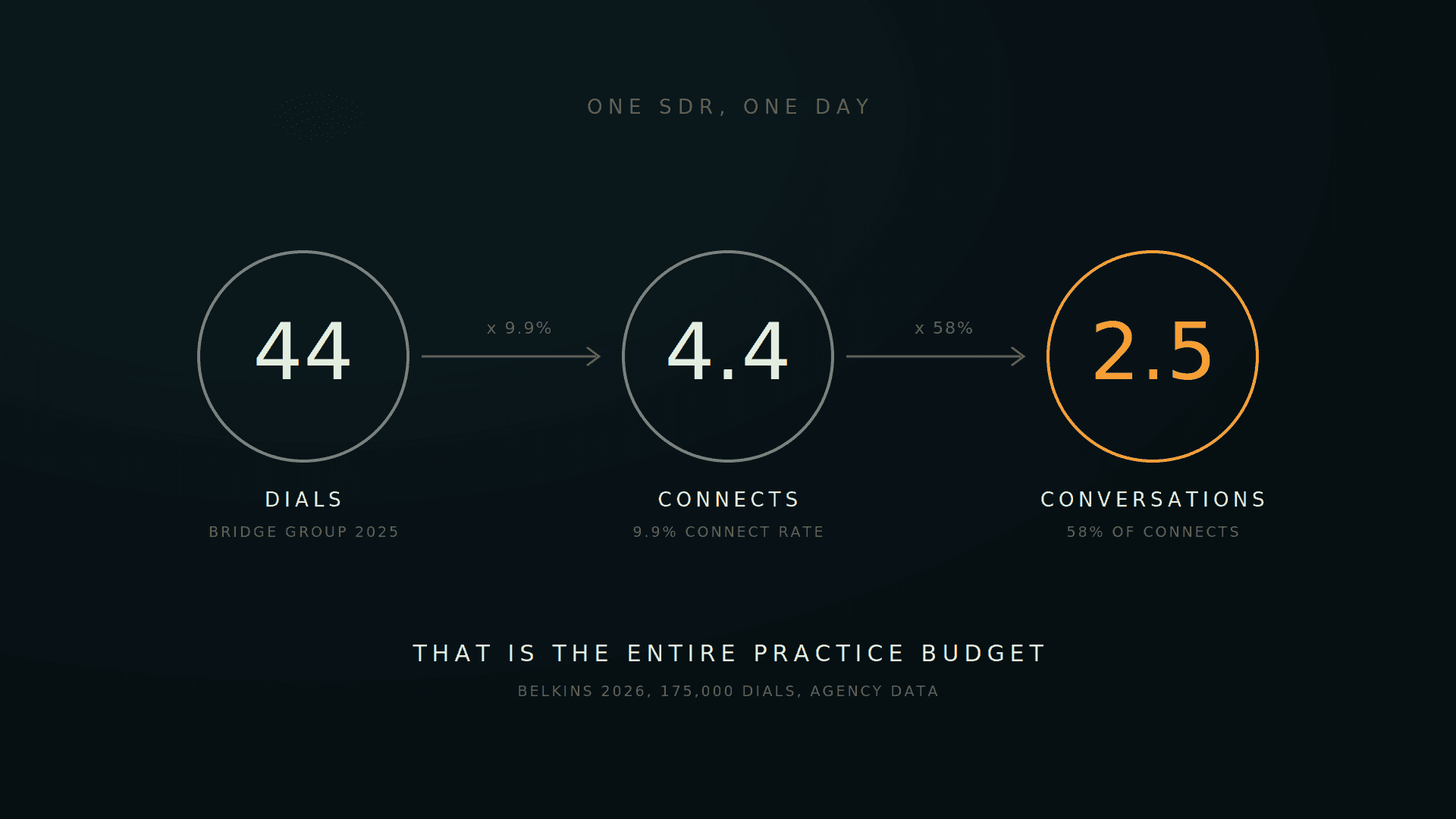
Here is the number that should change how you run cold calling training for sales teams. Take a median SDR at 44 dials a day (Bridge Group, 2025). Apply a 9.9% connect rate, then the 58% of connects that become an actual conversation (Belkins, 2026, one agency's 175,000 dials). You get about 2.5 real conversations a day. The rest is voicemail, wrong numbers, and "not interested" before the rep finishes their name.
So a rep learns to cold call in two and a half live attempts a day, in front of a stranger, with their number on the line. That is the whole practice budget most teams give them. A half-day workshop does not change it. A script PDF does not change it. Twenty reps doing this for a year is not a training system. It is a lottery with a headset.
We build one of these, so read on with that in mind. We will be harder on the category than anyone.
This is written manager to manager, for whoever owns the dial output of five to fifty inconsistent reps and has been asked why. No tips listicle. You get a repeatable coaching system, the 2026 benchmarks with sample sizes and dates attached, and an honest account of how the teams we work with run it, including what went wrong.
(Scanning this? Every section is a question. Jump to whichever one you actually have.)
What is cold calling training, and why does most of it fail?
Cold calling training is a repeatable coaching system that gets a team of reps to a consistent standard on the phone and keeps them there. It fails when it is a one-off workshop followed by "go dial."
That second sentence is the whole category. Week one, the rep gets the team script as a PDF. Week two, a half-day session ending in a role-play against a colleague playing a suspiciously polite buyer. Then a list, a dialer, and training is over. From there the only training is the real call and the only feedback is whether the meeting got booked.
A first-time SDR manager at a German SaaS company said it straight: "My first priority would have been definitely cold calls." He wanted his rep drilled on the opening and on price objections, not generic selling. He had also never listened to one of his rep's live calls, and rated the role-play "okayish." That is not a bad manager. That is the default. He knew what needed training and had no evidence, no time, and no mechanism.
A system, as opposed to an event, has four parts. A standard, by stage of the call. A source of truth (real-call data, not opinion). A practice layer, where a rep can attempt the hard moments more than 2.5 times a day. And a manager rhythm that does not depend on a spare hour. Every section below is one of those parts.
The anatomy of the call itself lives in our entry on what a cold call is. This article assumes you know what a good call sounds like and asks how you get twenty people to do it on a Tuesday afternoon.
Is cold calling still worth training in 2026?
Yes. The phone still books meetings, and the gap between an average rep and a trained one is enormous. That gap is the argument for training.
On belief: Orum's 2026 State of Sales Development survey (300 sales professionals, so opinion, not dial data) has 64% saying calling is an effective driver of pipeline. Salesforce's State of Sales 2026 (4,050 professionals, 22 countries, surveyed August to September 2025) has 47% calling cold outreach one of the worst parts of the job. Hold onto that 47%.
On the gap, three datasets, three vendors, one story.
Gong's 2024 analysis with 30 Minutes to President's Club, from over 300 million calls, found top-quartile reps connect on 13.3% of dials against 5.4%, and set meetings on 16.7% of conversations against 4.6%. Caveat: Gong does not define "success" on that page, so treat the multiples as directional.
Cognism's State of Cold Calling 2026, built with WHAM on 200,000-plus calls, puts industry conversation-to-meeting at 2.7%. Cognism's own SDRs, same report, book 11.3%. A vendor's number about its own team, so salt it. But a team that trains the phone daily converting four times the industry rate is not noise.
And Gong's 2018 study of 90,380 connected cold calls found successful calls last almost twice as long as unsuccessful ones, 5:50 against 3:14. Dated, and Gong has not published a refreshed cold-call dataset we could find. But it points the same way: the difference between a meeting and a hang-up is behaviour on the call, and behaviour is trainable.
Optimistic read: train reps well and you can triple your meeting rate from the same dials. Skeptical read, ours: top-quartile reps are also on better lists, calling warmer accounts, with more tenure. Training is one variable. It is the one a manager controls on a Monday morning, and the only one nobody funds.
The gap most teams hit is that they believe cold calling works but train it like it does not. That is the problem SecondBody was built to solve, by giving reps a place to attempt the opener and the objection hundreds of times before a buyer hears it.
What do the 2026 cold calling benchmarks actually say?
They say a rep gets very few real conversations, most go nowhere, and the team you hire this year will be half gone in two. Sample size and year on every row, because most cold calling statistics online have neither.
Metric | Number | Source, year, sample | Read it as |
|---|---|---|---|
Connect rate (per dial) | 9.9% | Belkins, 2026, 175K dials | Agency data, one outbound shop |
Connects that become conversations | 58% (Belkins); 65.6% (Cognism 2025) | Belkins 2026; Cognism 2025 PDF | Agency; vendor |
Conversation-to-meeting | 2.7% industry, 11.3% Cognism's SDRs | Cognism/WHAM, State of Cold Calling 2026, 200K+ calls | Per conversation, not per dial |
Conversation-to-meeting (agency) | 4.6% | Belkins, 2026 | About 370 dials per meeting |
Average call length | 82 seconds industry; 2:38 Cognism's SDRs | Cognism 2026 | Vendor |
Attempts to reach a prospect | 1.55 (2026), 2.9 (2025) | Cognism 2026 and 2025 editions | Vendor; different samples |
Dials per day, SDR median | 44 (56 for phone-centric teams) | Bridge Group 2025, 351 companies | Company survey, self-reported |
Quality conversations per day | 4.1 | Bridge Group 2025 | Self-reported by companies |
Ramp time | 3.0 months | Bridge Group 2025 | Survey |
SDR tenure | 1.9 years | Bridge Group 2025 | Survey |
Annual SDR attrition, median | 40% | Bridge Group 2025 | Survey |
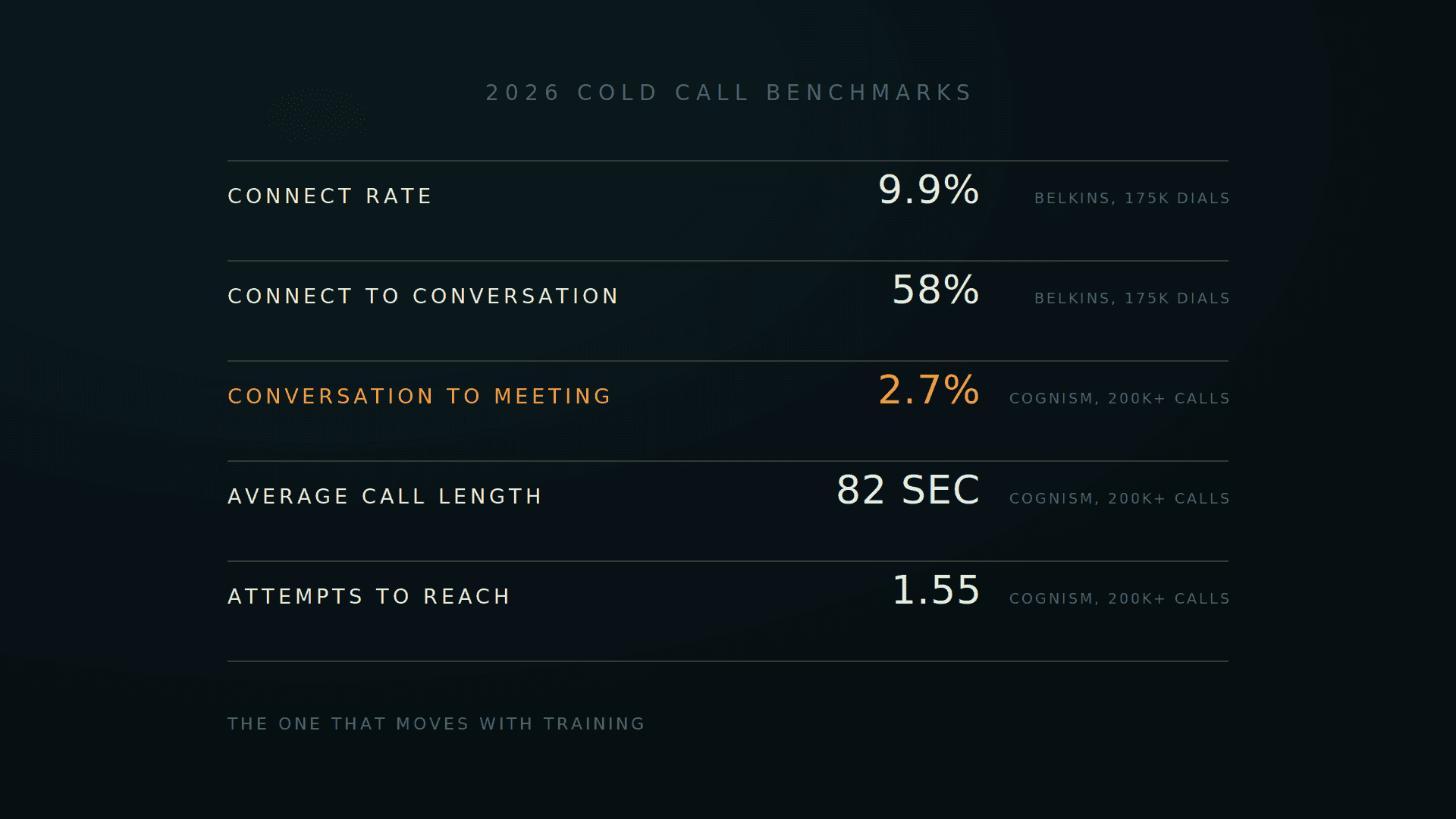
Reading notes. Cognism's rates are per conversation, not per dial, and its own team has unusually good phone data, so compare yourself against its industry number. Its three editions run 4.82% (2024) to 2.3% (2025) to 2.7% (2026) on different samples: a hint the phone got harder, not a proof. Belkins is one agency's dials. Bridge Group is what 351 companies say about themselves, which companies round up. And one number is missing: our own customers'. Not one we asked had their dials, connect rate or meetings figures to hand. That is the state of the category.
The "Reps per Rep" maths
Now the arithmetic. We call the result Reps per Rep: the number of practice attempts a rep gets for every real dial. On most teams it is close to zero. Here is why that matters.
Take the median rep at 44 dials a day.
44 dials at a 9.9% connect rate is about 4.4 connects. (44 × 0.099 = 4.36.)
58% of connects become a real conversation. That is about 2.5 conversations. (4.36 × 0.58 = 2.53.)
At Belkins's 4.6% conversation-to-meeting rate, that is 0.12 meetings a day. (2.53 × 0.046 = 0.116.) Roughly one meeting every eight or nine working days, which matches Belkins's own "about 370 dials per meeting" (370 ÷ 44 = 8.4 days).
Bridge Group's self-reported 4.1 quality conversations a day is the optimistic version. Take either. Your rep gets between 2.5 and 4 real attempts a day at the thing you hired them for.
Now multiply. That is 12 to 20 conversations a week, 150 to 250 across a 12-week ramp, in which to learn the opener, the pivot, the objection and the ask, each a different stranger, most over in 82 seconds. A twenty-rep team with one bad week (bad list, outage, manager on holiday) loses 250 to 400 conversations. Not a dip in activity. A chunk of the only training the team gets, gone.
And every attempt costs something. A real cold call is a practice rep where the mistake goes on the prospect's record and the rep's number. Reps per Rep in one line: the practice is the performance, so nobody practises.
What should you train, by stage of the call?
Train the call in the order the prospect experiences it, and drill each stage separately. A rep who is fine on the opener and freezes at the objection does not need "more role-play." They need thirty attempts at the objection.
This is where most cold calling training goes generic. The workshop covers "the call." The scorecard has one column. But a receptionist asking "How can I help you?" is a different problem from a VP saying "we already have a vendor." A manager at a UK healthcare distributor asked us not to score gatekeeper, negotiation and discovery calls on one rubric, because the receptionist's question is not an objection; the goal there is "just to get the process moving." He is right.
The opener
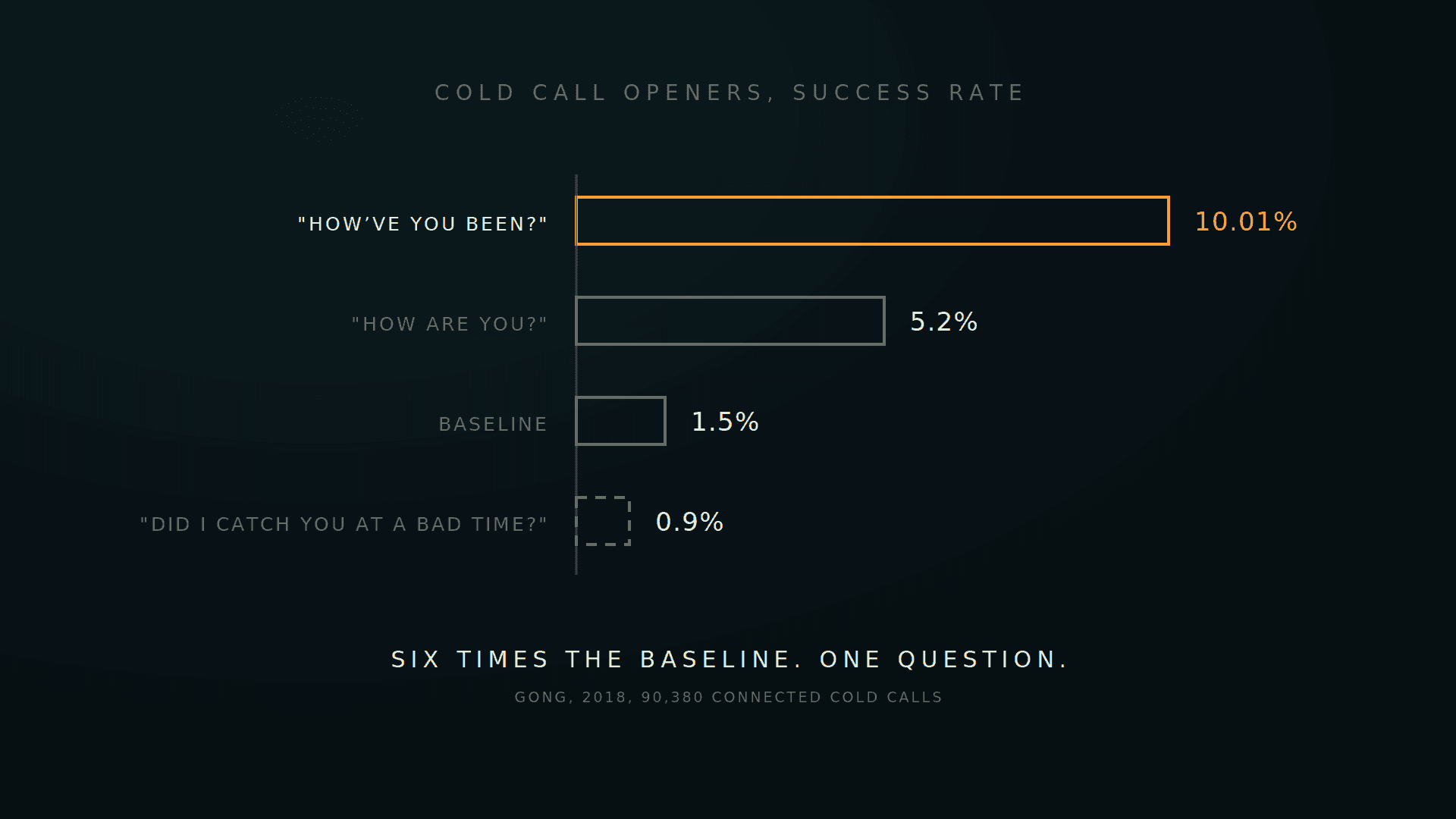
The first ten seconds decide whether there is a call at all. The best opener data we have is Gong's 2018 analysis of 90,380 connected cold calls. Old, so read it as a strong hint about human behaviour, not a 2026 fact.
"How've you been?" had a 10.01% success rate against a 1.5% baseline, 6.6 times better. "How are you?" ran at 5.2%. Stating the reason for the call up front doubled success (2.1 times). And the one every nervous rep reaches for, "Did I catch you at a bad time?", ran at 0.9%, about 40% below baseline.
What to drill: the first two sentences, a hundred times in the first two weeks, until the rep can deliver them at normal pace while the prospect is clearly annoyed. The actual words, by trigger and persona, are in our sister piece on cold call scripts that work in 2026. This section is about the reps, not the words.
The first 30 seconds after the opener
The counter-intuitive one. In Gong's 2018 data, successful cold calls had a longer rep monologue, not a shorter one: 37 seconds at the longest, against 25 in unsuccessful calls. The prospect's longest monologue was shorter, 3.5 seconds against 8. Talk ratio ran 55:45 in the rep's favour, against 42:58. And question count had no relationship with success.
Read that before you tell your SDRs to "ask more questions." The prospect did not agree to be interviewed. A confident 30-second reason for the call beats five open questions fired at someone mid-task. What kills it is the monologue that never ends. Cognism's State of Outbound 2026 (451,895 calls, Cognism's own team) found engagement drops once a monologue passes 90 seconds.
What to drill: a 30 to 40 second pitch, timed, ending in one question the prospect can answer in a sentence. Then the rep stops talking. The stopping is the hard part. Silence feels like losing.
The ask
The close on a cold call is a specific next step with a time and a reason. Most reps under-ask: a warm-ish signal, a panic, an offer to "send some information over." That is the rep ending the call for the prospect. Drill the ask three ways: direct when the prospect is engaged, soft when neutral, smaller after a no.
The objection
The objection is where "knowing the rebuttal" and "saying it at pace while your stomach drops" come apart. We wrote a whole spoke on running objection handling training drills, with formats, scoring and sequencing. The one thing to carry: drill objections as their own stage, in sets, the same objection coming back in different moods. One rebuttal read once is not training.
Voicemail
Gong's 2024 voicemail study earns a drill of its own. Leaving a voicemail cut the future connect rate by 28% but lifted email reply rates from 2.73% to 5.87%. So a voicemail is an email warm-up, not a call. Drill a fifteen-second message that references the email and nothing else, in one take. Reps leave twenty a day.
How do you train the fear part?
You train fear the way you train anything else: repetition under conditions that feel like the real thing, until the real thing stops being novel. And you start by admitting fear is what you are training. Most cold calling training pretends it is technique.
That Salesforce 47% is nearly half your reps, and they will not put their hand up. A medical device sales leader we work with said his reps "probably wouldn't come and tell me about a flat on their face call." Of course not. That call is the one that would help most to review, and the one that disappears.
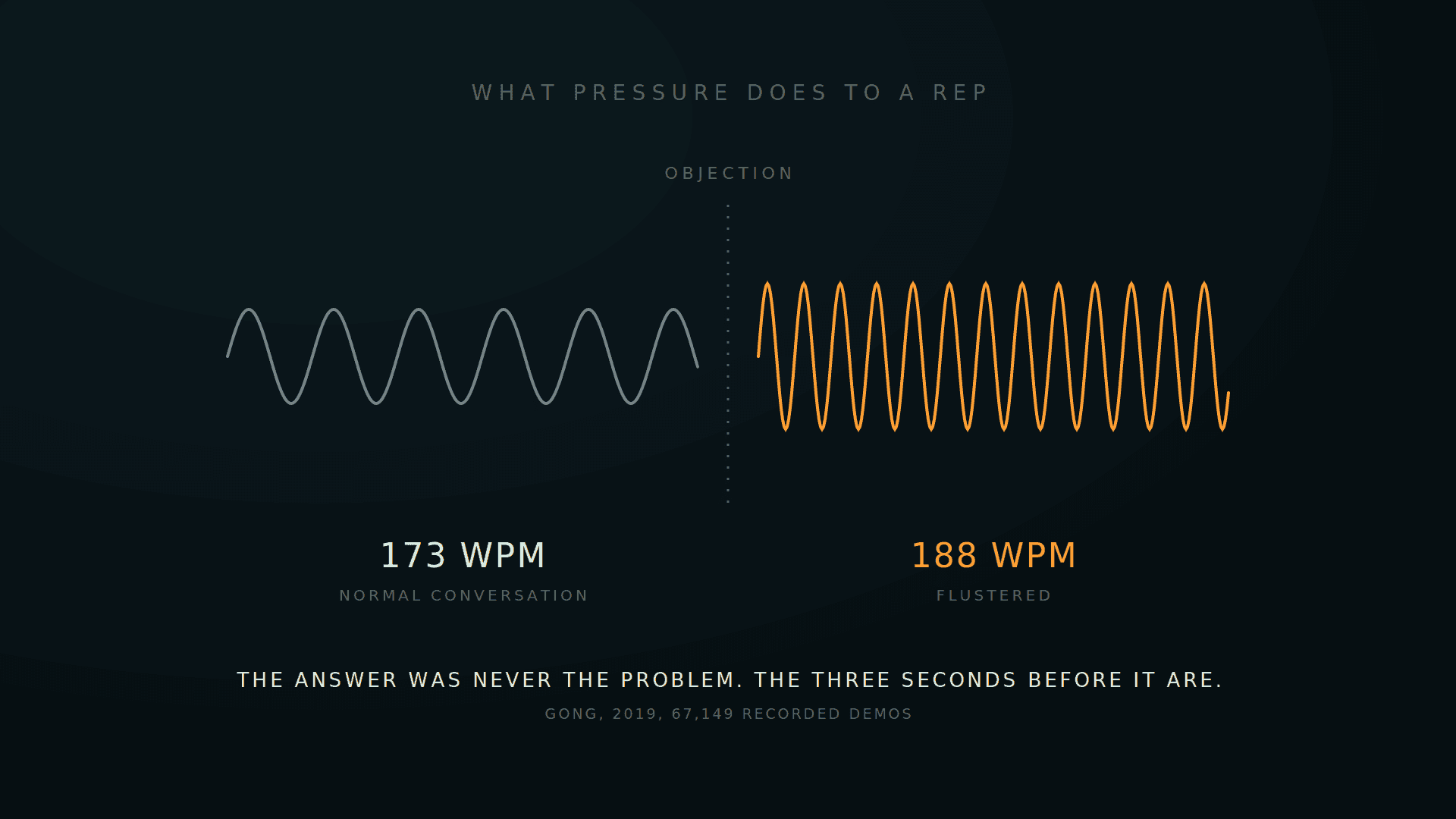
The psychology is not mysterious. Beilock and Carr, in lab studies published in 2001 and 2005, showed that pressure eats working memory and that skilled performers suffer most when they start consciously monitoring what should be automatic. That is research on maths problems and golf putts, not sales, so we borrow the mechanism, not the numbers. But anyone who has heard a good rep freeze on a live objection recognises it. The rep knew the answer. The pressure took the part of the brain that was going to say it.
The same research found the fix: practise under pressure-like conditions and choking goes down. Not "practise more." Practise with something at stake. That is why conference-room role-play with a friendly colleague does so little, and why real calls do work as training, slowly, at 2.5 a day, at full price.
You will see a claim that 40% of salespeople suffer from call reluctance. We could not find a source, so we do not use it. The 47% is sourced and bad enough.
As a manager: play one of your own flat-on-face calls at the team meeting. Put the scary bits on a schedule, ten attempts a week at the price objection where the mistake costs nothing. Measure attempts, not just outcomes. The gap most teams hit is that fear only gets addressed after it has cost a quarter. That is the problem SecondBody was built to solve, by letting a rep take the hit from a difficult AI buyer before a real one does.
How do you manufacture practice?
You build a layer between the script and the real dial, where a rep can attempt the hard moments dozens of times a week with feedback. Five ways to do it; a good programme uses all five.
Salesforce first. In that 2026 report, 41% of reps said they do not get enough opportunities to role-play before customer calls, 46% rarely get feedback on their conversations, and by the report's count only about 26% of teams offer role-play sessions at all. Three quarters of teams have no practice layer at all.
Real-call review. The rep listens to their own recorded call against the team standard. The most honest practice, because the prospect was real. Also slow and post-hoc. Weekly, per rep, and not enough alone.
Live listening. The manager sits beside the rep during a call block. High value, badly scalable: fifty reps means each is heard monthly at best. Diagnosis, not volume.
Peer role-play. Cheap, immediate, and usually far too kind. It works when the "buyer" has a specific objection and orders to be difficult, and stops working the moment it becomes a chat.
AI role-play. The rep calls an AI buyer who plays a persona and pushes back, and is scored against the team's rubric. This is what we build, so here is the honest version. It is the only format with unlimited attempts at the same moment, at any hour, with no colleague's time spent. And it is only as good as the scenarios and scorecard you give it. See the friction below.
Scoring against the team script. Whatever the format, practice without a standard is just talking. Score by stage, and make the bar reachable.
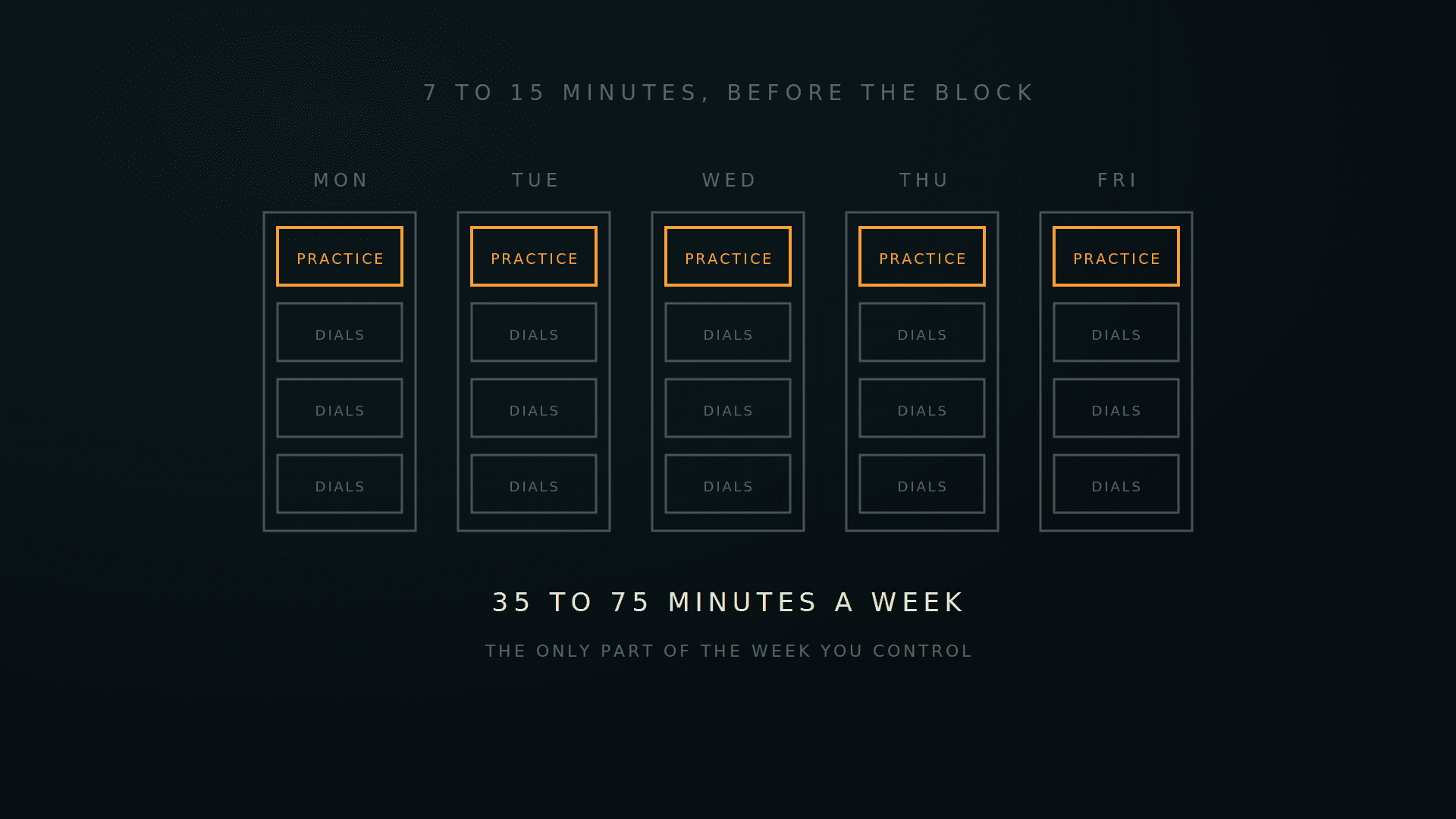
What teams we work with actually do. The German SaaS team runs a "Duolingo for sales" model: a daily sprint of quick objection responses, one longer intro or discovery simulation, and coaching on the result. Target: "7 to 15 minutes at the beginning of the day," with five objection quests a week. One SDR there went from practice scores of 5 to 6 out of ten to a 7 to 8 average. Small, real, a leading indicator.
The UK healthcare distributor budgeted 20 minutes a week for 13 weeks, about 260 minutes across a six-month probation. One new starter did 40 a week against the 20 planned. And a UK enterprise that quadrupled its business development team in a quarter came to us because account manager productivity had "bombed" and leadership feared they were "missing opportunities left, right, and center" on objection quality. You cannot ramp that many people on live calls alone.
Now where it went wrong. At the distributor, reps got frustrated with the scoring. One said, "I've done two hours, and I'm getting threes, fours, fives," after copying the top transcripts and still not moving. The programme was paused. The manager felt top levels should be reachable "within the first sort of six months," and he was right. A scorecard calibrated for a veteran, applied to a week-two rep, demoralises. We rebuilt the difficulty gradient. The lesson for any manager, with any tool or none: if the bar is not reachable in weeks, the practice stops quietly.
While we are being straight: SecondBody does not dial for you, does not fix your list, and does not replace live call listening. It is the practice layer between the script and the real dial. Fix list quality alongside rep skill, or reps get very good at calling the wrong people.
General principles of good practice are in our entries on pitch practice and sales simulation; the product version is the AI conversation practice platform.
What does a weekly cold calling training cadence look like?
Weekly, not quarterly, because spaced practice beats massed practice and SDRs turn over too fast for a quarterly rhythm to catch them. A cadence a manager with 20 reps can run:
When | What | Who | Time |
|---|---|---|---|
Daily, before the block | Warm-up drill: the opener and one objection, against a scripted peer or an AI buyer | Every rep | 7 to 15 minutes |
Daily, during the block | Live listening on two or three reps, rotating so everyone is heard fortnightly | Manager | 30 minutes |
Weekly, per rep | One recorded real call scored by stage; rep picks one, manager adds one | Rep plus manager or peer | 20 minutes |
Friday | Objection drill: the week's most-heard objection, every rep, three rounds, scored | Team | 30 minutes |
Friday | Manager scorecard: conversations, practice reps, one behaviour to fix per rep | Manager | 30 minutes |
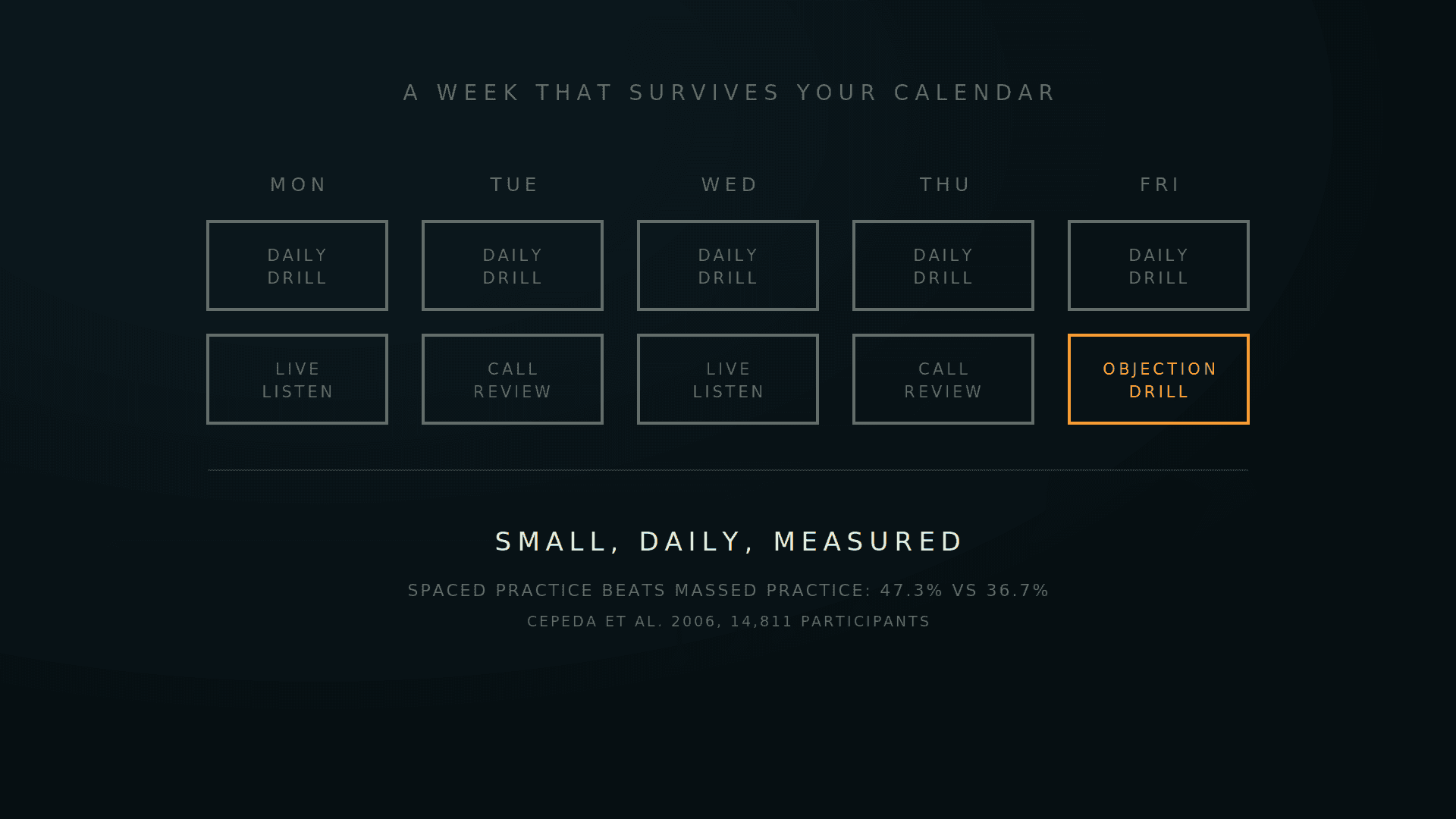
Why weekly? Cepeda and colleagues' 2006 meta-analysis of spacing, 14,811 participants, found spaced practice retained 47.3% against 36.7% for massed. Memory research, not sales research, but the mechanism is general and the gap is large. A day-long bootcamp is massed practice by definition. It fades by the following Tuesday, and at 1.9-year tenure a quarterly rhythm gets seven shots at a rep.
On coaching cadence, MySalesCoach's 2026 report (vendor data, 1,050 respondents, gated) has weekly-coached reps at 76% quota attainment against 56% monthly and 47% quarterly or less. The 2025 MySalesCoach and Aircall study of 1,600 professionals found 38% of reps rarely or never receive coaching while 90% of leaders claim they coach monthly. Someone there is wrong, and it is usually not the rep. Reps who rated their coaching excellent were 50% more likely to hit quota. Correlation, vendor survey, consistent with everything else here.
The gap most teams hit is that the weekly rhythm survives exactly as long as the manager's calendar does. That is the problem SecondBody was built to solve, by running the daily drill without the manager in the room and handing them a briefing before the 1:1.
How do you coach from real calls?
Score behaviours that correlate with meetings, not whether the meeting got booked. A rubric built from call data gives you something to say that is not "be more confident."
The behaviours the data supports, mostly Gong 2018 (correlational, one vendor's customers, dated) with Cognism 2026 as a check:
Talk ratio near 55:45, rep-heavy. Unsuccessful calls ran 42:58.
Longest rep monologue around 37 seconds, never past 90. Gong's successful calls topped out near 37. Cognism found engagement drops past 90. Coach into that window.
Short prospect answers are fine. 3.5 seconds in successful calls versus 8. A prospect talking at length on a cold call is often explaining why not.
Call length as a leading indicator. 5:50 versus 3:14. Conversations averaging under two minutes: look at the first 30 seconds first.
The reason for the call, stated early. 2.1 times success. Easy to hear, easy to score.
What not to put on the rubric: question count. Gong found no relationship between questions asked and cold-call success. That sounds like it contradicts a call audit we ran for one customer, where reps were "too verbose, feature-dumping instead of asking questions," and our advice was "ask questions first, listen, then pitch." It does not. The problem there was the ninety-second feature monologue; the fix was one good question early, not five. Count monologue length, not questions.
Run the review like this. Rep picks one call. Manager picks one, ideally a flat-on-their-face one, because the rep will not. Score both against the stage rubric, on the same sheet as their practice scores. Agree one behaviour, and that becomes next week's daily drill. Review tells you what to practise. Practice is where it changes. Review alone is the rear-view mirror: accurate, and too late for that call.
Related: what "good enough" calls cost in hidden revenue leaks, and why one rep sounds like two people on two calls in call consistency.
How long does it take a new SDR to ramp on the phone?
About three months, and you get under two years of them afterwards. Bridge Group's 2025 report (351 companies, self-reported) puts median SDR ramp at 3.0 months, tenure at 1.9 years, quota attainment at 60% (the lowest in that series), and median annual attrition at 40%.
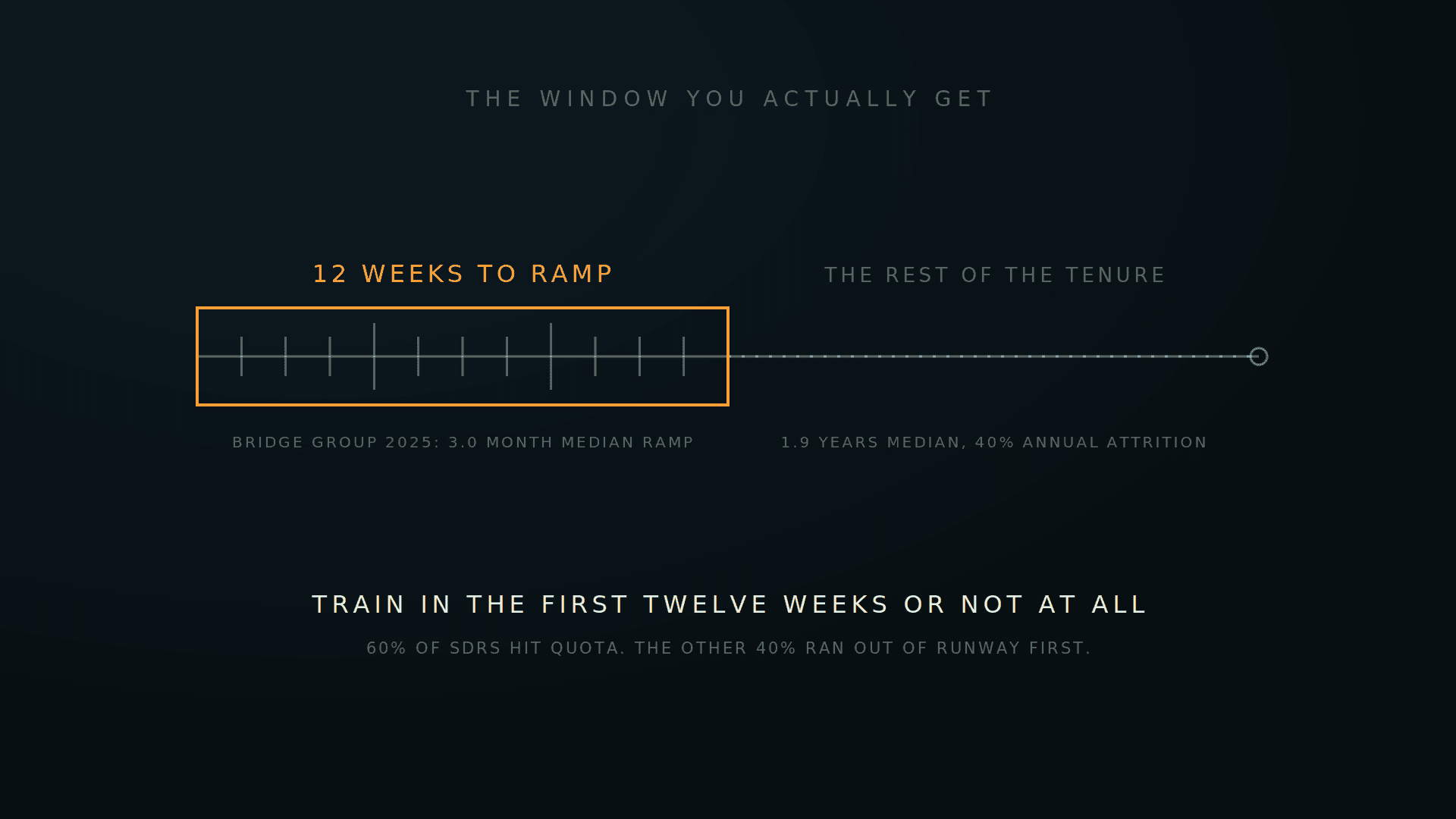
Do the sums. Forty percent attrition on twenty reps is eight new hires a year, each taking three months. By the time the last cohort ramps, the first is updating LinkedIn. Cold calling training is a permanent production line, and the twelve-week ramp is where the rep's shape is set.
So build the twelve weeks deliberately. Weeks one and two: the opener and the reason for the call, drilled to reflex before the rep hears a real prospect, plus listening to good reps. Weeks three to six: objection sets and the first live blocks, with the daily warm-up and weekly review. Weeks seven to twelve: full volume with the Friday drill and the scorecard, aiming for conversation-to-meeting above the team floor, not a rep who "seems fine."
The distributor's 260 minutes of practice over 13 weeks sits against 150 to 250 real conversations in the same window. It is the only point in a rep's tenure where practice reps and real reps come near parity. Use it. More in our entry on ramp time; the generic programme is in how to train a sales rep, of which this is the cold-call child.
What are the best times and days to cold call?
Mid-morning, a second window after lunch, Tuesday through Thursday. Hold it loosely. It is the most over-quoted and least important question in cold calling.
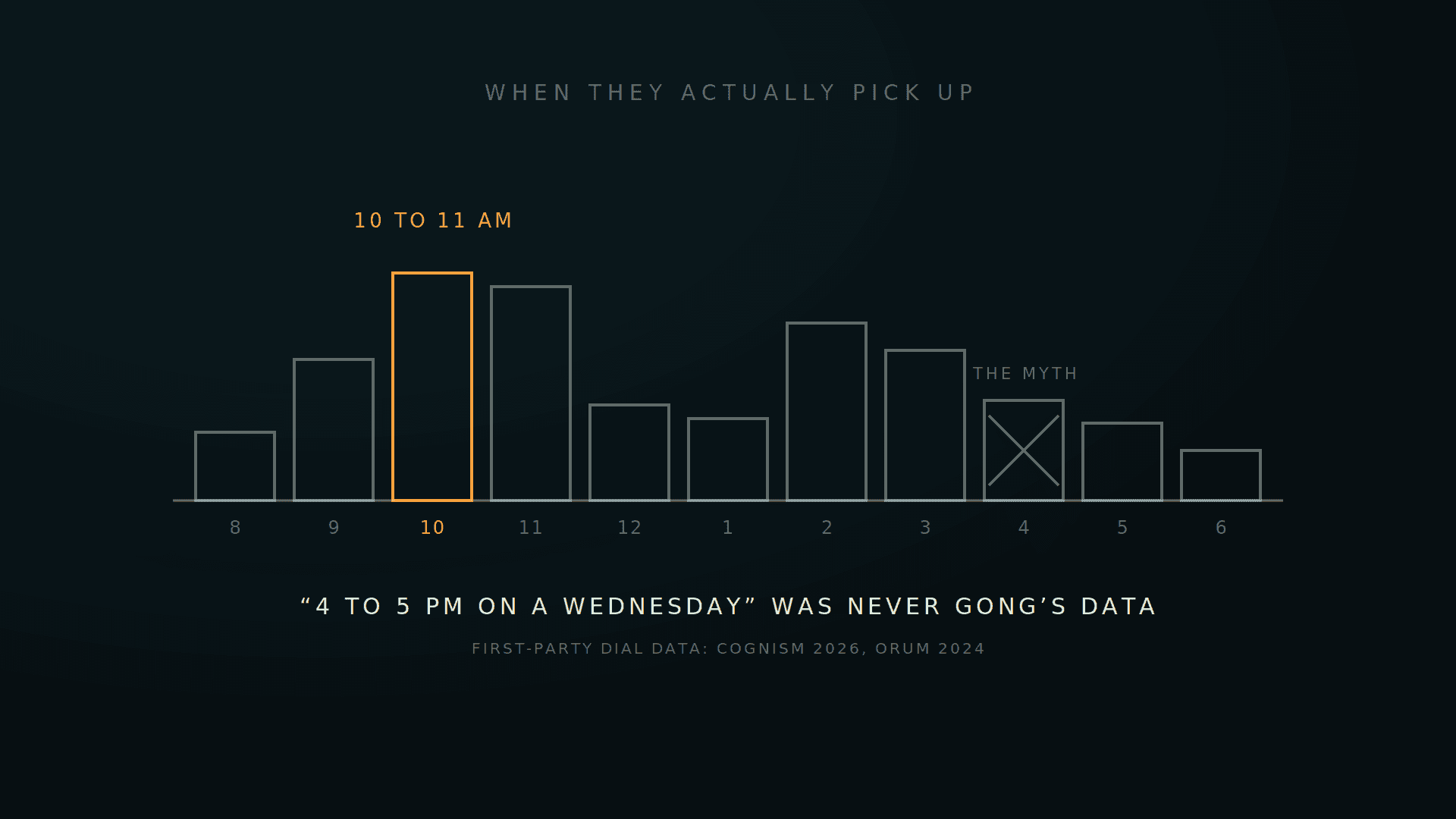
First-party dial data only. Cognism's 2025 report, actual dial logs, found the best windows were 10 to 11am and then 2 to 3pm, on Tuesday and Thursday. Orum's 2024 platform data had connects peaking at 10am local time, Tuesdays and Wednesdays producing the most conversations and meetings. Belkins's 2026 agency data had Wednesday strongest. Same neighbourhood.
Now the correction. "The best time to cold call is 4 to 5pm on Wednesday, according to Gong" is everywhere. It is not Gong's data. Gong's 2018 post borrowed the day from InsideSales.com and the hour from unnamed studies, and every newer first-party dataset contradicts it.
Then stop thinking about it. A good hour versus a bad hour is a point or two of connect rate. A rep who opens well versus one who does not is a multiple. Timing is a dialer question; training is a rep question.
How do you measure cold calling training?
Leading indicators weekly, lagging indicators monthly, and never let the second replace the first. If the only number on your dashboard is meetings booked, you are measuring the lottery, not the training.
Leading, per rep, per week:
Conversations per day. Not dials. Dials measure the dialer and the list. Conversations measure whether the rep can get past hello.
Conversation-to-meeting rate. The core skill number. Benchmark against 2.7% (Cognism industry) and 4.6% (Belkins agency), and track the trend per rep. A rep moving from 2% to 4% has doubled output on the same dials.
Longest monologue on reviewed calls, against the 37-second and 90-second markers.
Average conversation length. Under two minutes is a flag.
Practice reps per week. The Reps per Rep number itself: attempts at the opener and the objection outside live calls, and the scores. If this is zero, you have a dialer, not a training system.
Lagging, per team, per month: meetings held (not booked), pipeline from outbound, and the twelve-week outcome per cohort. These say whether the programme works, not which rep needs what, and by the time they move the quarter is over.
One thing to watch. Practice scores are a leading indicator of a leading indicator. The SDR who climbed from 5 to 6 up to 7 to 8 is a good sign; the test is whether their live conversation-to-meeting rate follows within weeks. If not, your scenarios are too easy or your scorecard is wrong. Fix the scorecard, not the rep.
For connecting training numbers to revenue in a way a CFO accepts, see the five key metrics to measure sales training ROI.
How is cold calling training different from a cold calling script, and from objection handling training?
A script is the words. Cold calling training is the system that gets the words out of a rep's mouth at pace, in order, while a stranger is being difficult. Objection handling training is one stage of that system, drilled separately because it breaks most.
The tell is a manager who thinks "we have a script" means "we have trained cold calling." A script is necessary; twenty reps improvising twenty openers cannot be coached. But a script that has been read is knowledge, and cold calling fails at execution. Every rep who has frozen on a live call knew the script.
For the words, openers by trigger, gatekeeper lines, voicemail scripts, and a protocol for rehearsing a script until it stops sounding like one, read cold call scripts that work in 2026. For the stage that needs its own programme, read objection handling training drills. This article is the frame that holds both.
What are the common mistakes in cold calling training?
Seven, all watched from the inside.
Training once. The onboarding bootcamp, then silence. The spacing research says it fades within weeks; the tenure data says you will do it again for the replacement inside two years. A bootcamp is a fine start to a cadence and a terrible substitute.
Coaching dials, not conversations. Dials are the easiest number to see and the least about the rep. Push dials and you get more dials, a burnt list, and the same 2.5 conversations.
One script for every persona and one scorecard for every call. The gatekeeper is not the VP. Score by stage and by persona.
No call review. The German SDR manager had never heard his rep's live calls. Most managers we meet are in the same spot, from calendar, not laziness. Without review, every rubric is opinion.
Letting the fear go unaddressed. Nearly half your reps hate this part of the job and none will tell you. Without a safe place to fail, the failures happen on real prospects, hidden from you.
Measuring only meetings. Meetings lag skill by weeks and are swamped by list quality. Measure conversations, conversion per conversation, monologue length and practice reps.
No manager rhythm. MySalesCoach's 2026 data (vendor, gated) has 66% of managers never trained to coach; the 2025 Aircall study has 38% of reps rarely or never coached. The cadence has to survive the manager's week.
An eighth, from us, because we made it. Setting the bar where a veteran stands and putting a new rep under it. The paused programme above was scoring calibrated for people who did not yet exist on that team.
Frequently asked questions
How do you train a sales team to cold call?
Build a repeatable coaching system, not a one-off workshop. Set a standard by stage of the call, drill each stage daily in short sessions, review one recorded call per rep per week, run a Friday objection drill, and measure conversations and conversion per conversation rather than dials. The cadence table above works for a team of 20.
Is cold calling still effective in 2026?
Yes, unevenly. Industry conversation-to-meeting sits around 2.7% (Cognism/WHAM, 2026, 200K+ calls), but trained teams convert several times that. Orum's 2026 survey of 300 professionals has 64% calling the phone an effective pipeline driver. Untrained phones work badly.
What is a good cold call connect rate?
Around 10% per dial (Belkins, 2026, 175K dials, 9.9%); Cognism's own SDR team reports 13.3% on 451,895 calls. Under 5% is usually a list problem. Connect rate is the one metric here that training barely moves.
How many cold calls should an SDR make a day?
Median is 44 dials a day, 56 on phone-centric teams (Bridge Group, 2025, 351 companies). That yields about 4 quality conversations by the companies' own count, or about 2.5 at agency connect rates. Count conversations, not dials.
How long does cold calling training take?
Ramp is about 3.0 months (Bridge Group, 2025), and that window is where phone habits set. But training never finishes: tenure is 1.9 years and attrition 40% a year. Plan a twelve-week ramp inside a permanent weekly cadence.
What is the best time to cold call?
Roughly 10 to 11am, with a second window at 2 to 3pm, Tuesday to Thursday, per first-party dial data (Cognism 2025, Orum 2024, Belkins 2026). The often-quoted "4 to 5pm Wednesday, per Gong" is not Gong's data.
How do you get over fear of cold calling?
Repetition under realistic pressure, until the moment stops being novel. Lab research (Beilock and Carr, 2001 and 2005) shows pressure consumes working memory and practising under pressure-like conditions reduces choking. Drill the scary moments daily where the mistake costs nothing, and make the failed call something the team talks about.
What is a cold calling bootcamp?
A concentrated block of cold calling training, one to five days, covering the talk track, openers, objections and live dial blocks. Useful as the start of a programme, useless as the whole of it, because massed practice fades (Cepeda 2006, 47.3% retention spaced versus 36.7% massed). Follow it with a weekly cadence.
Does AI roleplay work for cold calling?
For what it is designed for, yes: volume of attempts at specific moments with immediate scoring, at any hour, without a colleague's time. It does not replace real-call review or live listening, and it fails when scenarios are too easy or the scorecard is set for a veteran. With about 26% of teams offering any role-play (Salesforce, 2026), the real question is role-play versus none.
How does SecondBody train cold calling?
A rep calls Rory, the AI coach, by voice on WhatsApp, the phone or the browser, and works through cold call scenarios built on the team's own script and personas: opener, gatekeeper, first 30 seconds, objections, the ask. Rory scores each attempt against the team rubric, methodology-native for SPIN, MEDDIC or Sandler. Pre-call practice, not post-call analysis. See the cold calling use case page.
Can a manager see which reps practised?
Yes. Managers see practice reps per rep, scores by stage and the trend, and get a pre-1:1 briefing on each rep so the weekly review starts from evidence. Reps per Rep becomes visible, and a rep doing the work gets credit before the meetings arrive. The rep's side is on the sales reps page.
What does SecondBody cost for an SDR team?
The Pro tier is $30 per user per month, public pricing, unlimited seats, SOC 2 in place. There is a tier you can start with today, or book a demo and we will build a scenario from your script. Details on the pricing page.
Where does this leave a manager with 20 inconsistent reps?
Back at Reps per Rep. Your rep gets about 2.5 real conversations a day, four if you trust the survey over the dial logs. That is the entire practice budget, and every attempt is scored by a stranger, in public, with commission attached. Under those conditions "inconsistent on the phone" is not a talent problem. It is the only possible outcome.
The fix is not a better bootcamp. It is four parts: a standard by stage of the call, real-call data to coach against, a weekly rhythm that survives the manager's calendar, and a practice layer that pushes Reps per Rep from zero to something. Five objection quests a week. Twenty minutes a week for thirteen weeks. Nothing heroic. Small, daily, measured, and the reps who want it most do double.
That practice layer, the space between the script and the real dial where a rep can fail at full pressure and nobody's record takes the hit, is what SecondBody is. Rory plays the buyer, the gatekeeper, the VP who already has a vendor. He scores the attempt against your script, at 8am before the block, for $30 a rep a month. Cyera runs it, plus others under NDA. The rest of the system is yours to build, and most of it costs a Friday afternoon. Start with the cadence table. Pick one stage of the call for two weeks. Count the practice reps. Then see what your 2.5 conversations a day turn into.
Good luck out there.
How we know this: we build an AI sales practice platform, we sat in the calls with the managers quoted below, and we checked every number in this article at its source.
Here is the number that should change how you run cold calling training for sales teams. Take a median SDR at 44 dials a day (Bridge Group, 2025). Apply a 9.9% connect rate, then the 58% of connects that become an actual conversation (Belkins, 2026, one agency's 175,000 dials). You get about 2.5 real conversations a day. The rest is voicemail, wrong numbers, and "not interested" before the rep finishes their name.
So a rep learns to cold call in two and a half live attempts a day, in front of a stranger, with their number on the line. That is the whole practice budget most teams give them. A half-day workshop does not change it. A script PDF does not change it. Twenty reps doing this for a year is not a training system. It is a lottery with a headset.
We build one of these, so read on with that in mind. We will be harder on the category than anyone.
This is written manager to manager, for whoever owns the dial output of five to fifty inconsistent reps and has been asked why. No tips listicle. You get a repeatable coaching system, the 2026 benchmarks with sample sizes and dates attached, and an honest account of how the teams we work with run it, including what went wrong.
(Scanning this? Every section is a question. Jump to whichever one you actually have.)
What is cold calling training, and why does most of it fail?
Cold calling training is a repeatable coaching system that gets a team of reps to a consistent standard on the phone and keeps them there. It fails when it is a one-off workshop followed by "go dial."
That second sentence is the whole category. Week one, the rep gets the team script as a PDF. Week two, a half-day session ending in a role-play against a colleague playing a suspiciously polite buyer. Then a list, a dialer, and training is over. From there the only training is the real call and the only feedback is whether the meeting got booked.
A first-time SDR manager at a German SaaS company said it straight: "My first priority would have been definitely cold calls." He wanted his rep drilled on the opening and on price objections, not generic selling. He had also never listened to one of his rep's live calls, and rated the role-play "okayish." That is not a bad manager. That is the default. He knew what needed training and had no evidence, no time, and no mechanism.
A system, as opposed to an event, has four parts. A standard, by stage of the call. A source of truth (real-call data, not opinion). A practice layer, where a rep can attempt the hard moments more than 2.5 times a day. And a manager rhythm that does not depend on a spare hour. Every section below is one of those parts.
The anatomy of the call itself lives in our entry on what a cold call is. This article assumes you know what a good call sounds like and asks how you get twenty people to do it on a Tuesday afternoon.
Is cold calling still worth training in 2026?
Yes. The phone still books meetings, and the gap between an average rep and a trained one is enormous. That gap is the argument for training.
On belief: Orum's 2026 State of Sales Development survey (300 sales professionals, so opinion, not dial data) has 64% saying calling is an effective driver of pipeline. Salesforce's State of Sales 2026 (4,050 professionals, 22 countries, surveyed August to September 2025) has 47% calling cold outreach one of the worst parts of the job. Hold onto that 47%.
On the gap, three datasets, three vendors, one story.
Gong's 2024 analysis with 30 Minutes to President's Club, from over 300 million calls, found top-quartile reps connect on 13.3% of dials against 5.4%, and set meetings on 16.7% of conversations against 4.6%. Caveat: Gong does not define "success" on that page, so treat the multiples as directional.
Cognism's State of Cold Calling 2026, built with WHAM on 200,000-plus calls, puts industry conversation-to-meeting at 2.7%. Cognism's own SDRs, same report, book 11.3%. A vendor's number about its own team, so salt it. But a team that trains the phone daily converting four times the industry rate is not noise.
And Gong's 2018 study of 90,380 connected cold calls found successful calls last almost twice as long as unsuccessful ones, 5:50 against 3:14. Dated, and Gong has not published a refreshed cold-call dataset we could find. But it points the same way: the difference between a meeting and a hang-up is behaviour on the call, and behaviour is trainable.
Optimistic read: train reps well and you can triple your meeting rate from the same dials. Skeptical read, ours: top-quartile reps are also on better lists, calling warmer accounts, with more tenure. Training is one variable. It is the one a manager controls on a Monday morning, and the only one nobody funds.
The gap most teams hit is that they believe cold calling works but train it like it does not. That is the problem SecondBody was built to solve, by giving reps a place to attempt the opener and the objection hundreds of times before a buyer hears it.
What do the 2026 cold calling benchmarks actually say?
They say a rep gets very few real conversations, most go nowhere, and the team you hire this year will be half gone in two. Sample size and year on every row, because most cold calling statistics online have neither.
Metric | Number | Source, year, sample | Read it as |
|---|---|---|---|
Connect rate (per dial) | 9.9% | Belkins, 2026, 175K dials | Agency data, one outbound shop |
Connects that become conversations | 58% (Belkins); 65.6% (Cognism 2025) | Belkins 2026; Cognism 2025 PDF | Agency; vendor |
Conversation-to-meeting | 2.7% industry, 11.3% Cognism's SDRs | Cognism/WHAM, State of Cold Calling 2026, 200K+ calls | Per conversation, not per dial |
Conversation-to-meeting (agency) | 4.6% | Belkins, 2026 | About 370 dials per meeting |
Average call length | 82 seconds industry; 2:38 Cognism's SDRs | Cognism 2026 | Vendor |
Attempts to reach a prospect | 1.55 (2026), 2.9 (2025) | Cognism 2026 and 2025 editions | Vendor; different samples |
Dials per day, SDR median | 44 (56 for phone-centric teams) | Bridge Group 2025, 351 companies | Company survey, self-reported |
Quality conversations per day | 4.1 | Bridge Group 2025 | Self-reported by companies |
Ramp time | 3.0 months | Bridge Group 2025 | Survey |
SDR tenure | 1.9 years | Bridge Group 2025 | Survey |
Annual SDR attrition, median | 40% | Bridge Group 2025 | Survey |
Reading notes. Cognism's rates are per conversation, not per dial, and its own team has unusually good phone data, so compare yourself against its industry number. Its three editions run 4.82% (2024) to 2.3% (2025) to 2.7% (2026) on different samples: a hint the phone got harder, not a proof. Belkins is one agency's dials. Bridge Group is what 351 companies say about themselves, which companies round up. And one number is missing: our own customers'. Not one we asked had their dials, connect rate or meetings figures to hand. That is the state of the category.
The "Reps per Rep" maths
Now the arithmetic. We call the result Reps per Rep: the number of practice attempts a rep gets for every real dial. On most teams it is close to zero. Here is why that matters.
Take the median rep at 44 dials a day.
44 dials at a 9.9% connect rate is about 4.4 connects. (44 × 0.099 = 4.36.)
58% of connects become a real conversation. That is about 2.5 conversations. (4.36 × 0.58 = 2.53.)
At Belkins's 4.6% conversation-to-meeting rate, that is 0.12 meetings a day. (2.53 × 0.046 = 0.116.) Roughly one meeting every eight or nine working days, which matches Belkins's own "about 370 dials per meeting" (370 ÷ 44 = 8.4 days).
Bridge Group's self-reported 4.1 quality conversations a day is the optimistic version. Take either. Your rep gets between 2.5 and 4 real attempts a day at the thing you hired them for.
Now multiply. That is 12 to 20 conversations a week, 150 to 250 across a 12-week ramp, in which to learn the opener, the pivot, the objection and the ask, each a different stranger, most over in 82 seconds. A twenty-rep team with one bad week (bad list, outage, manager on holiday) loses 250 to 400 conversations. Not a dip in activity. A chunk of the only training the team gets, gone.
And every attempt costs something. A real cold call is a practice rep where the mistake goes on the prospect's record and the rep's number. Reps per Rep in one line: the practice is the performance, so nobody practises.
What should you train, by stage of the call?
Train the call in the order the prospect experiences it, and drill each stage separately. A rep who is fine on the opener and freezes at the objection does not need "more role-play." They need thirty attempts at the objection.
This is where most cold calling training goes generic. The workshop covers "the call." The scorecard has one column. But a receptionist asking "How can I help you?" is a different problem from a VP saying "we already have a vendor." A manager at a UK healthcare distributor asked us not to score gatekeeper, negotiation and discovery calls on one rubric, because the receptionist's question is not an objection; the goal there is "just to get the process moving." He is right.
The opener
The first ten seconds decide whether there is a call at all. The best opener data we have is Gong's 2018 analysis of 90,380 connected cold calls. Old, so read it as a strong hint about human behaviour, not a 2026 fact.
"How've you been?" had a 10.01% success rate against a 1.5% baseline, 6.6 times better. "How are you?" ran at 5.2%. Stating the reason for the call up front doubled success (2.1 times). And the one every nervous rep reaches for, "Did I catch you at a bad time?", ran at 0.9%, about 40% below baseline.
What to drill: the first two sentences, a hundred times in the first two weeks, until the rep can deliver them at normal pace while the prospect is clearly annoyed. The actual words, by trigger and persona, are in our sister piece on cold call scripts that work in 2026. This section is about the reps, not the words.
The first 30 seconds after the opener
The counter-intuitive one. In Gong's 2018 data, successful cold calls had a longer rep monologue, not a shorter one: 37 seconds at the longest, against 25 in unsuccessful calls. The prospect's longest monologue was shorter, 3.5 seconds against 8. Talk ratio ran 55:45 in the rep's favour, against 42:58. And question count had no relationship with success.
Read that before you tell your SDRs to "ask more questions." The prospect did not agree to be interviewed. A confident 30-second reason for the call beats five open questions fired at someone mid-task. What kills it is the monologue that never ends. Cognism's State of Outbound 2026 (451,895 calls, Cognism's own team) found engagement drops once a monologue passes 90 seconds.
What to drill: a 30 to 40 second pitch, timed, ending in one question the prospect can answer in a sentence. Then the rep stops talking. The stopping is the hard part. Silence feels like losing.
The ask
The close on a cold call is a specific next step with a time and a reason. Most reps under-ask: a warm-ish signal, a panic, an offer to "send some information over." That is the rep ending the call for the prospect. Drill the ask three ways: direct when the prospect is engaged, soft when neutral, smaller after a no.
The objection
The objection is where "knowing the rebuttal" and "saying it at pace while your stomach drops" come apart. We wrote a whole spoke on running objection handling training drills, with formats, scoring and sequencing. The one thing to carry: drill objections as their own stage, in sets, the same objection coming back in different moods. One rebuttal read once is not training.
Voicemail
Gong's 2024 voicemail study earns a drill of its own. Leaving a voicemail cut the future connect rate by 28% but lifted email reply rates from 2.73% to 5.87%. So a voicemail is an email warm-up, not a call. Drill a fifteen-second message that references the email and nothing else, in one take. Reps leave twenty a day.
How do you train the fear part?
You train fear the way you train anything else: repetition under conditions that feel like the real thing, until the real thing stops being novel. And you start by admitting fear is what you are training. Most cold calling training pretends it is technique.
That Salesforce 47% is nearly half your reps, and they will not put their hand up. A medical device sales leader we work with said his reps "probably wouldn't come and tell me about a flat on their face call." Of course not. That call is the one that would help most to review, and the one that disappears.
The psychology is not mysterious. Beilock and Carr, in lab studies published in 2001 and 2005, showed that pressure eats working memory and that skilled performers suffer most when they start consciously monitoring what should be automatic. That is research on maths problems and golf putts, not sales, so we borrow the mechanism, not the numbers. But anyone who has heard a good rep freeze on a live objection recognises it. The rep knew the answer. The pressure took the part of the brain that was going to say it.
The same research found the fix: practise under pressure-like conditions and choking goes down. Not "practise more." Practise with something at stake. That is why conference-room role-play with a friendly colleague does so little, and why real calls do work as training, slowly, at 2.5 a day, at full price.
You will see a claim that 40% of salespeople suffer from call reluctance. We could not find a source, so we do not use it. The 47% is sourced and bad enough.
As a manager: play one of your own flat-on-face calls at the team meeting. Put the scary bits on a schedule, ten attempts a week at the price objection where the mistake costs nothing. Measure attempts, not just outcomes. The gap most teams hit is that fear only gets addressed after it has cost a quarter. That is the problem SecondBody was built to solve, by letting a rep take the hit from a difficult AI buyer before a real one does.
How do you manufacture practice?
You build a layer between the script and the real dial, where a rep can attempt the hard moments dozens of times a week with feedback. Five ways to do it; a good programme uses all five.
Salesforce first. In that 2026 report, 41% of reps said they do not get enough opportunities to role-play before customer calls, 46% rarely get feedback on their conversations, and by the report's count only about 26% of teams offer role-play sessions at all. Three quarters of teams have no practice layer at all.
Real-call review. The rep listens to their own recorded call against the team standard. The most honest practice, because the prospect was real. Also slow and post-hoc. Weekly, per rep, and not enough alone.
Live listening. The manager sits beside the rep during a call block. High value, badly scalable: fifty reps means each is heard monthly at best. Diagnosis, not volume.
Peer role-play. Cheap, immediate, and usually far too kind. It works when the "buyer" has a specific objection and orders to be difficult, and stops working the moment it becomes a chat.
AI role-play. The rep calls an AI buyer who plays a persona and pushes back, and is scored against the team's rubric. This is what we build, so here is the honest version. It is the only format with unlimited attempts at the same moment, at any hour, with no colleague's time spent. And it is only as good as the scenarios and scorecard you give it. See the friction below.
Scoring against the team script. Whatever the format, practice without a standard is just talking. Score by stage, and make the bar reachable.
What teams we work with actually do. The German SaaS team runs a "Duolingo for sales" model: a daily sprint of quick objection responses, one longer intro or discovery simulation, and coaching on the result. Target: "7 to 15 minutes at the beginning of the day," with five objection quests a week. One SDR there went from practice scores of 5 to 6 out of ten to a 7 to 8 average. Small, real, a leading indicator.
The UK healthcare distributor budgeted 20 minutes a week for 13 weeks, about 260 minutes across a six-month probation. One new starter did 40 a week against the 20 planned. And a UK enterprise that quadrupled its business development team in a quarter came to us because account manager productivity had "bombed" and leadership feared they were "missing opportunities left, right, and center" on objection quality. You cannot ramp that many people on live calls alone.
Now where it went wrong. At the distributor, reps got frustrated with the scoring. One said, "I've done two hours, and I'm getting threes, fours, fives," after copying the top transcripts and still not moving. The programme was paused. The manager felt top levels should be reachable "within the first sort of six months," and he was right. A scorecard calibrated for a veteran, applied to a week-two rep, demoralises. We rebuilt the difficulty gradient. The lesson for any manager, with any tool or none: if the bar is not reachable in weeks, the practice stops quietly.
While we are being straight: SecondBody does not dial for you, does not fix your list, and does not replace live call listening. It is the practice layer between the script and the real dial. Fix list quality alongside rep skill, or reps get very good at calling the wrong people.
General principles of good practice are in our entries on pitch practice and sales simulation; the product version is the AI conversation practice platform.
What does a weekly cold calling training cadence look like?
Weekly, not quarterly, because spaced practice beats massed practice and SDRs turn over too fast for a quarterly rhythm to catch them. A cadence a manager with 20 reps can run:
When | What | Who | Time |
|---|---|---|---|
Daily, before the block | Warm-up drill: the opener and one objection, against a scripted peer or an AI buyer | Every rep | 7 to 15 minutes |
Daily, during the block | Live listening on two or three reps, rotating so everyone is heard fortnightly | Manager | 30 minutes |
Weekly, per rep | One recorded real call scored by stage; rep picks one, manager adds one | Rep plus manager or peer | 20 minutes |
Friday | Objection drill: the week's most-heard objection, every rep, three rounds, scored | Team | 30 minutes |
Friday | Manager scorecard: conversations, practice reps, one behaviour to fix per rep | Manager | 30 minutes |
Why weekly? Cepeda and colleagues' 2006 meta-analysis of spacing, 14,811 participants, found spaced practice retained 47.3% against 36.7% for massed. Memory research, not sales research, but the mechanism is general and the gap is large. A day-long bootcamp is massed practice by definition. It fades by the following Tuesday, and at 1.9-year tenure a quarterly rhythm gets seven shots at a rep.
On coaching cadence, MySalesCoach's 2026 report (vendor data, 1,050 respondents, gated) has weekly-coached reps at 76% quota attainment against 56% monthly and 47% quarterly or less. The 2025 MySalesCoach and Aircall study of 1,600 professionals found 38% of reps rarely or never receive coaching while 90% of leaders claim they coach monthly. Someone there is wrong, and it is usually not the rep. Reps who rated their coaching excellent were 50% more likely to hit quota. Correlation, vendor survey, consistent with everything else here.
The gap most teams hit is that the weekly rhythm survives exactly as long as the manager's calendar does. That is the problem SecondBody was built to solve, by running the daily drill without the manager in the room and handing them a briefing before the 1:1.
How do you coach from real calls?
Score behaviours that correlate with meetings, not whether the meeting got booked. A rubric built from call data gives you something to say that is not "be more confident."
The behaviours the data supports, mostly Gong 2018 (correlational, one vendor's customers, dated) with Cognism 2026 as a check:
Talk ratio near 55:45, rep-heavy. Unsuccessful calls ran 42:58.
Longest rep monologue around 37 seconds, never past 90. Gong's successful calls topped out near 37. Cognism found engagement drops past 90. Coach into that window.
Short prospect answers are fine. 3.5 seconds in successful calls versus 8. A prospect talking at length on a cold call is often explaining why not.
Call length as a leading indicator. 5:50 versus 3:14. Conversations averaging under two minutes: look at the first 30 seconds first.
The reason for the call, stated early. 2.1 times success. Easy to hear, easy to score.
What not to put on the rubric: question count. Gong found no relationship between questions asked and cold-call success. That sounds like it contradicts a call audit we ran for one customer, where reps were "too verbose, feature-dumping instead of asking questions," and our advice was "ask questions first, listen, then pitch." It does not. The problem there was the ninety-second feature monologue; the fix was one good question early, not five. Count monologue length, not questions.
Run the review like this. Rep picks one call. Manager picks one, ideally a flat-on-their-face one, because the rep will not. Score both against the stage rubric, on the same sheet as their practice scores. Agree one behaviour, and that becomes next week's daily drill. Review tells you what to practise. Practice is where it changes. Review alone is the rear-view mirror: accurate, and too late for that call.
Related: what "good enough" calls cost in hidden revenue leaks, and why one rep sounds like two people on two calls in call consistency.
How long does it take a new SDR to ramp on the phone?
About three months, and you get under two years of them afterwards. Bridge Group's 2025 report (351 companies, self-reported) puts median SDR ramp at 3.0 months, tenure at 1.9 years, quota attainment at 60% (the lowest in that series), and median annual attrition at 40%.
Do the sums. Forty percent attrition on twenty reps is eight new hires a year, each taking three months. By the time the last cohort ramps, the first is updating LinkedIn. Cold calling training is a permanent production line, and the twelve-week ramp is where the rep's shape is set.
So build the twelve weeks deliberately. Weeks one and two: the opener and the reason for the call, drilled to reflex before the rep hears a real prospect, plus listening to good reps. Weeks three to six: objection sets and the first live blocks, with the daily warm-up and weekly review. Weeks seven to twelve: full volume with the Friday drill and the scorecard, aiming for conversation-to-meeting above the team floor, not a rep who "seems fine."
The distributor's 260 minutes of practice over 13 weeks sits against 150 to 250 real conversations in the same window. It is the only point in a rep's tenure where practice reps and real reps come near parity. Use it. More in our entry on ramp time; the generic programme is in how to train a sales rep, of which this is the cold-call child.
What are the best times and days to cold call?
Mid-morning, a second window after lunch, Tuesday through Thursday. Hold it loosely. It is the most over-quoted and least important question in cold calling.
First-party dial data only. Cognism's 2025 report, actual dial logs, found the best windows were 10 to 11am and then 2 to 3pm, on Tuesday and Thursday. Orum's 2024 platform data had connects peaking at 10am local time, Tuesdays and Wednesdays producing the most conversations and meetings. Belkins's 2026 agency data had Wednesday strongest. Same neighbourhood.
Now the correction. "The best time to cold call is 4 to 5pm on Wednesday, according to Gong" is everywhere. It is not Gong's data. Gong's 2018 post borrowed the day from InsideSales.com and the hour from unnamed studies, and every newer first-party dataset contradicts it.
Then stop thinking about it. A good hour versus a bad hour is a point or two of connect rate. A rep who opens well versus one who does not is a multiple. Timing is a dialer question; training is a rep question.
How do you measure cold calling training?
Leading indicators weekly, lagging indicators monthly, and never let the second replace the first. If the only number on your dashboard is meetings booked, you are measuring the lottery, not the training.
Leading, per rep, per week:
Conversations per day. Not dials. Dials measure the dialer and the list. Conversations measure whether the rep can get past hello.
Conversation-to-meeting rate. The core skill number. Benchmark against 2.7% (Cognism industry) and 4.6% (Belkins agency), and track the trend per rep. A rep moving from 2% to 4% has doubled output on the same dials.
Longest monologue on reviewed calls, against the 37-second and 90-second markers.
Average conversation length. Under two minutes is a flag.
Practice reps per week. The Reps per Rep number itself: attempts at the opener and the objection outside live calls, and the scores. If this is zero, you have a dialer, not a training system.
Lagging, per team, per month: meetings held (not booked), pipeline from outbound, and the twelve-week outcome per cohort. These say whether the programme works, not which rep needs what, and by the time they move the quarter is over.
One thing to watch. Practice scores are a leading indicator of a leading indicator. The SDR who climbed from 5 to 6 up to 7 to 8 is a good sign; the test is whether their live conversation-to-meeting rate follows within weeks. If not, your scenarios are too easy or your scorecard is wrong. Fix the scorecard, not the rep.
For connecting training numbers to revenue in a way a CFO accepts, see the five key metrics to measure sales training ROI.
How is cold calling training different from a cold calling script, and from objection handling training?
A script is the words. Cold calling training is the system that gets the words out of a rep's mouth at pace, in order, while a stranger is being difficult. Objection handling training is one stage of that system, drilled separately because it breaks most.
The tell is a manager who thinks "we have a script" means "we have trained cold calling." A script is necessary; twenty reps improvising twenty openers cannot be coached. But a script that has been read is knowledge, and cold calling fails at execution. Every rep who has frozen on a live call knew the script.
For the words, openers by trigger, gatekeeper lines, voicemail scripts, and a protocol for rehearsing a script until it stops sounding like one, read cold call scripts that work in 2026. For the stage that needs its own programme, read objection handling training drills. This article is the frame that holds both.
What are the common mistakes in cold calling training?
Seven, all watched from the inside.
Training once. The onboarding bootcamp, then silence. The spacing research says it fades within weeks; the tenure data says you will do it again for the replacement inside two years. A bootcamp is a fine start to a cadence and a terrible substitute.
Coaching dials, not conversations. Dials are the easiest number to see and the least about the rep. Push dials and you get more dials, a burnt list, and the same 2.5 conversations.
One script for every persona and one scorecard for every call. The gatekeeper is not the VP. Score by stage and by persona.
No call review. The German SDR manager had never heard his rep's live calls. Most managers we meet are in the same spot, from calendar, not laziness. Without review, every rubric is opinion.
Letting the fear go unaddressed. Nearly half your reps hate this part of the job and none will tell you. Without a safe place to fail, the failures happen on real prospects, hidden from you.
Measuring only meetings. Meetings lag skill by weeks and are swamped by list quality. Measure conversations, conversion per conversation, monologue length and practice reps.
No manager rhythm. MySalesCoach's 2026 data (vendor, gated) has 66% of managers never trained to coach; the 2025 Aircall study has 38% of reps rarely or never coached. The cadence has to survive the manager's week.
An eighth, from us, because we made it. Setting the bar where a veteran stands and putting a new rep under it. The paused programme above was scoring calibrated for people who did not yet exist on that team.
Frequently asked questions
How do you train a sales team to cold call?
Build a repeatable coaching system, not a one-off workshop. Set a standard by stage of the call, drill each stage daily in short sessions, review one recorded call per rep per week, run a Friday objection drill, and measure conversations and conversion per conversation rather than dials. The cadence table above works for a team of 20.
Is cold calling still effective in 2026?
Yes, unevenly. Industry conversation-to-meeting sits around 2.7% (Cognism/WHAM, 2026, 200K+ calls), but trained teams convert several times that. Orum's 2026 survey of 300 professionals has 64% calling the phone an effective pipeline driver. Untrained phones work badly.
What is a good cold call connect rate?
Around 10% per dial (Belkins, 2026, 175K dials, 9.9%); Cognism's own SDR team reports 13.3% on 451,895 calls. Under 5% is usually a list problem. Connect rate is the one metric here that training barely moves.
How many cold calls should an SDR make a day?
Median is 44 dials a day, 56 on phone-centric teams (Bridge Group, 2025, 351 companies). That yields about 4 quality conversations by the companies' own count, or about 2.5 at agency connect rates. Count conversations, not dials.
How long does cold calling training take?
Ramp is about 3.0 months (Bridge Group, 2025), and that window is where phone habits set. But training never finishes: tenure is 1.9 years and attrition 40% a year. Plan a twelve-week ramp inside a permanent weekly cadence.
What is the best time to cold call?
Roughly 10 to 11am, with a second window at 2 to 3pm, Tuesday to Thursday, per first-party dial data (Cognism 2025, Orum 2024, Belkins 2026). The often-quoted "4 to 5pm Wednesday, per Gong" is not Gong's data.
How do you get over fear of cold calling?
Repetition under realistic pressure, until the moment stops being novel. Lab research (Beilock and Carr, 2001 and 2005) shows pressure consumes working memory and practising under pressure-like conditions reduces choking. Drill the scary moments daily where the mistake costs nothing, and make the failed call something the team talks about.
What is a cold calling bootcamp?
A concentrated block of cold calling training, one to five days, covering the talk track, openers, objections and live dial blocks. Useful as the start of a programme, useless as the whole of it, because massed practice fades (Cepeda 2006, 47.3% retention spaced versus 36.7% massed). Follow it with a weekly cadence.
Does AI roleplay work for cold calling?
For what it is designed for, yes: volume of attempts at specific moments with immediate scoring, at any hour, without a colleague's time. It does not replace real-call review or live listening, and it fails when scenarios are too easy or the scorecard is set for a veteran. With about 26% of teams offering any role-play (Salesforce, 2026), the real question is role-play versus none.
How does SecondBody train cold calling?
A rep calls Rory, the AI coach, by voice on WhatsApp, the phone or the browser, and works through cold call scenarios built on the team's own script and personas: opener, gatekeeper, first 30 seconds, objections, the ask. Rory scores each attempt against the team rubric, methodology-native for SPIN, MEDDIC or Sandler. Pre-call practice, not post-call analysis. See the cold calling use case page.
Can a manager see which reps practised?
Yes. Managers see practice reps per rep, scores by stage and the trend, and get a pre-1:1 briefing on each rep so the weekly review starts from evidence. Reps per Rep becomes visible, and a rep doing the work gets credit before the meetings arrive. The rep's side is on the sales reps page.
What does SecondBody cost for an SDR team?
The Pro tier is $30 per user per month, public pricing, unlimited seats, SOC 2 in place. There is a tier you can start with today, or book a demo and we will build a scenario from your script. Details on the pricing page.
Where does this leave a manager with 20 inconsistent reps?
Back at Reps per Rep. Your rep gets about 2.5 real conversations a day, four if you trust the survey over the dial logs. That is the entire practice budget, and every attempt is scored by a stranger, in public, with commission attached. Under those conditions "inconsistent on the phone" is not a talent problem. It is the only possible outcome.
The fix is not a better bootcamp. It is four parts: a standard by stage of the call, real-call data to coach against, a weekly rhythm that survives the manager's calendar, and a practice layer that pushes Reps per Rep from zero to something. Five objection quests a week. Twenty minutes a week for thirteen weeks. Nothing heroic. Small, daily, measured, and the reps who want it most do double.
That practice layer, the space between the script and the real dial where a rep can fail at full pressure and nobody's record takes the hit, is what SecondBody is. Rory plays the buyer, the gatekeeper, the VP who already has a vendor. He scores the attempt against your script, at 8am before the block, for $30 a rep a month. Cyera runs it, plus others under NDA. The rest of the system is yours to build, and most of it costs a Friday afternoon. Start with the cadence table. Pick one stage of the call for two weeks. Count the practice reps. Then see what your 2.5 conversations a day turn into.
Good luck out there.
Your reps get 2.5 real conversations a day. Give them more reps.
SecondBody runs seven to fifteen minutes of voice practice before the dial block, scored against your team script, no manager calendar required.


SecondBody is the AI sales practice platform built for field, regulated, and enterprise sales teams. Voice-first practice with Rory, your AI coach. Pre-call practice, not post-call analysis. Pre-1:1 manager briefings. Unlimited seats at $30 per user per month. Built in Paris. SOC 2 compliant.
Related reading: Cold Call Scripts That Work in 2026 · Objection Handling Training Drills · Cold Call Practice · What is Cold Calling?
Share this article