Back
Corporate Sales Training Programs: Why Most Produce Certificates, Not Behavior (2026 Guide)
How to choose and run a corporate sales training program that changes behavior: types, prices, manager-first rollout, and what to measure in month one.

Posted by
SecondBody.ai
Published by
Last Updated
How we know this: we build an AI sales practice platform, we sat in the buying calls with the sales leaders quoted below, and we checked every number in this article at its primary source.
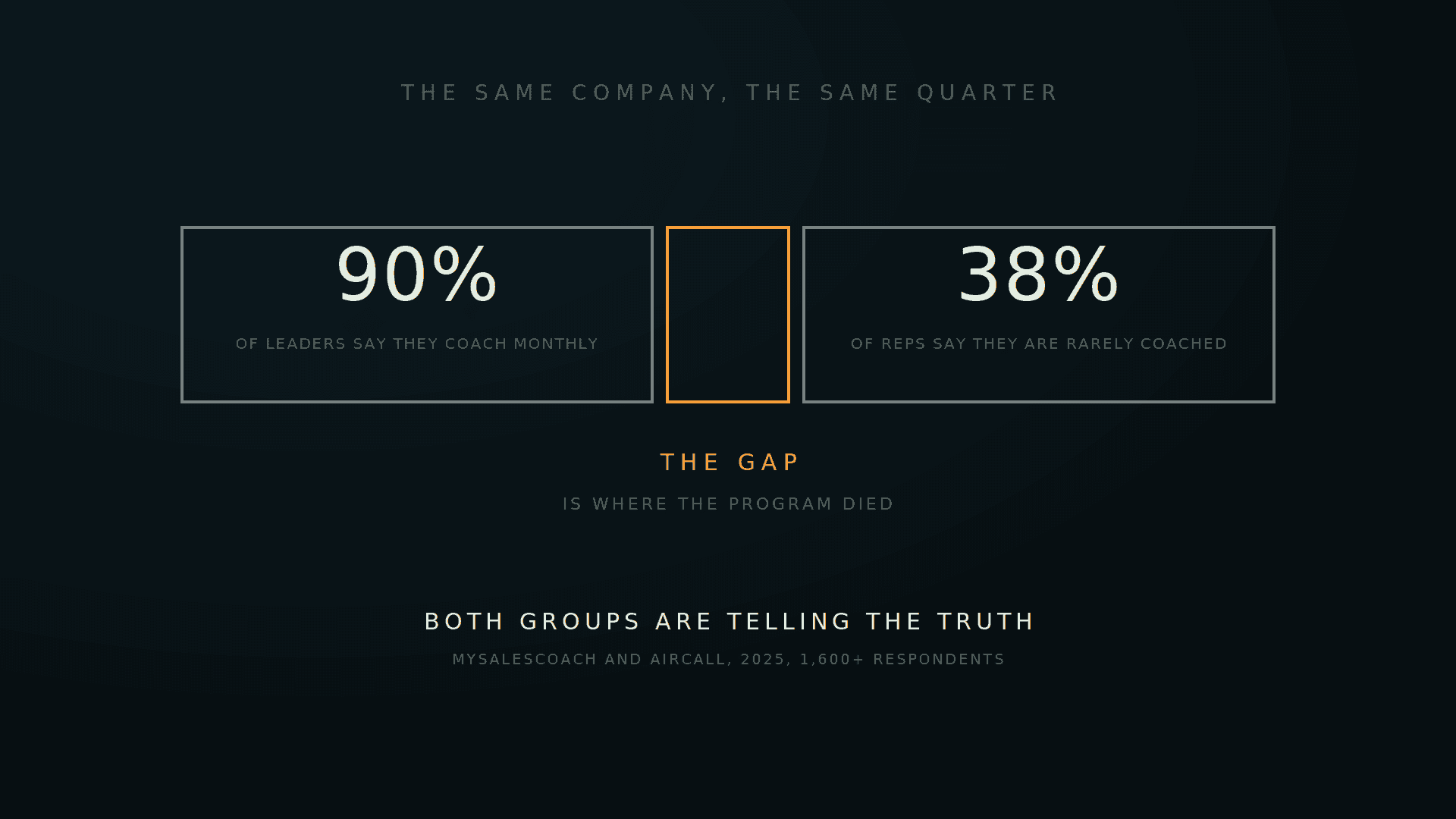
Ninety percent of sales leaders say they coach their reps at least monthly. Thirty-eight percent of reps say they rarely or never get coached. Same companies. Same quarter. Same budget line.
That gap is the whole story of corporate sales training. Somebody signs off on a program, somebody delivers it, somebody prints the certificates, and the people it was meant for go back to their desks and sell exactly the way they sold before. The program happened. The behavior did not change.
This guide is for the person who has to pick a corporate sales training program for 10 to 100 reps this quarter and defend the spend in January: what a program is, why most fail, what one should include, the types of sales training programs on the market, what they cost with public prices, who the top corporate sales training companies are, and how to run and measure one.
We build one of these, so read on with that in mind. We will be harder on the category than anyone.
One more thing. The most quoted statistic in this industry, "87% of sales training is forgotten within 30 days," has no source. No study, no sample, no year. We are not going to use it.
(Scanning this? Every section is a question. Jump to whichever one you actually have.)
What is a corporate sales training program?
A corporate sales training program is a company-funded, team-wide effort to build selling skills, usually owned by sales enablement or L&D, and delivered as some mix of workshops, online courses, coaching and practice. It differs from an individual course because the company picks it, pays for it, and expects the whole team to change as a result.
That is the clean definition. In practice, a corporate sales training program is usually a two-day workshop plus a learning management system. A vendor teaches a methodology, runs a few role-plays in a conference room, and leaves behind slides. The slides go into the LMS. The LMS sends reminders. Completion rates get reported upward. About nine in ten organizations with 100 or more employees run an LMS (89% in Training magazine's 2025 Training Industry Report), so this shape is the default.
Company sales training in this form is easy to buy, easy to schedule, and easy to report on. None of those is "it changes how reps sell".
A program that works may still have a workshop. But the spine is a rhythm: managers coach on a schedule, reps practice on a schedule, and somebody measures whether the practice shows up in real conversations. The workshop is a kickoff. The program is what happens every week after.
When a VP Sales asks "what is the best training program for sales," they are usually asking which course to buy. The better question is which system to run.
Why do most corporate sales training programs fail?
Most corporate sales training programs fail because they are built to be delivered, not to be practiced, and nobody in the chain is paid to notice the difference. The workshop gets scheduled, the LMS gets populated, the completion rate gets reported, and the selling behavior is never checked.
We have a name for this. Program Theater: a corporate sales training program that produces certificates, attendance logs and completion dashboards, and no measurable behavior change. It looks like training from the outside. From inside a sales call, nothing is different.
The reps know. In Salesforce's State of Sales 2026 survey (4,050 sales professionals, 22 countries), 52% agreed that "traditional enablement doesn't provide the skills I need," and 46% said they rarely get feedback on their sales conversations. The completion dashboard, meanwhile, says 97%.
Four mechanisms sit behind Program Theater.
The one-off workshop problem
The forgetting curve is real. The 87% number is not.
A 2015 replication of Ebbinghaus in PLOS ONE (Murre and Dros) confirmed the curve's shape: a steep early drop, then a slower fade. It used one participant memorizing nonsense syllables, so do not attach its percentages to sales training. Clario traced the citation chain for the 87% claim in July 2026 and found no publication, no sample, no year, no method.
What the science does support is spacing. A 2006 meta-analysis in Psychological Bulletin (Cepeda and colleagues, 839 assessments, 14,811 participants) found spaced practice beat massed practice on recall, 47.3% versus 36.7%. Roughly ten points. And the optimal gap between sessions grows with how long you need people to remember. If a rep must still run a good discovery call in nine months, a Tuesday and Wednesday in October is the worst possible schedule.
One-off workshops are cramming with a catering budget. The content may be excellent. The format guarantees decay.
The manager gap
Sales managers are supposed to be the reinforcement layer. Most have never been taught how.
MySalesCoach's State of Sales Coaching 2026 (vendor research, 1,050 respondents, full PDF gated) found 66% of managers have never received any training on being an effective coach, and only one in five has a coach themselves.
Then the perception gap. The MySalesCoach and Aircall State of Sales Coaching 2025 report (1,600 or more respondents, about a third leaders) found 90% of leaders say they coach at least monthly, while 38% of reps say they rarely or never receive coaching. Both groups are honest. The leader counts the pipeline review as coaching. The rep does not. When a program assumes managers will "reinforce in 1:1s" and the 1:1s are forecast calls, the program has no reinforcement.
Completion is not competence
An LMS can tell you a rep watched a module. It cannot tell you whether the rep can run the conversation.
An L&D lead at a global adtech company put it plainly: "We know the sales has a lack of knowledge, but we cannot check what is the gap." Reps "probably don't admit" what they cannot do, and they can use the materials during the tests, so "the gap is not filled." The quiz was passed. The knowledge was never load-tested against a buyer.
Highspot's 2026 GTM Performance Gap Report (methodology not visible on the open pages) found 37% of organizations identified weak reinforcement as a direct cause of execution breakdown, and 43% cited inadequate measurement. (The 83% "executing without clear proof" figure often attributed to Highspot is not in any Highspot report we could find, so we skip it.)
Completion metrics exist because they are the only thing an LMS can measure, not because anyone believes they mean anything.
Generic content
Reps resent being trained on things they already know.
A medical device sales leader in the UK told us why he had rejected his last program: "I don't want to just put training in place for everyone. I don't need this training, but I'm going to have to sit through it for six hours." A generic session, he said, is "a real waste of six hours of my life." Gartner's September 2024 seller survey (1,026 B2B sellers) found 72% of sellers already feel overwhelmed by the number of skills their job requires. More content is not the fix. Targeted practice on the one or two moves they fumble is.
Across the buyers we spoke with in the last ten months, the objection to sales team training was never "we don't need it." It was one of three things: it is generic, nobody owns it, or we cannot see it working fast enough. Program Theater is what you get when a program has all three. For the mechanics of the fade, read why sales training fails under real pressure.
What should a corporate sales training program include?
A corporate sales training program should include six things: sales coaching and reinforcement, an operational rhythm, driving accountability, live practice, a methodology, and measurement. If a vendor's proposal covers only content delivery, it covers one sixth of a program.
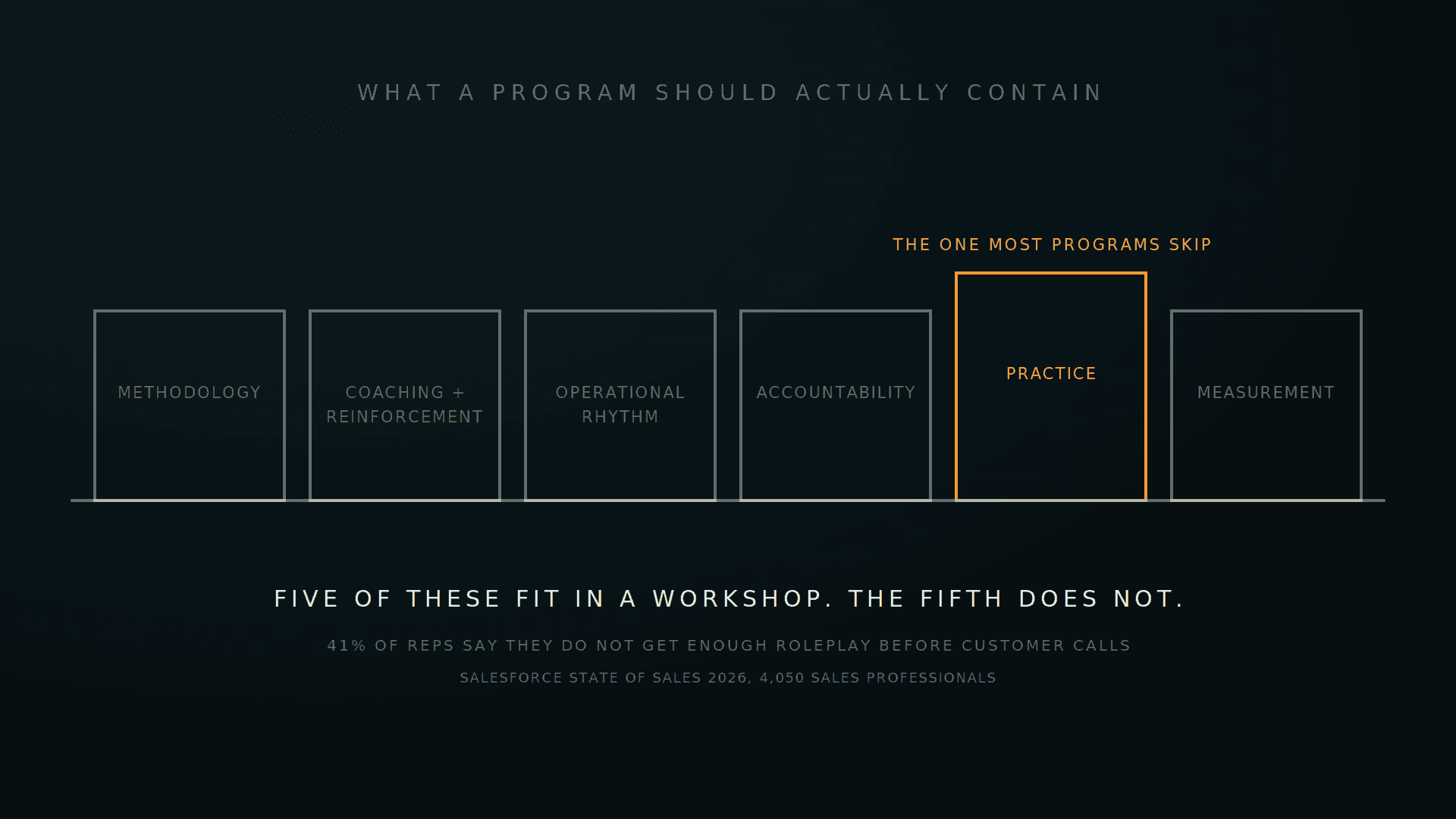
Google's AI Mode answers this question with a "sales management operating system" of three pillars: Sales Coaching and Reinforcement, Operational Rhythm and Pipelines, and Driving Accountability. Good skeleton. Incomplete, because it describes what managers do and says nothing about what reps practice.
Sales coaching and reinforcement
The manager's job after the workshop is to catch the new behavior in the wild: listen to a call or a practice session, name one thing to change, check next week whether it changed. Salesforce found 75% of reps agree they are more likely to hit their targets with a coach or mentor. That is an agreement rate, not a measured lift. Read it as: reps want this and mostly are not getting it.
Operational rhythm and pipelines
A program needs a calendar, not a date. Weekly practice slot. Weekly coaching slot. Pipeline inspection that asks methodology questions ("who is the economic buyer, what did they say the pain costs them") instead of only "when does it close." The operational rhythm is where the methodology stops being a slide and becomes a habit.
Driving accountability
Somebody owns the program. Somebody owns each rep's development. Somebody reports behavior, not attendance. If you cannot name the owner in one sentence, the program drifts by month two. More on this in the mistakes section, with a story that cost us a customer.
Practice
You cannot learn to ride a bike from a video. You cannot learn to handle "we're going with the incumbent" from one either.
The medical device leader again: "You can tell people what to do, but unless they practice it and actually do it, it never really generates in their head." His current mechanism was "a fake role play in front of me." Forty-one percent of reps in the Salesforce State of Sales 2026 PDF say they do not get enough opportunities to roleplay before customer calls (Salesforce's press page says 47%; we use the report). A program without a practice layer is a lecture series.
Methodology
SPIN, MEDDIC, MEDDPICC, Sandler, Challenger, or your own. One per role, as the shared language of every coaching conversation. Consistency matters more than the choice. We watched one mid-market team run SPIN, solution selling, Challenger and consequence questions at once, and nobody could say which one a given call was supposed to follow. See our sales methodology entry.
Measurement
Measure behavior first (practice sessions done, coaching conversations held, methodology criteria hit in real calls), then leading indicators, then lagging ones like win rate. ATD's 2026 State of the Industry (340 organizations, all employees rather than sales-specific) found fewer than a quarter of organizations measure whether training achieved its goals. Decide what you will measure before you sign, because after you sign nobody will.
What are the types of corporate sales training programs?
There are six types of sales training programs in common use: in-person workshops, virtual instructor-led training, self-paced online courses on an LMS, coaching-led programs, AI practice platforms, and blended programs combining two or more. Each trades off cost, time to run, and how fast the learning decays.
Training magazine's 2025 report (US organizations, 100 or more employees) puts the delivery mix by hours at 34% online, 28% classroom instructor-led, 24% virtual classroom, and 22% blended. The classroom is already a minority.
Type | Public cost anchors | Time to run | Retention risk | Best for |
|---|---|---|---|---|
In-person workshop | $1,500 to $5,000 per person (one vendor's estimate, Sales Assembly, June 2026); Harvard DCE $3,200 per seat | 1 to 3 days plus travel | High. Cramming format, no follow-up | Kickoffs, methodology launches |
Virtual instructor-led | Winning by Design, $1,500 per seat, four two-hour sessions | 4 to 8 weeks | Medium. Spaced, but passive between sessions | Distributed teams, one skill at a time |
Self-paced online / LMS | $200 to $2,000 per seat (same estimate); HubSpot Academy free | Whenever the rep gets to it | Very high. Completion without practice | Product knowledge, compliance, onboarding |
Coaching-led | Bundled into a methodology engagement ($30,000 to $150,000 and up, same estimate) or a manager's time | Ongoing | Low if managers coach; high if not | Teams whose managers are trained to coach |
AI practice platform | SecondBody Pro $30 per user per month, unlimited seats | 10 to 20 minutes per rep per week | Low. Spaced by design, behavior scored | Cold calls, discovery, objections, weekly reps |
Blended | Sum of the parts | Kickoff plus 12 weeks minimum | Depends on the practice and coaching layers | Most teams of 10 to 100 reps |

One honest note. The field ride-along, the most common format in medtech, pharma and industrial sales, is missing because it is not a program. The medical device leader called field training "a good support mechanism" that "doesn't fill the gap," because it has no systematic tracking and pulls revenue-producing salespeople out of the field. Ride-alongs are coaching, not a substitute for a program.
And if you searched "best online sales training programs" to get here: self-paced online content has the worst retention profile in the table. Online works when it is live, spaced and practiced. It fails as a video library with a quiz.
How much does corporate sales training cost?
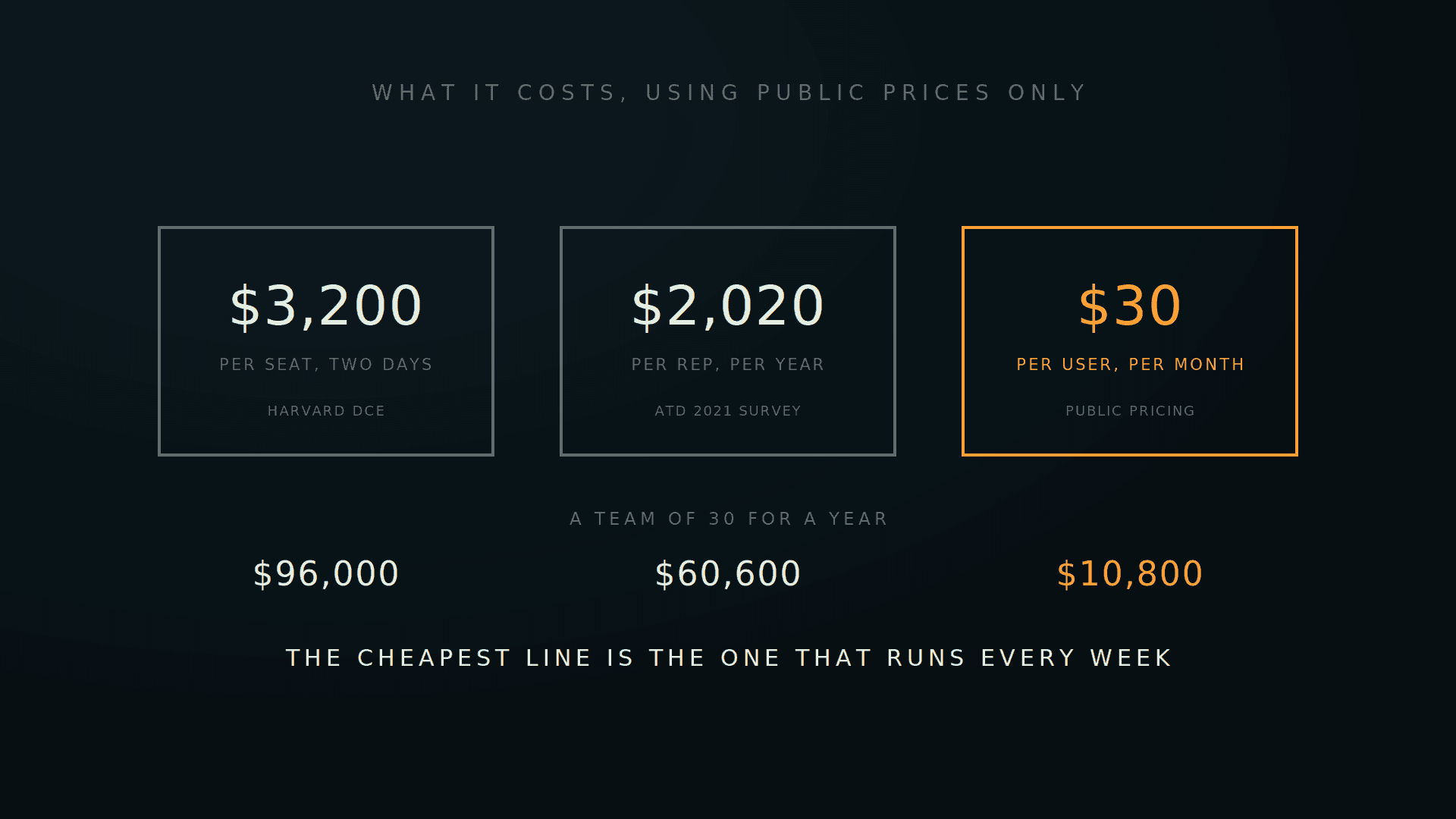
Corporate sales training costs anywhere from about $30 per rep per month for an AI practice platform to $3,200 per seat for a two-day university program to $150,000 or more for a full methodology engagement. For a team of 30, that is roughly $11,000 a year at one end and well into six figures at the other.
Here are the public prices, because "contact us" is not a cost section.
Harvard DCE, Strategic Sales Management: $3,200 per person, two consecutive days on campus. An individual leadership course, not a team program.
Winning by Design, Prospecting for Impact: $1,500 per seat, live virtual, four weekly two-hour sessions, maximum 25 per cohort.
JB Sales team packages: $7,500 for 15 users or $10,000 for 30 for a year of membership plus monthly live training; dedicated engagements $25,000 to $40,000.
Industry ranges from Sales Assembly's June 2026 cost guide, one vendor's estimate: self-paced $200 to $2,000 per seat; live workshops $1,500 to $5,000 per person; methodology engagements $30,000 to $150,000 and up.
SecondBody Pro: $30 per user per month, public pricing, unlimited seats. For 30 reps, $10,800 a year.
For a benchmark on actual spend, the most cited figure is ATD's $2,020 per salesperson per year. Carry the label: it comes from ATD's 2021 State of Sales Training, using 2020 data from 63 organizations. Five years old, small sample. ATD's 2026 State of the Industry puts average direct learning spend at $846 per employee across all roles. Somewhere between $850 and $2,000 per rep per year is a defensible planning number.
The optimistic read: a methodology engagement at $50,000 for 30 reps is under $1,700 a head, in line with the benchmark, and if it moves win rate by a couple of points it pays for itself.
The skeptical read: that $50,000 buys the workshop and the slides. It does not buy the twelve weeks of practice and coaching that decide whether the win rate moves. Price the reinforcement layer too, in money or manager hours, or you are pricing Program Theater.
Two things from real budget conversations. A UK enterprise told us 75 minutes a week per agent of practice was too much to absorb without a clear business case, and they were right. Reps in the Salesforce survey already self-report 60% of their week on non-selling work. Design for ten to twenty minutes a week and prove value before asking for more. And the medical device leader found his budget by cancelling a data subscription. Budgets are rarely new money.
The gap most teams hit is that the reinforcement layer is where the money runs out. That is the problem SecondBody was built to solve, by pricing practice at $30 per rep per month, publicly.
Who are the top corporate sales training companies?
The top corporate sales training companies by reputation and reach are Sandler, Richardson, Dale Carnegie, RAIN Group, Challenger, The Brooks Group, SBI Growth, HubSpot Academy and Harvard DCE, plus a newer layer of AI practice platforms, including ours. None is the best corporate sales training program in the abstract. Each is best at one thing.
This is not a listicle. Here is what each is for and what is annoying about it.
Sandler. A full methodology with a franchise network, strong on qualification and on not chasing. Annoying: quality varies by franchisee, and the pain-funnel language sounds scripted in a new rep's mouth. We watched one company move its whole team to Sandler under managers who, in the buyer's words, "have never been a sales rep." The methodology was fine. The reinforcement layer was missing.
Richardson. Long-established, structured, consultative, with a decent digital layer. Annoying: enterprise-priced and enterprise-paced.
Dale Carnegie. The oldest name, strong on presence and confidence. Annoying: a people-skills program more than a sales-process program.
RAIN Group. Consultative and insight selling, with a research arm that publishes real data (their 2024 study with Allego, 242 respondents, found only 33% rate their organization's sales training as extremely or very effective). Annoying: the workshop is the product and reinforcement is your problem.
Challenger. Teach, tailor, take control. Powerful for selling change into comfortable buyers. Annoying: hard for junior reps to execute without sounding arrogant.
The Brooks Group. IMPACT selling, strong in industrial and manufacturing. Annoying: less known outside those verticals.
SBI Growth. Consulting-led, more strategy than skills. Annoying: it is a consulting engagement.
HubSpot Academy. Free, well produced, good for fundamentals and SDRs. Annoying: self-paced video with quizzes, so "completion is not competence" applies.
Harvard DCE. $3,200 per seat, two days, a certificate with a name on it. Annoying: for individual managers, not teams.
AI practice platforms, including SecondBody. Reps practice cold calls, discovery, objection handling and closing out loud against an AI buyer, on a phone, in WhatsApp or in a browser, and get scored against SPIN, MEDDIC or Sandler criteria. Managers get a briefing before each 1:1 on what the rep fumbled. Here is the trade-off, stated once: SecondBody does not deliver classroom methodology training and does not certify trainers. It is the practice and coaching layer that sits under whichever methodology you pick. If you need someone to teach MEDDIC to 40 reps for the first time, you need one of the vendors above. If you need those 40 reps to still be running MEDDIC in March, you need something like us.
Most teams of 10 to 100 reps end up with a methodology vendor for the launch and a practice layer for the year. Highspot's State of Sales Enablement 2025 (350 GTM professionals, vendor research) reported 164% more companies using AI in their sales training programs year over year. For a broader framework, see our buyer's guide to choosing a sales training program.
Why should you train your sales managers first?
Train your managers first because they are the only part of a corporate sales training program still in the building six months later. A trained manager reinforces the program every week. An untrained one cancels it by accident, one skipped 1:1 at a time.
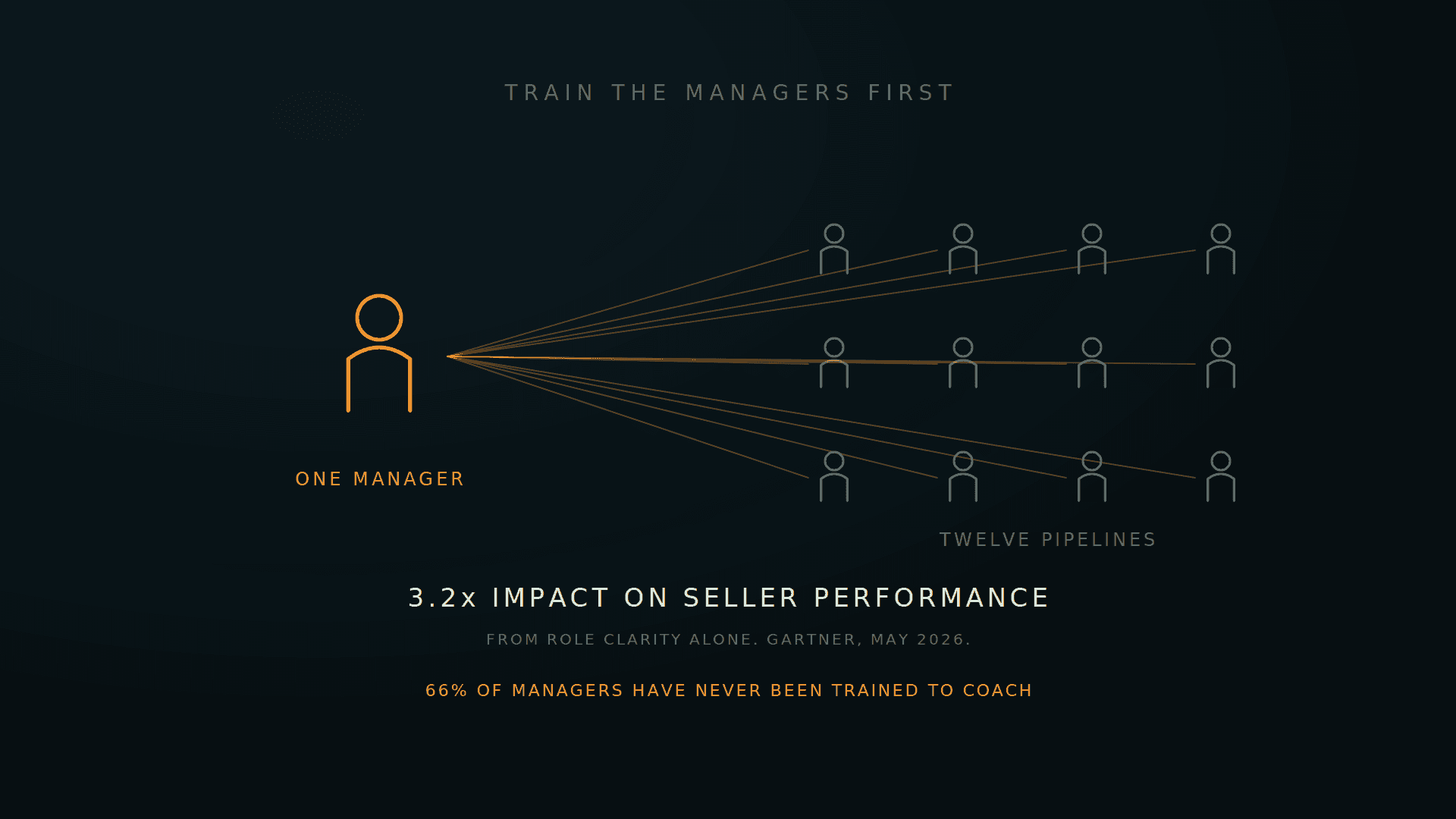
Gartner's May 2026 reporting says managers with role clarity can have a 3.2 times impact on seller performance compared with peers (no sample size disclosed, so hold it loosely). Even at a fraction of that, training a manager beats training a rep on arithmetic alone. One manager touches every rep on the team. One rep touches their own quota.
Yet the sequence in most programs is backwards. The reps get the workshop. The managers get an email. Sixty-six percent of them have never been trained to coach. We are asking people who have never been coached to become the coaching layer of a program they did not design.
The cadence data says what trained managers should do with their time. MySalesCoach's 2026 report found reps coached weekly hit quota at 76%, monthly at 56%, quarterly or less at 47%. That is a correlation in self-reported vendor data, and better managers probably coach more and do other things well too. But the direction matches the spacing research. Weekly beats monthly beats quarterly.
Highspot's 2025 survey has managers estimating 13 hours a week spent coaching. Set that against the 38% of reps who say they are rarely or never coached: the hours go somewhere, and the reps do not experience it as coaching.
What manager training should contain is its own subject, covered in sales management training for new sales managers. Short version: coaching skills before forecasting skills, and a weekly rhythm before a quarterly plan.
The gap most teams hit is that managers want to coach and have no time to listen to calls. That is the problem SecondBody was built to solve, by sending the manager a briefing before each 1:1 on what the rep practiced and where they lost the room. See coaching at scale.
How does corporate sales training change for enterprise teams?
Enterprise sales training differs from general corporate sales training in three ways: the buying committee is larger, the cycle is longer, and the failure modes are political rather than conversational. A program for enterprise reps has to cover multi-threading, deep qualification (MEDDPICC or similar), and procurement, security and legal navigation, none of which a generic selling-skills workshop touches.
Most corporate programs are built for a rep talking to a buyer. Enterprise deals are a rep talking to a committee over two or three quarters, with a champion who may leave, a CFO who has not been met, and a security questionnaire that arrives in month five. The skills are different: stakeholder mapping, discovery that quantifies value in the buyer's numbers, qualification strict enough to disqualify early, negotiation that survives procurement.
The delivery changes too. Enterprise reps have fewer live deals to learn on, so practice has to be simulated deliberately. Use real deal coaching: bring an open opportunity into the coaching session and work it against the methodology. Segment by role, because an enterprise AE and the SDR feeding them need different programs. And drip feed the content across the deal cycle, so the negotiation module arrives when the rep is about to negotiate, not in a two-day dump in January.
We cover the curriculum module by module in enterprise sales training: what the curriculum should include.
How do you run a corporate sales training program?
You run a corporate sales training program in five steps: diagnose the actual skill gaps, pick one methodology per role, train the managers, set a weekly practice cadence, and measure behavior before revenue. Most programs skip steps one, three and five and wonder why step two did not work.
1. Diagnose. Before you buy anything, find out what your reps cannot do. Listen to twenty recorded calls. Note where the conversation dies: the opener, the discovery questions, the moment the buyer says "send me something," the pricing conversation. Ask managers for the top two gaps per rep and compare their list to the calls. If the gap is objection handling, a full methodology rollout is the wrong purchase.
2. Pick a methodology per role. One for SDRs, one for AEs, possibly one for account managers. Not four. Match it to how your buyers buy: SPIN or Solution Selling for consultative mid-market, MEDDIC or MEDDPICC for enterprise committees, Sandler where qualification discipline is the problem. Write down why you chose it.
3. Train your managers first. Before the reps see anything, the managers get the methodology, the coaching model, and the operational rhythm. What does a weekly coaching conversation look like? What three questions do they ask in pipeline review? Two to four weeks, and the step most often cut for time.
4. Set a weekly practice cadence. Ten to twenty minutes per rep per week, every week, on the specific gap from step one. Out loud, against a person or an AI buyer, not a quiz. Log it. The cadence, not the content, is the program.
5. Measure execution, not completion. Track practice sessions per rep per week, coaching conversations per manager per week, and one behavior metric from the calls themselves (say, the share of discovery calls where the rep quantified the pain). Then the leading indicators those behaviors should move. Revenue comes last and slowest.
Run these five and you have a program. Run only step two, which is what buying a workshop amounts to, and you have Program Theater with a nicer logo.
What does a practical 12-week rollout look like?
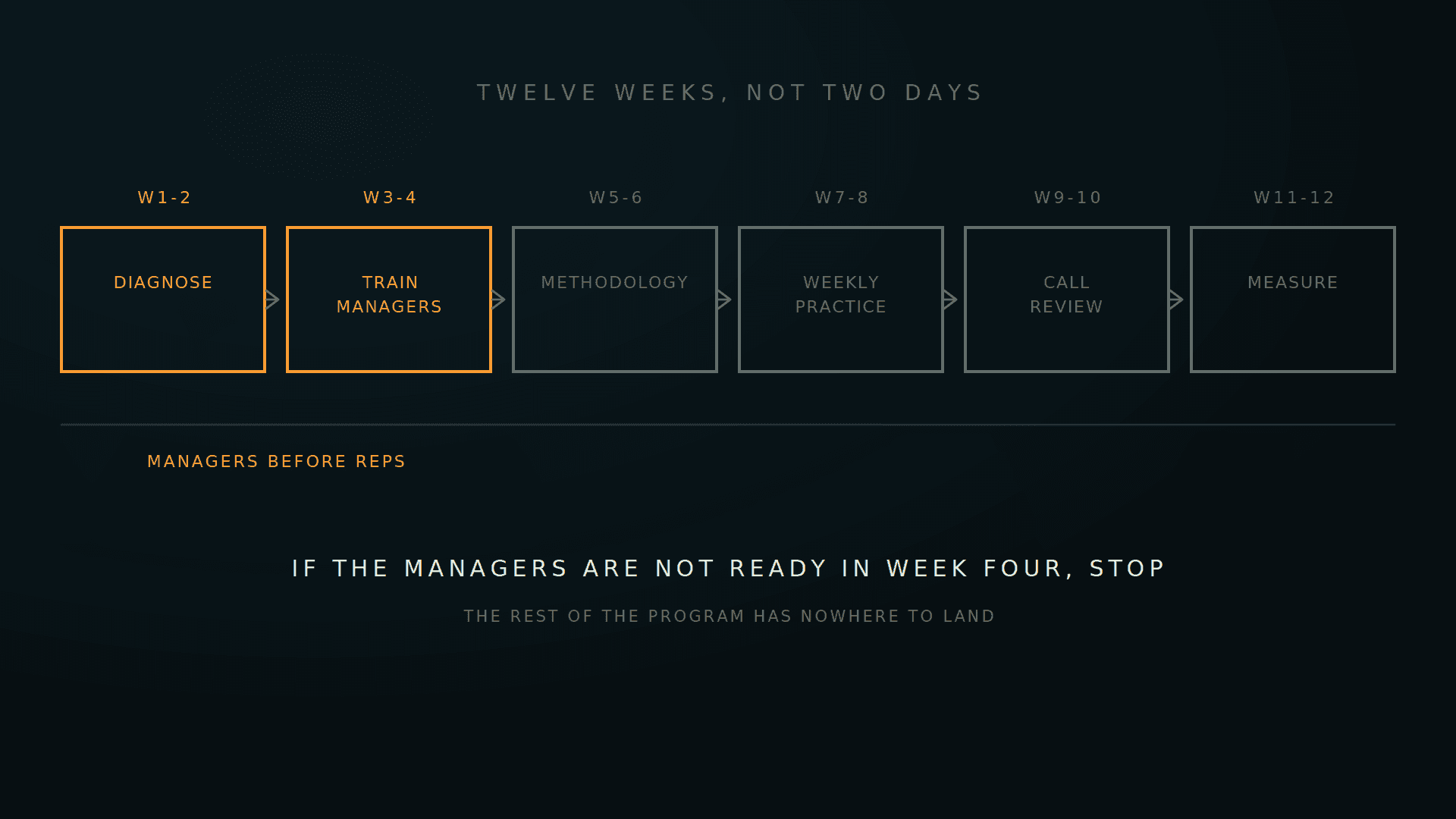
A practical 12-week corporate sales training rollout runs in four blocks: two weeks of diagnosis and manager preparation, two weeks of launch, six weeks of weekly practice and coaching, and two weeks of measurement and reset. Twelve weeks is the minimum for behavior to be visible. It is not the end of the program.
Weeks 1 to 2: diagnose and prepare managers. Score twenty call recordings against the methodology you chose. Name the top three gaps per role. Managers go through the methodology and the coaching model now, before reps see anything. Agree the three metrics you will report in week 12. Name the program owner in writing.
Weeks 3 to 4: launch and learn. Kickoff with the vendor or your own enablement team, one to two days at most. Teach the methodology, run first practice reps in the room, and make it clear the workshop is the start and the calendar is the program. Every rep leaves with a weekly practice slot booked for the next eight weeks.
Weeks 5 to 10: practice and coach. The program lives or dies here. Each rep practices the specific gap ten to twenty minutes a week, out loud. Each manager holds one coaching conversation per rep per week using what the practice surfaced. Rotate the scenario every two weeks (opener, discovery, objection, pricing, close). Drip feed the content in this window, one concept per fortnight, instead of front-loading the kickoff. Use real deal coaching in at least half the manager sessions.
Weeks 11 to 12: measure and reset. Report the three metrics from week 1. Compare weeks 9 to 10 against weeks 1 to 2. Decide what the next twelve weeks focus on. The rollout ends. The rhythm does not.
An enablement lead at a UK enterprise told us, "my capacity is not great for build." Most enablement leads are one person. Design the rollout so someone with no build capacity can run it: pre-built scenarios, automatic scoring, a manager briefing that writes itself. That is the difference between a program that runs for twelve weeks and one that runs for twelve months.
How do you measure corporate sales training ROI?
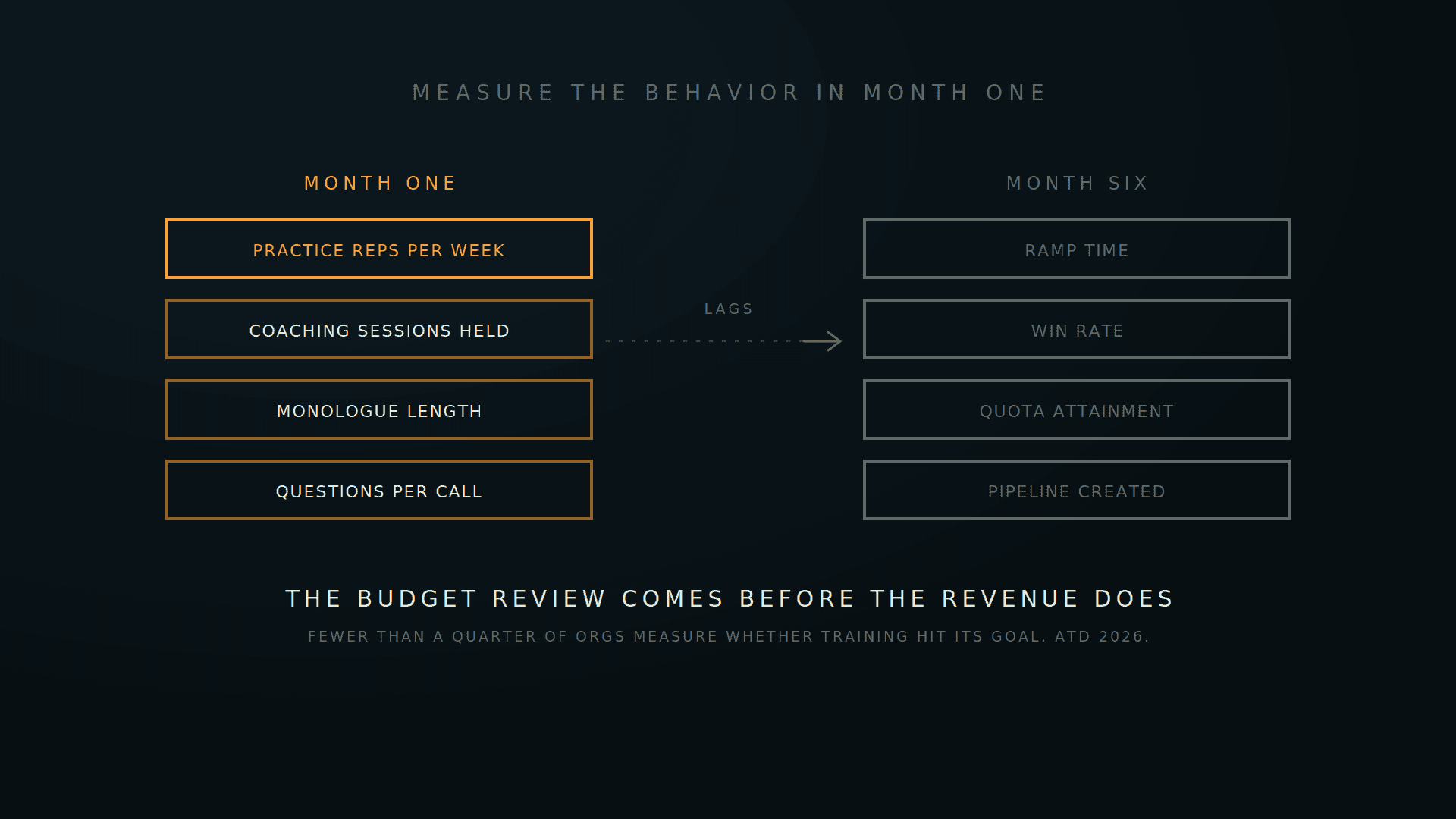
You measure corporate sales training ROI in three layers: behavior metrics in the first month, leading indicators in the first quarter, and lagging outcomes over two or more quarters. Judging a program on revenue alone in month two is how good programs get cancelled.
The medical device leader explained it better than any framework: "Sales can be quite lag. We could do one month of great work with them but it might be four months before we see the results." And: "We're not going to get that metric fast enough to say it's working." He was not arguing against measurement. He was arguing for leading indicators, because the lagging ones arrive after the budget review.
Layer one, behavior (weeks 1 to 4). Practice reps per rep per week. Coaching conversations per manager per week. Share of live calls hitting the methodology criteria you chose. These move fast and are the only proof you can show in month one. A buyer at a global adtech company asked us for scenario scoring "and how it's changing over time." That is the right first ask. Another enterprise buyer listed speed to competency, confidence, a quality score, and eventually commercial impact. Note the order.
Layer two, leading indicators (weeks 4 to 12). Meetings booked per SDR. Discovery to proposal conversion. Ramp time versus the previous cohort. Rep confidence if you must, but read confidence is not a KPI first.
Layer three, outcomes (two quarters and beyond). Win rate. Quota attainment. Undesired turnover. The RAIN Group and Allego study (242 respondents, late 2024) found organizations with highly effective training reported undesired turnover of 33.8% versus 45.5% for the rest.
The optimistic read: the correlations all point the same way. Weekly coaching goes with 76% quota attainment versus 47% for quarterly or less. Effective training goes with lower turnover.
The skeptical read: every one of those is self-reported, most are vendor-funded, and none isolates the training from manager quality, market and product. Gartner's May 2026 reporting says 31% of CSOs cite difficulty proving ROI of AI-driven tools (no sample size given). The chain from practice to revenue is long. Do not pretend otherwise in the board deck. Show behavior change, then the leading indicator, then the outcome when it arrives.
The full breakdown is in 5 key metrics to measure sales training ROI, and the dated stats live in the State of Sales Training 2026.
The gap most teams hit is that they have no layer one metric, so they wait for revenue and lose the budget. That is the problem SecondBody was built to solve, by scoring every practice call so a manager can show behavior change in week three.
How is corporate sales training different from sales enablement?
Corporate sales training is a program with a start, a curriculum and an outcome. Sales enablement is a standing function that supplies reps with content, tools, process and training on an ongoing basis. Training is one thing enablement does. Enablement is one place training lives.
In practice the boundary is who owns the calendar. A training program is a project: launch, rollout, measurement point. Enablement is the department that, in a healthy company, runs the project and keeps the rhythm going afterwards. In an unhealthy company, enablement is the department that maintains the LMS.
Buy corporate sales training with no enablement function and the program has no home after week twelve. Buy it without involving the enablement function you have and you get two owners, which is the same as none. For the full definition, see what is sales enablement.
How is corporate sales training different from sales coaching?
Corporate sales training teaches a team what to do. Sales coaching helps one rep do it better in their actual calls, one conversation at a time. Training is group and scheduled. Coaching is individual and continuous. A program without coaching decays. Coaching without a program has no shared language.
The confusion between the two is the root of the 90% versus 38% gap. Leaders count group activity as coaching. Reps count only the moments when someone looked at their specific conversation and told them one specific thing.
The practical rule: training sets the standard, coaching enforces it, practice closes the gap between them. The mechanics are in our sales coaching entry.
What are the most common corporate sales training mistakes?
The seven most common corporate sales training mistakes are buying the workshop instead of the system, skipping the managers, running no practice, using one methodology for every role, measuring completion, launching at the sales kickoff and stopping, and having no owner. We have watched every one of these, and one of them cost us a customer.
1. Buying the workshop, not the system. The proposal covers two days. The behavior change needs twelve weeks. Nobody priced the other ten. Every other mistake is downstream of this one.
2. Skipping the managers. The reps learn a methodology their manager cannot coach to. Within a month the 1:1s revert to forecast reviews.
3. No practice layer. Reps learn the discovery framework and run it for the first time on a live prospect. "A fake role play in front of me" is not a practice layer. Neither is a quiz.
4. One methodology for every role. SDRs get MEDDPICC they will never use. Enterprise AEs get an opener script. Segment by role or watch half the room check out (the "waste of six hours" reaction, at scale).
5. Measuring completion. The dashboard says 97%. The calls sound the same. It feels like measurement.
6. Launching at SKO and stopping. The kickoff is high energy and well attended. Then nothing is scheduled for February. The spacing research says the gap between sessions should grow, not go to infinity after session one.
7. No owner. This is the one we got wrong too. One company we worked with cancelled after a year. Not budget; the L&D lead was specific that it was "not a budget thing." It was because, in her words, "We don't have one owner. Everything is scattered. We don't have processes." The scenarios had gone stale, and stale content, she said, was "more creating harm for the sales versus helping." She was right. We sold a practice layer into a company with no operating rhythm to hang it on, and we did not push hard enough on who owned it. A program with no owner does not fail loudly. It just stops being used. Name the owner before you name the vendor.
Frequently asked questions
What is the best training program for sales?
There is no single best training program for sales, because it depends on what your reps cannot do and how your buyers buy. For qualification discipline, Sandler or MEDDIC-based programs. For consultative mid-market selling, SPIN or RAIN Group. For enterprise committees, MEDDPICC with a strong coaching layer. Whichever you pick, the one that changes behavior has weekly practice and trained managers behind it.
What are some good training programs for sales?
Sandler, Richardson, Dale Carnegie, RAIN Group, Challenger, The Brooks Group and SBI Growth for methodology and workshops; HubSpot Academy for free fundamentals; Harvard DCE for individual sales leaders; and AI practice platforms such as SecondBody for the weekly practice layer underneath any of them.
What are the 7 stages of sales?
Prospecting, preparation, approach, presentation, handling objections, closing and follow-up. A useful map of a deal, but a program built around stages teaches reps what happens next instead of how to handle the moment in front of them. Train the moments and the stages take care of themselves.
Where can I find corporate sales training?
From methodology vendors (Sandler, Richardson, RAIN Group, Challenger), university programs (Harvard DCE), free academies (HubSpot Academy), virtual cohort providers (Winning by Design), and AI practice platforms (SecondBody). Diagnose your team's gaps first, then shortlist vendors whose format matches the gap.
Corporate sales training programs online: do they work?
Online corporate sales training programs work when they are live, spaced over weeks and include practice out loud. They fail as a self-paced video library with a quiz, because completion does not test whether a rep can run the conversation. The question is not online versus in person. It is practiced versus watched.
How long should a corporate sales training program last?
At least 12 weeks: two weeks of diagnosis and manager preparation, a short launch, six or more weeks of weekly practice and coaching, and a measurement point. After that it becomes a standing rhythm. Anything shorter is a workshop, whatever the brochure calls it.
What is the difference between corporate and enterprise sales training?
Corporate sales training is any company-funded, team-wide program to build selling skills. Enterprise sales training is the subset built for reps selling large deals into buying committees over long cycles, so it adds account research, MEDDPICC-style qualification, multi-threading, and procurement and legal navigation. See enterprise sales training: what the curriculum should include.
What training does a sales manager need?
Coaching skills first, then pipeline inspection and forecasting discipline, then an operational rhythm for 1:1s and team reviews. Sixty-six percent of managers have never been trained to coach (MySalesCoach 2026, vendor research), which is why manager training should come before rep training. See sales management training for new sales managers.
Does SecondBody replace a corporate sales training vendor?
No. SecondBody does not teach a methodology from scratch or certify trainers. It is the practice and coaching layer: reps practice cold calls, discovery, objection handling and closing out loud against an AI buyer, and Rory, the AI coach, scores each session against SPIN, MEDDIC or Sandler criteria. Most teams pair it with a methodology vendor for the launch and use SecondBody for the weekly practice that keeps the methodology alive.
How does SecondBody fit into an existing corporate sales training program?
At steps four and five: the weekly practice cadence and the behavior measurement. Reps get a ten to twenty minute voice practice session each week on the scenario the manager chooses, on their phone, in WhatsApp or in a browser. Managers get a pre-1:1 briefing on what each rep practiced and where they lost the room. It integrates with Aircall, Cloudtalk, Momentum.io, Fathom and TeamTailor, and is SOC 2 certified.
What does SecondBody cost for a team?
SecondBody Pro is $30 per user per month, public pricing, unlimited seats: a team of 30 is $10,800 a year, a team of 100 is $36,000. There is a tier you can start with today, or you can book a demo to see it against your own scenarios first.
So what do you actually buy this quarter?
Buy the system, not the certificate. Pick one methodology per role, train the managers before the reps, put ten to twenty minutes of out-loud practice on every rep's calendar every week, and measure the behavior in month one so the budget survives until the revenue shows up in month six.
Program Theater is not a vendor problem. The vendors above mostly teach good methodologies well. It is a format problem, and the format was chosen because it is easy to schedule and easy to report, not because anyone believed a two-day workshop would still be in a rep's mouth in March. The 90% of leaders who think they coach monthly are not lying. The 38% of reps who say they are rarely coached are not lying either. The program just never reached the conversation.
That is what we built SecondBody to fix. Not the workshop. The Tuesday after it. A rep opens their phone, runs a cold call or a pricing objection against an AI buyer who pushes back the way real buyers do, and Rory tells them the one thing to change. Their manager gets the briefing before the 1:1. The methodology you paid for gets practiced, out loud, every week, for $30 a rep. Cyera runs it. Others do under NDA. It is built in Paris, and it does not need an enablement team with build capacity, because most of you do not have one.
Run the five steps, price the reinforcement layer, and name the owner. Then, if you want the practice layer handled, book a demo or start on the public tier.
Good luck out there.
How we know this: we build an AI sales practice platform, we sat in the buying calls with the sales leaders quoted below, and we checked every number in this article at its primary source.
Ninety percent of sales leaders say they coach their reps at least monthly. Thirty-eight percent of reps say they rarely or never get coached. Same companies. Same quarter. Same budget line.
That gap is the whole story of corporate sales training. Somebody signs off on a program, somebody delivers it, somebody prints the certificates, and the people it was meant for go back to their desks and sell exactly the way they sold before. The program happened. The behavior did not change.
This guide is for the person who has to pick a corporate sales training program for 10 to 100 reps this quarter and defend the spend in January: what a program is, why most fail, what one should include, the types of sales training programs on the market, what they cost with public prices, who the top corporate sales training companies are, and how to run and measure one.
We build one of these, so read on with that in mind. We will be harder on the category than anyone.
One more thing. The most quoted statistic in this industry, "87% of sales training is forgotten within 30 days," has no source. No study, no sample, no year. We are not going to use it.
(Scanning this? Every section is a question. Jump to whichever one you actually have.)
What is a corporate sales training program?
A corporate sales training program is a company-funded, team-wide effort to build selling skills, usually owned by sales enablement or L&D, and delivered as some mix of workshops, online courses, coaching and practice. It differs from an individual course because the company picks it, pays for it, and expects the whole team to change as a result.
That is the clean definition. In practice, a corporate sales training program is usually a two-day workshop plus a learning management system. A vendor teaches a methodology, runs a few role-plays in a conference room, and leaves behind slides. The slides go into the LMS. The LMS sends reminders. Completion rates get reported upward. About nine in ten organizations with 100 or more employees run an LMS (89% in Training magazine's 2025 Training Industry Report), so this shape is the default.
Company sales training in this form is easy to buy, easy to schedule, and easy to report on. None of those is "it changes how reps sell".
A program that works may still have a workshop. But the spine is a rhythm: managers coach on a schedule, reps practice on a schedule, and somebody measures whether the practice shows up in real conversations. The workshop is a kickoff. The program is what happens every week after.
When a VP Sales asks "what is the best training program for sales," they are usually asking which course to buy. The better question is which system to run.
Why do most corporate sales training programs fail?
Most corporate sales training programs fail because they are built to be delivered, not to be practiced, and nobody in the chain is paid to notice the difference. The workshop gets scheduled, the LMS gets populated, the completion rate gets reported, and the selling behavior is never checked.
We have a name for this. Program Theater: a corporate sales training program that produces certificates, attendance logs and completion dashboards, and no measurable behavior change. It looks like training from the outside. From inside a sales call, nothing is different.
The reps know. In Salesforce's State of Sales 2026 survey (4,050 sales professionals, 22 countries), 52% agreed that "traditional enablement doesn't provide the skills I need," and 46% said they rarely get feedback on their sales conversations. The completion dashboard, meanwhile, says 97%.
Four mechanisms sit behind Program Theater.
The one-off workshop problem
The forgetting curve is real. The 87% number is not.
A 2015 replication of Ebbinghaus in PLOS ONE (Murre and Dros) confirmed the curve's shape: a steep early drop, then a slower fade. It used one participant memorizing nonsense syllables, so do not attach its percentages to sales training. Clario traced the citation chain for the 87% claim in July 2026 and found no publication, no sample, no year, no method.
What the science does support is spacing. A 2006 meta-analysis in Psychological Bulletin (Cepeda and colleagues, 839 assessments, 14,811 participants) found spaced practice beat massed practice on recall, 47.3% versus 36.7%. Roughly ten points. And the optimal gap between sessions grows with how long you need people to remember. If a rep must still run a good discovery call in nine months, a Tuesday and Wednesday in October is the worst possible schedule.
One-off workshops are cramming with a catering budget. The content may be excellent. The format guarantees decay.
The manager gap
Sales managers are supposed to be the reinforcement layer. Most have never been taught how.
MySalesCoach's State of Sales Coaching 2026 (vendor research, 1,050 respondents, full PDF gated) found 66% of managers have never received any training on being an effective coach, and only one in five has a coach themselves.
Then the perception gap. The MySalesCoach and Aircall State of Sales Coaching 2025 report (1,600 or more respondents, about a third leaders) found 90% of leaders say they coach at least monthly, while 38% of reps say they rarely or never receive coaching. Both groups are honest. The leader counts the pipeline review as coaching. The rep does not. When a program assumes managers will "reinforce in 1:1s" and the 1:1s are forecast calls, the program has no reinforcement.
Completion is not competence
An LMS can tell you a rep watched a module. It cannot tell you whether the rep can run the conversation.
An L&D lead at a global adtech company put it plainly: "We know the sales has a lack of knowledge, but we cannot check what is the gap." Reps "probably don't admit" what they cannot do, and they can use the materials during the tests, so "the gap is not filled." The quiz was passed. The knowledge was never load-tested against a buyer.
Highspot's 2026 GTM Performance Gap Report (methodology not visible on the open pages) found 37% of organizations identified weak reinforcement as a direct cause of execution breakdown, and 43% cited inadequate measurement. (The 83% "executing without clear proof" figure often attributed to Highspot is not in any Highspot report we could find, so we skip it.)
Completion metrics exist because they are the only thing an LMS can measure, not because anyone believes they mean anything.
Generic content
Reps resent being trained on things they already know.
A medical device sales leader in the UK told us why he had rejected his last program: "I don't want to just put training in place for everyone. I don't need this training, but I'm going to have to sit through it for six hours." A generic session, he said, is "a real waste of six hours of my life." Gartner's September 2024 seller survey (1,026 B2B sellers) found 72% of sellers already feel overwhelmed by the number of skills their job requires. More content is not the fix. Targeted practice on the one or two moves they fumble is.
Across the buyers we spoke with in the last ten months, the objection to sales team training was never "we don't need it." It was one of three things: it is generic, nobody owns it, or we cannot see it working fast enough. Program Theater is what you get when a program has all three. For the mechanics of the fade, read why sales training fails under real pressure.
What should a corporate sales training program include?
A corporate sales training program should include six things: sales coaching and reinforcement, an operational rhythm, driving accountability, live practice, a methodology, and measurement. If a vendor's proposal covers only content delivery, it covers one sixth of a program.
Google's AI Mode answers this question with a "sales management operating system" of three pillars: Sales Coaching and Reinforcement, Operational Rhythm and Pipelines, and Driving Accountability. Good skeleton. Incomplete, because it describes what managers do and says nothing about what reps practice.
Sales coaching and reinforcement
The manager's job after the workshop is to catch the new behavior in the wild: listen to a call or a practice session, name one thing to change, check next week whether it changed. Salesforce found 75% of reps agree they are more likely to hit their targets with a coach or mentor. That is an agreement rate, not a measured lift. Read it as: reps want this and mostly are not getting it.
Operational rhythm and pipelines
A program needs a calendar, not a date. Weekly practice slot. Weekly coaching slot. Pipeline inspection that asks methodology questions ("who is the economic buyer, what did they say the pain costs them") instead of only "when does it close." The operational rhythm is where the methodology stops being a slide and becomes a habit.
Driving accountability
Somebody owns the program. Somebody owns each rep's development. Somebody reports behavior, not attendance. If you cannot name the owner in one sentence, the program drifts by month two. More on this in the mistakes section, with a story that cost us a customer.
Practice
You cannot learn to ride a bike from a video. You cannot learn to handle "we're going with the incumbent" from one either.
The medical device leader again: "You can tell people what to do, but unless they practice it and actually do it, it never really generates in their head." His current mechanism was "a fake role play in front of me." Forty-one percent of reps in the Salesforce State of Sales 2026 PDF say they do not get enough opportunities to roleplay before customer calls (Salesforce's press page says 47%; we use the report). A program without a practice layer is a lecture series.
Methodology
SPIN, MEDDIC, MEDDPICC, Sandler, Challenger, or your own. One per role, as the shared language of every coaching conversation. Consistency matters more than the choice. We watched one mid-market team run SPIN, solution selling, Challenger and consequence questions at once, and nobody could say which one a given call was supposed to follow. See our sales methodology entry.
Measurement
Measure behavior first (practice sessions done, coaching conversations held, methodology criteria hit in real calls), then leading indicators, then lagging ones like win rate. ATD's 2026 State of the Industry (340 organizations, all employees rather than sales-specific) found fewer than a quarter of organizations measure whether training achieved its goals. Decide what you will measure before you sign, because after you sign nobody will.
What are the types of corporate sales training programs?
There are six types of sales training programs in common use: in-person workshops, virtual instructor-led training, self-paced online courses on an LMS, coaching-led programs, AI practice platforms, and blended programs combining two or more. Each trades off cost, time to run, and how fast the learning decays.
Training magazine's 2025 report (US organizations, 100 or more employees) puts the delivery mix by hours at 34% online, 28% classroom instructor-led, 24% virtual classroom, and 22% blended. The classroom is already a minority.
Type | Public cost anchors | Time to run | Retention risk | Best for |
|---|---|---|---|---|
In-person workshop | $1,500 to $5,000 per person (one vendor's estimate, Sales Assembly, June 2026); Harvard DCE $3,200 per seat | 1 to 3 days plus travel | High. Cramming format, no follow-up | Kickoffs, methodology launches |
Virtual instructor-led | Winning by Design, $1,500 per seat, four two-hour sessions | 4 to 8 weeks | Medium. Spaced, but passive between sessions | Distributed teams, one skill at a time |
Self-paced online / LMS | $200 to $2,000 per seat (same estimate); HubSpot Academy free | Whenever the rep gets to it | Very high. Completion without practice | Product knowledge, compliance, onboarding |
Coaching-led | Bundled into a methodology engagement ($30,000 to $150,000 and up, same estimate) or a manager's time | Ongoing | Low if managers coach; high if not | Teams whose managers are trained to coach |
AI practice platform | SecondBody Pro $30 per user per month, unlimited seats | 10 to 20 minutes per rep per week | Low. Spaced by design, behavior scored | Cold calls, discovery, objections, weekly reps |
Blended | Sum of the parts | Kickoff plus 12 weeks minimum | Depends on the practice and coaching layers | Most teams of 10 to 100 reps |
One honest note. The field ride-along, the most common format in medtech, pharma and industrial sales, is missing because it is not a program. The medical device leader called field training "a good support mechanism" that "doesn't fill the gap," because it has no systematic tracking and pulls revenue-producing salespeople out of the field. Ride-alongs are coaching, not a substitute for a program.
And if you searched "best online sales training programs" to get here: self-paced online content has the worst retention profile in the table. Online works when it is live, spaced and practiced. It fails as a video library with a quiz.
How much does corporate sales training cost?
Corporate sales training costs anywhere from about $30 per rep per month for an AI practice platform to $3,200 per seat for a two-day university program to $150,000 or more for a full methodology engagement. For a team of 30, that is roughly $11,000 a year at one end and well into six figures at the other.
Here are the public prices, because "contact us" is not a cost section.
Harvard DCE, Strategic Sales Management: $3,200 per person, two consecutive days on campus. An individual leadership course, not a team program.
Winning by Design, Prospecting for Impact: $1,500 per seat, live virtual, four weekly two-hour sessions, maximum 25 per cohort.
JB Sales team packages: $7,500 for 15 users or $10,000 for 30 for a year of membership plus monthly live training; dedicated engagements $25,000 to $40,000.
Industry ranges from Sales Assembly's June 2026 cost guide, one vendor's estimate: self-paced $200 to $2,000 per seat; live workshops $1,500 to $5,000 per person; methodology engagements $30,000 to $150,000 and up.
SecondBody Pro: $30 per user per month, public pricing, unlimited seats. For 30 reps, $10,800 a year.
For a benchmark on actual spend, the most cited figure is ATD's $2,020 per salesperson per year. Carry the label: it comes from ATD's 2021 State of Sales Training, using 2020 data from 63 organizations. Five years old, small sample. ATD's 2026 State of the Industry puts average direct learning spend at $846 per employee across all roles. Somewhere between $850 and $2,000 per rep per year is a defensible planning number.
The optimistic read: a methodology engagement at $50,000 for 30 reps is under $1,700 a head, in line with the benchmark, and if it moves win rate by a couple of points it pays for itself.
The skeptical read: that $50,000 buys the workshop and the slides. It does not buy the twelve weeks of practice and coaching that decide whether the win rate moves. Price the reinforcement layer too, in money or manager hours, or you are pricing Program Theater.
Two things from real budget conversations. A UK enterprise told us 75 minutes a week per agent of practice was too much to absorb without a clear business case, and they were right. Reps in the Salesforce survey already self-report 60% of their week on non-selling work. Design for ten to twenty minutes a week and prove value before asking for more. And the medical device leader found his budget by cancelling a data subscription. Budgets are rarely new money.
The gap most teams hit is that the reinforcement layer is where the money runs out. That is the problem SecondBody was built to solve, by pricing practice at $30 per rep per month, publicly.
Who are the top corporate sales training companies?
The top corporate sales training companies by reputation and reach are Sandler, Richardson, Dale Carnegie, RAIN Group, Challenger, The Brooks Group, SBI Growth, HubSpot Academy and Harvard DCE, plus a newer layer of AI practice platforms, including ours. None is the best corporate sales training program in the abstract. Each is best at one thing.
This is not a listicle. Here is what each is for and what is annoying about it.
Sandler. A full methodology with a franchise network, strong on qualification and on not chasing. Annoying: quality varies by franchisee, and the pain-funnel language sounds scripted in a new rep's mouth. We watched one company move its whole team to Sandler under managers who, in the buyer's words, "have never been a sales rep." The methodology was fine. The reinforcement layer was missing.
Richardson. Long-established, structured, consultative, with a decent digital layer. Annoying: enterprise-priced and enterprise-paced.
Dale Carnegie. The oldest name, strong on presence and confidence. Annoying: a people-skills program more than a sales-process program.
RAIN Group. Consultative and insight selling, with a research arm that publishes real data (their 2024 study with Allego, 242 respondents, found only 33% rate their organization's sales training as extremely or very effective). Annoying: the workshop is the product and reinforcement is your problem.
Challenger. Teach, tailor, take control. Powerful for selling change into comfortable buyers. Annoying: hard for junior reps to execute without sounding arrogant.
The Brooks Group. IMPACT selling, strong in industrial and manufacturing. Annoying: less known outside those verticals.
SBI Growth. Consulting-led, more strategy than skills. Annoying: it is a consulting engagement.
HubSpot Academy. Free, well produced, good for fundamentals and SDRs. Annoying: self-paced video with quizzes, so "completion is not competence" applies.
Harvard DCE. $3,200 per seat, two days, a certificate with a name on it. Annoying: for individual managers, not teams.
AI practice platforms, including SecondBody. Reps practice cold calls, discovery, objection handling and closing out loud against an AI buyer, on a phone, in WhatsApp or in a browser, and get scored against SPIN, MEDDIC or Sandler criteria. Managers get a briefing before each 1:1 on what the rep fumbled. Here is the trade-off, stated once: SecondBody does not deliver classroom methodology training and does not certify trainers. It is the practice and coaching layer that sits under whichever methodology you pick. If you need someone to teach MEDDIC to 40 reps for the first time, you need one of the vendors above. If you need those 40 reps to still be running MEDDIC in March, you need something like us.
Most teams of 10 to 100 reps end up with a methodology vendor for the launch and a practice layer for the year. Highspot's State of Sales Enablement 2025 (350 GTM professionals, vendor research) reported 164% more companies using AI in their sales training programs year over year. For a broader framework, see our buyer's guide to choosing a sales training program.
Why should you train your sales managers first?
Train your managers first because they are the only part of a corporate sales training program still in the building six months later. A trained manager reinforces the program every week. An untrained one cancels it by accident, one skipped 1:1 at a time.
Gartner's May 2026 reporting says managers with role clarity can have a 3.2 times impact on seller performance compared with peers (no sample size disclosed, so hold it loosely). Even at a fraction of that, training a manager beats training a rep on arithmetic alone. One manager touches every rep on the team. One rep touches their own quota.
Yet the sequence in most programs is backwards. The reps get the workshop. The managers get an email. Sixty-six percent of them have never been trained to coach. We are asking people who have never been coached to become the coaching layer of a program they did not design.
The cadence data says what trained managers should do with their time. MySalesCoach's 2026 report found reps coached weekly hit quota at 76%, monthly at 56%, quarterly or less at 47%. That is a correlation in self-reported vendor data, and better managers probably coach more and do other things well too. But the direction matches the spacing research. Weekly beats monthly beats quarterly.
Highspot's 2025 survey has managers estimating 13 hours a week spent coaching. Set that against the 38% of reps who say they are rarely or never coached: the hours go somewhere, and the reps do not experience it as coaching.
What manager training should contain is its own subject, covered in sales management training for new sales managers. Short version: coaching skills before forecasting skills, and a weekly rhythm before a quarterly plan.
The gap most teams hit is that managers want to coach and have no time to listen to calls. That is the problem SecondBody was built to solve, by sending the manager a briefing before each 1:1 on what the rep practiced and where they lost the room. See coaching at scale.
How does corporate sales training change for enterprise teams?
Enterprise sales training differs from general corporate sales training in three ways: the buying committee is larger, the cycle is longer, and the failure modes are political rather than conversational. A program for enterprise reps has to cover multi-threading, deep qualification (MEDDPICC or similar), and procurement, security and legal navigation, none of which a generic selling-skills workshop touches.
Most corporate programs are built for a rep talking to a buyer. Enterprise deals are a rep talking to a committee over two or three quarters, with a champion who may leave, a CFO who has not been met, and a security questionnaire that arrives in month five. The skills are different: stakeholder mapping, discovery that quantifies value in the buyer's numbers, qualification strict enough to disqualify early, negotiation that survives procurement.
The delivery changes too. Enterprise reps have fewer live deals to learn on, so practice has to be simulated deliberately. Use real deal coaching: bring an open opportunity into the coaching session and work it against the methodology. Segment by role, because an enterprise AE and the SDR feeding them need different programs. And drip feed the content across the deal cycle, so the negotiation module arrives when the rep is about to negotiate, not in a two-day dump in January.
We cover the curriculum module by module in enterprise sales training: what the curriculum should include.
How do you run a corporate sales training program?
You run a corporate sales training program in five steps: diagnose the actual skill gaps, pick one methodology per role, train the managers, set a weekly practice cadence, and measure behavior before revenue. Most programs skip steps one, three and five and wonder why step two did not work.
1. Diagnose. Before you buy anything, find out what your reps cannot do. Listen to twenty recorded calls. Note where the conversation dies: the opener, the discovery questions, the moment the buyer says "send me something," the pricing conversation. Ask managers for the top two gaps per rep and compare their list to the calls. If the gap is objection handling, a full methodology rollout is the wrong purchase.
2. Pick a methodology per role. One for SDRs, one for AEs, possibly one for account managers. Not four. Match it to how your buyers buy: SPIN or Solution Selling for consultative mid-market, MEDDIC or MEDDPICC for enterprise committees, Sandler where qualification discipline is the problem. Write down why you chose it.
3. Train your managers first. Before the reps see anything, the managers get the methodology, the coaching model, and the operational rhythm. What does a weekly coaching conversation look like? What three questions do they ask in pipeline review? Two to four weeks, and the step most often cut for time.
4. Set a weekly practice cadence. Ten to twenty minutes per rep per week, every week, on the specific gap from step one. Out loud, against a person or an AI buyer, not a quiz. Log it. The cadence, not the content, is the program.
5. Measure execution, not completion. Track practice sessions per rep per week, coaching conversations per manager per week, and one behavior metric from the calls themselves (say, the share of discovery calls where the rep quantified the pain). Then the leading indicators those behaviors should move. Revenue comes last and slowest.
Run these five and you have a program. Run only step two, which is what buying a workshop amounts to, and you have Program Theater with a nicer logo.
What does a practical 12-week rollout look like?
A practical 12-week corporate sales training rollout runs in four blocks: two weeks of diagnosis and manager preparation, two weeks of launch, six weeks of weekly practice and coaching, and two weeks of measurement and reset. Twelve weeks is the minimum for behavior to be visible. It is not the end of the program.
Weeks 1 to 2: diagnose and prepare managers. Score twenty call recordings against the methodology you chose. Name the top three gaps per role. Managers go through the methodology and the coaching model now, before reps see anything. Agree the three metrics you will report in week 12. Name the program owner in writing.
Weeks 3 to 4: launch and learn. Kickoff with the vendor or your own enablement team, one to two days at most. Teach the methodology, run first practice reps in the room, and make it clear the workshop is the start and the calendar is the program. Every rep leaves with a weekly practice slot booked for the next eight weeks.
Weeks 5 to 10: practice and coach. The program lives or dies here. Each rep practices the specific gap ten to twenty minutes a week, out loud. Each manager holds one coaching conversation per rep per week using what the practice surfaced. Rotate the scenario every two weeks (opener, discovery, objection, pricing, close). Drip feed the content in this window, one concept per fortnight, instead of front-loading the kickoff. Use real deal coaching in at least half the manager sessions.
Weeks 11 to 12: measure and reset. Report the three metrics from week 1. Compare weeks 9 to 10 against weeks 1 to 2. Decide what the next twelve weeks focus on. The rollout ends. The rhythm does not.
An enablement lead at a UK enterprise told us, "my capacity is not great for build." Most enablement leads are one person. Design the rollout so someone with no build capacity can run it: pre-built scenarios, automatic scoring, a manager briefing that writes itself. That is the difference between a program that runs for twelve weeks and one that runs for twelve months.
How do you measure corporate sales training ROI?
You measure corporate sales training ROI in three layers: behavior metrics in the first month, leading indicators in the first quarter, and lagging outcomes over two or more quarters. Judging a program on revenue alone in month two is how good programs get cancelled.
The medical device leader explained it better than any framework: "Sales can be quite lag. We could do one month of great work with them but it might be four months before we see the results." And: "We're not going to get that metric fast enough to say it's working." He was not arguing against measurement. He was arguing for leading indicators, because the lagging ones arrive after the budget review.
Layer one, behavior (weeks 1 to 4). Practice reps per rep per week. Coaching conversations per manager per week. Share of live calls hitting the methodology criteria you chose. These move fast and are the only proof you can show in month one. A buyer at a global adtech company asked us for scenario scoring "and how it's changing over time." That is the right first ask. Another enterprise buyer listed speed to competency, confidence, a quality score, and eventually commercial impact. Note the order.
Layer two, leading indicators (weeks 4 to 12). Meetings booked per SDR. Discovery to proposal conversion. Ramp time versus the previous cohort. Rep confidence if you must, but read confidence is not a KPI first.
Layer three, outcomes (two quarters and beyond). Win rate. Quota attainment. Undesired turnover. The RAIN Group and Allego study (242 respondents, late 2024) found organizations with highly effective training reported undesired turnover of 33.8% versus 45.5% for the rest.
The optimistic read: the correlations all point the same way. Weekly coaching goes with 76% quota attainment versus 47% for quarterly or less. Effective training goes with lower turnover.
The skeptical read: every one of those is self-reported, most are vendor-funded, and none isolates the training from manager quality, market and product. Gartner's May 2026 reporting says 31% of CSOs cite difficulty proving ROI of AI-driven tools (no sample size given). The chain from practice to revenue is long. Do not pretend otherwise in the board deck. Show behavior change, then the leading indicator, then the outcome when it arrives.
The full breakdown is in 5 key metrics to measure sales training ROI, and the dated stats live in the State of Sales Training 2026.
The gap most teams hit is that they have no layer one metric, so they wait for revenue and lose the budget. That is the problem SecondBody was built to solve, by scoring every practice call so a manager can show behavior change in week three.
How is corporate sales training different from sales enablement?
Corporate sales training is a program with a start, a curriculum and an outcome. Sales enablement is a standing function that supplies reps with content, tools, process and training on an ongoing basis. Training is one thing enablement does. Enablement is one place training lives.
In practice the boundary is who owns the calendar. A training program is a project: launch, rollout, measurement point. Enablement is the department that, in a healthy company, runs the project and keeps the rhythm going afterwards. In an unhealthy company, enablement is the department that maintains the LMS.
Buy corporate sales training with no enablement function and the program has no home after week twelve. Buy it without involving the enablement function you have and you get two owners, which is the same as none. For the full definition, see what is sales enablement.
How is corporate sales training different from sales coaching?
Corporate sales training teaches a team what to do. Sales coaching helps one rep do it better in their actual calls, one conversation at a time. Training is group and scheduled. Coaching is individual and continuous. A program without coaching decays. Coaching without a program has no shared language.
The confusion between the two is the root of the 90% versus 38% gap. Leaders count group activity as coaching. Reps count only the moments when someone looked at their specific conversation and told them one specific thing.
The practical rule: training sets the standard, coaching enforces it, practice closes the gap between them. The mechanics are in our sales coaching entry.
What are the most common corporate sales training mistakes?
The seven most common corporate sales training mistakes are buying the workshop instead of the system, skipping the managers, running no practice, using one methodology for every role, measuring completion, launching at the sales kickoff and stopping, and having no owner. We have watched every one of these, and one of them cost us a customer.
1. Buying the workshop, not the system. The proposal covers two days. The behavior change needs twelve weeks. Nobody priced the other ten. Every other mistake is downstream of this one.
2. Skipping the managers. The reps learn a methodology their manager cannot coach to. Within a month the 1:1s revert to forecast reviews.
3. No practice layer. Reps learn the discovery framework and run it for the first time on a live prospect. "A fake role play in front of me" is not a practice layer. Neither is a quiz.
4. One methodology for every role. SDRs get MEDDPICC they will never use. Enterprise AEs get an opener script. Segment by role or watch half the room check out (the "waste of six hours" reaction, at scale).
5. Measuring completion. The dashboard says 97%. The calls sound the same. It feels like measurement.
6. Launching at SKO and stopping. The kickoff is high energy and well attended. Then nothing is scheduled for February. The spacing research says the gap between sessions should grow, not go to infinity after session one.
7. No owner. This is the one we got wrong too. One company we worked with cancelled after a year. Not budget; the L&D lead was specific that it was "not a budget thing." It was because, in her words, "We don't have one owner. Everything is scattered. We don't have processes." The scenarios had gone stale, and stale content, she said, was "more creating harm for the sales versus helping." She was right. We sold a practice layer into a company with no operating rhythm to hang it on, and we did not push hard enough on who owned it. A program with no owner does not fail loudly. It just stops being used. Name the owner before you name the vendor.
Frequently asked questions
What is the best training program for sales?
There is no single best training program for sales, because it depends on what your reps cannot do and how your buyers buy. For qualification discipline, Sandler or MEDDIC-based programs. For consultative mid-market selling, SPIN or RAIN Group. For enterprise committees, MEDDPICC with a strong coaching layer. Whichever you pick, the one that changes behavior has weekly practice and trained managers behind it.
What are some good training programs for sales?
Sandler, Richardson, Dale Carnegie, RAIN Group, Challenger, The Brooks Group and SBI Growth for methodology and workshops; HubSpot Academy for free fundamentals; Harvard DCE for individual sales leaders; and AI practice platforms such as SecondBody for the weekly practice layer underneath any of them.
What are the 7 stages of sales?
Prospecting, preparation, approach, presentation, handling objections, closing and follow-up. A useful map of a deal, but a program built around stages teaches reps what happens next instead of how to handle the moment in front of them. Train the moments and the stages take care of themselves.
Where can I find corporate sales training?
From methodology vendors (Sandler, Richardson, RAIN Group, Challenger), university programs (Harvard DCE), free academies (HubSpot Academy), virtual cohort providers (Winning by Design), and AI practice platforms (SecondBody). Diagnose your team's gaps first, then shortlist vendors whose format matches the gap.
Corporate sales training programs online: do they work?
Online corporate sales training programs work when they are live, spaced over weeks and include practice out loud. They fail as a self-paced video library with a quiz, because completion does not test whether a rep can run the conversation. The question is not online versus in person. It is practiced versus watched.
How long should a corporate sales training program last?
At least 12 weeks: two weeks of diagnosis and manager preparation, a short launch, six or more weeks of weekly practice and coaching, and a measurement point. After that it becomes a standing rhythm. Anything shorter is a workshop, whatever the brochure calls it.
What is the difference between corporate and enterprise sales training?
Corporate sales training is any company-funded, team-wide program to build selling skills. Enterprise sales training is the subset built for reps selling large deals into buying committees over long cycles, so it adds account research, MEDDPICC-style qualification, multi-threading, and procurement and legal navigation. See enterprise sales training: what the curriculum should include.
What training does a sales manager need?
Coaching skills first, then pipeline inspection and forecasting discipline, then an operational rhythm for 1:1s and team reviews. Sixty-six percent of managers have never been trained to coach (MySalesCoach 2026, vendor research), which is why manager training should come before rep training. See sales management training for new sales managers.
Does SecondBody replace a corporate sales training vendor?
No. SecondBody does not teach a methodology from scratch or certify trainers. It is the practice and coaching layer: reps practice cold calls, discovery, objection handling and closing out loud against an AI buyer, and Rory, the AI coach, scores each session against SPIN, MEDDIC or Sandler criteria. Most teams pair it with a methodology vendor for the launch and use SecondBody for the weekly practice that keeps the methodology alive.
How does SecondBody fit into an existing corporate sales training program?
At steps four and five: the weekly practice cadence and the behavior measurement. Reps get a ten to twenty minute voice practice session each week on the scenario the manager chooses, on their phone, in WhatsApp or in a browser. Managers get a pre-1:1 briefing on what each rep practiced and where they lost the room. It integrates with Aircall, Cloudtalk, Momentum.io, Fathom and TeamTailor, and is SOC 2 certified.
What does SecondBody cost for a team?
SecondBody Pro is $30 per user per month, public pricing, unlimited seats: a team of 30 is $10,800 a year, a team of 100 is $36,000. There is a tier you can start with today, or you can book a demo to see it against your own scenarios first.
So what do you actually buy this quarter?
Buy the system, not the certificate. Pick one methodology per role, train the managers before the reps, put ten to twenty minutes of out-loud practice on every rep's calendar every week, and measure the behavior in month one so the budget survives until the revenue shows up in month six.
Program Theater is not a vendor problem. The vendors above mostly teach good methodologies well. It is a format problem, and the format was chosen because it is easy to schedule and easy to report, not because anyone believed a two-day workshop would still be in a rep's mouth in March. The 90% of leaders who think they coach monthly are not lying. The 38% of reps who say they are rarely coached are not lying either. The program just never reached the conversation.
That is what we built SecondBody to fix. Not the workshop. The Tuesday after it. A rep opens their phone, runs a cold call or a pricing objection against an AI buyer who pushes back the way real buyers do, and Rory tells them the one thing to change. Their manager gets the briefing before the 1:1. The methodology you paid for gets practiced, out loud, every week, for $30 a rep. Cyera runs it. Others do under NDA. It is built in Paris, and it does not need an enablement team with build capacity, because most of you do not have one.
Run the five steps, price the reinforcement layer, and name the owner. Then, if you want the practice layer handled, book a demo or start on the public tier.
Good luck out there.
Training that ends in a certificate is theater.
SecondBody gives every rep daily voice practice with Rory, scored against your methodology, so the behavior survives the workshop.


SecondBody is the AI sales practice platform built for field, regulated, and enterprise sales teams. Voice-first practice with Rory, your AI coach. Pre-call practice, not post-call analysis. Pre-1:1 manager briefings. Unlimited seats at $30 per user per month. Built in Paris. SOC 2 compliant.
Related reading: Sales Management Training for New Sales Managers · Enterprise Sales Training Curriculum · How to Choose a Sales Training Program · Coaching at Scale · What is Sales Coaching?
Share this article