Back
Enterprise Sales Training: The Six-Module Curriculum, and the Four-Meetings-a-Year Problem Nobody Plans For
What enterprise sales training should include: six modules from research to procurement, and why four committee meetings a year will never make it stick.
Posted by
SecondBody.ai
Published by
Last Updated
How we know this: we build an AI sales practice platform, we sell it into enterprise ourselves, we sat in the calls quoted below, and we checked every number in this article at its source.
Type "enterprise sales training" into Google today and the first result is an archived Reddit thread from 2024. Someone asks what a new enterprise AE should study. The answers are four book titles and "LinkedIn Learning". That is the state of the art for a job where one deal carries a year of quota.
The short answer to what enterprise sales training should include: six modules that follow the shape of a large deal, from account research to expansion. The part that gets skipped: an enterprise AE meets a real buying committee about once a quarter. Four times a year. Any curriculum that does not manufacture practice in between is a reading list with a certificate.
We build one of these, so read on with that in mind. We will be harder on the category than anyone.
This is the enterprise spoke of our guide to corporate sales training programs, only about reps who close six-figure deals over six to twelve months.
(Scanning this? Every section is a question. Jump to whichever one you actually have.)
What is enterprise sales training?
Enterprise sales training is training for reps who sell high-value, long-cycle deals into large organisations with formal buying committees, procurement functions and security reviews. The buyer is not a person. It is a group, and the group has politics.
In practice, most companies run the same program as their SMB team and add a MEDDPICC deck. The rep learns the acronym on Tuesday, gets certified on Thursday, and walks into a call where procurement has declined the last three meeting invites. Nothing in the deck covers that.
Here is something worth sitting with. We reviewed every recorded call from ten months of our own enterprise deals. Not one prospect said MEDDIC or MEDDPICC. They talked about budget holders, sponsors, security, procurement, return on investment, and who would own the thing after signature. Teach those conversations. The acronym is the filing system.
How is enterprise sales training different from B2B sales training?
Enterprise sales training differs from B2B sales training in three ways: the cycle is measured in quarters, the buyer is a committee, and the main competitor is "no decision". Standard B2B sales training assumes one or two decision makers and a cycle you can move with follow-up. Enterprise has neither.
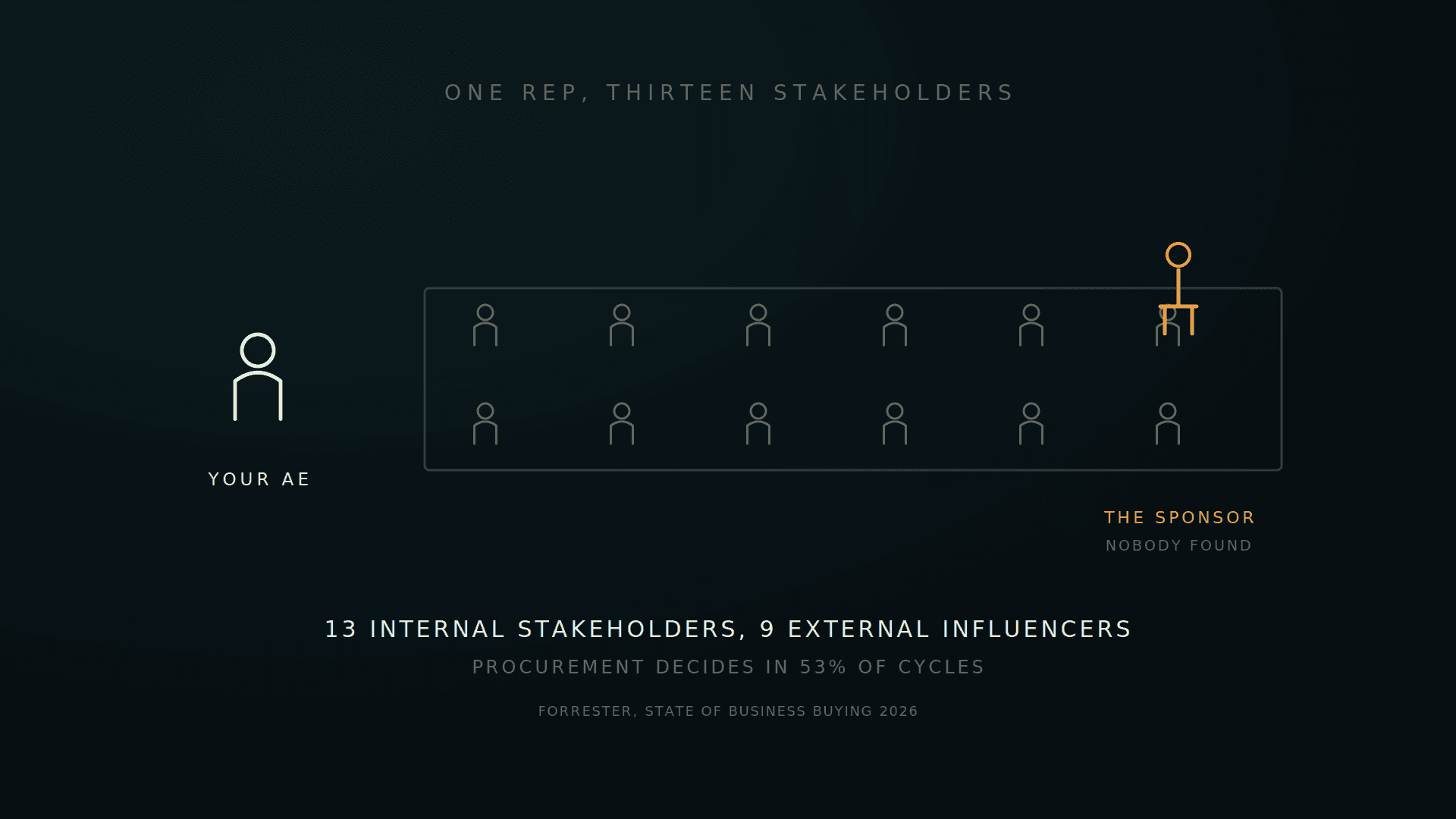
The numbers, dated and sourced. Forrester's State of Business Buying 2026 puts the typical buying decision at 13 internal stakeholders plus nine external influencers, with procurement a decision maker in 53% of cycles. Gartner's May 2025 survey of 632 buyers found groups of 5 to 16 people across up to four functions, and 74% of those groups showed unhealthy conflict during the decision. Forrester's 2024 edition found 86% of B2B purchases stall at some point. (You will see that 86% attributed to Gartner all over the internet. It is Forrester.)
SMB and mid-market | Enterprise | |
|---|---|---|
Cycle | Weeks to a quarter | Two to four quarters |
People in the decision | One to three | 5 to 16 internal (Gartner 2025), plus external influencers |
Main skill | Running a good discovery call and closing | Keeping a committee moving toward a decision |
Main risk | Losing to a competitor | Losing to no decision |
What kills the deal | Price, fit | A missing sponsor, a security review, an unbudgeted line, a champion leaving |
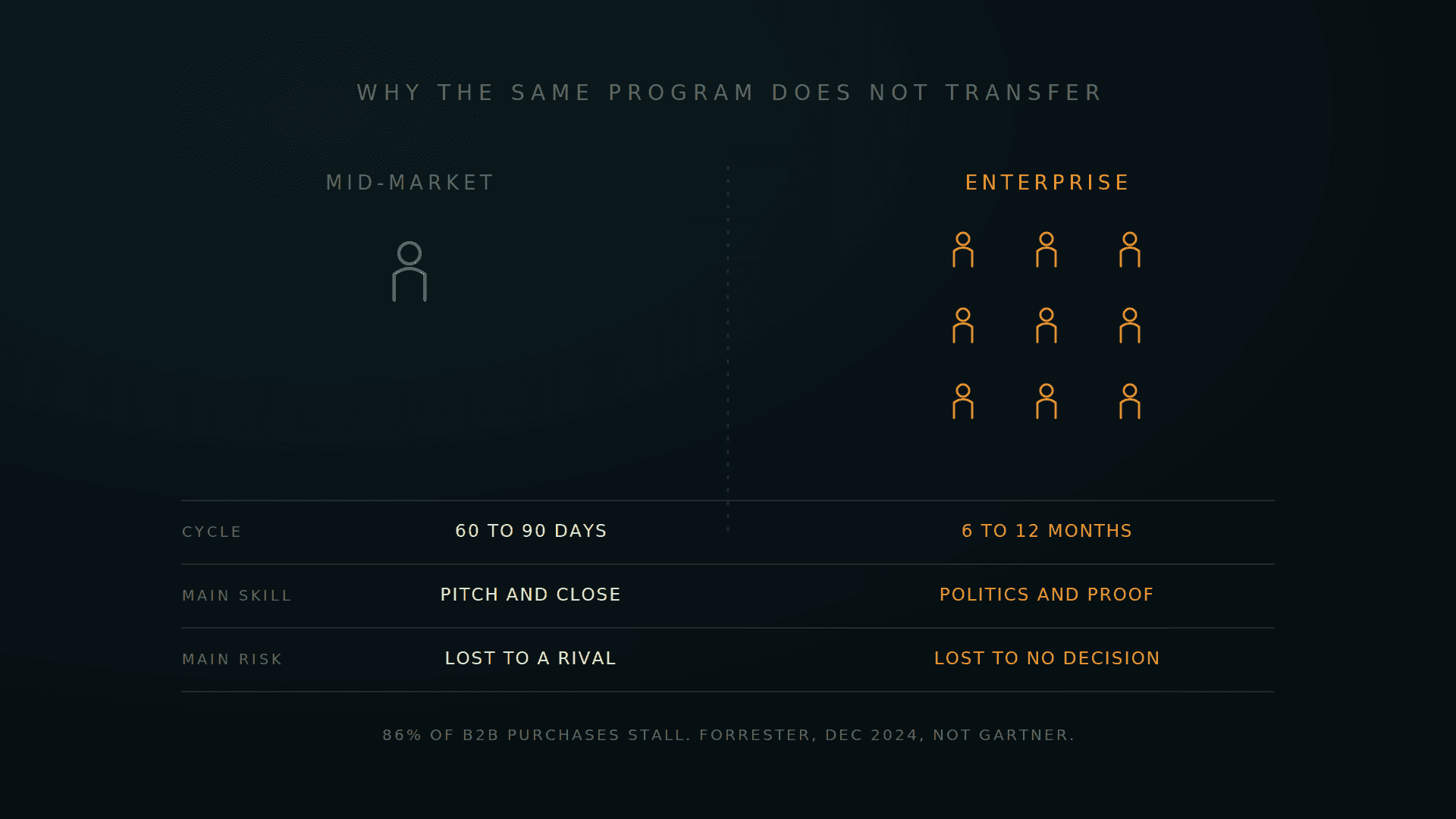
So the "enterprise sales vs B2B sales" question has a plain answer. All enterprise sales is B2B. Not all B2B is enterprise. The training earns the name when it is built around the committee.
What skills are needed for enterprise sales?
The skills needed for enterprise sales are business acumen, political mapping, multi-threading, quantifying pain in money, procurement navigation, and patience. Brooks Group lists six competencies in its own guide to enterprise sales training, and they are fair. What the list leaves out is that every one is a conversation, and the conversations are rare.
Political mapping is not a slide. It is an enablement lead at a UK enterprise telling us, "That needed a VP sponsor. I can't progress without that." The rep has to hear champion versus sponsor in real time. Multi-threading is not a CRM field. It is a UK healthcare distributor telling us, of our own pipeline, that if we had only engaged one stakeholder per account, "this isn't filling us with confidence that this is qualified." A buyer said that to a vendor. Read it twice.
Patience is the skill nobody trains. A medical device sales leader told us the real discussion with a clinician is "six or seven discussions down from the initial discussion." His view of the gap in his own reps was not product knowledge. It was, "Do they know when to shut up and listen first?"
That is an enterprise software sales skills training curriculum in one sentence, from someone who has never read one.
What should an enterprise sales training program include?
An enterprise sales training program should include six modules that follow the life of a large deal. Google's AI Mode produces this exact list when you ask it, and it is right about the list. It is quiet about what makes any of it stick.

Strategic Account Research & Prospecting
Reading a 10-K, mapping personas across functions, and sequencing outreach so the first meeting is with someone who can sponsor, not just someone who will take a call. The trainable conversation is the first executive touch: know who the executive is, then earn the right to bring them in.
Advanced Discovery & Value Quantification
Turning pain into a number the CFO recognises, whiteboarding the current state, and crossing the "confidence chasm", where a buyer believes the problem is real but not worth the disruption. Gartner's 2019 research (1,000-plus buyers, note the year) found buyers facing contradictory information were 153% more likely to settle for a smaller purchase.
The conversation to train: an enablement lead at a UK enterprise told us anything they trialed would need "a really clear mapped out return on investment", and, separately, "we don't do paid pilots." The rep who cannot build that case in the room does not get a second room.
Deal Qualification Frameworks
MEDDPICC, or whichever deal qualification framework you use, taught as questions the rep asks out loud, not a form filled in after the call. The discipline that matters is disqualification. We wrote about that in why MEDDIC and MEDDPICC exist to disqualify early, and the MEDDIC dictionary entry has the letters.
The economic buyer question, as we asked it on a real call: "What's the one signal that the decision maker or the budget holder needs to see to say we're gonna pull the trigger?" The answer: "We need one person to be happy, and that person needs to be the budget holder." The E in MEDDPICC, in the buyer's words, because the rep asked.
Navigating Buying Committees & Corporate Politics
Building a champion, identifying the six buying roles, and neutralising blockers without making enemies. Gartner's 2025 data has a sharp lesson: tailoring your message to one persona's needs had a 59% negative impact on the group's ability to reach consensus, and consensus groups were 2.5 times more likely to report a high-quality deal. Personalising to the champion can lose you the committee.
The failure mode is champion risk. An enablement lead at a UK enterprise told us her sponsor "has been a big sponsor, but as he's on the way out, it's maybe good to bring other people in." Same call: "Everything's a priority at the moment, which makes nothing a priority." Our piece on executive stakeholder management in B2B sales goes deeper.
Procurement, Security & Legal Navigation
InfoSec reviews, SOC 2 evidence, mutual action plans, RFP discipline, and the rhythm of a procurement function that does not answer email. Forrester 2026 says procurement is a decision maker in 53% of buying cycles. That is a stakeholder from day one, not a late-stage hurdle.
What it sounds like. From a UK enterprise: "The InfoSec process does indicate it could be up to two to three weeks." From a medical device sales leader describing his own company's process while championing us: procurement people "just decline every Teams meeting you send them", and "the protection teams and freaking cybersecurity guys" are where deals go to wait. Train the mutual action plan conversation before the rep needs it.
Complex Negotiations & Expansion
Trading value instead of discounts, holding a position through legal redlines, and structuring multi-year expansion from a small first land. A European events company told us, "I don't think we have anything budgeted for this, we'd have to scrape the budget," and "we really would need big success and strong ambassadors for us to scale it up." That is a land-and-expand deal described by the buyer. The rep has to hear it and shape the first contract to fit. Our sales negotiation playbook covers the tactics.
Expansion has a quiet killer. A global adtech company that churned told us afterward: "We don't have one owner. Everything is scattered." Nobody inside had owned the contract. A deal with no internal owner is a churn with a delay, so the ownership conversation belongs in this module.
Why does enterprise sales training usually fail to stick?
Enterprise sales training fails to stick because the skills are conversational and the conversations are rare. A rep gets one real buying committee meeting a quarter, one real procurement pushback, one real CFO reframe if they are lucky. Nobody gets good at anything on four reps a year.
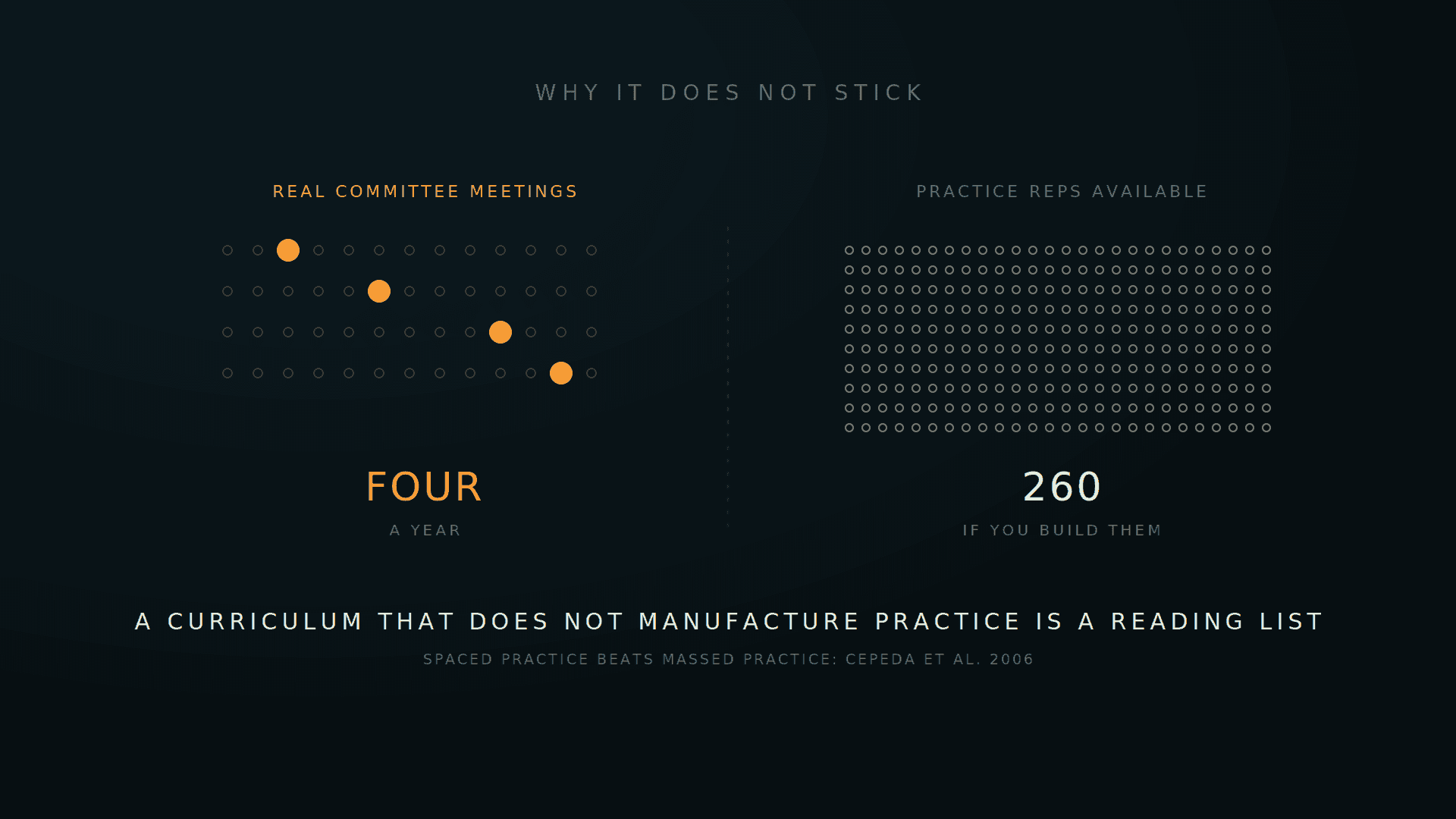
The learning science is not on the bootcamp's side either. Cepeda and colleagues' 2006 meta-analysis of 839 assessments across 14,811 participants found spaced practice beat massed practice, 47.3% versus 36.7% recall. A three-day enterprise selling bootcamp is the definition of massed practice. It works until roughly Tuesday.
Then there is who gets coached. The MySalesCoach and Aircall 2025 survey of over 1,600 sellers found AEs are 50% less likely to get frequent coaching than SDRs. The biggest deals get the least reinforcement. Gartner's September 2024 survey of 1,026 sellers found 72% feel overwhelmed by the number of skills their job requires. Dump six modules on them in one week and you have made that worse.
We have written about Atlassian's enterprise sales skill gap: a company with an excellent knowledge base discovering that knowing and doing are different muscles. That is the Conversation Gap, the distance between what a rep knows and what comes out of their mouth under pressure. We named it in an earlier piece on why deals are lost. Enterprise is where it is widest.
How should you deliver enterprise sales training?
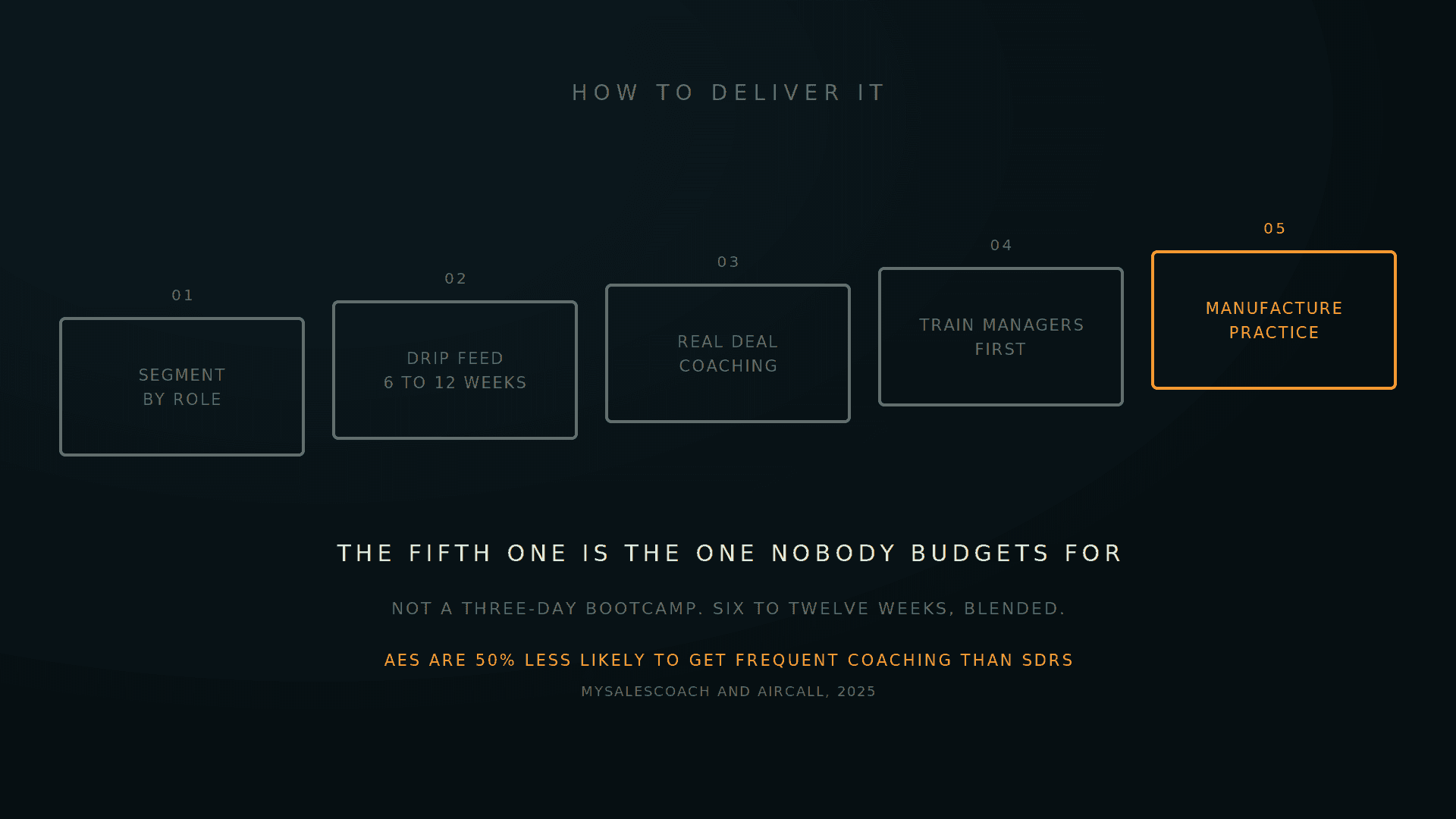
Deliver enterprise sales training by role, over weeks not days, against live deals, with managers trained first and practice manufactured in between. AI Mode's four delivery tips are good. It missed the fifth.
Segment by Role
An enterprise AE, a solutions consultant and an SDR feeding enterprise pipeline need different modules at different depth. The SDR needs account research and the first executive touch. The AE needs all six.
Drip Feed the Content
Six to twelve weeks, one module every one to two weeks, gaps filled by practice. Cepeda's spacing finding applied. A bootcamp is efficient at forgetting.
Use Real Deal Coaching
Every week, a pipeline scrub where the manager takes one live deal and applies the module of the week to it. Not a forecast call. A coaching session about that deal's committee and missing sponsor.
Train Your Managers First
If managers cannot inspect a deal for multi-threading and champion risk, reps will not be held to it. Our sister piece on sales management training for new sales managers covers this.
Manufacture Practice
The missing tip. Between real committee meetings, a rep should run the conversation in practice: a procurement lead asking for a discount, a CISO raising a security objection, a CFO asking why now. Voice, not multiple choice. Enough times that the response is a reflex, not a recall.
The gap most teams hit is that their program has content and coaching but nowhere to rehearse. That is the problem SecondBody was built to solve, by putting an AI buyer on the line that plays the procurement lead, the CISO and the CFO on demand.
How do you practice enterprise conversations before the real one?
You practice enterprise conversations by running them out loud against a realistic counterpart, scoring the attempt, and repeating until the hard moment stops being hard. This is the section about what we build.
Rory is our AI coach. A rep opens SecondBody on the phone, in WhatsApp or in a browser, picks a scenario, and talks. The enterprise scenarios teams run most: procurement asking for 30% off in the last week of the quarter; a CISO security objection mid-demo; a champion gone quiet; a "no decision" stall; an executive business review where the sponsor is leaving. Rory plays the buyer, pushes back the way buyers do, then scores the rep against the team's methodology, MEDDIC, MEDDPICC, SPIN or Sandler, and shows where the room was lost. Pairing this with a framework rollout is covered in MEDDIC implementation with AI roleplay.
Managers get a briefing before each 1:1 showing what the rep practiced and where they stalled. It is $30 per user per month on the Pro tier, public pricing, unlimited seats, SOC 2 (see our trust center), built in Paris. Tech and SaaS and cybersecurity teams are where we see the most enterprise use, Cyera among them.
What it is not. SecondBody does not run RFP responses, legal redlines or security questionnaires for you, and it does not replace a MEDDICC certification program. It is where reps rehearse the conversations those processes produce. If you need the rep to hold their price when procurement calls, that is us.
Who offers the best enterprise sales training?
The best enterprise sales training depends on whether you need a methodology, a cohort, or a practice layer, and most teams need two of the three. The enterprise sales training providers people shortlist, checked September 2026:
Provider | Good at | Format | Published price |
|---|---|---|---|
Sandler Enterprise Selling | Six-stage process for complex accounts | Instructor-led | Not public |
Brooks Group (IMPACT) | Consultative selling, teams new to enterprise | Instructor-led and virtual | Not public |
A Sales Growth Company (Gap Selling) | Problem-centric discovery | Workshops and on-demand | Not public |
Pavilion Enterprise Sales School | Peer cohort of working enterprise sellers | 10-week live cohort | Included in membership at $1,375 or $2,700 per year |
Force Management (MEDDICC) | Value messaging and MEDDICC as one system | Custom, about a quarter | Custom |
Caliber | Self-paced modules for individual AEs | On-demand | Not public |
Coursera (various) | Cheap fundamentals | Self-paced video | Low, varies |
SecondBody | Voice practice of the conversations the others teach, MEDDIC-native scoring | Phone, WhatsApp, browser | $30/user/month Pro, public |
The honest pairing: a methodology provider for the framework, a practice layer so it survives contact with a real committee.
What does an enterprise sales training program cost?
An enterprise sales training program typically costs five figures per cohort from a methodology vendor, with public exceptions like Pavilion's membership at $1,375 or $2,700 per year. Most vendors do not publish prices, so the five-figure range is what buyers tell us, not a rate card.
The optimistic read: a five-figure cohort across ten AEs carrying seven-figure quotas is a rounding error if it moves one deal. The skeptical read: it only moves a deal if it sticks, and without reinforcement the Cepeda data says most of it fades. A very expensive Tuesday.
Our number is public. $30 per user per month for SecondBody Pro, unlimited seats. Not a substitute for the cohort. The line item that keeps the cohort paying out after the trainer goes home.
What does a 12-week enterprise sales training plan look like?
A 12-week enterprise sales training plan maps the six modules to two-week blocks, with practice reps and a manager pipeline scrub every week.
Weeks | Module | Practice per rep per week | Manager scrub focus |
|---|---|---|---|
1 to 2 | Strategic Account Research & Prospecting | 3 first-executive-touch conversations | Which live accounts have a mapped sponsor |
3 to 4 | Advanced Discovery & Value Quantification | 4 discovery calls ending in a number | One deal's business case in two minutes |
5 to 6 | Deal Qualification Frameworks | 3 economic-buyer conversations, 1 disqualification | Which deals get killed this week |
7 to 8 | Navigating Buying Committees & Corporate Politics | 3 champion check-ins, 2 blocker conversations | Thread count per deal |
9 to 10 | Procurement, Security & Legal Navigation | 3 procurement pushbacks, 2 security objections | Mutual action plan status on every late-stage deal |
11 to 12 | Complex Negotiations & Expansion | 4 price-hold negotiations, 1 ownership handover | Post-signature owner on every closing deal |
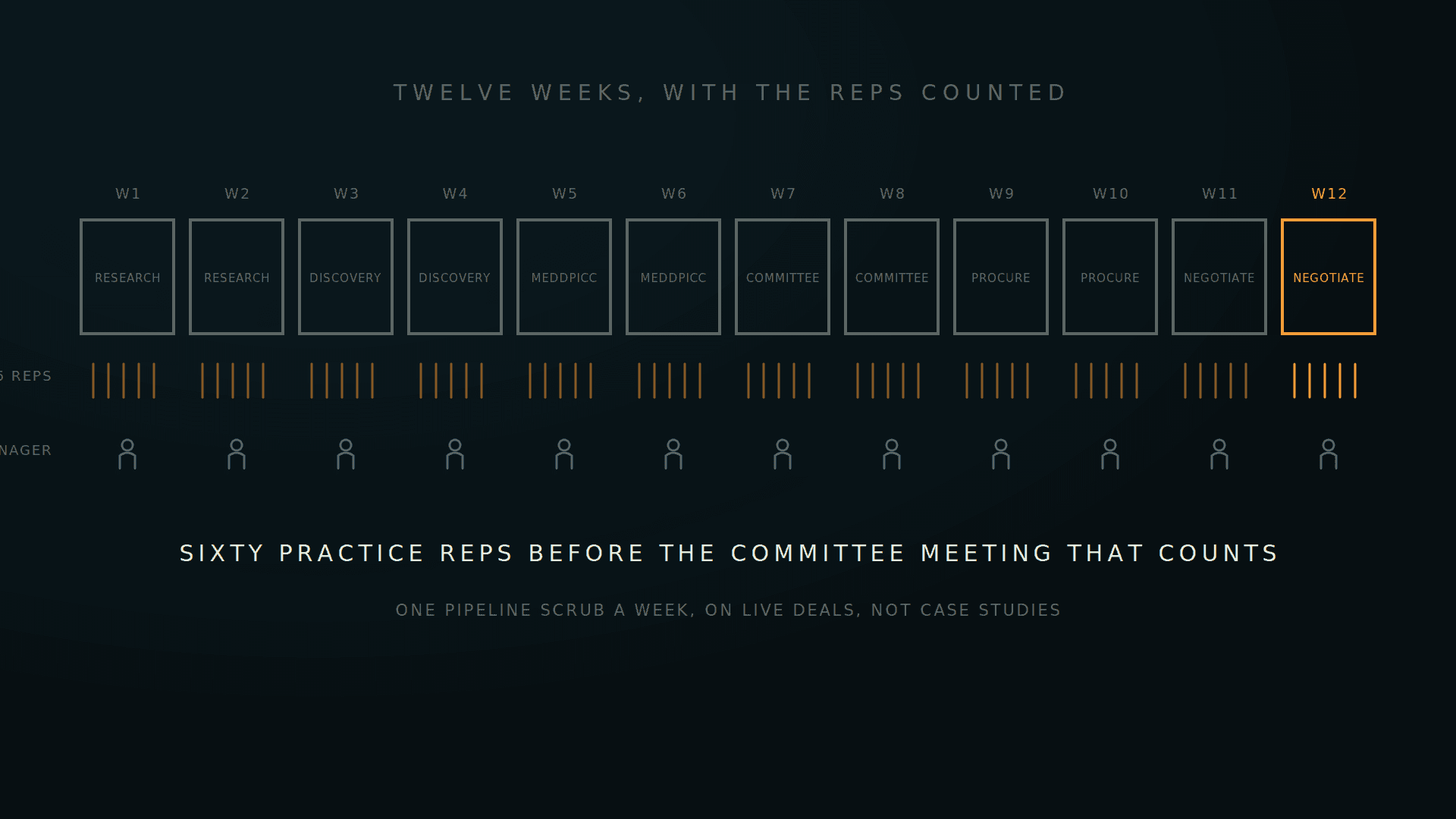
Roughly 36 practice conversations per rep. Against four real committee meetings a year, a decade of reps in a quarter.
How do you measure enterprise sales training?
Measure enterprise sales training with multi-threading rate, stage conversion, cycle length, forecast accuracy, and no-decision rate, in that order of how fast they move.
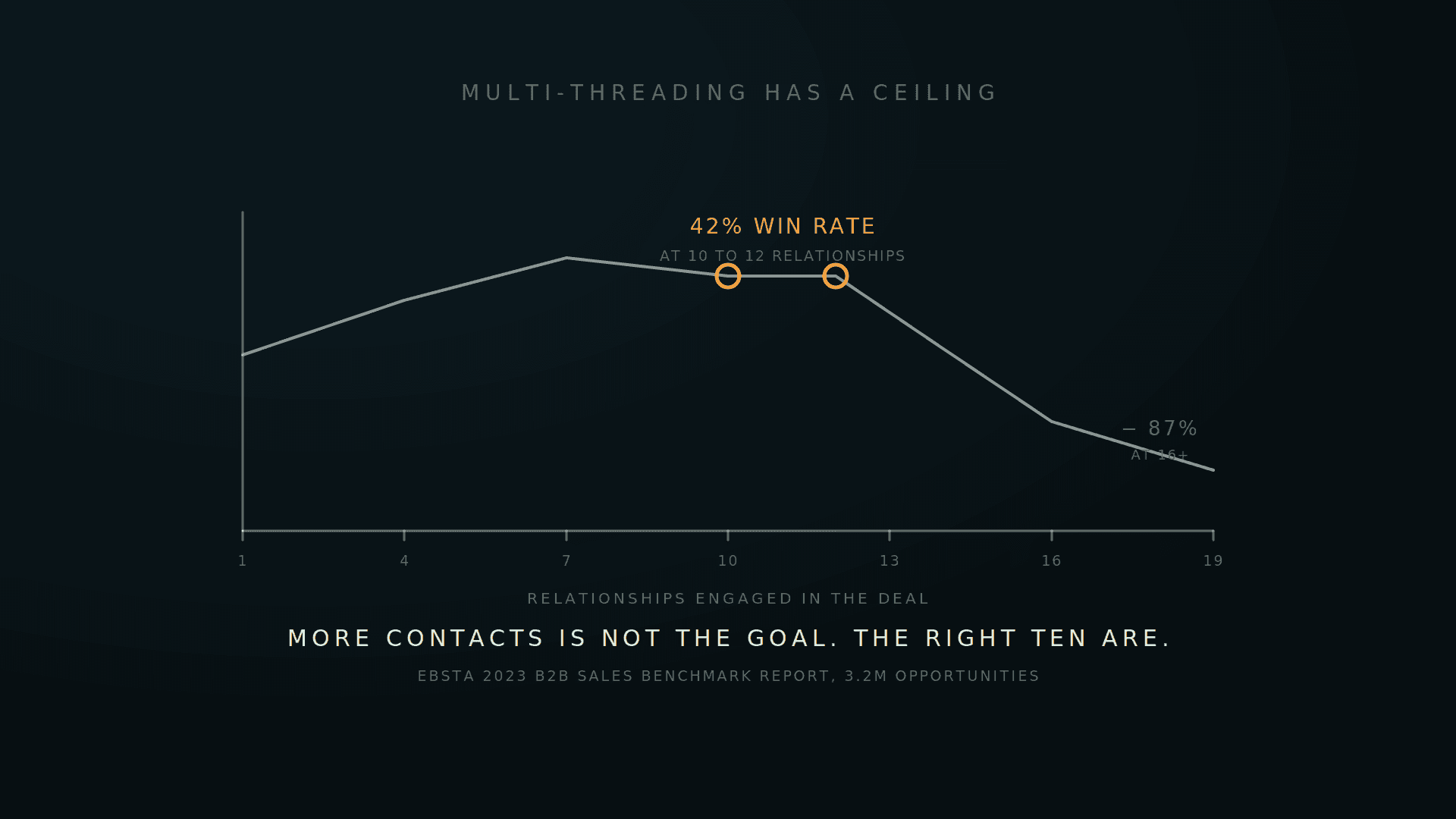
Multi-threading is the leading indicator, and three vendor datasets agree on direction while disagreeing on size. Gong (1.8 million opportunities, January 2026): closed-won deals include 67% more contacts than closed-lost, and strategic enterprise deals average 17. Ebsta (2023): enterprise deals peak at 10 to 12 relationships with win rates around 42%, and, the part nobody quotes, win rate falls 87% at 16 or more. Outreach (undated, no method published): deals with more than one contact are 37% more likely to close. The widely repeated "single-threaded deals close at 5%, five-plus stakeholders at 30%" has no traceable source, so we do not use it.
On no-decision rate, Dixon and McKenna's JOLT Effect research across 2.5 million sales conversations found 40% to 60% of qualified deals are lost to indecision. If your program works, that number falls before your win rate rises.
Our win rate definition and five metrics for sales training ROI cover the mechanics.
What are the common mistakes in enterprise sales training?
The common mistakes are the SMB program with a MEDDPICC deck bolted on, bootcamp then silence, the framework as a form, single-threading, procurement as a surprise, no manager reinforcement, and no practice. We have watched all seven.
Same program as SMB. The reps learn to run a great demo. The committee wants a case, a plan and a sponsor.
Bootcamp, then nothing. Three days in a hotel, then a quarter of silence. The worst possible spacing.
MEDDPICC as a form. The economic buyer field says "TBD" for four months because nobody asked the question out loud.
Single-threading. A buyer told us our own pipeline looked unqualified because we had one contact per account. If a buyer can see it, your board can.
Procurement as a late-stage surprise. Forrester says procurement decides in more than half of cycles. Start the mutual action plan in week one.
No manager reinforcement. Managers never trained to inspect a committee inspect a forecast instead.
No practice. A knowledge base, a certification, and nowhere to rehearse. The rep meets the real CFO and does it for the first time.
Number seven makes the other six worse.
Frequently asked questions
What is enterprise sales training?
Training for reps who sell high-value, long-cycle deals into large organisations with buying committees, procurement and security reviews. Six modules, account research through expansion.
What skills are needed for enterprise sales?
Business acumen, political mapping, multi-threading, quantifying pain in money, procurement navigation, and patience. All conversational, so reading about them is not having them.
What is the best enterprise sales training?
The one that pairs a methodology with reinforcement. Sandler, Brooks Group, Force Management, Gap Selling and Pavilion are the usual methodology shortlist. Reinforcement is weekly practice and manager deal coaching, where most programs are thin.
How to manage enterprise sales training?
Segment by role, drip feed the content over 6 to 12 weeks, run a weekly real-deal scrub, train your managers first, and give reps somewhere to practice. Measure multi-threading and no-decision rate, not completion.
Where can I find enterprise sales training?
Methodology vendors (Sandler, Brooks Group, Force Management, A Sales Growth Company), cohorts (Pavilion), self-paced platforms (Caliber, Coursera), and practice platforms like SecondBody.
Enterprise sales training online: does it work?
For knowledge, yes. For skill, only with live practice and feedback. A video about a procurement negotiation is about as useful as a video about swimming.
Enterprise sales vs B2B sales: what is the difference?
All enterprise sales is B2B. Enterprise is the subset with 5 to 16 people in the decision (Gartner 2025), cycles of two to four quarters, formal procurement and security steps, and "no decision" as the main competitor.
How to get into enterprise sales?
Usually through mid-market first. Get good at discovery and qualification on smaller deals, learn to read an org chart, find a manager who runs real deal reviews. Then ask for one enterprise account.
How long is an enterprise sales cycle?
Six to twelve months. 6sense's 2024 vendor survey says 11.3 months on average. Ebsta's 2023 platform data puts the optimal enterprise close window at 150 to 180 days, with win likelihood falling 60% one month past the expected close date.
Can SecondBody simulate a buying committee?
Rory plays one persona at a time, so a rep runs the procurement lead, then the CISO, then the CFO as separate conversations rather than a twelve-person call. That is how the real ones happen too. The committee mostly meets without you.
Does SecondBody score MEDDIC and MEDDPICC?
Yes. Scoring is methodology-native, against the MEDDIC or MEDDPICC letters your team uses, or SPIN and Sandler. The manager sees which letters the rep keeps missing.
Is SecondBody enterprise-only?
No. Mid-market and SMB teams are core users. It is SOC 2, there is a tier you can start with today at $30 per user per month, and enterprise teams usually book a demo to talk through security review.
What does this all come back to?
It comes back to the Conversation Gap. The six-module enterprise sales training curriculum is correct, and every serious provider teaches a version of it. The gap is between the rep who can explain how to handle procurement asking for 30% off, and the rep who does it, on the call, with the quarter on the line. Four real committee meetings a year will not close that gap. Forty practice conversations a quarter might.
If you are building the whole program for a sales organisation, start with our guide to corporate sales training programs. If you are building the enterprise piece, take the six modules, drip them over twelve weeks, train the managers first, and put a practice layer underneath so the rep meets the real CFO for the twenty-first time, not the first. That last part is what SecondBody does. Rory has heard every objection your procurement team has.
Good luck out there.
How we know this: we build an AI sales practice platform, we sell it into enterprise ourselves, we sat in the calls quoted below, and we checked every number in this article at its source.
Type "enterprise sales training" into Google today and the first result is an archived Reddit thread from 2024. Someone asks what a new enterprise AE should study. The answers are four book titles and "LinkedIn Learning". That is the state of the art for a job where one deal carries a year of quota.
The short answer to what enterprise sales training should include: six modules that follow the shape of a large deal, from account research to expansion. The part that gets skipped: an enterprise AE meets a real buying committee about once a quarter. Four times a year. Any curriculum that does not manufacture practice in between is a reading list with a certificate.
We build one of these, so read on with that in mind. We will be harder on the category than anyone.
This is the enterprise spoke of our guide to corporate sales training programs, only about reps who close six-figure deals over six to twelve months.
(Scanning this? Every section is a question. Jump to whichever one you actually have.)
What is enterprise sales training?
Enterprise sales training is training for reps who sell high-value, long-cycle deals into large organisations with formal buying committees, procurement functions and security reviews. The buyer is not a person. It is a group, and the group has politics.
In practice, most companies run the same program as their SMB team and add a MEDDPICC deck. The rep learns the acronym on Tuesday, gets certified on Thursday, and walks into a call where procurement has declined the last three meeting invites. Nothing in the deck covers that.
Here is something worth sitting with. We reviewed every recorded call from ten months of our own enterprise deals. Not one prospect said MEDDIC or MEDDPICC. They talked about budget holders, sponsors, security, procurement, return on investment, and who would own the thing after signature. Teach those conversations. The acronym is the filing system.
How is enterprise sales training different from B2B sales training?
Enterprise sales training differs from B2B sales training in three ways: the cycle is measured in quarters, the buyer is a committee, and the main competitor is "no decision". Standard B2B sales training assumes one or two decision makers and a cycle you can move with follow-up. Enterprise has neither.
The numbers, dated and sourced. Forrester's State of Business Buying 2026 puts the typical buying decision at 13 internal stakeholders plus nine external influencers, with procurement a decision maker in 53% of cycles. Gartner's May 2025 survey of 632 buyers found groups of 5 to 16 people across up to four functions, and 74% of those groups showed unhealthy conflict during the decision. Forrester's 2024 edition found 86% of B2B purchases stall at some point. (You will see that 86% attributed to Gartner all over the internet. It is Forrester.)
SMB and mid-market | Enterprise | |
|---|---|---|
Cycle | Weeks to a quarter | Two to four quarters |
People in the decision | One to three | 5 to 16 internal (Gartner 2025), plus external influencers |
Main skill | Running a good discovery call and closing | Keeping a committee moving toward a decision |
Main risk | Losing to a competitor | Losing to no decision |
What kills the deal | Price, fit | A missing sponsor, a security review, an unbudgeted line, a champion leaving |
So the "enterprise sales vs B2B sales" question has a plain answer. All enterprise sales is B2B. Not all B2B is enterprise. The training earns the name when it is built around the committee.
What skills are needed for enterprise sales?
The skills needed for enterprise sales are business acumen, political mapping, multi-threading, quantifying pain in money, procurement navigation, and patience. Brooks Group lists six competencies in its own guide to enterprise sales training, and they are fair. What the list leaves out is that every one is a conversation, and the conversations are rare.
Political mapping is not a slide. It is an enablement lead at a UK enterprise telling us, "That needed a VP sponsor. I can't progress without that." The rep has to hear champion versus sponsor in real time. Multi-threading is not a CRM field. It is a UK healthcare distributor telling us, of our own pipeline, that if we had only engaged one stakeholder per account, "this isn't filling us with confidence that this is qualified." A buyer said that to a vendor. Read it twice.
Patience is the skill nobody trains. A medical device sales leader told us the real discussion with a clinician is "six or seven discussions down from the initial discussion." His view of the gap in his own reps was not product knowledge. It was, "Do they know when to shut up and listen first?"
That is an enterprise software sales skills training curriculum in one sentence, from someone who has never read one.
What should an enterprise sales training program include?
An enterprise sales training program should include six modules that follow the life of a large deal. Google's AI Mode produces this exact list when you ask it, and it is right about the list. It is quiet about what makes any of it stick.
Strategic Account Research & Prospecting
Reading a 10-K, mapping personas across functions, and sequencing outreach so the first meeting is with someone who can sponsor, not just someone who will take a call. The trainable conversation is the first executive touch: know who the executive is, then earn the right to bring them in.
Advanced Discovery & Value Quantification
Turning pain into a number the CFO recognises, whiteboarding the current state, and crossing the "confidence chasm", where a buyer believes the problem is real but not worth the disruption. Gartner's 2019 research (1,000-plus buyers, note the year) found buyers facing contradictory information were 153% more likely to settle for a smaller purchase.
The conversation to train: an enablement lead at a UK enterprise told us anything they trialed would need "a really clear mapped out return on investment", and, separately, "we don't do paid pilots." The rep who cannot build that case in the room does not get a second room.
Deal Qualification Frameworks
MEDDPICC, or whichever deal qualification framework you use, taught as questions the rep asks out loud, not a form filled in after the call. The discipline that matters is disqualification. We wrote about that in why MEDDIC and MEDDPICC exist to disqualify early, and the MEDDIC dictionary entry has the letters.
The economic buyer question, as we asked it on a real call: "What's the one signal that the decision maker or the budget holder needs to see to say we're gonna pull the trigger?" The answer: "We need one person to be happy, and that person needs to be the budget holder." The E in MEDDPICC, in the buyer's words, because the rep asked.
Navigating Buying Committees & Corporate Politics
Building a champion, identifying the six buying roles, and neutralising blockers without making enemies. Gartner's 2025 data has a sharp lesson: tailoring your message to one persona's needs had a 59% negative impact on the group's ability to reach consensus, and consensus groups were 2.5 times more likely to report a high-quality deal. Personalising to the champion can lose you the committee.
The failure mode is champion risk. An enablement lead at a UK enterprise told us her sponsor "has been a big sponsor, but as he's on the way out, it's maybe good to bring other people in." Same call: "Everything's a priority at the moment, which makes nothing a priority." Our piece on executive stakeholder management in B2B sales goes deeper.
Procurement, Security & Legal Navigation
InfoSec reviews, SOC 2 evidence, mutual action plans, RFP discipline, and the rhythm of a procurement function that does not answer email. Forrester 2026 says procurement is a decision maker in 53% of buying cycles. That is a stakeholder from day one, not a late-stage hurdle.
What it sounds like. From a UK enterprise: "The InfoSec process does indicate it could be up to two to three weeks." From a medical device sales leader describing his own company's process while championing us: procurement people "just decline every Teams meeting you send them", and "the protection teams and freaking cybersecurity guys" are where deals go to wait. Train the mutual action plan conversation before the rep needs it.
Complex Negotiations & Expansion
Trading value instead of discounts, holding a position through legal redlines, and structuring multi-year expansion from a small first land. A European events company told us, "I don't think we have anything budgeted for this, we'd have to scrape the budget," and "we really would need big success and strong ambassadors for us to scale it up." That is a land-and-expand deal described by the buyer. The rep has to hear it and shape the first contract to fit. Our sales negotiation playbook covers the tactics.
Expansion has a quiet killer. A global adtech company that churned told us afterward: "We don't have one owner. Everything is scattered." Nobody inside had owned the contract. A deal with no internal owner is a churn with a delay, so the ownership conversation belongs in this module.
Why does enterprise sales training usually fail to stick?
Enterprise sales training fails to stick because the skills are conversational and the conversations are rare. A rep gets one real buying committee meeting a quarter, one real procurement pushback, one real CFO reframe if they are lucky. Nobody gets good at anything on four reps a year.
The learning science is not on the bootcamp's side either. Cepeda and colleagues' 2006 meta-analysis of 839 assessments across 14,811 participants found spaced practice beat massed practice, 47.3% versus 36.7% recall. A three-day enterprise selling bootcamp is the definition of massed practice. It works until roughly Tuesday.
Then there is who gets coached. The MySalesCoach and Aircall 2025 survey of over 1,600 sellers found AEs are 50% less likely to get frequent coaching than SDRs. The biggest deals get the least reinforcement. Gartner's September 2024 survey of 1,026 sellers found 72% feel overwhelmed by the number of skills their job requires. Dump six modules on them in one week and you have made that worse.
We have written about Atlassian's enterprise sales skill gap: a company with an excellent knowledge base discovering that knowing and doing are different muscles. That is the Conversation Gap, the distance between what a rep knows and what comes out of their mouth under pressure. We named it in an earlier piece on why deals are lost. Enterprise is where it is widest.
How should you deliver enterprise sales training?
Deliver enterprise sales training by role, over weeks not days, against live deals, with managers trained first and practice manufactured in between. AI Mode's four delivery tips are good. It missed the fifth.
Segment by Role
An enterprise AE, a solutions consultant and an SDR feeding enterprise pipeline need different modules at different depth. The SDR needs account research and the first executive touch. The AE needs all six.
Drip Feed the Content
Six to twelve weeks, one module every one to two weeks, gaps filled by practice. Cepeda's spacing finding applied. A bootcamp is efficient at forgetting.
Use Real Deal Coaching
Every week, a pipeline scrub where the manager takes one live deal and applies the module of the week to it. Not a forecast call. A coaching session about that deal's committee and missing sponsor.
Train Your Managers First
If managers cannot inspect a deal for multi-threading and champion risk, reps will not be held to it. Our sister piece on sales management training for new sales managers covers this.
Manufacture Practice
The missing tip. Between real committee meetings, a rep should run the conversation in practice: a procurement lead asking for a discount, a CISO raising a security objection, a CFO asking why now. Voice, not multiple choice. Enough times that the response is a reflex, not a recall.
The gap most teams hit is that their program has content and coaching but nowhere to rehearse. That is the problem SecondBody was built to solve, by putting an AI buyer on the line that plays the procurement lead, the CISO and the CFO on demand.
How do you practice enterprise conversations before the real one?
You practice enterprise conversations by running them out loud against a realistic counterpart, scoring the attempt, and repeating until the hard moment stops being hard. This is the section about what we build.
Rory is our AI coach. A rep opens SecondBody on the phone, in WhatsApp or in a browser, picks a scenario, and talks. The enterprise scenarios teams run most: procurement asking for 30% off in the last week of the quarter; a CISO security objection mid-demo; a champion gone quiet; a "no decision" stall; an executive business review where the sponsor is leaving. Rory plays the buyer, pushes back the way buyers do, then scores the rep against the team's methodology, MEDDIC, MEDDPICC, SPIN or Sandler, and shows where the room was lost. Pairing this with a framework rollout is covered in MEDDIC implementation with AI roleplay.
Managers get a briefing before each 1:1 showing what the rep practiced and where they stalled. It is $30 per user per month on the Pro tier, public pricing, unlimited seats, SOC 2 (see our trust center), built in Paris. Tech and SaaS and cybersecurity teams are where we see the most enterprise use, Cyera among them.
What it is not. SecondBody does not run RFP responses, legal redlines or security questionnaires for you, and it does not replace a MEDDICC certification program. It is where reps rehearse the conversations those processes produce. If you need the rep to hold their price when procurement calls, that is us.
Who offers the best enterprise sales training?
The best enterprise sales training depends on whether you need a methodology, a cohort, or a practice layer, and most teams need two of the three. The enterprise sales training providers people shortlist, checked September 2026:
Provider | Good at | Format | Published price |
|---|---|---|---|
Sandler Enterprise Selling | Six-stage process for complex accounts | Instructor-led | Not public |
Brooks Group (IMPACT) | Consultative selling, teams new to enterprise | Instructor-led and virtual | Not public |
A Sales Growth Company (Gap Selling) | Problem-centric discovery | Workshops and on-demand | Not public |
Pavilion Enterprise Sales School | Peer cohort of working enterprise sellers | 10-week live cohort | Included in membership at $1,375 or $2,700 per year |
Force Management (MEDDICC) | Value messaging and MEDDICC as one system | Custom, about a quarter | Custom |
Caliber | Self-paced modules for individual AEs | On-demand | Not public |
Coursera (various) | Cheap fundamentals | Self-paced video | Low, varies |
SecondBody | Voice practice of the conversations the others teach, MEDDIC-native scoring | Phone, WhatsApp, browser | $30/user/month Pro, public |
The honest pairing: a methodology provider for the framework, a practice layer so it survives contact with a real committee.
What does an enterprise sales training program cost?
An enterprise sales training program typically costs five figures per cohort from a methodology vendor, with public exceptions like Pavilion's membership at $1,375 or $2,700 per year. Most vendors do not publish prices, so the five-figure range is what buyers tell us, not a rate card.
The optimistic read: a five-figure cohort across ten AEs carrying seven-figure quotas is a rounding error if it moves one deal. The skeptical read: it only moves a deal if it sticks, and without reinforcement the Cepeda data says most of it fades. A very expensive Tuesday.
Our number is public. $30 per user per month for SecondBody Pro, unlimited seats. Not a substitute for the cohort. The line item that keeps the cohort paying out after the trainer goes home.
What does a 12-week enterprise sales training plan look like?
A 12-week enterprise sales training plan maps the six modules to two-week blocks, with practice reps and a manager pipeline scrub every week.
Weeks | Module | Practice per rep per week | Manager scrub focus |
|---|---|---|---|
1 to 2 | Strategic Account Research & Prospecting | 3 first-executive-touch conversations | Which live accounts have a mapped sponsor |
3 to 4 | Advanced Discovery & Value Quantification | 4 discovery calls ending in a number | One deal's business case in two minutes |
5 to 6 | Deal Qualification Frameworks | 3 economic-buyer conversations, 1 disqualification | Which deals get killed this week |
7 to 8 | Navigating Buying Committees & Corporate Politics | 3 champion check-ins, 2 blocker conversations | Thread count per deal |
9 to 10 | Procurement, Security & Legal Navigation | 3 procurement pushbacks, 2 security objections | Mutual action plan status on every late-stage deal |
11 to 12 | Complex Negotiations & Expansion | 4 price-hold negotiations, 1 ownership handover | Post-signature owner on every closing deal |
Roughly 36 practice conversations per rep. Against four real committee meetings a year, a decade of reps in a quarter.
How do you measure enterprise sales training?
Measure enterprise sales training with multi-threading rate, stage conversion, cycle length, forecast accuracy, and no-decision rate, in that order of how fast they move.
Multi-threading is the leading indicator, and three vendor datasets agree on direction while disagreeing on size. Gong (1.8 million opportunities, January 2026): closed-won deals include 67% more contacts than closed-lost, and strategic enterprise deals average 17. Ebsta (2023): enterprise deals peak at 10 to 12 relationships with win rates around 42%, and, the part nobody quotes, win rate falls 87% at 16 or more. Outreach (undated, no method published): deals with more than one contact are 37% more likely to close. The widely repeated "single-threaded deals close at 5%, five-plus stakeholders at 30%" has no traceable source, so we do not use it.
On no-decision rate, Dixon and McKenna's JOLT Effect research across 2.5 million sales conversations found 40% to 60% of qualified deals are lost to indecision. If your program works, that number falls before your win rate rises.
Our win rate definition and five metrics for sales training ROI cover the mechanics.
What are the common mistakes in enterprise sales training?
The common mistakes are the SMB program with a MEDDPICC deck bolted on, bootcamp then silence, the framework as a form, single-threading, procurement as a surprise, no manager reinforcement, and no practice. We have watched all seven.
Same program as SMB. The reps learn to run a great demo. The committee wants a case, a plan and a sponsor.
Bootcamp, then nothing. Three days in a hotel, then a quarter of silence. The worst possible spacing.
MEDDPICC as a form. The economic buyer field says "TBD" for four months because nobody asked the question out loud.
Single-threading. A buyer told us our own pipeline looked unqualified because we had one contact per account. If a buyer can see it, your board can.
Procurement as a late-stage surprise. Forrester says procurement decides in more than half of cycles. Start the mutual action plan in week one.
No manager reinforcement. Managers never trained to inspect a committee inspect a forecast instead.
No practice. A knowledge base, a certification, and nowhere to rehearse. The rep meets the real CFO and does it for the first time.
Number seven makes the other six worse.
Frequently asked questions
What is enterprise sales training?
Training for reps who sell high-value, long-cycle deals into large organisations with buying committees, procurement and security reviews. Six modules, account research through expansion.
What skills are needed for enterprise sales?
Business acumen, political mapping, multi-threading, quantifying pain in money, procurement navigation, and patience. All conversational, so reading about them is not having them.
What is the best enterprise sales training?
The one that pairs a methodology with reinforcement. Sandler, Brooks Group, Force Management, Gap Selling and Pavilion are the usual methodology shortlist. Reinforcement is weekly practice and manager deal coaching, where most programs are thin.
How to manage enterprise sales training?
Segment by role, drip feed the content over 6 to 12 weeks, run a weekly real-deal scrub, train your managers first, and give reps somewhere to practice. Measure multi-threading and no-decision rate, not completion.
Where can I find enterprise sales training?
Methodology vendors (Sandler, Brooks Group, Force Management, A Sales Growth Company), cohorts (Pavilion), self-paced platforms (Caliber, Coursera), and practice platforms like SecondBody.
Enterprise sales training online: does it work?
For knowledge, yes. For skill, only with live practice and feedback. A video about a procurement negotiation is about as useful as a video about swimming.
Enterprise sales vs B2B sales: what is the difference?
All enterprise sales is B2B. Enterprise is the subset with 5 to 16 people in the decision (Gartner 2025), cycles of two to four quarters, formal procurement and security steps, and "no decision" as the main competitor.
How to get into enterprise sales?
Usually through mid-market first. Get good at discovery and qualification on smaller deals, learn to read an org chart, find a manager who runs real deal reviews. Then ask for one enterprise account.
How long is an enterprise sales cycle?
Six to twelve months. 6sense's 2024 vendor survey says 11.3 months on average. Ebsta's 2023 platform data puts the optimal enterprise close window at 150 to 180 days, with win likelihood falling 60% one month past the expected close date.
Can SecondBody simulate a buying committee?
Rory plays one persona at a time, so a rep runs the procurement lead, then the CISO, then the CFO as separate conversations rather than a twelve-person call. That is how the real ones happen too. The committee mostly meets without you.
Does SecondBody score MEDDIC and MEDDPICC?
Yes. Scoring is methodology-native, against the MEDDIC or MEDDPICC letters your team uses, or SPIN and Sandler. The manager sees which letters the rep keeps missing.
Is SecondBody enterprise-only?
No. Mid-market and SMB teams are core users. It is SOC 2, there is a tier you can start with today at $30 per user per month, and enterprise teams usually book a demo to talk through security review.
What does this all come back to?
It comes back to the Conversation Gap. The six-module enterprise sales training curriculum is correct, and every serious provider teaches a version of it. The gap is between the rep who can explain how to handle procurement asking for 30% off, and the rep who does it, on the call, with the quarter on the line. Four real committee meetings a year will not close that gap. Forty practice conversations a quarter might.
If you are building the whole program for a sales organisation, start with our guide to corporate sales training programs. If you are building the enterprise piece, take the six modules, drip them over twelve weeks, train the managers first, and put a practice layer underneath so the rep meets the real CFO for the twenty-first time, not the first. That last part is what SecondBody does. Rory has heard every objection your procurement team has.
Good luck out there.
Four committee meetings a year is not enough practice.
SecondBody puts an enterprise buying committee in front of your reps every week, with Rory playing the CFO, the champion and procurement.


SecondBody is the AI sales practice platform built for field, regulated, and enterprise sales teams. Voice-first practice with Rory, your AI coach. Pre-call practice, not post-call analysis. Pre-1:1 manager briefings. Unlimited seats at $30 per user per month. Built in Paris. SOC 2 compliant.
Related reading: Corporate Sales Training Programs: 2026 Guide · Sales Management Training for New Sales Managers · Discovery Call Practice · What is Win Rate?
Share this article