Back
Cold Call Scripts That Work in 2026: Three Scripts, Every Line Backed by 90,000 Calls, and the 10 Days It Takes to Stop Sounding Like You Are Reading One
Three cold call scripts for 2026, with voicemail and gatekeeper tracks, and every line traced back to published call data. A 10-day drill plan is included.

Posted by
SecondBody.ai
Published by
Last Updated
How we know this: we build an AI sales practice platform, we sat in the calls where sales leaders told us what their scripts do and do not do, and we checked every number here at its source, year and sample size attached.
Most cold call scripts fail for a reason that has nothing to do with the words. A real person picks up, says something slightly off-pattern, and the rep's brain goes to the page instead of the person. You can hear it. The prospect can hear it. The call is over in nine seconds.
So this article gives you three scripts, not twenty-five, every line tied to a dated, sized dataset, then a 10-day method for rehearsing them until you can leave them. A script you cannot leave is a script you are reading.
We build one of these, so read on with that in mind. We will be harder on the category than anyone.
Managers: this is the spoke off our hub on cold calling training for sales teams.
(Scanning this? Every section is a question. Jump to whichever one you actually have.)
Should you even use a cold call script?
Yes. As scaffolding. Not as a teleprompter.
Our dictionary page says cold calling is not a script, and that still holds. You write the script so you have something to practice, and you practice it until you can deviate without losing the thread. We call this Script Scaffolding. The scaffold goes up so the building can stand on its own, then it comes down. A rep still reading in week six is living in the scaffolding.
The research backs the deviation part. Franke and Park's 2006 meta-analysis in the Journal of Marketing Research (155 samples, more than 31,000 salespeople) found adaptive selling, adjusting to what the buyer does in the moment, improves performance. Verbeke and colleagues' 2011 meta-analysis ranked adaptiveness the second strongest driver of sales performance. Neither says "throw away the script". The rep who can adjust wins, and you can only adjust from something you know cold.
Reps already do this. HubSpot's 2025 sales survey (vendor survey) found 52% of reps adapt a script rather than read or improvise.
What does the data say a cold call script should contain in 2026?
The AI-search summary is right as far as it goes: short, personalized, permission-based, and conversational, a framework rather than a teleprompter, one useful question, a specific next step. Here is what the call data adds.
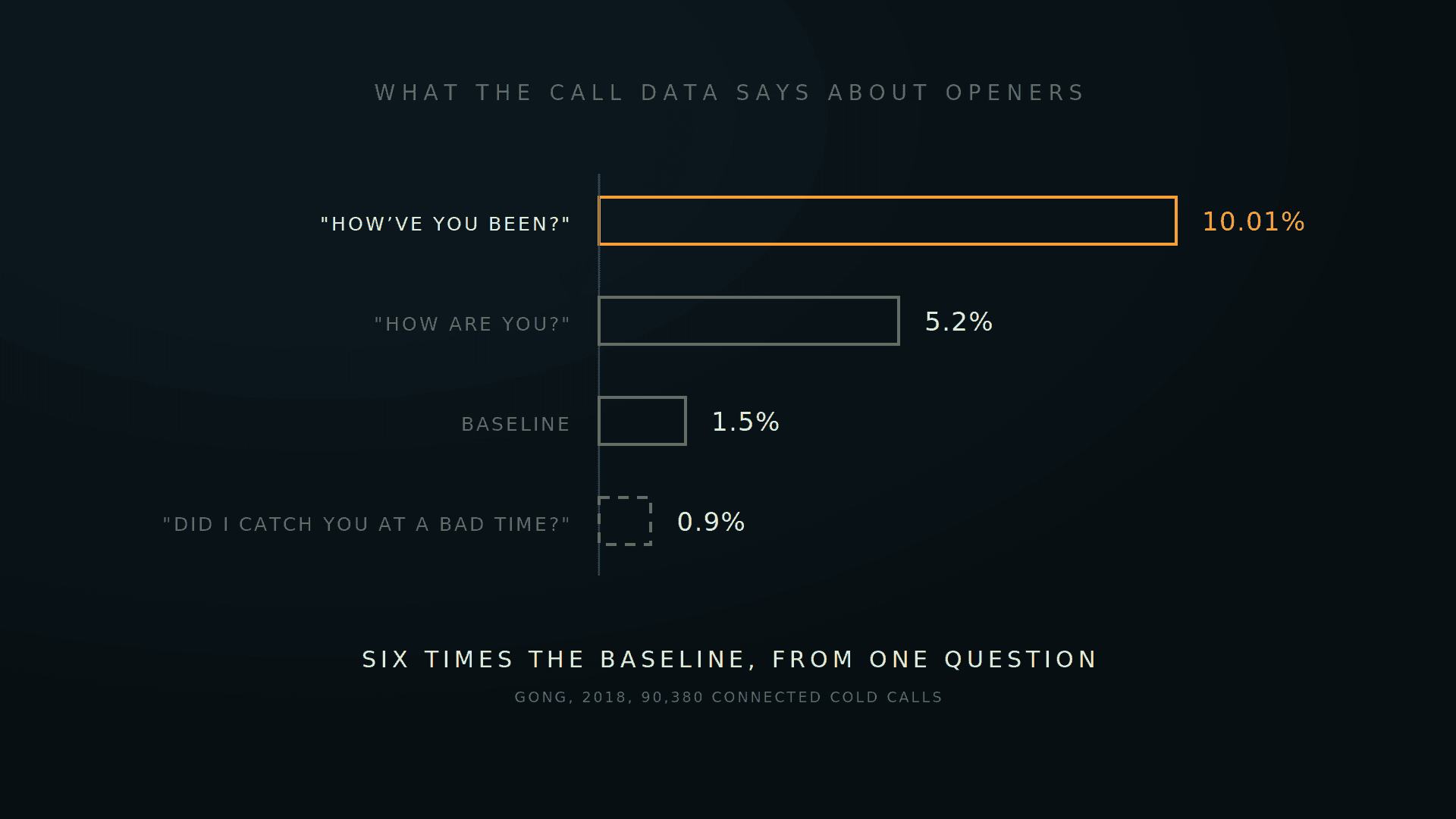
Gong, 2018, 90,380 connected cold calls. Baseline success (a meeting booked) was 1.5%. "How've you been?" succeeded 10.01% of the time, 6.6 times baseline. Stating "the reason for my call" lifted success 2.1 times. "Did I catch you at a bad time?" came in at 0.9%, 40% below baseline. Correlational, one vendor's customers, eight years old. Optimistic read: human attention has not changed since 2018. Skeptical read: a line thousands of SDRs have since copied cannot keep its novelty. Use it, and be ready to swap it.
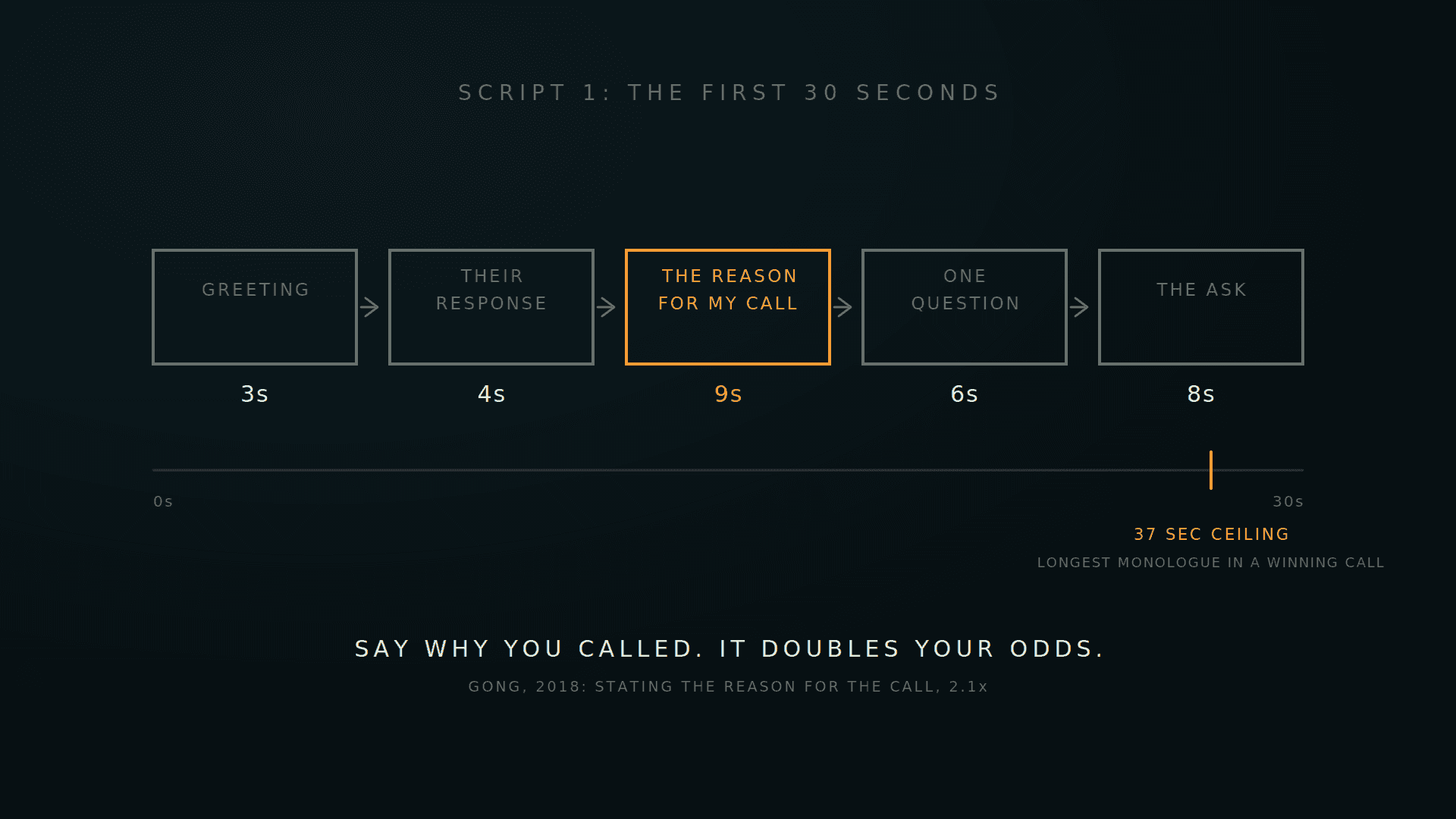
Gong, same dataset, call structure. Successful cold calls ran a 55:45 talk-to-listen ratio, rep to prospect, versus 42:58 in failed ones. The longest rep monologue in successful calls was 37 seconds versus 25. Successful reps used 35% more "we" relative to "I", with 77% more speaker switches per minute. And the one nobody prints: Gong found no relationship between question count and cold-call success.
Gong and 30 Minutes to President's Club, 2024, 300 million-plus calls. The permission-based opener ("Can I take 30 seconds to tell you why I called?") scored 11.18%. "I heard the name tossed around" scored 11.24%. "Did I catch you at a bad time?" scored 2.15%. The caveat is large: the study does not define what "success" means for the opener figures, so you cannot compare 11.18% to the 2018 numbers. "Bad time" scoring 2.15% here and 0.9% in 2018 tells you these are directional, not laws.
Put together: open like a person, say why you called, ask one question, propose one next step, and get your part done in under 30 seconds of your own talking. That cap comes from a call audit we ran on our own recordings, where reps were too verbose, feature-dumping instead of asking questions. The 37-second monologue figure backs it.
Script 1: What does a 30-second B2B cold call script actually sound like?
Brackets are yours. Everything outside them has a reason.
Rep: Hi [first name], it's [your name] from [your company]. How've you been?
(They answer. Respond to what they actually said, in one sentence, like a person. Then move.)
Rep: The reason for my call is, we've been talking to a few [their job title]s at [type of company] and the thing that keeps coming up is [the problem you fix]. I wanted to see whether that's true for you too, or whether you've got it handled.
(Stop. Whatever they say next is the call. Listen to all of it.)
Rep: That makes sense. Here's what I'd suggest. Give us 20 minutes on [day], we'll show you how [type of company] are dealing with [the problem], and if it isn't useful you tell me and we're done. Does [day] morning or afternoon work better?
Why each line is there:
"How've you been?" The 10.01% line from Gong 2018, against a 1.5% baseline. It implies familiarity and is easy to answer.
Respond in one sentence. The 77% more speaker switches.
"The reason for my call is" The 2.1x line. Prospects relax when they know why you are there.
"We've been talking to", "we'll show you". The 35% higher We-to-I ratio.
One problem, one question. Gong's no-relationship finding is why there is exactly one question. This is not discovery. The discovery-call opener is a different call.
"Give us 20 minutes on [day]" The specific next step. A day, a duration, a promise.
"If it isn't useful you tell me and we're done." The permission-based opener's cousin, moved to the end where it costs nothing. Nooks' 2024 data (vendor, thin on method) says 53% of top reps skip the front-loaded version, anyway.
Deliberately missing: "Did I catch you at a bad time?" 40% below baseline in 2018. It is always a bad time. Asking hands them the exit.
Three persona swaps, not ten templates. An SDR manager at a German SaaS company told us their SDR cold call scripts did not exist in their practice workspace, because everything had been written for AEs. That is the template trap. Change two phrases instead.
Operator (director or head of): "the thing they're spending most of their week on" instead of "the thing that keeps coming up". Operators respond to time.
Executive (VP and above): the consequence instead of the problem, "[the problem] and what it's doing to [the number they report on]".
Technical buyer: "we'll walk you through how, and you can tell us where it breaks". They want to find the hole.
The gap most teams hit is that the rep has one script, three personas, and no way to hear the difference. That is the problem SecondBody was built to solve, by letting a rep run the same opener against three AI buyers back to back and getting scored on each.
Script 2: What should a cold call voicemail script say?
Very little. Its job is not a callback but to get your next email opened.
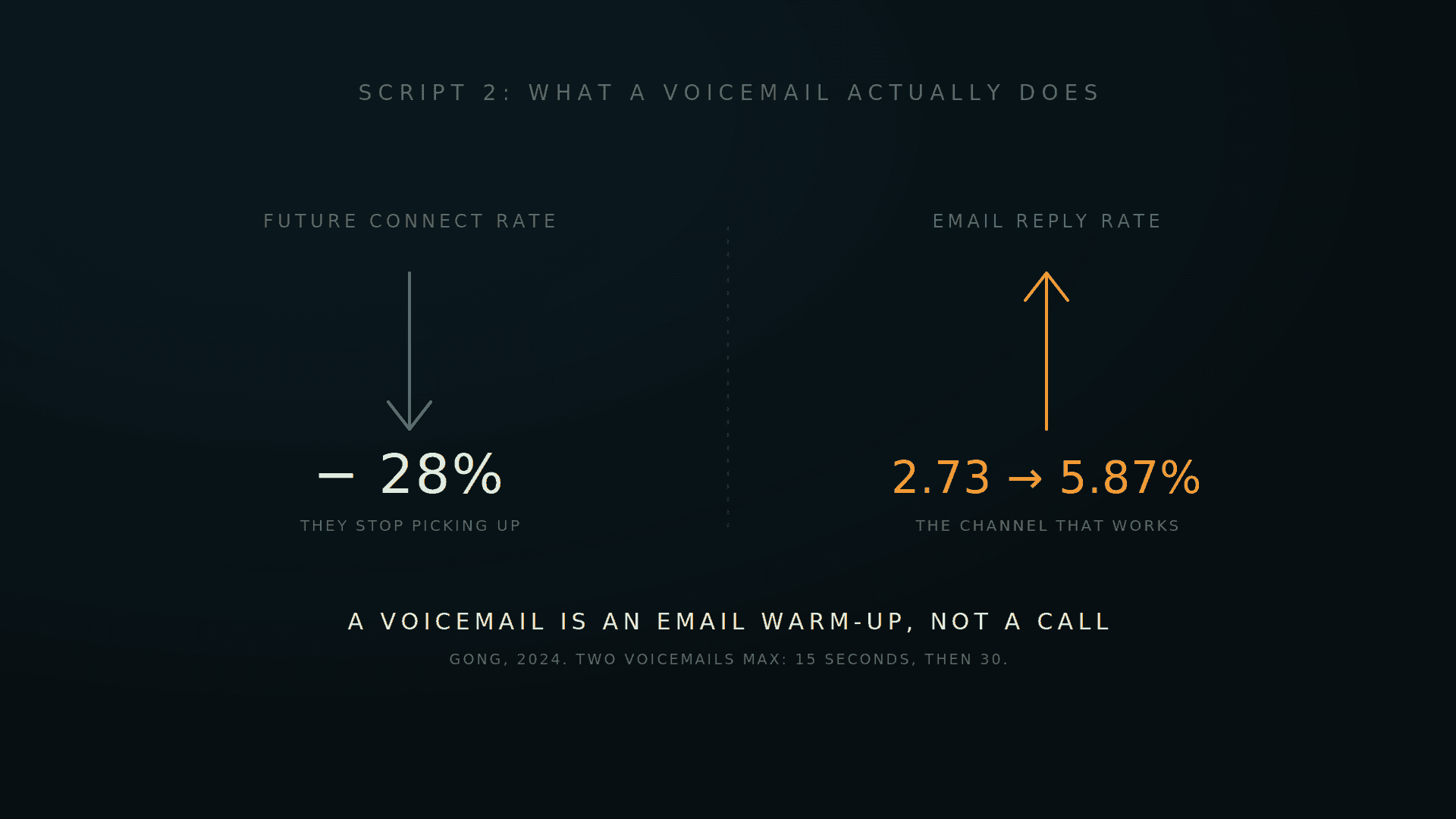
Gong's 2024 voicemail study: leaving a voicemail cut the chance of connecting on a future dial by 28%, and lifted email reply rates from 2.73% to 5.87%. The voicemail is a primer for the channel that works. Gong's guidance: two voicemails per prospect, maximum, the first about 15 seconds and the second about 30. And the "4.8% voicemail callback rate" you will see elsewhere is not a callback rate. It is a 2012 InsideSales anecdote about a response-rate lift.
Voicemail 1 (about 15 seconds):
Hi [first name], [your name] from [your company]. Quick one. We're working with a few [type of company] on [the problem you fix] and I've sent you an email with the subject line "[your subject line]". Have a look, and I'll try you again [day]. Thanks.
Voicemail 2 (about 30 seconds, a few days later):
Hi [first name], [your name] again from [your company]. I left you a note on [day] and sent an email with "[your subject line]" in the subject. The short version: [their job title]s at [type of company] keep telling us [the problem you fix] is eating [the thing it costs them], and we've got a fix that takes 20 minutes to show. If it's not relevant, reply "no" to the email and I'll leave you alone. Otherwise I'll try you one more time [day]. Thanks.
Why each line is there:
Name and company, immediately. You are paying the 28% connect drop. Do not waste the first five seconds.
"I've sent you an email with the subject line..." The whole point. The 2.73% to 5.87% lift only happens if the voicemail points at a specific email.
"Reply 'no' and I'll leave you alone." Second voicemail only. It saves you a wasted third attempt.
No features, no "I'd love to connect". Fifteen seconds is about 40 words. Spend them on the email.
Script 3: How do you get past a gatekeeper on a cold call?
By remembering the gatekeeper is not objecting. They asked a question. Answer it.
A UK healthcare sales director put it this way: "How can I help you?" from a receptionist is not an objection, and reps who treat it like one get defensive. The goal is "just to get the process moving". A name, a better time, a direct line.
Gatekeeper: Good morning, [company], how can I help you?
Rep: Morning. It's [your name] from [your company]. I'm trying to reach [first name last name] about [the problem you fix, in four words or fewer]. Is [first name] around this morning?
(If yes, say thank you and wait. If no:)
Rep: No problem. When's usually a good time to catch [first name]? And is there a better number, or is this the best way through?
(If they ask what it is regarding:)
Rep: It's about [the problem you fix]. Is [first name] the right person for that, or is it someone else on the team?
Why each line is there:
Full name, then first name. It signals you know who they are.
"About [the problem], in four words or fewer." Enough for the gatekeeper to route you, not enough to trigger "can I take a message".
"When's usually a good time?" The "get the process moving" line.
"Or is it someone else?" The gatekeeper knows the org chart better than your data vendor. No tricks. Gatekeepers remember.
How fast and how loud should you talk on a cold call?
About 3.5 words a second, four or five deliberate pauses a minute, and slower than you feel like going.
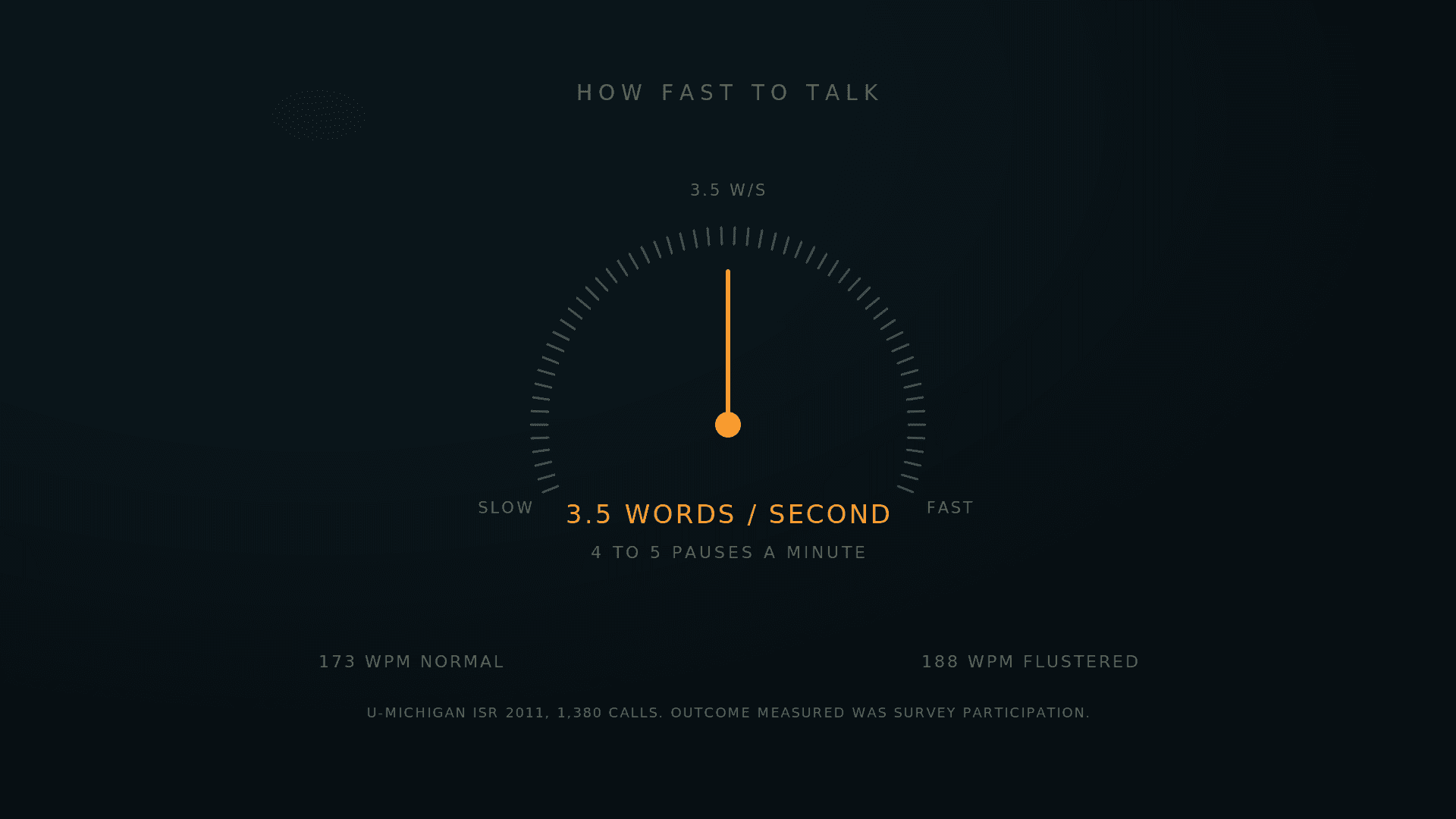
The pace figure is from a University of Michigan Institute for Social Research study presented in 2011: 1,380 calls by 100 interviewers, and those speaking at roughly 3.5 words per second with four to five pauses per minute won the most. The caveat: the outcome was agreeing to take a survey, not booking a meeting. A stranger deciding in ten seconds whether to keep listening is close enough.
Gong's 2019 analysis of 67,149 demo calls (demos, not cold calls) found a baseline of 173 words per minute, top producers at 176, flustered reps at 188. Speed is what stress sounds like from the outside.
The pauses matter more than the speed. They are where the speaker switches happen.
What happens when the script meets an objection?
You pause, you ask one question, and you stop following the script.
This is not a rebuttal library. The LAER framework page is where the method lives. The moment the prospect objects is the moment Script Scaffolding is supposed to come down. If your reps are hunting for the "objection" section of the talk track while the buyer is mid-sentence, the script has become a liability.
What the script can do is set the reflex: write "pause, then ask" as a stage direction and rehearse the pause as a line. The manager's side, how to drill objections until they stop scaring the rep, is the sister article on objection handling training drills.
How do you practice a cold call script until it sounds like you?
Daily, out loud, in short sessions, against something that talks back. One read-through the night before does almost nothing.
Murre and Dros replicated Ebbinghaus's forgetting curve in 2015 (PLOS ONE). It is a single-subject study, n=1, so treat the figures as an illustration: about 56% retained at 20 minutes, 32% at one day, 4% at 31 days. Read the script on Sunday, dial on Monday, and you are working from roughly a third of it.
Spacing fixes this. Cepeda and colleagues' 2006 meta-analysis (271 comparisons, 14,811 participants) found spaced practice produced 47.3% correct recall versus 36.7% for the same practice massed into one session. Same total time, ten points of difference. That is the whole argument for 15 minutes a day over a Friday workshop.
Then the awkward one. Macnamara, Hambrick and Oswald's 2014 meta-analysis found deliberate practice explained 26% of performance variance in games, 21% in music, 18% in sports, 4% in education, and under 1% in professions. The professions figure gets quoted as "practice doesn't work for sales", but those studies measured practice loosely. The honest takeaway: practice matters, and what you practice and how you measure it matters as much.
The teams we work with converged on the same cadence: 7 to 15 minutes at the beginning of the day, or a post-lunch blocker. One SDR on one of those teams moved from practice scores of 5 or 6 out of 10 to a steady 7 or 8 over a few weeks. Not a controlled study. A pattern we keep seeing.
The 10-day plan, assuming the script is written:
Day | What to do | Time | What "done" looks like |
|---|---|---|---|
1 | Read the full script aloud. Record it. Listen back once. | 15 min | Your baseline. |
2 | Opener only (greeting, response, reason). 20 reps aloud, no paper after rep 5. | 10 min | First two turns without looking. |
3 | Opener only. 20 reps. Vary the prospect's reply (busy, suspicious, cheerful, silent). | 10 min | Your one-sentence response changes with their answer. |
4 | Opener only. 20 reps. Record reps 15 to 20, listen for pace and pauses. | 10 min | Under 15 seconds for your part. Two audible pauses. |
5 | Full script with a peer as the prospect. One curveball per run. 10 runs. | 15 min | You reach the ask every time. |
6 | Full script with a peer. Swap roles for half the runs. 10 runs. | 15 min | You can name the weakest line. Rewrite it tonight. |
7 | AI roleplay, persona 1 (operator). 5 scored runs. | 15 min | Score trending up across the five. |
8 | AI roleplay, persona 2 (executive). 5 scored runs, using the executive swaps. | 15 min | You changed the two phrases without stalling. |
9 | AI roleplay, persona 3 (technical buyer). 5 scored runs, then all three personas back to back. | 15 min | Three personas in a row, no paper. |
10 | Live dials. Review three recorded calls against the script with your manager or peer. | Dial block plus 20 min | You know which lines you kept, which you dropped, and which one you should never have written. |
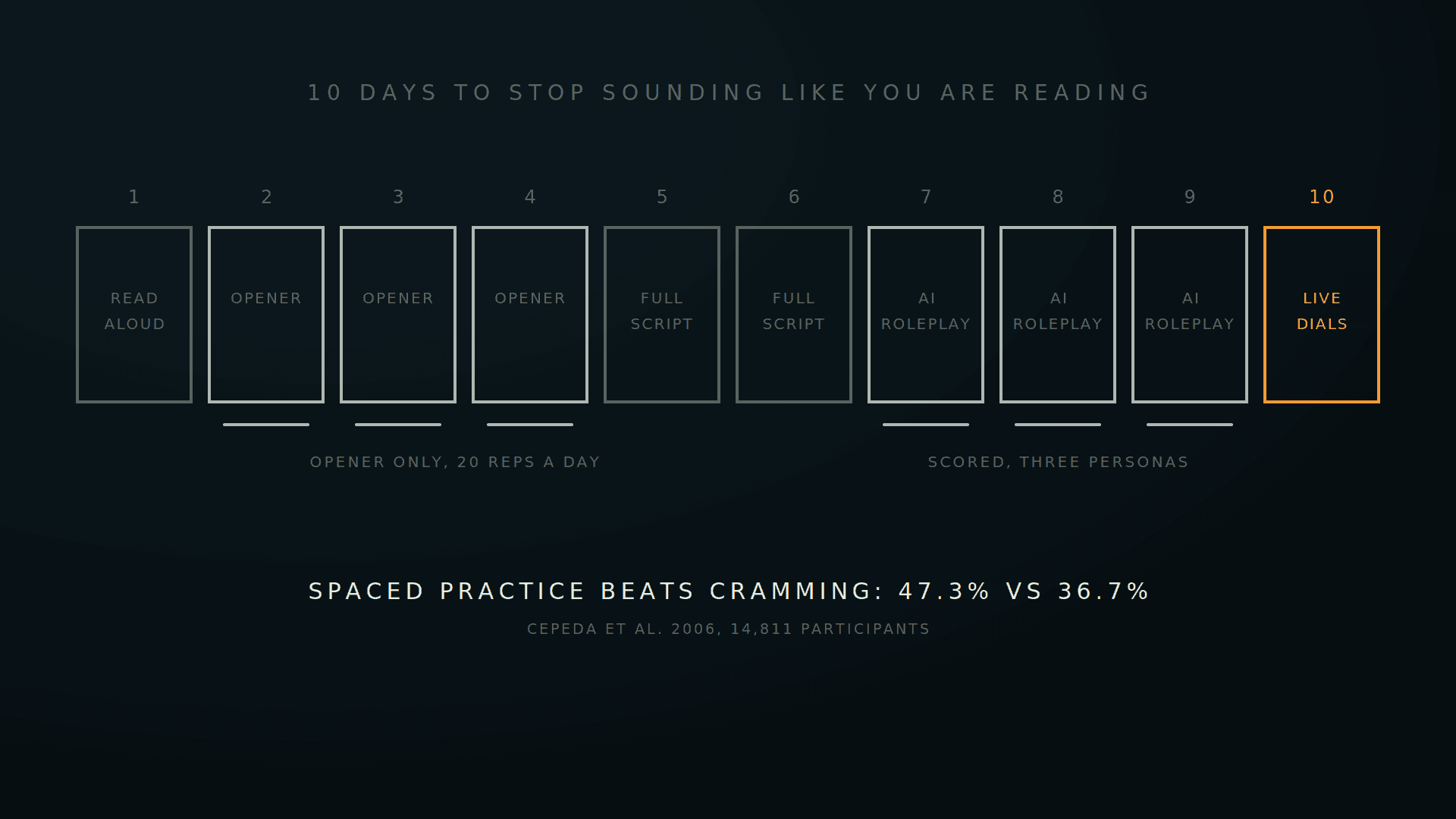
Days 2 to 4 are opener-only because the 2018 data says the greeting and reason line carry most of the lift. Day 6 forces a rewrite because after 70 reps you know which line is a lie.
The gap most teams hit is days 7 to 9. Peers get bored and go easy on you, managers get busy, the rep goes back to reading. That is the problem SecondBody was built to solve, by giving a rep an AI buyer that runs the same persona as many times as it takes and scores each run against the script. See pitch practice and sales simulation for what makes a practice rep count.
Now the honest caveat. SecondBody will not write your cold call script for you from nothing. It practices and scores the script you bring, and it tells you where your reps drift from it. Days 0 and 6 are yours.
How do you know the script is working?
Two numbers: how long your conversations last, and how many turn into meetings.
The industry baseline, from Cognism and WHAM's 2026 report across more than 200,000 calls (vendor data), is a 2.7% conversation-to-meeting rate and an average connected call of 82 seconds. The top end, from the Gong and 30MPC 2024 dataset, is a 16.7% set rate for top-quartile reps versus 4.6%, same undisclosed-metric caveat, so read the gap rather than the absolute.
Track conversation length per rep per week. Stuck near 80 seconds and the opener is not landing. Long calls with no meetings and the reps are having nice chats and not asking. Then track conversation-to-meeting. Below 2.7% and the script or the list is wrong. The leading indicator is the practice score: when the SDR above went from 5-6 to 7-8, it showed up weeks before the meeting rate did.
One thing not to measure against: question count. The "11 to 14 targeted questions" figure comes from Gong's 2017 analysis of 519,000 discovery calls. Good advice for the meeting you booked, irrelevant to the call that booked it.
What are the most common cold call script mistakes?
Seven, and most teams are making at least three.
Reading it. Eyes on the page means ears off the prospect. The fix is ten days of reps.
Pitching in the opener. The first 15 seconds earn the next 15. Features before the prospect has finished a sentence is monologue.
"Is now a bad time?" 40% below baseline in 2018, no better in 2024. Still in half the templates on page one.
Asking permission you do not need. The permission-based opener scored well in 2024, and 53% of top reps skip it anyway. Never stack it with "bad time".
Twenty templates and no rehearsal. Every page competing for "cold call script template" has 10 to 25 of them and none covers how to practice one. Twenty templates is twenty things you cannot say fluently.
No voicemail script. The 28% connect penalty is only worth paying if the voicemail points at an email.
Never updating it from real calls. The script written before anyone dialed is a hypothesis. If nobody changes the lines that keep dying, reps quietly go back to improvising.
The gap most teams hit is the last one: nobody owns the script after launch, so nobody hears it drift. That is the problem SecondBody was built to solve, by scoring each practice run against the current team script, so drift shows up in practice data before it shows up in pipeline.
Frequently asked questions
What is a good cold call script?
Under 30 seconds of rep talking: open like a person, state the reason for the call, ask one useful question, propose a specific next step.
How do you start a cold call?
Name, company, and a human question. "Hi [first name], it's [your name] from [your company]. How've you been?" That opener ran at 10.01% against a 1.5% baseline in 2018.
What is the best cold call opening line?
In 2018 data, "How've you been?" at 10.01%. In 2024 data, "I heard the name tossed around" at 11.24% and the permission-based opener at 11.18%, though that study does not disclose its success metric.
How long should a cold call be?
About 82 seconds on average (Cognism and WHAM, 2026). Your opening should be under 30 seconds; the longest rep monologue in successful calls was 37 seconds (Gong 2018).
Should I ask "is now a bad time"?
No. It scored 0.9% in 2018, 40% below baseline, and 2.15% in 2024. State the reason for your call instead.
Should you leave a voicemail on a cold call?
Twice at most, and only alongside email. Gong's 2024 data shows voicemail cuts future connects by 28% but lifts email reply from 2.73% to 5.87%. Name the email subject line in both.
How do you get past a gatekeeper?
Treat "How can I help you?" as a question, not an objection. Your name, the prospect's full name, the reason in four words. If they are out, ask for a better time and number.
How do you practice cold calling alone?
Record yourself, opener only, 20 reps a day for three days, listening back for pace and pauses. After that you need something that talks back: a peer, then an AI buyer that scores you.
Cold call script template: is there one that works for every industry?
No. The structure carries across industries: greeting, reason, one question, one ask, under 30 seconds. Two or three phrases change per persona. Write one script and three swaps, then rehearse.
Can I practice my own cold call script in SecondBody?
Yes. You bring the script, set up your personas, and practice by voice against Rory, our AI coach, on your phone, on WhatsApp, or in a browser. Rory plays the buyer, scores the run, and shows where you drifted. Cyera runs reps this way, along with others under NDA.
Does SecondBody score against the team script?
Yes. Managers load the current team script and every practice run is scored against it, including where the rep left the scaffold and whether it helped. Managers get a pre-1:1 briefing on which lines the rep keeps missing. Scoring can be methodology-native (SPIN, MEDDIC, Sandler).
Is there a starter tier?
There is a tier you can start with today. Pro is $30 per user per month, public pricing, unlimited seats, SOC 2. Details are on the pricing page, or book a demo and we will run your own script against Rory on the call.
Scripts are scaffolding. When does yours come down?
The words in a cold call script are rarely the problem. The problem is a rep who knows the words and cannot leave them, because the only time they said them aloud was on a live dial.
Script Scaffolding is the fix. Write one script, not twenty. Tie every line to a reason, so when a line dies you know what it was for. Rehearse it, spaced, out loud, against something that talks back, for ten days. Day 1 you sound like you are reading. Day 10 you have rewritten the weak line, run three personas back to back, and made your first live dials. The rep who can deviate wins, and deviation is only possible from something you know cold.
Managers, the full team method is in the hub on cold calling training for sales teams. To see what days 7 to 9 look like with an AI buyer scoring against your script, that is what our conversation practice platform does, for $30 a user a month, on the phone your reps already carry.
Write the script. Run the ten days. Take the scaffold down.
Good luck out there.
How we know this: we build an AI sales practice platform, we sat in the calls where sales leaders told us what their scripts do and do not do, and we checked every number here at its source, year and sample size attached.
Most cold call scripts fail for a reason that has nothing to do with the words. A real person picks up, says something slightly off-pattern, and the rep's brain goes to the page instead of the person. You can hear it. The prospect can hear it. The call is over in nine seconds.
So this article gives you three scripts, not twenty-five, every line tied to a dated, sized dataset, then a 10-day method for rehearsing them until you can leave them. A script you cannot leave is a script you are reading.
We build one of these, so read on with that in mind. We will be harder on the category than anyone.
Managers: this is the spoke off our hub on cold calling training for sales teams.
(Scanning this? Every section is a question. Jump to whichever one you actually have.)
Should you even use a cold call script?
Yes. As scaffolding. Not as a teleprompter.
Our dictionary page says cold calling is not a script, and that still holds. You write the script so you have something to practice, and you practice it until you can deviate without losing the thread. We call this Script Scaffolding. The scaffold goes up so the building can stand on its own, then it comes down. A rep still reading in week six is living in the scaffolding.
The research backs the deviation part. Franke and Park's 2006 meta-analysis in the Journal of Marketing Research (155 samples, more than 31,000 salespeople) found adaptive selling, adjusting to what the buyer does in the moment, improves performance. Verbeke and colleagues' 2011 meta-analysis ranked adaptiveness the second strongest driver of sales performance. Neither says "throw away the script". The rep who can adjust wins, and you can only adjust from something you know cold.
Reps already do this. HubSpot's 2025 sales survey (vendor survey) found 52% of reps adapt a script rather than read or improvise.
What does the data say a cold call script should contain in 2026?
The AI-search summary is right as far as it goes: short, personalized, permission-based, and conversational, a framework rather than a teleprompter, one useful question, a specific next step. Here is what the call data adds.
Gong, 2018, 90,380 connected cold calls. Baseline success (a meeting booked) was 1.5%. "How've you been?" succeeded 10.01% of the time, 6.6 times baseline. Stating "the reason for my call" lifted success 2.1 times. "Did I catch you at a bad time?" came in at 0.9%, 40% below baseline. Correlational, one vendor's customers, eight years old. Optimistic read: human attention has not changed since 2018. Skeptical read: a line thousands of SDRs have since copied cannot keep its novelty. Use it, and be ready to swap it.
Gong, same dataset, call structure. Successful cold calls ran a 55:45 talk-to-listen ratio, rep to prospect, versus 42:58 in failed ones. The longest rep monologue in successful calls was 37 seconds versus 25. Successful reps used 35% more "we" relative to "I", with 77% more speaker switches per minute. And the one nobody prints: Gong found no relationship between question count and cold-call success.
Gong and 30 Minutes to President's Club, 2024, 300 million-plus calls. The permission-based opener ("Can I take 30 seconds to tell you why I called?") scored 11.18%. "I heard the name tossed around" scored 11.24%. "Did I catch you at a bad time?" scored 2.15%. The caveat is large: the study does not define what "success" means for the opener figures, so you cannot compare 11.18% to the 2018 numbers. "Bad time" scoring 2.15% here and 0.9% in 2018 tells you these are directional, not laws.
Put together: open like a person, say why you called, ask one question, propose one next step, and get your part done in under 30 seconds of your own talking. That cap comes from a call audit we ran on our own recordings, where reps were too verbose, feature-dumping instead of asking questions. The 37-second monologue figure backs it.
Script 1: What does a 30-second B2B cold call script actually sound like?
Brackets are yours. Everything outside them has a reason.
Rep: Hi [first name], it's [your name] from [your company]. How've you been?
(They answer. Respond to what they actually said, in one sentence, like a person. Then move.)
Rep: The reason for my call is, we've been talking to a few [their job title]s at [type of company] and the thing that keeps coming up is [the problem you fix]. I wanted to see whether that's true for you too, or whether you've got it handled.
(Stop. Whatever they say next is the call. Listen to all of it.)
Rep: That makes sense. Here's what I'd suggest. Give us 20 minutes on [day], we'll show you how [type of company] are dealing with [the problem], and if it isn't useful you tell me and we're done. Does [day] morning or afternoon work better?
Why each line is there:
"How've you been?" The 10.01% line from Gong 2018, against a 1.5% baseline. It implies familiarity and is easy to answer.
Respond in one sentence. The 77% more speaker switches.
"The reason for my call is" The 2.1x line. Prospects relax when they know why you are there.
"We've been talking to", "we'll show you". The 35% higher We-to-I ratio.
One problem, one question. Gong's no-relationship finding is why there is exactly one question. This is not discovery. The discovery-call opener is a different call.
"Give us 20 minutes on [day]" The specific next step. A day, a duration, a promise.
"If it isn't useful you tell me and we're done." The permission-based opener's cousin, moved to the end where it costs nothing. Nooks' 2024 data (vendor, thin on method) says 53% of top reps skip the front-loaded version, anyway.
Deliberately missing: "Did I catch you at a bad time?" 40% below baseline in 2018. It is always a bad time. Asking hands them the exit.
Three persona swaps, not ten templates. An SDR manager at a German SaaS company told us their SDR cold call scripts did not exist in their practice workspace, because everything had been written for AEs. That is the template trap. Change two phrases instead.
Operator (director or head of): "the thing they're spending most of their week on" instead of "the thing that keeps coming up". Operators respond to time.
Executive (VP and above): the consequence instead of the problem, "[the problem] and what it's doing to [the number they report on]".
Technical buyer: "we'll walk you through how, and you can tell us where it breaks". They want to find the hole.
The gap most teams hit is that the rep has one script, three personas, and no way to hear the difference. That is the problem SecondBody was built to solve, by letting a rep run the same opener against three AI buyers back to back and getting scored on each.
Script 2: What should a cold call voicemail script say?
Very little. Its job is not a callback but to get your next email opened.
Gong's 2024 voicemail study: leaving a voicemail cut the chance of connecting on a future dial by 28%, and lifted email reply rates from 2.73% to 5.87%. The voicemail is a primer for the channel that works. Gong's guidance: two voicemails per prospect, maximum, the first about 15 seconds and the second about 30. And the "4.8% voicemail callback rate" you will see elsewhere is not a callback rate. It is a 2012 InsideSales anecdote about a response-rate lift.
Voicemail 1 (about 15 seconds):
Hi [first name], [your name] from [your company]. Quick one. We're working with a few [type of company] on [the problem you fix] and I've sent you an email with the subject line "[your subject line]". Have a look, and I'll try you again [day]. Thanks.
Voicemail 2 (about 30 seconds, a few days later):
Hi [first name], [your name] again from [your company]. I left you a note on [day] and sent an email with "[your subject line]" in the subject. The short version: [their job title]s at [type of company] keep telling us [the problem you fix] is eating [the thing it costs them], and we've got a fix that takes 20 minutes to show. If it's not relevant, reply "no" to the email and I'll leave you alone. Otherwise I'll try you one more time [day]. Thanks.
Why each line is there:
Name and company, immediately. You are paying the 28% connect drop. Do not waste the first five seconds.
"I've sent you an email with the subject line..." The whole point. The 2.73% to 5.87% lift only happens if the voicemail points at a specific email.
"Reply 'no' and I'll leave you alone." Second voicemail only. It saves you a wasted third attempt.
No features, no "I'd love to connect". Fifteen seconds is about 40 words. Spend them on the email.
Script 3: How do you get past a gatekeeper on a cold call?
By remembering the gatekeeper is not objecting. They asked a question. Answer it.
A UK healthcare sales director put it this way: "How can I help you?" from a receptionist is not an objection, and reps who treat it like one get defensive. The goal is "just to get the process moving". A name, a better time, a direct line.
Gatekeeper: Good morning, [company], how can I help you?
Rep: Morning. It's [your name] from [your company]. I'm trying to reach [first name last name] about [the problem you fix, in four words or fewer]. Is [first name] around this morning?
(If yes, say thank you and wait. If no:)
Rep: No problem. When's usually a good time to catch [first name]? And is there a better number, or is this the best way through?
(If they ask what it is regarding:)
Rep: It's about [the problem you fix]. Is [first name] the right person for that, or is it someone else on the team?
Why each line is there:
Full name, then first name. It signals you know who they are.
"About [the problem], in four words or fewer." Enough for the gatekeeper to route you, not enough to trigger "can I take a message".
"When's usually a good time?" The "get the process moving" line.
"Or is it someone else?" The gatekeeper knows the org chart better than your data vendor. No tricks. Gatekeepers remember.
How fast and how loud should you talk on a cold call?
About 3.5 words a second, four or five deliberate pauses a minute, and slower than you feel like going.
The pace figure is from a University of Michigan Institute for Social Research study presented in 2011: 1,380 calls by 100 interviewers, and those speaking at roughly 3.5 words per second with four to five pauses per minute won the most. The caveat: the outcome was agreeing to take a survey, not booking a meeting. A stranger deciding in ten seconds whether to keep listening is close enough.
Gong's 2019 analysis of 67,149 demo calls (demos, not cold calls) found a baseline of 173 words per minute, top producers at 176, flustered reps at 188. Speed is what stress sounds like from the outside.
The pauses matter more than the speed. They are where the speaker switches happen.
What happens when the script meets an objection?
You pause, you ask one question, and you stop following the script.
This is not a rebuttal library. The LAER framework page is where the method lives. The moment the prospect objects is the moment Script Scaffolding is supposed to come down. If your reps are hunting for the "objection" section of the talk track while the buyer is mid-sentence, the script has become a liability.
What the script can do is set the reflex: write "pause, then ask" as a stage direction and rehearse the pause as a line. The manager's side, how to drill objections until they stop scaring the rep, is the sister article on objection handling training drills.
How do you practice a cold call script until it sounds like you?
Daily, out loud, in short sessions, against something that talks back. One read-through the night before does almost nothing.
Murre and Dros replicated Ebbinghaus's forgetting curve in 2015 (PLOS ONE). It is a single-subject study, n=1, so treat the figures as an illustration: about 56% retained at 20 minutes, 32% at one day, 4% at 31 days. Read the script on Sunday, dial on Monday, and you are working from roughly a third of it.
Spacing fixes this. Cepeda and colleagues' 2006 meta-analysis (271 comparisons, 14,811 participants) found spaced practice produced 47.3% correct recall versus 36.7% for the same practice massed into one session. Same total time, ten points of difference. That is the whole argument for 15 minutes a day over a Friday workshop.
Then the awkward one. Macnamara, Hambrick and Oswald's 2014 meta-analysis found deliberate practice explained 26% of performance variance in games, 21% in music, 18% in sports, 4% in education, and under 1% in professions. The professions figure gets quoted as "practice doesn't work for sales", but those studies measured practice loosely. The honest takeaway: practice matters, and what you practice and how you measure it matters as much.
The teams we work with converged on the same cadence: 7 to 15 minutes at the beginning of the day, or a post-lunch blocker. One SDR on one of those teams moved from practice scores of 5 or 6 out of 10 to a steady 7 or 8 over a few weeks. Not a controlled study. A pattern we keep seeing.
The 10-day plan, assuming the script is written:
Day | What to do | Time | What "done" looks like |
|---|---|---|---|
1 | Read the full script aloud. Record it. Listen back once. | 15 min | Your baseline. |
2 | Opener only (greeting, response, reason). 20 reps aloud, no paper after rep 5. | 10 min | First two turns without looking. |
3 | Opener only. 20 reps. Vary the prospect's reply (busy, suspicious, cheerful, silent). | 10 min | Your one-sentence response changes with their answer. |
4 | Opener only. 20 reps. Record reps 15 to 20, listen for pace and pauses. | 10 min | Under 15 seconds for your part. Two audible pauses. |
5 | Full script with a peer as the prospect. One curveball per run. 10 runs. | 15 min | You reach the ask every time. |
6 | Full script with a peer. Swap roles for half the runs. 10 runs. | 15 min | You can name the weakest line. Rewrite it tonight. |
7 | AI roleplay, persona 1 (operator). 5 scored runs. | 15 min | Score trending up across the five. |
8 | AI roleplay, persona 2 (executive). 5 scored runs, using the executive swaps. | 15 min | You changed the two phrases without stalling. |
9 | AI roleplay, persona 3 (technical buyer). 5 scored runs, then all three personas back to back. | 15 min | Three personas in a row, no paper. |
10 | Live dials. Review three recorded calls against the script with your manager or peer. | Dial block plus 20 min | You know which lines you kept, which you dropped, and which one you should never have written. |
Days 2 to 4 are opener-only because the 2018 data says the greeting and reason line carry most of the lift. Day 6 forces a rewrite because after 70 reps you know which line is a lie.
The gap most teams hit is days 7 to 9. Peers get bored and go easy on you, managers get busy, the rep goes back to reading. That is the problem SecondBody was built to solve, by giving a rep an AI buyer that runs the same persona as many times as it takes and scores each run against the script. See pitch practice and sales simulation for what makes a practice rep count.
Now the honest caveat. SecondBody will not write your cold call script for you from nothing. It practices and scores the script you bring, and it tells you where your reps drift from it. Days 0 and 6 are yours.
How do you know the script is working?
Two numbers: how long your conversations last, and how many turn into meetings.
The industry baseline, from Cognism and WHAM's 2026 report across more than 200,000 calls (vendor data), is a 2.7% conversation-to-meeting rate and an average connected call of 82 seconds. The top end, from the Gong and 30MPC 2024 dataset, is a 16.7% set rate for top-quartile reps versus 4.6%, same undisclosed-metric caveat, so read the gap rather than the absolute.
Track conversation length per rep per week. Stuck near 80 seconds and the opener is not landing. Long calls with no meetings and the reps are having nice chats and not asking. Then track conversation-to-meeting. Below 2.7% and the script or the list is wrong. The leading indicator is the practice score: when the SDR above went from 5-6 to 7-8, it showed up weeks before the meeting rate did.
One thing not to measure against: question count. The "11 to 14 targeted questions" figure comes from Gong's 2017 analysis of 519,000 discovery calls. Good advice for the meeting you booked, irrelevant to the call that booked it.
What are the most common cold call script mistakes?
Seven, and most teams are making at least three.
Reading it. Eyes on the page means ears off the prospect. The fix is ten days of reps.
Pitching in the opener. The first 15 seconds earn the next 15. Features before the prospect has finished a sentence is monologue.
"Is now a bad time?" 40% below baseline in 2018, no better in 2024. Still in half the templates on page one.
Asking permission you do not need. The permission-based opener scored well in 2024, and 53% of top reps skip it anyway. Never stack it with "bad time".
Twenty templates and no rehearsal. Every page competing for "cold call script template" has 10 to 25 of them and none covers how to practice one. Twenty templates is twenty things you cannot say fluently.
No voicemail script. The 28% connect penalty is only worth paying if the voicemail points at an email.
Never updating it from real calls. The script written before anyone dialed is a hypothesis. If nobody changes the lines that keep dying, reps quietly go back to improvising.
The gap most teams hit is the last one: nobody owns the script after launch, so nobody hears it drift. That is the problem SecondBody was built to solve, by scoring each practice run against the current team script, so drift shows up in practice data before it shows up in pipeline.
Frequently asked questions
What is a good cold call script?
Under 30 seconds of rep talking: open like a person, state the reason for the call, ask one useful question, propose a specific next step.
How do you start a cold call?
Name, company, and a human question. "Hi [first name], it's [your name] from [your company]. How've you been?" That opener ran at 10.01% against a 1.5% baseline in 2018.
What is the best cold call opening line?
In 2018 data, "How've you been?" at 10.01%. In 2024 data, "I heard the name tossed around" at 11.24% and the permission-based opener at 11.18%, though that study does not disclose its success metric.
How long should a cold call be?
About 82 seconds on average (Cognism and WHAM, 2026). Your opening should be under 30 seconds; the longest rep monologue in successful calls was 37 seconds (Gong 2018).
Should I ask "is now a bad time"?
No. It scored 0.9% in 2018, 40% below baseline, and 2.15% in 2024. State the reason for your call instead.
Should you leave a voicemail on a cold call?
Twice at most, and only alongside email. Gong's 2024 data shows voicemail cuts future connects by 28% but lifts email reply from 2.73% to 5.87%. Name the email subject line in both.
How do you get past a gatekeeper?
Treat "How can I help you?" as a question, not an objection. Your name, the prospect's full name, the reason in four words. If they are out, ask for a better time and number.
How do you practice cold calling alone?
Record yourself, opener only, 20 reps a day for three days, listening back for pace and pauses. After that you need something that talks back: a peer, then an AI buyer that scores you.
Cold call script template: is there one that works for every industry?
No. The structure carries across industries: greeting, reason, one question, one ask, under 30 seconds. Two or three phrases change per persona. Write one script and three swaps, then rehearse.
Can I practice my own cold call script in SecondBody?
Yes. You bring the script, set up your personas, and practice by voice against Rory, our AI coach, on your phone, on WhatsApp, or in a browser. Rory plays the buyer, scores the run, and shows where you drifted. Cyera runs reps this way, along with others under NDA.
Does SecondBody score against the team script?
Yes. Managers load the current team script and every practice run is scored against it, including where the rep left the scaffold and whether it helped. Managers get a pre-1:1 briefing on which lines the rep keeps missing. Scoring can be methodology-native (SPIN, MEDDIC, Sandler).
Is there a starter tier?
There is a tier you can start with today. Pro is $30 per user per month, public pricing, unlimited seats, SOC 2. Details are on the pricing page, or book a demo and we will run your own script against Rory on the call.
Scripts are scaffolding. When does yours come down?
The words in a cold call script are rarely the problem. The problem is a rep who knows the words and cannot leave them, because the only time they said them aloud was on a live dial.
Script Scaffolding is the fix. Write one script, not twenty. Tie every line to a reason, so when a line dies you know what it was for. Rehearse it, spaced, out loud, against something that talks back, for ten days. Day 1 you sound like you are reading. Day 10 you have rewritten the weak line, run three personas back to back, and made your first live dials. The rep who can deviate wins, and deviation is only possible from something you know cold.
Managers, the full team method is in the hub on cold calling training for sales teams. To see what days 7 to 9 look like with an AI buyer scoring against your script, that is what our conversation practice platform does, for $30 a user a month, on the phone your reps already carry.
Write the script. Run the ten days. Take the scaffold down.
Good luck out there.
A script only works once you can leave it.
Rehearse your own cold call script out loud with Rory until the opener is a reflex, then get scored line by line.


SecondBody is the AI sales practice platform built for field, regulated, and enterprise sales teams. Voice-first practice with Rory, your AI coach. Pre-call practice, not post-call analysis. Pre-1:1 manager briefings. Unlimited seats at $30 per user per month. Built in Paris. SOC 2 compliant.
Related reading: Cold Calling Training for Sales Teams · Objection Handling Training Drills · Cold Call Practice · What is Cold Calling?
Share this article