Back
Sales Management Training: Why Your Best Rep Just Became Your Worst Bet, and What to Do About It
What first-time sales managers need from sales management training: coaching, pipeline inspection, a weekly rhythm. And why the promotion is the problem.

Posted by
SecondBody.ai
Published by
Last Updated
How we know this: we build an AI sales practice platform, we sat in the calls with the managers quoted below, and we checked every number in this article at its source.
Here is a number that should worry anyone promoted last year. A study of 214 firms, 1,500 promotions and 156 million sales transactions found that doubling a salesperson's sales raises their odds of promotion by 14.3%. Then the other half: a doubling of the new manager's pre-promotion sales is associated with a 7.5% decline in the sales of each person who now reports to them. That is Benson, Li and Shue, "Promotions and the Peter Principle", Quarterly Journal of Economics, 2019. Peer reviewed, not a vendor survey.
So the better you sold, the more likely you got the job, and the more likely your team is about to sell less. Nobody says this at the promotion dinner.
This is sales management training for new sales managers, written to the person promoted in the last 12 months who now runs 8 to 15 reps with no coaching training. If you are the VP who promoted them, read over their shoulder. We build one of these, so read on with that in mind. We will be harder on the category than anyone.
One idea runs through it all. Call it the Manager Multiplier: one manager who coaches 12 reps well beats any rep-level program, because every improvement in the manager lands on 12 pipelines at once.
(Scanning this? Every section is a question. Jump to whichever one you actually have.)
What is sales management training?
Sales management training is any structured program that teaches a salesperson to run a sales team: coaching reps, inspecting pipeline, forecasting, hiring, and holding people to account. Gemini's summary puts it neatly: it "bridges the gap between being a top-performing individual contributor and becoming an effective people leader".
In practice it is a two-day workshop or an online certificate. A binder, or a badge. Then the pipeline review is at 9am and nothing you learned gets touched again. The problem with sales management training is not what it teaches. It is that it stops. A program that ends on day two has taught you coaching the way a cookbook teaches cooking.
What type of training is required for a sales manager?
Five areas, and if you only get one, get the first. Google's AI Mode answers this question with the same five, so we will use its words.
The transition from doing to coaching
You were paid to close. Now you are paid to make 12 other people close. Different job, different skill, and the skill is coaching. Most of this article is about it, because most of the job is.
Pipeline inspection and forecasting discipline
Reading a pipeline for what the buyer has done, not what the rep hopes. Exit criteria per stage. Forecasts from evidence, not gut feel.
Management rhythm
A fixed calendar of 1:1s, pipeline reviews, forecast calls and team meetings. Without one you coach whoever is loudest.
Accountability and difficult conversations
Controllable targets, noticing early when they slip, and having the conversation you would rather not have before it becomes a performance plan.
AI operating habits
Knowing what to hand to software (summaries, pattern spotting, practice scenarios, pre-1:1 briefings) and what to keep (the judgement, the conversation, the decision).
Why do new sales managers struggle?
Because they were picked for a skill the job does not need, then handed a team without being taught the one it does. Five pieces of that.
The Super-Rep Trap
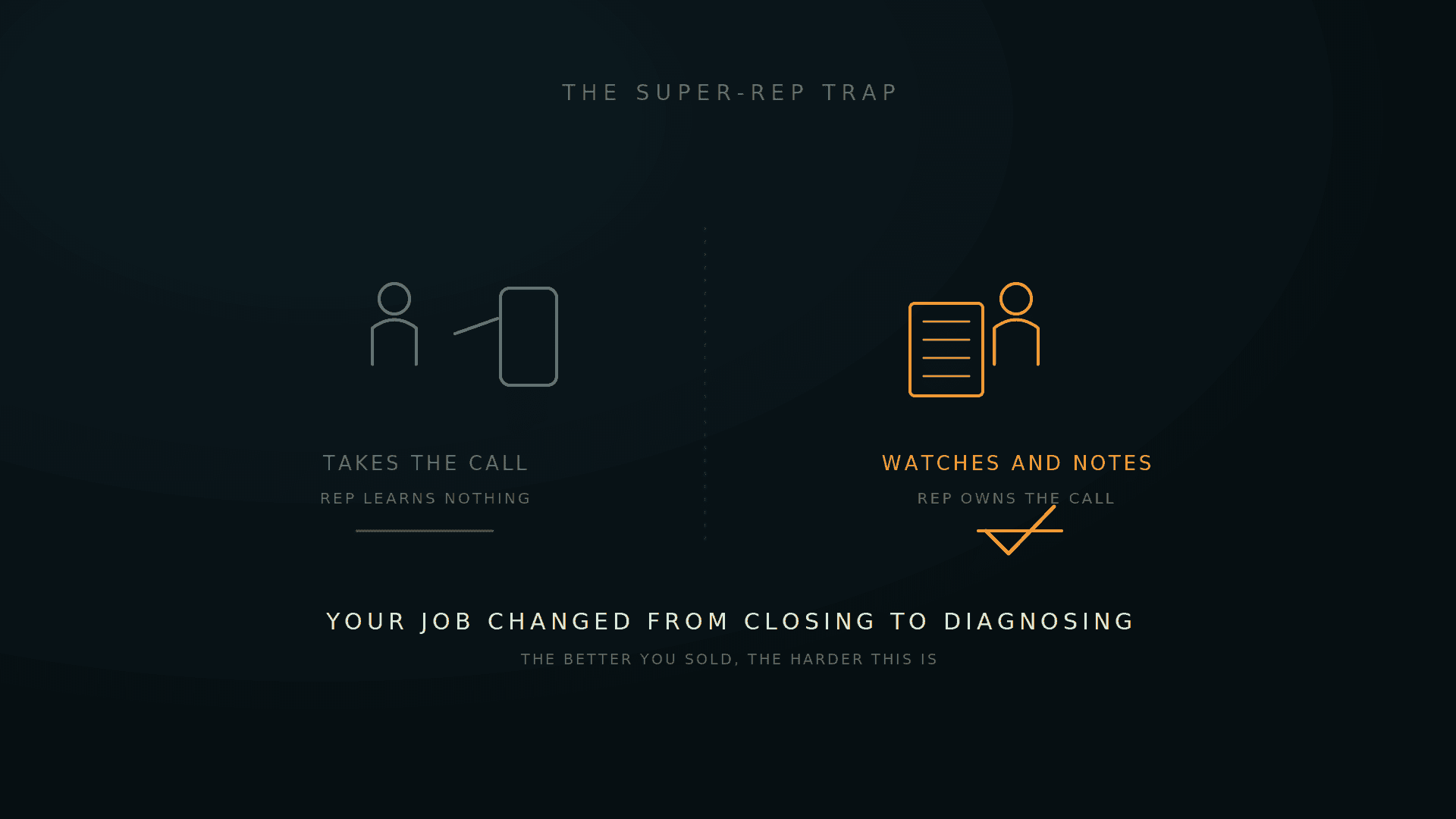
You are on a ride-along. The rep fumbles the objection. You know the answer. You take the call. You win the deal, and the rep learns one thing: when it gets hard, the manager takes over. That is the Super-Rep Trap, and it is institutional. In a May 2026 Gartner press release (no sample size given), 63% of CSOs ranked selling and closing as a top activity for managers. Your boss may want you in the trap.
Nobody trained them to coach
Only 44% of managers globally have received any manager training, according to Gallup (all managers, not sales-specific). In sales it is worse. The MySalesCoach State of Sales Coaching 2026 survey (1,050 respondents, vendor data from a company that sells coaching, PDF gated) found 66% of sales managers have never received any training on being an effective coach, and only 1 in 5 has a coach themselves.
They coach less than they think
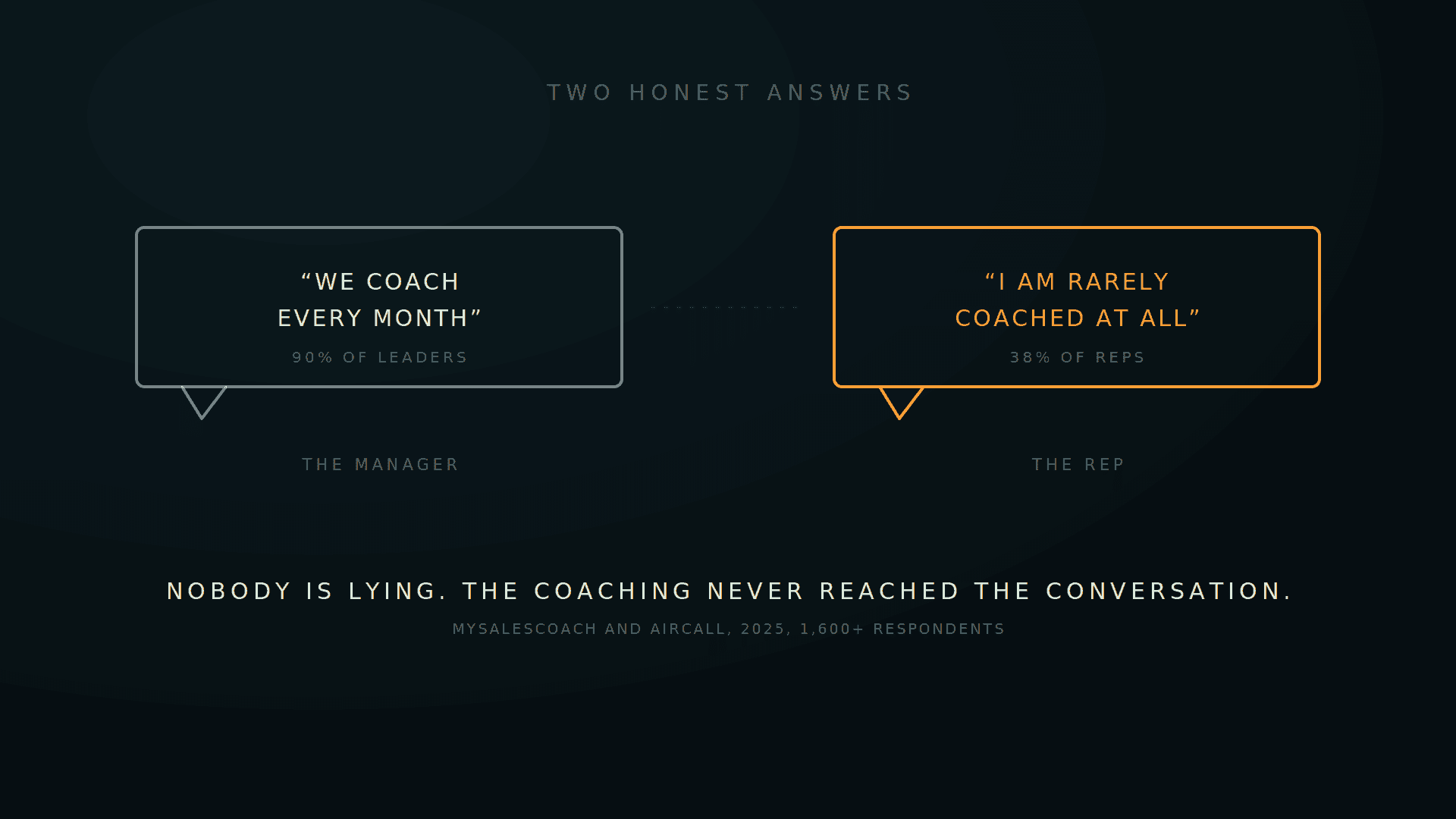
In the MySalesCoach and Aircall 2025 report (1,600+ respondents), 90% of leaders said they coach at least monthly. 38% of reps said they rarely or never receive coaching. Same market, different planet. The 2026 follow-up found 67% of managers would recommend their own coaching while fewer than 1 in 5 reps rated it highly effective. The optimistic read: managers are trying and reps are ungrateful. The skeptical read, which is ours: what a manager calls coaching (a deal review, a quick "how did that go") does not register as coaching to the person receiving it.
Span of control grew to 12.1 reps
Gallup's January 2026 research (US managers, all functions) found the average span of control rose from 10.9 direct reports in 2024 to 12.1 in 2025. More people, same hours. And the feedback is thinning: in a Gartner survey of 2,947 employees and managers (April 2026, all managers), only 39% of employees said their manager gives effective developmental feedback.
Time is the top barrier
When MySalesCoach asked managers what stops them coaching, 33% named lack of time first, 23% struggle to measure impact, and 15% need support on how to coach at all. Time is real. It is also the answer you give when you do not know what you would do with it. For the rep-level version, see a practical guide to training a sales rep. This article stays on the manager.
What should sales management training include?
Coaching first and everything else second, with a lot of practice and very little theory. Highspot's ten-skill list covers similar ground; here is the curriculum we would insist on: coaching conversations (ask before you tell, leave the rep with one thing). Call review, meaning finding the moment a real call turned. Leading roleplay without becoming the star of it. A 1:1 structure that is not a pipeline review in disguise. Pipeline inspection and forecasting from buyer actions. Hiring and onboarding. Performance plans and hard conversations. And AI call analysis without outsourcing your judgement to it.
One blind spot deserves its own line. The 2025 report found account executives are 50% less likely to get frequent coaching than SDRs. Coaching stops at the people closing your biggest deals, because you assume they know. They were you two years ago. You did not know either.
How do you move from doing to coaching?
You stop being the answer and start being the question. Four habits, all learnable, none of which anybody taught you.
Shadow without taking over. Sit on the call. Say nothing. Write down the exact moment the rep lost the room. A UK healthcare sales director we spoke with does it the honest way: he takes the occasional live call, turns a product objection into discovery on the spot, then debriefs the rep on why. "We teach them during training to do it," he told us, "but sometimes they need to learn through osmosis and watching you do it." The trap is when osmosis is the only method.
Ask before tell. "What were you trying to get from that question?" beats "you should have asked about budget". One builds a rep who thinks, the other a rep who waits for you.
Coach from evidence, not from what reps volunteer. A medical device sales manager with 10 years in role put it plainly: "They probably wouldn't come and tell me about a flat on their face call." He finds problems through ride-alongs and looks for repeated points across reps. A first-time manager at a German SaaS company was more candid: "I've never listened actually to one of her calls." His read on the rep, from roleplay alone, was "okayish". That is where most first-time sales managers are. Managing on vibes.
One skill per session. The same medical device manager described his loop: observe a call, give one note, have the rep practice that scenario "three times this week", then open the next 1:1 with "How did it go? What questions did you ask?" Every manager we have seen coach well did those three things: watched a real call, gave one note, made the rep practice it before the next 1:1. None had been trained to. They worked it out.
The gap most teams hit is that a new manager's first coached conversation is a live one, on a real rep. That is the problem SecondBody was built to solve, by letting managers rehearse coaching conversations against an AI before they have them for real.
How should a new sales manager inspect pipeline and forecast?
Inspect for what the buyer did, not what the rep felt. That sentence is most of forecasting discipline.
Happy ears are the disease. A rep hears "this looks interesting" and logs a 60% close probability. Your job is to ask what the buyer has done. Introduced you to someone else? Shared a number? Agreed a date? Buyer actions move stages. Rep feelings do not. Write exit criteria per stage about the buyer: "economic buyer met" is an exit criterion. "Rep feels good" is not.
Then separate what you can control from what you cannot. Bookings are an outcome. Calls made, discovery meetings held, proposals sent within 48 hours: those are activities, and activities are what you coach and hold people to. Inspect only outcomes and you find out in the last week of the quarter.
If your team sells into buying committees, inspection changes and the manager has to coach to a framework like MEDDPICC. We cover that in our guide to enterprise sales training curriculum.
What does a weekly management rhythm look like?
It looks like a calendar you do not move. The moment you move a 1:1 for a deal review, you have told the team which one matters. A global adtech L&D lead described the alternative: "Some run weekly team calls, others bi-weekly or monthly 1:1s." The rep with the quiet manager gets nothing. Here is a management rhythm you can install in week one.
Cadence | What happens | Why |
|---|---|---|
Daily (15 min) | Deal exceptions only: what moved, what stalled, what needs you today | Keeps you out of every deal and inside the ones that need you |
Weekly | One 30-minute 1:1 per rep, half skill coaching, half pipeline. One pipeline review. One forecast call. One team meeting with one skill topic | MySalesCoach 2026 (vendor, correlation): weekly-coached reps at 76% quota attainment vs 56% monthly and 47% quarterly or less |
Monthly | Win/loss on three deals, one talent conversation per rep | Patterns show up across deals, not inside one |
Quarterly | Territory review, capability review (what can this team not do yet) | Plan training instead of reacting to a bad month |

Two notes on the weekly line. The 76% versus 47% is a vendor correlation; we believe the direction, not the decimals. And the half-skill, half-pipeline split is the whole point. An all-pipeline 1:1 is inspecting, not coaching, and your rep will tell the next survey they never get coached.
How does a sales manager handle accountability and difficult conversations?
Early, in private, and with a number the rep controls. Accountability is a system you install so the hard conversation stays small.
Set controllable metrics per rep per week and review them in the 1:1. When one slips two weeks running, say so in the third, plainly, and agree one change. That is accountability. It is boring. That is why it works.
The formal performance improvement plan is what happens when the boring version was skipped for a quarter. If you get there, structure it: the gap, the behavior that closes it, the timeline, the review date. Write it down.
And practice the conversation before you have it. Say the opening line out loud, to a peer, to a wall, to an AI. New managers wing these and wonder why they came out as an apology or an ambush. You would never let a rep walk into a pricing objection cold. Do not walk into a performance conversation cold either.
How should sales managers use AI?
Use it for the parts of coaching that are about finding, and keep the parts that are about deciding. That is the whole of AI operating habits.
Call summaries, so you review eight calls in the time it took to listen to two. Gap detection, so the software tells you three reps all stall at the same objection. Practice scenarios, so the rep who blew a pricing conversation on Tuesday runs it five times on Wednesday. Pre-1:1 briefings, so you walk in knowing what the rep practiced and where they slipped. Our State of Sales Training 2026 report has the wider numbers on the manager coaching crisis.
Then AI judgement. A summary can be wrong. A score can miss the thing that lost the deal. Trust the software to find, verify before you act. Forward an AI note unread and you have automated the "too generic" complaint 39% of reps already have.
The gap most teams hit is the arithmetic: 12 reps, one manager, 30 minutes a week each, and no way to know what any of them practiced in between. That is the problem SecondBody was built to solve, by giving each manager a briefing before every 1:1 built from what the rep rehearsed with Rory, our AI coach. It is how one manager coaches 20 to 30 reps without the coaching turning into a newsletter. We call it coaching at scale.
What are the best sales management training programs and certifications?
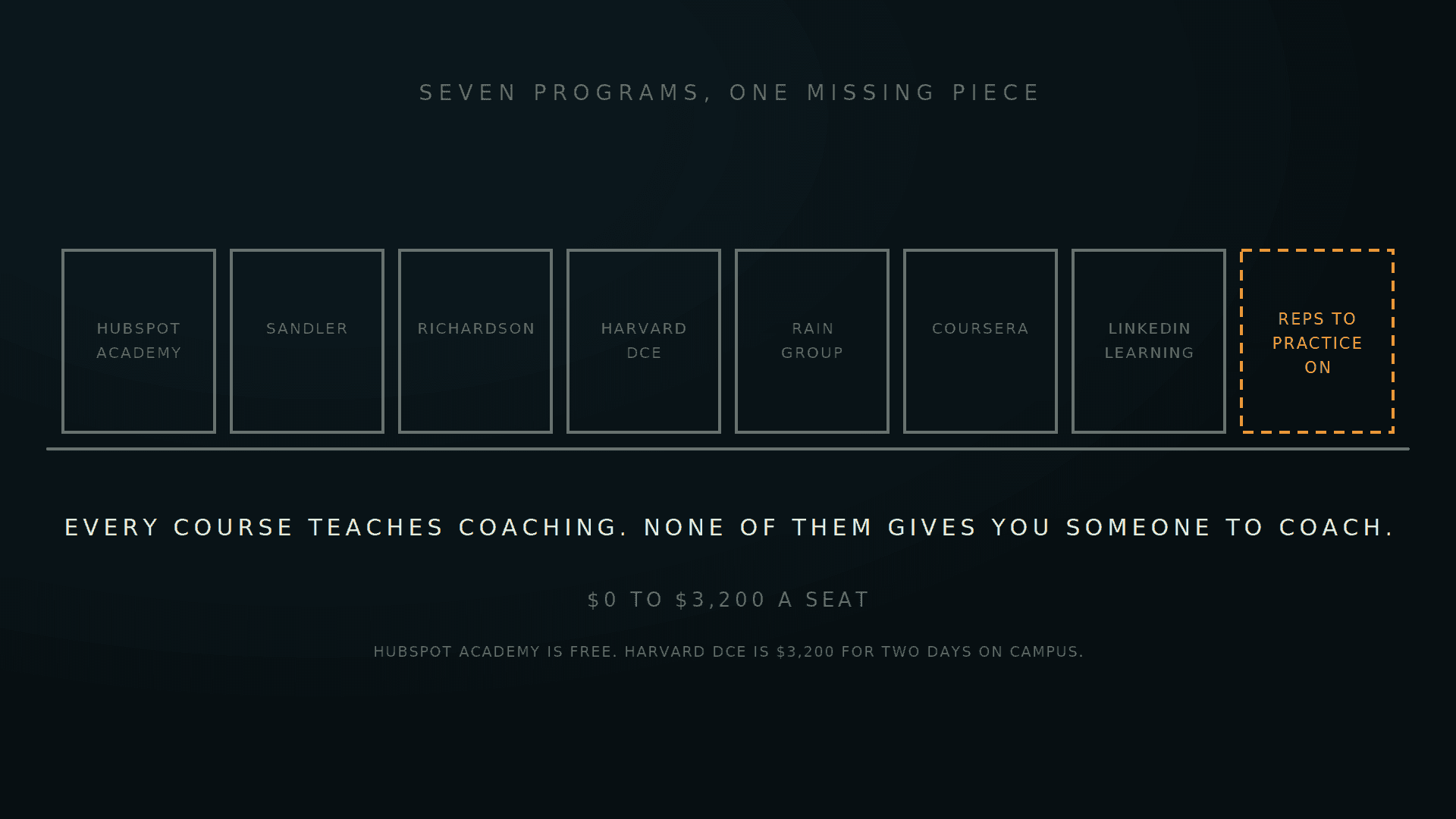
The best sales management training program is the one you are still doing in month three, and none of the well-known ones are built for that. Here is a fair comparison of the sales manager training courses people search for.
Program | Format and price | Good for |
|---|---|---|
Free, online, six lessons built from interviews with 23 sales leaders, badge and certificate | A first-time sales manager who wants the vocabulary this week | |
Sandler Management Solutions | Local franchise delivery, pricing by quote | Teams already running Sandler on the rep side |
Richardson Consultative Sales Coaching | Three four-hour virtual sessions or a 1.5-day workshop, pricing by quote | A coaching conversation structure |
Harvard DCE Strategic Sales Management | $3,200, two days on campus, for managers with under 10 years of experience | A credential on the manager's CV |
RAIN Group | Workshops and coaching, pricing by quote | Consultative selling teams |
Coursera Sales Team Management (HubSpot Academy) | Free to audit, self-paced | The HubSpot material with a deadline |
LinkedIn Learning, Udemy | Subscription or per course | Filling one hole, like forecasting, cheaply |
The HubSpot course is the best sales management training online free option. Do it this weekend.
Here is what none of them give you: reps to practice coaching on. You learn the model in the room. Then you run your first coached conversation on a real rep, with real stakes, having never done it before. One company we heard about was moving to Sandler and hit this wall: managers who "have never been a sales rep" could not coach to the methodology. The methodology was fine. The managers' coaching reps were zero. That is the gap in the whole category. A practice gap, not a knowledge gap.
How much training does a sales manager need?
A two-day course is the floor. Weekly practice for 90 days is what changes behavior. Everyone in this search result sells the first. Nobody mentions the second.
Cepeda and colleagues' 2006 meta-analysis of 14,811 participants found spaced practice produced 47.3% recall versus 36.7% for the same material crammed into one block, and the longer you need to remember, the wider the gaps should be. A two-day workshop is massed practice by definition. The worst shape for a skill you need in six months.
While we are here: you will read that "87% of sales training is forgotten within 30 days". It is folklore. Nobody can trace it to a study. The forgetting curve itself is real. Murre and Dros replicated Ebbinghaus in 2015 and found memory savings around 36% after a day and 4% after 31 days, though with one participant learning nonsense syllables, so treat it as a shape, not a statistic. Unpracticed knowledge goes.
So take the course. Then block 30 minutes every week for 13 weeks to practice one coaching skill or rehearse one hard conversation. Gallup's findings on coaching-focused manager training (team engagement up to 18% higher, turnover 21% to 28% lower) describe training with follow-through, not a certificate.
How is sales management training different from sales leadership training?
Sales management training teaches you to run a team. Sales leadership training teaches you to run a sales organization. They get sold together, and they are not the same course.
The manager's job is frontline: coaching, pipeline inspection, forecasting, hiring the next rep, the weekly rhythm. The leader's job is structural: strategy, territory design, compensation, org design, hiring the next manager. Sign up for sales leadership training as a new manager and you will spend two days on comp philosophy and come back no better at the Tuesday 1:1. Do the manager training first. If you already run managers, our page for sales leaders is for you.
What does a 90-day plan for a new sales manager look like?
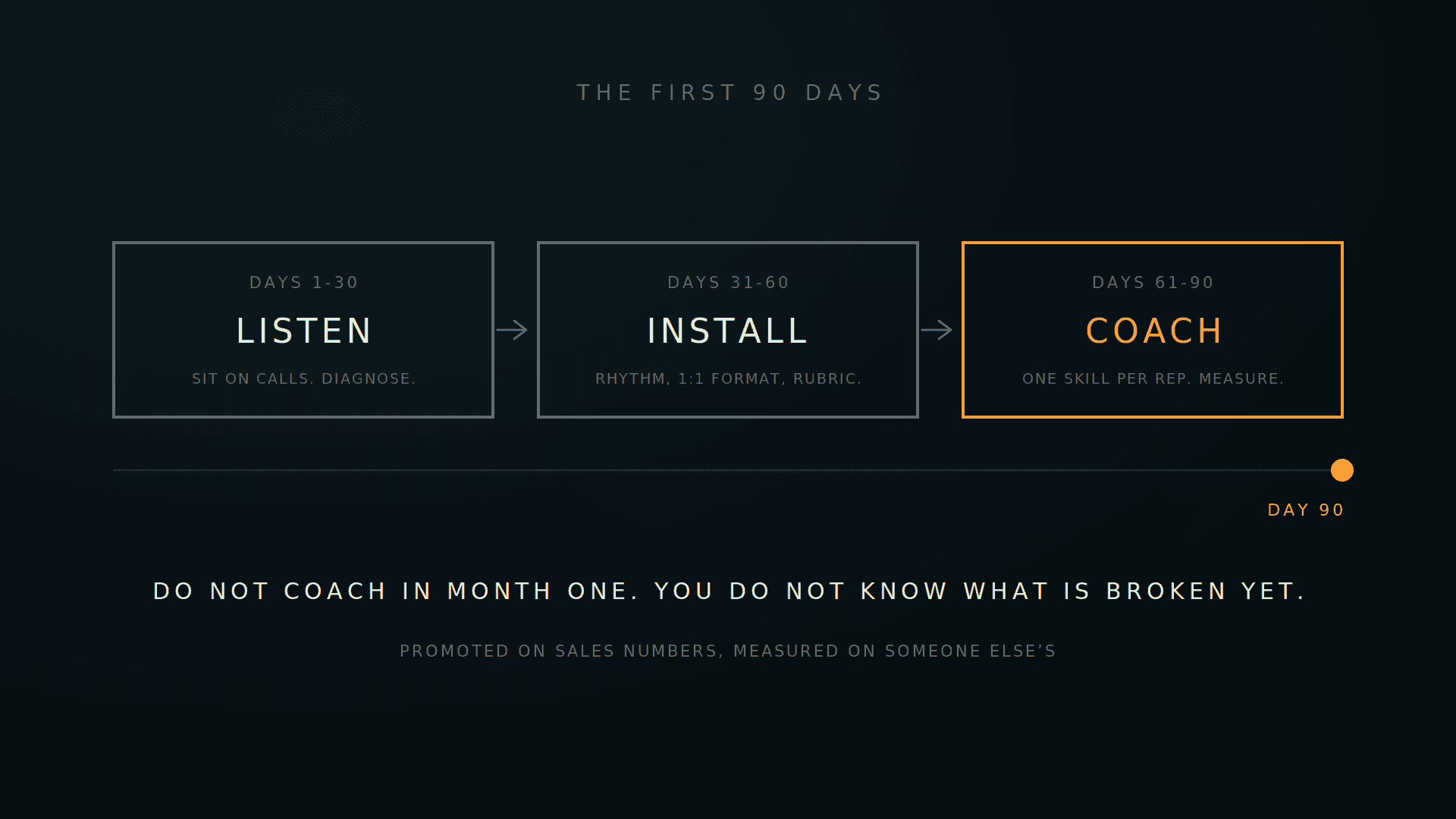
Listen, install, coach. In that order. Do not skip the listening because you are itching to fix things.
Days 1 to 30: listen and diagnose. Sit on two calls per rep. Read every open deal and write your own probability next to the rep's. Have a 1:1 with each person that is entirely about them. Change nothing yet. You will want to. Don't.
Days 31 to 60: install the rhythm. Put the calendar above into everyone's diary, including yours. Set exit criteria per pipeline stage. Pick one controllable metric per rep. Run your first coached 1:1s, one skill each, and keep notes. You will be worse at this than you expect.
Days 61 to 90: coach and measure. Now the 1:1s have history: "three weeks ago we worked on discovery questions, let's listen to Thursday's call." Watch a leading indicator you can see weekly. At one SaaS customer of ours, a rep's practice scores moved from 5 or 6 to 7 or 8 over a few weeks of coaching, long before any quota number moved. At day 90, tell your boss what the team can and cannot do yet. For the company-wide view, see our corporate sales training programs guide.
What are the common mistakes new sales managers make?
We have watched these happen. Some we did ourselves.
Taking the call. The Super-Rep Trap, week one. You win a deal and lose a rep's development in one afternoon.
Coaching the closer least. Senior AEs get the fewest coaching conversations because they seem fine. They carry your biggest deals.
Turning the 1:1 into a pipeline review. The rep leaves knowing their forecast and nothing about their skills.
Coaching from memory. "How did that call go?" is not coaching. Listening to the call and asking about minute twelve is.
Giving five notes when one would do. Reps told the 2025 survey coaching is too generic (39%), repetitive (34%), and lacks practical advice (29%). One note, practiced, is coaching.
Forgetting the expert's blind spot. The 10-year veteran said it: "I can't even remember what the baby steps were when I first started." New reps need the steps you skip.
Never practicing your own craft. You run coaching and performance conversations cold every week and call it experience.
Frequently asked questions
What type of training is required for a sales manager?
Coaching skills first, then pipeline inspection and forecasting discipline, a management rhythm, accountability and difficult conversations, and AI operating habits. Most new sales managers get a course on all five and practice on none.
What should sales manager training include?
Coaching conversations, call review, leading roleplay, 1:1 structure, pipeline inspection, forecasting from buyer actions, hiring and onboarding, performance plans, and AI call analysis. Plus weekly practice after the course ends.
How much training does a sales manager need?
A two-day course as a floor, then weekly practice for at least 90 days. Spaced practice beats one block by about 10 points of recall across nearly 15,000 participants. Coaching is built in repetitions.
Who offers the best sales manager training?
HubSpot Academy for a free foundation, Richardson for a coaching structure, Sandler if your reps already run Sandler, Harvard DCE for a $3,200 two-day credential. None give you reps to practice coaching on.
Is sales management training online free worth it?
Yes, for the vocabulary and the hiring and onboarding lessons. HubSpot Academy's course is free, six lessons, an afternoon or two. It will not make you a coach. Nothing you watch will.
What is a sales management certification?
A certificate from a provider (HubSpot Academy, Harvard DCE, Sandler and others) saying you completed their course. It helps a CV. It does not tell anyone whether you can run a 1:1.
What are the top 3 skills for sales managers?
Coaching a rep to improve one thing at a time, inspecting pipeline for buyer actions instead of rep optimism, and holding a hard conversation early and plainly. Everything else is a version of those.
Sales management training for beginners: where to start?
Do the free HubSpot Academy course this week. Then, before any other course, sit on two calls per rep and say nothing. That teaches you more about your gaps than any certificate.
Can a sales manager use SecondBody to practice coaching?
Yes. Managers rehearse coaching and feedback conversations against Rory, our AI coach, the same way reps rehearse cold calls and objections. You practice the hard 1:1 before you have it, and you see what your reps practiced.
How does SecondBody's pre-1:1 briefing work?
Before each 1:1, the manager gets a short briefing from the rep's practice sessions: which scenarios they ran, where their scores moved, where they keep slipping, and a suggested first thing to work on. A status update becomes a coached conversation.
Does SecondBody replace a sales management course?
No. SecondBody does not teach management theory, hiring or comp design. It is where managers and reps practice conversations and where managers get coaching briefings before every 1:1. Take a course for the theory. Use SecondBody for the weekly repetition the course cannot give you. Pro is $30 per user per month, public pricing, unlimited seats, or book a demo.
What does the Manager Multiplier mean for you on Monday?
It means the most valuable training budget in your company is the one spent on you, and the most valuable hour in your week is the one where you practice coaching.
Go back to the number we opened with. The better you sold, the more likely your team is selling 7.5% less. Not because you are a bad manager. Because you were picked for a different skill and nobody taught you the new one. Two-thirds of sales managers were never trained to coach, and nine in ten think they coach monthly while four in ten reps say they rarely or never get coached. That is not a knowledge gap. It is an execution gap, the same one we see in reps who know the script and freeze on the call. The Manager Multiplier says fix the manager's execution and you fix 12 pipelines. Fix a rep's and you fix one.
The programs in the table will teach you the model. What they cannot give you is 12 reps to practice on, feedback on your own coaching, and a briefing before every 1:1. That is what SecondBody is for. Reps practice real conversations with Rory by voice, on WhatsApp, phone or browser. Managers walk into the 1:1 knowing the one thing to work on. It is the practice layer under whatever corporate sales training program your company runs, at $30 per user per month, with a tier you can start with today. See how the coaching feedback works, or book a demo and bring your worst 1:1.
Take the course. Then practice. Good luck out there.
How we know this: we build an AI sales practice platform, we sat in the calls with the managers quoted below, and we checked every number in this article at its source.
Here is a number that should worry anyone promoted last year. A study of 214 firms, 1,500 promotions and 156 million sales transactions found that doubling a salesperson's sales raises their odds of promotion by 14.3%. Then the other half: a doubling of the new manager's pre-promotion sales is associated with a 7.5% decline in the sales of each person who now reports to them. That is Benson, Li and Shue, "Promotions and the Peter Principle", Quarterly Journal of Economics, 2019. Peer reviewed, not a vendor survey.
So the better you sold, the more likely you got the job, and the more likely your team is about to sell less. Nobody says this at the promotion dinner.
This is sales management training for new sales managers, written to the person promoted in the last 12 months who now runs 8 to 15 reps with no coaching training. If you are the VP who promoted them, read over their shoulder. We build one of these, so read on with that in mind. We will be harder on the category than anyone.
One idea runs through it all. Call it the Manager Multiplier: one manager who coaches 12 reps well beats any rep-level program, because every improvement in the manager lands on 12 pipelines at once.
(Scanning this? Every section is a question. Jump to whichever one you actually have.)
What is sales management training?
Sales management training is any structured program that teaches a salesperson to run a sales team: coaching reps, inspecting pipeline, forecasting, hiring, and holding people to account. Gemini's summary puts it neatly: it "bridges the gap between being a top-performing individual contributor and becoming an effective people leader".
In practice it is a two-day workshop or an online certificate. A binder, or a badge. Then the pipeline review is at 9am and nothing you learned gets touched again. The problem with sales management training is not what it teaches. It is that it stops. A program that ends on day two has taught you coaching the way a cookbook teaches cooking.
What type of training is required for a sales manager?
Five areas, and if you only get one, get the first. Google's AI Mode answers this question with the same five, so we will use its words.
The transition from doing to coaching
You were paid to close. Now you are paid to make 12 other people close. Different job, different skill, and the skill is coaching. Most of this article is about it, because most of the job is.
Pipeline inspection and forecasting discipline
Reading a pipeline for what the buyer has done, not what the rep hopes. Exit criteria per stage. Forecasts from evidence, not gut feel.
Management rhythm
A fixed calendar of 1:1s, pipeline reviews, forecast calls and team meetings. Without one you coach whoever is loudest.
Accountability and difficult conversations
Controllable targets, noticing early when they slip, and having the conversation you would rather not have before it becomes a performance plan.
AI operating habits
Knowing what to hand to software (summaries, pattern spotting, practice scenarios, pre-1:1 briefings) and what to keep (the judgement, the conversation, the decision).
Why do new sales managers struggle?
Because they were picked for a skill the job does not need, then handed a team without being taught the one it does. Five pieces of that.
The Super-Rep Trap
You are on a ride-along. The rep fumbles the objection. You know the answer. You take the call. You win the deal, and the rep learns one thing: when it gets hard, the manager takes over. That is the Super-Rep Trap, and it is institutional. In a May 2026 Gartner press release (no sample size given), 63% of CSOs ranked selling and closing as a top activity for managers. Your boss may want you in the trap.
Nobody trained them to coach
Only 44% of managers globally have received any manager training, according to Gallup (all managers, not sales-specific). In sales it is worse. The MySalesCoach State of Sales Coaching 2026 survey (1,050 respondents, vendor data from a company that sells coaching, PDF gated) found 66% of sales managers have never received any training on being an effective coach, and only 1 in 5 has a coach themselves.
They coach less than they think
In the MySalesCoach and Aircall 2025 report (1,600+ respondents), 90% of leaders said they coach at least monthly. 38% of reps said they rarely or never receive coaching. Same market, different planet. The 2026 follow-up found 67% of managers would recommend their own coaching while fewer than 1 in 5 reps rated it highly effective. The optimistic read: managers are trying and reps are ungrateful. The skeptical read, which is ours: what a manager calls coaching (a deal review, a quick "how did that go") does not register as coaching to the person receiving it.
Span of control grew to 12.1 reps
Gallup's January 2026 research (US managers, all functions) found the average span of control rose from 10.9 direct reports in 2024 to 12.1 in 2025. More people, same hours. And the feedback is thinning: in a Gartner survey of 2,947 employees and managers (April 2026, all managers), only 39% of employees said their manager gives effective developmental feedback.
Time is the top barrier
When MySalesCoach asked managers what stops them coaching, 33% named lack of time first, 23% struggle to measure impact, and 15% need support on how to coach at all. Time is real. It is also the answer you give when you do not know what you would do with it. For the rep-level version, see a practical guide to training a sales rep. This article stays on the manager.
What should sales management training include?
Coaching first and everything else second, with a lot of practice and very little theory. Highspot's ten-skill list covers similar ground; here is the curriculum we would insist on: coaching conversations (ask before you tell, leave the rep with one thing). Call review, meaning finding the moment a real call turned. Leading roleplay without becoming the star of it. A 1:1 structure that is not a pipeline review in disguise. Pipeline inspection and forecasting from buyer actions. Hiring and onboarding. Performance plans and hard conversations. And AI call analysis without outsourcing your judgement to it.
One blind spot deserves its own line. The 2025 report found account executives are 50% less likely to get frequent coaching than SDRs. Coaching stops at the people closing your biggest deals, because you assume they know. They were you two years ago. You did not know either.
How do you move from doing to coaching?
You stop being the answer and start being the question. Four habits, all learnable, none of which anybody taught you.
Shadow without taking over. Sit on the call. Say nothing. Write down the exact moment the rep lost the room. A UK healthcare sales director we spoke with does it the honest way: he takes the occasional live call, turns a product objection into discovery on the spot, then debriefs the rep on why. "We teach them during training to do it," he told us, "but sometimes they need to learn through osmosis and watching you do it." The trap is when osmosis is the only method.
Ask before tell. "What were you trying to get from that question?" beats "you should have asked about budget". One builds a rep who thinks, the other a rep who waits for you.
Coach from evidence, not from what reps volunteer. A medical device sales manager with 10 years in role put it plainly: "They probably wouldn't come and tell me about a flat on their face call." He finds problems through ride-alongs and looks for repeated points across reps. A first-time manager at a German SaaS company was more candid: "I've never listened actually to one of her calls." His read on the rep, from roleplay alone, was "okayish". That is where most first-time sales managers are. Managing on vibes.
One skill per session. The same medical device manager described his loop: observe a call, give one note, have the rep practice that scenario "three times this week", then open the next 1:1 with "How did it go? What questions did you ask?" Every manager we have seen coach well did those three things: watched a real call, gave one note, made the rep practice it before the next 1:1. None had been trained to. They worked it out.
The gap most teams hit is that a new manager's first coached conversation is a live one, on a real rep. That is the problem SecondBody was built to solve, by letting managers rehearse coaching conversations against an AI before they have them for real.
How should a new sales manager inspect pipeline and forecast?
Inspect for what the buyer did, not what the rep felt. That sentence is most of forecasting discipline.
Happy ears are the disease. A rep hears "this looks interesting" and logs a 60% close probability. Your job is to ask what the buyer has done. Introduced you to someone else? Shared a number? Agreed a date? Buyer actions move stages. Rep feelings do not. Write exit criteria per stage about the buyer: "economic buyer met" is an exit criterion. "Rep feels good" is not.
Then separate what you can control from what you cannot. Bookings are an outcome. Calls made, discovery meetings held, proposals sent within 48 hours: those are activities, and activities are what you coach and hold people to. Inspect only outcomes and you find out in the last week of the quarter.
If your team sells into buying committees, inspection changes and the manager has to coach to a framework like MEDDPICC. We cover that in our guide to enterprise sales training curriculum.
What does a weekly management rhythm look like?
It looks like a calendar you do not move. The moment you move a 1:1 for a deal review, you have told the team which one matters. A global adtech L&D lead described the alternative: "Some run weekly team calls, others bi-weekly or monthly 1:1s." The rep with the quiet manager gets nothing. Here is a management rhythm you can install in week one.
Cadence | What happens | Why |
|---|---|---|
Daily (15 min) | Deal exceptions only: what moved, what stalled, what needs you today | Keeps you out of every deal and inside the ones that need you |
Weekly | One 30-minute 1:1 per rep, half skill coaching, half pipeline. One pipeline review. One forecast call. One team meeting with one skill topic | MySalesCoach 2026 (vendor, correlation): weekly-coached reps at 76% quota attainment vs 56% monthly and 47% quarterly or less |
Monthly | Win/loss on three deals, one talent conversation per rep | Patterns show up across deals, not inside one |
Quarterly | Territory review, capability review (what can this team not do yet) | Plan training instead of reacting to a bad month |
Two notes on the weekly line. The 76% versus 47% is a vendor correlation; we believe the direction, not the decimals. And the half-skill, half-pipeline split is the whole point. An all-pipeline 1:1 is inspecting, not coaching, and your rep will tell the next survey they never get coached.
How does a sales manager handle accountability and difficult conversations?
Early, in private, and with a number the rep controls. Accountability is a system you install so the hard conversation stays small.
Set controllable metrics per rep per week and review them in the 1:1. When one slips two weeks running, say so in the third, plainly, and agree one change. That is accountability. It is boring. That is why it works.
The formal performance improvement plan is what happens when the boring version was skipped for a quarter. If you get there, structure it: the gap, the behavior that closes it, the timeline, the review date. Write it down.
And practice the conversation before you have it. Say the opening line out loud, to a peer, to a wall, to an AI. New managers wing these and wonder why they came out as an apology or an ambush. You would never let a rep walk into a pricing objection cold. Do not walk into a performance conversation cold either.
How should sales managers use AI?
Use it for the parts of coaching that are about finding, and keep the parts that are about deciding. That is the whole of AI operating habits.
Call summaries, so you review eight calls in the time it took to listen to two. Gap detection, so the software tells you three reps all stall at the same objection. Practice scenarios, so the rep who blew a pricing conversation on Tuesday runs it five times on Wednesday. Pre-1:1 briefings, so you walk in knowing what the rep practiced and where they slipped. Our State of Sales Training 2026 report has the wider numbers on the manager coaching crisis.
Then AI judgement. A summary can be wrong. A score can miss the thing that lost the deal. Trust the software to find, verify before you act. Forward an AI note unread and you have automated the "too generic" complaint 39% of reps already have.
The gap most teams hit is the arithmetic: 12 reps, one manager, 30 minutes a week each, and no way to know what any of them practiced in between. That is the problem SecondBody was built to solve, by giving each manager a briefing before every 1:1 built from what the rep rehearsed with Rory, our AI coach. It is how one manager coaches 20 to 30 reps without the coaching turning into a newsletter. We call it coaching at scale.
What are the best sales management training programs and certifications?
The best sales management training program is the one you are still doing in month three, and none of the well-known ones are built for that. Here is a fair comparison of the sales manager training courses people search for.
Program | Format and price | Good for |
|---|---|---|
Free, online, six lessons built from interviews with 23 sales leaders, badge and certificate | A first-time sales manager who wants the vocabulary this week | |
Sandler Management Solutions | Local franchise delivery, pricing by quote | Teams already running Sandler on the rep side |
Richardson Consultative Sales Coaching | Three four-hour virtual sessions or a 1.5-day workshop, pricing by quote | A coaching conversation structure |
Harvard DCE Strategic Sales Management | $3,200, two days on campus, for managers with under 10 years of experience | A credential on the manager's CV |
RAIN Group | Workshops and coaching, pricing by quote | Consultative selling teams |
Coursera Sales Team Management (HubSpot Academy) | Free to audit, self-paced | The HubSpot material with a deadline |
LinkedIn Learning, Udemy | Subscription or per course | Filling one hole, like forecasting, cheaply |
The HubSpot course is the best sales management training online free option. Do it this weekend.
Here is what none of them give you: reps to practice coaching on. You learn the model in the room. Then you run your first coached conversation on a real rep, with real stakes, having never done it before. One company we heard about was moving to Sandler and hit this wall: managers who "have never been a sales rep" could not coach to the methodology. The methodology was fine. The managers' coaching reps were zero. That is the gap in the whole category. A practice gap, not a knowledge gap.
How much training does a sales manager need?
A two-day course is the floor. Weekly practice for 90 days is what changes behavior. Everyone in this search result sells the first. Nobody mentions the second.
Cepeda and colleagues' 2006 meta-analysis of 14,811 participants found spaced practice produced 47.3% recall versus 36.7% for the same material crammed into one block, and the longer you need to remember, the wider the gaps should be. A two-day workshop is massed practice by definition. The worst shape for a skill you need in six months.
While we are here: you will read that "87% of sales training is forgotten within 30 days". It is folklore. Nobody can trace it to a study. The forgetting curve itself is real. Murre and Dros replicated Ebbinghaus in 2015 and found memory savings around 36% after a day and 4% after 31 days, though with one participant learning nonsense syllables, so treat it as a shape, not a statistic. Unpracticed knowledge goes.
So take the course. Then block 30 minutes every week for 13 weeks to practice one coaching skill or rehearse one hard conversation. Gallup's findings on coaching-focused manager training (team engagement up to 18% higher, turnover 21% to 28% lower) describe training with follow-through, not a certificate.
How is sales management training different from sales leadership training?
Sales management training teaches you to run a team. Sales leadership training teaches you to run a sales organization. They get sold together, and they are not the same course.
The manager's job is frontline: coaching, pipeline inspection, forecasting, hiring the next rep, the weekly rhythm. The leader's job is structural: strategy, territory design, compensation, org design, hiring the next manager. Sign up for sales leadership training as a new manager and you will spend two days on comp philosophy and come back no better at the Tuesday 1:1. Do the manager training first. If you already run managers, our page for sales leaders is for you.
What does a 90-day plan for a new sales manager look like?
Listen, install, coach. In that order. Do not skip the listening because you are itching to fix things.
Days 1 to 30: listen and diagnose. Sit on two calls per rep. Read every open deal and write your own probability next to the rep's. Have a 1:1 with each person that is entirely about them. Change nothing yet. You will want to. Don't.
Days 31 to 60: install the rhythm. Put the calendar above into everyone's diary, including yours. Set exit criteria per pipeline stage. Pick one controllable metric per rep. Run your first coached 1:1s, one skill each, and keep notes. You will be worse at this than you expect.
Days 61 to 90: coach and measure. Now the 1:1s have history: "three weeks ago we worked on discovery questions, let's listen to Thursday's call." Watch a leading indicator you can see weekly. At one SaaS customer of ours, a rep's practice scores moved from 5 or 6 to 7 or 8 over a few weeks of coaching, long before any quota number moved. At day 90, tell your boss what the team can and cannot do yet. For the company-wide view, see our corporate sales training programs guide.
What are the common mistakes new sales managers make?
We have watched these happen. Some we did ourselves.
Taking the call. The Super-Rep Trap, week one. You win a deal and lose a rep's development in one afternoon.
Coaching the closer least. Senior AEs get the fewest coaching conversations because they seem fine. They carry your biggest deals.
Turning the 1:1 into a pipeline review. The rep leaves knowing their forecast and nothing about their skills.
Coaching from memory. "How did that call go?" is not coaching. Listening to the call and asking about minute twelve is.
Giving five notes when one would do. Reps told the 2025 survey coaching is too generic (39%), repetitive (34%), and lacks practical advice (29%). One note, practiced, is coaching.
Forgetting the expert's blind spot. The 10-year veteran said it: "I can't even remember what the baby steps were when I first started." New reps need the steps you skip.
Never practicing your own craft. You run coaching and performance conversations cold every week and call it experience.
Frequently asked questions
What type of training is required for a sales manager?
Coaching skills first, then pipeline inspection and forecasting discipline, a management rhythm, accountability and difficult conversations, and AI operating habits. Most new sales managers get a course on all five and practice on none.
What should sales manager training include?
Coaching conversations, call review, leading roleplay, 1:1 structure, pipeline inspection, forecasting from buyer actions, hiring and onboarding, performance plans, and AI call analysis. Plus weekly practice after the course ends.
How much training does a sales manager need?
A two-day course as a floor, then weekly practice for at least 90 days. Spaced practice beats one block by about 10 points of recall across nearly 15,000 participants. Coaching is built in repetitions.
Who offers the best sales manager training?
HubSpot Academy for a free foundation, Richardson for a coaching structure, Sandler if your reps already run Sandler, Harvard DCE for a $3,200 two-day credential. None give you reps to practice coaching on.
Is sales management training online free worth it?
Yes, for the vocabulary and the hiring and onboarding lessons. HubSpot Academy's course is free, six lessons, an afternoon or two. It will not make you a coach. Nothing you watch will.
What is a sales management certification?
A certificate from a provider (HubSpot Academy, Harvard DCE, Sandler and others) saying you completed their course. It helps a CV. It does not tell anyone whether you can run a 1:1.
What are the top 3 skills for sales managers?
Coaching a rep to improve one thing at a time, inspecting pipeline for buyer actions instead of rep optimism, and holding a hard conversation early and plainly. Everything else is a version of those.
Sales management training for beginners: where to start?
Do the free HubSpot Academy course this week. Then, before any other course, sit on two calls per rep and say nothing. That teaches you more about your gaps than any certificate.
Can a sales manager use SecondBody to practice coaching?
Yes. Managers rehearse coaching and feedback conversations against Rory, our AI coach, the same way reps rehearse cold calls and objections. You practice the hard 1:1 before you have it, and you see what your reps practiced.
How does SecondBody's pre-1:1 briefing work?
Before each 1:1, the manager gets a short briefing from the rep's practice sessions: which scenarios they ran, where their scores moved, where they keep slipping, and a suggested first thing to work on. A status update becomes a coached conversation.
Does SecondBody replace a sales management course?
No. SecondBody does not teach management theory, hiring or comp design. It is where managers and reps practice conversations and where managers get coaching briefings before every 1:1. Take a course for the theory. Use SecondBody for the weekly repetition the course cannot give you. Pro is $30 per user per month, public pricing, unlimited seats, or book a demo.
What does the Manager Multiplier mean for you on Monday?
It means the most valuable training budget in your company is the one spent on you, and the most valuable hour in your week is the one where you practice coaching.
Go back to the number we opened with. The better you sold, the more likely your team is selling 7.5% less. Not because you are a bad manager. Because you were picked for a different skill and nobody taught you the new one. Two-thirds of sales managers were never trained to coach, and nine in ten think they coach monthly while four in ten reps say they rarely or never get coached. That is not a knowledge gap. It is an execution gap, the same one we see in reps who know the script and freeze on the call. The Manager Multiplier says fix the manager's execution and you fix 12 pipelines. Fix a rep's and you fix one.
The programs in the table will teach you the model. What they cannot give you is 12 reps to practice on, feedback on your own coaching, and a briefing before every 1:1. That is what SecondBody is for. Reps practice real conversations with Rory by voice, on WhatsApp, phone or browser. Managers walk into the 1:1 knowing the one thing to work on. It is the practice layer under whatever corporate sales training program your company runs, at $30 per user per month, with a tier you can start with today. See how the coaching feedback works, or book a demo and bring your worst 1:1.
Take the course. Then practice. Good luck out there.
Your new manager needs reps to practice coaching on.
SecondBody briefs managers before every 1:1 with what each rep actually did in practice, so coaching starts from evidence.


SecondBody is the AI sales practice platform built for field, regulated, and enterprise sales teams. Voice-first practice with Rory, your AI coach. Pre-call practice, not post-call analysis. Pre-1:1 manager briefings. Unlimited seats at $30 per user per month. Built in Paris. SOC 2 compliant.
Related reading: Corporate Sales Training Programs: 2026 Guide · Enterprise Sales Training Curriculum · SecondBody for Sales Leaders · What is Sales Coaching?
Share this article