Back
How Do You Reduce Sales Rep Ramp Time, and Why Does Most Onboarding Make It Longer?
Average SaaS AE ramp is 5.7 months. Here is the ramp time formula, benchmarks by role, a week-by-week practice plan and a 2-week pilot to prove it.

By Omid, founder of SecondBody
Key answers, up front
The short answer. You reduce sales rep ramp time by moving practice to the front of onboarding. New reps do not ramp slowly because they lack information. They ramp slowly because their first hundred real conversations are also their first hundred attempts. Give them those attempts before the buyer is on the line.
The formula. Ramp time = the date a rep first sustains full productivity minus their start date. Track three clocks, not one: time to first deal, time to readiness (a scored practice standard), and time to full quota.
The benchmarks. The Bridge Group puts average SDR ramp at 3.0 months (2025, 351 companies) and average SaaS AE ramp at 5.7 months (2024, 172 companies), up from 4.3 months in 2020. For complex and field roles, the honest rule of thumb is your sales cycle plus about 90 days.
What to watch before revenue. Practice volume, rubric scores per skill, first-pass rate on certification scenarios, objection recovery, and confidence. These move in week two. Revenue moves in month four.
How to prove it. Run a two-week pilot with about 10 new joiners, one number to move, a named content owner, and a comparison group.
Here is the moment every enablement leader knows.
Week five. Your new rep has finished the product modules. Passed the quiz. Watched eleven recorded calls. Sat in on three of a senior rep's meetings. Their manager says they are "ready to get on the phones."
First real call. The buyer says, "We already use something for that." And your rep, who could have written an essay on how to handle that objection, says "Oh, okay, no problem," and lets the buyer go.
That rep did not lack knowledge. They lacked a reflex. And no amount of content builds a reflex.
That is the whole problem with ramp, and most onboarding programs are built to solve the wrong half of it. They load knowledge fast and leave execution to chance, which means the rep learns to sell on live buyers, in your pipeline, at your expense. That is why ramp stays long. Not because reps are slow. Because the first real practice happens in front of the customer.
We build an AI coaching and roleplay platform, so read this with that in mind. We will also be harder on the "just buy a tool" answer than most vendors are, because we have watched what happens when nobody owns the practice.
This guide replaces our older piece on speeding up onboarding with online training. It goes further: what ramp time is, how to calculate it, what good looks like by role, why it drags, a week-by-week plan built around practice, the leading indicators you can see before revenue shows up, a cost calculator you can run on a napkin, the mistakes we keep seeing, and a two-week pilot you can run with your next cohort.
What is sales ramp time, really?
Sales ramp time is the time between a new rep's start date and the point where they produce at the level of a fully productive rep in the same role, and keep producing at that level. That is it. Start date to sustained full productivity.
The word that matters is "sustained." One lucky deal in week six is not ramp. A rep who hits 100% of a ramped quota once and then drops to 40% the next month is not ramped. Ramped means the output is now predictable enough that you can put it in a forecast without crossing your fingers.
Here is what it means in practice. Ramp is not onboarding. Onboarding is the structured learning period: product, process, systems, territory, methodology. It usually lasts weeks. Ramp is the whole curve from zero to full output, and it usually lasts months. You can finish onboarding in four weeks and still be ramping in month six. Most teams measure the first and get surprised by the second.
Ramp is also not a single number. It is a curve. A new AE might produce nothing in month one, a little in month two, a quarter of a full rep's output in month three, and so on. The shape of that curve matters as much as where it ends, because every month spent in the low part of the curve is quota you planned for and did not get.
If you want the short dictionary version, we keep one at ramp time. This article is the long one.
One more distinction that saves arguments later. "Time to productivity" is the same idea as ramp time, used more often by L&D and HR teams. "Ramp quota" is something different: it is the reduced target you give a rep while they ramp (for example a fraction of full quota in each of the first few months). Ramp quota is a compensation design choice. Ramp time is what actually happens. Do not let the first one hide the second.
How do you calculate ramp time?
The simple ramp time formula is:
Ramp time = (date the rep first reaches sustained full productivity) minus (start date)
To make the formula usable, you have to define "sustained full productivity" before the cohort starts, not after. A clean definition looks like this:
Full productivity = the median monthly output of reps in the same role with more than 12 months of tenure. Output can be bookings, qualified meetings, pipeline created, or units sold, depending on the role.
Sustained = the rep hits at least that level (or a set share of it, such as 80%) for two or three consecutive months.
So the measured version reads: ramp time is the number of months from start date to the first month of the first run of three consecutive months at 80% or more of the tenured median. It sounds fussy. It is the only version that stops people from declaring victory on a single good month.
The three clocks you should track
Most teams only track the last clock, and that is why they learn about a bad cohort four months too late. Track three.
1. Time to first deal (or first meeting, for SDRs). The first closed-won deal for an AE, the first qualified meeting held for an SDR, the first order for a field rep. This is a weak signal on its own (some first deals are inherited or lucky) but it tells you whether the rep is in the game at all.
2. Time to readiness. The date a rep first passes a scored practice standard for the core conversations of the role. For example: discovery, the top five objections, pricing, and the first two minutes of a cold call, each scored against your methodology rubric, each passed at a set threshold. This clock is the one you control, and it is the one most teams do not measure. We will come back to it, because it is the earliest honest signal you have.
3. Time to full quota. The formula above. The lagging clock. The one finance cares about.
The gap between clock two and clock three tells you about your market and your pipeline. The gap between start date and clock two tells you about your onboarding. If you only watch clock three, you cannot tell those two problems apart.
Other ways teams estimate ramp
You will see two other methods in planning models, and both are worth knowing.
The sales cycle plus 90 days method sets expected ramp equal to your average sales cycle length plus a 90-day buffer for onboarding and training. It appears in an Insight Partners piece by InsightSquared from 2018, which itself calls the 90 days somewhat arbitrary. It is a decent sanity check. If your cycle is 60 days and your reps take nine months to ramp, something other than the cycle is slowing them down.
The ramp-adjusted capacity method treats each month of ramp as a percentage of a full rep. If month one is 0%, month two is 10%, month three is 25%, and so on, you add those up to see how many "full rep months" a new hire gives you in their first year. RevOps teams use this for headcount planning. It is also the method we use for the cost calculator later on, because it makes the cost of a slow curve visible.
A useful number from the Bridge Group's 2024 SaaS AE report: they calculate "months at productivity" as tenure minus ramp, and found a median of 24 months. Average AE tenure in that report was 2.8 years and average ramp was 5.7 months. Put those together and ramp eats roughly a sixth of a typical AE's time with you. That is the slice you are trying to shrink.
What is the average ramp time for sales reps?
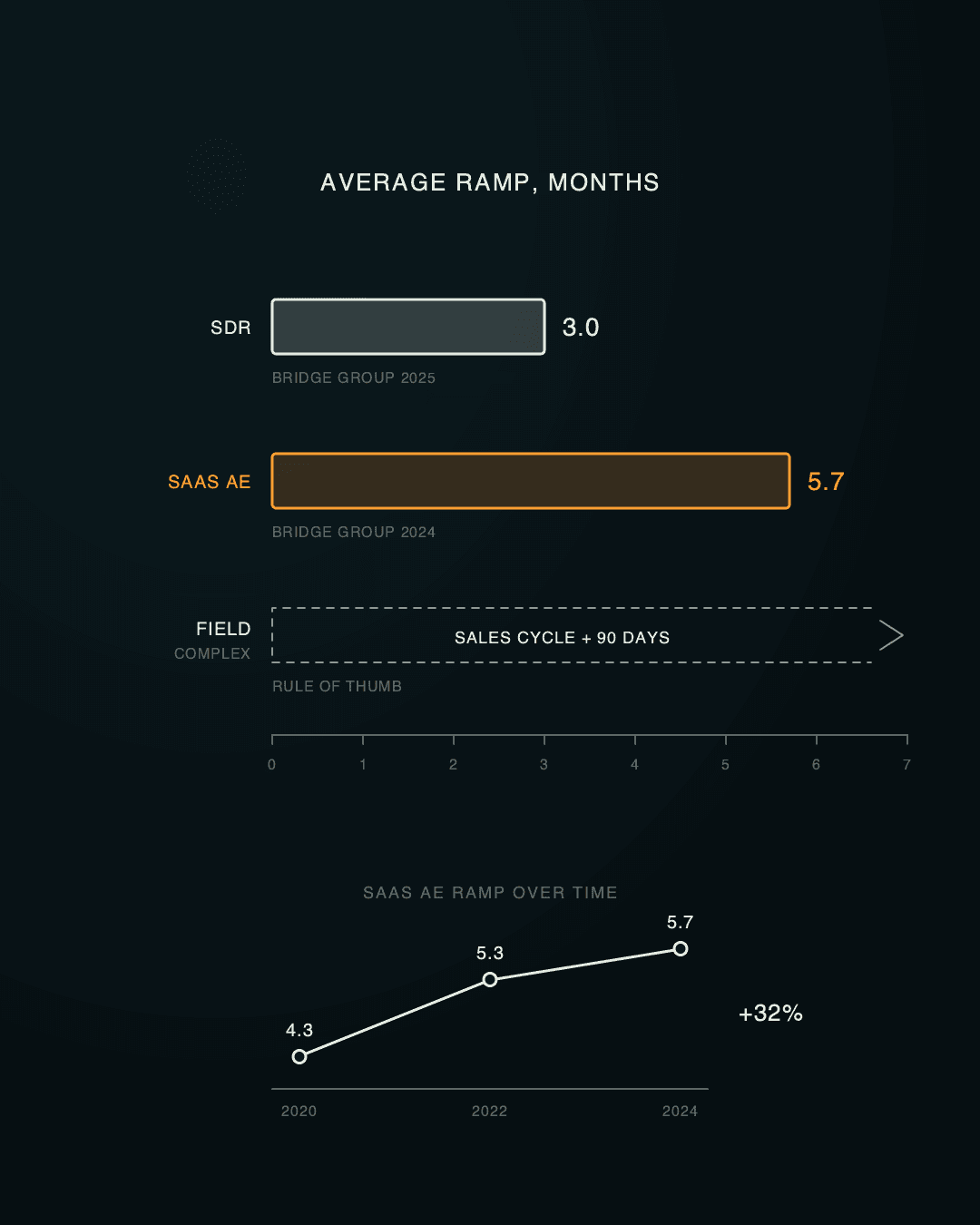
Here are the benchmarks we trust enough to use, with the caveats you should hold them to.
Role | Average ramp | Source | What to watch |
|---|---|---|---|
SDR / BDR | 3.0 months | Bridge Group, 2025 SDR Models and Metrics, 351 B2B companies, published Feb 2025 | Lowest since 2010, down from a peak of 3.8 months in 2014. Only 60% of SDRs were at quota, the lowest in the study's history. |
SaaS AE | 5.7 months | Bridge Group, 2024 SaaS AE Metrics and Compensation, 172 B2B SaaS companies, published Mar 2024 | Up from 5.3 months in 2022 and 4.3 months in 2020, a 32% rise. 51% of AEs hit quota. |
Enterprise AE, field sales, regulated sales | No independent benchmark we could verify | Rule of thumb: sales cycle plus about 90 days | Long cycles, buying committees, and compliance training push this out. Measure your own. |
A few honest notes on those numbers.
They are survey averages. The Bridge Group asks sales leaders what their average ramp is. That is self-reported, and every company defines "ramped" differently. Use these as a rough frame, not a target you hold a cohort to.
The SDR and AE numbers are moving in opposite directions. SDR ramp got shorter (the Bridge Group suggests AI-assisted onboarding or tighter management expectations as possible reasons). AE ramp got longer. Our read: SDR work is narrower and more repetitive, so it responds faster to structure and drilling. AE work involves more conversation types, longer cycles, and more people on the buyer side, and that is exactly where "learn it on live deals" costs the most time.
Watch secondary sources. You will find dozens of blogs quoting "Bridge Group says" with numbers that do not match the reports (4.2 months, 4.7 months, 5.0 months, and so on), often mixing editions, medians, and averages. We read the reports. Where we could not read the original, we did not use the number. The Bridge Group has also published a newer AE report for 2026; if your team has it, use its figure instead of ours.
Field and medtech ramp is longer, and nobody has a clean number. We looked. We did not find an independent, recent benchmark for field sales or medical device ramp that we would put our name to. What we see on our own calls is that field cohorts, especially in medtech and pharma, carry two extra loads: compliance training that has to happen before they can say anything, and very few observed conversations because the manager cannot sit in the car for every visit. Both push ramp out. If you run a field team, use sales cycle plus 90 days as your starting estimate, then measure the three clocks and replace the estimate with your own number after one cohort.
What is a "good" ramp time?
A good ramp time is shorter than your last cohort's, with the same or better quality at month twelve. That is the only benchmark that matters inside your company.
Industry averages tell you whether you are wildly off. If your SaaS AEs take 11 months, look hard at your onboarding. If they take 4, you are already ahead of the Bridge Group average and the next gains come from consistency (fewer reps stuck in the tail) rather than from the median.
The tail is where most of the money hides. A cohort where eight reps ramp in five months and two reps take ten is not a five-month cohort. It is a cohort with a hidden 20% problem.
Why does ramp take so long?
Because onboarding loads knowledge in week two and leaves execution to be learned on live buyers for months.
Look at what a typical first month contains. Product training. CRM training. Methodology slides. Recorded calls. A shadowing schedule. A quiz. Maybe one roleplay with the manager, done in a conference room, with the rest of the cohort watching. Everything in that list puts information into the rep's head. Almost nothing in that list makes them say the words out loud, under pressure, enough times to make the words automatic.
Then the rep goes live, and the real learning starts. Every call is a rep. Every objection they fumble is a lesson. The trouble is the price of each lesson: it costs a real prospect, a real meeting, sometimes a real account. And reps get very few of them. An SDR might get a handful of real conversations a day. A field rep visiting customers might get a handful of meaningful conversations a week. An enterprise AE might get one real discovery call a week in the first month.
Think about learning to swim. You can read everything about the front crawl. You can watch the Olympics. The first time you are in the deep end, you will still swallow water, because your body has not done it yet. Sales onboarding hands reps the textbook and the Olympic footage, then pushes them into the deep end with a customer watching.
We call this the Execution Gap: the distance between what a rep knows and what they can do when their stomach drops and the buyer says something they did not expect. Ramp time is mostly the time it takes to close that gap one live call at a time.
Here's what nobody says out loud about shadowing
Shadowing is the most popular ramp tactic, and it is mostly watching. Watching a great rep handle an objection is like watching a great chef chop an onion. It looks easy. It teaches you what good looks like. It does not put the knife skills in your hands.
Shadowing earns its place in week one, when the rep needs to see the shape of a real conversation. After that, every extra hour of watching is an hour not spent doing.
The forgetting problem
There is a second reason ramp drags, and it is quieter. Most of what you load in week one is gone by week six if it is not used. The forgetting curve is old psychology, and you have probably seen inflated percentages attached to it on vendor sites (we are not going to repeat a number we cannot source). You do not need the number. You have seen it. A rep who aced the pricing module in week one cannot explain the pricing tiers to a buyer in week seven, because they never had to.
The fix for forgetting is not more content. It is spaced, out-loud retrieval: saying the thing, in a realistic setting, again and again, at spaced intervals. In plain language: practice.
Why the manager cannot fix it alone
Every enablement leader we speak to says some version of the same thing: the managers want to coach, but they cannot hear the conversations. Field managers cannot ride along with eight reps at once. Inside sales managers have their own number to hit. On our calls, the line we hear most is that readiness is invisible until the forecast shows it, and by then it is month four.
Rentokil Terminix's Ryan Bueler put it better than we could: "90% of my job is, I could give great advice all day long to the direct field people, but the daily coaching is what they really need." The advice is not the bottleneck. The daily reps are. (Their story is here.)
How do you reduce sales rep ramp time?
Six moves, in order. None of them is "buy more content."
1. Define ramped before the cohort starts. Write down what full productivity means for this role (the tenured median), what "sustained" means (two or three months at 80% or more), and what the readiness standard is (the five to eight conversations a rep must pass, scored on your methodology). If you cannot write it down, you cannot shorten it. You can only argue about it.
2. Cut the knowledge load to what the first 30 days actually need. Most onboarding programs front-load everything the company has ever written. A new rep does not need the full product catalogue in week one. They need the 20% of product knowledge that comes up in 80% of first conversations, the three or four objections they will hear by Friday, and the CRM steps that block them from working. Everything else can arrive just in time. The old rule from our previous onboarding guide still holds here: get accounts, devices and system access sorted before day one, so week one is not spent waiting for logins.
3. Make practice the main event, not the closing exercise. From day two, every new piece of knowledge gets turned into a short spoken exercise. Learned the discovery framework this morning? Run three discovery calls against a realistic buyer this afternoon. Learned the pricing model? Handle the price objection five times before you go home. The target is volume. Not one big roleplay at the end of week four. Dozens of short ones, every day.
4. Score practice against your own standard, every time. Practice without a score is rehearsal. Rehearsal feels good and changes little. Score every practice conversation on the same rubric you use for real calls (SPIN, MEDDIC, Sandler, or your own), so the rep sees exactly where they lost the room and the manager sees who needs what. This is also how you get the readiness clock.
5. Gate live calls on readiness, not on the calendar. "Week five, you go live" is a calendar gate. "When you pass discovery and the top five objections at the standard, you go live" is a readiness gate. Readiness gates sound slower. They are faster, because the reps who are ready go live early, and the reps who are not ready stop burning real prospects while they learn.
6. Keep practice running after go-live. Ramp does not end when live calls start. It speeds up, if the rep keeps practising the specific things their live calls are exposing. A short warm-up before the day's first call, a debrief at the end of the day, a targeted drill on whatever went wrong. Ten to fifteen minutes. Every day.
That last point is where most teams fall off. The structured program ends, the rep is "onboarded," and practice stops just as it starts to matter most.
The gap most teams hit is the one between knowing and doing. That is the problem SecondBody was built to solve, by giving a new rep a realistic buyer to practise against every day, scoring each conversation against the team's methodology and objection library, and telling the manager who to coach on what before their next one-to-one.
What does a week-by-week ramp plan built around practice look like?
Here is a 12-week plan for a new AE or field rep. SDRs can compress it to about six to eight weeks. Enterprise roles stretch weeks 5 to 12 over a longer period. The structure stays the same: load a little, practise a lot, gate on readiness, keep practising live.
For the full 30-60-90 version with targets for each month, see our 30-60-90 day plan for new sales reps. This is the practice spine that sits inside it.
Before day one
Accounts, devices, CRM access, phone or dialler, and practice tool set up and tested. (Every day a rep spends waiting for a login is a day added to ramp.)
A named onboarding buddy (a tenured rep, not the manager) and a named content owner for practice scenarios.
The readiness standard written down and shared with the rep on day one, so they know what "ready" means.
Week 1: See the shape of the job
Knowledge: company story, ideal customer, the core problem you solve, the 20% of product that comes up most, CRM basics.
Watching: two or three live or recorded calls, chosen to show good and bad versions of the same conversation.
Practice: from day two, 15 to 20 minutes a day. Start with the opening of a call and the first discovery questions. Short. Low stakes. Out loud.
Gate: none yet. The goal is comfort with speaking the language of the job.
Week 2: Discovery, out loud
Knowledge: your methodology's discovery model, the buyer personas the rep will meet first.
Practice: 20 to 30 minutes a day of discovery against different personas. Scored on the rubric. The rep sees their score after each one and repeats the weak parts.
Manager: one 30-minute session reviewing two practice conversations with the rep. Not a lecture. "Play me the moment you lost them."
Gate: first readiness check on discovery. Many reps will not pass yet. That is the point.
Week 3: The top objections
Knowledge: the five objections reps hear most in this role, sourced from real calls (ask your tenured reps, check your call recordings, use whatever your conversation intelligence tool shows).
Practice: daily objection drills. Same objection, different buyers, until the response is automatic. Then mix them.
Gate: readiness check on the top five objections.
Week 4: Full conversations, and the first readiness gate
Practice: full simulated calls, start to finish, in the shape of the real first call (cold call for SDRs, first meeting for AEs, first visit for field reps). Include pricing and next-step setting.
Gate: the readiness gate. Pass discovery, the top five objections, and a full first conversation at the standard. Reps who pass go live with real prospects this week or next. Reps who do not get targeted drills on the specific skill they missed, and retest in a few days.
Weeks 5 to 6: Go live with a net under them
Live: a controlled share of real conversations. Lower-value accounts or warmer leads first, if you can route them.
Practice: a short warm-up before the first live call each day, rehearsing the call they are about to have. A five-minute debrief at the end of the day.
Manager: listens to a sample of live calls and compares them with practice scores. Where live and practice disagree, practice scenarios get updated.
Watch: first meetings held, first opportunities, first pipeline.
Weeks 7 to 8: Widen the range
Practice: second-tier conversations. Multi-stakeholder meetings, the procurement call, the competitor comparison, the "we're happy with what we have" buyer, negotiation basics.
Live: full call load for reps who passed the gate early.
Gate: second readiness check on the wider set.
Weeks 9 to 12: Practise what live calls expose
Practice: no longer a fixed curriculum. Each rep practises what their own live calls show they need. One rep keeps losing the room on pricing. Another rambles in discovery. Their practice should be different.
Manager: weekly one-to-ones run off a one-page brief: what the rep practised, what scores moved, which two moments to replay together.
Watch: pipeline coverage, stage progression, and the first closed-won deal for AEs.
What about the content from traditional onboarding?
Keep it. E-learning modules, video libraries, written playbooks, and live webinars all still have a job: they are where knowledge comes from. The change is the ratio. In most programs we have seen, content takes most of the first month and practice takes a sliver. Flip it. Content becomes the short brief before each practice block, and practice becomes the main thing a new rep does every day.
Which leading indicators show a rep is ready before revenue does?
Revenue is the last thing to move. If you wait for it, you find out about a struggling rep in month four or five, when fixing them costs the most. These leading indicators move in the first two to three weeks.
1. Practice volume. How many scored practice conversations has the rep completed this week? This is the simplest predictor we know. Reps who practise a lot, early, tend to pass readiness gates sooner. Reps who avoid practice usually avoid it for a reason (fear, overload, a bad first experience) and that reason will show up on live calls too.
2. Rubric scores by skill. Not one overall score. A score per skill: opening, discovery depth, objection handling, pricing, next steps. The pattern tells the manager what to coach. A rep scoring well on discovery and badly on objections needs different help from a rep with the opposite profile.
3. First-pass rate on readiness scenarios. What share of readiness checks does the rep pass on the first attempt? And how many attempts does it take to pass the rest? A rep who needs six tries on the price objection is telling you something.
4. Objection recovery. When the simulated buyer pushes back, does the rep recover the conversation (ask a question, reframe, get back to the buyer's problem) or fold? Folding in practice predicts folding on live calls. Recovery is a skill you can watch improve week by week.
5. Confidence. Ask the rep, every week, how confident they feel about each core conversation on a simple 1 to 5 scale. Self-reported confidence is soft data. It is also the indicator our buyers ask about most, especially for reps moving from clinical, technical or operations roles into sales. Those reps often know the product better than anyone and freeze on the commercial part. Rising confidence alongside rising scores is a good sign. Rising confidence with flat scores is a warning.
6. Practice-to-live alignment. Once the rep is live, compare their live call scores (from your conversation intelligence tool or a manager's review) with their practice scores on the same skill. If they line up, your practice scenarios are realistic. If practice scores are high and live scores are low, the scenarios are too easy. Fix the scenarios.
Then the early live indicators: first meetings held, first opportunities created, pipeline created by day 30 and day 60, and stage progression. These are still earlier than revenue.
Put these on one page, per rep, per week. That page is what "readiness before forecast" looks like in practice. It is also what enablement teams use to answer the question every sales leader asks in month two: "Is this cohort going to make it?"
How much does a slow ramp actually cost?
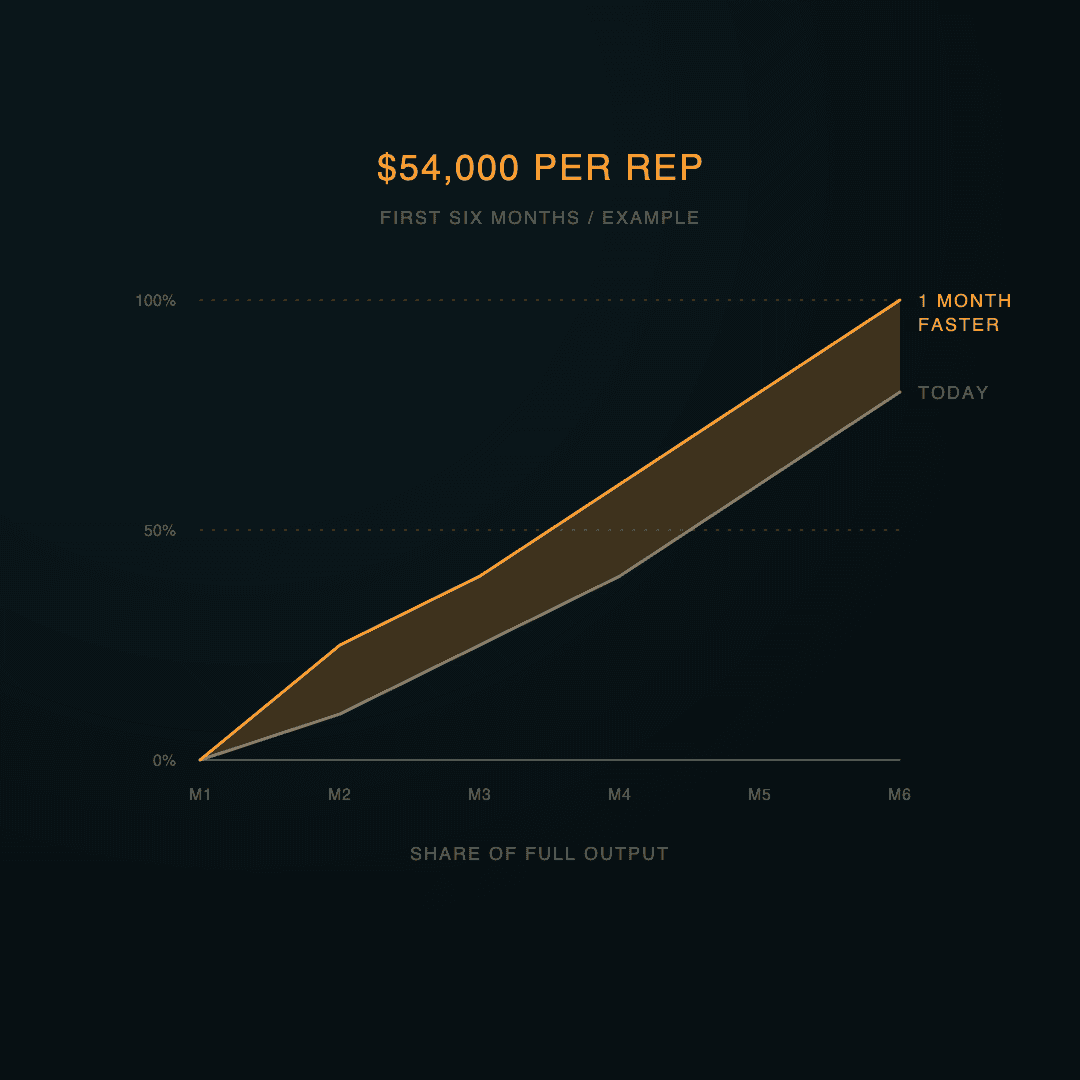
More than most teams think, because the cost is spread across months and hidden inside a quota plan. Here is a walk-through you can run with your own numbers. The numbers below are an example, not data, and they are deliberately simple.
Step 1: Write down a full rep's monthly output
Say a fully ramped AE carries an annual quota of $720,000. That is $60,000 a month.
Step 2: Write down your current ramp curve
Use your last cohort. If you do not have one, a curve like this is in the range of the Bridge Group's 5.7-month average:
Month | 1 | 2 | 3 | 4 | 5 | 6 |
|---|---|---|---|---|---|---|
Share of full output | 0% | 10% | 25% | 40% | 60% | 80% |
Add the percentages: 0 + 10 + 25 + 40 + 60 + 80 = 215%. That rep gives you 2.15 "full rep months" in their first six months.
Step 3: Calculate the gap
A full rep would produce 6 × $60,000 = $360,000 in six months. The ramping rep produces 2.15 × $60,000 = $129,000. The ramp gap is $231,000 per rep, in the first six months alone.
Step 4: Model one month faster
Now shift the curve one month earlier. Same shape, reached a month sooner:
Month | 1 | 2 | 3 | 4 | 5 | 6 |
|---|---|---|---|---|---|---|
Share of full output | 0% | 25% | 40% | 60% | 80% | 100% |
That adds to 305%, or 3.05 full rep months, which is $183,000. The difference is $54,000 per rep in the first six months.
Step 5: Multiply by the cohort
A cohort of 10 AEs ramping one month faster is about $540,000 of quota-equivalent output brought forward in the first half-year. A cohort of 50 is about $2.7 million.
Step 6: Add the cost you are already paying
While the rep ramps, you are paying them. The Bridge Group's 2024 report put median AE on-target earnings at $190,000, with a $100,000 base. Even counting only the base, that is more than $8,000 a month per rep paid during months of low output. Add the manager hours spent on coaching, and for field teams the travel, the car, the samples.
Step 7: Be honest about the caveats
This is the part most ROI slides skip.
Quota is not profit. Bookings brought forward are worth your gross margin on them, and some of that output would have arrived later anyway. Present the number as "output brought forward," not "new revenue."
Faster ramp is only good if quality holds. A cohort that ramps a month faster and churns more customers, or discounts more, has not saved anything. Track month-twelve performance and win rate, not just ramp.
Attrition matters more than ramp for some teams. The Bridge Group's 2024 AE report put median annual turnover at 30%. A rep who leaves in month eight never pays back their ramp at all. Faster ramp shortens the time a new rep is a cost. Better readiness also tends to help retention, because reps who feel capable early are less likely to quit, but measure that before you claim it.
The objection we hear most on sales calls is some version of "how do we prove this makes our money back?" The answer is this walk-through, with your numbers, plus a pilot that moves one leading indicator you agreed on in advance. More on that below.
Who needs to fix ramp first?
Everybody ramps. Some teams feel it more.
Sales enablement leaders with a hiring cohort. This is the most common trigger we see. A cohort of 10, 15, 50 new reps starting on the same date, a regional rollout, a new product line that needs a new team. The cohort makes ramp visible, because ten slow ramps at once is a forecast problem, not an individual one. If that is you, our page for sales enablement teams shows how teams run practice at cohort scale.
Heads of Sales Development. SDR ramp is shorter, but SDR teams hire more often and turn over faster, so they pay the ramp cost more often. Cold-call openings and the first 30 seconds of objection handling are the most drillable skills in sales. They are also where new SDRs lose the most conversations.
Field sales leaders. Field reps ramp with the fewest observed conversations. The manager cannot be in every car or every clinic. Practice that happens on the phone, in the car park, between visits, is often the only practice a field rep gets. At Allwyn, a field team of 200 retail sales executives, practice moved off desktop and onto phone and WhatsApp because that is where the reps actually were.
Regulated industries (medtech, pharma, financial services). Compliance training eats the first weeks, and reps cannot improvise. They need to say the approved thing, accurately, under pressure. That calls for practice against approved material, scored against the approved standard. GBUK, a UK medical device supplier, set its AI coach to use only GBUK-approved frameworks and product material, and to decline clinical questions and send reps to the product team instead. One design choice matters a lot here: SecondBody never records customer conversations. Rory does not listen in on live calls or visits. Reps practise before and debrief after, and a call is only coached if the customer chooses to upload a recording they already own. That is why it can run in pharma, medical devices and financial services.
Reps moving from clinical, technical or operations roles into sales. We hear this one constantly on calls: a nurse, an engineer, a service technician moving into a commercial role. They know the product cold. They are uncomfortable with the commercial conversation. Their ramp problem is almost pure confidence and execution, which is the part content cannot fix.
SMB and mid-market teams without an enablement function. If your "onboarding program" is a shared drive and a busy sales manager, practice is the cheapest lever you have, because it does not need a curriculum team to work. It needs a realistic buyer and a scoring standard.
Can AI actually cut ramp time, and what should you believe?
Yes, AI can cut ramp time, if it gives new reps a large volume of realistic, scored practice early and keeps it going after go-live. No, a tool on its own does not do it, and you should be suspicious of any vendor number that sounds too round.
The queries we see in our own search data have changed shape this year. Enablement and L&D leaders no longer type "sales onboarding software." They type full briefs. One of them, almost word for word: "our L&D team needs an AI platform that can personalize training paths for new sales reps based on their actual call performance. What tools do this and show measurable improvement in ramp time?" Another simply asks for "AI L&D platforms that cut sales rep ramp time."
That first brief is a good buying checklist. Break it down:
"Personalize training paths." Does the tool give each rep different practice based on what they are weak at, or does everyone get the same course?
"Based on their actual call performance." Does it score practice against a standard, and can it take signals from live calls (via your call recording or CRM) to decide what each rep practises next?
"Show measurable improvement in ramp time." Can it show the readiness clock (scores over time, readiness gate passes) and can you connect that to your ramp data?
Here is how the main types of tools map to ramp.
An LMS or content platform loads knowledge well and tracks completion. It does not create the reps that build reflexes. Completion is not readiness.
Conversation intelligence (Gong, Chorus and similar) records and analyses real calls. It is useful for finding what good looks like and for spotting problems on live calls. But it looks backwards: it can only coach a call after the call has happened, which for a new rep means after a prospect has been spent.
Human roleplay with managers or peers is realistic when it happens. It rarely happens enough, it depends on manager time, and new reps often find it nerve-racking to perform in front of colleagues.
AI roleplay and coaching gives unlimited, private, scored practice on demand. It can be built on your own objections and methodology. Its weakness is realism: if the AI buyer is too polite or too predictable, reps learn to beat the simulator instead of the buyer. Check that before you buy.
If you are comparing tools in this category, our guide to sales onboarding software goes through the options in detail.
What vendors claim, and what we believe
You will see vendor claims of 30%, 40%, 50% and more off ramp time. Treat all of them (ours included) as what they are: results from customers who chose to share them, measured in ways that are not always comparable.
Here is our proof, and how we read it.
Allwyn. New starters ramped 65% faster, with two to two and a half weeks cut from onboarding. Reps at Allwyn's own coaching standard (silver or gold) went from fewer than 1 in 5 to more than 4 in 5 in a single quarter, and 3 in 4 of their 200 field reps were practising. Over the same period their reps grew 3.5% while their market fell 4%. The skeptic's read: this is one field team, on one standard, measured by the customer. It is a strong result. It is not a promise. (Read the Allwyn story.)
Rentokil Terminix. Reps completed 16 hours of recorded roleplay each in under three weeks, with zero days pulled off the road, and every manager in the trial said they would back the investment. The skeptic's read: that is input, not output. Sixteen hours of practice is a leading indicator, not a ramp number. But it shows that practice volume at that level is possible for a field team without losing selling days, which most enablement leaders assume is impossible.
GBUK. Consistent users scored 8 to 10 out of 10 on cold-call assessments, against about 6 for intermittent users, and managers got back about a week a month previously spent chasing account activity. The skeptic's read: consistent users may have been stronger reps to begin with. A comparison group would make this cleaner, which is why we recommend one in the pilot below.
What we actually believe, after watching enough rollouts: practice volume in the first three weeks is the best early predictor of ramp we have seen. Teams that get new reps to dozens of scored practice conversations before go-live see the readiness clock move fast. Teams that buy a tool and do not assign an owner see a spike of usage in week one and silence by week four.
That last point is our one honest warning. Practice tools, ours included, fail when nobody owns the content and nobody looks at the scores. We have lost a customer for exactly that reason. The tool was fine. Nobody opened it after the launch email.
What mistakes make ramp longer?
These are the ones we have watched, more than once.
1. Measuring onboarding completion instead of readiness. "100% of the cohort completed the program" tells you nothing about whether they can sell. Measure what they can do, not what they have watched.
2. Saving practice for the end. A big roleplay in week four, in a conference room, in front of the cohort. One attempt each. That is not practice. That is an exam with an audience. Spread practice across every day from day two, and keep most of it private.
3. Going live on a calendar date. "Everyone goes live in week five" sends ready reps live too late and unready reps live too early. Gate on readiness.
4. Using generic scenarios. If the practice buyer does not sound like your buyers, raise your objections, or work in your industry, reps learn generic sales. Build scenarios from your own call recordings and your own objection list. Update them when live calls show something new.
5. Stopping practice at go-live. This is the most expensive mistake on the list. The weeks right after go-live are when reps finally know what they are bad at, and that is exactly when most programs stop giving them a place to work on it.
6. Leaving managers out. If the manager never sees practice scores, practice feels like homework and the manager keeps coaching from gut feel. Put a one-page brief in front of the manager before each one-to-one: what the rep practised, what moved, what to replay.
7. Nobody owns the content. Every practice program needs a named person on your side who owns the scenarios and looks at the data weekly. Not a committee. A person. Without one, the program decays by month two.
8. Chasing speed and ignoring quality. A faster ramp that produces reps who discount, over-promise or churn customers is not a faster ramp. Check month-twelve performance and win rate alongside ramp time.
How do you prove it in two weeks?
Run a small, scoped pilot with your next cohort. Not a 90-day "let's see how it goes." Two weeks, ten people, one number. This is the format that has closed the most decisions on our own sales calls, because it answers the "prove it" question before anyone signs a large contract.
The design
Who. About 10 new joiners from one cohort. If your cohort is bigger, split it: 10 in the pilot, the rest as a comparison group on your normal onboarding. If it is smaller, compare against your last cohort's numbers at the same point.
How long. Two weeks of daily practice, 15 to 20 minutes a day, built into the onboarding schedule (not "in your spare time," because new reps do not have any).
What to practise. The three conversations that matter most in the first month. For SDRs: cold-call opener, the top three objections, booking the meeting. For AEs: discovery, the top objections, setting next steps. For field reps: the first visit, the top objections, the ask.
One number to move. Pick it before you start. The best pilot metric is a leading indicator you can measure in two weeks: the share of pilot reps who pass the readiness standard by day 14, compared with the comparison group. Other good options: average rubric score on objection handling, or first-pass rate on the readiness scenario.
A named owner. One person on your side who owns the scenarios, checks the scores twice a week, and nudges reps who have gone quiet.
Managers in the loop. Each manager gets a short weekly brief per rep. At the end of two weeks, ask each manager directly whether they would back a wider rollout. (At Rentokil Terminix, every manager in the trial said yes when asked.)
What to check before you start
Data and compliance. What is recorded, where it is stored, who can delete it, whether it is used to train anything else. (For the record: SecondBody does not record customer conversations at all. Practice sessions are between the rep and Rory.) Get the DPA, NDA and SSO questions answered in week zero, not week two. These are the questions procurement asks, and they are better asked early.
Setup effort. Building scenarios from your playbook and objection list should take days, not months. If a vendor needs a quarter to set up a pilot, the pilot will not happen.
Access. Can reps practise where they actually are? For field reps, that means on the phone, without a laptop and a login.
What to do with the result
If the pilot group passes the readiness standard faster and the managers back it, roll it out to the full cohort and start tracking the three clocks. Then check at month three and month six whether the readiness gap turned into a ramp gap. If the pilot did not move the number, look at practice volume first. In our experience, a pilot that did not work is usually a pilot where reps did not practise enough, and that is an owner problem, not a tool problem.
Frequently asked questions
What is ramp time in sales?
Ramp time is how long a new sales rep takes from their start date to consistent full productivity, meaning they produce at the level of a tenured rep in the same role for two or three months in a row. It is longer than onboarding, which is only the structured learning period at the start.
What is the ramp time formula?
Ramp time = the date a rep first reaches sustained full productivity minus their start date. Define "full productivity" as the median monthly output of tenured reps in the same role, and "sustained" as two or three consecutive months at 80% or more of that level.
What is the average ramp time for sales reps?
The Bridge Group's research puts average SDR ramp at 3.0 months (2025 report, 351 companies) and average SaaS AE ramp at 5.7 months (2024 report, 172 companies). Enterprise, field and regulated roles usually take longer. A common rule of thumb is your sales cycle plus about 90 days.
Why is AE ramp time getting longer?
The Bridge Group found average SaaS AE ramp rose from 4.3 months in 2020 to 5.7 months in 2024. Longer sales cycles and tougher selling conditions are part of it. Our view is that AE roles involve more conversation types than ever, and most onboarding still leaves those conversations to be learned on live deals.
How do you accelerate sales onboarding?
Cut the knowledge load to what the first 30 days need, make daily spoken practice the main activity from day two, score every practice conversation against your own standard, gate live calls on readiness instead of the calendar, and keep practising after go-live.
How do you measure time to productivity in sales?
Track three clocks: time to first deal (or first meeting for SDRs), time to readiness (passing a scored practice standard), and time to full quota. The first two give you an early warning. The third is the number finance uses.
What is a good ramp time for an SDR?
Around three months is the current average in the Bridge Group's 2025 research. A good ramp time inside your own company is one that beats your last cohort with the same or better quality at month twelve.
Does a faster ramp mean lower quality?
It can, if you get speed by pushing reps live before they are ready. It does not have to, if you get speed by giving them more practice earlier. Watch win rate, discounting and month-twelve performance alongside ramp time.
How do AI agents help with sales training and onboarding of new reps?
AI agents can play a realistic buyer for practice, score each conversation against your methodology, tell each rep what to work on next, and brief managers on who to coach. The best use is volume: dozens of scored practice conversations before a rep's first live call.
Which sales coaching software delivers the fastest ramp time?
The tools that cut ramp most are the ones reps actually use daily. Look for realistic voice practice, scoring against your own playbook, practice that adapts to each rep's weak spots, and manager visibility. Then prove it with a two-week pilot on your next cohort before rolling out.
How long should a new rep practise each day during onboarding?
Fifteen to thirty minutes a day of scored, spoken practice is a workable range for most roles. Short and daily beats long and weekly. After go-live, a ten-minute warm-up before the first call and a short end-of-day debrief keep the gains.
We have 50 new reps starting at once. Where do we start?
Write the readiness standard first, then build practice scenarios from your top objections and first-call types, then run a two-week pilot with 10 of the 50 while the rest follow the normal program. Use the result to decide how to roll out to the full group.
How does SecondBody help reduce ramp time?
Rory, our AI coach, runs realistic voice roleplay for new reps on web and mobile, built from your own objection library and custom buyer personas, and scored against your methodology (SPIN, MEDDIC, Sandler). On team plans, Rory is trained on your playbook and calls reps on WhatsApp or phone (no login needed) for a morning warm-up, practice before a big meeting, and an end-of-day debrief. Managers get a one-page brief on who to coach this week, on what. See how Rory roleplay works.
What does SecondBody cost?
$75 per seat a month, or $750 per seat a year, including 120 minutes of AI roleplay and 60 minutes of coaching with Rory each month, custom personas and objection-library uploads. Team and enterprise packages are custom priced and add Rory on WhatsApp and phone, playbook training, SSO and volume minute packages. You can start with a plan today or book a demo to scope a pilot.
Is SecondBody suitable for regulated and field teams?
Yes. It is built for field sales and regulated industries such as medtech, pharma and financial services. SecondBody never records customer conversations; reps practise before and debrief after. On team plans you also get SOC 2 Type II, enterprise SSO, custom data retention, coaching in 12+ languages, and Rory restricted to your approved material only.
How we know this
We build SecondBody, an AI coaching and roleplay platform. The patterns in this article come from three places: rollouts with customers like Allwyn, Rentokil Terminix and GBUK; about twenty sales calls with enablement and sales leaders between January and September 2026, where hiring cohorts and invisible readiness came up again and again; and our own search data, where enablement and L&D leaders now ask long, specific questions about ramp. The benchmarks come from the Bridge Group's published research, which we read directly. Where we could not verify a number, we said so and left it out.
Knowledge loads in a week. Reflexes take reps.
Every onboarding program we have seen loads knowledge fast. That part is solved. The slow part, the part that turns into months of ramp, is the gap between knowing and doing, the Execution Gap, and it only closes one rep at a time.
So stop asking how to get more information into new reps faster. Ask how many times they have said it out loud, to a realistic buyer, with a score, before they say it to a real one. Count that. Gate on it. Keep it going after go-live. Ramp time follows.
That is what we built SecondBody to do: a coach who practises the exact conversations your new reps are about to have, every day (on team plans, Rory calls them on WhatsApp or phone), and tells their manager what to work on next. If you have a cohort starting soon, run the two-week pilot with us and see what moves.
Good luck out there.
Omid
By Omid, founder of SecondBody
Key answers, up front
The short answer. You reduce sales rep ramp time by moving practice to the front of onboarding. New reps do not ramp slowly because they lack information. They ramp slowly because their first hundred real conversations are also their first hundred attempts. Give them those attempts before the buyer is on the line.
The formula. Ramp time = the date a rep first sustains full productivity minus their start date. Track three clocks, not one: time to first deal, time to readiness (a scored practice standard), and time to full quota.
The benchmarks. The Bridge Group puts average SDR ramp at 3.0 months (2025, 351 companies) and average SaaS AE ramp at 5.7 months (2024, 172 companies), up from 4.3 months in 2020. For complex and field roles, the honest rule of thumb is your sales cycle plus about 90 days.
What to watch before revenue. Practice volume, rubric scores per skill, first-pass rate on certification scenarios, objection recovery, and confidence. These move in week two. Revenue moves in month four.
How to prove it. Run a two-week pilot with about 10 new joiners, one number to move, a named content owner, and a comparison group.
Here is the moment every enablement leader knows.
Week five. Your new rep has finished the product modules. Passed the quiz. Watched eleven recorded calls. Sat in on three of a senior rep's meetings. Their manager says they are "ready to get on the phones."
First real call. The buyer says, "We already use something for that." And your rep, who could have written an essay on how to handle that objection, says "Oh, okay, no problem," and lets the buyer go.
That rep did not lack knowledge. They lacked a reflex. And no amount of content builds a reflex.
That is the whole problem with ramp, and most onboarding programs are built to solve the wrong half of it. They load knowledge fast and leave execution to chance, which means the rep learns to sell on live buyers, in your pipeline, at your expense. That is why ramp stays long. Not because reps are slow. Because the first real practice happens in front of the customer.
We build an AI coaching and roleplay platform, so read this with that in mind. We will also be harder on the "just buy a tool" answer than most vendors are, because we have watched what happens when nobody owns the practice.
This guide replaces our older piece on speeding up onboarding with online training. It goes further: what ramp time is, how to calculate it, what good looks like by role, why it drags, a week-by-week plan built around practice, the leading indicators you can see before revenue shows up, a cost calculator you can run on a napkin, the mistakes we keep seeing, and a two-week pilot you can run with your next cohort.
What is sales ramp time, really?
Sales ramp time is the time between a new rep's start date and the point where they produce at the level of a fully productive rep in the same role, and keep producing at that level. That is it. Start date to sustained full productivity.
The word that matters is "sustained." One lucky deal in week six is not ramp. A rep who hits 100% of a ramped quota once and then drops to 40% the next month is not ramped. Ramped means the output is now predictable enough that you can put it in a forecast without crossing your fingers.
Here is what it means in practice. Ramp is not onboarding. Onboarding is the structured learning period: product, process, systems, territory, methodology. It usually lasts weeks. Ramp is the whole curve from zero to full output, and it usually lasts months. You can finish onboarding in four weeks and still be ramping in month six. Most teams measure the first and get surprised by the second.
Ramp is also not a single number. It is a curve. A new AE might produce nothing in month one, a little in month two, a quarter of a full rep's output in month three, and so on. The shape of that curve matters as much as where it ends, because every month spent in the low part of the curve is quota you planned for and did not get.
If you want the short dictionary version, we keep one at ramp time. This article is the long one.
One more distinction that saves arguments later. "Time to productivity" is the same idea as ramp time, used more often by L&D and HR teams. "Ramp quota" is something different: it is the reduced target you give a rep while they ramp (for example a fraction of full quota in each of the first few months). Ramp quota is a compensation design choice. Ramp time is what actually happens. Do not let the first one hide the second.
How do you calculate ramp time?
The simple ramp time formula is:
Ramp time = (date the rep first reaches sustained full productivity) minus (start date)
To make the formula usable, you have to define "sustained full productivity" before the cohort starts, not after. A clean definition looks like this:
Full productivity = the median monthly output of reps in the same role with more than 12 months of tenure. Output can be bookings, qualified meetings, pipeline created, or units sold, depending on the role.
Sustained = the rep hits at least that level (or a set share of it, such as 80%) for two or three consecutive months.
So the measured version reads: ramp time is the number of months from start date to the first month of the first run of three consecutive months at 80% or more of the tenured median. It sounds fussy. It is the only version that stops people from declaring victory on a single good month.
The three clocks you should track
Most teams only track the last clock, and that is why they learn about a bad cohort four months too late. Track three.
1. Time to first deal (or first meeting, for SDRs). The first closed-won deal for an AE, the first qualified meeting held for an SDR, the first order for a field rep. This is a weak signal on its own (some first deals are inherited or lucky) but it tells you whether the rep is in the game at all.
2. Time to readiness. The date a rep first passes a scored practice standard for the core conversations of the role. For example: discovery, the top five objections, pricing, and the first two minutes of a cold call, each scored against your methodology rubric, each passed at a set threshold. This clock is the one you control, and it is the one most teams do not measure. We will come back to it, because it is the earliest honest signal you have.
3. Time to full quota. The formula above. The lagging clock. The one finance cares about.
The gap between clock two and clock three tells you about your market and your pipeline. The gap between start date and clock two tells you about your onboarding. If you only watch clock three, you cannot tell those two problems apart.
Other ways teams estimate ramp
You will see two other methods in planning models, and both are worth knowing.
The sales cycle plus 90 days method sets expected ramp equal to your average sales cycle length plus a 90-day buffer for onboarding and training. It appears in an Insight Partners piece by InsightSquared from 2018, which itself calls the 90 days somewhat arbitrary. It is a decent sanity check. If your cycle is 60 days and your reps take nine months to ramp, something other than the cycle is slowing them down.
The ramp-adjusted capacity method treats each month of ramp as a percentage of a full rep. If month one is 0%, month two is 10%, month three is 25%, and so on, you add those up to see how many "full rep months" a new hire gives you in their first year. RevOps teams use this for headcount planning. It is also the method we use for the cost calculator later on, because it makes the cost of a slow curve visible.
A useful number from the Bridge Group's 2024 SaaS AE report: they calculate "months at productivity" as tenure minus ramp, and found a median of 24 months. Average AE tenure in that report was 2.8 years and average ramp was 5.7 months. Put those together and ramp eats roughly a sixth of a typical AE's time with you. That is the slice you are trying to shrink.
What is the average ramp time for sales reps?
Here are the benchmarks we trust enough to use, with the caveats you should hold them to.
Role | Average ramp | Source | What to watch |
|---|---|---|---|
SDR / BDR | 3.0 months | Bridge Group, 2025 SDR Models and Metrics, 351 B2B companies, published Feb 2025 | Lowest since 2010, down from a peak of 3.8 months in 2014. Only 60% of SDRs were at quota, the lowest in the study's history. |
SaaS AE | 5.7 months | Bridge Group, 2024 SaaS AE Metrics and Compensation, 172 B2B SaaS companies, published Mar 2024 | Up from 5.3 months in 2022 and 4.3 months in 2020, a 32% rise. 51% of AEs hit quota. |
Enterprise AE, field sales, regulated sales | No independent benchmark we could verify | Rule of thumb: sales cycle plus about 90 days | Long cycles, buying committees, and compliance training push this out. Measure your own. |
A few honest notes on those numbers.
They are survey averages. The Bridge Group asks sales leaders what their average ramp is. That is self-reported, and every company defines "ramped" differently. Use these as a rough frame, not a target you hold a cohort to.
The SDR and AE numbers are moving in opposite directions. SDR ramp got shorter (the Bridge Group suggests AI-assisted onboarding or tighter management expectations as possible reasons). AE ramp got longer. Our read: SDR work is narrower and more repetitive, so it responds faster to structure and drilling. AE work involves more conversation types, longer cycles, and more people on the buyer side, and that is exactly where "learn it on live deals" costs the most time.
Watch secondary sources. You will find dozens of blogs quoting "Bridge Group says" with numbers that do not match the reports (4.2 months, 4.7 months, 5.0 months, and so on), often mixing editions, medians, and averages. We read the reports. Where we could not read the original, we did not use the number. The Bridge Group has also published a newer AE report for 2026; if your team has it, use its figure instead of ours.
Field and medtech ramp is longer, and nobody has a clean number. We looked. We did not find an independent, recent benchmark for field sales or medical device ramp that we would put our name to. What we see on our own calls is that field cohorts, especially in medtech and pharma, carry two extra loads: compliance training that has to happen before they can say anything, and very few observed conversations because the manager cannot sit in the car for every visit. Both push ramp out. If you run a field team, use sales cycle plus 90 days as your starting estimate, then measure the three clocks and replace the estimate with your own number after one cohort.
What is a "good" ramp time?
A good ramp time is shorter than your last cohort's, with the same or better quality at month twelve. That is the only benchmark that matters inside your company.
Industry averages tell you whether you are wildly off. If your SaaS AEs take 11 months, look hard at your onboarding. If they take 4, you are already ahead of the Bridge Group average and the next gains come from consistency (fewer reps stuck in the tail) rather than from the median.
The tail is where most of the money hides. A cohort where eight reps ramp in five months and two reps take ten is not a five-month cohort. It is a cohort with a hidden 20% problem.
Why does ramp take so long?
Because onboarding loads knowledge in week two and leaves execution to be learned on live buyers for months.
Look at what a typical first month contains. Product training. CRM training. Methodology slides. Recorded calls. A shadowing schedule. A quiz. Maybe one roleplay with the manager, done in a conference room, with the rest of the cohort watching. Everything in that list puts information into the rep's head. Almost nothing in that list makes them say the words out loud, under pressure, enough times to make the words automatic.
Then the rep goes live, and the real learning starts. Every call is a rep. Every objection they fumble is a lesson. The trouble is the price of each lesson: it costs a real prospect, a real meeting, sometimes a real account. And reps get very few of them. An SDR might get a handful of real conversations a day. A field rep visiting customers might get a handful of meaningful conversations a week. An enterprise AE might get one real discovery call a week in the first month.
Think about learning to swim. You can read everything about the front crawl. You can watch the Olympics. The first time you are in the deep end, you will still swallow water, because your body has not done it yet. Sales onboarding hands reps the textbook and the Olympic footage, then pushes them into the deep end with a customer watching.
We call this the Execution Gap: the distance between what a rep knows and what they can do when their stomach drops and the buyer says something they did not expect. Ramp time is mostly the time it takes to close that gap one live call at a time.
Here's what nobody says out loud about shadowing
Shadowing is the most popular ramp tactic, and it is mostly watching. Watching a great rep handle an objection is like watching a great chef chop an onion. It looks easy. It teaches you what good looks like. It does not put the knife skills in your hands.
Shadowing earns its place in week one, when the rep needs to see the shape of a real conversation. After that, every extra hour of watching is an hour not spent doing.
The forgetting problem
There is a second reason ramp drags, and it is quieter. Most of what you load in week one is gone by week six if it is not used. The forgetting curve is old psychology, and you have probably seen inflated percentages attached to it on vendor sites (we are not going to repeat a number we cannot source). You do not need the number. You have seen it. A rep who aced the pricing module in week one cannot explain the pricing tiers to a buyer in week seven, because they never had to.
The fix for forgetting is not more content. It is spaced, out-loud retrieval: saying the thing, in a realistic setting, again and again, at spaced intervals. In plain language: practice.
Why the manager cannot fix it alone
Every enablement leader we speak to says some version of the same thing: the managers want to coach, but they cannot hear the conversations. Field managers cannot ride along with eight reps at once. Inside sales managers have their own number to hit. On our calls, the line we hear most is that readiness is invisible until the forecast shows it, and by then it is month four.
Rentokil Terminix's Ryan Bueler put it better than we could: "90% of my job is, I could give great advice all day long to the direct field people, but the daily coaching is what they really need." The advice is not the bottleneck. The daily reps are. (Their story is here.)
How do you reduce sales rep ramp time?
Six moves, in order. None of them is "buy more content."
1. Define ramped before the cohort starts. Write down what full productivity means for this role (the tenured median), what "sustained" means (two or three months at 80% or more), and what the readiness standard is (the five to eight conversations a rep must pass, scored on your methodology). If you cannot write it down, you cannot shorten it. You can only argue about it.
2. Cut the knowledge load to what the first 30 days actually need. Most onboarding programs front-load everything the company has ever written. A new rep does not need the full product catalogue in week one. They need the 20% of product knowledge that comes up in 80% of first conversations, the three or four objections they will hear by Friday, and the CRM steps that block them from working. Everything else can arrive just in time. The old rule from our previous onboarding guide still holds here: get accounts, devices and system access sorted before day one, so week one is not spent waiting for logins.
3. Make practice the main event, not the closing exercise. From day two, every new piece of knowledge gets turned into a short spoken exercise. Learned the discovery framework this morning? Run three discovery calls against a realistic buyer this afternoon. Learned the pricing model? Handle the price objection five times before you go home. The target is volume. Not one big roleplay at the end of week four. Dozens of short ones, every day.
4. Score practice against your own standard, every time. Practice without a score is rehearsal. Rehearsal feels good and changes little. Score every practice conversation on the same rubric you use for real calls (SPIN, MEDDIC, Sandler, or your own), so the rep sees exactly where they lost the room and the manager sees who needs what. This is also how you get the readiness clock.
5. Gate live calls on readiness, not on the calendar. "Week five, you go live" is a calendar gate. "When you pass discovery and the top five objections at the standard, you go live" is a readiness gate. Readiness gates sound slower. They are faster, because the reps who are ready go live early, and the reps who are not ready stop burning real prospects while they learn.
6. Keep practice running after go-live. Ramp does not end when live calls start. It speeds up, if the rep keeps practising the specific things their live calls are exposing. A short warm-up before the day's first call, a debrief at the end of the day, a targeted drill on whatever went wrong. Ten to fifteen minutes. Every day.
That last point is where most teams fall off. The structured program ends, the rep is "onboarded," and practice stops just as it starts to matter most.
The gap most teams hit is the one between knowing and doing. That is the problem SecondBody was built to solve, by giving a new rep a realistic buyer to practise against every day, scoring each conversation against the team's methodology and objection library, and telling the manager who to coach on what before their next one-to-one.
What does a week-by-week ramp plan built around practice look like?
Here is a 12-week plan for a new AE or field rep. SDRs can compress it to about six to eight weeks. Enterprise roles stretch weeks 5 to 12 over a longer period. The structure stays the same: load a little, practise a lot, gate on readiness, keep practising live.
For the full 30-60-90 version with targets for each month, see our 30-60-90 day plan for new sales reps. This is the practice spine that sits inside it.
Before day one
Accounts, devices, CRM access, phone or dialler, and practice tool set up and tested. (Every day a rep spends waiting for a login is a day added to ramp.)
A named onboarding buddy (a tenured rep, not the manager) and a named content owner for practice scenarios.
The readiness standard written down and shared with the rep on day one, so they know what "ready" means.
Week 1: See the shape of the job
Knowledge: company story, ideal customer, the core problem you solve, the 20% of product that comes up most, CRM basics.
Watching: two or three live or recorded calls, chosen to show good and bad versions of the same conversation.
Practice: from day two, 15 to 20 minutes a day. Start with the opening of a call and the first discovery questions. Short. Low stakes. Out loud.
Gate: none yet. The goal is comfort with speaking the language of the job.
Week 2: Discovery, out loud
Knowledge: your methodology's discovery model, the buyer personas the rep will meet first.
Practice: 20 to 30 minutes a day of discovery against different personas. Scored on the rubric. The rep sees their score after each one and repeats the weak parts.
Manager: one 30-minute session reviewing two practice conversations with the rep. Not a lecture. "Play me the moment you lost them."
Gate: first readiness check on discovery. Many reps will not pass yet. That is the point.
Week 3: The top objections
Knowledge: the five objections reps hear most in this role, sourced from real calls (ask your tenured reps, check your call recordings, use whatever your conversation intelligence tool shows).
Practice: daily objection drills. Same objection, different buyers, until the response is automatic. Then mix them.
Gate: readiness check on the top five objections.
Week 4: Full conversations, and the first readiness gate
Practice: full simulated calls, start to finish, in the shape of the real first call (cold call for SDRs, first meeting for AEs, first visit for field reps). Include pricing and next-step setting.
Gate: the readiness gate. Pass discovery, the top five objections, and a full first conversation at the standard. Reps who pass go live with real prospects this week or next. Reps who do not get targeted drills on the specific skill they missed, and retest in a few days.
Weeks 5 to 6: Go live with a net under them
Live: a controlled share of real conversations. Lower-value accounts or warmer leads first, if you can route them.
Practice: a short warm-up before the first live call each day, rehearsing the call they are about to have. A five-minute debrief at the end of the day.
Manager: listens to a sample of live calls and compares them with practice scores. Where live and practice disagree, practice scenarios get updated.
Watch: first meetings held, first opportunities, first pipeline.
Weeks 7 to 8: Widen the range
Practice: second-tier conversations. Multi-stakeholder meetings, the procurement call, the competitor comparison, the "we're happy with what we have" buyer, negotiation basics.
Live: full call load for reps who passed the gate early.
Gate: second readiness check on the wider set.
Weeks 9 to 12: Practise what live calls expose
Practice: no longer a fixed curriculum. Each rep practises what their own live calls show they need. One rep keeps losing the room on pricing. Another rambles in discovery. Their practice should be different.
Manager: weekly one-to-ones run off a one-page brief: what the rep practised, what scores moved, which two moments to replay together.
Watch: pipeline coverage, stage progression, and the first closed-won deal for AEs.
What about the content from traditional onboarding?
Keep it. E-learning modules, video libraries, written playbooks, and live webinars all still have a job: they are where knowledge comes from. The change is the ratio. In most programs we have seen, content takes most of the first month and practice takes a sliver. Flip it. Content becomes the short brief before each practice block, and practice becomes the main thing a new rep does every day.
Which leading indicators show a rep is ready before revenue does?
Revenue is the last thing to move. If you wait for it, you find out about a struggling rep in month four or five, when fixing them costs the most. These leading indicators move in the first two to three weeks.
1. Practice volume. How many scored practice conversations has the rep completed this week? This is the simplest predictor we know. Reps who practise a lot, early, tend to pass readiness gates sooner. Reps who avoid practice usually avoid it for a reason (fear, overload, a bad first experience) and that reason will show up on live calls too.
2. Rubric scores by skill. Not one overall score. A score per skill: opening, discovery depth, objection handling, pricing, next steps. The pattern tells the manager what to coach. A rep scoring well on discovery and badly on objections needs different help from a rep with the opposite profile.
3. First-pass rate on readiness scenarios. What share of readiness checks does the rep pass on the first attempt? And how many attempts does it take to pass the rest? A rep who needs six tries on the price objection is telling you something.
4. Objection recovery. When the simulated buyer pushes back, does the rep recover the conversation (ask a question, reframe, get back to the buyer's problem) or fold? Folding in practice predicts folding on live calls. Recovery is a skill you can watch improve week by week.
5. Confidence. Ask the rep, every week, how confident they feel about each core conversation on a simple 1 to 5 scale. Self-reported confidence is soft data. It is also the indicator our buyers ask about most, especially for reps moving from clinical, technical or operations roles into sales. Those reps often know the product better than anyone and freeze on the commercial part. Rising confidence alongside rising scores is a good sign. Rising confidence with flat scores is a warning.
6. Practice-to-live alignment. Once the rep is live, compare their live call scores (from your conversation intelligence tool or a manager's review) with their practice scores on the same skill. If they line up, your practice scenarios are realistic. If practice scores are high and live scores are low, the scenarios are too easy. Fix the scenarios.
Then the early live indicators: first meetings held, first opportunities created, pipeline created by day 30 and day 60, and stage progression. These are still earlier than revenue.
Put these on one page, per rep, per week. That page is what "readiness before forecast" looks like in practice. It is also what enablement teams use to answer the question every sales leader asks in month two: "Is this cohort going to make it?"
How much does a slow ramp actually cost?
More than most teams think, because the cost is spread across months and hidden inside a quota plan. Here is a walk-through you can run with your own numbers. The numbers below are an example, not data, and they are deliberately simple.
Step 1: Write down a full rep's monthly output
Say a fully ramped AE carries an annual quota of $720,000. That is $60,000 a month.
Step 2: Write down your current ramp curve
Use your last cohort. If you do not have one, a curve like this is in the range of the Bridge Group's 5.7-month average:
Month | 1 | 2 | 3 | 4 | 5 | 6 |
|---|---|---|---|---|---|---|
Share of full output | 0% | 10% | 25% | 40% | 60% | 80% |
Add the percentages: 0 + 10 + 25 + 40 + 60 + 80 = 215%. That rep gives you 2.15 "full rep months" in their first six months.
Step 3: Calculate the gap
A full rep would produce 6 × $60,000 = $360,000 in six months. The ramping rep produces 2.15 × $60,000 = $129,000. The ramp gap is $231,000 per rep, in the first six months alone.
Step 4: Model one month faster
Now shift the curve one month earlier. Same shape, reached a month sooner:
Month | 1 | 2 | 3 | 4 | 5 | 6 |
|---|---|---|---|---|---|---|
Share of full output | 0% | 25% | 40% | 60% | 80% | 100% |
That adds to 305%, or 3.05 full rep months, which is $183,000. The difference is $54,000 per rep in the first six months.
Step 5: Multiply by the cohort
A cohort of 10 AEs ramping one month faster is about $540,000 of quota-equivalent output brought forward in the first half-year. A cohort of 50 is about $2.7 million.
Step 6: Add the cost you are already paying
While the rep ramps, you are paying them. The Bridge Group's 2024 report put median AE on-target earnings at $190,000, with a $100,000 base. Even counting only the base, that is more than $8,000 a month per rep paid during months of low output. Add the manager hours spent on coaching, and for field teams the travel, the car, the samples.
Step 7: Be honest about the caveats
This is the part most ROI slides skip.
Quota is not profit. Bookings brought forward are worth your gross margin on them, and some of that output would have arrived later anyway. Present the number as "output brought forward," not "new revenue."
Faster ramp is only good if quality holds. A cohort that ramps a month faster and churns more customers, or discounts more, has not saved anything. Track month-twelve performance and win rate, not just ramp.
Attrition matters more than ramp for some teams. The Bridge Group's 2024 AE report put median annual turnover at 30%. A rep who leaves in month eight never pays back their ramp at all. Faster ramp shortens the time a new rep is a cost. Better readiness also tends to help retention, because reps who feel capable early are less likely to quit, but measure that before you claim it.
The objection we hear most on sales calls is some version of "how do we prove this makes our money back?" The answer is this walk-through, with your numbers, plus a pilot that moves one leading indicator you agreed on in advance. More on that below.
Who needs to fix ramp first?
Everybody ramps. Some teams feel it more.
Sales enablement leaders with a hiring cohort. This is the most common trigger we see. A cohort of 10, 15, 50 new reps starting on the same date, a regional rollout, a new product line that needs a new team. The cohort makes ramp visible, because ten slow ramps at once is a forecast problem, not an individual one. If that is you, our page for sales enablement teams shows how teams run practice at cohort scale.
Heads of Sales Development. SDR ramp is shorter, but SDR teams hire more often and turn over faster, so they pay the ramp cost more often. Cold-call openings and the first 30 seconds of objection handling are the most drillable skills in sales. They are also where new SDRs lose the most conversations.
Field sales leaders. Field reps ramp with the fewest observed conversations. The manager cannot be in every car or every clinic. Practice that happens on the phone, in the car park, between visits, is often the only practice a field rep gets. At Allwyn, a field team of 200 retail sales executives, practice moved off desktop and onto phone and WhatsApp because that is where the reps actually were.
Regulated industries (medtech, pharma, financial services). Compliance training eats the first weeks, and reps cannot improvise. They need to say the approved thing, accurately, under pressure. That calls for practice against approved material, scored against the approved standard. GBUK, a UK medical device supplier, set its AI coach to use only GBUK-approved frameworks and product material, and to decline clinical questions and send reps to the product team instead. One design choice matters a lot here: SecondBody never records customer conversations. Rory does not listen in on live calls or visits. Reps practise before and debrief after, and a call is only coached if the customer chooses to upload a recording they already own. That is why it can run in pharma, medical devices and financial services.
Reps moving from clinical, technical or operations roles into sales. We hear this one constantly on calls: a nurse, an engineer, a service technician moving into a commercial role. They know the product cold. They are uncomfortable with the commercial conversation. Their ramp problem is almost pure confidence and execution, which is the part content cannot fix.
SMB and mid-market teams without an enablement function. If your "onboarding program" is a shared drive and a busy sales manager, practice is the cheapest lever you have, because it does not need a curriculum team to work. It needs a realistic buyer and a scoring standard.
Can AI actually cut ramp time, and what should you believe?
Yes, AI can cut ramp time, if it gives new reps a large volume of realistic, scored practice early and keeps it going after go-live. No, a tool on its own does not do it, and you should be suspicious of any vendor number that sounds too round.
The queries we see in our own search data have changed shape this year. Enablement and L&D leaders no longer type "sales onboarding software." They type full briefs. One of them, almost word for word: "our L&D team needs an AI platform that can personalize training paths for new sales reps based on their actual call performance. What tools do this and show measurable improvement in ramp time?" Another simply asks for "AI L&D platforms that cut sales rep ramp time."
That first brief is a good buying checklist. Break it down:
"Personalize training paths." Does the tool give each rep different practice based on what they are weak at, or does everyone get the same course?
"Based on their actual call performance." Does it score practice against a standard, and can it take signals from live calls (via your call recording or CRM) to decide what each rep practises next?
"Show measurable improvement in ramp time." Can it show the readiness clock (scores over time, readiness gate passes) and can you connect that to your ramp data?
Here is how the main types of tools map to ramp.
An LMS or content platform loads knowledge well and tracks completion. It does not create the reps that build reflexes. Completion is not readiness.
Conversation intelligence (Gong, Chorus and similar) records and analyses real calls. It is useful for finding what good looks like and for spotting problems on live calls. But it looks backwards: it can only coach a call after the call has happened, which for a new rep means after a prospect has been spent.
Human roleplay with managers or peers is realistic when it happens. It rarely happens enough, it depends on manager time, and new reps often find it nerve-racking to perform in front of colleagues.
AI roleplay and coaching gives unlimited, private, scored practice on demand. It can be built on your own objections and methodology. Its weakness is realism: if the AI buyer is too polite or too predictable, reps learn to beat the simulator instead of the buyer. Check that before you buy.
If you are comparing tools in this category, our guide to sales onboarding software goes through the options in detail.
What vendors claim, and what we believe
You will see vendor claims of 30%, 40%, 50% and more off ramp time. Treat all of them (ours included) as what they are: results from customers who chose to share them, measured in ways that are not always comparable.
Here is our proof, and how we read it.
Allwyn. New starters ramped 65% faster, with two to two and a half weeks cut from onboarding. Reps at Allwyn's own coaching standard (silver or gold) went from fewer than 1 in 5 to more than 4 in 5 in a single quarter, and 3 in 4 of their 200 field reps were practising. Over the same period their reps grew 3.5% while their market fell 4%. The skeptic's read: this is one field team, on one standard, measured by the customer. It is a strong result. It is not a promise. (Read the Allwyn story.)
Rentokil Terminix. Reps completed 16 hours of recorded roleplay each in under three weeks, with zero days pulled off the road, and every manager in the trial said they would back the investment. The skeptic's read: that is input, not output. Sixteen hours of practice is a leading indicator, not a ramp number. But it shows that practice volume at that level is possible for a field team without losing selling days, which most enablement leaders assume is impossible.
GBUK. Consistent users scored 8 to 10 out of 10 on cold-call assessments, against about 6 for intermittent users, and managers got back about a week a month previously spent chasing account activity. The skeptic's read: consistent users may have been stronger reps to begin with. A comparison group would make this cleaner, which is why we recommend one in the pilot below.
What we actually believe, after watching enough rollouts: practice volume in the first three weeks is the best early predictor of ramp we have seen. Teams that get new reps to dozens of scored practice conversations before go-live see the readiness clock move fast. Teams that buy a tool and do not assign an owner see a spike of usage in week one and silence by week four.
That last point is our one honest warning. Practice tools, ours included, fail when nobody owns the content and nobody looks at the scores. We have lost a customer for exactly that reason. The tool was fine. Nobody opened it after the launch email.
What mistakes make ramp longer?
These are the ones we have watched, more than once.
1. Measuring onboarding completion instead of readiness. "100% of the cohort completed the program" tells you nothing about whether they can sell. Measure what they can do, not what they have watched.
2. Saving practice for the end. A big roleplay in week four, in a conference room, in front of the cohort. One attempt each. That is not practice. That is an exam with an audience. Spread practice across every day from day two, and keep most of it private.
3. Going live on a calendar date. "Everyone goes live in week five" sends ready reps live too late and unready reps live too early. Gate on readiness.
4. Using generic scenarios. If the practice buyer does not sound like your buyers, raise your objections, or work in your industry, reps learn generic sales. Build scenarios from your own call recordings and your own objection list. Update them when live calls show something new.
5. Stopping practice at go-live. This is the most expensive mistake on the list. The weeks right after go-live are when reps finally know what they are bad at, and that is exactly when most programs stop giving them a place to work on it.
6. Leaving managers out. If the manager never sees practice scores, practice feels like homework and the manager keeps coaching from gut feel. Put a one-page brief in front of the manager before each one-to-one: what the rep practised, what moved, what to replay.
7. Nobody owns the content. Every practice program needs a named person on your side who owns the scenarios and looks at the data weekly. Not a committee. A person. Without one, the program decays by month two.
8. Chasing speed and ignoring quality. A faster ramp that produces reps who discount, over-promise or churn customers is not a faster ramp. Check month-twelve performance and win rate alongside ramp time.
How do you prove it in two weeks?
Run a small, scoped pilot with your next cohort. Not a 90-day "let's see how it goes." Two weeks, ten people, one number. This is the format that has closed the most decisions on our own sales calls, because it answers the "prove it" question before anyone signs a large contract.
The design
Who. About 10 new joiners from one cohort. If your cohort is bigger, split it: 10 in the pilot, the rest as a comparison group on your normal onboarding. If it is smaller, compare against your last cohort's numbers at the same point.
How long. Two weeks of daily practice, 15 to 20 minutes a day, built into the onboarding schedule (not "in your spare time," because new reps do not have any).
What to practise. The three conversations that matter most in the first month. For SDRs: cold-call opener, the top three objections, booking the meeting. For AEs: discovery, the top objections, setting next steps. For field reps: the first visit, the top objections, the ask.
One number to move. Pick it before you start. The best pilot metric is a leading indicator you can measure in two weeks: the share of pilot reps who pass the readiness standard by day 14, compared with the comparison group. Other good options: average rubric score on objection handling, or first-pass rate on the readiness scenario.
A named owner. One person on your side who owns the scenarios, checks the scores twice a week, and nudges reps who have gone quiet.
Managers in the loop. Each manager gets a short weekly brief per rep. At the end of two weeks, ask each manager directly whether they would back a wider rollout. (At Rentokil Terminix, every manager in the trial said yes when asked.)
What to check before you start
Data and compliance. What is recorded, where it is stored, who can delete it, whether it is used to train anything else. (For the record: SecondBody does not record customer conversations at all. Practice sessions are between the rep and Rory.) Get the DPA, NDA and SSO questions answered in week zero, not week two. These are the questions procurement asks, and they are better asked early.
Setup effort. Building scenarios from your playbook and objection list should take days, not months. If a vendor needs a quarter to set up a pilot, the pilot will not happen.
Access. Can reps practise where they actually are? For field reps, that means on the phone, without a laptop and a login.
What to do with the result
If the pilot group passes the readiness standard faster and the managers back it, roll it out to the full cohort and start tracking the three clocks. Then check at month three and month six whether the readiness gap turned into a ramp gap. If the pilot did not move the number, look at practice volume first. In our experience, a pilot that did not work is usually a pilot where reps did not practise enough, and that is an owner problem, not a tool problem.
Frequently asked questions
What is ramp time in sales?
Ramp time is how long a new sales rep takes from their start date to consistent full productivity, meaning they produce at the level of a tenured rep in the same role for two or three months in a row. It is longer than onboarding, which is only the structured learning period at the start.
What is the ramp time formula?
Ramp time = the date a rep first reaches sustained full productivity minus their start date. Define "full productivity" as the median monthly output of tenured reps in the same role, and "sustained" as two or three consecutive months at 80% or more of that level.
What is the average ramp time for sales reps?
The Bridge Group's research puts average SDR ramp at 3.0 months (2025 report, 351 companies) and average SaaS AE ramp at 5.7 months (2024 report, 172 companies). Enterprise, field and regulated roles usually take longer. A common rule of thumb is your sales cycle plus about 90 days.
Why is AE ramp time getting longer?
The Bridge Group found average SaaS AE ramp rose from 4.3 months in 2020 to 5.7 months in 2024. Longer sales cycles and tougher selling conditions are part of it. Our view is that AE roles involve more conversation types than ever, and most onboarding still leaves those conversations to be learned on live deals.
How do you accelerate sales onboarding?
Cut the knowledge load to what the first 30 days need, make daily spoken practice the main activity from day two, score every practice conversation against your own standard, gate live calls on readiness instead of the calendar, and keep practising after go-live.
How do you measure time to productivity in sales?
Track three clocks: time to first deal (or first meeting for SDRs), time to readiness (passing a scored practice standard), and time to full quota. The first two give you an early warning. The third is the number finance uses.
What is a good ramp time for an SDR?
Around three months is the current average in the Bridge Group's 2025 research. A good ramp time inside your own company is one that beats your last cohort with the same or better quality at month twelve.
Does a faster ramp mean lower quality?
It can, if you get speed by pushing reps live before they are ready. It does not have to, if you get speed by giving them more practice earlier. Watch win rate, discounting and month-twelve performance alongside ramp time.
How do AI agents help with sales training and onboarding of new reps?
AI agents can play a realistic buyer for practice, score each conversation against your methodology, tell each rep what to work on next, and brief managers on who to coach. The best use is volume: dozens of scored practice conversations before a rep's first live call.
Which sales coaching software delivers the fastest ramp time?
The tools that cut ramp most are the ones reps actually use daily. Look for realistic voice practice, scoring against your own playbook, practice that adapts to each rep's weak spots, and manager visibility. Then prove it with a two-week pilot on your next cohort before rolling out.
How long should a new rep practise each day during onboarding?
Fifteen to thirty minutes a day of scored, spoken practice is a workable range for most roles. Short and daily beats long and weekly. After go-live, a ten-minute warm-up before the first call and a short end-of-day debrief keep the gains.
We have 50 new reps starting at once. Where do we start?
Write the readiness standard first, then build practice scenarios from your top objections and first-call types, then run a two-week pilot with 10 of the 50 while the rest follow the normal program. Use the result to decide how to roll out to the full group.
How does SecondBody help reduce ramp time?
Rory, our AI coach, runs realistic voice roleplay for new reps on web and mobile, built from your own objection library and custom buyer personas, and scored against your methodology (SPIN, MEDDIC, Sandler). On team plans, Rory is trained on your playbook and calls reps on WhatsApp or phone (no login needed) for a morning warm-up, practice before a big meeting, and an end-of-day debrief. Managers get a one-page brief on who to coach this week, on what. See how Rory roleplay works.
What does SecondBody cost?
$75 per seat a month, or $750 per seat a year, including 120 minutes of AI roleplay and 60 minutes of coaching with Rory each month, custom personas and objection-library uploads. Team and enterprise packages are custom priced and add Rory on WhatsApp and phone, playbook training, SSO and volume minute packages. You can start with a plan today or book a demo to scope a pilot.
Is SecondBody suitable for regulated and field teams?
Yes. It is built for field sales and regulated industries such as medtech, pharma and financial services. SecondBody never records customer conversations; reps practise before and debrief after. On team plans you also get SOC 2 Type II, enterprise SSO, custom data retention, coaching in 12+ languages, and Rory restricted to your approved material only.
How we know this
We build SecondBody, an AI coaching and roleplay platform. The patterns in this article come from three places: rollouts with customers like Allwyn, Rentokil Terminix and GBUK; about twenty sales calls with enablement and sales leaders between January and September 2026, where hiring cohorts and invisible readiness came up again and again; and our own search data, where enablement and L&D leaders now ask long, specific questions about ramp. The benchmarks come from the Bridge Group's published research, which we read directly. Where we could not verify a number, we said so and left it out.
Knowledge loads in a week. Reflexes take reps.
Every onboarding program we have seen loads knowledge fast. That part is solved. The slow part, the part that turns into months of ramp, is the gap between knowing and doing, the Execution Gap, and it only closes one rep at a time.
So stop asking how to get more information into new reps faster. Ask how many times they have said it out loud, to a realistic buyer, with a score, before they say it to a real one. Count that. Gate on it. Keep it going after go-live. Ramp time follows.
That is what we built SecondBody to do: a coach who practises the exact conversations your new reps are about to have, every day (on team plans, Rory calls them on WhatsApp or phone), and tells their manager what to work on next. If you have a cohort starting soon, run the two-week pilot with us and see what moves.
Good luck out there.
Omid
Ready before revenue says so.
New reps practice the conversations that decide their first quarter, and you see who is ready.


SecondBody helps new reps ramp by practicing the conversations that matter with Rory, the AI roleplay coach, and shows managers who is ready before revenue does. Explore pricing or book a demo.
Related reading: What Is the Best Sales Onboarding Software for a New Rep Cohort?, What Should a 30-60-90 Day Plan for Sales Reps Actually Include?.
Share this article