Back
How Do You Coach Field Sales Reps You Can't Ride Along With?
Ride-alongs see a few percent of your reps' visits. A field manager's playbook for coaching before and after every visit, with a weekly rhythm and a pilot.

By Omid, founder of SecondBody
You can't. Not by riding along, anyway. A field manager with twelve reps sees each of them in the car maybe once every six weeks, and sees a tiny slice of their visits even then. So stop trying to coach the conversation you can't hear. Coach the two moments you can reach every single day: the ten minutes before a visit, and the two minutes after it. Then walk into each 1:1 already knowing which rep needs you, on which skill, and which moment to replay.
That is the whole playbook. The rest of this article is how to run it on a Tuesday.
This is written for the person who owns a territory: a regional or front-line manager with 8 to 25 reps spread across a map, a car full of coffee cups, and a forecast call on Friday. If you want the bigger system view (what field coaching is, why the old models fail, how a program is built), we wrote that already in Field Sales Coaching: How Do You Actually Coach Reps You Never See?. This one is the manager's view. What you do, in what order, with the hours you actually have.
One thing to know up front: we build an AI coaching product for field teams, so read with that in mind. We will tell you where it helps and where it doesn't, and most of this playbook works with a phone, a calendar and some discipline.
Key answers, up front
Ride-alongs don't scale because of arithmetic, not effort. One manager, one car, one rep a day. With 12 reps you see each one roughly every six weeks and observe a low single-digit percentage of their visits.
You can coach a lot without hearing the call. Preparation, the hard moments (price, the gatekeeper, the buyer who cuts you off), the debrief, and the pipeline. You can't coach rapport in the room or body language from a distance. Be honest about that line.
The weekly rhythm is three beats. Practice before visits, a short voice debrief after them, and a one-page briefing before every 1:1 so the 1:1 is about one skill, not "how's it going?"
In regulated settings, record the practice, not the customer. Hospitals, pharmacies and homes in all-party consent states are no place for a recorder. Practice sessions and rep debriefs are.
Run a two-week pilot with one number. Ten reps, one skill, one measure you agree before day one. It's the format behind most of the field deals we've closed, because it answers the real question in a fortnight.
The proof we can show you: Rentokil Terminix reps logged 16 hours of roleplay each in under three weeks without a single rep coming off the road. GBUK got about a week a month of manager time back.
Why don't ride-alongs scale past a handful of reps?

Because a ride-along is one manager, in one car, with one rep, for one day. That ratio never changes, no matter how hard you work.
Do the math for your own team. Here is ours, for a typical manager we talk to on sales calls. Illustrative numbers, so swap in yours.
12 reps.
Realistically two ride-along days a week. The other three go to forecast calls, hiring, escalations, internal meetings and your own accounts. (Gartner's figures, as quoted second-hand by Outreach, put internal work at 55% of a sales manager's time and coaching at about 21%. We haven't seen the underlying report, so treat that as directional. It matches what managers tell us.)
So each rep gets you in the passenger seat about once every six weeks. Call it eight days a year after holidays, sickness and the quarter-end scramble.
A rep doing six visits a day across about 220 working days runs roughly 1,300 visits a year.
You observe eight days times six visits. About 48.
Forty-eight out of 1,300. Under 4%. And those 48 are the least representative visits of the year, because you were sitting in them.
Demodesk, a vendor selling recording tools to field teams, runs the same math for team leads with five or six reps and lands near 10% coverage. That is the best case, with a tiny team and a lead who rides three days a week. Most regional managers we speak to are nowhere near it.
What does the manager in the passenger seat actually change?
The rep. Not in a good way.
When Rentokil Terminix started looking at coaching for its residential reps, one thing came up straight away: reps froze when a manager sat beside them. Shirley Riddle, a branch manager there, described the alternative they wanted as a way to "sit in your truck and role-play back and forth without eyes on you." That line stuck with us, because it names the problem nobody puts in the ride-along policy. You are not observing the rep's normal visit. You are observing the rep performing for you.
So the ride-along gives you a small, biased sample, on a delay, at the cost of a full day of your week. And the reps who get the most ride-alongs are usually the ones who live nearest to you. Not the ones who need you most.
So should you stop doing ride-alongs?
No. Stop using them as the coaching system. A ride-along is a great calibration tool and a terrible coverage tool. We'll come back to what to do with the ones you keep.
What can you coach without hearing the conversation, and what can't you?
You can coach most of what decides the visit. You can't coach the room itself. Draw that line clearly and your reps will trust the rest.
Here is the split we use with managers.
You CAN coach without being there | You CAN'T coach without being there |
|---|---|
Which accounts the rep picks this week, and why | Rapport and warmth in the room |
How the rep opens, out loud, before the visit | Body language and how they handle the space |
The hard moments: price pushback, the gatekeeper, the surgeon who cuts them off, the quiet buyer | How they read a buyer's face in real time |
Product answers, checked against approved material | Exactly what was said word for word, live |
The debrief: what happened, what was committed, what's next | Whether they actually used the line they practised |
Pipeline movement after visits | The vibe of a site you have never visited |
Why is the left column bigger than it looks?
Two reasons.
First, a lot of field selling is decided before the rep walks in. Michelle Vazzana made this point years ago in Training Industry: by the time a manager joins the call, the rep has already chosen the account, the person, the timing and the angle. Her line: "A perfectly executed shot aimed at the wrong target is always a miss." You can coach the aim from anywhere.
Second, the moments that lose the visit are usually not mysterious. They are the same four or five moments, again and again. Rentokil Terminix found one in its first trial: when buyers pushed on price, many reps asked the manager for a discount instead of handling it. That pattern showed up in practice sessions. Nobody needed to stand on a doorstep to see it.
And the right column?
Keep it honest. A rep can nail every practice run and still be cold in the room. That is real, and no software will see it. This is what your remaining ride-alongs are for. Use them on the right column only.
Here's what nobody says out loud: most managers already coach from the right column, badly. "How did it go?" "Good, yeah, they liked it." That's not coaching. That's two people agreeing not to look at anything. Moving to the left column gives you something concrete to talk about.
What do you need in place before you start?
Less than you think. Four things, and you can do all of them in a week.
1. A one-page "what good looks like" per visit type
Not a methodology deck. One page. For each visit type your reps do (first visit, follow-up, closing visit, renewal), write the three or four things a good version always has.
Parkingeye did a smart version of this. Before building anything, it interviewed three of its top salespeople to define what good selling looked like there. Your top two reps already know. Ask them, write it down, and use their words.
2. Five to eight hard moments
List the moments your reps fumble. Not topics. Moments. "Buyer says we already have a supplier and hangs up the conversation." "Surgeon says he has four minutes." "Homeowner says they need to ask their partner." "Store manager says head office decides, not me."
If you don't know them, ask your reps. Fair warning: they may not answer. When Allwyn asked its field reps for the objections they heard at the counter, 10 of 125 replied. Reps don't hide objections on purpose. They just don't write things down while driving. Which is why the debrief later in this playbook is a voice note, not a form.
3. A roster with tenure and one current focus each
A simple sheet: rep, months in role, territory, the one skill you're working on with them right now. If a rep has three focus skills, they have none.
4. One named owner for the content
This one comes straight from our sales calls. The biggest reason a coaching program dies is not the reps. It's that nobody owns the scenarios. One prospect told us they cancelled a tool because nobody owned the content. We now ask for a named owner before we start, and so should you, whatever tool you use. If you're the manager reading this, it might be you. That's fine. It's two hours a month.
How do you coach field sales reps you can't ride along with? The seven steps
Here's the playbook itself. Seven steps, in the order you set them up.
Step 1: Pick one skill per rep for the next two weeks
Look at your roster. For each rep, choose one skill from your list of hard moments. New rep from a clinical background: the commercial ask at the end of the visit. Experienced rep losing on price: holding value before talking discount. Rep with plenty of visits but no next steps: the close of the visit.
Write it next to their name. Tell them. This is the single most useful sentence in field coaching: "For the next two weeks, you and I are working on this one thing."
Step 2: Move practice to the ten minutes before the visit
This is where the payoff is. The rep is parked outside, five or ten minutes early. They have their phone. They are already thinking about the visit. That's the best coaching window in their day, and nobody uses it.
Have them rehearse the hard moment out loud before they walk in. With a colleague on the phone if you have the capacity, with an AI buyer if you don't. The point is out loud and under a little pressure, not reading notes.
The numbers we've seen from teams doing this are small per day and big over time. Rentokil Terminix reps practised 13 to 17 minutes a day from their trucks during the first trial. Parkingeye reps practise about 15 minutes a day. Darren Harrington, a senior commercial leader there, put it simply: "If you're doing it every day for 15 minutes, you're going to get better at it."
Fifteen minutes. That's less time than your reps spend looking for parking.
Step 3: Make the debrief a voice note, not a form
After the visit, the rep has two minutes before driving off. Ask for a 60-second voice note: what happened, what the buyer objected to, what was agreed, what's next. Voice, because nobody types a good debrief in a car park.
Over a week this gives you something you never had: a running record of what's actually happening in your territory, in your reps' own words. Objections you didn't know about. Commitments that were never logged. Visits that went nowhere.
Step 4: Read patterns, not recordings
Here's the trap. You now have practice runs and debriefs coming in from 12 reps. If you try to listen to all of it, you've just rebuilt the ride-along problem at your desk.
Don't. Read the patterns. Who practised, who didn't. Which hard moment the team keeps failing. Which rep's scores are flat after two weeks. Which debriefs mention the same objection. Pick one or two moments a week to actually listen to. That's it.
Parkingeye's managers describe the shift well: they used to coach from a CRM dashboard that showed meeting counts but not quality. Now they read the result instead of asking reps how it went.
Step 5: Run every 1:1 from a one-page briefing
Before each 1:1, spend five minutes on a briefing: what this rep practised, how they scored on their focus skill, one moment worth replaying together, and anything the debriefs or pipeline flagged. Then the 1:1 is about that. We cover the format in its own section below.
Step 6: Point your ride-alongs where the data says
Keep one ride-along day a fortnight, maybe less. Choose the rep by the data, not by geography. The rep whose practice scores look great but whose visits aren't converting. The new rep in week three. The rep whose debriefs keep saying "they'll think about it." Go and watch the right column.
Step 7: Change the focus skill only when it sticks
After two weeks, check. Did the score on the focus skill move? Did the behaviour show up in debriefs? If yes, pick the next skill. If no, keep it, and change the practice scenario so it's harder or closer to real life. Don't rotate skills on a calendar. Rotate them on evidence.
What does a field sales manager's coaching week look like?
Three beats a day for the reps, two blocks a week for you. Here's the version we'd hand a manager with 12 reps.
When | Reps do | You do | Time for you |
|---|---|---|---|
Monday morning | Read their focus skill for the week | Send each rep their focus skill (one line each) | 20 minutes |
Before each visit, daily | 5 to 15 minutes of out-loud practice on the hard moment | Nothing. That's the point | 0 |
After each visit, daily | 60-second voice debrief | Nothing live | 0 |
Wednesday | Normal day | Read patterns: who practised, which moment the team fails, which debriefs flag the same objection | 30 minutes |
Thursday | 20-minute 1:1 with you | Five-minute briefing read, then the 1:1 | About 5 hours for 12 reps, or split across Thursday and Friday |
Friday | 15-minute team huddle | Play one great practice moment and one fumble (with permission) | 15 minutes |
Every second week | One rep gets a ride-along | Ride along with the rep the data picked | One day |
Total, excluding the ride-along: roughly six and a half hours a week. Most of that is the 1:1s you already run. The difference is that they now have something in them.
For context, SPOTIO, a field sales software company, reports from its own survey that roughly four in ten managers spend fewer than three hours a week on coaching (SPOTIO's field manager playbook). It's vendor research and we couldn't see the sample for that specific figure, so hold it lightly. But it lines up with what we hear: the time is not the problem. The time is spent on the wrong things.
What if you have 25 reps, not 12?
The rhythm holds; the 1:1s change. Move to fortnightly 1:1s for experienced reps who are moving on their focus skill and keep weekly 1:1s for new reps and anyone stuck. Your Wednesday pattern read becomes more important, not less, because it's how you decide who gets the weekly slot.
Allwyn shows what this looks like at real scale. Its 200 retail sales executives each do about eight store visits a day. No manager sees that. What changed things there was structured practice: reps at coaching standard went from fewer than 1 in 5 to more than 4 in 5 in a quarter. Dawn Connolly, a regional sales manager there, said her team now practises "commercial conversations in a safe space before they hit the floor."
Why does frequency matter more than session length?
Because skills fade fast without use. The forgetting curve is old science, and a 2015 replication published in PLOS ONE (Murre and Dros) found much the same shape Ebbinghaus did in the 1880s. One quarterly workshop is one big deposit into an account that leaks every day. Ten minutes a day is a drip that keeps it topped up. It's like brushing your teeth. Nobody brushes for two hours once a quarter.
How do you run a 1:1 when you weren't in the room?
From a one-page briefing, about one skill, with one moment replayed. Twenty minutes.
Most field 1:1s are pipeline reviews in disguise. "Where's the Henderson deal at?" That's a forecast conversation, and it's fine, but it isn't coaching. Split them. Pipeline gets its own slot.
What goes on the briefing?
Three lines, and you should be able to read it in the car park before you dial in.
Who and what. This rep, this focus skill, this week's practice volume and score trend on it.
One moment to replay. A specific practice run, ideally a fumble that is fixable, or a strong run worth naming.
One flag from the field. Something the debriefs or pipeline surfaced: a repeated objection, a stalled set of deals, a commitment that didn't get logged.
That's what we built the manager briefing in SecondBody to produce automatically, because we watched managers try to assemble it by hand on Sunday nights and give up by week three. But you can build it by hand, especially with a small team. The format matters more than the tool.
How should the 20 minutes go?
Two minutes: "Here's what I saw this week." Specific. "You did nine practice runs on price. Your first three, you dropped to discount within two exchanges. Your last two, you held for four."
Eight minutes: Replay one moment together. Listen to it, or read the transcript. Ask: what was going through your head right there? Then try it again, live, with you playing the buyer.
Five minutes: The flag from the field. "Three debriefs this week mention the buyer's existing contract. What's going on?"
Five minutes: Agree the next two weeks. Same skill or new one. What practice, how much.
Why replay the moment instead of discussing it?
Because talking about a skill and doing the skill live with the clock running are different muscles. The rep who says "yeah, I should have asked about budget earlier" knows that already. Knowing isn't the problem. Doing it when the buyer goes quiet is. So do it in the 1:1. Out loud. With you as the difficult buyer. That's eight minutes of real practice under a little pressure, and it's the most valuable part of the meeting.
What should you do with the ride-alongs you still have?
Use them for three jobs only: calibration, the right column, and capturing what great looks like.
Calibration
Every few weeks, ride with a rep whose practice scores you trust and check that the field matches. If a rep scores well in practice but stumbles in the room, that tells you your scenarios are too easy, or too unlike your real buyers. Fix the scenarios. That's not a failed rep. That's a failed simulation.
The right column
Rapport. Presence. How they handle a site they know. Go and watch the things software can't see. Use the classic structure: agree one thing to watch before you go in, stay quiet during the visit unless something is going badly wrong, and debrief on one thing to keep and one thing to change. One. Not seven.
Capturing what great looks like
Rentokil Terminix did something clever when it moved from a single-region trial to a wider rollout: it started with top performers, who recorded examples of good selling first. Those recordings became the reference for everyone else. Do the same with your best rep on a ride-along day. Then write down what they did and turn it into a practice scenario.
What about "virtual ride-along" tools that record the real visit?
They exist, and for some teams they're a fair choice. Tools like Rilla and Demodesk have reps record in-person conversations on their phone, with consent, and then score or summarise them so the manager can review remotely. If you sell in a setting where recording the customer is legal, accepted and won't spook the buyer, you get to see the real thing. That's a real advantage.
The trade-offs are also real. You're reviewing after the visit, so the coaching is backward-looking. You need the customer's consent every time, which changes the conversation for some buyers. And in many of the settings our customers sell in (hospitals, homes in all-party consent states, regulated financial conversations) it's simply not an option. More on that below.
How do you coach new reps who came from clinical or operations roles?
Start with confidence, not technique. Then practise the commercial moment until it feels normal.
This is one of the most common reasons people book a call with us. A medtech or healthcare company hires nurses, theatre staff or clinical specialists into sales roles. They know the product better than anyone. They are respected by clinicians. And they freeze at the commercial ask, because nobody ever taught them that asking for the business is part of the job, not a betrayal of it.
Operations-to-sales moves look similar. At Rentokil Terminix, around 100 branch managers oversaw 258 residential reps, and most of those managers came from operations and had never sold. Which makes the coach's job harder too: how do you coach a skill you never practised yourself?
What works for clinical-to-commercial reps?
Separate product knowledge from selling. They already have the first. Don't bury them in more of it. Their gap is the commercial conversation: the opening, the ask, the follow-up.
Practise the exact uncomfortable sentence. "Would you be open to trialling this on your ward next month?" Out loud, twenty times, until it stops sounding like someone else's voice.
Practise being told no. Clinicians are used to being the expert in the room. Being dismissed by a procurement lead is new. Rehearse it so the first one isn't live.
Keep clinical claims out of the practice tool. This matters in medtech. GBUK set its coaching up so Rory declines clinical and product questions and sends reps to the product team instead. Mike Brown, Head of Sales Development there, wanted a coach that pushes back: "I don't want Rory to be agreeable." Get the boundaries right before rollout.
GBUK's results are the clearest we can point to here. Its reps sell single-use medical devices, often products they've never sold before, to clinicians who spot a bluffer immediately. Consistent users scored 8 to 10 out of 10 on cold-call assessments, against 6 for intermittent users. You can read the full GBUK story.
What about managers who never sold?
Give them a standard to coach against, not their own instincts. A manager who came up through operations can still run every step of this playbook, because the practice gets scored against a defined standard and the manager's job is to read the patterns and run the 1:1. Rentokil Terminix found something we didn't expect: the managers who knew least about sales were often the most engaged. They finally had something concrete to coach from.
How do you coach door-to-door reps consistently while you scale from 15 to 50?
Standardise the hard moments, make practice daily, and give every manager the same briefing format. Consistency at scale comes from the system, not from cloning your best manager.
This exact question shows up in our own Search Console, almost word for word: "we're scaling a door-to-door sales org from 15 to 50 reps. our managers can't ride along with everyone." So does its cousin: "we have 25 door-to-door reps and no way to coach them consistently." And a pest control version, with 20 field reps and objections about price and timing. These are long, specific briefs, typed by people with a real hiring plan. Here's our answer.
Why does consistency break when a door-to-door team grows?
Because at 15 reps, the founder or first manager is the coaching system. Every rep has heard them pitch. At 50 reps across three or four managers, every manager teaches their own version. Reps in one area learn to lead on price, reps in another learn to lead on the guarantee. Six months later, your conversion rates vary by manager and nobody can say why.
What does a scaled door-to-door coaching setup look like?
One shared list of hard moments. "I need to talk to my husband." "We already have someone." "How much?" before you've said anything. "Come back later." Every manager coaches the same list.
Practice before the first door, every day. Ten minutes in the car. The first door of the day should never be the warm-up.
A voice debrief after the block, not each door. Door-to-door volume is too high for per-visit debriefs. One voice note per block of doors: which objection came up most, which door went furthest.
Same scoring standard across managers. This is how you see the region that's drifting before the numbers show it.
New hires practise the full door in week one. Before they knock on a real one.
Is there a compliance moment to practise too?
Yes, and most teams forget it. In the US, the FTC's Cooling-Off Rule covers many sales made at a buyer's home for $25 or more. Sellers have to tell the buyer about the right to cancel within three business days, both orally and in writing, with a cancellation form. Check the rule for what applies to your products and your state rules on top. Then practise the disclosure until reps can deliver it calmly, in a way that builds trust instead of sounding like a confession. A nervous rep mumbles it. A practised rep uses it.
Rentokil Terminix is the clearest example of this working at scale. Its residential reps sell pest control into homes. In the first trial, about 35 reps and 15 managers across eight or nine branches practised in their trucks for around a month. Each rep logged 16 hours of roleplay in under three weeks, without taking a single rep off the road, and every trial manager said they would back the investment. The company then moved from a single-region trial to a wider rollout. The Rentokil Terminix story has the details.
What gets recorded in regulated field settings, and what doesn't?
Record the practice. Don't record the customer. That single rule removes most of the compliance fight.
This is the question procurement asks on almost every call we have with medtech, pharma and financial services teams: what exactly is recorded, where does it live, and who can see it? Get the answer ready before your rollout, or your pilot will stall in legal for a month.
Why is recording the real visit hard in the field?
Three reasons, depending on where your reps sell.
Consent laws. In the US, a number of states require every party's consent to record a confidential conversation. California is the best known: Penal Code 632 makes recording a confidential conversation without all parties' consent a crime, with fines per violation. Published lists of all-party consent states differ, so check current law for every state you sell in. In the UK and EU, recording people engages GDPR: you need a lawful basis, transparency, and a way to honour deletion requests. None of that is impossible. All of it adds friction to every visit.
Clinical settings. Medical device reps work under hospital vendor credentialing rules, which commonly include training on HIPAA privacy requirements. AdvaMed's long-standing position on reps in the operating room is that they should be present only at the physician's request, should not enter the sterile field, and that patients should be told why they're there (AdvaMed position paper). Pulling out a phone to record in that environment is a non-starter.
Trust. Even where it's legal, asking a homeowner, a pharmacist or a buyer at a trade counter if you can record them changes the conversation. Some will say no. Some will say yes and go quiet.
So what do you record instead?
The practice and the debrief. Here's how it works with SecondBody, so procurement has something concrete to check:
The customer is never recorded. SecondBody never records customer conversations, and Rory never listens in on live calls or visits. Reps practise before and debrief after. Insights come from practice runs and rep debriefs, not customer audio.
The only real calls coached are ones you choose to upload. If your team already owns recordings (say, from a recorded phone line), you can upload them for coaching. Nothing is captured in the room.
Practice recordings are stored encrypted in a workspace you own, and you can delete them at will.
Your data does not train other clients' models.
A signed DPA, and on team plans, SOC 2 Type II and enterprise SSO through your identity provider (SAML 2.0, Okta, Azure AD), plus custom data retention.
CRM access can be read-only. At GBUK, Rory reads Dynamics 365 data through Microsoft's MCP connection, read-only, with nothing written back. GBUK's IT and information governance teams approved the setup.
Full detail is on our data and trust page.
What should you tell reps about their own debriefs?
Two things. First, debriefs are for coaching, not for discipline. If reps think a voice note will be used against them, they'll send "went fine, will follow up" forever. Say it out loud at the kickoff. Second, keep identifying details out. In healthcare especially, a debrief should say "the theatre lead at the trust" and never a patient's name or details. Write that into your one-page guide.
How do you practise compliance itself?
Turn the compliance moments into scenarios. The off-label question a clinician asks casually. The pharmacist who asks for a comparison you're not allowed to make. The buyer who asks for a guarantee your legal team never approved. These are the moments where reps improvise, and improvisation is where compliance breaks. Practise the approved answer until it comes out naturally under pressure. Our field readiness page shows how this works for medtech and pharma teams.
How do you run a two-week coaching pilot?
Ten reps, one skill, one number, fourteen days. Agree the number before day one.
This is the format that has closed most of our deals, and not because it's a sales tactic. It's because it answers the only question that matters to a field leader: will my reps actually use this, and will it change anything I can see?
Who goes in the pilot?
Pick ten reps. Ideally a group with a shared trigger: a new hiring cohort, a new product, or a region about to roll out. New joiners are best, because their improvement curve is steep and visible in two weeks. Include one or two experienced reps too, as a sense check.
Don't pick only your enthusiasts. A pilot that works with the five reps who'd try anything tells you nothing about the other forty.
What's the one number?
Choose before you start. Some good ones:
Practice runs completed per rep on the focus skill.
Score on the focus skill, first three runs versus last three.
Share of reps who reach your coaching standard on the focus skill.
Manager hours spent on coaching prep, before and after.
A field outcome you already track, if your sales cycle is short enough: next steps booked per visit, for example.
One number. You'll look at others, but you agree in advance which one decides.
What happens on each day?
Days | What happens |
|---|---|
Day 1 | Kickoff, 30 minutes. Focus skill explained. Reps do one practice run each, live, so nobody's first one is alone. Debrief format explained. |
Days 2 to 5 | Daily practice before visits, 5 to 15 minutes. Voice debriefs after. Manager reads patterns once, midweek. |
Day 5 | First 1:1s from the briefing. 20 minutes each. |
Days 8 to 12 | Practice continues. Scenarios get harder for reps who are scoring well. One targeted ride-along. |
Day 12 | Second round of 1:1s. |
Day 14 | Read the number. Ask the reps. Ask the managers. Decide: expand, adjust, or stop. |
What do you ask at the end?
Ask the managers one direct question: would you back this investment for your team? Rentokil Terminix asked exactly that after its first trial. Every manager said yes. That's a better signal than any dashboard, because managers are the people who will either keep it alive or let it die quietly.
And ask the reps whether they'd keep doing it if it were optional. At Rentokil Terminix, some reps practised more than was sustainable alongside a full day of visits, so the regional sales manager running it asked for usage caps. That's the kind of problem you want, and worth planning for: set a sensible daily ceiling so practice supports the field day instead of eating it.
How do you prove the coaching time is worth it?
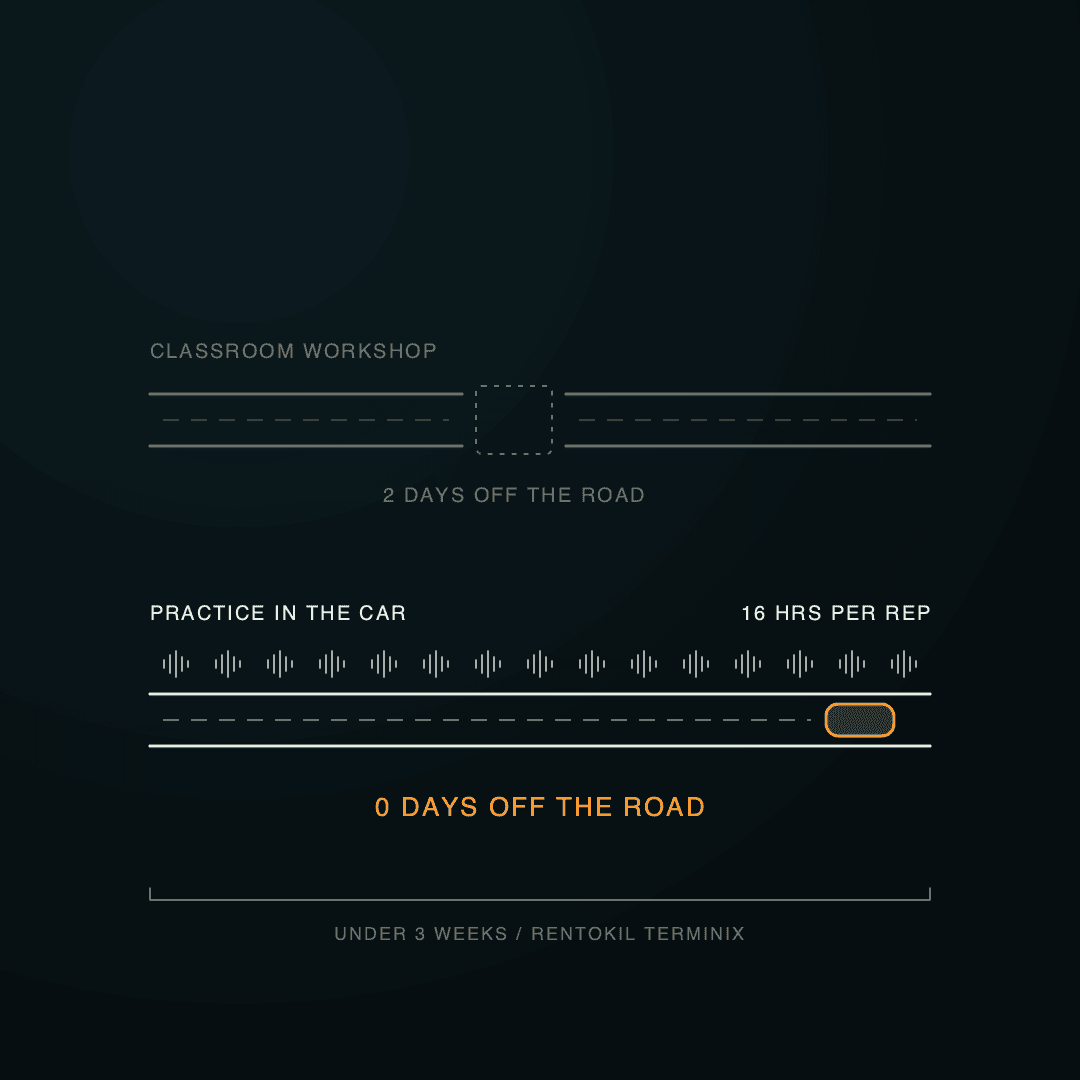
Show that coaching costs almost no field time, then show leading indicators moving before revenue does.
"How do we prove we make our money back?" comes up on nearly every serious call we have. It's a fair question. A field rep's time is the most expensive thing in your territory. Every hour in training is an hour not in front of a buyer.
Does daily practice take reps off the road?
Not if it happens where they already are. Practice in the car before a visit uses dead time: the ten minutes early, the wait in reception. That's why the Rentokil Terminix result matters so much to us. Sixteen hours of roleplay per rep in under three weeks, and not a single rep taken off the road. Compare that with a two-day classroom workshop, which takes two full days of visits from every rep at once.
What about the manager's time?
Count it honestly. At GBUK, Mike Brown used to spend roughly a week a month working through a combined sales report to find quiet accounts and chase reps. With Rory surfacing that account activity automatically, GBUK estimates it saves about one week a month of manager time. That's a week a month that can go back to coaching, or to selling.
Which numbers move first?
Leading indicators move in weeks. Revenue moves in quarters. Track both, and don't let anyone judge a coaching program on revenue after 14 days.
Weeks 1 to 4: practice volume, focus-skill scores, share of reps at standard.
Months 2 to 3: visit outcomes you already track, like next steps booked or proposals sent.
Quarter 2 onward: conversion and revenue, ideally against a comparison group.
Here's our skeptic's note. Most coaching ROI stories, including ours, aren't controlled trials. When Parkingeye's most active division ended up 33% over its year-to-date target, that's a strong signal, but the division that practised most may also have had other things going for it. Allwyn's reps grew 3.5% while their market fell 4%. Strong, but still one company. If you want proof that survives a CFO, do what Rentokil Terminix's residential leadership asked for next: a pilot with a matched comparison group. That's the honest way to settle it.
What does it cost?
For reference, SecondBody is $75 a month or $750 a year per seat, including 120 minutes of roleplay and 60 minutes of coaching with Rory a month. Rory calling reps on WhatsApp or by phone, and Rory trained on your playbook, come with team plans, which are priced as custom packages. The full breakdown is on our pricing page.
What mistakes have we watched field managers make?
Seven, mostly made with good intentions. We've seen every one of these in real rollouts.
1. Trying to listen to everything
The manager gets access to practice runs and debriefs and decides to listen to all of them. By Thursday of week two they're four hours behind and the whole thing feels like homework. Read patterns. Listen to one or two moments a week. The rest is for the rep.
2. Coaching five skills at once
"This week, work on your opener, discovery, objection handling, the close and your CRM notes." The rep hears: nothing in particular. One focus skill per rep. Two weeks. Then the next.
3. Using practice data to punish
The first time a manager quotes a bad practice score in a team meeting, practice volume drops, and it is slow to come back. Practice has to be a safe place to fail. That's literally what it's for. Praise volume in public. Talk about scores in private.
4. Skipping the kickoff run
Managers send a link and say "try it this week." Half the reps never start, because the first practice run alone in a car feels weird. Do the first run together, in the kickoff, so everyone has done one before they're alone.
5. Scenarios that are too easy
If every rep scores 9 out of 10 in week one, your scenarios are a participation trophy. Make the buyer harder. Add the interruption, the silence, the "we already have someone." Practice should be a little harder than the real thing, like a sparring partner who hits back.
6. Rolling out to everyone at once
A regional rollout to every rep on the same Monday, with no pilot, no named content owner and no manager briefing. Three weeks later nobody can say whether it's working. Start with ten. Prove one number. Then go wide.
7. Letting the 1:1 become a pipeline review again
The briefing is open, the moment is ready to replay, and then the rep mentions a big deal and the next 20 minutes are about the deal. Give the pipeline its own slot. Protect the coaching one.
What should a field manager look for in coaching software?
Buy for the moment you can't reach. For most field managers that's the time before the visit, not the recording after it.
We cover the whole category in our sales coaching software guide, so here's just the field manager's short list.
What kinds of tools are there?
Field activity tools, like SPOTIO. They track stops, territory coverage and activity per rep. Useful for where your reps went. They don't tell you how the conversation went.
Virtual ride-along tools, like Rilla or Demodesk. They record the real in-person conversation on the rep's phone and score it. Useful where recording is legal and accepted. Backward-looking by design.
Conversation intelligence, like Gong. Built for recorded calls and video meetings. Strong for inside teams. Limited for reps whose conversations happen in kitchens, pharmacies and hospital corridors.
Practice and coaching tools, like SecondBody. Reps rehearse the hard moment before the visit and debrief after it. The manager gets patterns and a briefing. Nothing in the room gets recorded.
What questions should you ask any vendor?
Can my reps use it from a phone, in a car, with no laptop and no login?
Does it record the customer? If yes, how is consent handled in every state or country we sell in?
Does it score against our standard and our methodology, or a generic one?
What does a manager see each week, and how long does it take to read?
Who on our side owns the scenarios, and how long does that take a month?
Can we run a two-week pilot with ten reps and one number?
That first question rules out more tools than you'd expect. Field reps don't open portals. On team plans, Rory reaches reps on WhatsApp or by phone, with no login, which is a big part of why field teams actually use it. If you want to see how roleplay fits field teams specifically, we wrote about AI sales roleplay for field sales.
Frequently asked questions
How do I coach field sales reps without doing ride-alongs every week when we have 20 outside reps across 4 regions?
Move coaching to before and after the visit. Reps practise the hard moment for 5 to 15 minutes before visits and send a short voice debrief after. You read patterns once a week, run each 1:1 from a one-page briefing, and keep ride-alongs for one targeted rep a fortnight per region. This is the exact question we see in our own search data, and the answer is the same at 20 reps or 200.
How often should a field sales manager do ride-alongs?
Less often than most do, and more deliberately. For a manager with 10 to 15 reps, one ride-along day every one or two weeks is enough if daily practice and debriefs are in place. Choose the rep by data, not geography, and watch only the things you can't see remotely.
How many reps can one field sales manager coach well?
With ride-alongs as the main tool, realistically six to eight, and even then each rep gets you rarely. With practice before visits, voice debriefs and briefing-led 1:1s, the rhythm in this playbook is built for 15 to 25 reps, as long as you protect the weekly 1:1 slot for new reps and anyone who's stuck.
Can you coach reps on what they said if you never hear the real conversation?
Partly. You can coach what they say in practice, what they report in the debrief, and what happens in the pipeline. You can't verify exactly what they said in the room. That's why the ride-alongs you keep should focus on the things only presence reveals.
We have 25 door-to-door reps and no way to coach them consistently. What works for field teams that aren't on video calls?
Voice-first practice on the phone, before the first door of the day, with one shared list of hard moments and one scoring standard across all managers. Field teams don't sit in front of webcams, so any coaching that needs a video call or a laptop will get skipped. Coaching has to live on the phone they already carry.
What's the difference between a ride-along and a virtual ride-along?
A ride-along is a manager physically joining visits. A virtual ride-along usually means the rep records the real customer conversation on a phone, with consent, and the manager reviews a summary or score later. Both look backward at a visit that already happened. Practice-based coaching works on the visit that hasn't happened yet.
How do you coach medical device reps who can't record in hospitals?
Record the practice, not the hospital. Reps rehearse the surgeon who has four minutes, the procurement lead who wants a price, and the clinician who asks an off-label question, all before they walk in. Then they debrief by voice afterwards, without patient details. Clinical questions should go to your product team, not a coaching tool.
How long before a new field rep can be coached remotely?
From week one. New reps benefit most from daily practice, because every scenario is new to them. Allwyn cut new-starter ramp time by 65%, about two to two and a half weeks off onboarding, after putting structured practice in place.
What should a field rep's voice debrief include?
Four things in about a minute: what happened, the main objection, what was agreed, and the next step. No customer names beyond role and organisation if you work in healthcare, and nothing that wouldn't be appropriate to share with the manager.
How do you get reps to actually practise?
Do the first run together at kickoff, keep sessions short, make practice happen where reps already are (the car, the car park), praise volume in public, and never quote a bad practice score in a team setting. And ask for a named content owner, so scenarios stay fresh.
Does SecondBody record customer conversations?
No. SecondBody never records customer conversations, and Rory never listens in on live calls or visits. Reps practise with Rory before and send voice debriefs after. The only real calls coached are ones you choose to upload. Practice recordings sit encrypted in a workspace you own and can delete, and your data doesn't train other clients' models. Team plans add SOC 2 Type II, enterprise SSO and custom data retention.
Do reps need to download an app or log in to use SecondBody?
No. On team plans, Rory reaches reps on WhatsApp or by phone, for a morning warm-up, an end-of-day debrief, or practice before a big visit. Managers get a pre-1:1 briefing showing who to coach, on which skill, and which practice moments to replay.
How would we run a pilot with SecondBody?
Ten reps, two weeks, one number agreed up front, and a named owner for the scenarios on your side. On team plans, we train Rory on your playbook and objection library, scored against your methodology, whether that's SPIN, MEDDIC, Sandler or your own standard. At the end, you ask your managers whether they'd back it. That's the decision.
How we know this
This playbook comes from three places. First, our customers' field teams: Rentokil Terminix's residential reps in the US, GBUK's medical device team in the UK, Allwyn's 200 retail sales executives, and Parkingeye's field sales team. Every number from them in this article is from their published customer stories on our site. Second, around twenty sales calls with field sales leaders, capability managers and enablement heads between January and September 2026, where the same triggers came up again and again: managers who can't hear the conversations, regional rollouts, new reps moving over from clinical roles. We've kept those prospects anonymous. Third, our own Search Console, where field managers type their problems in as full paragraphs. Several of those paragraphs became the headings and questions above. Third-party figures are linked and hedged where we couldn't check the underlying data.
Coach the visit that hasn't happened yet
The ride-along was never really a coaching system. It was a manager trying to be in twelve places at once, one car at a time, and seeing the rep at their most nervous.
You don't need to be in the room. You need to be in the ten minutes before it and the two minutes after it, every day, for every rep. And you need to walk into each 1:1 already knowing what to work on. That's a coaching system one manager can actually run.
That's what we built SecondBody to do for field teams: Rory on the rep's phone before and after every visit (on WhatsApp or a call, on team plans), the customer never recorded and no one listening in on the visit, and a briefing on your desk before every 1:1. If you want to see it with your own reps, book a demo and we'll scope a two-week pilot around one number.
Good luck out there.
Omid
By Omid, founder of SecondBody
You can't. Not by riding along, anyway. A field manager with twelve reps sees each of them in the car maybe once every six weeks, and sees a tiny slice of their visits even then. So stop trying to coach the conversation you can't hear. Coach the two moments you can reach every single day: the ten minutes before a visit, and the two minutes after it. Then walk into each 1:1 already knowing which rep needs you, on which skill, and which moment to replay.
That is the whole playbook. The rest of this article is how to run it on a Tuesday.
This is written for the person who owns a territory: a regional or front-line manager with 8 to 25 reps spread across a map, a car full of coffee cups, and a forecast call on Friday. If you want the bigger system view (what field coaching is, why the old models fail, how a program is built), we wrote that already in Field Sales Coaching: How Do You Actually Coach Reps You Never See?. This one is the manager's view. What you do, in what order, with the hours you actually have.
One thing to know up front: we build an AI coaching product for field teams, so read with that in mind. We will tell you where it helps and where it doesn't, and most of this playbook works with a phone, a calendar and some discipline.
Key answers, up front
Ride-alongs don't scale because of arithmetic, not effort. One manager, one car, one rep a day. With 12 reps you see each one roughly every six weeks and observe a low single-digit percentage of their visits.
You can coach a lot without hearing the call. Preparation, the hard moments (price, the gatekeeper, the buyer who cuts you off), the debrief, and the pipeline. You can't coach rapport in the room or body language from a distance. Be honest about that line.
The weekly rhythm is three beats. Practice before visits, a short voice debrief after them, and a one-page briefing before every 1:1 so the 1:1 is about one skill, not "how's it going?"
In regulated settings, record the practice, not the customer. Hospitals, pharmacies and homes in all-party consent states are no place for a recorder. Practice sessions and rep debriefs are.
Run a two-week pilot with one number. Ten reps, one skill, one measure you agree before day one. It's the format behind most of the field deals we've closed, because it answers the real question in a fortnight.
The proof we can show you: Rentokil Terminix reps logged 16 hours of roleplay each in under three weeks without a single rep coming off the road. GBUK got about a week a month of manager time back.
Why don't ride-alongs scale past a handful of reps?
Because a ride-along is one manager, in one car, with one rep, for one day. That ratio never changes, no matter how hard you work.
Do the math for your own team. Here is ours, for a typical manager we talk to on sales calls. Illustrative numbers, so swap in yours.
12 reps.
Realistically two ride-along days a week. The other three go to forecast calls, hiring, escalations, internal meetings and your own accounts. (Gartner's figures, as quoted second-hand by Outreach, put internal work at 55% of a sales manager's time and coaching at about 21%. We haven't seen the underlying report, so treat that as directional. It matches what managers tell us.)
So each rep gets you in the passenger seat about once every six weeks. Call it eight days a year after holidays, sickness and the quarter-end scramble.
A rep doing six visits a day across about 220 working days runs roughly 1,300 visits a year.
You observe eight days times six visits. About 48.
Forty-eight out of 1,300. Under 4%. And those 48 are the least representative visits of the year, because you were sitting in them.
Demodesk, a vendor selling recording tools to field teams, runs the same math for team leads with five or six reps and lands near 10% coverage. That is the best case, with a tiny team and a lead who rides three days a week. Most regional managers we speak to are nowhere near it.
What does the manager in the passenger seat actually change?
The rep. Not in a good way.
When Rentokil Terminix started looking at coaching for its residential reps, one thing came up straight away: reps froze when a manager sat beside them. Shirley Riddle, a branch manager there, described the alternative they wanted as a way to "sit in your truck and role-play back and forth without eyes on you." That line stuck with us, because it names the problem nobody puts in the ride-along policy. You are not observing the rep's normal visit. You are observing the rep performing for you.
So the ride-along gives you a small, biased sample, on a delay, at the cost of a full day of your week. And the reps who get the most ride-alongs are usually the ones who live nearest to you. Not the ones who need you most.
So should you stop doing ride-alongs?
No. Stop using them as the coaching system. A ride-along is a great calibration tool and a terrible coverage tool. We'll come back to what to do with the ones you keep.
What can you coach without hearing the conversation, and what can't you?
You can coach most of what decides the visit. You can't coach the room itself. Draw that line clearly and your reps will trust the rest.
Here is the split we use with managers.
You CAN coach without being there | You CAN'T coach without being there |
|---|---|
Which accounts the rep picks this week, and why | Rapport and warmth in the room |
How the rep opens, out loud, before the visit | Body language and how they handle the space |
The hard moments: price pushback, the gatekeeper, the surgeon who cuts them off, the quiet buyer | How they read a buyer's face in real time |
Product answers, checked against approved material | Exactly what was said word for word, live |
The debrief: what happened, what was committed, what's next | Whether they actually used the line they practised |
Pipeline movement after visits | The vibe of a site you have never visited |
Why is the left column bigger than it looks?
Two reasons.
First, a lot of field selling is decided before the rep walks in. Michelle Vazzana made this point years ago in Training Industry: by the time a manager joins the call, the rep has already chosen the account, the person, the timing and the angle. Her line: "A perfectly executed shot aimed at the wrong target is always a miss." You can coach the aim from anywhere.
Second, the moments that lose the visit are usually not mysterious. They are the same four or five moments, again and again. Rentokil Terminix found one in its first trial: when buyers pushed on price, many reps asked the manager for a discount instead of handling it. That pattern showed up in practice sessions. Nobody needed to stand on a doorstep to see it.
And the right column?
Keep it honest. A rep can nail every practice run and still be cold in the room. That is real, and no software will see it. This is what your remaining ride-alongs are for. Use them on the right column only.
Here's what nobody says out loud: most managers already coach from the right column, badly. "How did it go?" "Good, yeah, they liked it." That's not coaching. That's two people agreeing not to look at anything. Moving to the left column gives you something concrete to talk about.
What do you need in place before you start?
Less than you think. Four things, and you can do all of them in a week.
1. A one-page "what good looks like" per visit type
Not a methodology deck. One page. For each visit type your reps do (first visit, follow-up, closing visit, renewal), write the three or four things a good version always has.
Parkingeye did a smart version of this. Before building anything, it interviewed three of its top salespeople to define what good selling looked like there. Your top two reps already know. Ask them, write it down, and use their words.
2. Five to eight hard moments
List the moments your reps fumble. Not topics. Moments. "Buyer says we already have a supplier and hangs up the conversation." "Surgeon says he has four minutes." "Homeowner says they need to ask their partner." "Store manager says head office decides, not me."
If you don't know them, ask your reps. Fair warning: they may not answer. When Allwyn asked its field reps for the objections they heard at the counter, 10 of 125 replied. Reps don't hide objections on purpose. They just don't write things down while driving. Which is why the debrief later in this playbook is a voice note, not a form.
3. A roster with tenure and one current focus each
A simple sheet: rep, months in role, territory, the one skill you're working on with them right now. If a rep has three focus skills, they have none.
4. One named owner for the content
This one comes straight from our sales calls. The biggest reason a coaching program dies is not the reps. It's that nobody owns the scenarios. One prospect told us they cancelled a tool because nobody owned the content. We now ask for a named owner before we start, and so should you, whatever tool you use. If you're the manager reading this, it might be you. That's fine. It's two hours a month.
How do you coach field sales reps you can't ride along with? The seven steps
Here's the playbook itself. Seven steps, in the order you set them up.
Step 1: Pick one skill per rep for the next two weeks
Look at your roster. For each rep, choose one skill from your list of hard moments. New rep from a clinical background: the commercial ask at the end of the visit. Experienced rep losing on price: holding value before talking discount. Rep with plenty of visits but no next steps: the close of the visit.
Write it next to their name. Tell them. This is the single most useful sentence in field coaching: "For the next two weeks, you and I are working on this one thing."
Step 2: Move practice to the ten minutes before the visit
This is where the payoff is. The rep is parked outside, five or ten minutes early. They have their phone. They are already thinking about the visit. That's the best coaching window in their day, and nobody uses it.
Have them rehearse the hard moment out loud before they walk in. With a colleague on the phone if you have the capacity, with an AI buyer if you don't. The point is out loud and under a little pressure, not reading notes.
The numbers we've seen from teams doing this are small per day and big over time. Rentokil Terminix reps practised 13 to 17 minutes a day from their trucks during the first trial. Parkingeye reps practise about 15 minutes a day. Darren Harrington, a senior commercial leader there, put it simply: "If you're doing it every day for 15 minutes, you're going to get better at it."
Fifteen minutes. That's less time than your reps spend looking for parking.
Step 3: Make the debrief a voice note, not a form
After the visit, the rep has two minutes before driving off. Ask for a 60-second voice note: what happened, what the buyer objected to, what was agreed, what's next. Voice, because nobody types a good debrief in a car park.
Over a week this gives you something you never had: a running record of what's actually happening in your territory, in your reps' own words. Objections you didn't know about. Commitments that were never logged. Visits that went nowhere.
Step 4: Read patterns, not recordings
Here's the trap. You now have practice runs and debriefs coming in from 12 reps. If you try to listen to all of it, you've just rebuilt the ride-along problem at your desk.
Don't. Read the patterns. Who practised, who didn't. Which hard moment the team keeps failing. Which rep's scores are flat after two weeks. Which debriefs mention the same objection. Pick one or two moments a week to actually listen to. That's it.
Parkingeye's managers describe the shift well: they used to coach from a CRM dashboard that showed meeting counts but not quality. Now they read the result instead of asking reps how it went.
Step 5: Run every 1:1 from a one-page briefing
Before each 1:1, spend five minutes on a briefing: what this rep practised, how they scored on their focus skill, one moment worth replaying together, and anything the debriefs or pipeline flagged. Then the 1:1 is about that. We cover the format in its own section below.
Step 6: Point your ride-alongs where the data says
Keep one ride-along day a fortnight, maybe less. Choose the rep by the data, not by geography. The rep whose practice scores look great but whose visits aren't converting. The new rep in week three. The rep whose debriefs keep saying "they'll think about it." Go and watch the right column.
Step 7: Change the focus skill only when it sticks
After two weeks, check. Did the score on the focus skill move? Did the behaviour show up in debriefs? If yes, pick the next skill. If no, keep it, and change the practice scenario so it's harder or closer to real life. Don't rotate skills on a calendar. Rotate them on evidence.
What does a field sales manager's coaching week look like?
Three beats a day for the reps, two blocks a week for you. Here's the version we'd hand a manager with 12 reps.
When | Reps do | You do | Time for you |
|---|---|---|---|
Monday morning | Read their focus skill for the week | Send each rep their focus skill (one line each) | 20 minutes |
Before each visit, daily | 5 to 15 minutes of out-loud practice on the hard moment | Nothing. That's the point | 0 |
After each visit, daily | 60-second voice debrief | Nothing live | 0 |
Wednesday | Normal day | Read patterns: who practised, which moment the team fails, which debriefs flag the same objection | 30 minutes |
Thursday | 20-minute 1:1 with you | Five-minute briefing read, then the 1:1 | About 5 hours for 12 reps, or split across Thursday and Friday |
Friday | 15-minute team huddle | Play one great practice moment and one fumble (with permission) | 15 minutes |
Every second week | One rep gets a ride-along | Ride along with the rep the data picked | One day |
Total, excluding the ride-along: roughly six and a half hours a week. Most of that is the 1:1s you already run. The difference is that they now have something in them.
For context, SPOTIO, a field sales software company, reports from its own survey that roughly four in ten managers spend fewer than three hours a week on coaching (SPOTIO's field manager playbook). It's vendor research and we couldn't see the sample for that specific figure, so hold it lightly. But it lines up with what we hear: the time is not the problem. The time is spent on the wrong things.
What if you have 25 reps, not 12?
The rhythm holds; the 1:1s change. Move to fortnightly 1:1s for experienced reps who are moving on their focus skill and keep weekly 1:1s for new reps and anyone stuck. Your Wednesday pattern read becomes more important, not less, because it's how you decide who gets the weekly slot.
Allwyn shows what this looks like at real scale. Its 200 retail sales executives each do about eight store visits a day. No manager sees that. What changed things there was structured practice: reps at coaching standard went from fewer than 1 in 5 to more than 4 in 5 in a quarter. Dawn Connolly, a regional sales manager there, said her team now practises "commercial conversations in a safe space before they hit the floor."
Why does frequency matter more than session length?
Because skills fade fast without use. The forgetting curve is old science, and a 2015 replication published in PLOS ONE (Murre and Dros) found much the same shape Ebbinghaus did in the 1880s. One quarterly workshop is one big deposit into an account that leaks every day. Ten minutes a day is a drip that keeps it topped up. It's like brushing your teeth. Nobody brushes for two hours once a quarter.
How do you run a 1:1 when you weren't in the room?
From a one-page briefing, about one skill, with one moment replayed. Twenty minutes.
Most field 1:1s are pipeline reviews in disguise. "Where's the Henderson deal at?" That's a forecast conversation, and it's fine, but it isn't coaching. Split them. Pipeline gets its own slot.
What goes on the briefing?
Three lines, and you should be able to read it in the car park before you dial in.
Who and what. This rep, this focus skill, this week's practice volume and score trend on it.
One moment to replay. A specific practice run, ideally a fumble that is fixable, or a strong run worth naming.
One flag from the field. Something the debriefs or pipeline surfaced: a repeated objection, a stalled set of deals, a commitment that didn't get logged.
That's what we built the manager briefing in SecondBody to produce automatically, because we watched managers try to assemble it by hand on Sunday nights and give up by week three. But you can build it by hand, especially with a small team. The format matters more than the tool.
How should the 20 minutes go?
Two minutes: "Here's what I saw this week." Specific. "You did nine practice runs on price. Your first three, you dropped to discount within two exchanges. Your last two, you held for four."
Eight minutes: Replay one moment together. Listen to it, or read the transcript. Ask: what was going through your head right there? Then try it again, live, with you playing the buyer.
Five minutes: The flag from the field. "Three debriefs this week mention the buyer's existing contract. What's going on?"
Five minutes: Agree the next two weeks. Same skill or new one. What practice, how much.
Why replay the moment instead of discussing it?
Because talking about a skill and doing the skill live with the clock running are different muscles. The rep who says "yeah, I should have asked about budget earlier" knows that already. Knowing isn't the problem. Doing it when the buyer goes quiet is. So do it in the 1:1. Out loud. With you as the difficult buyer. That's eight minutes of real practice under a little pressure, and it's the most valuable part of the meeting.
What should you do with the ride-alongs you still have?
Use them for three jobs only: calibration, the right column, and capturing what great looks like.
Calibration
Every few weeks, ride with a rep whose practice scores you trust and check that the field matches. If a rep scores well in practice but stumbles in the room, that tells you your scenarios are too easy, or too unlike your real buyers. Fix the scenarios. That's not a failed rep. That's a failed simulation.
The right column
Rapport. Presence. How they handle a site they know. Go and watch the things software can't see. Use the classic structure: agree one thing to watch before you go in, stay quiet during the visit unless something is going badly wrong, and debrief on one thing to keep and one thing to change. One. Not seven.
Capturing what great looks like
Rentokil Terminix did something clever when it moved from a single-region trial to a wider rollout: it started with top performers, who recorded examples of good selling first. Those recordings became the reference for everyone else. Do the same with your best rep on a ride-along day. Then write down what they did and turn it into a practice scenario.
What about "virtual ride-along" tools that record the real visit?
They exist, and for some teams they're a fair choice. Tools like Rilla and Demodesk have reps record in-person conversations on their phone, with consent, and then score or summarise them so the manager can review remotely. If you sell in a setting where recording the customer is legal, accepted and won't spook the buyer, you get to see the real thing. That's a real advantage.
The trade-offs are also real. You're reviewing after the visit, so the coaching is backward-looking. You need the customer's consent every time, which changes the conversation for some buyers. And in many of the settings our customers sell in (hospitals, homes in all-party consent states, regulated financial conversations) it's simply not an option. More on that below.
How do you coach new reps who came from clinical or operations roles?
Start with confidence, not technique. Then practise the commercial moment until it feels normal.
This is one of the most common reasons people book a call with us. A medtech or healthcare company hires nurses, theatre staff or clinical specialists into sales roles. They know the product better than anyone. They are respected by clinicians. And they freeze at the commercial ask, because nobody ever taught them that asking for the business is part of the job, not a betrayal of it.
Operations-to-sales moves look similar. At Rentokil Terminix, around 100 branch managers oversaw 258 residential reps, and most of those managers came from operations and had never sold. Which makes the coach's job harder too: how do you coach a skill you never practised yourself?
What works for clinical-to-commercial reps?
Separate product knowledge from selling. They already have the first. Don't bury them in more of it. Their gap is the commercial conversation: the opening, the ask, the follow-up.
Practise the exact uncomfortable sentence. "Would you be open to trialling this on your ward next month?" Out loud, twenty times, until it stops sounding like someone else's voice.
Practise being told no. Clinicians are used to being the expert in the room. Being dismissed by a procurement lead is new. Rehearse it so the first one isn't live.
Keep clinical claims out of the practice tool. This matters in medtech. GBUK set its coaching up so Rory declines clinical and product questions and sends reps to the product team instead. Mike Brown, Head of Sales Development there, wanted a coach that pushes back: "I don't want Rory to be agreeable." Get the boundaries right before rollout.
GBUK's results are the clearest we can point to here. Its reps sell single-use medical devices, often products they've never sold before, to clinicians who spot a bluffer immediately. Consistent users scored 8 to 10 out of 10 on cold-call assessments, against 6 for intermittent users. You can read the full GBUK story.
What about managers who never sold?
Give them a standard to coach against, not their own instincts. A manager who came up through operations can still run every step of this playbook, because the practice gets scored against a defined standard and the manager's job is to read the patterns and run the 1:1. Rentokil Terminix found something we didn't expect: the managers who knew least about sales were often the most engaged. They finally had something concrete to coach from.
How do you coach door-to-door reps consistently while you scale from 15 to 50?
Standardise the hard moments, make practice daily, and give every manager the same briefing format. Consistency at scale comes from the system, not from cloning your best manager.
This exact question shows up in our own Search Console, almost word for word: "we're scaling a door-to-door sales org from 15 to 50 reps. our managers can't ride along with everyone." So does its cousin: "we have 25 door-to-door reps and no way to coach them consistently." And a pest control version, with 20 field reps and objections about price and timing. These are long, specific briefs, typed by people with a real hiring plan. Here's our answer.
Why does consistency break when a door-to-door team grows?
Because at 15 reps, the founder or first manager is the coaching system. Every rep has heard them pitch. At 50 reps across three or four managers, every manager teaches their own version. Reps in one area learn to lead on price, reps in another learn to lead on the guarantee. Six months later, your conversion rates vary by manager and nobody can say why.
What does a scaled door-to-door coaching setup look like?
One shared list of hard moments. "I need to talk to my husband." "We already have someone." "How much?" before you've said anything. "Come back later." Every manager coaches the same list.
Practice before the first door, every day. Ten minutes in the car. The first door of the day should never be the warm-up.
A voice debrief after the block, not each door. Door-to-door volume is too high for per-visit debriefs. One voice note per block of doors: which objection came up most, which door went furthest.
Same scoring standard across managers. This is how you see the region that's drifting before the numbers show it.
New hires practise the full door in week one. Before they knock on a real one.
Is there a compliance moment to practise too?
Yes, and most teams forget it. In the US, the FTC's Cooling-Off Rule covers many sales made at a buyer's home for $25 or more. Sellers have to tell the buyer about the right to cancel within three business days, both orally and in writing, with a cancellation form. Check the rule for what applies to your products and your state rules on top. Then practise the disclosure until reps can deliver it calmly, in a way that builds trust instead of sounding like a confession. A nervous rep mumbles it. A practised rep uses it.
Rentokil Terminix is the clearest example of this working at scale. Its residential reps sell pest control into homes. In the first trial, about 35 reps and 15 managers across eight or nine branches practised in their trucks for around a month. Each rep logged 16 hours of roleplay in under three weeks, without taking a single rep off the road, and every trial manager said they would back the investment. The company then moved from a single-region trial to a wider rollout. The Rentokil Terminix story has the details.
What gets recorded in regulated field settings, and what doesn't?
Record the practice. Don't record the customer. That single rule removes most of the compliance fight.
This is the question procurement asks on almost every call we have with medtech, pharma and financial services teams: what exactly is recorded, where does it live, and who can see it? Get the answer ready before your rollout, or your pilot will stall in legal for a month.
Why is recording the real visit hard in the field?
Three reasons, depending on where your reps sell.
Consent laws. In the US, a number of states require every party's consent to record a confidential conversation. California is the best known: Penal Code 632 makes recording a confidential conversation without all parties' consent a crime, with fines per violation. Published lists of all-party consent states differ, so check current law for every state you sell in. In the UK and EU, recording people engages GDPR: you need a lawful basis, transparency, and a way to honour deletion requests. None of that is impossible. All of it adds friction to every visit.
Clinical settings. Medical device reps work under hospital vendor credentialing rules, which commonly include training on HIPAA privacy requirements. AdvaMed's long-standing position on reps in the operating room is that they should be present only at the physician's request, should not enter the sterile field, and that patients should be told why they're there (AdvaMed position paper). Pulling out a phone to record in that environment is a non-starter.
Trust. Even where it's legal, asking a homeowner, a pharmacist or a buyer at a trade counter if you can record them changes the conversation. Some will say no. Some will say yes and go quiet.
So what do you record instead?
The practice and the debrief. Here's how it works with SecondBody, so procurement has something concrete to check:
The customer is never recorded. SecondBody never records customer conversations, and Rory never listens in on live calls or visits. Reps practise before and debrief after. Insights come from practice runs and rep debriefs, not customer audio.
The only real calls coached are ones you choose to upload. If your team already owns recordings (say, from a recorded phone line), you can upload them for coaching. Nothing is captured in the room.
Practice recordings are stored encrypted in a workspace you own, and you can delete them at will.
Your data does not train other clients' models.
A signed DPA, and on team plans, SOC 2 Type II and enterprise SSO through your identity provider (SAML 2.0, Okta, Azure AD), plus custom data retention.
CRM access can be read-only. At GBUK, Rory reads Dynamics 365 data through Microsoft's MCP connection, read-only, with nothing written back. GBUK's IT and information governance teams approved the setup.
Full detail is on our data and trust page.
What should you tell reps about their own debriefs?
Two things. First, debriefs are for coaching, not for discipline. If reps think a voice note will be used against them, they'll send "went fine, will follow up" forever. Say it out loud at the kickoff. Second, keep identifying details out. In healthcare especially, a debrief should say "the theatre lead at the trust" and never a patient's name or details. Write that into your one-page guide.
How do you practise compliance itself?
Turn the compliance moments into scenarios. The off-label question a clinician asks casually. The pharmacist who asks for a comparison you're not allowed to make. The buyer who asks for a guarantee your legal team never approved. These are the moments where reps improvise, and improvisation is where compliance breaks. Practise the approved answer until it comes out naturally under pressure. Our field readiness page shows how this works for medtech and pharma teams.
How do you run a two-week coaching pilot?
Ten reps, one skill, one number, fourteen days. Agree the number before day one.
This is the format that has closed most of our deals, and not because it's a sales tactic. It's because it answers the only question that matters to a field leader: will my reps actually use this, and will it change anything I can see?
Who goes in the pilot?
Pick ten reps. Ideally a group with a shared trigger: a new hiring cohort, a new product, or a region about to roll out. New joiners are best, because their improvement curve is steep and visible in two weeks. Include one or two experienced reps too, as a sense check.
Don't pick only your enthusiasts. A pilot that works with the five reps who'd try anything tells you nothing about the other forty.
What's the one number?
Choose before you start. Some good ones:
Practice runs completed per rep on the focus skill.
Score on the focus skill, first three runs versus last three.
Share of reps who reach your coaching standard on the focus skill.
Manager hours spent on coaching prep, before and after.
A field outcome you already track, if your sales cycle is short enough: next steps booked per visit, for example.
One number. You'll look at others, but you agree in advance which one decides.
What happens on each day?
Days | What happens |
|---|---|
Day 1 | Kickoff, 30 minutes. Focus skill explained. Reps do one practice run each, live, so nobody's first one is alone. Debrief format explained. |
Days 2 to 5 | Daily practice before visits, 5 to 15 minutes. Voice debriefs after. Manager reads patterns once, midweek. |
Day 5 | First 1:1s from the briefing. 20 minutes each. |
Days 8 to 12 | Practice continues. Scenarios get harder for reps who are scoring well. One targeted ride-along. |
Day 12 | Second round of 1:1s. |
Day 14 | Read the number. Ask the reps. Ask the managers. Decide: expand, adjust, or stop. |
What do you ask at the end?
Ask the managers one direct question: would you back this investment for your team? Rentokil Terminix asked exactly that after its first trial. Every manager said yes. That's a better signal than any dashboard, because managers are the people who will either keep it alive or let it die quietly.
And ask the reps whether they'd keep doing it if it were optional. At Rentokil Terminix, some reps practised more than was sustainable alongside a full day of visits, so the regional sales manager running it asked for usage caps. That's the kind of problem you want, and worth planning for: set a sensible daily ceiling so practice supports the field day instead of eating it.
How do you prove the coaching time is worth it?
Show that coaching costs almost no field time, then show leading indicators moving before revenue does.
"How do we prove we make our money back?" comes up on nearly every serious call we have. It's a fair question. A field rep's time is the most expensive thing in your territory. Every hour in training is an hour not in front of a buyer.
Does daily practice take reps off the road?
Not if it happens where they already are. Practice in the car before a visit uses dead time: the ten minutes early, the wait in reception. That's why the Rentokil Terminix result matters so much to us. Sixteen hours of roleplay per rep in under three weeks, and not a single rep taken off the road. Compare that with a two-day classroom workshop, which takes two full days of visits from every rep at once.
What about the manager's time?
Count it honestly. At GBUK, Mike Brown used to spend roughly a week a month working through a combined sales report to find quiet accounts and chase reps. With Rory surfacing that account activity automatically, GBUK estimates it saves about one week a month of manager time. That's a week a month that can go back to coaching, or to selling.
Which numbers move first?
Leading indicators move in weeks. Revenue moves in quarters. Track both, and don't let anyone judge a coaching program on revenue after 14 days.
Weeks 1 to 4: practice volume, focus-skill scores, share of reps at standard.
Months 2 to 3: visit outcomes you already track, like next steps booked or proposals sent.
Quarter 2 onward: conversion and revenue, ideally against a comparison group.
Here's our skeptic's note. Most coaching ROI stories, including ours, aren't controlled trials. When Parkingeye's most active division ended up 33% over its year-to-date target, that's a strong signal, but the division that practised most may also have had other things going for it. Allwyn's reps grew 3.5% while their market fell 4%. Strong, but still one company. If you want proof that survives a CFO, do what Rentokil Terminix's residential leadership asked for next: a pilot with a matched comparison group. That's the honest way to settle it.
What does it cost?
For reference, SecondBody is $75 a month or $750 a year per seat, including 120 minutes of roleplay and 60 minutes of coaching with Rory a month. Rory calling reps on WhatsApp or by phone, and Rory trained on your playbook, come with team plans, which are priced as custom packages. The full breakdown is on our pricing page.
What mistakes have we watched field managers make?
Seven, mostly made with good intentions. We've seen every one of these in real rollouts.
1. Trying to listen to everything
The manager gets access to practice runs and debriefs and decides to listen to all of them. By Thursday of week two they're four hours behind and the whole thing feels like homework. Read patterns. Listen to one or two moments a week. The rest is for the rep.
2. Coaching five skills at once
"This week, work on your opener, discovery, objection handling, the close and your CRM notes." The rep hears: nothing in particular. One focus skill per rep. Two weeks. Then the next.
3. Using practice data to punish
The first time a manager quotes a bad practice score in a team meeting, practice volume drops, and it is slow to come back. Practice has to be a safe place to fail. That's literally what it's for. Praise volume in public. Talk about scores in private.
4. Skipping the kickoff run
Managers send a link and say "try it this week." Half the reps never start, because the first practice run alone in a car feels weird. Do the first run together, in the kickoff, so everyone has done one before they're alone.
5. Scenarios that are too easy
If every rep scores 9 out of 10 in week one, your scenarios are a participation trophy. Make the buyer harder. Add the interruption, the silence, the "we already have someone." Practice should be a little harder than the real thing, like a sparring partner who hits back.
6. Rolling out to everyone at once
A regional rollout to every rep on the same Monday, with no pilot, no named content owner and no manager briefing. Three weeks later nobody can say whether it's working. Start with ten. Prove one number. Then go wide.
7. Letting the 1:1 become a pipeline review again
The briefing is open, the moment is ready to replay, and then the rep mentions a big deal and the next 20 minutes are about the deal. Give the pipeline its own slot. Protect the coaching one.
What should a field manager look for in coaching software?
Buy for the moment you can't reach. For most field managers that's the time before the visit, not the recording after it.
We cover the whole category in our sales coaching software guide, so here's just the field manager's short list.
What kinds of tools are there?
Field activity tools, like SPOTIO. They track stops, territory coverage and activity per rep. Useful for where your reps went. They don't tell you how the conversation went.
Virtual ride-along tools, like Rilla or Demodesk. They record the real in-person conversation on the rep's phone and score it. Useful where recording is legal and accepted. Backward-looking by design.
Conversation intelligence, like Gong. Built for recorded calls and video meetings. Strong for inside teams. Limited for reps whose conversations happen in kitchens, pharmacies and hospital corridors.
Practice and coaching tools, like SecondBody. Reps rehearse the hard moment before the visit and debrief after it. The manager gets patterns and a briefing. Nothing in the room gets recorded.
What questions should you ask any vendor?
Can my reps use it from a phone, in a car, with no laptop and no login?
Does it record the customer? If yes, how is consent handled in every state or country we sell in?
Does it score against our standard and our methodology, or a generic one?
What does a manager see each week, and how long does it take to read?
Who on our side owns the scenarios, and how long does that take a month?
Can we run a two-week pilot with ten reps and one number?
That first question rules out more tools than you'd expect. Field reps don't open portals. On team plans, Rory reaches reps on WhatsApp or by phone, with no login, which is a big part of why field teams actually use it. If you want to see how roleplay fits field teams specifically, we wrote about AI sales roleplay for field sales.
Frequently asked questions
How do I coach field sales reps without doing ride-alongs every week when we have 20 outside reps across 4 regions?
Move coaching to before and after the visit. Reps practise the hard moment for 5 to 15 minutes before visits and send a short voice debrief after. You read patterns once a week, run each 1:1 from a one-page briefing, and keep ride-alongs for one targeted rep a fortnight per region. This is the exact question we see in our own search data, and the answer is the same at 20 reps or 200.
How often should a field sales manager do ride-alongs?
Less often than most do, and more deliberately. For a manager with 10 to 15 reps, one ride-along day every one or two weeks is enough if daily practice and debriefs are in place. Choose the rep by data, not geography, and watch only the things you can't see remotely.
How many reps can one field sales manager coach well?
With ride-alongs as the main tool, realistically six to eight, and even then each rep gets you rarely. With practice before visits, voice debriefs and briefing-led 1:1s, the rhythm in this playbook is built for 15 to 25 reps, as long as you protect the weekly 1:1 slot for new reps and anyone who's stuck.
Can you coach reps on what they said if you never hear the real conversation?
Partly. You can coach what they say in practice, what they report in the debrief, and what happens in the pipeline. You can't verify exactly what they said in the room. That's why the ride-alongs you keep should focus on the things only presence reveals.
We have 25 door-to-door reps and no way to coach them consistently. What works for field teams that aren't on video calls?
Voice-first practice on the phone, before the first door of the day, with one shared list of hard moments and one scoring standard across all managers. Field teams don't sit in front of webcams, so any coaching that needs a video call or a laptop will get skipped. Coaching has to live on the phone they already carry.
What's the difference between a ride-along and a virtual ride-along?
A ride-along is a manager physically joining visits. A virtual ride-along usually means the rep records the real customer conversation on a phone, with consent, and the manager reviews a summary or score later. Both look backward at a visit that already happened. Practice-based coaching works on the visit that hasn't happened yet.
How do you coach medical device reps who can't record in hospitals?
Record the practice, not the hospital. Reps rehearse the surgeon who has four minutes, the procurement lead who wants a price, and the clinician who asks an off-label question, all before they walk in. Then they debrief by voice afterwards, without patient details. Clinical questions should go to your product team, not a coaching tool.
How long before a new field rep can be coached remotely?
From week one. New reps benefit most from daily practice, because every scenario is new to them. Allwyn cut new-starter ramp time by 65%, about two to two and a half weeks off onboarding, after putting structured practice in place.
What should a field rep's voice debrief include?
Four things in about a minute: what happened, the main objection, what was agreed, and the next step. No customer names beyond role and organisation if you work in healthcare, and nothing that wouldn't be appropriate to share with the manager.
How do you get reps to actually practise?
Do the first run together at kickoff, keep sessions short, make practice happen where reps already are (the car, the car park), praise volume in public, and never quote a bad practice score in a team setting. And ask for a named content owner, so scenarios stay fresh.
Does SecondBody record customer conversations?
No. SecondBody never records customer conversations, and Rory never listens in on live calls or visits. Reps practise with Rory before and send voice debriefs after. The only real calls coached are ones you choose to upload. Practice recordings sit encrypted in a workspace you own and can delete, and your data doesn't train other clients' models. Team plans add SOC 2 Type II, enterprise SSO and custom data retention.
Do reps need to download an app or log in to use SecondBody?
No. On team plans, Rory reaches reps on WhatsApp or by phone, for a morning warm-up, an end-of-day debrief, or practice before a big visit. Managers get a pre-1:1 briefing showing who to coach, on which skill, and which practice moments to replay.
How would we run a pilot with SecondBody?
Ten reps, two weeks, one number agreed up front, and a named owner for the scenarios on your side. On team plans, we train Rory on your playbook and objection library, scored against your methodology, whether that's SPIN, MEDDIC, Sandler or your own standard. At the end, you ask your managers whether they'd back it. That's the decision.
How we know this
This playbook comes from three places. First, our customers' field teams: Rentokil Terminix's residential reps in the US, GBUK's medical device team in the UK, Allwyn's 200 retail sales executives, and Parkingeye's field sales team. Every number from them in this article is from their published customer stories on our site. Second, around twenty sales calls with field sales leaders, capability managers and enablement heads between January and September 2026, where the same triggers came up again and again: managers who can't hear the conversations, regional rollouts, new reps moving over from clinical roles. We've kept those prospects anonymous. Third, our own Search Console, where field managers type their problems in as full paragraphs. Several of those paragraphs became the headings and questions above. Third-party figures are linked and hedged where we couldn't check the underlying data.
Coach the visit that hasn't happened yet
The ride-along was never really a coaching system. It was a manager trying to be in twelve places at once, one car at a time, and seeing the rep at their most nervous.
You don't need to be in the room. You need to be in the ten minutes before it and the two minutes after it, every day, for every rep. And you need to walk into each 1:1 already knowing what to work on. That's a coaching system one manager can actually run.
That's what we built SecondBody to do for field teams: Rory on the rep's phone before and after every visit (on WhatsApp or a call, on team plans), the customer never recorded and no one listening in on the visit, and a briefing on your desk before every 1:1. If you want to see it with your own reps, book a demo and we'll scope a two-week pilot around one number.
Good luck out there.
Omid
Coach before the call, not after it.
Daily voice practice for reps. A one-page briefing for managers before every 1:1.


SecondBody is the AI sales coaching platform that coaches before the call: daily voice practice with Rory for reps, and a one-page briefing for managers before every 1:1. Explore pricing or book a demo.
Related reading: Sales Coaching Software in 2026: Which Kind Does Your Team Actually Need?, Sales Coaching Software Pricing: What Does It Really Cost a 50 to 500 Rep Team?.
Share this article