Back
What Should a 30-60-90 Day Plan for Sales Reps Actually Include?
A 30-60-90 day plan for new sales reps with goals, practice milestones and a readiness check every 30 days. Inside and field versions, plus a table.

By Omid, founder of SecondBody
Day 47. The new rep has passed every product quiz. Finished every module. Shadowed eleven calls. The CRM is spotless. Then the first real buyer says, "We already use someone for this," and the rep goes silent for four seconds that feel like forty.
Nothing in the plan predicted that moment. That is the problem with most 30-60-90 day plans for sales reps. They measure what the rep has consumed, not what the rep can do when the buyer pushes back.
A good 30-60-90 day plan for a new sales rep has four things in every phase: a goal, the activities that get there, a practice milestone with a number on it, and a readiness check the rep has to pass before the next phase starts. Learn, then practise, then sell. Each 30 days ends with a gate, not a calendar date.
This guide gives you the full plan in two versions (inside SDR or AE, and field rep), a table you can copy, the leading indicators that tell you who is on track before revenue arrives, and a plan for the rep who is behind at day 45. We build an AI coaching and roleplay platform, so read the practice sections with that in mind. The plan works with or without us. It works much worse without practice.
Key answers, up front
What it is: a written plan for a new sales hire's first 90 days, split into three phases. Days 1 to 30 learn, days 31 to 60 apply under supervision, days 61 to 90 own a pipeline.
What most plans miss: practice milestones and readiness checks. They list activities ("complete product training", "shadow calls") but never test whether the rep can hold a real conversation under pressure.
What each phase needs: a goal, activities, a practice milestone (for example, 20 scored roleplays on discovery by day 30) and a readiness check with a pass bar (for example, a 10-minute certification call scored 7 out of 10 or better).
How to measure before revenue: track practice volume, practice scores over time, time to first meeting, first-call quality, next steps booked and pipeline created. Revenue shows up too late to help.
Inside vs field: same skeleton, different activities. Field reps need ride-alongs with a written rubric, territory planning and practice they can do in the car, because nobody can hear their conversations.
If a rep is behind at day 45: work out whether the problem is activity, knowledge, skill, nerves or territory. Each one has a different fix. Do not just add more training.
How long ramp takes: The Bridge Group's 2025 SDR report puts average SDR ramp at 3.0 months. Its 2026 AE report puts AE ramp at 6.2 months, the highest in the study's history. So day 90 is a readiness milestone for most AEs, not full quota.
What is a 30-60-90 day plan for sales reps, really?
A 30-60-90 day plan for sales reps is a written agreement between a manager and a new hire about what the rep will learn, practise and deliver in their first three months, with a checkpoint at the end of each month.
That is the definition. Here is what it means in practice.
It is not a curriculum. A curriculum is a list of things to watch and read. A plan is a list of things the rep must be able to do, by a date, with proof.
It is not only a document for the interview, either. A lot of what ranks for this term is advice for candidates presenting a plan to land the job. That version is fine. This article is about the other one: the plan a manager hands a new rep on day one, and the plan a rep runs on themselves when their manager is too busy to write one.
Most plans use the same three phases, and the names barely matter:
Days 1 to 30: learn. Product, customer, process, tools. Watch and listen.
Days 31 to 60: apply. Real conversations with a safety net. A manager or senior rep listens, scores and debriefs.
Days 61 to 90: own. The rep runs their own pipeline, forecasts their own deals and asks for help when they need it, not when they are told to.
Where plans differ is in what sits between the phases. Weak plans move a rep from phase one to phase two because the calendar said so. Strong plans move a rep because they passed something. That small change is the whole article.
Why do most 30-60-90 day sales plans fail?
Most 30-60-90 day sales plans fail because they measure inputs (modules done, calls shadowed, accounts researched) and assume the outputs will follow. The outputs do not follow. Knowing what to say and saying it while a buyer stares at you are two different skills.
Here is what nobody says out loud. Your new rep almost certainly knows enough by day 30. They can recite the value proposition. They passed the quiz. What they cannot do yet is execute when their stomach drops. We call that the Execution Gap, and a plan that never tests for it will look green right up until the first live calls go badly.
Watch how it plays out:
Week 1 to 4: the rep completes every task on the list. The plan says "on track".
Week 5 to 6: live calls start. The rep talks too much, skips discovery, folds at the first price question. The manager hears two of those calls, maybe.
Week 7 to 8: pipeline is thin. The manager gets nervous and adds "more training". The rep watches more videos.
Week 9 to 12: the rep is now behind and knows it. Confidence drops. Activity drops with it.
Every step looked reasonable. The plan failed at the first one, because it had no test of skill, only a test of attendance.
Three more reasons we see plans break, from the sales calls we run with enablement leaders:
Managers cannot hear the calls. This comes up again and again, especially with field teams. A regional manager with eight reps spread across a territory hears a tiny slice of what those reps say. In person, at a counter or a kitchen table, the manager hears nothing at all unless they ride along. So the plan gets judged on activity data because activity data is all there is.
Nobody owns the content. One team we spoke to cancelled a training tool because nobody on their side owned the scenarios and the objection library. The plan had a line saying "practise objection handling". It did not say which objections, written by whom, updated when.
Practice is optional. Roleplay sits in the plan as a nice-to-have, usually "roleplay with your manager". Managers are busy. It happens twice. Two roleplays in 90 days is like learning to swim from two lessons and a book.
The fix is not a longer plan. It is a plan with practice built into every phase and a gate at the end of each one.
What do you need in place before the rep's first day?
Before day one you need seven things: a clear role definition, a ramp quota, a written talk track, a top 10 objection list, a scoring rubric, a practice setup and a named owner for all of it. Without these the plan has nothing to measure against.
Here is the pre-boarding checklist we would hand any manager. Most of it takes an afternoon if you have done it before.
Write the job in outcomes. "Books 12 qualified meetings a month" or "Runs 8 store visits a day and lifts reorder rate". Not "prospects and builds relationships".
Set the ramp quota. Decide now what counts as on track at day 30, 60 and 90. Many teams use a stepped quota (for example a small share of full target in month two, more in month three). Pick numbers that fit your sales cycle and write them down before the rep arrives, so nobody negotiates them in week eight.
Write the talk track. The opener, the three discovery questions that matter most, the one-sentence value proposition and the ask. One page. If your best rep would not say it out loud, rewrite it.
List the top 10 objections. Not 40. Ten. With the answer your best rep actually gives, in their words. Ask your top performers what they hear most this quarter, because it changes. (Allwyn asked 125 reps for objections in writing and got 10 replies. Ask in person or on a call.)
Build a scoring rubric. Five or six things you score every practice and live conversation on, each out of 10. For example: opener, discovery depth, value linked to the buyer's problem, objection handling, clear next step. If you sell with SPIN, MEDDIC or Sandler, score against that. The same rubric runs all 90 days, so progress is visible.
Set up practice. Decide how the rep will practise every day without a manager in the room. A peer rota, recorded roleplays, an AI buyer, or all three. If practice depends on the manager's diary, it will not happen.
Name an owner. One person owns the plan, the rubric and the objection list. Usually the manager, sometimes enablement. Write their name at the top.
Also sort the boring things: laptop, CRM access, phone, email, calendar, territory assignment, product samples for field reps, and any compliance training they must finish before they speak to a customer (in medtech, pharma and finance this can take most of week one). A rep who spends days 1 to 5 waiting for logins has already lost a week of a 90-day plan.
What should a new sales rep do in the first 30 days?
In the first 30 days a new sales rep should learn the customer, the product and the process well enough to explain them in their own words, start practising the core conversation every day, and pass a certification call at day 30. Goal: competent in practice. Not yet on live calls that matter.
Goal for days 1 to 30
The rep can run a full first conversation (opener, discovery, value, next step) against a realistic buyer and score 7 out of 10 or better on your rubric. They can explain who buys, why they buy and why they say no.
Activities: inside SDR or AE version
Week 1: company, product and ICP basics. Compliance training if your industry needs it. Set up CRM, dialler and email. Read the talk track and the top 10 objections.
Week 1 to 2: listen to 15 to 20 recorded calls from top reps. Not passively. For each call, write down the opener, the best question asked and the moment the buyer leaned in or pulled back.
Week 2: sit in on live calls with two or three different reps, not just one. Different reps handle the same objection differently, and the new rep should steal the best version.
Week 2 to 4 (SDR): build a first target list of accounts in the ICP, write first sequences with the manager, and start low-risk outreach to accounts that are not your best ones.
Week 2 to 4 (AE): learn the full deal cycle. Review three closed-won and two closed-lost deals end to end with the manager. Learn the demo. Practise the demo until it fits in the time you have.
Weekly: a 30-minute 1:1 with the manager that looks at practice scores, not just task completion.
Activities: field rep version
Week 1: product, customer and compliance basics. For regulated products, learn what you are allowed to claim before you learn anything else.
Week 1 to 2: map the territory. Top 20 accounts, who the decision-makers are, who the gatekeepers are (receptionists, store managers, theatre managers, procurement), and the visit route.
Week 2 to 4: at least four ride-alongs with different reps. Each ride-along uses a written observation sheet: what the rep said in the first 30 seconds at the door, the question that opened the buyer up, the objection, how they asked for the next step. A ride-along without a sheet is a day in a car.
Week 3 to 4: handle the product physically. Run the demo or the product walk-through on a table, in a car park, in a store. Field demos fail on the mechanics more often than on the words.
Weekly: a call with the manager, by phone if needed, that reviews practice scores and one ride-along observation.
Practice milestone for days 1 to 30
Twenty scored roleplays of the core first conversation by day 30. Roughly one per working day from week two, ten to fifteen minutes each. At least five of those should include one of the top 10 objections. Inside reps practise at the desk between tasks. Field reps practise in the car between visits, by phone, because that is the only quiet room they have.
Why twenty? Because the rep needs enough repetitions that the words stop being something they remember and start being something they say. The exact number matters less than the habit. A rep who practised twice will not pass the check. A rep who practised twenty times usually will.
Readiness check at day 30
A certification call. The manager (or an AI buyer scored against your rubric) plays a realistic prospect for ten minutes. The rep runs the conversation from opener to next step. Pass bar:
7 out of 10 or better on the rubric overall.
No score below 5 on any single line.
Handles two objections from the top 10 without reading.
Explains the ICP and the top three reasons buyers say yes, in their own words, in under two minutes.
Pass, and the rep moves to supervised live work. Do not pass, and the rep gets five more working days of focused practice on the weak line and retakes it. Do not move them on because the calendar says so. That is how day 47 happens.
What should a new sales rep do in days 31 to 60?
In days 31 to 60 a new rep should run real conversations with a safety net: live calls or visits that a manager hears and scores, daily practice targeted at whatever the live calls exposed, and the first pipeline. Goal: consistent on live conversations, not just in practice.
Goal for days 31 to 60
The rep runs live first conversations that score 7 out of 10 or better on the same rubric, books next steps on a steady share of them and builds the first real pipeline.
Activities: inside SDR or AE version
SDR: full prospecting cadence at a ramped activity level, agreed in advance. For example, a set number of dials and emails per day, rising week on week. The manager listens to at least five recorded calls a week and scores two of them with the rep.
AE: run first meetings and demos on qualified opportunities, with the manager on the first three as a silent observer. The rule for a silent observer: no rescuing. If the rep is drowning, the manager notes the moment, and they debrief afterwards. Rescuing teaches the rep that someone will always catch them.
Both: a weekly call review where the rep picks their own best and worst call. Self-diagnosis is a skill. Reps who can name their own mistakes ramp faster than reps who wait to be told.
Both: shadow one deal or sequence further down the funnel (a negotiation call, a renewal, a multi-stakeholder meeting) so day 61 is not the first time they see it.
Activities: field rep version
Week 5 to 6: joint visits. The rep leads, the manager or a senior rep stays quiet and scores against the same rubric used for the ride-along sheets. Aim for at least six led visits with an observer in this phase.
Week 6 to 8: solo visits on a planned route, with a short voice note or written debrief after each visit: what happened, what the buyer said, what the next step is.
Week 6 to 8: build account plans for the top ten accounts in the territory. Who matters, what they buy now, what the opening is.
Throughout: one manager ride-along every two weeks, minimum. A field manager who only sees the rep in the weekly pipeline call is coaching a spreadsheet.
Practice milestone for days 31 to 60
Daily practice continues, but now it is targeted. Each week, the manager picks the weakest line on the rubric from that week's live calls or visits, and the rep practises that one thing every day. Five to ten minutes a day is enough if it is focused. By day 60, aim for 40 or more scored practice sessions in total, with the score on the weakest line trending up.
This is where most plans drop practice, because the rep is now "doing real calls". That is backwards. Live calls expose the gaps. Practice closes them. A footballer does not stop training once the season starts.
Rentokil Terminix's residential field reps practised about 13 to 17 minutes a day and logged 16 hours of roleplay each in under three weeks, without a single day taken off the road. Those were experienced sellers, not new hires, but the point carries: daily practice fits inside a field rep's day if it lives on the phone in the truck and not in a classroom. The team even added usage caps, because some reps practised more than was sustainable. That is the opposite of the problem most plans plan for.
Readiness check at day 60
A live-call review. The manager scores three live conversations (recorded calls for inside reps, observed visits for field reps) picked by the manager, not the rep. Pass bar:
7 out of 10 or better on the rubric across all three.
A clear, dated next step agreed on at least two of the three.
The rep can say what went wrong in their weakest call before the manager does.
Pipeline or activity at the ramp target you set before day one.
Pass, and the rep gets their own book. Do not pass, and go to the day 45 section below, because by now you should already have seen it coming.
What should a new sales rep do in days 61 to 90?
In days 61 to 90 a new rep should own their pipeline, run full cycles with less supervision, forecast their own deals and handle the harder conversations (negotiation, multi-stakeholder meetings, the tough buyer) with practice before each one. Goal: independent and predictable. For most AEs this is not full quota yet.
Goal for days 61 to 90
The rep runs their own territory or book at the ramp target, forecasts their deals with reasonable accuracy and prepares for big conversations without being told to.
Activities: inside SDR or AE version
SDR: full activity level, own their lead list and sequences, hit the ramp target for qualified meetings. Start handing over meetings to AEs with notes the AE actually finds useful (ask the AE).
AE: own the full cycle on new opportunities. Run the first negotiation conversation with the manager in the room, then the second without. Forecast their own pipeline in the weekly forecast call and explain the reasoning for each deal.
Both: practise before every high-stakes conversation. The night before a big demo or pricing call, the rep runs the hardest version of that call against a tough buyer. Make this a habit now and it stays.
Both: teach one thing back to the team. A ten-minute share on something they learned in the first 90 days. Teaching forces clarity, and it tells you whether they actually understand it.
Activities: field rep version
Full territory: the rep owns the route, the visit plan and the account plans, and adjusts them weekly based on what is working.
Harder rooms: the first multi-stakeholder meeting, the first procurement conversation, the first account where a competitor is already in. Practise each one before walking in.
Self-coaching: a short debrief after every important visit, logged where the manager can see it. This replaces the manager's ears. In a field team, written or recorded debriefs are how a manager hears 50 visits a week without riding along on 50.
Manager touchpoints: a ride-along every two to three weeks focused on one skill, plus the weekly pipeline call.
Practice milestone for days 61 to 90
Practice moves from daily drills to preparation. At least one practice run before every high-stakes meeting, plus three short sessions a week on whatever the weakest rubric line is now. By day 90, the rep should have practised every one of the top 10 objections at least three times, and should have a practice score trend that is flat or rising over the last four weeks.
Readiness check at day 90
The ramp review. Pass bar:
Live conversation scores at 7 out of 10 or better, consistently, over the last month.
Pipeline or meetings at the day 90 ramp target.
Forecast accuracy: the deals they called for the month mostly did what they said.
A 90-day self-review written by the rep: what they are good at, what they are working on, what they need from the manager.
Pass, and the rep moves to the standard team coaching rhythm. The plan ends. Practice does not.
What does the full 30-60-90 day sales plan look like as a table?
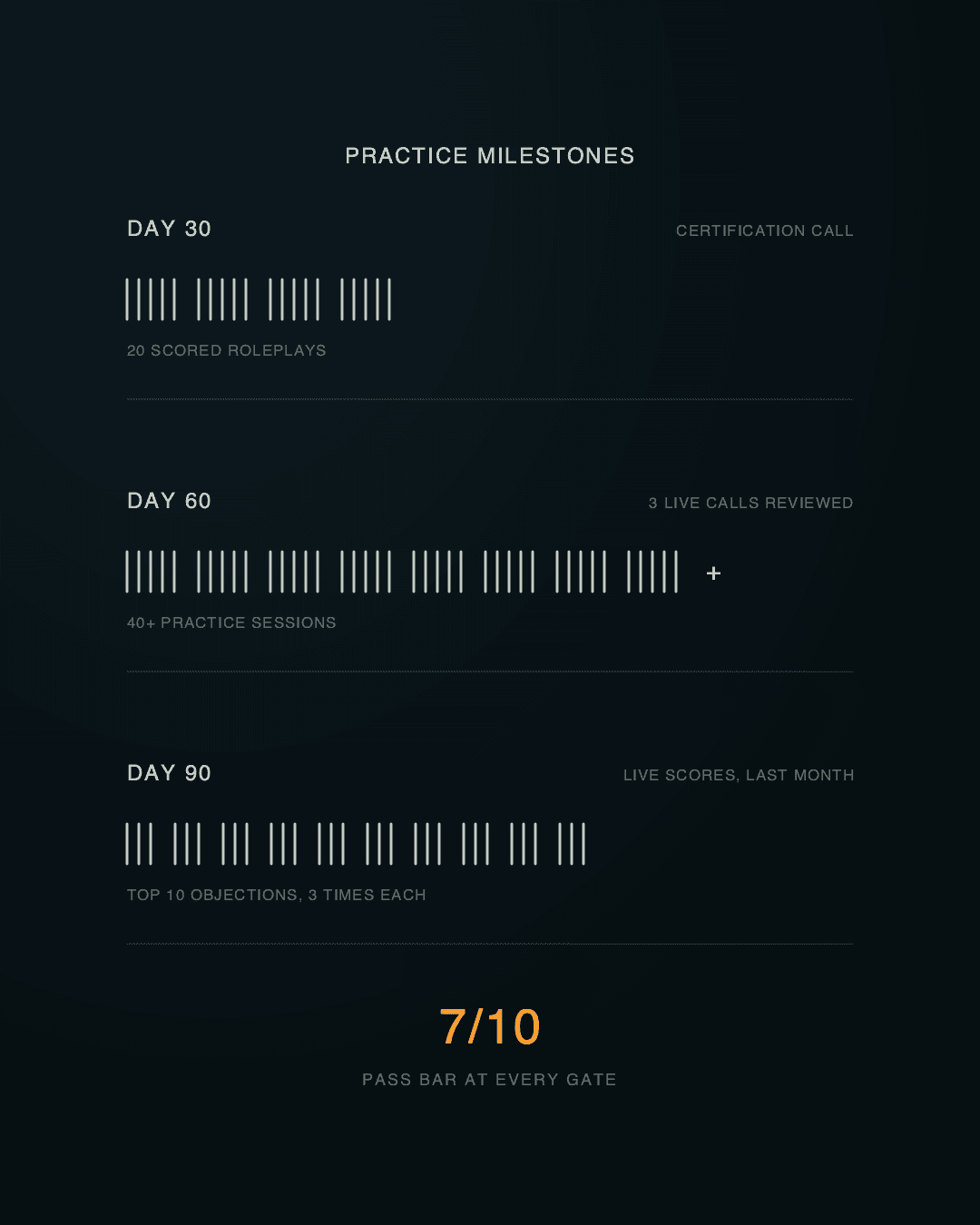
Here is the whole plan on one page. Copy it into a doc or spreadsheet and edit the numbers to fit your sales cycle. The pass bars are a starting point we would use, not an industry standard. Adjust them, then hold to them.
Inside SDR or AE version
Phase | Goal | Key activities | Practice milestone | Readiness check (pass bar) | Leading indicators to watch |
|---|---|---|---|---|---|
Days 1 to 30: learn | Can run a full first conversation in practice | Product, ICP, tools; listen to 15 to 20 recorded calls; sit in with 2 to 3 reps; SDR: first list and sequences; AE: review 5 past deals, learn demo | 20 scored roleplays of the first conversation, 5 with objections | Certification call: 7/10 overall, no line below 5, 2 objections handled, ICP explained in 2 minutes | Practice sessions per week, practice score trend, time to first scored session |
Days 31 to 60: apply | Consistent on live conversations | SDR: ramped cadence, manager scores 2 calls a week; AE: first meetings with silent observer; weekly self-review of best and worst call | Daily 5 to 10 minute drill on the weakest rubric line; 40+ total sessions | Live review of 3 manager-picked calls: 7/10, next step on 2 of 3, rep names own mistake first, at ramp target | Time to first meeting, first-call scores, next-step rate, pipeline created |
Days 61 to 90: own | Independent and predictable | Own the book; AE: first negotiations, own forecast; practise before every big call; teach one thing back | Prep run before every high-stakes call; each top 10 objection practised 3+ times | Ramp review: 7/10 sustained, at day 90 target, forecast mostly right, written self-review | Pipeline coverage, stage conversion, forecast accuracy, unprompted practice |
Field rep version
Phase | Goal | Key activities | Practice milestone | Readiness check (pass bar) | Leading indicators to watch |
|---|---|---|---|---|---|
Days 1 to 30: learn | Can run a full first visit in practice | Product and compliance; territory map with top 20 accounts and gatekeepers; 4+ ride-alongs with an observation sheet; hands-on product demo | 20 scored roleplays, done by phone between visits, 5 with objections | Certification call: 7/10 overall, no line below 5, 2 objections handled, territory plan presented | Practice sessions per week, score trend, ride-along sheets completed |
Days 31 to 60: apply | Consistent on live visits | 6+ led visits with a silent observer; solo visits with a debrief after each; account plans for top 10 | Daily 5 to 10 minute drill in the car on the weakest line; 40+ total sessions | 3 observed visits picked by the manager: 7/10, next step on 2 of 3, rep names own mistake first, at visit and pipeline target | Visits per day, next-step rate, debriefs logged, first orders or opportunities |
Days 61 to 90: own | Independent on the territory | Own route and visit plan; first multi-stakeholder and competitor-held accounts; debriefs after every key visit; ride-along every 2 to 3 weeks | Prep run before every key visit; each top 10 objection practised 3+ times | Ramp review: 7/10 sustained, at day 90 target, account plans current, written self-review | Pipeline or reorder growth, account coverage, forecast accuracy, unprompted practice |
If you want a plainer checklist for the rep's desk, strip it down to three lines per phase: "By day 30 I can...", "By day 60 I can...", "By day 90 I can...". Every line should start with a verb a buyer would notice. "Handle the price objection without discounting" is a good line. "Complete pricing module" is not.
How do you measure a new rep's progress before revenue shows up?
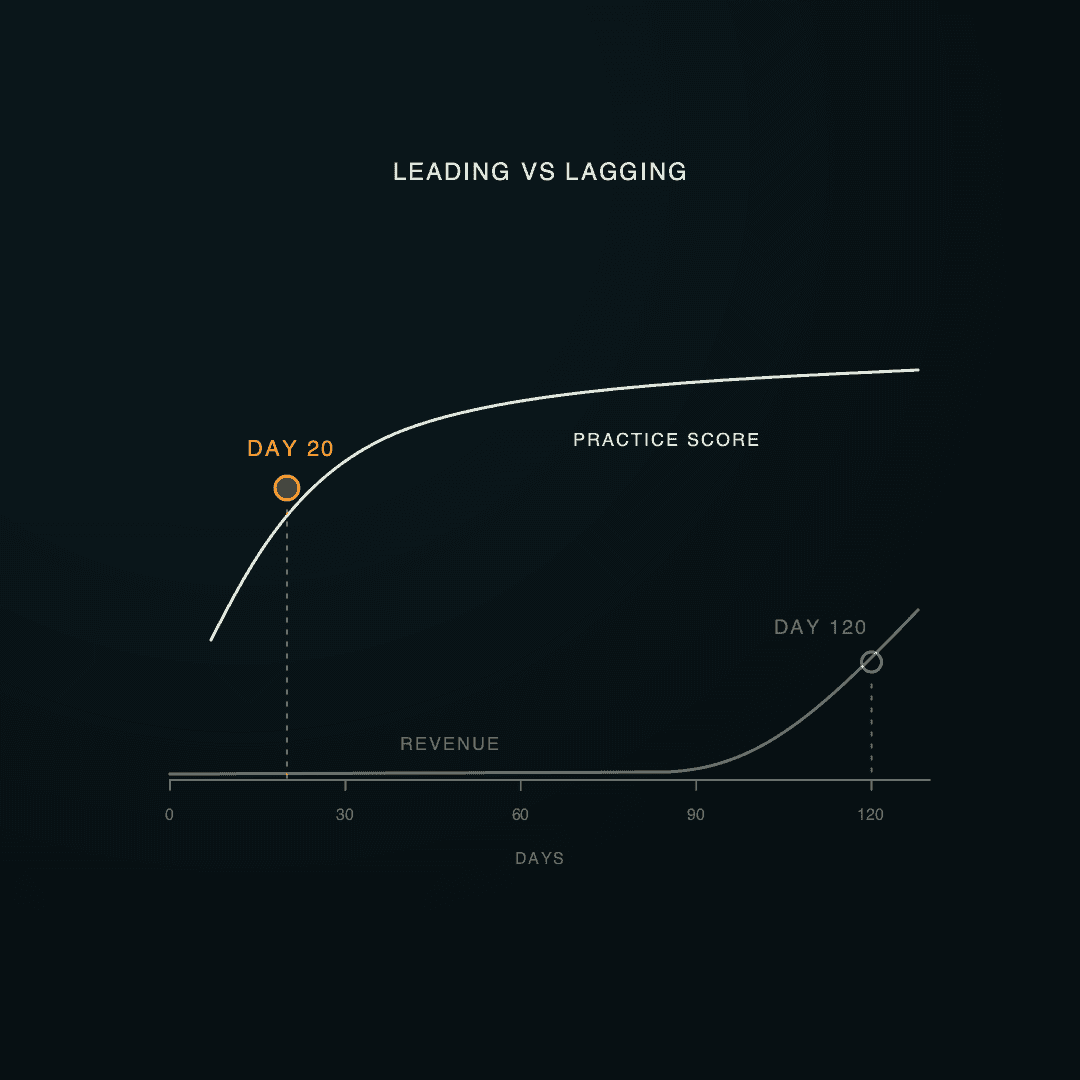
You measure a new rep's progress before revenue with leading indicators: how much they practise, how their practice and live scores move over time, how fast they reach their first real conversations and how often those conversations end in a next step. Revenue tells you at day 120 what these numbers told you at day 20.
The leading indicators we would track, in the order they become useful:
Practice volume (from week 1). Sessions per week. The simplest and most honest early signal. Reps who practise without being chased usually ramp. Reps who need reminding every time are telling you something about the next six months.
Practice score trend (from week 2). Not the score, the direction. A rep who starts at 4 and is at 6 by week three is fine. A rep stuck at 6 for three weeks needs a different kind of help.
Time to first scored practice session. Days from start date to first scored roleplay. If it is more than ten days, the plan is front-loaded with reading.
Time to first real conversation. Days from start to first live call or visit that the rep leads. Track it per cohort. It tells you whether onboarding is a runway or a waiting room.
First-call quality (from week 5). The same rubric, on live calls or observed visits. If live scores sit well below practice scores, the practice is too easy. Make the AI buyer or the peer playing the buyer harder.
Next-step rate. Share of first conversations that end in a dated next step. This is where nerves show up. Nervous reps end calls with "I will send you something".
Pipeline created (from week 6). Opportunities or qualified meetings at your defined stage, against the ramp target.
Confidence, asked directly. Once a week, ask the rep to rate their confidence on the core call out of 10, and compare it to their scores. A rep who rates themselves 8 and scores 5 needs a different conversation from a rep who rates themselves 4 and scores 7.
That last one is something we hear a lot on calls with buyers: leaders want a view of readiness before it shows up in the forecast. It is one of the most common reasons a sales leader starts looking at practice tools at all. They are tired of finding out in month four.
A note on honesty. Leading indicators can be gamed. A rep can run ten easy roleplays to hit a number. That is why the score trend and the live-call scores sit next to the volume. You want all three moving together.
If you need the full measurement picture, our guide to how to reduce sales rep ramp time goes deeper on ramp metrics, and the ramp time entry in our dictionary covers the definitions.
What should you do when a new rep is behind at day 45?
When a new rep is behind at day 45, first work out what they are behind on: activity, knowledge, skill, nerves or territory. Each has a different fix. Then run a ten-working-day recovery plan with one goal, daily practice on that goal, and a retake of the check at day 55 or 60.
Day 45 is the right moment because it is late enough to see a real pattern and early enough to fix it before the day 60 check. Here is how to diagnose it. Ask four questions, in this order.
1. Are they doing the activity? Look at calls, visits, emails and practice sessions. If activity is low, the problem is time, will or confusion about priorities. Fix: a fixed daily schedule, blocked in the calendar, reviewed every day for two weeks. Sometimes the rep is spending three hours a day on admin nobody told them to stop doing.
2. Do they know the material? Ask them to explain the product, the ICP and the top three objections out loud. If they cannot, the problem is knowledge, which is the easiest to fix. Fix: three focused sessions on the gaps, then a re-test. Do not send them back through the whole course.
3. Can they do it in practice? Run a practice call. If they know the material but score poorly in practice, the problem is skill. Fix: daily practice on the single weakest rubric line, scored, with the manager reviewing three sessions a week.
4. Can they do it live? If practice scores are good and live scores are poor, the problem is nerves, not skill. This is the Execution Gap in its purest form. Fix: make practice harder (a tougher buyer, more interruptions, the objection they fear most), practise right before live calls, and have the manager sit in silently on a few live calls so the rep gets used to performing with pressure in the room.
There is a fifth possibility, and it is not the rep's fault. The territory or lead flow is bad. A field rep with a patch nobody has worked in two years, or an SDR given a list of accounts that churned, will look behind on every metric. Check this before you have a hard conversation.
The ten-day recovery plan
Day 1: a one-hour sit-down. Show the rep the data. Agree on the one thing to fix. Write it down.
Days 2 to 9: daily practice on that one thing, 10 to 15 minutes, scored. The manager reviews at least three sessions and hears at least three live calls or joins two visits.
Day 5: a 15-minute check-in. Is the score moving?
Day 10: retake the relevant check (the day 30 certification call, or a partial day 60 review).
If the score moves, keep going and fold them back into the normal plan, perhaps with the day 60 gate pushed by two weeks. That is fine. Ramp is not a race against the calendar.
If nothing moves after ten focused days, with real practice and real manager attention, you have learned something important. Sometimes the fit is wrong. It is kinder to say so at day 60 than at day 180.
One more thing. Tell the rep they are behind. Clearly, early and kindly. Most reps already know. Pretending everything is fine makes them feel worse and wastes the two weeks you most need.
How does the plan change for career changers, experienced hires and field reps?
The skeleton stays the same. What changes is where you spend the time. Career changers need more practice on asking for commitment. Experienced hires need less product theory and more practice on your specific buyer. Field reps need practice that happens in the car and a manager who coaches from debriefs, not just ride-alongs.
Career changers: clinical, operations or service people moving into sales
This is one of the most common situations we hear about on sales calls: new reps moving from clinical or operations roles into sales who know the customer inside out and lack confidence selling to them. A former nurse selling into hospitals. An operations lead now selling the service they used to deliver.
These reps are often the best hires you will make. They know the buyer's day better than any career seller. GBUK, a UK medical device supplier, has salespeople who used to work in the hospitals they now sell into.
Their gap is narrow and specific. They are comfortable explaining. They are uncomfortable asking. Asking for the meeting, asking for the order, asking who else needs to sign off. So:
Shorten the knowledge phase. They do not need two weeks on the customer's world. They need two days on your product and your process.
Double the practice on the ask. Half their day 1 to 30 practice should end with a request for commitment. Let them hear themselves do it twenty times before a real buyer hears it once.
Add a "pushy buyer" scenario. They are often too agreeable. Mike Brown, Head of Sales Development at GBUK, put it plainly about the AI coach: "I don't want Rory to be agreeable." Practise against someone who says no.
Experienced reps in a new company
An experienced rep can skip much of phase one. Do not let them skip the certification call. Experienced reps bring habits from their last product and their last buyer, and some of those habits are wrong here. The day 30 check is how you find out which.
For experienced hires, compress days 1 to 30 into two to three weeks, keep the full practice milestone on your specific objections, and move them into supervised live work sooner.
Field reps
Field reps get the same plan with three changes we have already built in above, worth repeating because most templates miss them:
Practice has to live where they are. The car, between visits, by phone. Not a laptop course they open on Sunday night. Allwyn's field reps sell National Lottery products into shops across the UK. When their practice moved onto the phone, reps started calling before half seven in the morning without being asked, according to the team.
Ride-alongs need a rubric. The same rubric as practice. Otherwise the debrief is "good visit, maybe slow down a bit".
Debriefs replace the manager's ears. A short debrief after key visits, logged, so the manager can coach 50 visits a week without seeing them.
There is a related twist. In some field teams the managers came from operations and never sold themselves. At Rentokil Terminix, most branch managers came up through operations, so they were responsible for coaching a skill they had never been trained in. If that is your team, put a structured rubric and scored practice in the plan so the manager has something concrete to coach from. Our guide on field sales coaching covers that side in detail.
How long should it take a new sales rep to ramp?
It depends on the role and the deal size. The Bridge Group's 2025 SDR report, based on 351 B2B companies, puts average SDR ramp at 3.0 months, the lowest since 2010. Its 2026 AE report, based on 158 B2B companies, puts average AE ramp at 6.2 months, the highest in the study's history, which it links to deal complexity and bigger buying committees.
Sources: The Bridge Group, 2025 SDR Models and Metrics and The Bridge Group, 2026 AE Models, Motions and Metrics.
What that means for your plan:
For SDRs, 90 days is about the length of a full ramp. Day 90 can mean "at full activity and close to full meeting target".
For AEs, 90 days is roughly half of an average ramp. Day 90 should mean "ready and building pipeline at the ramp target", not "at full quota". If your plan says full quota at day 90 for an AE selling complex deals, the plan is wrong, not the rep.
For field reps, ramp often runs longer because there are fewer conversations per week. A field rep may hold 30 to 40 conversations a week, where an SDR might hold that in a day. Fewer live reps means practice matters more, not less.
A skeptic's note on benchmarks. Averages hide huge spread, and "ramp" means different things in different companies (some mean first deal, some mean full quota). Measure your own ramp, per cohort, the same way every time. That number is worth more than any benchmark.
What changes ramp, in our experience, is practice volume in the first 60 days. Allwyn's new starters ramped 65% faster, cutting two to two and a half weeks from onboarding, after they moved daily coaching onto Rory. That is one customer, on one team, with one definition of ramp. We think the mechanism carries. The exact number will not carry to every team. Our guide on how to reduce sales rep ramp time goes further into what moves the number.
Where does AI roleplay fit in a 30-60-90 day plan?
AI roleplay fits in the practice milestones of every phase. It gives the rep a realistic buyer to practise against every day, scores them on your rubric and shows the manager the results, without the manager running each session. It is how a plan with 20 roleplays by day 30 becomes something that actually happens.
The maths is simple. The plan above asks for about 20 practice sessions by day 30, 40 or more by day 60, and practice before every big call after that. A manager with six reps cannot play the buyer 300 times in a quarter. A peer rota helps, but peers are busy and polite. So practice either gets automated or it gets skipped.
That shows up in what we see in our own search data. The long questions people type about onboarding and ramp come from enablement and L&D leaders with a hiring cohort, and they read like briefs. One query that found us this month: "we're onboarding 15 new account executives and need an ai sales training tool that provides realistic roleplay scenarios without requiring a manager to run every session." Another, from a medical device team, asked how to get 50 new reps trained fast on sales calls. Both are asking the same thing: how do we get practice volume without burning our managers?
What to look for if you add AI practice to a 30-60-90 day plan:
It uses your playbook. Your talk track, your top 10 objections, your buyer types. Generic scenarios teach generic selling.
It scores against your rubric. The same lines you use in the day 30 and day 60 checks. Otherwise practice scores and gate scores do not match and nobody trusts either.
It is voice, not text. Reps freeze in their mouths, not their keyboards.
It is easy to reach. If a field rep needs a laptop and a login, it will not happen in the car. If it is a phone call or a WhatsApp message, it might.
It sounds human and pushes back. A buyer who agrees with everything builds false confidence.
The manager sees the patterns. Who to coach this week, on which line of the rubric.
Somebody owns it. A named person on your side keeps the scenarios fresh. The tools that die are the ones nobody owns.
The gap most onboarding plans hit is that practice depends on the manager's diary. That is the problem SecondBody was built to solve, by giving every rep Rory, our AI coach, for short voice practice sessions on your objections and personas, and giving managers a one-page briefing before each 1:1 on who needs coaching and on what. On team plans, Rory is trained on your playbook and calls reps on their phone or WhatsApp, so practice does not wait for anyone to open a laptop.
Two customer examples, with honest context. Rentokil Terminix reps logged 16 hours of roleplay each in under three weeks with no time off the road, and every manager in the trial backed it. At GBUK, consistent users scored 8 to 10 out of 10 on the team's cold-call assessment, against about 6 for reps who used it on and off. Neither is a controlled study, and the GBUK numbers compare two groups of users, not the same reps before and after, so some of that gap is who chooses to practise. Both still point the same way: practice volume and consistency travel with better scores. That is the whole thesis of this article.
For a wider view of tools, see our guide to sales onboarding software.
What mistakes do managers make with a 30-60-90 day plan?
The most common mistake is a plan that measures attendance instead of ability. The rest follow from it. Here are the ones we have watched happen.
1. Moving reps on by date, not by gate. Day 30 arrives, so the rep goes live. If they have not passed a skill check, you are sending them to learn on your buyers. Buyers are expensive teachers.
2. Front-loading everything into week one. Forty hours of product content in five days. By week three the rep remembers a fraction of it. Spread knowledge across the 90 days and tie each piece to a conversation they will have soon.
3. Shadowing one rep only. The new rep copies one person's habits, good and bad. Shadow three. Better still, ask the new rep to write down how each one handles the same objection.
4. Treating practice as optional. "Roleplay with your manager when you can." It will happen twice. Put a number on it and track it like pipeline.
5. Using a different standard at each stage. Quiz scores at day 30, manager gut feel at day 60, revenue at day 90. Use one rubric for all three, so the rep and the manager can see progress on the same scale.
6. Rescuing on live calls. The manager jumps in the moment the rep stumbles. The deal is saved. The rep learns nothing except that someone will catch them. Stay quiet, take notes, debrief.
7. Ignoring the field rep you cannot see. Field reps get judged on visit counts because nobody hears their conversations. Build debriefs and phone-based practice into the plan, or you are coaching a mileage log.
8. Copying a template without changing the numbers. Every template on the internet, including the one above, is a starting point. If your sales cycle is nine months, 90 days is a third of one deal. Set targets that fit.
9. Stopping at day 90. The plan ends, the practice ends, and by month six the rep has drifted back to habits. Keep a lighter practice rhythm forever. Our guide on how to train a sales rep covers what that looks like after ramp.
What if you are the new rep and nobody gave you a plan?
Write your own, show it to your manager in week one and run it on yourself. Managers almost always say yes to a new rep who arrives with a plan, because it is one less thing for them to write.
Here is how to do it in an afternoon:
Ask your manager three questions. What does good look like at 90 days? What do your best reps do that others do not? What are the five objections that lose us the most deals?
Copy the table above and change the numbers to match what your manager said.
Build your own practice. If your company has no practice setup, pair up with another new hire and swap roles for 15 minutes a day. Record yourself on your phone and listen back. It will be painful. Do it anyway.
Ask for your own day 30 check. "Can you play a tough prospect for ten minutes on Friday and score me?" Few managers say no to that.
Keep a call log. After every call or visit, write three lines: what went well, what went wrong, what you will try next time. By day 60 you will have a record of your own learning that is worth more than any course.
Practise before every call that scares you. Ten minutes, out loud, in the car or a meeting room. The nerves do not go away. You just get used to performing with them.
One last tip for reps. The rep who asks for feedback gets more of it. The rep who asks for a harder practice buyer gets better faster. Be that rep. It also makes your day 90 review a much easier conversation.
For a deeper set of drills, our objection handling training drills work on your own or with a partner.
Frequently asked questions
What is the 30-60-90 rule in sales?
It is a way of splitting a new rep's first three months into three phases: learn (days 1 to 30), apply (days 31 to 60) and own (days 61 to 90). Each phase has its own goals. The rule is a structure, not a law. What makes it work is having a clear check at the end of each phase.
What should a new sales rep accomplish in the first 30 days?
They should learn the product, the customer and the sales process well enough to explain them in their own words, complete around 20 scored practice conversations, and pass a certification call at day 30. Inside reps should also have their tools set up and a first target list. Field reps should have a territory map and four or more ride-alongs done.
Who should write the 30-60-90 day plan, the manager or the rep?
The manager should write the first version before the rep starts, because the ramp targets and the pass bars are the manager's call. The rep should then add their own goals in week one. If nobody writes one, the rep should write it and bring it to the manager.
Should a new sales rep hit quota in 90 days?
Usually not, especially AEs. The Bridge Group's 2026 AE report puts average AE ramp at 6.2 months. SDRs ramp faster, around 3.0 months on average in the 2025 SDR report, so an SDR can be close to full target by day 90. Use a stepped ramp quota and judge the rep on it.
How long should a 30-60-90 day sales plan be?
One to two pages for the plan itself, plus the table. If it runs to ten pages, nobody will read it after week one. The detail belongs in the rubric, the talk track and the objection list, not in the plan.
What is a readiness check in a sales onboarding plan?
A test the rep has to pass before moving to the next phase. For example, a ten-minute certification call scored on a rubric at day 30, or a review of three live calls at day 60. It replaces "the calendar says day 31" with "the rep can do the thing".
How many roleplays should a new sales rep do?
Enough that the core conversation becomes automatic. We suggest about 20 scored sessions by day 30 and 40 or more by day 60, then practice before every high-stakes call. The number is less important than the daily habit.
What metrics should you track in a new rep's first 90 days?
Practice volume, practice score trend, time to first real conversation, live-call or visit scores, next-step rate, pipeline created against the ramp target and, by day 90, forecast accuracy. Track them weekly, not monthly, so you can act at day 45.
What is different about a 30-60-90 day plan for a field sales rep?
Field reps need territory mapping, ride-alongs with a written observation sheet, practice they can do by phone between visits, and debriefs after key visits so the manager can coach without being there. The phases and gates stay the same.
Does this plan work for a medical device or pharma sales rep?
Yes, with two additions. Put compliance training and approved claims at the very start of phase one, before any customer contact. Practise those claims too, because an off-label slip under pressure is a bigger problem than a lost deal. Choose a practice tool that does not record customer conversations; SecondBody never does, which is one reason it runs in medtech and pharma. And give extra practice to reps coming from clinical roles, focused on asking for commitment rather than explaining the product.
What should I do if my new rep is struggling?
Diagnose before you prescribe. Work out whether the problem is activity, knowledge, skill, nerves or territory, then run a ten-day recovery plan with daily practice on one thing and a retake of the relevant check. See the day 45 section above.
How does SecondBody fit into a 30-60-90 day plan?
SecondBody covers the practice milestones and gives you data for the readiness checks. Rory, the AI coach, runs short voice practice sessions on your objections and buyer personas, scores them (including against SPIN, MEDDIC or Sandler), and gives managers a one-page briefing before each 1:1. On team plans, Rory is trained on your playbook and calls reps on their phone or WhatsApp, so reps do not need a login. SecondBody never records customer conversations. Reps practise before the call and debrief after it.
How much does SecondBody cost for a new hire cohort?
Plans are $75 a month or $750 a year per seat, including 120 minutes of roleplay and 60 minutes of coaching with Rory each month. Team and enterprise plans are custom priced, and that is where Rory calling reps on WhatsApp or phone and training on your playbook live. Many teams start with a small scoped pilot, for example ten new joiners for two weeks with one number to move.
Can SecondBody work for field reps who are on the road all day?
Yes. That is who it was built for. On team plans, Rory calls the rep on their phone or WhatsApp, so a field rep can practise in the car between visits without opening a laptop. Rory never listens in on live visits or records customers, which matters in pharma, medical devices and financial services. Rentokil Terminix reps did 16 hours of roleplay each in under three weeks without a day off the road.
How we know this
We run SecondBody, an AI sales coaching and roleplay platform used by field and inside sales teams. The patterns in this article come from three places: what our customers' rollouts show (Allwyn, Rentokil Terminix and GBUK are quoted from their published stories), what we hear on sales calls with enablement leaders and sales directors in 2026, and the questions buyers type into Google that bring them to our site. The ramp benchmarks are from The Bridge Group's published reports. The practice numbers and pass bars in the plan are our recommendations, not an industry standard. Test them on your own team.
Is the rep ready, or is it just day 90?
A 30-60-90 day plan for sales reps is not a to-do list with dates on it. It is three gates. Each one asks a single question: can this rep do the thing yet, under pressure, with a buyer who pushes back?
Most plans never ask. They count modules and calls logged, and they find out in month four. A plan with daily practice and a real check every 30 days finds out in week three, when there is still time to fix it.
The calendar will always say day 90. Readiness is a different number, and you can see it coming if you build the plan to measure it.
If you want the practice part handled, SecondBody gives every new rep a coach to practise with every day (on team plans, one who calls them on their own playbook), and tells you who is ready before the forecast does. Book a demo and we will show you what the first 30 days look like with Rory in them.
Good luck out there.
Omid
By Omid, founder of SecondBody
Day 47. The new rep has passed every product quiz. Finished every module. Shadowed eleven calls. The CRM is spotless. Then the first real buyer says, "We already use someone for this," and the rep goes silent for four seconds that feel like forty.
Nothing in the plan predicted that moment. That is the problem with most 30-60-90 day plans for sales reps. They measure what the rep has consumed, not what the rep can do when the buyer pushes back.
A good 30-60-90 day plan for a new sales rep has four things in every phase: a goal, the activities that get there, a practice milestone with a number on it, and a readiness check the rep has to pass before the next phase starts. Learn, then practise, then sell. Each 30 days ends with a gate, not a calendar date.
This guide gives you the full plan in two versions (inside SDR or AE, and field rep), a table you can copy, the leading indicators that tell you who is on track before revenue arrives, and a plan for the rep who is behind at day 45. We build an AI coaching and roleplay platform, so read the practice sections with that in mind. The plan works with or without us. It works much worse without practice.
Key answers, up front
What it is: a written plan for a new sales hire's first 90 days, split into three phases. Days 1 to 30 learn, days 31 to 60 apply under supervision, days 61 to 90 own a pipeline.
What most plans miss: practice milestones and readiness checks. They list activities ("complete product training", "shadow calls") but never test whether the rep can hold a real conversation under pressure.
What each phase needs: a goal, activities, a practice milestone (for example, 20 scored roleplays on discovery by day 30) and a readiness check with a pass bar (for example, a 10-minute certification call scored 7 out of 10 or better).
How to measure before revenue: track practice volume, practice scores over time, time to first meeting, first-call quality, next steps booked and pipeline created. Revenue shows up too late to help.
Inside vs field: same skeleton, different activities. Field reps need ride-alongs with a written rubric, territory planning and practice they can do in the car, because nobody can hear their conversations.
If a rep is behind at day 45: work out whether the problem is activity, knowledge, skill, nerves or territory. Each one has a different fix. Do not just add more training.
How long ramp takes: The Bridge Group's 2025 SDR report puts average SDR ramp at 3.0 months. Its 2026 AE report puts AE ramp at 6.2 months, the highest in the study's history. So day 90 is a readiness milestone for most AEs, not full quota.
What is a 30-60-90 day plan for sales reps, really?
A 30-60-90 day plan for sales reps is a written agreement between a manager and a new hire about what the rep will learn, practise and deliver in their first three months, with a checkpoint at the end of each month.
That is the definition. Here is what it means in practice.
It is not a curriculum. A curriculum is a list of things to watch and read. A plan is a list of things the rep must be able to do, by a date, with proof.
It is not only a document for the interview, either. A lot of what ranks for this term is advice for candidates presenting a plan to land the job. That version is fine. This article is about the other one: the plan a manager hands a new rep on day one, and the plan a rep runs on themselves when their manager is too busy to write one.
Most plans use the same three phases, and the names barely matter:
Days 1 to 30: learn. Product, customer, process, tools. Watch and listen.
Days 31 to 60: apply. Real conversations with a safety net. A manager or senior rep listens, scores and debriefs.
Days 61 to 90: own. The rep runs their own pipeline, forecasts their own deals and asks for help when they need it, not when they are told to.
Where plans differ is in what sits between the phases. Weak plans move a rep from phase one to phase two because the calendar said so. Strong plans move a rep because they passed something. That small change is the whole article.
Why do most 30-60-90 day sales plans fail?
Most 30-60-90 day sales plans fail because they measure inputs (modules done, calls shadowed, accounts researched) and assume the outputs will follow. The outputs do not follow. Knowing what to say and saying it while a buyer stares at you are two different skills.
Here is what nobody says out loud. Your new rep almost certainly knows enough by day 30. They can recite the value proposition. They passed the quiz. What they cannot do yet is execute when their stomach drops. We call that the Execution Gap, and a plan that never tests for it will look green right up until the first live calls go badly.
Watch how it plays out:
Week 1 to 4: the rep completes every task on the list. The plan says "on track".
Week 5 to 6: live calls start. The rep talks too much, skips discovery, folds at the first price question. The manager hears two of those calls, maybe.
Week 7 to 8: pipeline is thin. The manager gets nervous and adds "more training". The rep watches more videos.
Week 9 to 12: the rep is now behind and knows it. Confidence drops. Activity drops with it.
Every step looked reasonable. The plan failed at the first one, because it had no test of skill, only a test of attendance.
Three more reasons we see plans break, from the sales calls we run with enablement leaders:
Managers cannot hear the calls. This comes up again and again, especially with field teams. A regional manager with eight reps spread across a territory hears a tiny slice of what those reps say. In person, at a counter or a kitchen table, the manager hears nothing at all unless they ride along. So the plan gets judged on activity data because activity data is all there is.
Nobody owns the content. One team we spoke to cancelled a training tool because nobody on their side owned the scenarios and the objection library. The plan had a line saying "practise objection handling". It did not say which objections, written by whom, updated when.
Practice is optional. Roleplay sits in the plan as a nice-to-have, usually "roleplay with your manager". Managers are busy. It happens twice. Two roleplays in 90 days is like learning to swim from two lessons and a book.
The fix is not a longer plan. It is a plan with practice built into every phase and a gate at the end of each one.
What do you need in place before the rep's first day?
Before day one you need seven things: a clear role definition, a ramp quota, a written talk track, a top 10 objection list, a scoring rubric, a practice setup and a named owner for all of it. Without these the plan has nothing to measure against.
Here is the pre-boarding checklist we would hand any manager. Most of it takes an afternoon if you have done it before.
Write the job in outcomes. "Books 12 qualified meetings a month" or "Runs 8 store visits a day and lifts reorder rate". Not "prospects and builds relationships".
Set the ramp quota. Decide now what counts as on track at day 30, 60 and 90. Many teams use a stepped quota (for example a small share of full target in month two, more in month three). Pick numbers that fit your sales cycle and write them down before the rep arrives, so nobody negotiates them in week eight.
Write the talk track. The opener, the three discovery questions that matter most, the one-sentence value proposition and the ask. One page. If your best rep would not say it out loud, rewrite it.
List the top 10 objections. Not 40. Ten. With the answer your best rep actually gives, in their words. Ask your top performers what they hear most this quarter, because it changes. (Allwyn asked 125 reps for objections in writing and got 10 replies. Ask in person or on a call.)
Build a scoring rubric. Five or six things you score every practice and live conversation on, each out of 10. For example: opener, discovery depth, value linked to the buyer's problem, objection handling, clear next step. If you sell with SPIN, MEDDIC or Sandler, score against that. The same rubric runs all 90 days, so progress is visible.
Set up practice. Decide how the rep will practise every day without a manager in the room. A peer rota, recorded roleplays, an AI buyer, or all three. If practice depends on the manager's diary, it will not happen.
Name an owner. One person owns the plan, the rubric and the objection list. Usually the manager, sometimes enablement. Write their name at the top.
Also sort the boring things: laptop, CRM access, phone, email, calendar, territory assignment, product samples for field reps, and any compliance training they must finish before they speak to a customer (in medtech, pharma and finance this can take most of week one). A rep who spends days 1 to 5 waiting for logins has already lost a week of a 90-day plan.
What should a new sales rep do in the first 30 days?
In the first 30 days a new sales rep should learn the customer, the product and the process well enough to explain them in their own words, start practising the core conversation every day, and pass a certification call at day 30. Goal: competent in practice. Not yet on live calls that matter.
Goal for days 1 to 30
The rep can run a full first conversation (opener, discovery, value, next step) against a realistic buyer and score 7 out of 10 or better on your rubric. They can explain who buys, why they buy and why they say no.
Activities: inside SDR or AE version
Week 1: company, product and ICP basics. Compliance training if your industry needs it. Set up CRM, dialler and email. Read the talk track and the top 10 objections.
Week 1 to 2: listen to 15 to 20 recorded calls from top reps. Not passively. For each call, write down the opener, the best question asked and the moment the buyer leaned in or pulled back.
Week 2: sit in on live calls with two or three different reps, not just one. Different reps handle the same objection differently, and the new rep should steal the best version.
Week 2 to 4 (SDR): build a first target list of accounts in the ICP, write first sequences with the manager, and start low-risk outreach to accounts that are not your best ones.
Week 2 to 4 (AE): learn the full deal cycle. Review three closed-won and two closed-lost deals end to end with the manager. Learn the demo. Practise the demo until it fits in the time you have.
Weekly: a 30-minute 1:1 with the manager that looks at practice scores, not just task completion.
Activities: field rep version
Week 1: product, customer and compliance basics. For regulated products, learn what you are allowed to claim before you learn anything else.
Week 1 to 2: map the territory. Top 20 accounts, who the decision-makers are, who the gatekeepers are (receptionists, store managers, theatre managers, procurement), and the visit route.
Week 2 to 4: at least four ride-alongs with different reps. Each ride-along uses a written observation sheet: what the rep said in the first 30 seconds at the door, the question that opened the buyer up, the objection, how they asked for the next step. A ride-along without a sheet is a day in a car.
Week 3 to 4: handle the product physically. Run the demo or the product walk-through on a table, in a car park, in a store. Field demos fail on the mechanics more often than on the words.
Weekly: a call with the manager, by phone if needed, that reviews practice scores and one ride-along observation.
Practice milestone for days 1 to 30
Twenty scored roleplays of the core first conversation by day 30. Roughly one per working day from week two, ten to fifteen minutes each. At least five of those should include one of the top 10 objections. Inside reps practise at the desk between tasks. Field reps practise in the car between visits, by phone, because that is the only quiet room they have.
Why twenty? Because the rep needs enough repetitions that the words stop being something they remember and start being something they say. The exact number matters less than the habit. A rep who practised twice will not pass the check. A rep who practised twenty times usually will.
Readiness check at day 30
A certification call. The manager (or an AI buyer scored against your rubric) plays a realistic prospect for ten minutes. The rep runs the conversation from opener to next step. Pass bar:
7 out of 10 or better on the rubric overall.
No score below 5 on any single line.
Handles two objections from the top 10 without reading.
Explains the ICP and the top three reasons buyers say yes, in their own words, in under two minutes.
Pass, and the rep moves to supervised live work. Do not pass, and the rep gets five more working days of focused practice on the weak line and retakes it. Do not move them on because the calendar says so. That is how day 47 happens.
What should a new sales rep do in days 31 to 60?
In days 31 to 60 a new rep should run real conversations with a safety net: live calls or visits that a manager hears and scores, daily practice targeted at whatever the live calls exposed, and the first pipeline. Goal: consistent on live conversations, not just in practice.
Goal for days 31 to 60
The rep runs live first conversations that score 7 out of 10 or better on the same rubric, books next steps on a steady share of them and builds the first real pipeline.
Activities: inside SDR or AE version
SDR: full prospecting cadence at a ramped activity level, agreed in advance. For example, a set number of dials and emails per day, rising week on week. The manager listens to at least five recorded calls a week and scores two of them with the rep.
AE: run first meetings and demos on qualified opportunities, with the manager on the first three as a silent observer. The rule for a silent observer: no rescuing. If the rep is drowning, the manager notes the moment, and they debrief afterwards. Rescuing teaches the rep that someone will always catch them.
Both: a weekly call review where the rep picks their own best and worst call. Self-diagnosis is a skill. Reps who can name their own mistakes ramp faster than reps who wait to be told.
Both: shadow one deal or sequence further down the funnel (a negotiation call, a renewal, a multi-stakeholder meeting) so day 61 is not the first time they see it.
Activities: field rep version
Week 5 to 6: joint visits. The rep leads, the manager or a senior rep stays quiet and scores against the same rubric used for the ride-along sheets. Aim for at least six led visits with an observer in this phase.
Week 6 to 8: solo visits on a planned route, with a short voice note or written debrief after each visit: what happened, what the buyer said, what the next step is.
Week 6 to 8: build account plans for the top ten accounts in the territory. Who matters, what they buy now, what the opening is.
Throughout: one manager ride-along every two weeks, minimum. A field manager who only sees the rep in the weekly pipeline call is coaching a spreadsheet.
Practice milestone for days 31 to 60
Daily practice continues, but now it is targeted. Each week, the manager picks the weakest line on the rubric from that week's live calls or visits, and the rep practises that one thing every day. Five to ten minutes a day is enough if it is focused. By day 60, aim for 40 or more scored practice sessions in total, with the score on the weakest line trending up.
This is where most plans drop practice, because the rep is now "doing real calls". That is backwards. Live calls expose the gaps. Practice closes them. A footballer does not stop training once the season starts.
Rentokil Terminix's residential field reps practised about 13 to 17 minutes a day and logged 16 hours of roleplay each in under three weeks, without a single day taken off the road. Those were experienced sellers, not new hires, but the point carries: daily practice fits inside a field rep's day if it lives on the phone in the truck and not in a classroom. The team even added usage caps, because some reps practised more than was sustainable. That is the opposite of the problem most plans plan for.
Readiness check at day 60
A live-call review. The manager scores three live conversations (recorded calls for inside reps, observed visits for field reps) picked by the manager, not the rep. Pass bar:
7 out of 10 or better on the rubric across all three.
A clear, dated next step agreed on at least two of the three.
The rep can say what went wrong in their weakest call before the manager does.
Pipeline or activity at the ramp target you set before day one.
Pass, and the rep gets their own book. Do not pass, and go to the day 45 section below, because by now you should already have seen it coming.
What should a new sales rep do in days 61 to 90?
In days 61 to 90 a new rep should own their pipeline, run full cycles with less supervision, forecast their own deals and handle the harder conversations (negotiation, multi-stakeholder meetings, the tough buyer) with practice before each one. Goal: independent and predictable. For most AEs this is not full quota yet.
Goal for days 61 to 90
The rep runs their own territory or book at the ramp target, forecasts their deals with reasonable accuracy and prepares for big conversations without being told to.
Activities: inside SDR or AE version
SDR: full activity level, own their lead list and sequences, hit the ramp target for qualified meetings. Start handing over meetings to AEs with notes the AE actually finds useful (ask the AE).
AE: own the full cycle on new opportunities. Run the first negotiation conversation with the manager in the room, then the second without. Forecast their own pipeline in the weekly forecast call and explain the reasoning for each deal.
Both: practise before every high-stakes conversation. The night before a big demo or pricing call, the rep runs the hardest version of that call against a tough buyer. Make this a habit now and it stays.
Both: teach one thing back to the team. A ten-minute share on something they learned in the first 90 days. Teaching forces clarity, and it tells you whether they actually understand it.
Activities: field rep version
Full territory: the rep owns the route, the visit plan and the account plans, and adjusts them weekly based on what is working.
Harder rooms: the first multi-stakeholder meeting, the first procurement conversation, the first account where a competitor is already in. Practise each one before walking in.
Self-coaching: a short debrief after every important visit, logged where the manager can see it. This replaces the manager's ears. In a field team, written or recorded debriefs are how a manager hears 50 visits a week without riding along on 50.
Manager touchpoints: a ride-along every two to three weeks focused on one skill, plus the weekly pipeline call.
Practice milestone for days 61 to 90
Practice moves from daily drills to preparation. At least one practice run before every high-stakes meeting, plus three short sessions a week on whatever the weakest rubric line is now. By day 90, the rep should have practised every one of the top 10 objections at least three times, and should have a practice score trend that is flat or rising over the last four weeks.
Readiness check at day 90
The ramp review. Pass bar:
Live conversation scores at 7 out of 10 or better, consistently, over the last month.
Pipeline or meetings at the day 90 ramp target.
Forecast accuracy: the deals they called for the month mostly did what they said.
A 90-day self-review written by the rep: what they are good at, what they are working on, what they need from the manager.
Pass, and the rep moves to the standard team coaching rhythm. The plan ends. Practice does not.
What does the full 30-60-90 day sales plan look like as a table?
Here is the whole plan on one page. Copy it into a doc or spreadsheet and edit the numbers to fit your sales cycle. The pass bars are a starting point we would use, not an industry standard. Adjust them, then hold to them.
Inside SDR or AE version
Phase | Goal | Key activities | Practice milestone | Readiness check (pass bar) | Leading indicators to watch |
|---|---|---|---|---|---|
Days 1 to 30: learn | Can run a full first conversation in practice | Product, ICP, tools; listen to 15 to 20 recorded calls; sit in with 2 to 3 reps; SDR: first list and sequences; AE: review 5 past deals, learn demo | 20 scored roleplays of the first conversation, 5 with objections | Certification call: 7/10 overall, no line below 5, 2 objections handled, ICP explained in 2 minutes | Practice sessions per week, practice score trend, time to first scored session |
Days 31 to 60: apply | Consistent on live conversations | SDR: ramped cadence, manager scores 2 calls a week; AE: first meetings with silent observer; weekly self-review of best and worst call | Daily 5 to 10 minute drill on the weakest rubric line; 40+ total sessions | Live review of 3 manager-picked calls: 7/10, next step on 2 of 3, rep names own mistake first, at ramp target | Time to first meeting, first-call scores, next-step rate, pipeline created |
Days 61 to 90: own | Independent and predictable | Own the book; AE: first negotiations, own forecast; practise before every big call; teach one thing back | Prep run before every high-stakes call; each top 10 objection practised 3+ times | Ramp review: 7/10 sustained, at day 90 target, forecast mostly right, written self-review | Pipeline coverage, stage conversion, forecast accuracy, unprompted practice |
Field rep version
Phase | Goal | Key activities | Practice milestone | Readiness check (pass bar) | Leading indicators to watch |
|---|---|---|---|---|---|
Days 1 to 30: learn | Can run a full first visit in practice | Product and compliance; territory map with top 20 accounts and gatekeepers; 4+ ride-alongs with an observation sheet; hands-on product demo | 20 scored roleplays, done by phone between visits, 5 with objections | Certification call: 7/10 overall, no line below 5, 2 objections handled, territory plan presented | Practice sessions per week, score trend, ride-along sheets completed |
Days 31 to 60: apply | Consistent on live visits | 6+ led visits with a silent observer; solo visits with a debrief after each; account plans for top 10 | Daily 5 to 10 minute drill in the car on the weakest line; 40+ total sessions | 3 observed visits picked by the manager: 7/10, next step on 2 of 3, rep names own mistake first, at visit and pipeline target | Visits per day, next-step rate, debriefs logged, first orders or opportunities |
Days 61 to 90: own | Independent on the territory | Own route and visit plan; first multi-stakeholder and competitor-held accounts; debriefs after every key visit; ride-along every 2 to 3 weeks | Prep run before every key visit; each top 10 objection practised 3+ times | Ramp review: 7/10 sustained, at day 90 target, account plans current, written self-review | Pipeline or reorder growth, account coverage, forecast accuracy, unprompted practice |
If you want a plainer checklist for the rep's desk, strip it down to three lines per phase: "By day 30 I can...", "By day 60 I can...", "By day 90 I can...". Every line should start with a verb a buyer would notice. "Handle the price objection without discounting" is a good line. "Complete pricing module" is not.
How do you measure a new rep's progress before revenue shows up?
You measure a new rep's progress before revenue with leading indicators: how much they practise, how their practice and live scores move over time, how fast they reach their first real conversations and how often those conversations end in a next step. Revenue tells you at day 120 what these numbers told you at day 20.
The leading indicators we would track, in the order they become useful:
Practice volume (from week 1). Sessions per week. The simplest and most honest early signal. Reps who practise without being chased usually ramp. Reps who need reminding every time are telling you something about the next six months.
Practice score trend (from week 2). Not the score, the direction. A rep who starts at 4 and is at 6 by week three is fine. A rep stuck at 6 for three weeks needs a different kind of help.
Time to first scored practice session. Days from start date to first scored roleplay. If it is more than ten days, the plan is front-loaded with reading.
Time to first real conversation. Days from start to first live call or visit that the rep leads. Track it per cohort. It tells you whether onboarding is a runway or a waiting room.
First-call quality (from week 5). The same rubric, on live calls or observed visits. If live scores sit well below practice scores, the practice is too easy. Make the AI buyer or the peer playing the buyer harder.
Next-step rate. Share of first conversations that end in a dated next step. This is where nerves show up. Nervous reps end calls with "I will send you something".
Pipeline created (from week 6). Opportunities or qualified meetings at your defined stage, against the ramp target.
Confidence, asked directly. Once a week, ask the rep to rate their confidence on the core call out of 10, and compare it to their scores. A rep who rates themselves 8 and scores 5 needs a different conversation from a rep who rates themselves 4 and scores 7.
That last one is something we hear a lot on calls with buyers: leaders want a view of readiness before it shows up in the forecast. It is one of the most common reasons a sales leader starts looking at practice tools at all. They are tired of finding out in month four.
A note on honesty. Leading indicators can be gamed. A rep can run ten easy roleplays to hit a number. That is why the score trend and the live-call scores sit next to the volume. You want all three moving together.
If you need the full measurement picture, our guide to how to reduce sales rep ramp time goes deeper on ramp metrics, and the ramp time entry in our dictionary covers the definitions.
What should you do when a new rep is behind at day 45?
When a new rep is behind at day 45, first work out what they are behind on: activity, knowledge, skill, nerves or territory. Each has a different fix. Then run a ten-working-day recovery plan with one goal, daily practice on that goal, and a retake of the check at day 55 or 60.
Day 45 is the right moment because it is late enough to see a real pattern and early enough to fix it before the day 60 check. Here is how to diagnose it. Ask four questions, in this order.
1. Are they doing the activity? Look at calls, visits, emails and practice sessions. If activity is low, the problem is time, will or confusion about priorities. Fix: a fixed daily schedule, blocked in the calendar, reviewed every day for two weeks. Sometimes the rep is spending three hours a day on admin nobody told them to stop doing.
2. Do they know the material? Ask them to explain the product, the ICP and the top three objections out loud. If they cannot, the problem is knowledge, which is the easiest to fix. Fix: three focused sessions on the gaps, then a re-test. Do not send them back through the whole course.
3. Can they do it in practice? Run a practice call. If they know the material but score poorly in practice, the problem is skill. Fix: daily practice on the single weakest rubric line, scored, with the manager reviewing three sessions a week.
4. Can they do it live? If practice scores are good and live scores are poor, the problem is nerves, not skill. This is the Execution Gap in its purest form. Fix: make practice harder (a tougher buyer, more interruptions, the objection they fear most), practise right before live calls, and have the manager sit in silently on a few live calls so the rep gets used to performing with pressure in the room.
There is a fifth possibility, and it is not the rep's fault. The territory or lead flow is bad. A field rep with a patch nobody has worked in two years, or an SDR given a list of accounts that churned, will look behind on every metric. Check this before you have a hard conversation.
The ten-day recovery plan
Day 1: a one-hour sit-down. Show the rep the data. Agree on the one thing to fix. Write it down.
Days 2 to 9: daily practice on that one thing, 10 to 15 minutes, scored. The manager reviews at least three sessions and hears at least three live calls or joins two visits.
Day 5: a 15-minute check-in. Is the score moving?
Day 10: retake the relevant check (the day 30 certification call, or a partial day 60 review).
If the score moves, keep going and fold them back into the normal plan, perhaps with the day 60 gate pushed by two weeks. That is fine. Ramp is not a race against the calendar.
If nothing moves after ten focused days, with real practice and real manager attention, you have learned something important. Sometimes the fit is wrong. It is kinder to say so at day 60 than at day 180.
One more thing. Tell the rep they are behind. Clearly, early and kindly. Most reps already know. Pretending everything is fine makes them feel worse and wastes the two weeks you most need.
How does the plan change for career changers, experienced hires and field reps?
The skeleton stays the same. What changes is where you spend the time. Career changers need more practice on asking for commitment. Experienced hires need less product theory and more practice on your specific buyer. Field reps need practice that happens in the car and a manager who coaches from debriefs, not just ride-alongs.
Career changers: clinical, operations or service people moving into sales
This is one of the most common situations we hear about on sales calls: new reps moving from clinical or operations roles into sales who know the customer inside out and lack confidence selling to them. A former nurse selling into hospitals. An operations lead now selling the service they used to deliver.
These reps are often the best hires you will make. They know the buyer's day better than any career seller. GBUK, a UK medical device supplier, has salespeople who used to work in the hospitals they now sell into.
Their gap is narrow and specific. They are comfortable explaining. They are uncomfortable asking. Asking for the meeting, asking for the order, asking who else needs to sign off. So:
Shorten the knowledge phase. They do not need two weeks on the customer's world. They need two days on your product and your process.
Double the practice on the ask. Half their day 1 to 30 practice should end with a request for commitment. Let them hear themselves do it twenty times before a real buyer hears it once.
Add a "pushy buyer" scenario. They are often too agreeable. Mike Brown, Head of Sales Development at GBUK, put it plainly about the AI coach: "I don't want Rory to be agreeable." Practise against someone who says no.
Experienced reps in a new company
An experienced rep can skip much of phase one. Do not let them skip the certification call. Experienced reps bring habits from their last product and their last buyer, and some of those habits are wrong here. The day 30 check is how you find out which.
For experienced hires, compress days 1 to 30 into two to three weeks, keep the full practice milestone on your specific objections, and move them into supervised live work sooner.
Field reps
Field reps get the same plan with three changes we have already built in above, worth repeating because most templates miss them:
Practice has to live where they are. The car, between visits, by phone. Not a laptop course they open on Sunday night. Allwyn's field reps sell National Lottery products into shops across the UK. When their practice moved onto the phone, reps started calling before half seven in the morning without being asked, according to the team.
Ride-alongs need a rubric. The same rubric as practice. Otherwise the debrief is "good visit, maybe slow down a bit".
Debriefs replace the manager's ears. A short debrief after key visits, logged, so the manager can coach 50 visits a week without seeing them.
There is a related twist. In some field teams the managers came from operations and never sold themselves. At Rentokil Terminix, most branch managers came up through operations, so they were responsible for coaching a skill they had never been trained in. If that is your team, put a structured rubric and scored practice in the plan so the manager has something concrete to coach from. Our guide on field sales coaching covers that side in detail.
How long should it take a new sales rep to ramp?
It depends on the role and the deal size. The Bridge Group's 2025 SDR report, based on 351 B2B companies, puts average SDR ramp at 3.0 months, the lowest since 2010. Its 2026 AE report, based on 158 B2B companies, puts average AE ramp at 6.2 months, the highest in the study's history, which it links to deal complexity and bigger buying committees.
Sources: The Bridge Group, 2025 SDR Models and Metrics and The Bridge Group, 2026 AE Models, Motions and Metrics.
What that means for your plan:
For SDRs, 90 days is about the length of a full ramp. Day 90 can mean "at full activity and close to full meeting target".
For AEs, 90 days is roughly half of an average ramp. Day 90 should mean "ready and building pipeline at the ramp target", not "at full quota". If your plan says full quota at day 90 for an AE selling complex deals, the plan is wrong, not the rep.
For field reps, ramp often runs longer because there are fewer conversations per week. A field rep may hold 30 to 40 conversations a week, where an SDR might hold that in a day. Fewer live reps means practice matters more, not less.
A skeptic's note on benchmarks. Averages hide huge spread, and "ramp" means different things in different companies (some mean first deal, some mean full quota). Measure your own ramp, per cohort, the same way every time. That number is worth more than any benchmark.
What changes ramp, in our experience, is practice volume in the first 60 days. Allwyn's new starters ramped 65% faster, cutting two to two and a half weeks from onboarding, after they moved daily coaching onto Rory. That is one customer, on one team, with one definition of ramp. We think the mechanism carries. The exact number will not carry to every team. Our guide on how to reduce sales rep ramp time goes further into what moves the number.
Where does AI roleplay fit in a 30-60-90 day plan?
AI roleplay fits in the practice milestones of every phase. It gives the rep a realistic buyer to practise against every day, scores them on your rubric and shows the manager the results, without the manager running each session. It is how a plan with 20 roleplays by day 30 becomes something that actually happens.
The maths is simple. The plan above asks for about 20 practice sessions by day 30, 40 or more by day 60, and practice before every big call after that. A manager with six reps cannot play the buyer 300 times in a quarter. A peer rota helps, but peers are busy and polite. So practice either gets automated or it gets skipped.
That shows up in what we see in our own search data. The long questions people type about onboarding and ramp come from enablement and L&D leaders with a hiring cohort, and they read like briefs. One query that found us this month: "we're onboarding 15 new account executives and need an ai sales training tool that provides realistic roleplay scenarios without requiring a manager to run every session." Another, from a medical device team, asked how to get 50 new reps trained fast on sales calls. Both are asking the same thing: how do we get practice volume without burning our managers?
What to look for if you add AI practice to a 30-60-90 day plan:
It uses your playbook. Your talk track, your top 10 objections, your buyer types. Generic scenarios teach generic selling.
It scores against your rubric. The same lines you use in the day 30 and day 60 checks. Otherwise practice scores and gate scores do not match and nobody trusts either.
It is voice, not text. Reps freeze in their mouths, not their keyboards.
It is easy to reach. If a field rep needs a laptop and a login, it will not happen in the car. If it is a phone call or a WhatsApp message, it might.
It sounds human and pushes back. A buyer who agrees with everything builds false confidence.
The manager sees the patterns. Who to coach this week, on which line of the rubric.
Somebody owns it. A named person on your side keeps the scenarios fresh. The tools that die are the ones nobody owns.
The gap most onboarding plans hit is that practice depends on the manager's diary. That is the problem SecondBody was built to solve, by giving every rep Rory, our AI coach, for short voice practice sessions on your objections and personas, and giving managers a one-page briefing before each 1:1 on who needs coaching and on what. On team plans, Rory is trained on your playbook and calls reps on their phone or WhatsApp, so practice does not wait for anyone to open a laptop.
Two customer examples, with honest context. Rentokil Terminix reps logged 16 hours of roleplay each in under three weeks with no time off the road, and every manager in the trial backed it. At GBUK, consistent users scored 8 to 10 out of 10 on the team's cold-call assessment, against about 6 for reps who used it on and off. Neither is a controlled study, and the GBUK numbers compare two groups of users, not the same reps before and after, so some of that gap is who chooses to practise. Both still point the same way: practice volume and consistency travel with better scores. That is the whole thesis of this article.
For a wider view of tools, see our guide to sales onboarding software.
What mistakes do managers make with a 30-60-90 day plan?
The most common mistake is a plan that measures attendance instead of ability. The rest follow from it. Here are the ones we have watched happen.
1. Moving reps on by date, not by gate. Day 30 arrives, so the rep goes live. If they have not passed a skill check, you are sending them to learn on your buyers. Buyers are expensive teachers.
2. Front-loading everything into week one. Forty hours of product content in five days. By week three the rep remembers a fraction of it. Spread knowledge across the 90 days and tie each piece to a conversation they will have soon.
3. Shadowing one rep only. The new rep copies one person's habits, good and bad. Shadow three. Better still, ask the new rep to write down how each one handles the same objection.
4. Treating practice as optional. "Roleplay with your manager when you can." It will happen twice. Put a number on it and track it like pipeline.
5. Using a different standard at each stage. Quiz scores at day 30, manager gut feel at day 60, revenue at day 90. Use one rubric for all three, so the rep and the manager can see progress on the same scale.
6. Rescuing on live calls. The manager jumps in the moment the rep stumbles. The deal is saved. The rep learns nothing except that someone will catch them. Stay quiet, take notes, debrief.
7. Ignoring the field rep you cannot see. Field reps get judged on visit counts because nobody hears their conversations. Build debriefs and phone-based practice into the plan, or you are coaching a mileage log.
8. Copying a template without changing the numbers. Every template on the internet, including the one above, is a starting point. If your sales cycle is nine months, 90 days is a third of one deal. Set targets that fit.
9. Stopping at day 90. The plan ends, the practice ends, and by month six the rep has drifted back to habits. Keep a lighter practice rhythm forever. Our guide on how to train a sales rep covers what that looks like after ramp.
What if you are the new rep and nobody gave you a plan?
Write your own, show it to your manager in week one and run it on yourself. Managers almost always say yes to a new rep who arrives with a plan, because it is one less thing for them to write.
Here is how to do it in an afternoon:
Ask your manager three questions. What does good look like at 90 days? What do your best reps do that others do not? What are the five objections that lose us the most deals?
Copy the table above and change the numbers to match what your manager said.
Build your own practice. If your company has no practice setup, pair up with another new hire and swap roles for 15 minutes a day. Record yourself on your phone and listen back. It will be painful. Do it anyway.
Ask for your own day 30 check. "Can you play a tough prospect for ten minutes on Friday and score me?" Few managers say no to that.
Keep a call log. After every call or visit, write three lines: what went well, what went wrong, what you will try next time. By day 60 you will have a record of your own learning that is worth more than any course.
Practise before every call that scares you. Ten minutes, out loud, in the car or a meeting room. The nerves do not go away. You just get used to performing with them.
One last tip for reps. The rep who asks for feedback gets more of it. The rep who asks for a harder practice buyer gets better faster. Be that rep. It also makes your day 90 review a much easier conversation.
For a deeper set of drills, our objection handling training drills work on your own or with a partner.
Frequently asked questions
What is the 30-60-90 rule in sales?
It is a way of splitting a new rep's first three months into three phases: learn (days 1 to 30), apply (days 31 to 60) and own (days 61 to 90). Each phase has its own goals. The rule is a structure, not a law. What makes it work is having a clear check at the end of each phase.
What should a new sales rep accomplish in the first 30 days?
They should learn the product, the customer and the sales process well enough to explain them in their own words, complete around 20 scored practice conversations, and pass a certification call at day 30. Inside reps should also have their tools set up and a first target list. Field reps should have a territory map and four or more ride-alongs done.
Who should write the 30-60-90 day plan, the manager or the rep?
The manager should write the first version before the rep starts, because the ramp targets and the pass bars are the manager's call. The rep should then add their own goals in week one. If nobody writes one, the rep should write it and bring it to the manager.
Should a new sales rep hit quota in 90 days?
Usually not, especially AEs. The Bridge Group's 2026 AE report puts average AE ramp at 6.2 months. SDRs ramp faster, around 3.0 months on average in the 2025 SDR report, so an SDR can be close to full target by day 90. Use a stepped ramp quota and judge the rep on it.
How long should a 30-60-90 day sales plan be?
One to two pages for the plan itself, plus the table. If it runs to ten pages, nobody will read it after week one. The detail belongs in the rubric, the talk track and the objection list, not in the plan.
What is a readiness check in a sales onboarding plan?
A test the rep has to pass before moving to the next phase. For example, a ten-minute certification call scored on a rubric at day 30, or a review of three live calls at day 60. It replaces "the calendar says day 31" with "the rep can do the thing".
How many roleplays should a new sales rep do?
Enough that the core conversation becomes automatic. We suggest about 20 scored sessions by day 30 and 40 or more by day 60, then practice before every high-stakes call. The number is less important than the daily habit.
What metrics should you track in a new rep's first 90 days?
Practice volume, practice score trend, time to first real conversation, live-call or visit scores, next-step rate, pipeline created against the ramp target and, by day 90, forecast accuracy. Track them weekly, not monthly, so you can act at day 45.
What is different about a 30-60-90 day plan for a field sales rep?
Field reps need territory mapping, ride-alongs with a written observation sheet, practice they can do by phone between visits, and debriefs after key visits so the manager can coach without being there. The phases and gates stay the same.
Does this plan work for a medical device or pharma sales rep?
Yes, with two additions. Put compliance training and approved claims at the very start of phase one, before any customer contact. Practise those claims too, because an off-label slip under pressure is a bigger problem than a lost deal. Choose a practice tool that does not record customer conversations; SecondBody never does, which is one reason it runs in medtech and pharma. And give extra practice to reps coming from clinical roles, focused on asking for commitment rather than explaining the product.
What should I do if my new rep is struggling?
Diagnose before you prescribe. Work out whether the problem is activity, knowledge, skill, nerves or territory, then run a ten-day recovery plan with daily practice on one thing and a retake of the relevant check. See the day 45 section above.
How does SecondBody fit into a 30-60-90 day plan?
SecondBody covers the practice milestones and gives you data for the readiness checks. Rory, the AI coach, runs short voice practice sessions on your objections and buyer personas, scores them (including against SPIN, MEDDIC or Sandler), and gives managers a one-page briefing before each 1:1. On team plans, Rory is trained on your playbook and calls reps on their phone or WhatsApp, so reps do not need a login. SecondBody never records customer conversations. Reps practise before the call and debrief after it.
How much does SecondBody cost for a new hire cohort?
Plans are $75 a month or $750 a year per seat, including 120 minutes of roleplay and 60 minutes of coaching with Rory each month. Team and enterprise plans are custom priced, and that is where Rory calling reps on WhatsApp or phone and training on your playbook live. Many teams start with a small scoped pilot, for example ten new joiners for two weeks with one number to move.
Can SecondBody work for field reps who are on the road all day?
Yes. That is who it was built for. On team plans, Rory calls the rep on their phone or WhatsApp, so a field rep can practise in the car between visits without opening a laptop. Rory never listens in on live visits or records customers, which matters in pharma, medical devices and financial services. Rentokil Terminix reps did 16 hours of roleplay each in under three weeks without a day off the road.
How we know this
We run SecondBody, an AI sales coaching and roleplay platform used by field and inside sales teams. The patterns in this article come from three places: what our customers' rollouts show (Allwyn, Rentokil Terminix and GBUK are quoted from their published stories), what we hear on sales calls with enablement leaders and sales directors in 2026, and the questions buyers type into Google that bring them to our site. The ramp benchmarks are from The Bridge Group's published reports. The practice numbers and pass bars in the plan are our recommendations, not an industry standard. Test them on your own team.
Is the rep ready, or is it just day 90?
A 30-60-90 day plan for sales reps is not a to-do list with dates on it. It is three gates. Each one asks a single question: can this rep do the thing yet, under pressure, with a buyer who pushes back?
Most plans never ask. They count modules and calls logged, and they find out in month four. A plan with daily practice and a real check every 30 days finds out in week three, when there is still time to fix it.
The calendar will always say day 90. Readiness is a different number, and you can see it coming if you build the plan to measure it.
If you want the practice part handled, SecondBody gives every new rep a coach to practise with every day (on team plans, one who calls them on their own playbook), and tells you who is ready before the forecast does. Book a demo and we will show you what the first 30 days look like with Rory in them.
Good luck out there.
Omid
Ready before revenue says so.
New reps practice the conversations that decide their first quarter, and you see who is ready.


SecondBody helps new reps ramp by practicing the conversations that matter with Rory, the AI roleplay coach, and shows managers who is ready before revenue does. Explore pricing or book a demo.
Related reading: How Do You Reduce Sales Rep Ramp Time, and Why Does Most Onboarding Make It Longer?, What Is the Best Sales Onboarding Software for a New Rep Cohort?.
Share this article