Back
Objection Handling Training: How to Drill Sales Reps Until Objections Stop Scaring Them
How to train objection handling as a behaviour, not a script: six drills, a scoring rubric from call data, a six-week plan, and mistakes managers make.

Posted by
SecondBody.ai
Published by
Last Updated
How we know this: we build an AI sales practice platform, we sat in the customer calls quoted below, and we checked every number in this article at its source.
Your reps already know the answer to "we're happy with our current vendor." They could write it on a whiteboard. Then a buyer says it on a live call, and that rep starts talking at 188 words a minute and does not stop for twenty seconds. That is the problem with objection handling training as most teams run it. It teaches answers. The failure is in the three seconds before the answer.
This is for the manager or enablement lead who has to design the training. It is not a list of rebuttals; those pages are live and linked wherever one would otherwise appear. This is a drill book: six objection handling drills with format, time and group size, a five-point scoring rubric built from call data, a six-week plan, and the manager mistakes I have watched.
We build one of these, so read on with that in mind. We will be harder on the category than anyone.
(Scanning this? Every section is a question. Jump to whichever one you actually have.)
What is objection handling training?
Objection handling definition, in two lines: objection handling is what a rep does in the moment a buyer pushes back. Objection handling training is the practice of drilling reps to respond to that pushback calmly, with a question rather than a speech, until the calm and the question are automatic.
That last word is the one most programmes skip. In practice, "objection handling training for sales reps" means a rebuttal document and a lunch-and-learn. Everyone nods. Then the phones go live and the document is nowhere.
Knowing the rebuttal is knowledge. Delivering it while your stomach drops is a behavioral skill, built through repeated role-play, not reading. Treat it like a free throw: a thousand bad ones so the one that counts goes in. Definition at what is objection handling; this is the training piece, part of our guide to cold calling training for sales teams.
Why do trained reps still freeze on objections?
Because pressure eats working memory, and objection handling runs on working memory. Beilock and Carr showed this in a 2005 lab study in Psychological Science: under pressure, performance on working-memory tasks drops, most for people with the highest capacity. Your smartest rep is the most exposed.
Now real calls. Gong analysed 67,149 recorded demos in 2019 and found the average rep talks at about 173 words per minute. Hit them with an objection and the flustered ones speed up to 188. In the same dataset, the average rep's knee-jerk response to an objection runs 21.45 seconds of monologue. That is what fear sounds like on a phone, and the buyer hears it too.
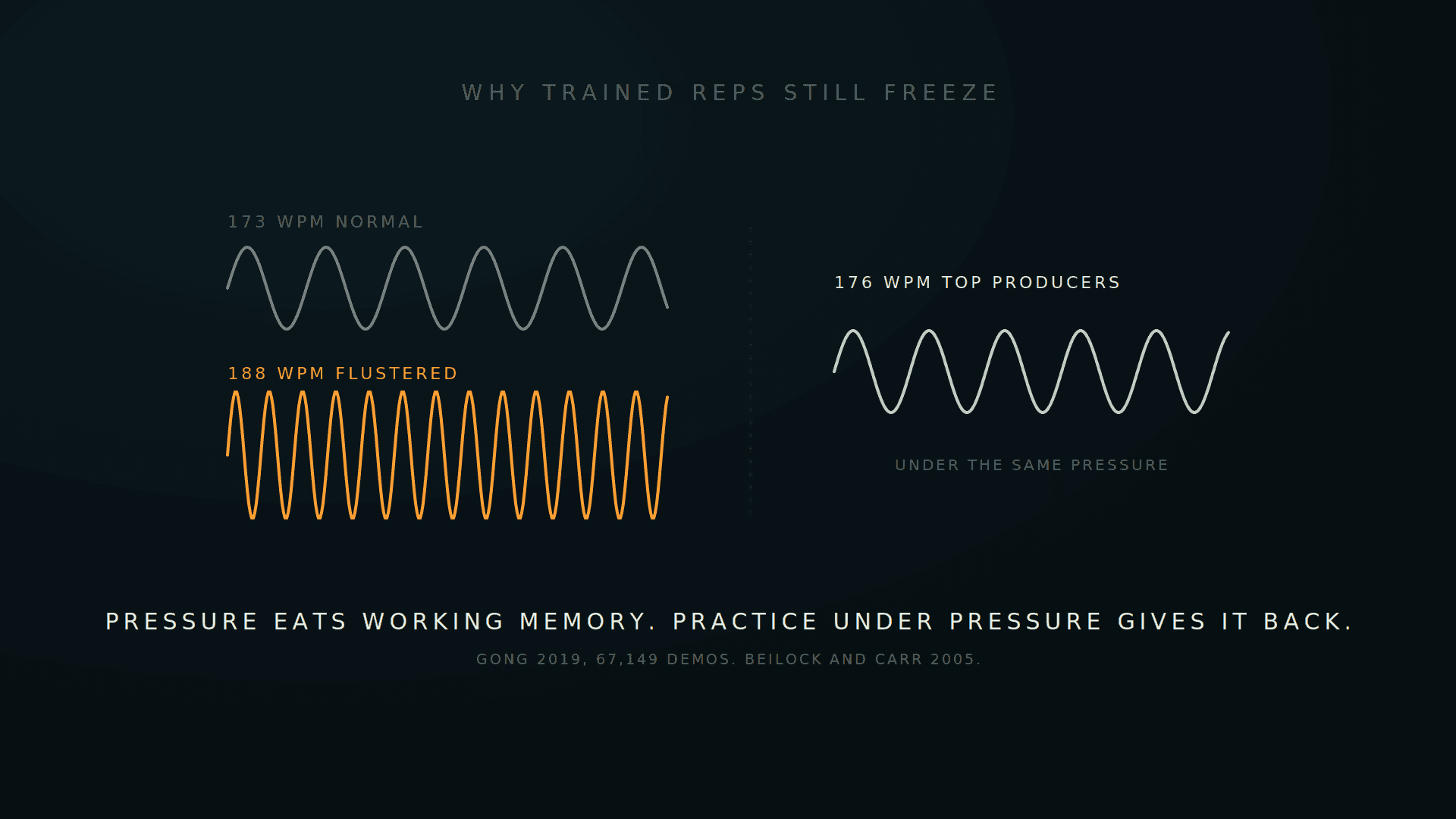
This is the Execution Gap: the rep has the knowledge and pressure blocks the execution. A trained rep and an untrained rep can sound identical at the moment the objection lands. Beilock and Carr also found, in 2001, that people who practised with someone watching choked less later. Friendly roleplay does not count.
One number you will see around this topic, "40% of salespeople experience call reluctance," has no primary source I could find. Treat it as unsourced.
What does good objection handling look like in the data?
Top reps pause longer, ask more questions and talk at a normal speed. That is the pattern, from the same 67,149 Gong demos.
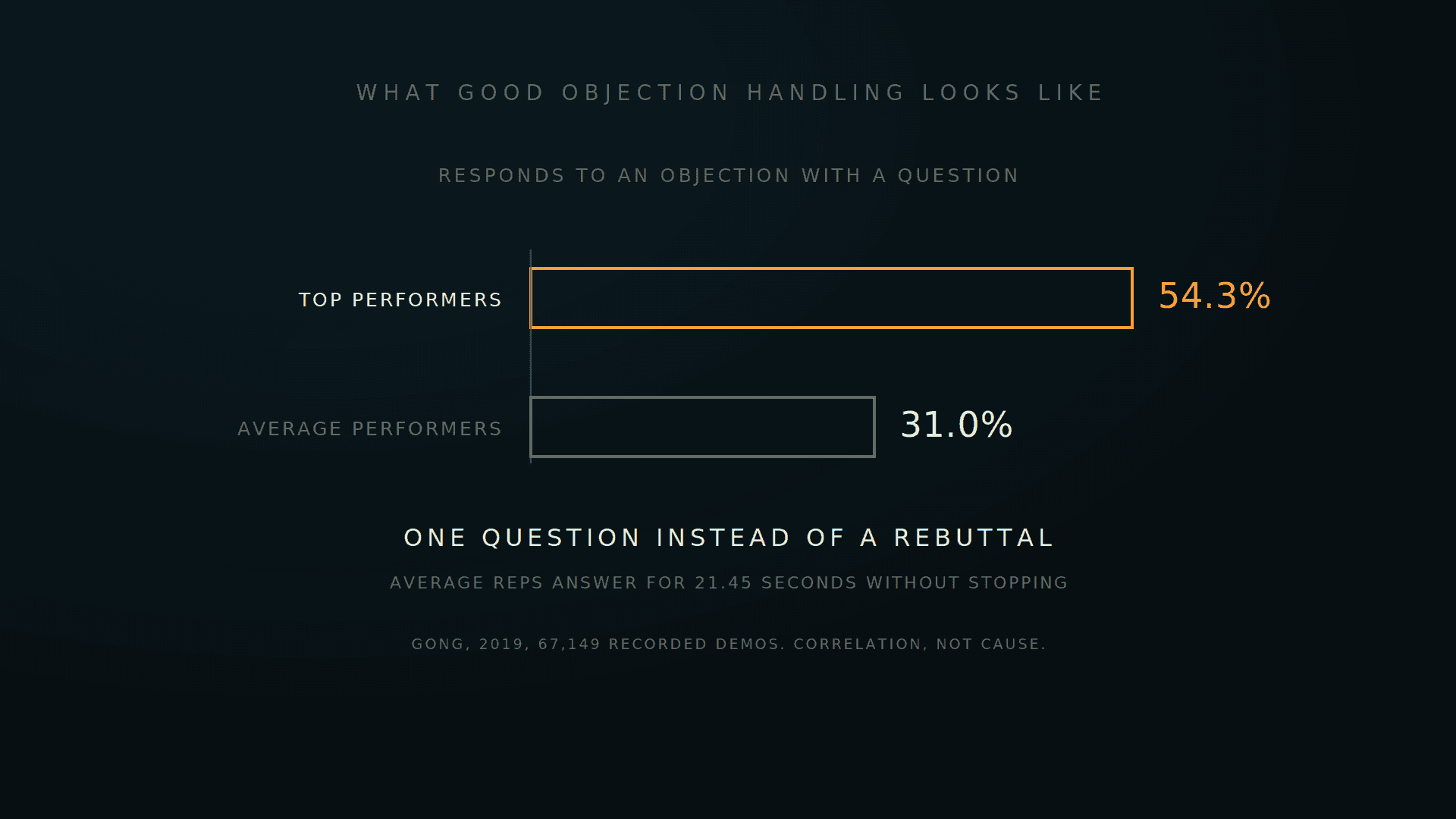
Top performers pause roughly five times longer after an objection than average performers. Gong published this as a chart caption without the seconds, so treat "roughly five times" as a shape, not a stopwatch reading. Top performers respond to an objection with a question 54.3% of the time; average performers, 31.0%. And top producers talk at about 176 words per minute after an objection, close to the normal 173 rather than the panicked 188.
The optimistic read: pause, ask, slow down, and you handle objections like the top decile. The skeptical read: correlational data from one vendor's customer base in 2019. Top reps may pause because they are calm, not calm because they pause. What the data does give you is the finished skill in behaviours you can count in a roleplay, which is exactly what a scoring rubric needs.
What to say when the objection lands is on the LAER framework and Feel-Felt-Found pages. This article is how to train it. The structure they share, acknowledge, clarify, respond, confirm, is what the drills break into parts.
Which objections should you drill first?
The ones your team actually hears, in the order they hear them. Not a generic list.
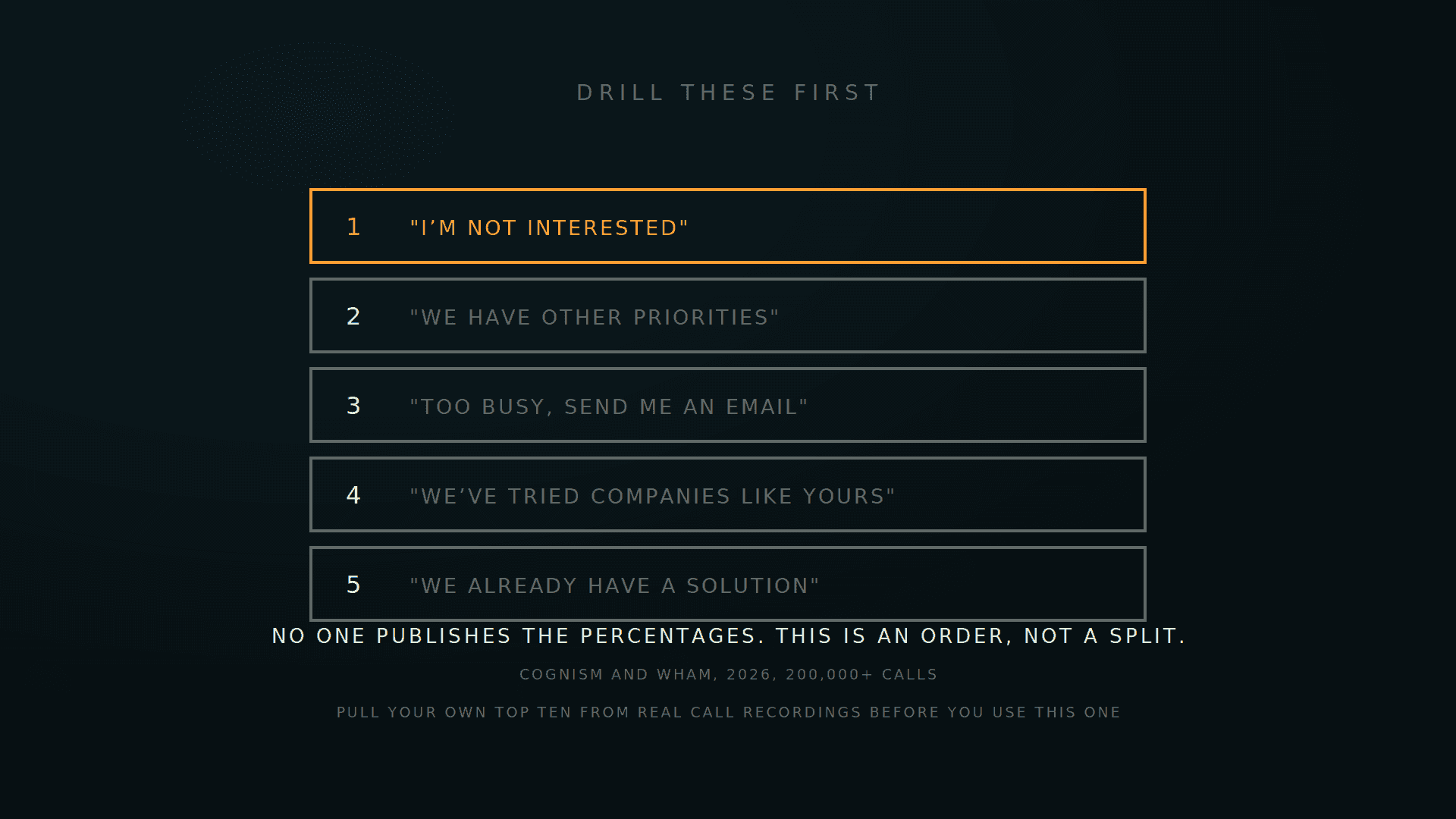
Cognism's 2026 cold calling report, built from more than 200,000 calls, ranks the most common objections as: "I'm not interested"; "we have other priorities"; "too busy, send me an email"; "we've tried businesses like yours"; and "we already have a solution." It ranks them without percentages. Nobody publishes objection frequency percentages, not Cognism, Gong or Chorus, so anyone quoting one is guessing.
The same report notes objections shifting toward "caution, mistrust, or shifting priorities" rather than outright rejection, which fits our piece on sales objections that aren't really objections: the words are a proxy, so drill diagnosis.
The better source is your own calls. A field team of more than a hundred sellers that piloted with us spent two to three weeks mapping fifteen key objections from real calls before running a single drill, and that heatmap became the training foundation. A German SaaS team wanted real objections from actual calls, not "random general objections." Pull your team's top ten from recordings, sort by call type, then drill. A UK healthcare sales director told us not to use one scorecard for "gatekeeper, negotiation, discovery calls," and he was right. If the drill does not know which call it is training for, neither will the rep.
What are the six objection handling drills?
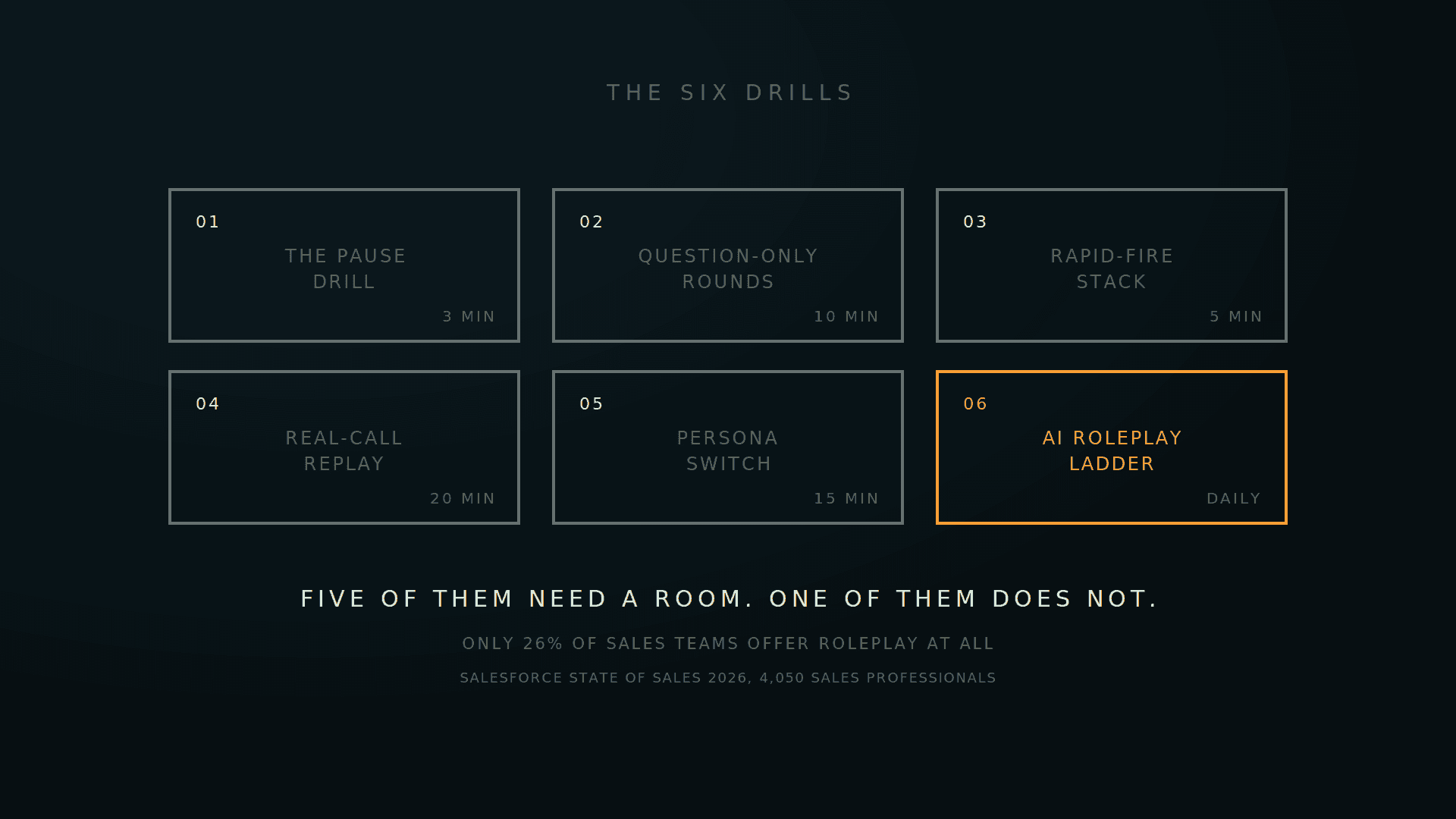
Six formats, one piece of the skill each. Run them in order for a new rep, mix them for a veteran. Start from the team's actual talk track, which is why this pairs with our guide to cold call scripts that work in 2026.
Drill 1: The Pause Drill
Format: One person plays the buyer and objects. The rep holds a full three-second silence before speaking. Count it aloud the first few rounds. Speak early, restart. Time: 10 minutes. Group size: Pairs, or one buyer and a rotating line of reps. What it trains: The pause before answering. It is the behaviour Gong ties most to top performers, and the one nobody drills because it feels stupid. Three seconds is long enough for working memory to catch up.
Drill 2: Question-Only Rounds
Format: Buyer objects. The rep may respond only with a question. Any statement ends the round. Ten objections, ten questions. Time: 15 minutes. Group size: Pairs, swapping roles halfway. What it trains: The clarify step, and the 54.3% question rate. Most reps have never answered an objection without a rebuttal. This forces the question first, by reflex.
Drill 3: Rapid-Fire Stack
Format: One buyer persona. Ten objections from the mapped list, back to back in five minutes. The rep runs the full loop each time: acknowledge, clarify, respond, confirm. Debrief at the end. Time: 5 minutes drilling, 10 minutes debrief. Group size: Threes: buyer, rep, scorer with the rubric. What it trains: Recovery. Real calls stack objections, and the rep who handles the first well often collapses on the third.
Drill 4: Real-Call Replay
Format: Play a recording of a real team call. Stop it the moment the buyer objects. A rep who was not on the call answers live. Then play the original. Compare. Time: 20 to 30 minutes. Group size: Whole team, up to eight. What it trains: Transfer. The objection and the tone are real, and the comparison stings in the way that builds resistance. It also fixes a problem a medical device sales leader named for us: reps "wouldn't come and tell me about a flat on their face call." Recordings do not need to.
Drill 5: Persona Switch
Format: Same objection, three buyers in a row: a skeptical CFO, a friendly champion with no authority, a distracted operator on a mobile. Time: 15 minutes. Group size: Pairs or threes, buyer rotating. What it trains: Diagnosis. "Send me an email" from a champion is a request. From a CFO it is a dismissal. For price, pair it with the price objections guide.
Drill 6: AI Roleplay Ladder
Format: The rep runs objection scenarios against an AI buyer, scored against the rubric below, difficulty rising as scores clear a threshold. Time: 10 to 15 minutes a day, alone. Group size: One. What it trains: Volume and spacing. The five drills above need a second human, so they happen rarely. The gap most teams hit is that objection handling practice needs to be daily and managers cannot run daily roleplay for fifteen people. That is the problem SecondBody was built to solve, by giving each rep an AI buyer that runs scored objection scenarios on demand and hands the manager a summary before the 1:1. A global adtech team runs it as a bootcamp module, "Objection Handling Direct," then five objection quests a week.
The honest limit: an AI buyer is not your hardest customer. It is a consistent one. A live CFO with a budget freeze will still be harder than the drill, which is what drilling is for.
How do you score objection handling?
Score behaviours, not outcomes. A roleplay has no real close, so "did they win" is meaningless. Count whether the rep did the five things the top decile does.
Most sales objection training never scores anything. If you score role-plays, use a scoring rubric the reps have seen. One point per line, built from the Gong behaviours above.
# | Behaviour | What it looks like | Source of the standard |
|---|---|---|---|
1 | Paused before answering | A clear beat of silence, no filler | Gong 2019: top reps pause roughly five times longer (no seconds given) |
2 | Acknowledged without agreeing | Named the concern back, did not concede it | LAER "acknowledge" step |
3 | Asked one clarifying question | A real question about the concern, before any pitch | Gong 2019: 54.3% vs 31.0% question rate |
4 | Answered in under 30 seconds | Tight, normal pace, no monologue | Gong: average knee-jerk response 21.45 seconds; top producers 176 wpm |
5 | Confirmed | Closed with some version of "does that make sense?" | Gong: star reps close the loop this way |
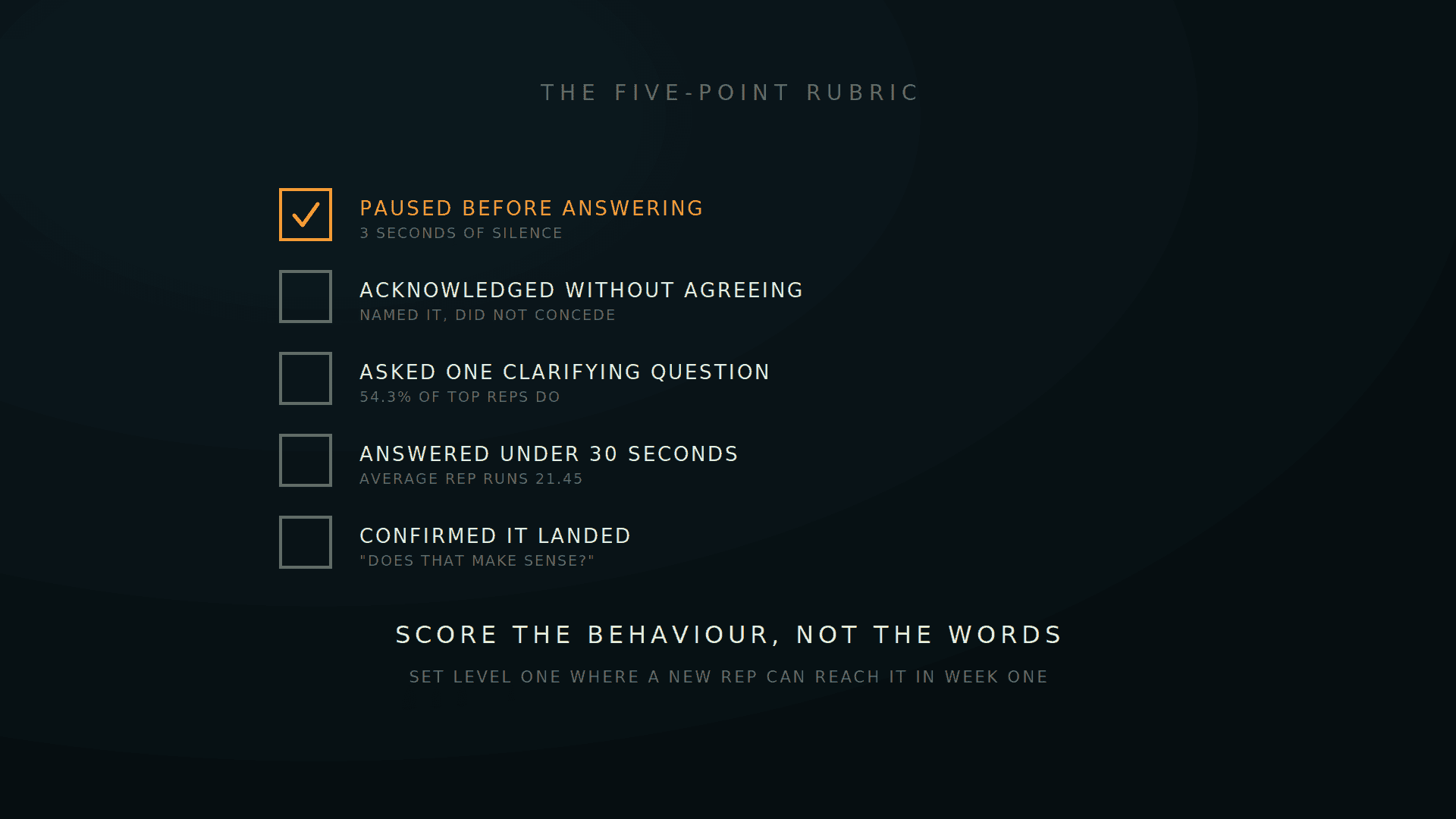
Five points per objection, fifty per Rapid-Fire Stack. Track the weekly average per rep. Three rules: one rubric per call type, publish it before the first drill (a secret standard feels like a trap), and make the top level reachable.
That last rule is the one that hurt. A UK healthcare team's reps were scored against transcripts of the team's best performer. One of them, after copying the phrasing almost word for word, told the director, "I've done two hours, and I'm getting threes, fours, fives." He knew the words. The words were not the skill, and the score would not move. The programme was paused. The director's view afterwards: progression should be reachable "within the first sort of six months." He was right. The mistake was ours as much as theirs. Distance from a genius is a demotivator. Five observable behaviours is a ladder.
What does a six-week objection handling training plan look like?
Six weeks, one focus per week, short sessions spread out rather than one long workshop. Cepeda and colleagues' 2006 meta-analysis found spaced learners retained 47.3% against 36.7% for massed, and only 12 of 271 comparisons showed no spacing benefit. A single workshop is the massed condition.
Week | Focus | Drills | Manager's job | What you should see |
|---|---|---|---|---|
1 | Map | None. Pull the top ten objections from recordings, by call type | Build the list, publish the rubric | A list every rep recognises |
2 | Pause and acknowledge | Pause Drill daily, 10 min. Rubric lines 1 and 2 | Run it in stand-up, count aloud | Reps stop talking over the objection |
3 | Clarify | Question-Only Rounds, three sessions. Persona Switch once | Score lines 1 to 3. Note who still pitches first | Question rate climbing |
4 | Clarify under load | Rapid-Fire Stack twice. Persona Switch once. AI Ladder begins, daily | Review AI scores before each 1:1 | Scores stable across ten objections |
5 | Transfer | Real-Call Replay, two sessions, full rubric | Pick the recordings. Debrief the comparison, not the person | Reps hear the gap between drill and call |
6 | Live | Live calls, manager listening. AI Ladder at a harder rung | Score three live objections per rep, same rubric | Live scores within a point of roleplay scores |
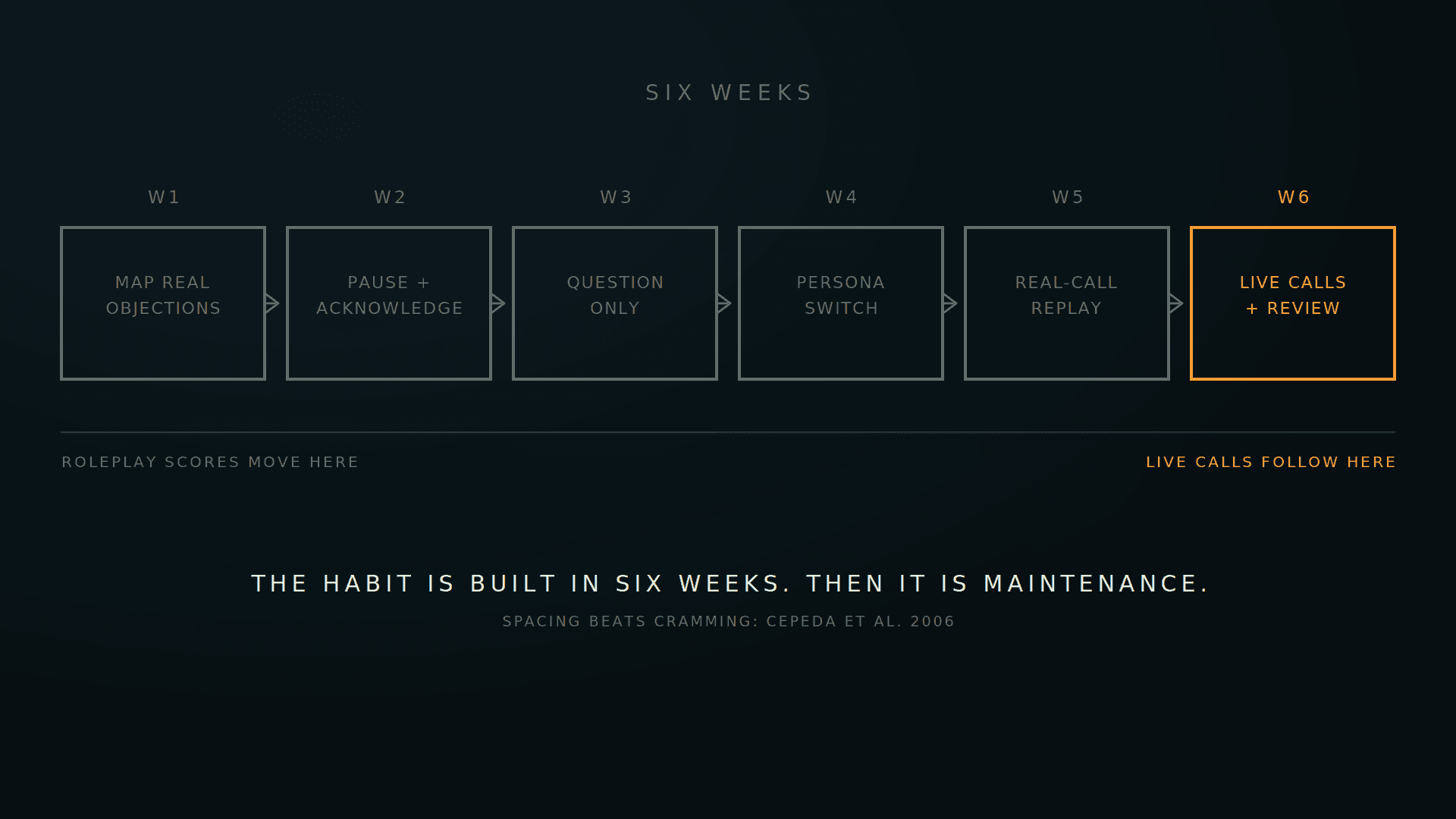
After week six the drills shrink: ten minutes a day on the ladder, one Real-Call Replay a fortnight, a re-map every quarter. Teams that reinforce continuously keep the skill. Teams that stop are back to 188 words a minute by next quarter.
Why does simulation work for this and not for product knowledge?
Because simulation trains what you do, and product knowledge is what you know. Objection handling is a doing skill.
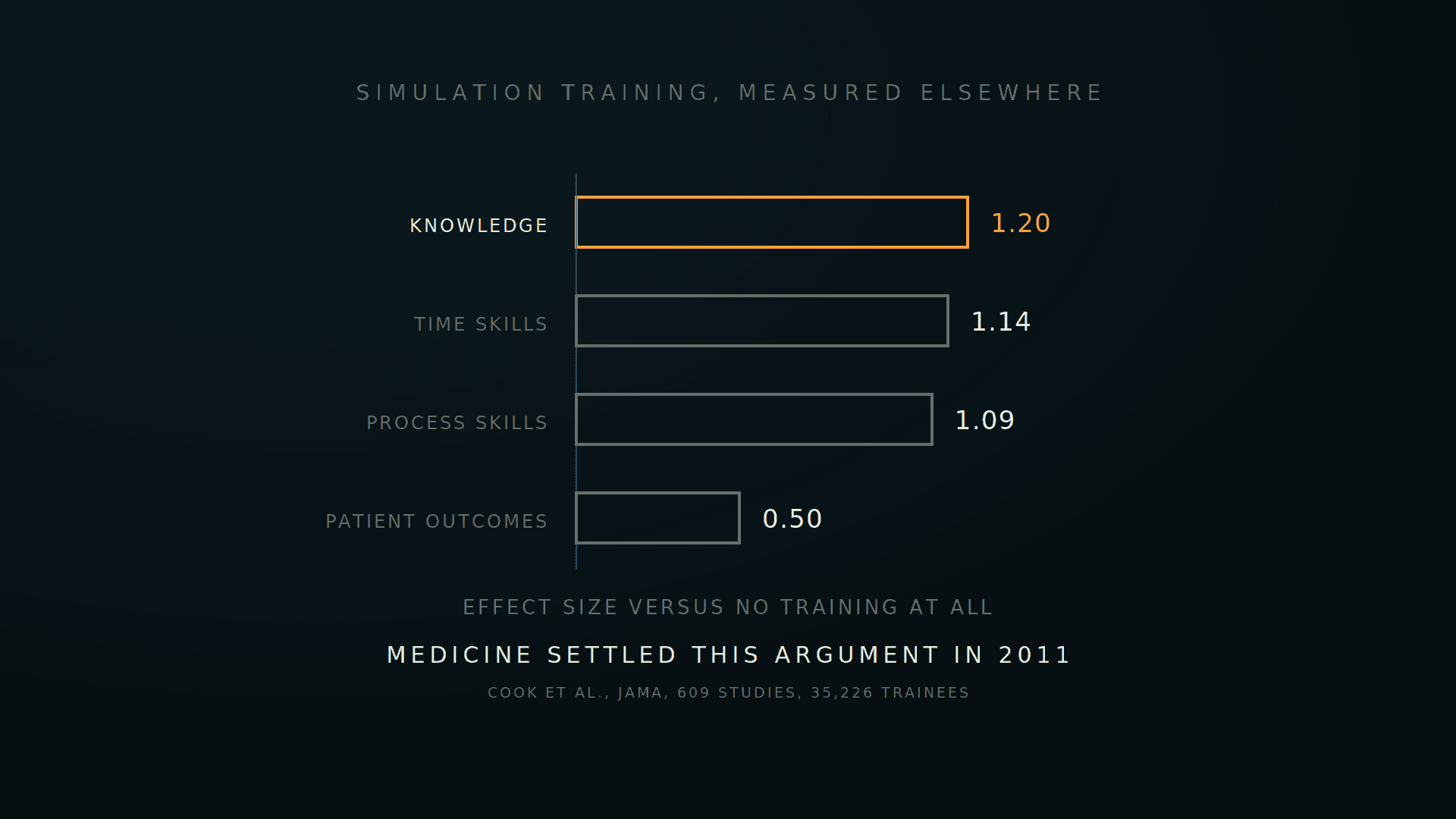
The strongest evidence is from outside sales. Cook and colleagues' 2011 meta-analysis in JAMA covered 609 studies and 35,226 trainees in medical education, simulation against no intervention. Pooled effect sizes: 1.20 for knowledge, 1.09 for process skills, 1.14 for time skills, about 0.8 for behaviours, 0.50 for patient outcomes. Above 0.8 is large.
The optimistic read: simulation is one of the most effective training methods ever measured. The skeptical read: this is medical education, with structured curricula and motivated trainees, and the effect on the outcome that matters most was the smallest at 0.50. Expect big gains in the roleplay, smaller in the pipeline. Still gains.
Now the gap. Salesforce's State of Sales 2026, a survey of 4,050 sales professionals in 22 countries, found roleplay sessions offered by 26% of teams, while 41% of reps say they do not get enough opportunities to roleplay before customer calls and 46% rarely get feedback on their sales conversations. Self-reported and vendor-run, but the pattern holds.
Our sales simulation page covers design principles, and the psychology of AI role play in sales training covers why a buyer that does not judge you changes how much you practise. The gap most teams hit is that they agree simulation works and then offer it once a quarter. That is the problem SecondBody was built to solve, by making it daily at a price that needs no budget line.
How do you coach objection handling from real calls?
Catch the objection in the moment and turn it into a question in front of the rep. Then let them do it next time.
The best example I have came from that UK healthcare director in March 2026. A buyer objected to a feature. Instead of defending it, the director asked, "Why do you need that fork? What does the fork represent to you?" The objection turned into discovery on the spot. His comment afterwards is the part I keep quoting: "We teach them during training to do it, but sometimes they need to learn through osmosis and watching you do it." Reps know the move. They need to see it survive contact.
Three habits. Listen to recordings, not to what the rep reports. Coach one behaviour per call, the lowest-scoring rubric line. Then send the rep back into the drill that trains that line, not into a conversation about it. The gap most teams hit is that the manager can hear the flub but cannot make the rep repeat the moment. That is the problem SecondBody was built to solve, by turning the flub into a scenario the rep runs again that afternoon, with coaching feedback on each attempt.
What are the common mistakes managers make?
Six, and I have made at least four of them.
Teaching rebuttals, not behaviour. The rebuttal document is the easiest thing to produce and the least likely to survive a live call.
One drill session, then nothing. A January workshop is the massed condition Cepeda measured. By March it is gone.
Same rubric for every call type. A gatekeeper at second one and a procurement lead at week six are different sports.
Scoring reps against top-performer transcripts on day one. The mistake that paused a programme. Measure five reachable behaviours, not distance from your best rep.
Never re-mapping objections. Cognism's data shows objections shifting from rejection toward caution and mistrust. A 2024 list drills for a buyer who has moved on.
Letting AEs skip it. A MySalesCoach and Aircall 2025 survey of more than 1,600 people found account executives 50% less likely than SDRs to get frequent coaching, just as the objections get harder. Put the AEs in the Rapid-Fire Stack. They will hate it.
Frequently asked questions
What is objection handling training?
Drilling sales reps to respond to buyer pushback calmly, with a question before a rebuttal, until the behaviour is automatic. A skill programme, not a document. Definition at what is objection handling.
What are the most common sales objections?
Cognism's 2026 ranking: "I'm not interested"; "we have other priorities"; "too busy, send me an email"; "we've tried businesses like yours"; "we already have a solution." No percentages exist. Answers are on the LAER framework page.
How do you train reps to handle "not interested"?
Pause Drill, then Question-Only Rounds, so the reflex is silence and a question. Then Persona Switch, because "not interested" from a gatekeeper and from a decision-maker need different reads. For the words, use LAER.
How often should you run objection handling roleplay?
Daily if you can, three times a week at minimum, ten to fifteen minutes a session. Spaced practice retained 47.3% against 36.7% for massed in Cepeda's 2006 meta-analysis.
What is a good objection handling framework?
LAER: Listen, Acknowledge, Explore, Respond. It maps onto the rubric above. Feel-Felt-Found is a second option for emotional objections. See LAER and Feel-Felt-Found.
Does AI roleplay work for objection handling?
The best evidence for simulation is medical education, where Cook's 2011 JAMA meta-analysis found large effect sizes for skills. Sales has no equivalent study yet. What AI roleplay clearly does is remove the scheduling problem: reps drill daily without a manager.
How long does objection handling training take?
Six weeks to build the habit, then maintenance. Roleplay scores move within two to three weeks; live calls follow by week five or six.
Does SecondBody use our real objections?
Yes. Scenarios are built from the objections your team actually hears. The German SaaS team that asked for "real objections from actual calls, not random general objections" was describing this.
How does SecondBody score objection handling?
Rory, the AI coach, scores each attempt against observable behaviours, with methodology-native scoring for SPIN, MEDDIC or Sandler where those apply. Scores are tracked over time, so a rep sees the line move.
Can managers see rep scores over time?
Yes. Managers get a briefing before each 1:1 showing where each rep sits on the rubric and where scores stalled. Pro is $30 per user per month, unlimited seats, public pricing. Book a demo to see it.
Where does the Execution Gap close?
In the three seconds before the answer. Everything above trains those three seconds.
The Execution Gap is the distance between what a rep knows and what a rep does when a buyer pushes back. Rebuttal lists shrink the knowledge side and leave the gap where it is. Drills work on the doing side: the pause, the question, the normal pace, the confirmation. Score those, run them daily, map them to your real objections, and the gap narrows in a way you can measure by week three and hear by week six.
The cold calling training for sales teams guide covers everything around the objection. If you want the drills to run without you in the room, that is SecondBody: reps practise against Rory on WhatsApp, phone or browser, scored on the behaviours above, and you get the summary before the 1:1. The objection handling training page has the detail, and there is a tier you can start with today.
Good luck out there.
How we know this: we build an AI sales practice platform, we sat in the customer calls quoted below, and we checked every number in this article at its source.
Your reps already know the answer to "we're happy with our current vendor." They could write it on a whiteboard. Then a buyer says it on a live call, and that rep starts talking at 188 words a minute and does not stop for twenty seconds. That is the problem with objection handling training as most teams run it. It teaches answers. The failure is in the three seconds before the answer.
This is for the manager or enablement lead who has to design the training. It is not a list of rebuttals; those pages are live and linked wherever one would otherwise appear. This is a drill book: six objection handling drills with format, time and group size, a five-point scoring rubric built from call data, a six-week plan, and the manager mistakes I have watched.
We build one of these, so read on with that in mind. We will be harder on the category than anyone.
(Scanning this? Every section is a question. Jump to whichever one you actually have.)
What is objection handling training?
Objection handling definition, in two lines: objection handling is what a rep does in the moment a buyer pushes back. Objection handling training is the practice of drilling reps to respond to that pushback calmly, with a question rather than a speech, until the calm and the question are automatic.
That last word is the one most programmes skip. In practice, "objection handling training for sales reps" means a rebuttal document and a lunch-and-learn. Everyone nods. Then the phones go live and the document is nowhere.
Knowing the rebuttal is knowledge. Delivering it while your stomach drops is a behavioral skill, built through repeated role-play, not reading. Treat it like a free throw: a thousand bad ones so the one that counts goes in. Definition at what is objection handling; this is the training piece, part of our guide to cold calling training for sales teams.
Why do trained reps still freeze on objections?
Because pressure eats working memory, and objection handling runs on working memory. Beilock and Carr showed this in a 2005 lab study in Psychological Science: under pressure, performance on working-memory tasks drops, most for people with the highest capacity. Your smartest rep is the most exposed.
Now real calls. Gong analysed 67,149 recorded demos in 2019 and found the average rep talks at about 173 words per minute. Hit them with an objection and the flustered ones speed up to 188. In the same dataset, the average rep's knee-jerk response to an objection runs 21.45 seconds of monologue. That is what fear sounds like on a phone, and the buyer hears it too.
This is the Execution Gap: the rep has the knowledge and pressure blocks the execution. A trained rep and an untrained rep can sound identical at the moment the objection lands. Beilock and Carr also found, in 2001, that people who practised with someone watching choked less later. Friendly roleplay does not count.
One number you will see around this topic, "40% of salespeople experience call reluctance," has no primary source I could find. Treat it as unsourced.
What does good objection handling look like in the data?
Top reps pause longer, ask more questions and talk at a normal speed. That is the pattern, from the same 67,149 Gong demos.
Top performers pause roughly five times longer after an objection than average performers. Gong published this as a chart caption without the seconds, so treat "roughly five times" as a shape, not a stopwatch reading. Top performers respond to an objection with a question 54.3% of the time; average performers, 31.0%. And top producers talk at about 176 words per minute after an objection, close to the normal 173 rather than the panicked 188.
The optimistic read: pause, ask, slow down, and you handle objections like the top decile. The skeptical read: correlational data from one vendor's customer base in 2019. Top reps may pause because they are calm, not calm because they pause. What the data does give you is the finished skill in behaviours you can count in a roleplay, which is exactly what a scoring rubric needs.
What to say when the objection lands is on the LAER framework and Feel-Felt-Found pages. This article is how to train it. The structure they share, acknowledge, clarify, respond, confirm, is what the drills break into parts.
Which objections should you drill first?
The ones your team actually hears, in the order they hear them. Not a generic list.
Cognism's 2026 cold calling report, built from more than 200,000 calls, ranks the most common objections as: "I'm not interested"; "we have other priorities"; "too busy, send me an email"; "we've tried businesses like yours"; and "we already have a solution." It ranks them without percentages. Nobody publishes objection frequency percentages, not Cognism, Gong or Chorus, so anyone quoting one is guessing.
The same report notes objections shifting toward "caution, mistrust, or shifting priorities" rather than outright rejection, which fits our piece on sales objections that aren't really objections: the words are a proxy, so drill diagnosis.
The better source is your own calls. A field team of more than a hundred sellers that piloted with us spent two to three weeks mapping fifteen key objections from real calls before running a single drill, and that heatmap became the training foundation. A German SaaS team wanted real objections from actual calls, not "random general objections." Pull your team's top ten from recordings, sort by call type, then drill. A UK healthcare sales director told us not to use one scorecard for "gatekeeper, negotiation, discovery calls," and he was right. If the drill does not know which call it is training for, neither will the rep.
What are the six objection handling drills?
Six formats, one piece of the skill each. Run them in order for a new rep, mix them for a veteran. Start from the team's actual talk track, which is why this pairs with our guide to cold call scripts that work in 2026.
Drill 1: The Pause Drill
Format: One person plays the buyer and objects. The rep holds a full three-second silence before speaking. Count it aloud the first few rounds. Speak early, restart. Time: 10 minutes. Group size: Pairs, or one buyer and a rotating line of reps. What it trains: The pause before answering. It is the behaviour Gong ties most to top performers, and the one nobody drills because it feels stupid. Three seconds is long enough for working memory to catch up.
Drill 2: Question-Only Rounds
Format: Buyer objects. The rep may respond only with a question. Any statement ends the round. Ten objections, ten questions. Time: 15 minutes. Group size: Pairs, swapping roles halfway. What it trains: The clarify step, and the 54.3% question rate. Most reps have never answered an objection without a rebuttal. This forces the question first, by reflex.
Drill 3: Rapid-Fire Stack
Format: One buyer persona. Ten objections from the mapped list, back to back in five minutes. The rep runs the full loop each time: acknowledge, clarify, respond, confirm. Debrief at the end. Time: 5 minutes drilling, 10 minutes debrief. Group size: Threes: buyer, rep, scorer with the rubric. What it trains: Recovery. Real calls stack objections, and the rep who handles the first well often collapses on the third.
Drill 4: Real-Call Replay
Format: Play a recording of a real team call. Stop it the moment the buyer objects. A rep who was not on the call answers live. Then play the original. Compare. Time: 20 to 30 minutes. Group size: Whole team, up to eight. What it trains: Transfer. The objection and the tone are real, and the comparison stings in the way that builds resistance. It also fixes a problem a medical device sales leader named for us: reps "wouldn't come and tell me about a flat on their face call." Recordings do not need to.
Drill 5: Persona Switch
Format: Same objection, three buyers in a row: a skeptical CFO, a friendly champion with no authority, a distracted operator on a mobile. Time: 15 minutes. Group size: Pairs or threes, buyer rotating. What it trains: Diagnosis. "Send me an email" from a champion is a request. From a CFO it is a dismissal. For price, pair it with the price objections guide.
Drill 6: AI Roleplay Ladder
Format: The rep runs objection scenarios against an AI buyer, scored against the rubric below, difficulty rising as scores clear a threshold. Time: 10 to 15 minutes a day, alone. Group size: One. What it trains: Volume and spacing. The five drills above need a second human, so they happen rarely. The gap most teams hit is that objection handling practice needs to be daily and managers cannot run daily roleplay for fifteen people. That is the problem SecondBody was built to solve, by giving each rep an AI buyer that runs scored objection scenarios on demand and hands the manager a summary before the 1:1. A global adtech team runs it as a bootcamp module, "Objection Handling Direct," then five objection quests a week.
The honest limit: an AI buyer is not your hardest customer. It is a consistent one. A live CFO with a budget freeze will still be harder than the drill, which is what drilling is for.
How do you score objection handling?
Score behaviours, not outcomes. A roleplay has no real close, so "did they win" is meaningless. Count whether the rep did the five things the top decile does.
Most sales objection training never scores anything. If you score role-plays, use a scoring rubric the reps have seen. One point per line, built from the Gong behaviours above.
# | Behaviour | What it looks like | Source of the standard |
|---|---|---|---|
1 | Paused before answering | A clear beat of silence, no filler | Gong 2019: top reps pause roughly five times longer (no seconds given) |
2 | Acknowledged without agreeing | Named the concern back, did not concede it | LAER "acknowledge" step |
3 | Asked one clarifying question | A real question about the concern, before any pitch | Gong 2019: 54.3% vs 31.0% question rate |
4 | Answered in under 30 seconds | Tight, normal pace, no monologue | Gong: average knee-jerk response 21.45 seconds; top producers 176 wpm |
5 | Confirmed | Closed with some version of "does that make sense?" | Gong: star reps close the loop this way |
Five points per objection, fifty per Rapid-Fire Stack. Track the weekly average per rep. Three rules: one rubric per call type, publish it before the first drill (a secret standard feels like a trap), and make the top level reachable.
That last rule is the one that hurt. A UK healthcare team's reps were scored against transcripts of the team's best performer. One of them, after copying the phrasing almost word for word, told the director, "I've done two hours, and I'm getting threes, fours, fives." He knew the words. The words were not the skill, and the score would not move. The programme was paused. The director's view afterwards: progression should be reachable "within the first sort of six months." He was right. The mistake was ours as much as theirs. Distance from a genius is a demotivator. Five observable behaviours is a ladder.
What does a six-week objection handling training plan look like?
Six weeks, one focus per week, short sessions spread out rather than one long workshop. Cepeda and colleagues' 2006 meta-analysis found spaced learners retained 47.3% against 36.7% for massed, and only 12 of 271 comparisons showed no spacing benefit. A single workshop is the massed condition.
Week | Focus | Drills | Manager's job | What you should see |
|---|---|---|---|---|
1 | Map | None. Pull the top ten objections from recordings, by call type | Build the list, publish the rubric | A list every rep recognises |
2 | Pause and acknowledge | Pause Drill daily, 10 min. Rubric lines 1 and 2 | Run it in stand-up, count aloud | Reps stop talking over the objection |
3 | Clarify | Question-Only Rounds, three sessions. Persona Switch once | Score lines 1 to 3. Note who still pitches first | Question rate climbing |
4 | Clarify under load | Rapid-Fire Stack twice. Persona Switch once. AI Ladder begins, daily | Review AI scores before each 1:1 | Scores stable across ten objections |
5 | Transfer | Real-Call Replay, two sessions, full rubric | Pick the recordings. Debrief the comparison, not the person | Reps hear the gap between drill and call |
6 | Live | Live calls, manager listening. AI Ladder at a harder rung | Score three live objections per rep, same rubric | Live scores within a point of roleplay scores |
After week six the drills shrink: ten minutes a day on the ladder, one Real-Call Replay a fortnight, a re-map every quarter. Teams that reinforce continuously keep the skill. Teams that stop are back to 188 words a minute by next quarter.
Why does simulation work for this and not for product knowledge?
Because simulation trains what you do, and product knowledge is what you know. Objection handling is a doing skill.
The strongest evidence is from outside sales. Cook and colleagues' 2011 meta-analysis in JAMA covered 609 studies and 35,226 trainees in medical education, simulation against no intervention. Pooled effect sizes: 1.20 for knowledge, 1.09 for process skills, 1.14 for time skills, about 0.8 for behaviours, 0.50 for patient outcomes. Above 0.8 is large.
The optimistic read: simulation is one of the most effective training methods ever measured. The skeptical read: this is medical education, with structured curricula and motivated trainees, and the effect on the outcome that matters most was the smallest at 0.50. Expect big gains in the roleplay, smaller in the pipeline. Still gains.
Now the gap. Salesforce's State of Sales 2026, a survey of 4,050 sales professionals in 22 countries, found roleplay sessions offered by 26% of teams, while 41% of reps say they do not get enough opportunities to roleplay before customer calls and 46% rarely get feedback on their sales conversations. Self-reported and vendor-run, but the pattern holds.
Our sales simulation page covers design principles, and the psychology of AI role play in sales training covers why a buyer that does not judge you changes how much you practise. The gap most teams hit is that they agree simulation works and then offer it once a quarter. That is the problem SecondBody was built to solve, by making it daily at a price that needs no budget line.
How do you coach objection handling from real calls?
Catch the objection in the moment and turn it into a question in front of the rep. Then let them do it next time.
The best example I have came from that UK healthcare director in March 2026. A buyer objected to a feature. Instead of defending it, the director asked, "Why do you need that fork? What does the fork represent to you?" The objection turned into discovery on the spot. His comment afterwards is the part I keep quoting: "We teach them during training to do it, but sometimes they need to learn through osmosis and watching you do it." Reps know the move. They need to see it survive contact.
Three habits. Listen to recordings, not to what the rep reports. Coach one behaviour per call, the lowest-scoring rubric line. Then send the rep back into the drill that trains that line, not into a conversation about it. The gap most teams hit is that the manager can hear the flub but cannot make the rep repeat the moment. That is the problem SecondBody was built to solve, by turning the flub into a scenario the rep runs again that afternoon, with coaching feedback on each attempt.
What are the common mistakes managers make?
Six, and I have made at least four of them.
Teaching rebuttals, not behaviour. The rebuttal document is the easiest thing to produce and the least likely to survive a live call.
One drill session, then nothing. A January workshop is the massed condition Cepeda measured. By March it is gone.
Same rubric for every call type. A gatekeeper at second one and a procurement lead at week six are different sports.
Scoring reps against top-performer transcripts on day one. The mistake that paused a programme. Measure five reachable behaviours, not distance from your best rep.
Never re-mapping objections. Cognism's data shows objections shifting from rejection toward caution and mistrust. A 2024 list drills for a buyer who has moved on.
Letting AEs skip it. A MySalesCoach and Aircall 2025 survey of more than 1,600 people found account executives 50% less likely than SDRs to get frequent coaching, just as the objections get harder. Put the AEs in the Rapid-Fire Stack. They will hate it.
Frequently asked questions
What is objection handling training?
Drilling sales reps to respond to buyer pushback calmly, with a question before a rebuttal, until the behaviour is automatic. A skill programme, not a document. Definition at what is objection handling.
What are the most common sales objections?
Cognism's 2026 ranking: "I'm not interested"; "we have other priorities"; "too busy, send me an email"; "we've tried businesses like yours"; "we already have a solution." No percentages exist. Answers are on the LAER framework page.
How do you train reps to handle "not interested"?
Pause Drill, then Question-Only Rounds, so the reflex is silence and a question. Then Persona Switch, because "not interested" from a gatekeeper and from a decision-maker need different reads. For the words, use LAER.
How often should you run objection handling roleplay?
Daily if you can, three times a week at minimum, ten to fifteen minutes a session. Spaced practice retained 47.3% against 36.7% for massed in Cepeda's 2006 meta-analysis.
What is a good objection handling framework?
LAER: Listen, Acknowledge, Explore, Respond. It maps onto the rubric above. Feel-Felt-Found is a second option for emotional objections. See LAER and Feel-Felt-Found.
Does AI roleplay work for objection handling?
The best evidence for simulation is medical education, where Cook's 2011 JAMA meta-analysis found large effect sizes for skills. Sales has no equivalent study yet. What AI roleplay clearly does is remove the scheduling problem: reps drill daily without a manager.
How long does objection handling training take?
Six weeks to build the habit, then maintenance. Roleplay scores move within two to three weeks; live calls follow by week five or six.
Does SecondBody use our real objections?
Yes. Scenarios are built from the objections your team actually hears. The German SaaS team that asked for "real objections from actual calls, not random general objections" was describing this.
How does SecondBody score objection handling?
Rory, the AI coach, scores each attempt against observable behaviours, with methodology-native scoring for SPIN, MEDDIC or Sandler where those apply. Scores are tracked over time, so a rep sees the line move.
Can managers see rep scores over time?
Yes. Managers get a briefing before each 1:1 showing where each rep sits on the rubric and where scores stalled. Pro is $30 per user per month, unlimited seats, public pricing. Book a demo to see it.
Where does the Execution Gap close?
In the three seconds before the answer. Everything above trains those three seconds.
The Execution Gap is the distance between what a rep knows and what a rep does when a buyer pushes back. Rebuttal lists shrink the knowledge side and leave the gap where it is. Drills work on the doing side: the pause, the question, the normal pace, the confirmation. Score those, run them daily, map them to your real objections, and the gap narrows in a way you can measure by week three and hear by week six.
The cold calling training for sales teams guide covers everything around the objection. If you want the drills to run without you in the room, that is SecondBody: reps practise against Rory on WhatsApp, phone or browser, scored on the behaviours above, and you get the summary before the 1:1. The objection handling training page has the detail, and there is a tier you can start with today.
Good luck out there.
The failure is in the three seconds before the answer.
Drill objections against Rory until the pause, the question and the pace are reflexes, then see the rubric score for every rep.


SecondBody is the AI sales practice platform built for field, regulated, and enterprise sales teams. Voice-first practice with Rory, your AI coach. Pre-call practice, not post-call analysis. Pre-1:1 manager briefings. Unlimited seats at $30 per user per month. Built in Paris. SOC 2 compliant.
Related reading: Cold Calling Training for Sales Teams · Cold Call Scripts That Work in 2026 · Objection Handling Practice · What is Objection Handling?
Share this article