Back
AI Sales Roleplay Scenarios: Objection Handling, Discount Pushback, Cold Calls and Demo Practice
AI sales roleplay scenarios for objection handling, discount pushback, cold calls and SaaS demos, with beginner scenarios and scoring rubrics.

Posted by
SecondBody.ai
Published by
Last Updated
AI sales roleplay scenarios are scripted buyer situations, such as a cold call brush-off, a discount demand or a demo that goes sideways, that a rep practices out loud against an AI buyer until the response holds under pressure. The best AI roleplay for objection handling uses your real objections, raises the difficulty as reps improve, and scores every attempt against your methodology. This guide gives you the scenario library we'd build first, and how to run each one.
Key answers, up front
Best AI-driven roleplay for objection handling: one that uses your real objections, lets the buyer push twice, and scores the recovery, not just the first answer. SecondBody builds scenarios from your objection library and uploaded calls, from $75/month.
Practicing discount pushback before live calls: run a procurement persona that asks for 20% off in the first two minutes, and score whether the rep trades instead of caves.
Best role play scenarios for beginners: the cold open, "send me an email," "we're happy with our current vendor," the gatekeeper, and asking for the next step.
Cold call practice with AI: 90-second scenarios with an interruption in the first 15 seconds. Five attempts a morning beats one hour on Friday.
SaaS demo and qualification practice: a buyer who interrupts the demo to ask about price, integrations or a competitor, scored on whether the rep qualifies before pitching.
A reusable scenario library across regions: one master scenario, translated personas and local objections, same scoring everywhere.
This is a cluster article. The hub is our guide to AI sales roleplay training. For the tool shortlist, see AI sales roleplay tools. For scenarios by sector, see AI roleplay training by industry.
What makes a good AI sales roleplay scenario?
A good AI sales roleplay scenario has five parts: a specific buyer, a specific goal for the rep, one or two objections the buyer will raise, a difficulty level, and a scoring rubric. Miss any one and the scenario turns into a chat.
Here's what nobody says out loud: most scenario libraries are written by people who have never lost a deal to that objection. So the buyer raises it once, politely, and accepts the first half-decent answer. Real buyers don't do that. They repeat the objection in a different shape. "It's too expensive" comes back as "we don't have budget this quarter," then as "let me see what else is out there." The scenario has to do the same, or the rep only learns the first move.
The five parts in practice:
The buyer. Not "a CFO." A CFO at a 400-person logistics company who got burned by a software rollout last year and has twelve minutes.
The rep's goal. Book the meeting. Get the second stakeholder. Hold the price. One clear win condition.
The objection. Pulled from your lost deals, worded the way your buyers word it.
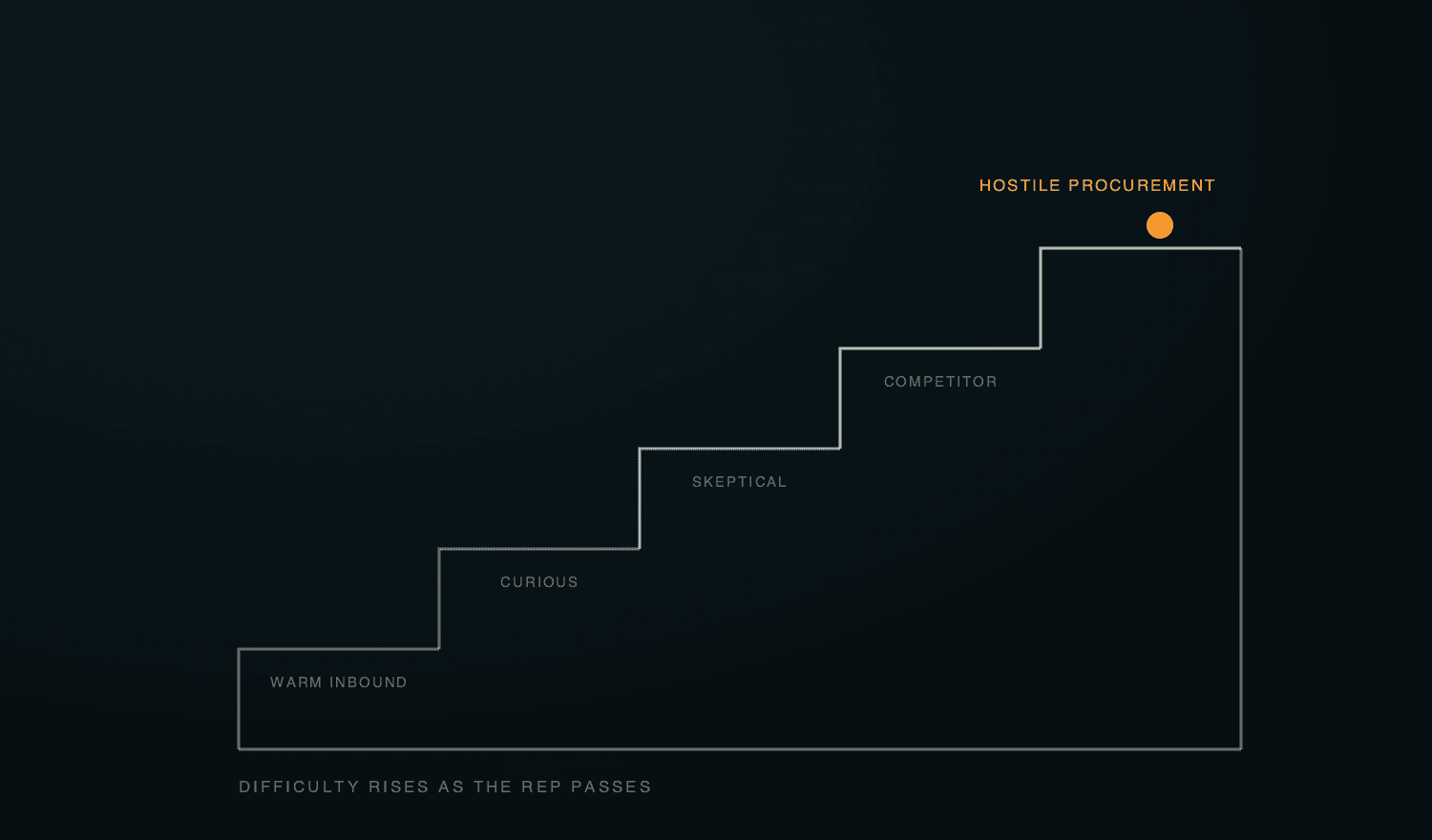
The difficulty. Level one repeats the objection once. Level three stacks it with a competitor mention and a time squeeze.
The rubric. What a great answer does: acknowledge, ask, reframe, confirm. Scored the same way for every rep.
SecondBody builds these from what you already have: your objection library, your playbook and, on team plans, your uploaded sales calls. A manager can have a new scenario live in minutes, which matters more than it sounds, because the scenarios that get built are the ones that get practiced.
What are the best AI-driven roleplay platforms for objection handling?
The best AI-driven roleplay platforms for objection handling let the buyer object more than once, score the recovery, and use objections from your own calls. Platforms that fire one objection and accept the first answer train reps to survive the easy version.
What to look for, in order:
Multi-turn objections. The buyer should push back on the rep's answer, not just the pitch.
Your objections. An uploaded objection library, or scenarios built from your call recordings.
Recovery scoring. Did the rep acknowledge, ask a question, and move the call forward? A score on the recovery, not only the words.
Voice. Objections hit differently out loud. The stomach drops. That's the moment you're training.
Frequency. An objection you practice once a quarter is an objection you'll freeze on in the field.
The gap most teams hit is that reps know the textbook answer and still freeze when the buyer says it for real. That's the problem SecondBody was built to solve, by having Rory throw the objection at the rep by voice, twice a day, until the recovery is automatic.
For the frameworks behind good answers, read the LAER framework for objection handling and feel, felt, found. For drills a manager can run live, see objection handling training drills.
What role play scenarios should beginners start with in 2026?
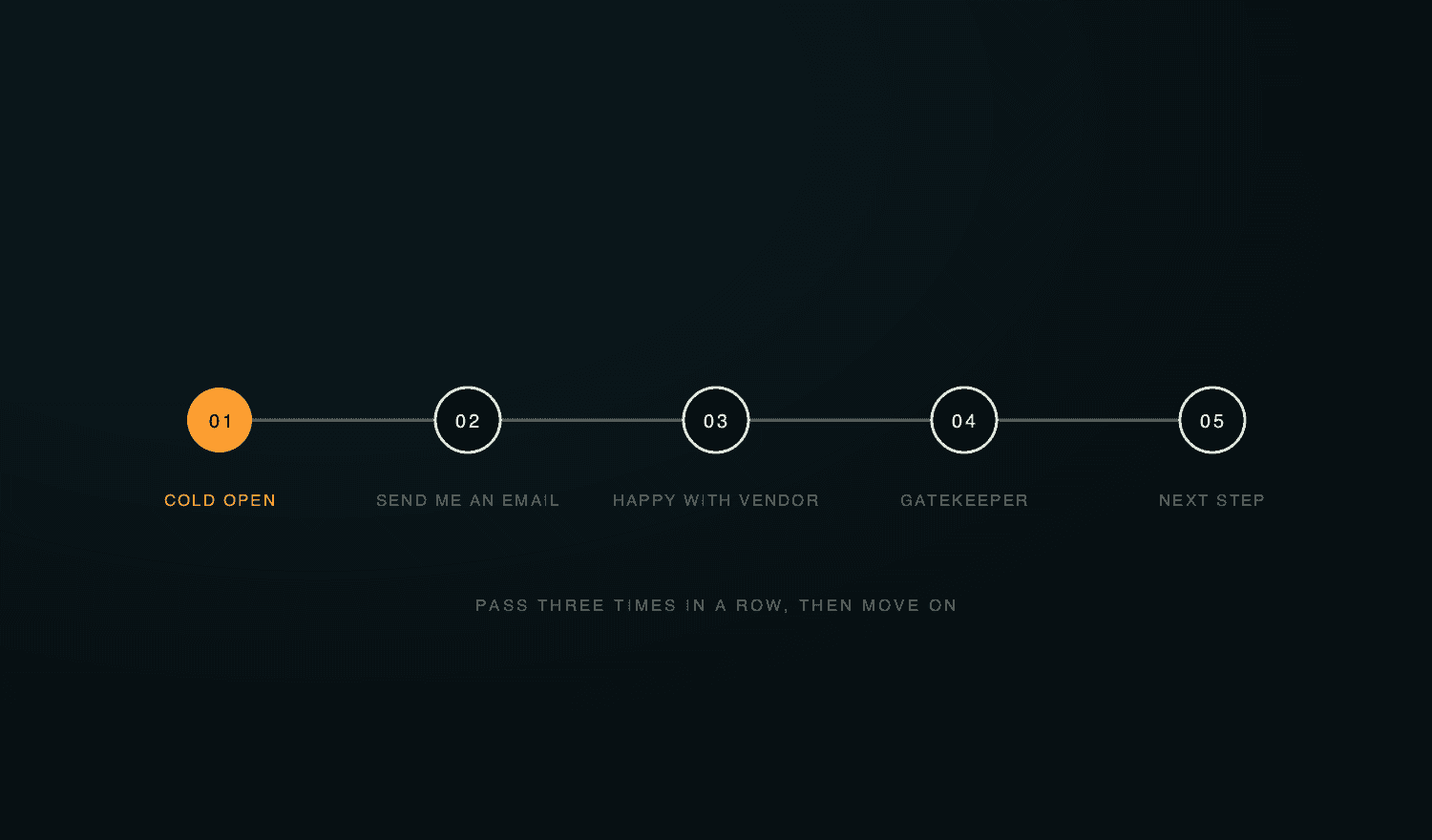
Beginners should start with five scenarios: the cold open, "send me an email," "we're happy with our current vendor," the gatekeeper, and asking for the next step. These make up most of the conversations a new rep has in the first month, and each one can be practiced in under three minutes.
1. The cold open
Buyer: a busy director who picks up by accident. Goal: earn 30 more seconds. What good looks like: say who you are, why them, and ask permission, in one breath. Common fail: a long intro about your company before the buyer knows why they should care.
2. "Send me an email"
Buyer: polite, already reaching for the hang-up button. Goal: turn the brush-off into a real question. What good looks like: "Happy to. So I send something useful, what would make it worth opening?" Common fail: "Sure, what's your email?" and the call is over.
3. "We're happy with our current vendor"
Buyer: loyal to what works well enough. Goal: find the one thing that isn't perfect. What good looks like: agree, then ask what they'd change if they could. Common fail: attacking the competitor, which makes the buyer defend their own decision.
4. The gatekeeper
Buyer: an assistant who's heard every trick. Goal: get through, or get the right name and time. What good looks like: honesty and a clear reason. Common fail: pretending to know the boss.
5. Asking for the next step
Buyer: interested but vague. Goal: a date in the calendar. What good looks like: propose a specific time and a specific reason. Common fail: "I'll follow up next week."
Run each at level one until the rep passes three times in a row, then move up. A new rep can clear all five in about two weeks at ten minutes a day. For scripts to practice with, see cold call scripts that work.
How do you practice discount pushback with AI before live calls?
Practice discount pushback with a procurement or finance persona that asks for a discount early, repeats it after the rep's first answer, and walks away if the rep caves. Score whether the rep holds value, trades concessions for something in return, and keeps the next step. That's the skill. Not the number.
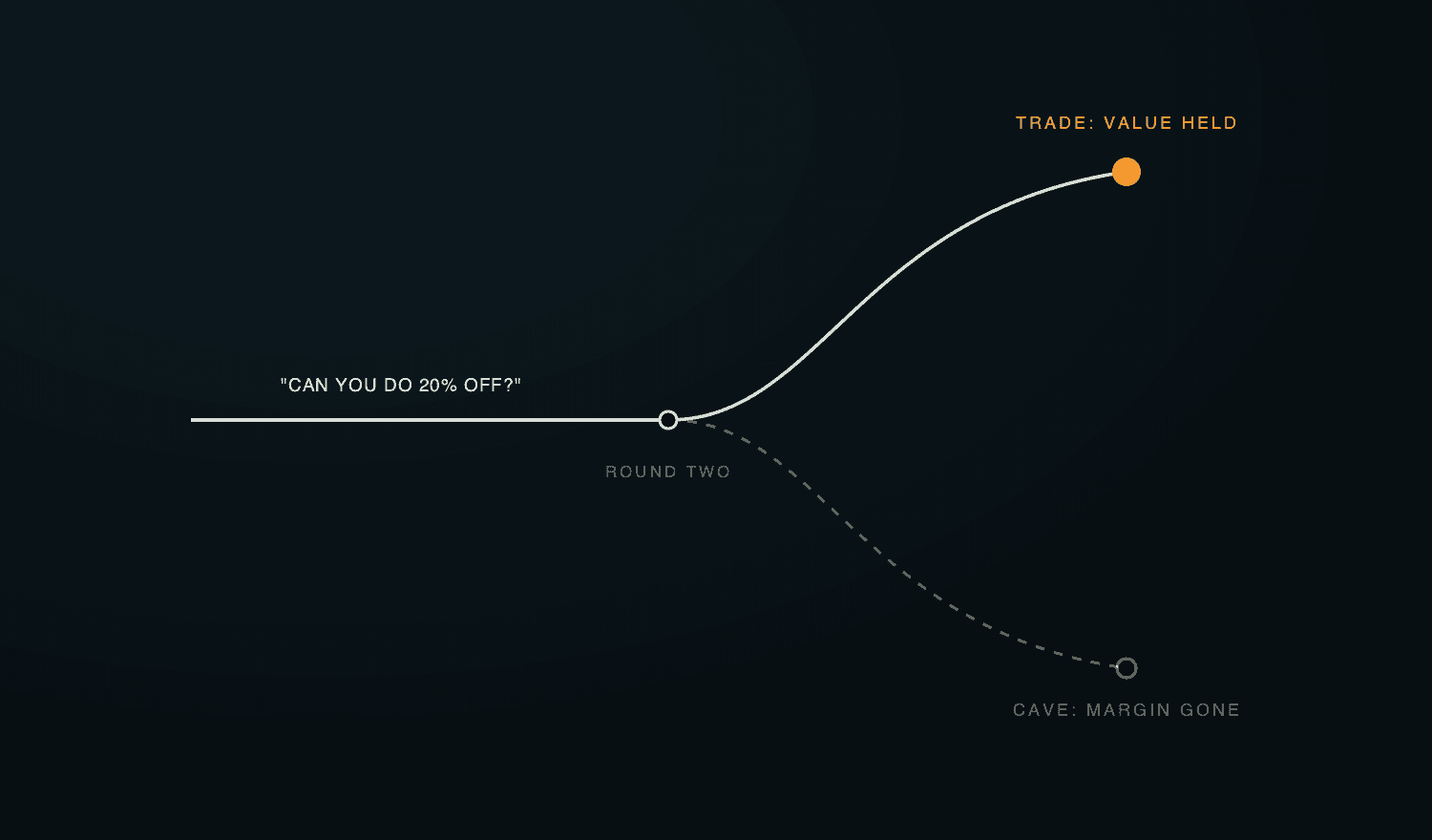
Here's the moment we're training for. Minute nine of a good call. The buyer leans back. "Look, I like it. But we'd need 20% off to get this through." Your rep's stomach drops. The quota is in their head. And the first words out of their mouth are "Let me see what I can do." Deal margin, gone in six words.
A discount pushback scenario that actually builds the reflex:
The ask comes early. The persona asks for a discount before value is set. The rep has to slow it down.
The ask comes twice. After the first answer, the buyer says "that's still too much." Most reps fold on round two, which is why round two is the one to practice.
The buyer offers a trade. At level three, the persona hints at what they'd give: a longer term, a case study, faster signature. Can the rep spot it?
The score looks at behavior. Did the rep ask what's driving the number? Did they trade, not give? Did they protect the next step?
Five things a strong answer usually does:
Pauses instead of reacting.
Asks what the number is based on: budget, a competitor quote, or a policy.
Restates the value the buyer already agreed with.
Offers a trade: "If we did X, could you do Y?"
Confirms the next step either way.
Run this scenario every week for a month before quarter end. It's the one that pays for the tool by itself. For the wider playbook, read how to handle price objections in B2B negotiations and the sales negotiation playbook.
How do you run AI cold call roleplay practice?
Run AI cold call practice in short, repeated scenarios: 60 to 120 seconds each, with the buyer interrupting in the first 15 seconds, five attempts in a row, one fix per attempt. Morning sessions before the first dial work best, because the practice is still warm when the real call starts.
A simple weekly plan for SDRs:
Monday: the cold open. Five attempts. Focus on the first ten seconds.
Tuesday: "send me an email" and "not interested." Focus on the question after the brush-off.
Wednesday: the gatekeeper. Focus on honesty and a clear reason.
Thursday: "we already use a competitor." Focus on curiosity over attack.
Friday: the full call, open to booked meeting, at higher difficulty.
What to score on a cold call scenario:
Time to relevance. How many seconds before the buyer hears why this is about them?
Talk ratio. Did the rep ask a question inside the first 30 seconds?
Recovery. After the brush-off, did the rep ask or accept?
The ask. Was there a specific time and reason?
Delivery. Pace, filler words, and whether the voice sounds like a person or a script.
That last one matters. Some reps want feedback on vocal delivery and pitch clarity as much as on words. Good AI roleplay scores both: what you said, and how it sounded. GBUK reps who practiced consistently reached cold-call scores of 8 to 10 out of 10, compared with about 6 for those who didn't (GBUK story). For the full program, see cold calling training for sales teams.
How do you practice SaaS demos and qualification with AI roleplay?
Practice SaaS demos with a buyer who interrupts: asks about price at slide two, asks whether you integrate with their CRM, mentions a competitor, or says "can you just show me the product?" Score whether the rep qualifies before pitching and ties every feature back to a pain the buyer named.
Here's the trap. Reps love demos because demos feel like progress. The screen is moving. The rep is talking. The buyer is nodding. And forty minutes later nobody knows the budget, the decision process, or whether the pain is real. That's demo hell. AI roleplay is a good place to break the habit, because the AI buyer can be told to reward questions and punish feature tours.
Four demo scenarios worth building:
"Just show me the product." Can the rep ask two questions before sharing a screen?
The early price question. Does the rep answer honestly and bring it back to scope?
The competitor mention. "We're also looking at X." Does the rep ask what they like about X?
The silent stakeholder. A second buyer joins and says nothing. Does the rep draw them in?
Score the demo against your qualification framework. If you run MEDDIC, the rubric checks for metrics, economic buyer, decision criteria and pain. If you run BANT, budget, authority, need and timing. For discovery before the demo, read SPIN selling discovery questions and how to win discovery calls in 30 seconds.
What AI roleplay scenarios build consultative selling skills?
Consultative selling scenarios put the rep in front of a buyer who has a problem they haven't named yet. The rep wins by asking, not telling. The AI buyer should give short answers to closed questions and open up only when the rep asks about impact and priorities.
Three scenarios that build the skill:
The vague complaint. "Things are a bit messy with our reporting." Can the rep get to the cost of the mess?
The wrong solution. The buyer asks for a feature that won't fix their real problem. Can the rep say so, kindly?
The priority test. The buyer has three problems. Which one matters this quarter, and who else cares?
Score these on question quality, not talk time. A good consultative call has the rep speaking less than half the time, and most of that speaking is questions. We cover the mechanics in discovery calls: perfect your pitch.
Which objections should every AI roleplay scenario library include?
Every AI roleplay scenario library should include price, status quo, timing, authority, competitor, trust, and "send me an email." Those seven cover most of the objections reps hear. Then add the three objections specific to your product and market, pulled from your last quarter of lost deals.
Objection | How the buyer says it | What the rep should practice |
|---|---|---|
Price | "It's too expensive." "Can you do 20% off?" | Ask what the number is based on. Trade, don't give. |
Status quo | "We're happy with what we have." | Agree, then ask what they'd change. |
Timing | "Not now. Maybe next quarter." | Find out what happens next quarter that isn't happening now. |
Authority | "I need to run it by my team." | Ask who, and offer to help them make the case. |
Competitor | "We're looking at X too." | Ask what they like about X. Don't attack. |
Trust | "How do I know this works?" | Offer proof that matches their situation. |
Brush-off | "Just send me an email." | Ask what would make the email worth opening. |
Some objections aren't objections at all. They're questions in disguise, or a buyer checking whether you'll hold your ground. We wrote about that in sales objections that aren't really objections.
How do you build a reusable AI roleplay scenario library that scales across regions?
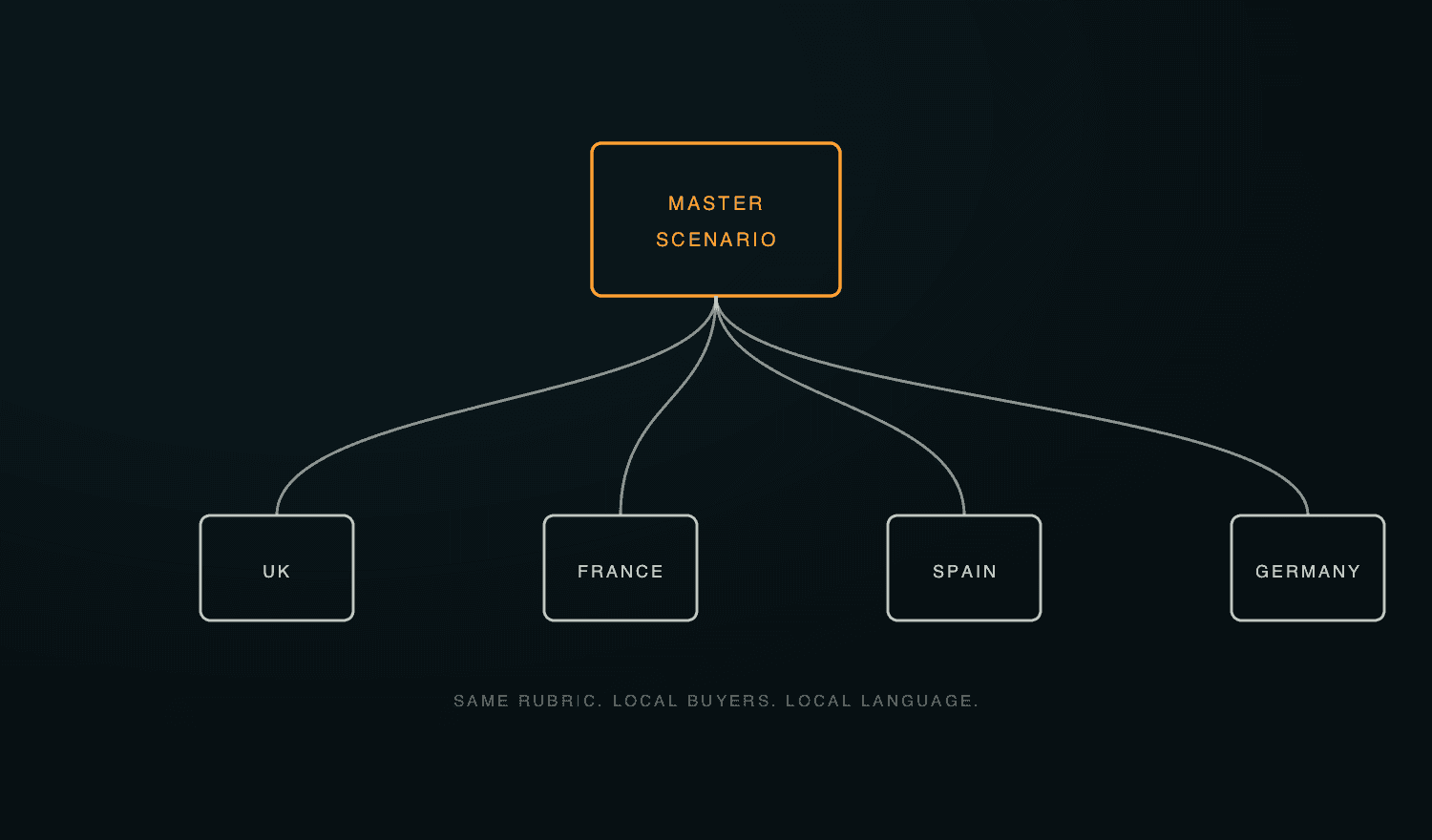
Build one master scenario per conversation type, then localize the persona, language and objections for each region while keeping the scoring rubric identical. That way a rep in Madrid and a rep in Manchester practice the same skill, in their own language, and a regional director can compare them fairly.
How to structure it:
Master scenarios. Ten to fifteen conversation types: cold open, discovery, demo, price, renewal and so on.
Regional personas. Same role, local company, local names, local buyer habits.
Local objections. Some objections are universal. Some, like procurement rules or tender processes, change by country.
One rubric. The scoring stays the same everywhere, or the numbers stop meaning anything.
An owner. One person owns the library. Without an owner, it rots. We've seen it happen.
SecondBody coaches in 12+ languages with the same scenarios and scoring for every region, which is why multi-country teams use it to keep standards consistent. If you're rolling out through partners or distributors, see SecondBody for channel selling.
How do you score an AI roleplay scenario fairly?
Score on behavior the rep controls: questions asked, how they handled the objection, whether they got a next step, and delivery. Don't score on whether the AI buyer "said yes," because a buyer's yes depends on the scenario's difficulty setting, not only the rep.
A simple four-part rubric that works for most scenarios:
Opening (0 to 25). Relevance, permission, a clear reason for the call.
Discovery (0 to 25). Open questions, follow-ups, and uncovering impact.
Handling (0 to 25). Acknowledge, ask, reframe, confirm on each objection.
Close (0 to 25). A specific next step with a date and a reason.
Map these to your methodology. If you run Sandler or MEDDIC, rename the parts and change the checks. The important thing is that every rep is scored the same way, so managers can compare and reps can trust the number.
How do outside sales reps practice objection handling with AI?
Outside sales reps practice objection handling with AI on their phone, between visits, in short voice sessions that come to them. They don't sit at a desk, so a browser portal they have to remember to open won't get used. The practice has to fit in the car park before the next appointment.
The objections are different too. A field rep hears them face to face, often standing up, sometimes with a customer's colleague listening in:
"Your competitor was here yesterday with a better deal." Price pressure with a name attached.
"I don't have time today." Said at the door, with the rep already inside.
"We tried something like this before and it didn't work." Trust, from a buyer who's been burned.
"Leave me a brochure." The field version of "send me an email."
Scenarios for field reps should be short, run by voice, and tied to the next visit on the calendar. A rep with a tough account at 2pm runs that buyer at 1:45. That's the pattern behind Rory calling field reps on WhatsApp, and it's why teams like Allwyn could coach 200 reps on the road instead of in a room (Allwyn story). For the wider picture, see AI sales roleplay for field sales and SecondBody for field sellers.
How often should reps practice objection handling with AI?
Practice objection handling a few minutes every day, not an hour once a week. Short daily sessions keep the response fresh, and the retry loop is where the reflex forms. Most teams see visibly better recoveries in transcripts within four to six weeks of daily practice.
A rhythm that works:
Every morning: one objection, five attempts, one fix per attempt.
Every week: the whole team runs the same objection. The top scorer shares what they did.
Before quarter end: discount pushback, every day, for two weeks.
Before a big call: a custom scenario built on that buyer.
SecondBody runs the daily part automatically. Rory calls each rep twice a day on WhatsApp: a warm-up in the morning, a debrief at the end of the day. Rentokil got 16 hours of roleplay per rep in under three weeks this way, without taking anyone off the road (Rentokil story).
How do managers use AI roleplay scenario results?
Managers use scenario results to decide who to coach, on what, this week. Instead of listening to hours of calls, they read a short briefing: which reps are below standard on which objection, with the transcript that shows the moment. Then the 1:1 is about one skill, not the whole pipeline.
What a useful weekly view shows:
Reps at, near and below standard on each core scenario.
The objection the team is losing to most this week.
The one transcript per rep worth opening together.
Who stopped practicing.
For more on the coaching side, see AI sales coaching software and how to train a sales rep.
FAQ: AI sales roleplay scenarios
How many scenarios does a team need to start?
Five to ten. The core beginner five, plus the three objections you lose to most. Add more once those are practiced weekly.
How long should one scenario take?
Cold call scenarios run 60 to 120 seconds. Discovery and demo scenarios run five to twelve minutes. Short enough to retry the same morning.
Can reps build their own scenarios?
Yes. The best scenarios often come from a rep who just lost a call and wants to practice that exact moment. SecondBody lets reps upload the call and practice it.
What difficulty should new reps start at?
The lowest. Pass three times in a row, then move up. Starting too hard teaches reps to dread practice.
Should the AI buyer ever say yes?
Yes, when the rep earns it. A buyer who never agrees teaches reps that nothing works, which is just as wrong as a buyer who always agrees.
Can AI roleplay score vocal delivery, not just words?
Good platforms score both: pace, filler words and clarity alongside what the rep said. Delivery matters most on cold calls.
How do I stop scenarios going stale?
Review the library monthly. Retire scenarios everyone passes. Add the objections that showed up in last month's lost deals.
Does SecondBody include a scenario library?
Yes, and you can build your own from your objection library, playbook and uploaded calls. On team plans, Rory is trained on your playbook.
What does SecondBody cost for objection handling practice?
$75/month or $750/year, with 120 minutes of roleplay and 60 minutes of coaching with Rory each month. Teams and Enterprise plans are custom. See pricing.
How we know this: these scenarios come from SecondBody rollouts with inside, field and customer success teams, from published customer stories linked above, and from the questions buyers search, pulled from our Search Console data in September 2026.
The objection isn't the problem. The freeze is.
Every rep on your team already knows what to say to "it's too expensive." They've read it. They've nodded at it in training. And then a real buyer says it, and the answer disappears. That's not a knowledge problem. It's a reflex problem. Reflexes come from repetition under pressure, and nothing else.
So build the five beginner scenarios this week. Add your three worst objections. Practice them out loud, every morning, until the answer shows up on its own. If you want a coach who throws those objections at your reps twice a day and tells you who's ready, see SecondBody pricing or book a demo.
Good luck out there.
AI sales roleplay scenarios are scripted buyer situations, such as a cold call brush-off, a discount demand or a demo that goes sideways, that a rep practices out loud against an AI buyer until the response holds under pressure. The best AI roleplay for objection handling uses your real objections, raises the difficulty as reps improve, and scores every attempt against your methodology. This guide gives you the scenario library we'd build first, and how to run each one.
Key answers, up front
Best AI-driven roleplay for objection handling: one that uses your real objections, lets the buyer push twice, and scores the recovery, not just the first answer. SecondBody builds scenarios from your objection library and uploaded calls, from $75/month.
Practicing discount pushback before live calls: run a procurement persona that asks for 20% off in the first two minutes, and score whether the rep trades instead of caves.
Best role play scenarios for beginners: the cold open, "send me an email," "we're happy with our current vendor," the gatekeeper, and asking for the next step.
Cold call practice with AI: 90-second scenarios with an interruption in the first 15 seconds. Five attempts a morning beats one hour on Friday.
SaaS demo and qualification practice: a buyer who interrupts the demo to ask about price, integrations or a competitor, scored on whether the rep qualifies before pitching.
A reusable scenario library across regions: one master scenario, translated personas and local objections, same scoring everywhere.
This is a cluster article. The hub is our guide to AI sales roleplay training. For the tool shortlist, see AI sales roleplay tools. For scenarios by sector, see AI roleplay training by industry.
What makes a good AI sales roleplay scenario?
A good AI sales roleplay scenario has five parts: a specific buyer, a specific goal for the rep, one or two objections the buyer will raise, a difficulty level, and a scoring rubric. Miss any one and the scenario turns into a chat.
Here's what nobody says out loud: most scenario libraries are written by people who have never lost a deal to that objection. So the buyer raises it once, politely, and accepts the first half-decent answer. Real buyers don't do that. They repeat the objection in a different shape. "It's too expensive" comes back as "we don't have budget this quarter," then as "let me see what else is out there." The scenario has to do the same, or the rep only learns the first move.
The five parts in practice:
The buyer. Not "a CFO." A CFO at a 400-person logistics company who got burned by a software rollout last year and has twelve minutes.
The rep's goal. Book the meeting. Get the second stakeholder. Hold the price. One clear win condition.
The objection. Pulled from your lost deals, worded the way your buyers word it.
The difficulty. Level one repeats the objection once. Level three stacks it with a competitor mention and a time squeeze.
The rubric. What a great answer does: acknowledge, ask, reframe, confirm. Scored the same way for every rep.
SecondBody builds these from what you already have: your objection library, your playbook and, on team plans, your uploaded sales calls. A manager can have a new scenario live in minutes, which matters more than it sounds, because the scenarios that get built are the ones that get practiced.
What are the best AI-driven roleplay platforms for objection handling?
The best AI-driven roleplay platforms for objection handling let the buyer object more than once, score the recovery, and use objections from your own calls. Platforms that fire one objection and accept the first answer train reps to survive the easy version.
What to look for, in order:
Multi-turn objections. The buyer should push back on the rep's answer, not just the pitch.
Your objections. An uploaded objection library, or scenarios built from your call recordings.
Recovery scoring. Did the rep acknowledge, ask a question, and move the call forward? A score on the recovery, not only the words.
Voice. Objections hit differently out loud. The stomach drops. That's the moment you're training.
Frequency. An objection you practice once a quarter is an objection you'll freeze on in the field.
The gap most teams hit is that reps know the textbook answer and still freeze when the buyer says it for real. That's the problem SecondBody was built to solve, by having Rory throw the objection at the rep by voice, twice a day, until the recovery is automatic.
For the frameworks behind good answers, read the LAER framework for objection handling and feel, felt, found. For drills a manager can run live, see objection handling training drills.
What role play scenarios should beginners start with in 2026?
Beginners should start with five scenarios: the cold open, "send me an email," "we're happy with our current vendor," the gatekeeper, and asking for the next step. These make up most of the conversations a new rep has in the first month, and each one can be practiced in under three minutes.
1. The cold open
Buyer: a busy director who picks up by accident. Goal: earn 30 more seconds. What good looks like: say who you are, why them, and ask permission, in one breath. Common fail: a long intro about your company before the buyer knows why they should care.
2. "Send me an email"
Buyer: polite, already reaching for the hang-up button. Goal: turn the brush-off into a real question. What good looks like: "Happy to. So I send something useful, what would make it worth opening?" Common fail: "Sure, what's your email?" and the call is over.
3. "We're happy with our current vendor"
Buyer: loyal to what works well enough. Goal: find the one thing that isn't perfect. What good looks like: agree, then ask what they'd change if they could. Common fail: attacking the competitor, which makes the buyer defend their own decision.
4. The gatekeeper
Buyer: an assistant who's heard every trick. Goal: get through, or get the right name and time. What good looks like: honesty and a clear reason. Common fail: pretending to know the boss.
5. Asking for the next step
Buyer: interested but vague. Goal: a date in the calendar. What good looks like: propose a specific time and a specific reason. Common fail: "I'll follow up next week."
Run each at level one until the rep passes three times in a row, then move up. A new rep can clear all five in about two weeks at ten minutes a day. For scripts to practice with, see cold call scripts that work.
How do you practice discount pushback with AI before live calls?
Practice discount pushback with a procurement or finance persona that asks for a discount early, repeats it after the rep's first answer, and walks away if the rep caves. Score whether the rep holds value, trades concessions for something in return, and keeps the next step. That's the skill. Not the number.
Here's the moment we're training for. Minute nine of a good call. The buyer leans back. "Look, I like it. But we'd need 20% off to get this through." Your rep's stomach drops. The quota is in their head. And the first words out of their mouth are "Let me see what I can do." Deal margin, gone in six words.
A discount pushback scenario that actually builds the reflex:
The ask comes early. The persona asks for a discount before value is set. The rep has to slow it down.
The ask comes twice. After the first answer, the buyer says "that's still too much." Most reps fold on round two, which is why round two is the one to practice.
The buyer offers a trade. At level three, the persona hints at what they'd give: a longer term, a case study, faster signature. Can the rep spot it?
The score looks at behavior. Did the rep ask what's driving the number? Did they trade, not give? Did they protect the next step?
Five things a strong answer usually does:
Pauses instead of reacting.
Asks what the number is based on: budget, a competitor quote, or a policy.
Restates the value the buyer already agreed with.
Offers a trade: "If we did X, could you do Y?"
Confirms the next step either way.
Run this scenario every week for a month before quarter end. It's the one that pays for the tool by itself. For the wider playbook, read how to handle price objections in B2B negotiations and the sales negotiation playbook.
How do you run AI cold call roleplay practice?
Run AI cold call practice in short, repeated scenarios: 60 to 120 seconds each, with the buyer interrupting in the first 15 seconds, five attempts in a row, one fix per attempt. Morning sessions before the first dial work best, because the practice is still warm when the real call starts.
A simple weekly plan for SDRs:
Monday: the cold open. Five attempts. Focus on the first ten seconds.
Tuesday: "send me an email" and "not interested." Focus on the question after the brush-off.
Wednesday: the gatekeeper. Focus on honesty and a clear reason.
Thursday: "we already use a competitor." Focus on curiosity over attack.
Friday: the full call, open to booked meeting, at higher difficulty.
What to score on a cold call scenario:
Time to relevance. How many seconds before the buyer hears why this is about them?
Talk ratio. Did the rep ask a question inside the first 30 seconds?
Recovery. After the brush-off, did the rep ask or accept?
The ask. Was there a specific time and reason?
Delivery. Pace, filler words, and whether the voice sounds like a person or a script.
That last one matters. Some reps want feedback on vocal delivery and pitch clarity as much as on words. Good AI roleplay scores both: what you said, and how it sounded. GBUK reps who practiced consistently reached cold-call scores of 8 to 10 out of 10, compared with about 6 for those who didn't (GBUK story). For the full program, see cold calling training for sales teams.
How do you practice SaaS demos and qualification with AI roleplay?
Practice SaaS demos with a buyer who interrupts: asks about price at slide two, asks whether you integrate with their CRM, mentions a competitor, or says "can you just show me the product?" Score whether the rep qualifies before pitching and ties every feature back to a pain the buyer named.
Here's the trap. Reps love demos because demos feel like progress. The screen is moving. The rep is talking. The buyer is nodding. And forty minutes later nobody knows the budget, the decision process, or whether the pain is real. That's demo hell. AI roleplay is a good place to break the habit, because the AI buyer can be told to reward questions and punish feature tours.
Four demo scenarios worth building:
"Just show me the product." Can the rep ask two questions before sharing a screen?
The early price question. Does the rep answer honestly and bring it back to scope?
The competitor mention. "We're also looking at X." Does the rep ask what they like about X?
The silent stakeholder. A second buyer joins and says nothing. Does the rep draw them in?
Score the demo against your qualification framework. If you run MEDDIC, the rubric checks for metrics, economic buyer, decision criteria and pain. If you run BANT, budget, authority, need and timing. For discovery before the demo, read SPIN selling discovery questions and how to win discovery calls in 30 seconds.
What AI roleplay scenarios build consultative selling skills?
Consultative selling scenarios put the rep in front of a buyer who has a problem they haven't named yet. The rep wins by asking, not telling. The AI buyer should give short answers to closed questions and open up only when the rep asks about impact and priorities.
Three scenarios that build the skill:
The vague complaint. "Things are a bit messy with our reporting." Can the rep get to the cost of the mess?
The wrong solution. The buyer asks for a feature that won't fix their real problem. Can the rep say so, kindly?
The priority test. The buyer has three problems. Which one matters this quarter, and who else cares?
Score these on question quality, not talk time. A good consultative call has the rep speaking less than half the time, and most of that speaking is questions. We cover the mechanics in discovery calls: perfect your pitch.
Which objections should every AI roleplay scenario library include?
Every AI roleplay scenario library should include price, status quo, timing, authority, competitor, trust, and "send me an email." Those seven cover most of the objections reps hear. Then add the three objections specific to your product and market, pulled from your last quarter of lost deals.
Objection | How the buyer says it | What the rep should practice |
|---|---|---|
Price | "It's too expensive." "Can you do 20% off?" | Ask what the number is based on. Trade, don't give. |
Status quo | "We're happy with what we have." | Agree, then ask what they'd change. |
Timing | "Not now. Maybe next quarter." | Find out what happens next quarter that isn't happening now. |
Authority | "I need to run it by my team." | Ask who, and offer to help them make the case. |
Competitor | "We're looking at X too." | Ask what they like about X. Don't attack. |
Trust | "How do I know this works?" | Offer proof that matches their situation. |
Brush-off | "Just send me an email." | Ask what would make the email worth opening. |
Some objections aren't objections at all. They're questions in disguise, or a buyer checking whether you'll hold your ground. We wrote about that in sales objections that aren't really objections.
How do you build a reusable AI roleplay scenario library that scales across regions?
Build one master scenario per conversation type, then localize the persona, language and objections for each region while keeping the scoring rubric identical. That way a rep in Madrid and a rep in Manchester practice the same skill, in their own language, and a regional director can compare them fairly.
How to structure it:
Master scenarios. Ten to fifteen conversation types: cold open, discovery, demo, price, renewal and so on.
Regional personas. Same role, local company, local names, local buyer habits.
Local objections. Some objections are universal. Some, like procurement rules or tender processes, change by country.
One rubric. The scoring stays the same everywhere, or the numbers stop meaning anything.
An owner. One person owns the library. Without an owner, it rots. We've seen it happen.
SecondBody coaches in 12+ languages with the same scenarios and scoring for every region, which is why multi-country teams use it to keep standards consistent. If you're rolling out through partners or distributors, see SecondBody for channel selling.
How do you score an AI roleplay scenario fairly?
Score on behavior the rep controls: questions asked, how they handled the objection, whether they got a next step, and delivery. Don't score on whether the AI buyer "said yes," because a buyer's yes depends on the scenario's difficulty setting, not only the rep.
A simple four-part rubric that works for most scenarios:
Opening (0 to 25). Relevance, permission, a clear reason for the call.
Discovery (0 to 25). Open questions, follow-ups, and uncovering impact.
Handling (0 to 25). Acknowledge, ask, reframe, confirm on each objection.
Close (0 to 25). A specific next step with a date and a reason.
Map these to your methodology. If you run Sandler or MEDDIC, rename the parts and change the checks. The important thing is that every rep is scored the same way, so managers can compare and reps can trust the number.
How do outside sales reps practice objection handling with AI?
Outside sales reps practice objection handling with AI on their phone, between visits, in short voice sessions that come to them. They don't sit at a desk, so a browser portal they have to remember to open won't get used. The practice has to fit in the car park before the next appointment.
The objections are different too. A field rep hears them face to face, often standing up, sometimes with a customer's colleague listening in:
"Your competitor was here yesterday with a better deal." Price pressure with a name attached.
"I don't have time today." Said at the door, with the rep already inside.
"We tried something like this before and it didn't work." Trust, from a buyer who's been burned.
"Leave me a brochure." The field version of "send me an email."
Scenarios for field reps should be short, run by voice, and tied to the next visit on the calendar. A rep with a tough account at 2pm runs that buyer at 1:45. That's the pattern behind Rory calling field reps on WhatsApp, and it's why teams like Allwyn could coach 200 reps on the road instead of in a room (Allwyn story). For the wider picture, see AI sales roleplay for field sales and SecondBody for field sellers.
How often should reps practice objection handling with AI?
Practice objection handling a few minutes every day, not an hour once a week. Short daily sessions keep the response fresh, and the retry loop is where the reflex forms. Most teams see visibly better recoveries in transcripts within four to six weeks of daily practice.
A rhythm that works:
Every morning: one objection, five attempts, one fix per attempt.
Every week: the whole team runs the same objection. The top scorer shares what they did.
Before quarter end: discount pushback, every day, for two weeks.
Before a big call: a custom scenario built on that buyer.
SecondBody runs the daily part automatically. Rory calls each rep twice a day on WhatsApp: a warm-up in the morning, a debrief at the end of the day. Rentokil got 16 hours of roleplay per rep in under three weeks this way, without taking anyone off the road (Rentokil story).
How do managers use AI roleplay scenario results?
Managers use scenario results to decide who to coach, on what, this week. Instead of listening to hours of calls, they read a short briefing: which reps are below standard on which objection, with the transcript that shows the moment. Then the 1:1 is about one skill, not the whole pipeline.
What a useful weekly view shows:
Reps at, near and below standard on each core scenario.
The objection the team is losing to most this week.
The one transcript per rep worth opening together.
Who stopped practicing.
For more on the coaching side, see AI sales coaching software and how to train a sales rep.
FAQ: AI sales roleplay scenarios
How many scenarios does a team need to start?
Five to ten. The core beginner five, plus the three objections you lose to most. Add more once those are practiced weekly.
How long should one scenario take?
Cold call scenarios run 60 to 120 seconds. Discovery and demo scenarios run five to twelve minutes. Short enough to retry the same morning.
Can reps build their own scenarios?
Yes. The best scenarios often come from a rep who just lost a call and wants to practice that exact moment. SecondBody lets reps upload the call and practice it.
What difficulty should new reps start at?
The lowest. Pass three times in a row, then move up. Starting too hard teaches reps to dread practice.
Should the AI buyer ever say yes?
Yes, when the rep earns it. A buyer who never agrees teaches reps that nothing works, which is just as wrong as a buyer who always agrees.
Can AI roleplay score vocal delivery, not just words?
Good platforms score both: pace, filler words and clarity alongside what the rep said. Delivery matters most on cold calls.
How do I stop scenarios going stale?
Review the library monthly. Retire scenarios everyone passes. Add the objections that showed up in last month's lost deals.
Does SecondBody include a scenario library?
Yes, and you can build your own from your objection library, playbook and uploaded calls. On team plans, Rory is trained on your playbook.
What does SecondBody cost for objection handling practice?
$75/month or $750/year, with 120 minutes of roleplay and 60 minutes of coaching with Rory each month. Teams and Enterprise plans are custom. See pricing.
How we know this: these scenarios come from SecondBody rollouts with inside, field and customer success teams, from published customer stories linked above, and from the questions buyers search, pulled from our Search Console data in September 2026.
The objection isn't the problem. The freeze is.
Every rep on your team already knows what to say to "it's too expensive." They've read it. They've nodded at it in training. And then a real buyer says it, and the answer disappears. That's not a knowledge problem. It's a reflex problem. Reflexes come from repetition under pressure, and nothing else.
So build the five beginner scenarios this week. Add your three worst objections. Practice them out loud, every morning, until the answer shows up on its own. If you want a coach who throws those objections at your reps twice a day and tells you who's ready, see SecondBody pricing or book a demo.
Good luck out there.
Practice that isn't theatre.
A buyer who doesn't pull punches. Feedback that doesn't fade. A cadence that doesn't need a manager's calendar.


SecondBody is the AI sales roleplay training platform built for the daily practice cadence: voice-first sessions with Rory, your AI coach, who plays the buyer, scores every call, and shows exactly what to fix. Explore pricing or book a demo.
Related reading: AI sales roleplay training, AI roleplay training by industry, objection handling training drills, cold calling training.
Share this article