Back
Sales Coaching Software Pricing: What Does It Really Cost a 50 to 500 Rep Team?
Sales coaching software pricing for 50 to 500 reps: per seat vs minutes, a 10-tool price table, year-one cost with hidden costs, and how to prove ROI.

By Omid, founder of SecondBody
Key answers, up front
The range is wide. Tools that publish prices sit between about $49 and $349 per seat per month. SecondBody is $75 a month or $750 a year per seat. Most enterprise platforms publish nothing. Third-party buyer data puts typical annual contracts for the big suites between roughly $19,000 and $60,000 a year at the median, with large deals well past $100,000.
The unit matters more than the number. Some vendors sell seats. Some sell minutes, sessions or credits. Some add a platform fee before the first seat. Two quotes with the same total can buy very different amounts of practice.
The license is rarely the biggest line. For a 150-rep team, our worked example puts the license at about 60% of year-one cost once you add setup, a content owner and manager time. Rep time is bigger than all of it, unless practice happens in dead time.
Prove ROI on one number, not a dashboard. The deals we closed this year were won by a small pilot: 10 new joiners, 2 weeks, one number to move.
Ask about renewal before you sign. Third-party data shows 3% to 7% annual escalators are common in this category. Year two is where budgets break.
How much does sales coaching software cost in 2026?
Short answer: anywhere from free to well over $200,000 a year, and the honest middle for a 50 to 500 rep team is a five or six figure annual line before you count anything else.
Here is the part nobody likes to say. That range is so wide because "sales coaching software" is not one thing. It is at least three different jobs sold under one label.
The first job is practice. A rep talks to an AI buyer, gets pushed, gets scored, does it again. That is AI roleplay, and it is what tools like SecondBody, Second Nature, Hyperbound, Yoodli, Kendo and PitchMonster sell.
The second job is analysis. Software records real calls and tells you what happened. That is conversation intelligence. Gong is the name everyone knows.
The third job is the whole enablement suite. Content, learning paths, certifications, sometimes roleplay bolted on. Mindtickle, Allego and Seismic (which now owns Highspot) live here.
A practice tool sold per seat and a suite sold with a platform fee, onboarding services and a three-year term are not the same purchase. Putting them in one price list is like comparing a gym membership with building a gym in your office. Both make you fitter. One of them needs a builder.
We build one of these tools, so read this with that in mind. I will try to be harder on the category, and on us, than anyone else on page one. You will see our price in the table next to everyone else's, and you will see where we cost more per minute than someone else.
The buyer I am writing for is the person whose name goes on the budget line. Head of Sales Enablement. Regional Sales Director. Commercial lead for a field team. You have a hiring cohort coming, or a regional rollout, or a board asking why ramp takes so long. You have 50 to 500 reps. You need a number you can defend in a finance meeting, and you need to know what will surprise you in month nine.
That is what the rest of this piece is for.
Why is sales coaching software pricing so hard to compare?
Because most vendors hide it, the ones that publish it use different units, and the pages that rank for "pricing" are mostly written by vendors who rank themselves first.
I went through the live Google results for "sales coaching software pricing" on 16 October 2026. Page one was a G2 category page, then listicles from Autobound, Oliv, MarketBetter, SaaSworthy, CRO Club, Amotions and PitchGenius, plus our own coaching guide. Almost every listicle is written by a vendor. Almost every one puts its own product at the top. That is not a scandal, it is just how the game works, but you should know it before you copy their numbers into a spreadsheet.
Here is what I saw that should worry a buyer.
The same tool gets different prices on different pages. One widely read listicle quotes Hyperbound at "$99 to $299 a month" for teams. Other pages around the web quote it per user per month at much lower numbers. Hyperbound's own pricing page, checked today, shows no price at all for its paid plans. One independent pricing blog traced a circulating Hyperbound figure back to a guess that Google's AI Overview had repeated. So the number your CFO finds by searching may have no source.
The listicles mix jobs without saying so. A conversation intelligence tool at $1,500 a seat a year sits next to a roleplay tool at $49 a month, as if they do the same thing. They do not. If you buy analysis expecting practice, you will get a very detailed picture of the calls your reps are still fumbling.
Our own search data says buyers have moved on from "how much". Across the pricing-related queries Google showed our site for over the last month, the most common one was not a price question. It was "how to measure ROI of AI sales roleplay training". The second tier was about large teams ("AI sales coaching platform pricing for large teams") and about comparing ("compare AI sales coaching platform pricing"). Buyers are now typing full briefs into search, sometimes a paragraph long, describing their team size, their industry and their deadline. They are not asking for a sticker price. They are asking whether this will pay back, and how to show it.
On our sales calls this year, the same thing came up in nearly the same words: "How do we prove we make our money back?" Usually followed by a quieter worry about time: every minute a rep spends practising is a minute off the phones or off the road. We will answer both. First, the models.
What pricing models do sales coaching platforms use?
There are four, and most vendors mix two or three of them. Learn to spot each one in a quote, because each has its own trap.
1. Per seat (per user, per month or per year)
The simplest model. You pay a fixed amount for each named rep. SecondBody, Kendo, Amotions, Allego and Gong all license per user in some form, though only some publish the number.
Where it helps: easy to budget, easy to compare, easy to cut.
The trap: "per seat" rarely means "unlimited". Many per-seat plans include a usage allowance (minutes, sessions, hours of call scoring). And seats are usually bought annually up front. Add a rep in month five and you may pay a higher rate for that seat. Vendr's buyer data on Gong notes mid-contract seat additions often carry overage fees 10% to 20% above the contracted rate.
2. Usage: minutes, sessions or credits
AI roleplay costs real money to run. Every minute a rep talks to an AI buyer costs the vendor compute and voice. So many practice tools meter it.
They meter it in different units, which is where the confusion starts:
Minutes per seat. SecondBody's plans include 120 minutes of roleplay and 60 minutes of coaching a month per seat.
Pooled minutes. Kendo includes 180 roleplay minutes per Pro seat (480 on its $100 plan) and pools them across the team, so heavy users can draw on light users' minutes.
Sessions. Amotions counts roleplay sessions, not minutes: 40 a month on its $49 Starter plan, 100 on Professional.
Credits. A competitor's review of Second Nature reports that its sales team quoted credits at $50 each, where one credit is one user for one month. That is a seat-month dressed up as a credit, and it means a credit pack can run out before the year does.
"Unlimited". PitchMonster lists unlimited roleplays on its roleplay plan. Yoodli lists unlimited custom roleplays on Team and Enterprise. Outdoo lists unlimited usage on its paid tiers. Unlimited is not free. It is priced into the seat.
On our sales calls, minute bundles were one of the most common points of confusion. Buyers did not know whether 120 minutes was a lot or a little, whether it pooled, and what happened when a keen rep ran out in week two. Those are fair questions, and they are the same questions you should ask every vendor. We answer them for our own plan further down.
3. Platform fee
A flat annual charge for access to the platform, before you pay for a single seat. Gong's own pricing page says it plainly: licenses are priced per user, and "there is a platform fee based on the number of users supported." It does not say how much. Third-party guides put Gong's platform fee anywhere from $5,000 to $50,000 a year. Vendr's notes on Mindtickle mention platform access fees plus per-user licensing.
The trap: platform fees hit small teams hardest. On a 20-seat deal, a $10,000 platform fee adds $500 a seat. On a 500-seat deal, it adds $20. If a vendor has a platform fee and you are a mid-size team, ask for it to be waived. Buyers report it can be waived, and can come back at renewal.
4. Enterprise suite bundles and multi-year terms
The suites sell modules. Seismic sells its learning product as an incremental per-user fee on top of the core platform, according to Vendr's buyer data, and add-on modules can raise contract value by 20% to 50%. Allego publishes its structure without numbers: per user per month, billed annually up front, typical term three years. Gong lists separate products for engagement, forecasting and enablement.
Where it helps: one vendor, one contract, one security review.
The trap: you pay for modules your team will never open, and you sign for three years to get the discount. If the thing you actually need is daily practice for new reps, a three-year suite contract is a lot of building for one gym.
Sales coaching software pricing compared: what do 10 tools actually charge?
Here is what each vendor shows on its own site, checked on 16 October 2026, next to the best third-party figure I could find for those that hide pricing. "Public" means the vendor shows the price. "Quote-only" means you have to book a call. Third-party numbers are hedged on purpose: they are single data points, often published by a competitor.
Tool | Main job | Public price? | What the vendor shows (16 Oct 2026) | Best third-party figure (hedged) |
|---|---|---|---|---|
SecondBody | AI roleplay + AI coach (Rory) | Yes | $75 per seat a month, or $750 a year (two months free). 120 min roleplay + 60 min coaching a month. Teams and Enterprise: custom, with custom minute packages and volume discounts | Not needed |
Kendo | AI roleplay + call scoring | Yes | Pro $55 per seat a month (180 min roleplay, 25 hrs call scoring); Max $100 (480 min, 100 hrs). Usage pooled across the team. Custom tier on request | Not needed |
Amotions | Real-time coaching + roleplay | Yes | Starter $49, Professional $99, Advanced $189, Power $349 per seat a month billed annually ($59 to $369 monthly). Usage capped per plan | Not needed |
Yoodli | Roleplay and speech coaching | Partly | Individual Pro $8 and Advanced $20 a month billed annually. Team and Enterprise quote-only | One competitor reports a 2026 quote of about $600 per user a year (about $50 a month) |
PitchMonster | AI roleplay + call analysis | No | Two plans, priced per seat, quote-based. Most teams start at 5+ seats. 12-month standard term, 3 and 6 month options. Onboarding included | Capterra lists $39 and $49 per user a month (could not open the listing directly; confirm) |
Hyperbound | AI roleplay + real-call scoring | No | Free tier (45 prebuilt roleplays). Practice and Perform plans per user, demo only | No figure I trust. Circulating numbers conflict and none trace to Hyperbound |
Second Nature | AI roleplay with avatars | No | No pricing page (the URL returned a 404 today). Quoted after a demo | Vendr: median buyer pays $19,000 a year (low $19,000, high $26,700). A competitor reports a credit model at $50 per user-month |
Quantified | AI roleplay, enterprise | No | Quote-only | Third-party estimates range from about $85 to $250 per seat a month. Too wide to budget on |
Gong | Conversation intelligence (now with AI roleplay in Gong Enable) | No | Per-user licenses plus a platform fee. Quote-only | Vendr: median $55,359 a year across 1,145 purchases (range $11,497 to $203,683); about $1,200 to $2,400 per seat a year |
Mindtickle | Sales readiness suite | No | No public pricing page | Vendr: median $44,356 a year (range $11,157 to $138,726). Onboarding often $10,000 to $50,000+ |
Two more suites belong in any 50 to 500 rep conversation, so here they are on their own line:
Allego: quote-only. Per user per month, billed annually, typical three-year term. Vendr reports a median of $49,600 a year (range $27,925 to $116,675). Managed content building costs extra, per Allego's own pricing page.
Seismic and Highspot: the two merged under the Seismic name. The deal was announced in February 2026 and closed on 18 August 2026, with Highspot now branded "Highspot by Seismic". Vendr medians before the merger: Seismic $31,950 a year, Highspot $60,005. Both quote per named user, with onboarding, training and add-ons extra.
A few things jump out of that table.
Only three of ten publish real team prices. Kendo, Amotions and us. Everyone else wants a call. That is not always sinister. Enterprise deals really do vary. But it means the buyer does the work of finding out, and the vendor holds the information.
The published prices cluster lower than the quoted ones. Public per-seat prices in this category run roughly $49 to $100 a month for team plans. The third-party medians for the quote-only suites work out far higher per head once you divide by typical seat counts. That gap is mostly the difference between practice tools and suites, and partly the price of not publishing.
"Median" hides a lot. Vendr's Gong range runs from about $11,500 to over $200,000 a year. A median tells you what the middle buyer paid, not what you will pay. Your number depends on seats, modules, term length and how hard you negotiate.
What is Second Nature pricing, and what does Hyperbound cost?
These are two of the most common pricing searches Google shows our site for, so they get their own answer.
Second Nature pricing
Second Nature does not publish pricing. On 16 October 2026 its pricing URL redirected to a page that returned "not found". You get a number after a demo.
What we can say from third parties, all of it second-hand:
Vendr's marketplace page shows a median buyer paying $19,000 a year, with a high of $26,700. It does not say how many purchases that is based on, and it does not explain the pricing model.
Outdoo, a competitor, published a review in September 2026 reporting that Second Nature's sales team quoted $50 a credit in 2026, where a credit is one user for one month. On that basis, continuous access for 50 reps needs about 600 credits, roughly $30,000 a year. The same review points out a trap worth knowing whatever vendor you buy from: a proposal for 240 credits at $12,000 looks like it covers 50 people, but it buys 50 people 4.8 months, not twelve.
Treat both as signals, not prices. A competitor has every reason to make a rival look expensive or confusing. But the credit math is worth running on any usage-based quote. Ask: "How many months does this cover for my actual headcount?"
What Second Nature is good at, briefly and fairly: avatar-led roleplay, including new moving-avatar and video-avatar scenarios, many languages, LMS integration, and certification workflows. If you want the full side-by-side, we wrote one: Second Nature vs SecondBody.
Hyperbound pricing
Hyperbound does not publish prices for its paid plans either. Its pricing page, checked today, shows three tiers:
Free: 45 prebuilt AI roleplays and example scorecards.
Practice: custom AI buyers, custom scorecards, coaching, analytics, a dedicated account manager. Demo only.
Perform: everything in Practice plus real-call scoring, deal coaching, CRM intelligence and call capture integrations. Demo only.
The page says licenses are per user, separate for Practice and Perform, with volume discounts by team size and extra savings on multi-year deals.
Any Hyperbound price you see quoted online should be treated with care. I found figures stated per user per month and others stated per team per month, and they do not agree. An independent pricing blog that checked in August 2026 concluded that a widely repeated number came from a guess, not from Hyperbound. If you need a number, book their demo and ask for it in writing, including whether call scoring (the Perform tier) is priced on top.
Our comparison is here if you want it: Hyperbound vs SecondBody.
What does sales readiness platform pricing look like?
Sales readiness platforms (Mindtickle, Allego, Seismic's learning product) are priced as enterprise suites: quote-only, per user, annual or multi-year, with services on top. Expect the license to be the start of the bill, not the bill.
Here is what the buyer data says, from Vendr's marketplace pages checked today:
Mindtickle: median $44,356 a year. Pricing includes platform access fees plus per-user licensing. Onboarding, integrations and premium support are typically extra: onboarding cited at $10,000 to $50,000+, premium support at 10% to 20% of contract value. Contracts often carry 3% to 7% annual price escalators.
Allego: median $49,600 a year. Allego says implementation and integration support are included, and managed content building is extra.
Seismic: median $31,950 a year. Professional services quoted separately, generally $10,000 to $100,000+. Renewal escalators of 3% to 7% unless renegotiated. Two-year terms often 10% to 20% cheaper per year than one-year terms.
Highspot: median $60,005 a year. Onboarding $10,000 to $50,000+, training $5,000 to $25,000, and Vendr says total cost of ownership runs 15% to 30% above the initial quote.
"Highspot with Gong vs Seismic alone: which stack lowers total cost of ownership?"
Someone typed exactly that into Google and our site showed up, so here is a straight answer. Since August, Highspot is part of Seismic, so the question has partly answered itself: if you run both today, you are now dealing with one owner, and you should expect consolidation offers at renewal. Gong is a separate contract either way.
On cost alone, one suite almost always beats two, because you pay one platform fee, one onboarding and one renewal escalator. But that is the wrong question if your real problem is that new reps freeze on calls. Neither a content library nor a call recorder makes a rep practise. A suite tells reps what to say. A recorder tells you afterwards what they said. The gap in the middle is the moment on the call itself. That is the gap practice tools were built for, and it is usually a much smaller line item than either.
What does SecondBody cost, and what do 120 roleplay minutes actually buy?
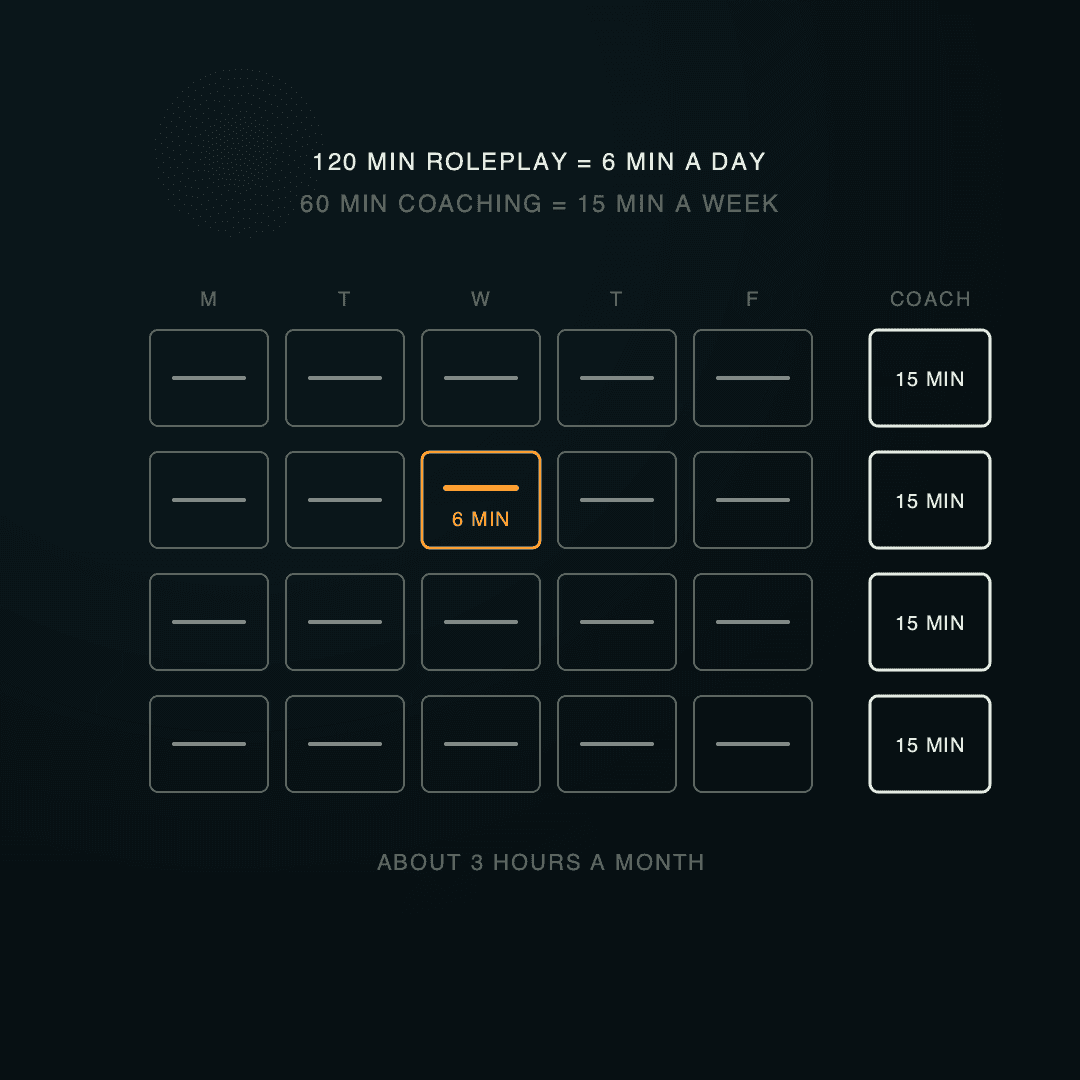
SecondBody costs $75 per seat a month, billed monthly and cancellable any time, or $750 per seat a year, which works out to two months free. Both include 120 minutes of AI roleplay and 60 minutes of AI coaching with Rory each month. Both also include custom AI personas, uploading your own objection library, coaching on calls you choose to upload, and web and mobile access.
Teams and Enterprise plans are custom priced. That is where the rest lives: Rory calling reps on WhatsApp or phone (the morning warm-up and the end-of-day debrief), Rory trained on your playbook, custom minute packages with volume discounts, enterprise SSO, SOC 2 Type II, custom data retention, 12+ languages, team analytics and benchmarking, a dedicated CSM and SLA support. All of it is on our pricing page.
One thing that matters for regulated teams and does not change by plan: SecondBody never records your customer conversations. Rory does not listen in on live calls or visits. Reps practise before and debrief after, and a real call is only coached if you choose to upload one you already own. That is a big part of why procurement goes faster in pharma, medical devices and financial services.
Now the honest part. What do those minutes mean in a real week?
120 roleplay minutes a month is about 30 minutes a week, or about 6 minutes per working day across a 20-day month. In practice, that looks like one or two short scenarios a day: a cold open, a price objection, a gatekeeper. Or it looks like two longer discovery calls a week. For a tenured rep keeping sharp before big meetings, that is plenty. It is the morning warm-up and the rehearsal before the call that matters.
60 coaching minutes a month is about 15 minutes a week with Rory: the end-of-day debrief where he tells you where you lost the buyer and what to try tomorrow, or a quick prep call before a meeting you are nervous about.
So a seat on the standard plan buys about three hours of focused work a month. That is the floor of a habit, not a bootcamp.
Where 120 minutes is not enough: a ramp cohort. New reps in their first weeks practise far more. At Rentokil Terminix, reps did 16 hours of roleplay each in under three weeks. That is eight months of the standard allowance in under a month. They did it with zero days off the road, because on their team plan Rory calls reps by phone or WhatsApp, so practice happened in the car between visits, not in a classroom. Here is the part you would not expect from a vendor: usage caps were added because some reps were practising more than was sustainable. Minutes are not only a cost control. They protect selling time. A cohort like that needs a custom minute package, sized up for the ramp and capped where it should be, which is exactly what our team plans are for. If you are budgeting for new hires, do not price them on the standard seat. Tell us the cohort size and the ramp window and get the minutes sized to it.
Where we are more expensive. On raw minutes per dollar, we are not the cheapest. Kendo's Pro plan includes 180 pooled roleplay minutes for $55 a seat. If your only metric is roleplay minutes per dollar, they win that line. Our case is different: on team plans Rory reaches reps where they already are, by phone or WhatsApp with no login, and the 60 coaching minutes are a coach who remembers what the rep struggled with last week. Minutes nobody uses cost infinity per minute. The cheapest minute is the one a rep actually spends.
What the pricing page does not say, and what you should ask us on a call: how minutes behave on team plans, what happens when a keen rep runs out mid-month, and how volume discounts step at 50, 150 and 500 seats. Those are quote questions. Ask them in writing.
What does AI sales coaching platform pricing look like for large teams?
For large teams, the license is the line everyone argues about and the smallest part of the real cost. Here are three worked year-one budgets: 50, 150 and 500 reps.
I use SecondBody's public list price ($750 per seat a year) as the license line because it is a real, published number. Team plans are custom and volume discounted, so treat it as a ceiling, not a quote. If you are pricing someone else, swap in their quote, and if their quote has a platform fee, add it.
Every other line is a planning assumption, not a statistic. I state each one so you can replace it with your own number. These are the costs that came up again and again on our sales calls.
The assumptions:
Setup, security and procurement. Internal hours for security review, DPA, SSO, and procurement. Assumed at $5,000 (50 reps), $8,000 (150) and $15,000 (500) in internal time. One vendor's own pricing guide puts enterprise security review and integration effort at $5,000 to $15,000+, which is in the same range.
Content owner. Someone on your side owns the scenarios, the objection library and the playbook updates. Assumed at 4 hours a week (50 reps), 8 hours (150) and 20 hours (500), for 48 weeks, at $60 an hour loaded.
Manager time. One manager per 8 reps. Each spends 30 minutes a week reading the pre-1:1 briefing and replaying practice moments. 48 weeks, at $90 an hour loaded.
Renewal uplift. Year two at 5% above year one, the middle of the 3% to 7% escalator range Vendr reports for suites. Your contract may say otherwise. Check.
Rep time. Three hours a month of practice and coaching per rep (the standard allowance), at $50 an hour loaded. Shown separately, because it is an opportunity cost, not a cash cost, and it shrinks a lot if practice happens in dead time.
50 reps
Line | Year one |
|---|---|
License (50 seats at $750 list) | $37,500 |
Setup, security, procurement (internal) | $5,000 |
Content owner (4 hrs a week) | $11,520 |
Manager time (6 managers, 30 min a week) | $12,960 |
Year-one total (cash + internal time) | $66,980 |
Rep time, if all practice is taken from selling hours | $90,000 |
License in year two at +5% | $39,375 |
The license is 56% of the year-one total. Per rep, the all-in number is about $1,340 a year, or $112 a month. Not $75.
150 reps
Line | Year one |
|---|---|
License (150 seats at $750 list) | $112,500 |
Setup, security, procurement (internal) | $8,000 |
Content owner (8 hrs a week) | $23,040 |
Manager time (19 managers, 30 min a week) | $41,040 |
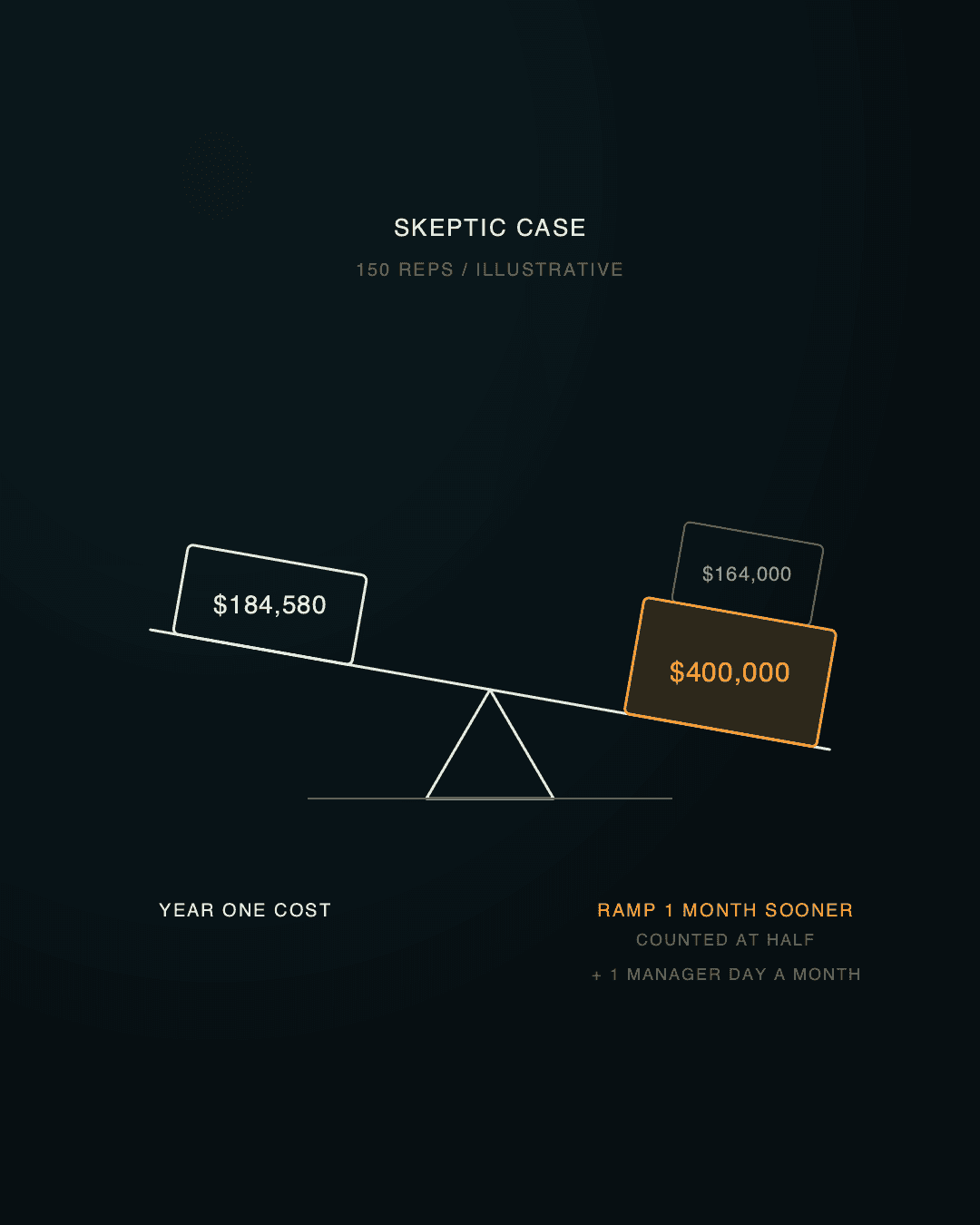
Year-one total (cash + internal time) | $184,580 |
Rep time, if all practice is taken from selling hours | $270,000 |
License in year two at +5% | $118,125 |
The license is 61% of the total. All-in per rep: about $1,230 a year.
500 reps
Line | Year one |
|---|---|
License (500 seats at $750 list) | $375,000 |
Setup, security, procurement (internal) | $15,000 |
Content owner (20 hrs a week, a half-time role) | $57,600 |
Manager time (63 managers, 30 min a week) | $136,080 |
Year-one total (cash + internal time) | $583,680 |
Rep time, if all practice is taken from selling hours | $900,000 |
License in year two at +5% | $393,750 |
At 500 seats you should not be paying list. Volume discounts exist on our team plans, and on everyone else's. But notice what does not get discounted: manager time and the content owner. Those scale with your org, not with the vendor's price sheet.
What the three tables are telling you
Three things.
First, the license is roughly half to two thirds of the real cost. If your business case only has the license in it, finance will find the rest, and they will find it in month nine.
Second, the rep time line is bigger than everything else combined. This is the "time off the phones" objection, and it is a real one. A field rep's hour is worth something. But look at how it changes. If Rory (on a team plan) calls a rep at 8:15 in the car and debriefs them at 5:30 on the drive home, that practice costs almost no selling time. Rentokil Terminix reps did 16 hours each without a single day off the road. If practice means sitting at a laptop in the office, the rep line is real cash. Where practice happens is a pricing decision, even though it never appears on a quote.
Third, manager time is a cost and a saving at the same time. Thirty minutes a week reading a briefing is a cost. But that briefing replaces the time a manager would have spent guessing who to coach. At GBUK, a UK medical device supplier, managers got back about a week a month. You do not need anything near that to cover the manager line. More on that in the ROI section.
What would the same team cost on a conversation intelligence platform?
For contrast, using Vendr's per-seat range for Gong of $1,200 to $2,400 a year: 150 seats would be $180,000 to $360,000 in license alone, before any platform fee. That is not a like-for-like comparison, because Gong does a different job (recording and analysing real calls). Many teams run both. But it is useful context when someone in the room says AI roleplay is expensive.
What hidden costs never show up on the quote?
Six of them. Ask about every one before you sign, and put the answer in the contract where you can.
1. Implementation and onboarding. Vendr's buyer data puts onboarding for the big suites at $10,000 to $50,000+, sometimes far more for professional services. Some vendors include it (PitchMonster and Allego both say onboarding is included). Ask: "Is onboarding included, and what exactly does it cover?"
2. Content building. Somebody has to write the scenarios, load the objection library and keep it current when pricing changes or a competitor launches. Allego charges extra for managed content building. Most tools leave it to you. This is the cost that kills rollouts. We lost a customer because nobody on their side owned the content. The tool was fine. Nobody was driving it. Budget a named owner and their hours, or budget the vendor to do it.
3. Manager time. If managers have to log into another dashboard, they will not. Budget the time it takes them to use the output in their 1:1s, and pick a tool that puts the output where they already work.
4. Rep time. Covered above. The difference between practice in dead time and practice at a desk can be the biggest number in your whole business case.
5. Usage overages and true-ups. Minutes, sessions and credits run out. Seats added mid-year can cost more. Vendr's Gong notes cite 10% to 20% above contracted rate for mid-contract seats, and its Seismic notes mention true-up charges for exceeding the licensed user count. Ask: "What happens when we go over, and what does it cost?"
6. Renewal uplift. Vendr reports 3% to 7% annual escalators as common for Mindtickle, Highspot and Seismic. Third-party Gong guides report automatic renewal uplifts unless you cap them, and buyers in community threads complain about renewal quotes landing above the original per-seat math. A 7% uplift on a $375,000 license is $26,250 a year, compounding. Negotiate the cap on day one, when you have the most leverage.
There is a seventh cost that never appears on any spreadsheet: shelfware. A tool nobody opens costs 100% of its price and returns nothing. "Another tool nobody opens" is one of the objections we hear most, and it is fair. The fix is not a cheaper tool. It is a tool that goes to the rep instead of waiting for the rep to come to it.
How do we prove we make our money back?
You prove it in two steps. First, on one leading indicator in a small pilot, which you can measure in weeks. Then on one revenue-linked number across the rollout, which takes a quarter or two. Nobody can honestly prove revenue ROI before buying. Anyone who claims they can is selling a spreadsheet.
Here is the shape of the case we help buyers build. For each number, I give you the vendor case (what our best customers saw) and the skeptic case (what I would actually put in front of a CFO).
Ramp time
Vendor case. At Allwyn, ramp was 65% faster, and the share of reps at coaching standard went from 1 in 5 to 4 in 5 in a quarter. Their reps grew 3.5% while their market fell 4%.
Skeptic case. Allwyn had a committed sales leadership team, 3 in 4 of their 200 reps practising, and its own market conditions. You will not get 65% by buying a license. Assume one month off ramp for new hires, and only count half of that month's output.
The math. Say you hire 40 reps a year and a fully ramped rep produces $20,000 a month in gross margin. (Use your own numbers. These are illustrative.) One month sooner, counted at half, is 40 × $20,000 × 0.5 = $400,000. Against a 150-rep year-one total of about $185,000, that is the case. And that is the skeptic version.
Manager time
Vendor case. At GBUK, managers saved about a week a month, because the briefing told them who to coach and on what instead of making them sit in on calls or guess.
Skeptic case. Assume one day a month per manager. At $90 an hour and 8 hours a day, that is $720 a month per manager. For 19 managers (our 150-rep example), that is about $164,000 a year. Even at half a day, it is about $82,000, which covers the entire manager-time line in the budget twice over.
Hitting target
Vendor case. Parkingeye closed 415 contracts against a target of 380 in 2025 and ran 33% over year-to-date target.
Skeptic case. A team that beats target also had a good manager, a good market and a good comp plan. You cannot attribute every extra contract to practice. Do not try. Use this kind of result as evidence the tool was used and the team performed, not as a formula.
Call quality
Vendor case. At GBUK, reps who practised consistently scored 8 to 10 out of 10 on cold calls, against about 6 for reps who practised only now and then.
Skeptic case. "Consistent users" is a self-selected group. The keen reps practise more and were maybe going to improve anyway. That is why the pilot below uses new joiners, who all start from the same place.
Why leading indicators come first
The pattern in every deal we closed this year: buyers did not want a revenue promise. They wanted to see something move before revenue could. Confidence. Readiness scores. The share of reps who can handle the top three objections without freezing. Those move in two weeks. Revenue moves in two quarters. If you show the first one early, you earn the time to measure the second.
How do you measure the ROI of AI sales roleplay training?
Measure four things: usage, skill, speed, and one revenue number. In that order. That is how you go from "people are using it" to "it paid for itself" without making anything up.
This is the most common pricing-related question Google shows our site for, so here is the full method.
1. Usage (week 1 onwards). Practice minutes per rep per week, and the share of reps who practised at all. If usage is low, nothing else matters. Allwyn had 3 in 4 of 200 reps practising. Rentokil Terminix reps did 16 hours each in under three weeks, enough that caps were added to keep it sustainable. Those are high bars. A pilot where most reps practise every week is a good start.
2. Skill (weeks 2 to 6). Scores on the scenarios that matter to you, scored against your methodology (SPIN, MEDDIC, Sandler or your own). Track the share of reps at "coaching standard", whatever you define that as. Allwyn's 1 in 5 to 4 in 5 is a skill number.
3. Speed (months 2 to 6). Time to first meeting booked, time to first deal, time to full quota. Compare the cohort that practised against the last cohort that did not. This is the ramp number, and it is where most of the money is.
4. One revenue number (quarter 2 onwards). Pick one: win rate on a specific stage, conversion from first meeting to second, average deal size on a product line. Not all of them. One.
How to present it to executives. Executives do not want a dashboard. They want one before-and-after number, a sentence on what you did, and the cost. Something like: "We put 10 new hires through two weeks of daily practice. Their first-meeting booking rate was X against Y for the last cohort. It cost $Z. Here is what that is worth at full team scale." That is a slide. That is a decision.
We wrote a longer piece on which numbers to pick: 5 key metrics to measure sales training ROI.
What not to do. Do not compare trained reps to untrained reps on the same team and call the difference ROI. The trained ones chose to train. Compare cohorts, or compare the same reps before and after, and say which you did.
What is the cheapest sales coaching software that is still worth paying for?
The cheapest tool worth paying for is the one your reps actually use every week. A $20 tool nobody opens costs more than a $100 tool everyone uses, because the first returns nothing.
That said, buyers ask this a lot. Two of the queries Google shows us for are "cheapest SDR coaching platform" and "automated sales coaching software with CRM integration for under $50 monthly". Here are the honest answers from the published prices:
Under $50 a seat a month, published: Amotions Starter at $49 billed annually (40 roleplay sessions a month). Yoodli's individual plans ($8 and $20 billed annually) are cheaper, but they are individual plans, not team plans with admin controls. Capterra lists PitchMonster at $39 and $49, but PitchMonster's own site is quote-based.
Around $50 to $100: Kendo Pro at $55. SecondBody at $75 monthly, or $62.50 a month effective on the annual plan. Kendo Max at $100.
CRM integration under $50: check carefully. On several tools, integrations (CRM, call recording) sit on a higher tier. Hyperbound puts CRM intelligence and call capture on its Perform tier, not Practice. Ask which tier the integration lives on before you compare.
For SDR teams specifically: the job is high-volume cold-call reps. You want lots of short reps (the gym kind), honest scoring, and practice that does not need a manager in the room. Per-seat plans with a clear minute allowance fit that well. If you are hiring a cohort of SDRs, make sure the allowance matches the ramp, not the steady state.
What questions should you ask on a sales coaching software pricing call?
Bring this list. Ask every vendor the same questions, including us, and get the answers in writing.
On the unit
What exactly am I buying: seats, minutes, sessions, credits, or a platform?
If it is usage-based, is it per seat or pooled across the team?
What happens when a rep runs out mid-month? Are they cut off, charged, or topped up?
How many months does this proposal cover for my actual headcount? (The credit trap.)
Is "unlimited" truly unlimited, or is there a fair-use cap?
On the total
Is there a platform fee? Can it be waived at my seat count?
Is onboarding included? What does it include, in hours or deliverables?
Who builds the content: the scenarios, the objection library, the scorecards? If you do, what does it cost?
Which features sit on a higher tier? Specifically CRM integration, call scoring, SSO and analytics.
What does adding seats mid-contract cost?
On renewal
What is the renewal uplift in year two and year three? Will you cap it in this contract?
What is the minimum term? Is there a monthly or six-month option?
If we cut seats at renewal, does the per-seat price go up?
On proof and risk
Will you run a scoped pilot on one number before we sign the annual contract?
Can I speak to a customer of my size, in my industry, who has renewed?
Do you record our customer conversations? What is stored, where, for how long, and will you sign our DPA? (Compliance and procurement questions came up again and again on our calls this year. Have the answers ready for your security team before they ask.)
On adoption
How does a rep start practising? Do they need to log in to something new?
What does a manager see, and where do they see it?
What usage do your customers actually get, per rep per week, after month three?
If a vendor will not answer 1 to 5 clearly, you cannot compare their price to anyone else's. That is not a negotiation tactic. It is just arithmetic.
How do you pilot sales coaching software for one number before you sign?
Run it on 10 new joiners, for 2 weeks, against one number. That is the shape that closed our deals this year, and it works for any vendor.
Why it works: big pilots fail for the same reasons big rollouts fail. Too many people, too many metrics, nobody owning it. A small, sharp pilot answers the only question that matters before a contract: will our reps use this, and does one thing move?
Step 1: Pick 10 new joiners
New joiners, not your best reps. Everyone starts from the same baseline, nobody has old habits to unlearn, and you have a natural comparison group: the last cohort that did not get the tool. If you do not have a cohort starting, pick 10 reps in their first six months.
Step 2: Pick one number
One. Write it down before day one. Good pilot numbers:
Score on the top three objections for your product, from first attempt to day 14.
Share of the cohort at "ready for live calls" by day 14, against the last cohort's time to ready.
First meetings booked in week two of live calling.
Rep self-reported confidence on a 1 to 10 scale, before and after. (Soft, but leading. Confidence and readiness, before revenue, are what several of our closed deals were decided on.)
Step 3: Name a content owner
One person on your side owns the scenarios. They load your real objections, your real buyer types, your real pricing pushback. The pilot is only as real as the content. This is the person whose absence killed the rollout we lost.
Step 4: Make practice daily and small
Five to fifteen minutes a day per rep, not a two-hour session on a Friday. With SecondBody on a team plan, that is Rory calling each rep in the morning for a warm-up and at the end of the day for a debrief, by phone or WhatsApp, no login. With any tool, the principle holds: short and daily beats long and rare. A pianist does not practise for eight hours on Sunday.
Step 5: Read the number on day 14
Did it move? By how much? Did 8 or more of the 10 reps practise most days? If usage was high and the number moved, you have a business case. If usage was low, find out why before you blame the tool or buy it.
What it costs
At our public monthly price, 10 seats for a month is $750 in license, plus the content owner's hours. That is less than most teams spend on lunch for a two-day sales kickoff. That gets reps roleplay and coaching on web and mobile, with your own objection library uploaded. If the pilot needs Rory calling reps on phone or WhatsApp, or Rory trained on your playbook, that is a team pilot and it goes through a short call with us, so the scenarios are yours from day one.
What to do with the result
Put it on one slide: the number before, the number after, the cost, and what it is worth at full team scale. Then take that slide into the budget meeting. That answers "how do we prove we make our money back" with evidence from your own reps, not ours.
What budgeting mistakes do teams make with sales coaching software?
These are the ones we have watched happen, on our side of the table and from buyers who came to us after another tool.
Budgeting the license and nothing else. The year-one tables above show the license is roughly half to two thirds of the cost. A budget with only the license in it will get cut or will surprise you.
Buying the suite to get the roleplay. If the need is practice for new reps, a three-year enablement suite with roleplay as one module is an expensive way to get it. You pay for the content library, the learning paths and the platform fee, and the roleplay module is the bit nobody configured.
Pricing a ramp cohort on a steady-state allowance. New hires can burn through many times the steady-state allowance in their first weeks. Rentokil Terminix reps did eight months' worth in under three weeks. Size the minutes to the ramp, or you will hit the ceiling in week two and either pay overage or stop practice exactly when it matters most.
No content owner. We said it twice already. Here it is a third time, because it is the one that actually kills rollouts. Name the person before you sign.
Signing for three years to get a discount on a tool you have not proven. Multi-year discounts are real. So is being locked into shelfware. Prove it on one number first, then sign longer if it works.
Ignoring renewal. The escalator clause is in the contract you sign today. Read it today.
Measuring ROI on everything. A dashboard with 30 metrics proves nothing to a CFO. One number, before and after, does.
Frequently asked questions
How much does sales coaching software cost per user?
Published team prices range from about $49 to $100 per seat a month for AI roleplay and coaching tools (Amotions, Kendo, SecondBody), with higher tiers up to $349. Enterprise suites rarely publish prices. Third-party data puts Gong at about $1,200 to $2,400 per seat a year, plus a platform fee.
What is the best sales coaching platform pricing model?
For most teams of 50 to 500, per-seat pricing with a clear, stated usage allowance is the easiest to budget and compare. Credits and platform fees are harder to compare and easier to get wrong. Whatever the model, ask how many months the quote covers for your real headcount.
What is AI sales coaching platform pricing for large teams?
At list price, 500 seats of a $750-a-year tool is $375,000 in license. Large teams should expect volume discounts on every vendor. Our worked example puts the all-in year-one cost, including setup, a content owner and manager time, at about $584,000 for 500 reps before discounts.
How much does AI roleplay training software cost?
Published prices for AI roleplay start around $39 to $55 per seat a month and run to about $100 for higher usage tiers. Quote-only vendors are reported by third parties at around $19,000 a year at the median for a mid-size deal. Usage limits vary a lot, so compare minutes, not just dollars.
Does Second Nature publish its pricing?
No. Second Nature quotes after a demo. Vendr reports a median of $19,000 a year. A competitor reports a credit model at $50 per user per month. Both are second-hand.
How much does Hyperbound cost?
Hyperbound does not publish prices for its paid Practice and Perform plans. It has a free tier with 45 prebuilt roleplays. Figures circulating online conflict, and none we found trace back to Hyperbound itself.
Is Gong a sales coaching tool?
Gong is mainly conversation intelligence: it records and analyses real calls. In February 2026 it announced guided AI roleplay inside Gong Enable. It is priced per user with a platform fee, and Vendr's median Gong deal is about $55,000 a year.
What hidden costs should I budget for?
Implementation and onboarding, content building, manager time, rep practice time, usage overages and seat true-ups, and renewal uplift. In our worked examples, these add roughly 55% to 80% on top of the license before counting rep time.
What is a normal renewal increase for sales enablement software?
Vendr's buyer data shows 3% to 7% annual escalators are common across Mindtickle, Highspot and Seismic. Negotiate a cap in the first contract, when you have the most leverage.
What is the ROI of a sales enablement or coaching platform?
It depends entirely on your ramp time, your hiring volume and how much reps actually use it. The strongest cases come from shorter ramp for new hires and manager time saved. Prove it on one leading indicator in a two-week pilot, then on one revenue number over a quarter.
How do I prove ROI from AI roleplay training to executives?
Show one number before and after, the cost, and what it is worth at full scale. Use a cohort comparison (this cohort vs the last one) rather than comparing keen reps to everyone else.
What does SecondBody cost?
$75 per seat a month, or $750 a year. Both include 120 minutes of AI roleplay and 60 minutes of coaching with Rory each month, on web and mobile. Teams and Enterprise plans are custom: Rory on WhatsApp and phone, playbook training, SSO, SOC 2 Type II, and minute packages with volume discounts sized to your team.
Is 120 minutes of roleplay a month enough?
For a tenured rep, yes: it is about 6 minutes a working day, enough for a daily warm-up and pre-meeting rehearsal. For new hires in a ramp cohort, no. They practise far more, so team plans size the minutes to the ramp.
Do reps need to log in to use SecondBody?
On team plans, no. Rory calls reps on the phone or WhatsApp for a morning warm-up, an end-of-day debrief or practice before a big meeting, which is why field teams practise in the car between visits instead of losing selling time. The $75 and $750 plans run on web and mobile.
How we know this
Every price in this piece was checked on the vendor's own site on 16 October 2026, or marked as a third-party figure with its source. Buyer data comes from Vendr's public marketplace pages. The objections, the pilot shape and the content-owner lesson come from 20 of our own sales calls between January and September 2026, anonymised. The search patterns come from our own Search Console data for the four weeks to 11 October 2026. Customer numbers come from our published customer stories. The worked budgets are illustrative, with every assumption stated so you can replace it with your own. If a vendor's price has changed since today, tell us and we will update it.
For the bigger picture on what these tools do and how to choose between them, start with our guide to sales coaching software.
The invoice is the smallest part of the bill
Here is the thing nobody puts in the listicle. The price of sales coaching software is not the number on the quote. It is the license, plus the person who owns the content, plus the managers who use the output, plus the minutes your reps spend practising, plus whatever the renewal clause does to you in year two.
Most of that bill is decided by one question: does practice go to the rep, or does the rep have to go to practice? If reps have to stop selling, open a laptop and log in, every line gets bigger and usage gets smaller. If practice comes to them in the car, between meetings, in six minutes, the hidden lines shrink and the license starts paying for itself.
That is why we built SecondBody the way we did. A published price you can put in a spreadsheet today. On team plans, Rory on the phone and WhatsApp, so practice happens in dead time. No recording of your customer conversations, ever. A one-page briefing so managers coach the right rep on the right skill. And a pilot you can run on 10 new joiners in two weeks to see if one number moves before you sign for a year.
Start with the pricing page, or book a demo and bring the 19 questions above. We will answer every one.
Good luck out there.
Omid
By Omid, founder of SecondBody
Key answers, up front
The range is wide. Tools that publish prices sit between about $49 and $349 per seat per month. SecondBody is $75 a month or $750 a year per seat. Most enterprise platforms publish nothing. Third-party buyer data puts typical annual contracts for the big suites between roughly $19,000 and $60,000 a year at the median, with large deals well past $100,000.
The unit matters more than the number. Some vendors sell seats. Some sell minutes, sessions or credits. Some add a platform fee before the first seat. Two quotes with the same total can buy very different amounts of practice.
The license is rarely the biggest line. For a 150-rep team, our worked example puts the license at about 60% of year-one cost once you add setup, a content owner and manager time. Rep time is bigger than all of it, unless practice happens in dead time.
Prove ROI on one number, not a dashboard. The deals we closed this year were won by a small pilot: 10 new joiners, 2 weeks, one number to move.
Ask about renewal before you sign. Third-party data shows 3% to 7% annual escalators are common in this category. Year two is where budgets break.
How much does sales coaching software cost in 2026?
Short answer: anywhere from free to well over $200,000 a year, and the honest middle for a 50 to 500 rep team is a five or six figure annual line before you count anything else.
Here is the part nobody likes to say. That range is so wide because "sales coaching software" is not one thing. It is at least three different jobs sold under one label.
The first job is practice. A rep talks to an AI buyer, gets pushed, gets scored, does it again. That is AI roleplay, and it is what tools like SecondBody, Second Nature, Hyperbound, Yoodli, Kendo and PitchMonster sell.
The second job is analysis. Software records real calls and tells you what happened. That is conversation intelligence. Gong is the name everyone knows.
The third job is the whole enablement suite. Content, learning paths, certifications, sometimes roleplay bolted on. Mindtickle, Allego and Seismic (which now owns Highspot) live here.
A practice tool sold per seat and a suite sold with a platform fee, onboarding services and a three-year term are not the same purchase. Putting them in one price list is like comparing a gym membership with building a gym in your office. Both make you fitter. One of them needs a builder.
We build one of these tools, so read this with that in mind. I will try to be harder on the category, and on us, than anyone else on page one. You will see our price in the table next to everyone else's, and you will see where we cost more per minute than someone else.
The buyer I am writing for is the person whose name goes on the budget line. Head of Sales Enablement. Regional Sales Director. Commercial lead for a field team. You have a hiring cohort coming, or a regional rollout, or a board asking why ramp takes so long. You have 50 to 500 reps. You need a number you can defend in a finance meeting, and you need to know what will surprise you in month nine.
That is what the rest of this piece is for.
Why is sales coaching software pricing so hard to compare?
Because most vendors hide it, the ones that publish it use different units, and the pages that rank for "pricing" are mostly written by vendors who rank themselves first.
I went through the live Google results for "sales coaching software pricing" on 16 October 2026. Page one was a G2 category page, then listicles from Autobound, Oliv, MarketBetter, SaaSworthy, CRO Club, Amotions and PitchGenius, plus our own coaching guide. Almost every listicle is written by a vendor. Almost every one puts its own product at the top. That is not a scandal, it is just how the game works, but you should know it before you copy their numbers into a spreadsheet.
Here is what I saw that should worry a buyer.
The same tool gets different prices on different pages. One widely read listicle quotes Hyperbound at "$99 to $299 a month" for teams. Other pages around the web quote it per user per month at much lower numbers. Hyperbound's own pricing page, checked today, shows no price at all for its paid plans. One independent pricing blog traced a circulating Hyperbound figure back to a guess that Google's AI Overview had repeated. So the number your CFO finds by searching may have no source.
The listicles mix jobs without saying so. A conversation intelligence tool at $1,500 a seat a year sits next to a roleplay tool at $49 a month, as if they do the same thing. They do not. If you buy analysis expecting practice, you will get a very detailed picture of the calls your reps are still fumbling.
Our own search data says buyers have moved on from "how much". Across the pricing-related queries Google showed our site for over the last month, the most common one was not a price question. It was "how to measure ROI of AI sales roleplay training". The second tier was about large teams ("AI sales coaching platform pricing for large teams") and about comparing ("compare AI sales coaching platform pricing"). Buyers are now typing full briefs into search, sometimes a paragraph long, describing their team size, their industry and their deadline. They are not asking for a sticker price. They are asking whether this will pay back, and how to show it.
On our sales calls this year, the same thing came up in nearly the same words: "How do we prove we make our money back?" Usually followed by a quieter worry about time: every minute a rep spends practising is a minute off the phones or off the road. We will answer both. First, the models.
What pricing models do sales coaching platforms use?
There are four, and most vendors mix two or three of them. Learn to spot each one in a quote, because each has its own trap.
1. Per seat (per user, per month or per year)
The simplest model. You pay a fixed amount for each named rep. SecondBody, Kendo, Amotions, Allego and Gong all license per user in some form, though only some publish the number.
Where it helps: easy to budget, easy to compare, easy to cut.
The trap: "per seat" rarely means "unlimited". Many per-seat plans include a usage allowance (minutes, sessions, hours of call scoring). And seats are usually bought annually up front. Add a rep in month five and you may pay a higher rate for that seat. Vendr's buyer data on Gong notes mid-contract seat additions often carry overage fees 10% to 20% above the contracted rate.
2. Usage: minutes, sessions or credits
AI roleplay costs real money to run. Every minute a rep talks to an AI buyer costs the vendor compute and voice. So many practice tools meter it.
They meter it in different units, which is where the confusion starts:
Minutes per seat. SecondBody's plans include 120 minutes of roleplay and 60 minutes of coaching a month per seat.
Pooled minutes. Kendo includes 180 roleplay minutes per Pro seat (480 on its $100 plan) and pools them across the team, so heavy users can draw on light users' minutes.
Sessions. Amotions counts roleplay sessions, not minutes: 40 a month on its $49 Starter plan, 100 on Professional.
Credits. A competitor's review of Second Nature reports that its sales team quoted credits at $50 each, where one credit is one user for one month. That is a seat-month dressed up as a credit, and it means a credit pack can run out before the year does.
"Unlimited". PitchMonster lists unlimited roleplays on its roleplay plan. Yoodli lists unlimited custom roleplays on Team and Enterprise. Outdoo lists unlimited usage on its paid tiers. Unlimited is not free. It is priced into the seat.
On our sales calls, minute bundles were one of the most common points of confusion. Buyers did not know whether 120 minutes was a lot or a little, whether it pooled, and what happened when a keen rep ran out in week two. Those are fair questions, and they are the same questions you should ask every vendor. We answer them for our own plan further down.
3. Platform fee
A flat annual charge for access to the platform, before you pay for a single seat. Gong's own pricing page says it plainly: licenses are priced per user, and "there is a platform fee based on the number of users supported." It does not say how much. Third-party guides put Gong's platform fee anywhere from $5,000 to $50,000 a year. Vendr's notes on Mindtickle mention platform access fees plus per-user licensing.
The trap: platform fees hit small teams hardest. On a 20-seat deal, a $10,000 platform fee adds $500 a seat. On a 500-seat deal, it adds $20. If a vendor has a platform fee and you are a mid-size team, ask for it to be waived. Buyers report it can be waived, and can come back at renewal.
4. Enterprise suite bundles and multi-year terms
The suites sell modules. Seismic sells its learning product as an incremental per-user fee on top of the core platform, according to Vendr's buyer data, and add-on modules can raise contract value by 20% to 50%. Allego publishes its structure without numbers: per user per month, billed annually up front, typical term three years. Gong lists separate products for engagement, forecasting and enablement.
Where it helps: one vendor, one contract, one security review.
The trap: you pay for modules your team will never open, and you sign for three years to get the discount. If the thing you actually need is daily practice for new reps, a three-year suite contract is a lot of building for one gym.
Sales coaching software pricing compared: what do 10 tools actually charge?
Here is what each vendor shows on its own site, checked on 16 October 2026, next to the best third-party figure I could find for those that hide pricing. "Public" means the vendor shows the price. "Quote-only" means you have to book a call. Third-party numbers are hedged on purpose: they are single data points, often published by a competitor.
Tool | Main job | Public price? | What the vendor shows (16 Oct 2026) | Best third-party figure (hedged) |
|---|---|---|---|---|
SecondBody | AI roleplay + AI coach (Rory) | Yes | $75 per seat a month, or $750 a year (two months free). 120 min roleplay + 60 min coaching a month. Teams and Enterprise: custom, with custom minute packages and volume discounts | Not needed |
Kendo | AI roleplay + call scoring | Yes | Pro $55 per seat a month (180 min roleplay, 25 hrs call scoring); Max $100 (480 min, 100 hrs). Usage pooled across the team. Custom tier on request | Not needed |
Amotions | Real-time coaching + roleplay | Yes | Starter $49, Professional $99, Advanced $189, Power $349 per seat a month billed annually ($59 to $369 monthly). Usage capped per plan | Not needed |
Yoodli | Roleplay and speech coaching | Partly | Individual Pro $8 and Advanced $20 a month billed annually. Team and Enterprise quote-only | One competitor reports a 2026 quote of about $600 per user a year (about $50 a month) |
PitchMonster | AI roleplay + call analysis | No | Two plans, priced per seat, quote-based. Most teams start at 5+ seats. 12-month standard term, 3 and 6 month options. Onboarding included | Capterra lists $39 and $49 per user a month (could not open the listing directly; confirm) |
Hyperbound | AI roleplay + real-call scoring | No | Free tier (45 prebuilt roleplays). Practice and Perform plans per user, demo only | No figure I trust. Circulating numbers conflict and none trace to Hyperbound |
Second Nature | AI roleplay with avatars | No | No pricing page (the URL returned a 404 today). Quoted after a demo | Vendr: median buyer pays $19,000 a year (low $19,000, high $26,700). A competitor reports a credit model at $50 per user-month |
Quantified | AI roleplay, enterprise | No | Quote-only | Third-party estimates range from about $85 to $250 per seat a month. Too wide to budget on |
Gong | Conversation intelligence (now with AI roleplay in Gong Enable) | No | Per-user licenses plus a platform fee. Quote-only | Vendr: median $55,359 a year across 1,145 purchases (range $11,497 to $203,683); about $1,200 to $2,400 per seat a year |
Mindtickle | Sales readiness suite | No | No public pricing page | Vendr: median $44,356 a year (range $11,157 to $138,726). Onboarding often $10,000 to $50,000+ |
Two more suites belong in any 50 to 500 rep conversation, so here they are on their own line:
Allego: quote-only. Per user per month, billed annually, typical three-year term. Vendr reports a median of $49,600 a year (range $27,925 to $116,675). Managed content building costs extra, per Allego's own pricing page.
Seismic and Highspot: the two merged under the Seismic name. The deal was announced in February 2026 and closed on 18 August 2026, with Highspot now branded "Highspot by Seismic". Vendr medians before the merger: Seismic $31,950 a year, Highspot $60,005. Both quote per named user, with onboarding, training and add-ons extra.
A few things jump out of that table.
Only three of ten publish real team prices. Kendo, Amotions and us. Everyone else wants a call. That is not always sinister. Enterprise deals really do vary. But it means the buyer does the work of finding out, and the vendor holds the information.
The published prices cluster lower than the quoted ones. Public per-seat prices in this category run roughly $49 to $100 a month for team plans. The third-party medians for the quote-only suites work out far higher per head once you divide by typical seat counts. That gap is mostly the difference between practice tools and suites, and partly the price of not publishing.
"Median" hides a lot. Vendr's Gong range runs from about $11,500 to over $200,000 a year. A median tells you what the middle buyer paid, not what you will pay. Your number depends on seats, modules, term length and how hard you negotiate.
What is Second Nature pricing, and what does Hyperbound cost?
These are two of the most common pricing searches Google shows our site for, so they get their own answer.
Second Nature pricing
Second Nature does not publish pricing. On 16 October 2026 its pricing URL redirected to a page that returned "not found". You get a number after a demo.
What we can say from third parties, all of it second-hand:
Vendr's marketplace page shows a median buyer paying $19,000 a year, with a high of $26,700. It does not say how many purchases that is based on, and it does not explain the pricing model.
Outdoo, a competitor, published a review in September 2026 reporting that Second Nature's sales team quoted $50 a credit in 2026, where a credit is one user for one month. On that basis, continuous access for 50 reps needs about 600 credits, roughly $30,000 a year. The same review points out a trap worth knowing whatever vendor you buy from: a proposal for 240 credits at $12,000 looks like it covers 50 people, but it buys 50 people 4.8 months, not twelve.
Treat both as signals, not prices. A competitor has every reason to make a rival look expensive or confusing. But the credit math is worth running on any usage-based quote. Ask: "How many months does this cover for my actual headcount?"
What Second Nature is good at, briefly and fairly: avatar-led roleplay, including new moving-avatar and video-avatar scenarios, many languages, LMS integration, and certification workflows. If you want the full side-by-side, we wrote one: Second Nature vs SecondBody.
Hyperbound pricing
Hyperbound does not publish prices for its paid plans either. Its pricing page, checked today, shows three tiers:
Free: 45 prebuilt AI roleplays and example scorecards.
Practice: custom AI buyers, custom scorecards, coaching, analytics, a dedicated account manager. Demo only.
Perform: everything in Practice plus real-call scoring, deal coaching, CRM intelligence and call capture integrations. Demo only.
The page says licenses are per user, separate for Practice and Perform, with volume discounts by team size and extra savings on multi-year deals.
Any Hyperbound price you see quoted online should be treated with care. I found figures stated per user per month and others stated per team per month, and they do not agree. An independent pricing blog that checked in August 2026 concluded that a widely repeated number came from a guess, not from Hyperbound. If you need a number, book their demo and ask for it in writing, including whether call scoring (the Perform tier) is priced on top.
Our comparison is here if you want it: Hyperbound vs SecondBody.
What does sales readiness platform pricing look like?
Sales readiness platforms (Mindtickle, Allego, Seismic's learning product) are priced as enterprise suites: quote-only, per user, annual or multi-year, with services on top. Expect the license to be the start of the bill, not the bill.
Here is what the buyer data says, from Vendr's marketplace pages checked today:
Mindtickle: median $44,356 a year. Pricing includes platform access fees plus per-user licensing. Onboarding, integrations and premium support are typically extra: onboarding cited at $10,000 to $50,000+, premium support at 10% to 20% of contract value. Contracts often carry 3% to 7% annual price escalators.
Allego: median $49,600 a year. Allego says implementation and integration support are included, and managed content building is extra.
Seismic: median $31,950 a year. Professional services quoted separately, generally $10,000 to $100,000+. Renewal escalators of 3% to 7% unless renegotiated. Two-year terms often 10% to 20% cheaper per year than one-year terms.
Highspot: median $60,005 a year. Onboarding $10,000 to $50,000+, training $5,000 to $25,000, and Vendr says total cost of ownership runs 15% to 30% above the initial quote.
"Highspot with Gong vs Seismic alone: which stack lowers total cost of ownership?"
Someone typed exactly that into Google and our site showed up, so here is a straight answer. Since August, Highspot is part of Seismic, so the question has partly answered itself: if you run both today, you are now dealing with one owner, and you should expect consolidation offers at renewal. Gong is a separate contract either way.
On cost alone, one suite almost always beats two, because you pay one platform fee, one onboarding and one renewal escalator. But that is the wrong question if your real problem is that new reps freeze on calls. Neither a content library nor a call recorder makes a rep practise. A suite tells reps what to say. A recorder tells you afterwards what they said. The gap in the middle is the moment on the call itself. That is the gap practice tools were built for, and it is usually a much smaller line item than either.
What does SecondBody cost, and what do 120 roleplay minutes actually buy?
SecondBody costs $75 per seat a month, billed monthly and cancellable any time, or $750 per seat a year, which works out to two months free. Both include 120 minutes of AI roleplay and 60 minutes of AI coaching with Rory each month. Both also include custom AI personas, uploading your own objection library, coaching on calls you choose to upload, and web and mobile access.
Teams and Enterprise plans are custom priced. That is where the rest lives: Rory calling reps on WhatsApp or phone (the morning warm-up and the end-of-day debrief), Rory trained on your playbook, custom minute packages with volume discounts, enterprise SSO, SOC 2 Type II, custom data retention, 12+ languages, team analytics and benchmarking, a dedicated CSM and SLA support. All of it is on our pricing page.
One thing that matters for regulated teams and does not change by plan: SecondBody never records your customer conversations. Rory does not listen in on live calls or visits. Reps practise before and debrief after, and a real call is only coached if you choose to upload one you already own. That is a big part of why procurement goes faster in pharma, medical devices and financial services.
Now the honest part. What do those minutes mean in a real week?
120 roleplay minutes a month is about 30 minutes a week, or about 6 minutes per working day across a 20-day month. In practice, that looks like one or two short scenarios a day: a cold open, a price objection, a gatekeeper. Or it looks like two longer discovery calls a week. For a tenured rep keeping sharp before big meetings, that is plenty. It is the morning warm-up and the rehearsal before the call that matters.
60 coaching minutes a month is about 15 minutes a week with Rory: the end-of-day debrief where he tells you where you lost the buyer and what to try tomorrow, or a quick prep call before a meeting you are nervous about.
So a seat on the standard plan buys about three hours of focused work a month. That is the floor of a habit, not a bootcamp.
Where 120 minutes is not enough: a ramp cohort. New reps in their first weeks practise far more. At Rentokil Terminix, reps did 16 hours of roleplay each in under three weeks. That is eight months of the standard allowance in under a month. They did it with zero days off the road, because on their team plan Rory calls reps by phone or WhatsApp, so practice happened in the car between visits, not in a classroom. Here is the part you would not expect from a vendor: usage caps were added because some reps were practising more than was sustainable. Minutes are not only a cost control. They protect selling time. A cohort like that needs a custom minute package, sized up for the ramp and capped where it should be, which is exactly what our team plans are for. If you are budgeting for new hires, do not price them on the standard seat. Tell us the cohort size and the ramp window and get the minutes sized to it.
Where we are more expensive. On raw minutes per dollar, we are not the cheapest. Kendo's Pro plan includes 180 pooled roleplay minutes for $55 a seat. If your only metric is roleplay minutes per dollar, they win that line. Our case is different: on team plans Rory reaches reps where they already are, by phone or WhatsApp with no login, and the 60 coaching minutes are a coach who remembers what the rep struggled with last week. Minutes nobody uses cost infinity per minute. The cheapest minute is the one a rep actually spends.
What the pricing page does not say, and what you should ask us on a call: how minutes behave on team plans, what happens when a keen rep runs out mid-month, and how volume discounts step at 50, 150 and 500 seats. Those are quote questions. Ask them in writing.
What does AI sales coaching platform pricing look like for large teams?
For large teams, the license is the line everyone argues about and the smallest part of the real cost. Here are three worked year-one budgets: 50, 150 and 500 reps.
I use SecondBody's public list price ($750 per seat a year) as the license line because it is a real, published number. Team plans are custom and volume discounted, so treat it as a ceiling, not a quote. If you are pricing someone else, swap in their quote, and if their quote has a platform fee, add it.
Every other line is a planning assumption, not a statistic. I state each one so you can replace it with your own number. These are the costs that came up again and again on our sales calls.
The assumptions:
Setup, security and procurement. Internal hours for security review, DPA, SSO, and procurement. Assumed at $5,000 (50 reps), $8,000 (150) and $15,000 (500) in internal time. One vendor's own pricing guide puts enterprise security review and integration effort at $5,000 to $15,000+, which is in the same range.
Content owner. Someone on your side owns the scenarios, the objection library and the playbook updates. Assumed at 4 hours a week (50 reps), 8 hours (150) and 20 hours (500), for 48 weeks, at $60 an hour loaded.
Manager time. One manager per 8 reps. Each spends 30 minutes a week reading the pre-1:1 briefing and replaying practice moments. 48 weeks, at $90 an hour loaded.
Renewal uplift. Year two at 5% above year one, the middle of the 3% to 7% escalator range Vendr reports for suites. Your contract may say otherwise. Check.
Rep time. Three hours a month of practice and coaching per rep (the standard allowance), at $50 an hour loaded. Shown separately, because it is an opportunity cost, not a cash cost, and it shrinks a lot if practice happens in dead time.
50 reps
Line | Year one |
|---|---|
License (50 seats at $750 list) | $37,500 |
Setup, security, procurement (internal) | $5,000 |
Content owner (4 hrs a week) | $11,520 |
Manager time (6 managers, 30 min a week) | $12,960 |
Year-one total (cash + internal time) | $66,980 |
Rep time, if all practice is taken from selling hours | $90,000 |
License in year two at +5% | $39,375 |
The license is 56% of the year-one total. Per rep, the all-in number is about $1,340 a year, or $112 a month. Not $75.
150 reps
Line | Year one |
|---|---|
License (150 seats at $750 list) | $112,500 |
Setup, security, procurement (internal) | $8,000 |
Content owner (8 hrs a week) | $23,040 |
Manager time (19 managers, 30 min a week) | $41,040 |
Year-one total (cash + internal time) | $184,580 |
Rep time, if all practice is taken from selling hours | $270,000 |
License in year two at +5% | $118,125 |
The license is 61% of the total. All-in per rep: about $1,230 a year.
500 reps
Line | Year one |
|---|---|
License (500 seats at $750 list) | $375,000 |
Setup, security, procurement (internal) | $15,000 |
Content owner (20 hrs a week, a half-time role) | $57,600 |
Manager time (63 managers, 30 min a week) | $136,080 |
Year-one total (cash + internal time) | $583,680 |
Rep time, if all practice is taken from selling hours | $900,000 |
License in year two at +5% | $393,750 |
At 500 seats you should not be paying list. Volume discounts exist on our team plans, and on everyone else's. But notice what does not get discounted: manager time and the content owner. Those scale with your org, not with the vendor's price sheet.
What the three tables are telling you
Three things.
First, the license is roughly half to two thirds of the real cost. If your business case only has the license in it, finance will find the rest, and they will find it in month nine.
Second, the rep time line is bigger than everything else combined. This is the "time off the phones" objection, and it is a real one. A field rep's hour is worth something. But look at how it changes. If Rory (on a team plan) calls a rep at 8:15 in the car and debriefs them at 5:30 on the drive home, that practice costs almost no selling time. Rentokil Terminix reps did 16 hours each without a single day off the road. If practice means sitting at a laptop in the office, the rep line is real cash. Where practice happens is a pricing decision, even though it never appears on a quote.
Third, manager time is a cost and a saving at the same time. Thirty minutes a week reading a briefing is a cost. But that briefing replaces the time a manager would have spent guessing who to coach. At GBUK, a UK medical device supplier, managers got back about a week a month. You do not need anything near that to cover the manager line. More on that in the ROI section.
What would the same team cost on a conversation intelligence platform?
For contrast, using Vendr's per-seat range for Gong of $1,200 to $2,400 a year: 150 seats would be $180,000 to $360,000 in license alone, before any platform fee. That is not a like-for-like comparison, because Gong does a different job (recording and analysing real calls). Many teams run both. But it is useful context when someone in the room says AI roleplay is expensive.
What hidden costs never show up on the quote?
Six of them. Ask about every one before you sign, and put the answer in the contract where you can.
1. Implementation and onboarding. Vendr's buyer data puts onboarding for the big suites at $10,000 to $50,000+, sometimes far more for professional services. Some vendors include it (PitchMonster and Allego both say onboarding is included). Ask: "Is onboarding included, and what exactly does it cover?"
2. Content building. Somebody has to write the scenarios, load the objection library and keep it current when pricing changes or a competitor launches. Allego charges extra for managed content building. Most tools leave it to you. This is the cost that kills rollouts. We lost a customer because nobody on their side owned the content. The tool was fine. Nobody was driving it. Budget a named owner and their hours, or budget the vendor to do it.
3. Manager time. If managers have to log into another dashboard, they will not. Budget the time it takes them to use the output in their 1:1s, and pick a tool that puts the output where they already work.
4. Rep time. Covered above. The difference between practice in dead time and practice at a desk can be the biggest number in your whole business case.
5. Usage overages and true-ups. Minutes, sessions and credits run out. Seats added mid-year can cost more. Vendr's Gong notes cite 10% to 20% above contracted rate for mid-contract seats, and its Seismic notes mention true-up charges for exceeding the licensed user count. Ask: "What happens when we go over, and what does it cost?"
6. Renewal uplift. Vendr reports 3% to 7% annual escalators as common for Mindtickle, Highspot and Seismic. Third-party Gong guides report automatic renewal uplifts unless you cap them, and buyers in community threads complain about renewal quotes landing above the original per-seat math. A 7% uplift on a $375,000 license is $26,250 a year, compounding. Negotiate the cap on day one, when you have the most leverage.
There is a seventh cost that never appears on any spreadsheet: shelfware. A tool nobody opens costs 100% of its price and returns nothing. "Another tool nobody opens" is one of the objections we hear most, and it is fair. The fix is not a cheaper tool. It is a tool that goes to the rep instead of waiting for the rep to come to it.
How do we prove we make our money back?
You prove it in two steps. First, on one leading indicator in a small pilot, which you can measure in weeks. Then on one revenue-linked number across the rollout, which takes a quarter or two. Nobody can honestly prove revenue ROI before buying. Anyone who claims they can is selling a spreadsheet.
Here is the shape of the case we help buyers build. For each number, I give you the vendor case (what our best customers saw) and the skeptic case (what I would actually put in front of a CFO).
Ramp time
Vendor case. At Allwyn, ramp was 65% faster, and the share of reps at coaching standard went from 1 in 5 to 4 in 5 in a quarter. Their reps grew 3.5% while their market fell 4%.
Skeptic case. Allwyn had a committed sales leadership team, 3 in 4 of their 200 reps practising, and its own market conditions. You will not get 65% by buying a license. Assume one month off ramp for new hires, and only count half of that month's output.
The math. Say you hire 40 reps a year and a fully ramped rep produces $20,000 a month in gross margin. (Use your own numbers. These are illustrative.) One month sooner, counted at half, is 40 × $20,000 × 0.5 = $400,000. Against a 150-rep year-one total of about $185,000, that is the case. And that is the skeptic version.
Manager time
Vendor case. At GBUK, managers saved about a week a month, because the briefing told them who to coach and on what instead of making them sit in on calls or guess.
Skeptic case. Assume one day a month per manager. At $90 an hour and 8 hours a day, that is $720 a month per manager. For 19 managers (our 150-rep example), that is about $164,000 a year. Even at half a day, it is about $82,000, which covers the entire manager-time line in the budget twice over.
Hitting target
Vendor case. Parkingeye closed 415 contracts against a target of 380 in 2025 and ran 33% over year-to-date target.
Skeptic case. A team that beats target also had a good manager, a good market and a good comp plan. You cannot attribute every extra contract to practice. Do not try. Use this kind of result as evidence the tool was used and the team performed, not as a formula.
Call quality
Vendor case. At GBUK, reps who practised consistently scored 8 to 10 out of 10 on cold calls, against about 6 for reps who practised only now and then.
Skeptic case. "Consistent users" is a self-selected group. The keen reps practise more and were maybe going to improve anyway. That is why the pilot below uses new joiners, who all start from the same place.
Why leading indicators come first
The pattern in every deal we closed this year: buyers did not want a revenue promise. They wanted to see something move before revenue could. Confidence. Readiness scores. The share of reps who can handle the top three objections without freezing. Those move in two weeks. Revenue moves in two quarters. If you show the first one early, you earn the time to measure the second.
How do you measure the ROI of AI sales roleplay training?
Measure four things: usage, skill, speed, and one revenue number. In that order. That is how you go from "people are using it" to "it paid for itself" without making anything up.
This is the most common pricing-related question Google shows our site for, so here is the full method.
1. Usage (week 1 onwards). Practice minutes per rep per week, and the share of reps who practised at all. If usage is low, nothing else matters. Allwyn had 3 in 4 of 200 reps practising. Rentokil Terminix reps did 16 hours each in under three weeks, enough that caps were added to keep it sustainable. Those are high bars. A pilot where most reps practise every week is a good start.
2. Skill (weeks 2 to 6). Scores on the scenarios that matter to you, scored against your methodology (SPIN, MEDDIC, Sandler or your own). Track the share of reps at "coaching standard", whatever you define that as. Allwyn's 1 in 5 to 4 in 5 is a skill number.
3. Speed (months 2 to 6). Time to first meeting booked, time to first deal, time to full quota. Compare the cohort that practised against the last cohort that did not. This is the ramp number, and it is where most of the money is.
4. One revenue number (quarter 2 onwards). Pick one: win rate on a specific stage, conversion from first meeting to second, average deal size on a product line. Not all of them. One.
How to present it to executives. Executives do not want a dashboard. They want one before-and-after number, a sentence on what you did, and the cost. Something like: "We put 10 new hires through two weeks of daily practice. Their first-meeting booking rate was X against Y for the last cohort. It cost $Z. Here is what that is worth at full team scale." That is a slide. That is a decision.
We wrote a longer piece on which numbers to pick: 5 key metrics to measure sales training ROI.
What not to do. Do not compare trained reps to untrained reps on the same team and call the difference ROI. The trained ones chose to train. Compare cohorts, or compare the same reps before and after, and say which you did.
What is the cheapest sales coaching software that is still worth paying for?
The cheapest tool worth paying for is the one your reps actually use every week. A $20 tool nobody opens costs more than a $100 tool everyone uses, because the first returns nothing.
That said, buyers ask this a lot. Two of the queries Google shows us for are "cheapest SDR coaching platform" and "automated sales coaching software with CRM integration for under $50 monthly". Here are the honest answers from the published prices:
Under $50 a seat a month, published: Amotions Starter at $49 billed annually (40 roleplay sessions a month). Yoodli's individual plans ($8 and $20 billed annually) are cheaper, but they are individual plans, not team plans with admin controls. Capterra lists PitchMonster at $39 and $49, but PitchMonster's own site is quote-based.
Around $50 to $100: Kendo Pro at $55. SecondBody at $75 monthly, or $62.50 a month effective on the annual plan. Kendo Max at $100.
CRM integration under $50: check carefully. On several tools, integrations (CRM, call recording) sit on a higher tier. Hyperbound puts CRM intelligence and call capture on its Perform tier, not Practice. Ask which tier the integration lives on before you compare.
For SDR teams specifically: the job is high-volume cold-call reps. You want lots of short reps (the gym kind), honest scoring, and practice that does not need a manager in the room. Per-seat plans with a clear minute allowance fit that well. If you are hiring a cohort of SDRs, make sure the allowance matches the ramp, not the steady state.
What questions should you ask on a sales coaching software pricing call?
Bring this list. Ask every vendor the same questions, including us, and get the answers in writing.
On the unit
What exactly am I buying: seats, minutes, sessions, credits, or a platform?
If it is usage-based, is it per seat or pooled across the team?
What happens when a rep runs out mid-month? Are they cut off, charged, or topped up?
How many months does this proposal cover for my actual headcount? (The credit trap.)
Is "unlimited" truly unlimited, or is there a fair-use cap?
On the total
Is there a platform fee? Can it be waived at my seat count?
Is onboarding included? What does it include, in hours or deliverables?
Who builds the content: the scenarios, the objection library, the scorecards? If you do, what does it cost?
Which features sit on a higher tier? Specifically CRM integration, call scoring, SSO and analytics.
What does adding seats mid-contract cost?
On renewal
What is the renewal uplift in year two and year three? Will you cap it in this contract?
What is the minimum term? Is there a monthly or six-month option?
If we cut seats at renewal, does the per-seat price go up?
On proof and risk
Will you run a scoped pilot on one number before we sign the annual contract?
Can I speak to a customer of my size, in my industry, who has renewed?
Do you record our customer conversations? What is stored, where, for how long, and will you sign our DPA? (Compliance and procurement questions came up again and again on our calls this year. Have the answers ready for your security team before they ask.)
On adoption
How does a rep start practising? Do they need to log in to something new?
What does a manager see, and where do they see it?
What usage do your customers actually get, per rep per week, after month three?
If a vendor will not answer 1 to 5 clearly, you cannot compare their price to anyone else's. That is not a negotiation tactic. It is just arithmetic.
How do you pilot sales coaching software for one number before you sign?
Run it on 10 new joiners, for 2 weeks, against one number. That is the shape that closed our deals this year, and it works for any vendor.
Why it works: big pilots fail for the same reasons big rollouts fail. Too many people, too many metrics, nobody owning it. A small, sharp pilot answers the only question that matters before a contract: will our reps use this, and does one thing move?
Step 1: Pick 10 new joiners
New joiners, not your best reps. Everyone starts from the same baseline, nobody has old habits to unlearn, and you have a natural comparison group: the last cohort that did not get the tool. If you do not have a cohort starting, pick 10 reps in their first six months.
Step 2: Pick one number
One. Write it down before day one. Good pilot numbers:
Score on the top three objections for your product, from first attempt to day 14.
Share of the cohort at "ready for live calls" by day 14, against the last cohort's time to ready.
First meetings booked in week two of live calling.
Rep self-reported confidence on a 1 to 10 scale, before and after. (Soft, but leading. Confidence and readiness, before revenue, are what several of our closed deals were decided on.)
Step 3: Name a content owner
One person on your side owns the scenarios. They load your real objections, your real buyer types, your real pricing pushback. The pilot is only as real as the content. This is the person whose absence killed the rollout we lost.
Step 4: Make practice daily and small
Five to fifteen minutes a day per rep, not a two-hour session on a Friday. With SecondBody on a team plan, that is Rory calling each rep in the morning for a warm-up and at the end of the day for a debrief, by phone or WhatsApp, no login. With any tool, the principle holds: short and daily beats long and rare. A pianist does not practise for eight hours on Sunday.
Step 5: Read the number on day 14
Did it move? By how much? Did 8 or more of the 10 reps practise most days? If usage was high and the number moved, you have a business case. If usage was low, find out why before you blame the tool or buy it.
What it costs
At our public monthly price, 10 seats for a month is $750 in license, plus the content owner's hours. That is less than most teams spend on lunch for a two-day sales kickoff. That gets reps roleplay and coaching on web and mobile, with your own objection library uploaded. If the pilot needs Rory calling reps on phone or WhatsApp, or Rory trained on your playbook, that is a team pilot and it goes through a short call with us, so the scenarios are yours from day one.
What to do with the result
Put it on one slide: the number before, the number after, the cost, and what it is worth at full team scale. Then take that slide into the budget meeting. That answers "how do we prove we make our money back" with evidence from your own reps, not ours.
What budgeting mistakes do teams make with sales coaching software?
These are the ones we have watched happen, on our side of the table and from buyers who came to us after another tool.
Budgeting the license and nothing else. The year-one tables above show the license is roughly half to two thirds of the cost. A budget with only the license in it will get cut or will surprise you.
Buying the suite to get the roleplay. If the need is practice for new reps, a three-year enablement suite with roleplay as one module is an expensive way to get it. You pay for the content library, the learning paths and the platform fee, and the roleplay module is the bit nobody configured.
Pricing a ramp cohort on a steady-state allowance. New hires can burn through many times the steady-state allowance in their first weeks. Rentokil Terminix reps did eight months' worth in under three weeks. Size the minutes to the ramp, or you will hit the ceiling in week two and either pay overage or stop practice exactly when it matters most.
No content owner. We said it twice already. Here it is a third time, because it is the one that actually kills rollouts. Name the person before you sign.
Signing for three years to get a discount on a tool you have not proven. Multi-year discounts are real. So is being locked into shelfware. Prove it on one number first, then sign longer if it works.
Ignoring renewal. The escalator clause is in the contract you sign today. Read it today.
Measuring ROI on everything. A dashboard with 30 metrics proves nothing to a CFO. One number, before and after, does.
Frequently asked questions
How much does sales coaching software cost per user?
Published team prices range from about $49 to $100 per seat a month for AI roleplay and coaching tools (Amotions, Kendo, SecondBody), with higher tiers up to $349. Enterprise suites rarely publish prices. Third-party data puts Gong at about $1,200 to $2,400 per seat a year, plus a platform fee.
What is the best sales coaching platform pricing model?
For most teams of 50 to 500, per-seat pricing with a clear, stated usage allowance is the easiest to budget and compare. Credits and platform fees are harder to compare and easier to get wrong. Whatever the model, ask how many months the quote covers for your real headcount.
What is AI sales coaching platform pricing for large teams?
At list price, 500 seats of a $750-a-year tool is $375,000 in license. Large teams should expect volume discounts on every vendor. Our worked example puts the all-in year-one cost, including setup, a content owner and manager time, at about $584,000 for 500 reps before discounts.
How much does AI roleplay training software cost?
Published prices for AI roleplay start around $39 to $55 per seat a month and run to about $100 for higher usage tiers. Quote-only vendors are reported by third parties at around $19,000 a year at the median for a mid-size deal. Usage limits vary a lot, so compare minutes, not just dollars.
Does Second Nature publish its pricing?
No. Second Nature quotes after a demo. Vendr reports a median of $19,000 a year. A competitor reports a credit model at $50 per user per month. Both are second-hand.
How much does Hyperbound cost?
Hyperbound does not publish prices for its paid Practice and Perform plans. It has a free tier with 45 prebuilt roleplays. Figures circulating online conflict, and none we found trace back to Hyperbound itself.
Is Gong a sales coaching tool?
Gong is mainly conversation intelligence: it records and analyses real calls. In February 2026 it announced guided AI roleplay inside Gong Enable. It is priced per user with a platform fee, and Vendr's median Gong deal is about $55,000 a year.
What hidden costs should I budget for?
Implementation and onboarding, content building, manager time, rep practice time, usage overages and seat true-ups, and renewal uplift. In our worked examples, these add roughly 55% to 80% on top of the license before counting rep time.
What is a normal renewal increase for sales enablement software?
Vendr's buyer data shows 3% to 7% annual escalators are common across Mindtickle, Highspot and Seismic. Negotiate a cap in the first contract, when you have the most leverage.
What is the ROI of a sales enablement or coaching platform?
It depends entirely on your ramp time, your hiring volume and how much reps actually use it. The strongest cases come from shorter ramp for new hires and manager time saved. Prove it on one leading indicator in a two-week pilot, then on one revenue number over a quarter.
How do I prove ROI from AI roleplay training to executives?
Show one number before and after, the cost, and what it is worth at full scale. Use a cohort comparison (this cohort vs the last one) rather than comparing keen reps to everyone else.
What does SecondBody cost?
$75 per seat a month, or $750 a year. Both include 120 minutes of AI roleplay and 60 minutes of coaching with Rory each month, on web and mobile. Teams and Enterprise plans are custom: Rory on WhatsApp and phone, playbook training, SSO, SOC 2 Type II, and minute packages with volume discounts sized to your team.
Is 120 minutes of roleplay a month enough?
For a tenured rep, yes: it is about 6 minutes a working day, enough for a daily warm-up and pre-meeting rehearsal. For new hires in a ramp cohort, no. They practise far more, so team plans size the minutes to the ramp.
Do reps need to log in to use SecondBody?
On team plans, no. Rory calls reps on the phone or WhatsApp for a morning warm-up, an end-of-day debrief or practice before a big meeting, which is why field teams practise in the car between visits instead of losing selling time. The $75 and $750 plans run on web and mobile.
How we know this
Every price in this piece was checked on the vendor's own site on 16 October 2026, or marked as a third-party figure with its source. Buyer data comes from Vendr's public marketplace pages. The objections, the pilot shape and the content-owner lesson come from 20 of our own sales calls between January and September 2026, anonymised. The search patterns come from our own Search Console data for the four weeks to 11 October 2026. Customer numbers come from our published customer stories. The worked budgets are illustrative, with every assumption stated so you can replace it with your own. If a vendor's price has changed since today, tell us and we will update it.
For the bigger picture on what these tools do and how to choose between them, start with our guide to sales coaching software.
The invoice is the smallest part of the bill
Here is the thing nobody puts in the listicle. The price of sales coaching software is not the number on the quote. It is the license, plus the person who owns the content, plus the managers who use the output, plus the minutes your reps spend practising, plus whatever the renewal clause does to you in year two.
Most of that bill is decided by one question: does practice go to the rep, or does the rep have to go to practice? If reps have to stop selling, open a laptop and log in, every line gets bigger and usage gets smaller. If practice comes to them in the car, between meetings, in six minutes, the hidden lines shrink and the license starts paying for itself.
That is why we built SecondBody the way we did. A published price you can put in a spreadsheet today. On team plans, Rory on the phone and WhatsApp, so practice happens in dead time. No recording of your customer conversations, ever. A one-page briefing so managers coach the right rep on the right skill. And a pilot you can run on 10 new joiners in two weeks to see if one number moves before you sign for a year.
Start with the pricing page, or book a demo and bring the 19 questions above. We will answer every one.
Good luck out there.
Omid
Coach before the call, not after it.
Daily voice practice for reps. A one-page briefing for managers before every 1:1.


SecondBody is the AI sales coaching platform that coaches before the call: daily voice practice with Rory for reps, and a one-page briefing for managers before every 1:1. Explore pricing or book a demo.
Related reading: Sales Coaching Software in 2026: Which Kind Does Your Team Actually Need?, How Do You Coach Field Sales Reps You Can't Ride Along With?.
Share this article