Back
What Are the Best Hyperbound Alternatives, and Which Teams Actually Need One?
Hyperbound is great for SDR cold calls at a desk. Here are 8 alternatives for field reps, regulated teams and managers who need more, compared honestly.

By Omid, founder of SecondBody
Key answers, up front
Short answer: the best Hyperbound alternative depends on what Hyperbound is not doing for you. For field reps, regulated teams and managers who need a weekly coaching plan, look at SecondBody. For video-avatar practice, Second Nature. For a full enablement suite, Mindtickle or Allego. For practice tied to recorded deals inside an existing Gong contract, Gong. For a cheap individual tool, Yoodli. For phone, face-to-face and screen-share modes in one package with EU data residency, PitchMonster. If you run a support team rather than a sales team, Solidroad.
How much does Hyperbound cost? Hyperbound does not publish a paid price. Its pricing page shows a Free plan (45 prebuilt roleplays) and two paid licenses, Practice and Perform, both priced on request. Figures you see elsewhere come from third parties and competitors, not from Hyperbound. Treat them as rumors until you have a quote.
Is Hyperbound worth it? For SDRs cold calling from a desk, often yes. It has a 4.9 out of 5 on G2 from about 40 reviews. It is weaker when the conversation happens in a car park, a hospital corridor or a client's office, when nothing gets recorded, and when the skill you need is a 45-minute discovery call rather than a 90-second opener.
Who is SecondBody for? Teams that want voice-first practice scored on SPIN, MEDDIC or Sandler, that never records customer conversations, with a one-page briefing for the manager before every 1:1. On team plans, Rory calls reps on WhatsApp or the phone with no login. $75 a month or $750 a year per seat, with custom team packages.
It is 7:40 on a Tuesday. Your SDR pod is on their third roleplay of the morning. The bot just said "send me an email" and every rep in the room has a decent answer now. Six weeks ago they did not. The tool worked.
Then your VP asks the obvious question. Can we roll this out to the field team? The 40 people who sell in person, who spend their day in the car, who have never had a single call recorded because there is nothing to record?
And you realise the tool that fixed your openers was built for a different room.
That is the honest story behind most "Hyperbound alternatives" searches. Nobody is running from Hyperbound because it is bad. They are running into the edge of what it was built for. This guide maps that edge, profiles eight tools that sit on the other side of it, and gives you a table to pick from.
We build one of these tools, so read on with that in mind. I will be fair to Hyperbound, and harder on the category than most vendor blogs are. If you want the wider view across every sales training platform, not just the ones that replace Hyperbound, our main guide to sales training software alternatives covers the whole field.
Here is something worth knowing before you read any list, including this one. In the last four weeks, Google showed secondbody.ai for 21 different Hyperbound searches and we got zero clicks on any of them. The two most-shown queries were not "hyperbound alternatives". They were "second nature vs hyperbound" and a full sentence: "solidroad vs hyperbound, which ai sales training tool should i pick?" Buyers are not browsing. They are asking a search engine to make a call for them. So this article makes calls.
What is Hyperbound, and what is it actually good at?
Hyperbound is an AI sales roleplay and coaching platform. Reps practise calls against AI buyers, get scored on a scorecard built around your methodology, and, on the higher license, get their real calls scored too. It is voice-first and phone-shaped. It came out of Y Combinator, and its homepage claims more than 100,000 reps in over 40 countries, with logos like LinkedIn, Workday, Klaviyo and Vanta.
Today it sells three things:
Hyperbound Practice. The roleplay product. AI buyer bots, a bot builder, scorecards, playlists, analytics, and integrations with LMS and content tools like Seismic, Highspot and WorkRamp.
Hyperbound Perform. Real-call scoring. It plugs into Gong, Zoom, Orum and your CRM, scores recorded calls against custom scorecards, writes summaries and follow-up drafts, and turns weak moments in real calls into practice. Hyperbound's own pricing page says "measurable improvement only comes from running the two together."
Kota Activate. A coaching agent that pulls calls, roleplays, email, CRM and Slack together into next steps.
What it is genuinely good at:
Cold-call reps at a desk. This is home turf. The bots interrupt, push back, hang up. The scoring is tuned to openers, objection handling and booking the meeting. Most third-party comparisons, even the ones written by competitors, concede this point. Second Nature's own comparison page calls Hyperbound "audio-first by design" and frames it as the SDR and outbound pick.
Teams with a big recorded-call library. If you already record every call through Gong or Zoom, Perform can score those calls and feed the gaps back into practice. That loop is real and it is useful.
Speed to a first bot. Hyperbound says a first bot and scorecard take under 10 minutes, with full personas and modules averaging about two weeks.
Security basics. The site lists SOC 2 and ISO 27001, and the paid tiers include SSO with SCIM and EU data residency.
Hold on to two words from that list: "desk" and "recorded". Every gap we cover later lives in the absence of one of them.
How much does Hyperbound cost?
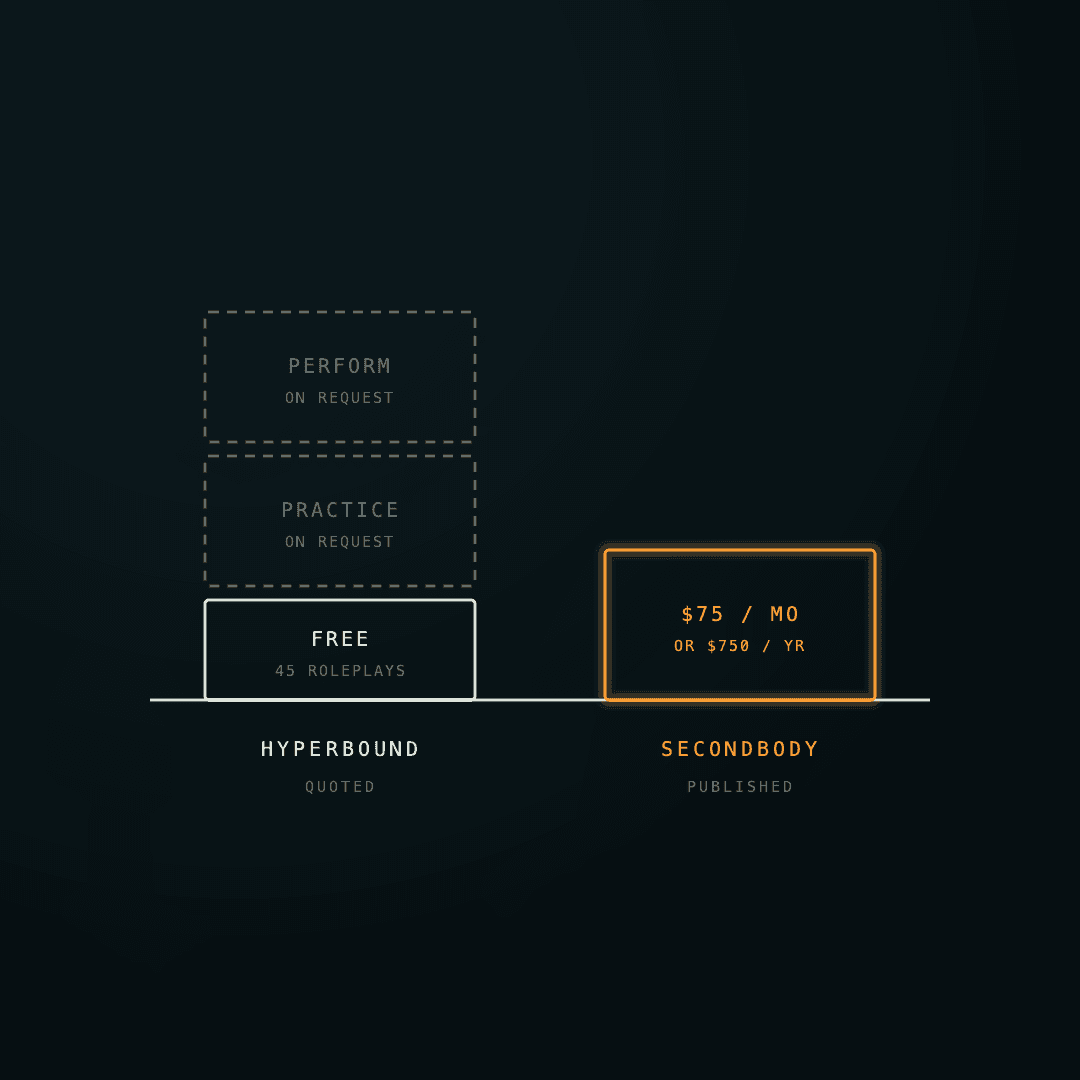
Hyperbound does not publish a paid price. As of 16 October 2026, hyperbound.ai/pricing shows three tiers:
Tier | Price shown | What you get |
|---|---|---|
Free | Free | 45 prebuilt AI roleplays (outbound, objection handling, inbound packs) and prebuilt example scorecards |
Practice | "Book a demo" (Enterprise) | Custom AI buyer bots, analytics, playlists, Kota coaching Q&A, LMS and CMS integrations, SSO and SCIM, Slack and Teams, EU data residency, implementation services |
Perform | "Book a demo" (Enterprise, recommended) | Everything in Practice plus real-call scoring, custom AI scorecards, deal-level coaching, CRM sync (HubSpot, Salesforce, Dynamics), call recorder and dialer integrations (Gong, Zoom, Orum). Live call coaching is an add-on |
The FAQ on that page says pricing is per user, Practice and Perform are separate licenses, and volume and multi-year discounts exist.
So where do the numbers floating around the internet come from? Here is what we found, ranked from most to least trustworthy:
About $63 to $70 per user per month. A competitor, Outdoo, reports that Hyperbound quoted around $70 per user per month at 50 seats and $63 at 150 seats in 2026. It does not name the source of the quote. Plausible, but second-hand.
Older "self-serve" per-seat figures. You will still find low per-seat numbers on review and comparison sites. Hyperbound's pricing page no longer shows any public price or self-serve paid tier (free tier, then quote-only), so ignore them.
Around $15,000 a year for enterprise. This number appears in Google's AI answers, attributed to Reddit and a review site. A pricing analysis on aitoolsbakery.com, checked in August 2026, says it could not trace that figure to Hyperbound at all.
What we actually believe: if you want Practice and Perform together for a real SDR team, budget for a quote in the high five figures a year once you pass 50 seats, and confirm whether the number you were given covers one license or both. The cleanest move is to ask the Hyperbound rep for the per-user figure for Practice alone and for Practice plus Perform, in writing. Comparison only works if you compare the same thing.
For contrast, and because this is what buyers ask us on calls, SecondBody publishes its price on the pricing page: $75 a month or $750 a year per seat, which includes 120 minutes of roleplay and 60 minutes of coaching with Rory each month. Teams and enterprise get custom minute packages and volume pricing. You can disagree with the price. You cannot be confused by it.
One thing we hear on sales calls that applies to every vendor here, us included: minute bundles confuse people. If a vendor sells you minutes or credits, ask what one rep doing two ten-minute roleplays a day for a month actually uses. Then multiply. That number is the honest one.
Is Hyperbound worth it?
For an SDR team that cold calls from a desk and already records its calls, Hyperbound is usually worth a serious look. For a field team, a regulated team, or a team whose biggest problem is AE discovery depth, it is usually the wrong first buy. The answer depends less on the tool and more on where your reps' conversations happen.
Here is the evidence, with the bias of each source stated.
What reviewers like. On G2, Hyperbound sits at 4.9 out of 5 from about 40 reviews. G2's own summary of the reviews (AI-generated, August 2025) says people praise the realism, the ease of use and the ability to spin up targeted scenarios on demand, and connect it to faster ramp and more consistent coaching. One reviewer, a VP of Technology quoted by Outdoo, said it "is not the cheapest solution out there" but that "you get what you pay for."
What reviewers dislike. The same G2 summary lists minor bugs, a learning curve for new users, missing global dashboards and analytics, and an AI that can be "too aggressive on objections" for beginners. Outdoo, a competitor, says reporting and dashboard flexibility is a recurring complaint across reviews about a year apart.
What practitioners say. We could not reach the Reddit threads directly, so treat this layer as second-hand. Vendor write-ups that quote r/sales describe a split: some reps say AI roleplay fixed their openers, others say the bots felt unrealistic for complex B2B calls because real buyers change direction. A competitor review page attributes an "adoption drops after month one" pattern to r/sales. We cannot verify that thread. We can tell you that pattern is real across the whole category, because we see it in our own data whenever practice depends on a rep remembering to open a tab.
The test we would run. Before you renew, pull three numbers from your Hyperbound admin view:
What share of licensed reps practised at least once a week in the last 30 days?
How many of those reps are SDRs versus AEs or field reps?
For the reps who practised most, did their real-call scores move?
If the answer to number one is above half and it is mostly SDRs, keep it. You have a working tool. If the field reps and AEs are the ones not practising, the problem is not motivation. The tool does not meet them where they sell. That is when an alternative is worth your time.
Why do teams start looking for a Hyperbound alternative?
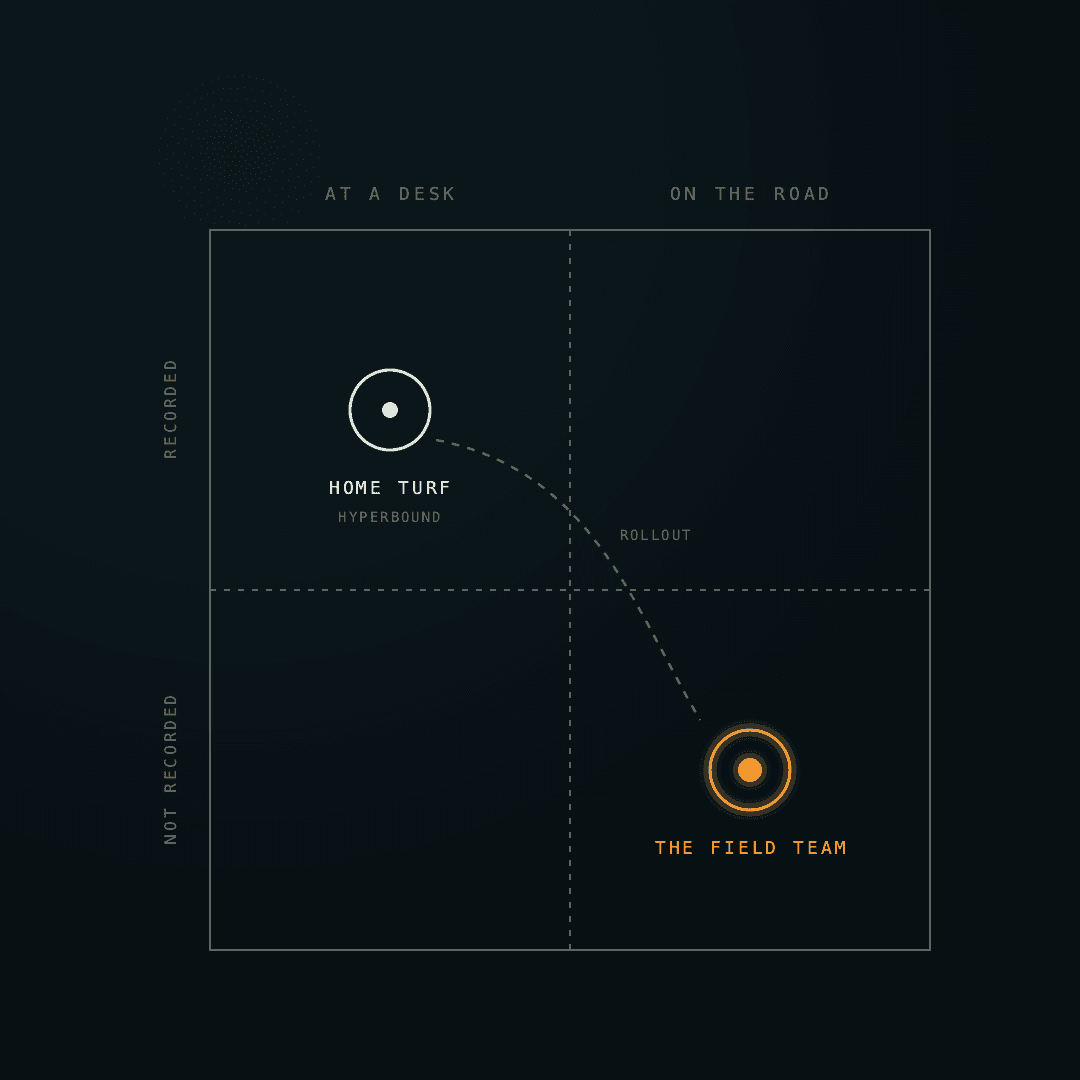
Teams look for a Hyperbound alternative when their sales motion grows past the desk-and-recording shape the tool was built around. In our sales calls this year, four situations come up again and again. For the wider decision, including suites and LMS tools, see our main guide to sales training software alternatives.
1. The field team arrives
A regional rollout or a new hiring cohort brings in reps who sell in person. Medical device reps, territory managers, retail capability teams, pest control and facilities sales. Their conversations are not on Zoom. Nothing is recorded. Their managers, as one Head of Sales Enablement put it to us, "cannot hear the conversations". Hyperbound's own site does not describe a field or in-person workflow, and its Perform loop depends on recorded calls existing in the first place.
The field rep does not need a better scorecard for a call that never got recorded. They need someone to practise with at 7:15 in the car before the first hospital visit.
2. Compliance gets involved
Regulated teams (pharma, medtech, financial services, insurance) are often fine with practice and nervous about recording. The questions we hear in procurement are always the same: what gets recorded, where does it live, who signs the DPA, is there SSO, can we set data retention. Hyperbound has good answers to several of those (SOC 2, ISO 27001, SSO, EU data residency). But a product whose best loop is "record every real call and score it" asks a compliance team for more than a practice-only rollout does. Some teams want to keep practice and real-call recording separate, at least in year one.
3. The manager has 20 reps and 40 minutes
At five reps, a manager can listen to roleplays. At 20, they cannot. Hyperbound gives managers dashboards and, on Perform, "manager coaching moments". G2 reviewers still ask for better global dashboards. What managers of large teams tell us they actually want is shorter: a one-page note before each 1:1 that says who to coach this week, on which skill, and which practice moment to replay. A dashboard is a place you have to go. A briefing comes to you.
4. The skill moves from opener to discovery
Hyperbound's prebuilt packs are outbound, objection handling and inbound, with competitive positioning in the paid tier. That covers the first two minutes of a lot of calls brilliantly. As SDRs get promoted, the hard part of their job moves later in the call. Running a discovery with three stakeholders. Handling a procurement pushback on price. Negotiating terms. You can build bots for those in Hyperbound. Teams with heavy AE needs often find themselves building and maintaining a lot of custom content to get there, and the scoring has to follow a methodology like MEDDIC rather than a cold-call checklist.
If none of these four sound like you, you may not need an alternative. You may need better adoption on the tool you have. That is a cheaper fix.
How did we judge these Hyperbound alternatives?
We judged every tool on six questions, the ones Hyperbound's own users raise when they outgrow it:
Where does practice happen? Desk only, or also phone, WhatsApp, mobile, face-to-face?
Does it need recordings? Can a team with zero recorded calls get full value?
What does the manager get? A dashboard, or a plan for the week?
How deep does it go? Openers only, or discovery, demos, negotiation and compliance-sensitive conversations?
Can you see the price? Published, quoted, or rumoured?
What is annoying about it? Every tool here has something. We name it.
We checked every price and feature on the vendor's own site on 16 October 2026. Where we use a number a third party reported, we say so. Where a competitor said something about a competitor, we treat it as an opinion, not a fact.
What are the top Hyperbound alternatives in 2026?
The top Hyperbound alternatives in 2026 are SecondBody, Second Nature, Mindtickle, Gong, Yoodli, PitchMonster, Allego and, for support teams, Solidroad. They are not interchangeable. Three are practice-first tools like Hyperbound, two are big suites that added roleplay, one is a conversation intelligence platform that added practice, one is an individual coaching app, and one is not a sales tool at all.
1. SecondBody: for field teams, regulated teams and managers who need a plan
What it is. An AI sales coaching and roleplay platform built in Paris. The coach is Rory. Rory is voice-first. Every plan gets roleplay and coaching on web and mobile. On team plans, Rory calls reps on WhatsApp or the phone: a morning warm-up, an end-of-day debrief, or on-demand practice before a big meeting, and reps do not need to log in. Managers get a one-page pre-1:1 briefing that says who to coach this week, on which skill, and which practice moments to replay.
Where it fits better than Hyperbound.
Field and in-person sellers. Rory does not need a recorded call to work. A rep in a car park can practise the hospital procurement conversation they are about to have. This is the gap we were built for. Our field sales roleplay guide goes deeper on how that works day to day.
Regulated teams. SecondBody never records customer conversations. Rory does not listen in on live calls or visits. Reps practise before and debrief after, and the only real calls coached are ones the customer chooses to upload from recordings it already owns. Team plans add SOC 2 Type II, enterprise SSO, custom data retention and 12+ languages. That is why it runs in pharma, medical devices and financial services.
Methodology-native scoring. SPIN, MEDDIC and Sandler, with team plans training Rory on your playbook and objection library. That matters once the skill is discovery, not openers.
Managers of 20+. The briefing exists because managers told us they had no time to watch roleplays.
Proof. Rentokil Terminix in the US had reps put in 16 hours of roleplay each in under three weeks with zero days off the road, and every manager backed it (the full story). At GBUK, a UK medical device supplier, reps who practised consistently scored 8 to 10 out of 10 on cold calls, against about 6 for intermittent users, and managers saved about a week a month. At Allwyn, reps at coaching standard went from 1 in 5 to 4 in 5 in a quarter. At Parkingeye, the team closed 415 contracts against a 380 target in 2025. Cyera is a customer too.
Pricing. $75 a month or $750 a year per seat, including 120 minutes of roleplay and 60 minutes of coaching with Rory a month. Team and enterprise packages are custom.
What is annoying. If your buyers expect a face on a screen and you want reps rehearsing eye contact with a photoreal video avatar, we do not do that. Rory is a voice. We think that is the right call because most selling pressure lives in the voice and the pause, but if video presence is the skill, look at Second Nature.
Versus Hyperbound in one line. Hyperbound is the better pure SDR cold-call bot for desk teams with big call libraries. SecondBody covers more of the team: field, regulated, AE-depth and the manager. Our Hyperbound vs SecondBody comparison has the side-by-side.
2. Second Nature: for teams that want avatars and structured certification
What it is. One of the older AI roleplay platforms (secondnature.ai). Reps practise with AI avatars, including newer moving and video-avatar scenarios, in more than 30 languages. It supports multi-persona meetings, certifications, a "Deal Coach" for live deals, SCORM and LTI for your LMS, SAML and CRM integrations. Customers on its site include Oracle NetSuite, GoHealth, iQor and Zoom, and its industries lean toward insurance, tech, telco, banking, education and contact centres.
Where it fits better than Hyperbound. Structured onboarding and certification across many roles, video-call practice, and teams that already live in an LMS. Second Nature's own comparison page positions it this way and concedes that Hyperbound is stronger on integration depth for teams already running Gong or Chorus. That concession is the most honest line on the page.
Pricing. Not published. Quoted after a demo. Third parties report deals starting around $20,000 a year, and one competitor reports a credit model. All second-hand.
What is annoying. G2 reviewers raise inconsistent or inaccurate AI scoring, conversations that can feel scripted or rigid, a learning curve, and language issues. One reviewer said the moving avatars "are not perfect yet". The avatar is also a screen, which means a desk.
Versus Hyperbound in one line. Pick Second Nature over Hyperbound if you need video, certification and LMS fit more than you need cold-call grit. We wrote a full guide to Second Nature alternatives if you are weighing it against others.
3. Mindtickle: for enablement teams that want one suite
What it is. A revenue enablement platform: onboarding, content, readiness scoring, coaching and, more recently, two-way AI roleplay. Mindtickle says its AI buyer pushes back and asks tough questions rather than following a fixed script, and its "Real Deal AI Role-Plays" let reps practise on their own deals using CRM data.
Where it fits better than Hyperbound. Large organisations that want readiness, certification, content and practice in one contract, with Salesforce data tying training to outcomes. If your question is "how does Hyperbound do on sales readiness and certification?", Mindtickle is the tool most buyers hold it up against.
Pricing. Not public. ZoomInfo's review says two-way AI roleplay is excluded from base packages and sold separately. We could not confirm that on Mindtickle's site, so ask.
What is annoying. It is a suite, with suite-length rollouts. Practice is one module among many, and enablement teams tell us the content side tends to eat the project. Reps still practise at a screen.
Versus Hyperbound in one line. Mindtickle is broader and heavier. Hyperbound is sharper at cold calls. Neither is built around the rep who is not at a desk.
4. Gong: for teams already paying for Gong
What it is. The best-known conversation intelligence platform. It records, transcribes and analyses real calls. Gong now also offers AI practice: its site describes turning an upcoming meeting into an AI roleplay with a persona and objections built from your real deals, plus a "dry run" to rehearse a meeting before it happens.
Where it fits better than Hyperbound. If Gong already records everything and you want practice built from the same deal data without a second vendor, this is the shortest path. Pre-meeting rehearsal on a live deal is a real use case.
Pricing. Custom quotes, platform licence plus add-ons. Reddit threads in 2026 complain about renewal tactics and cost, so negotiate the practice piece explicitly.
What is annoying. Practice is a newer feature inside a product built to look backward at calls that already happened. It needs recordings to know your deals, which brings back the field and compliance problems. And it is priced like the platform it is.
Versus Hyperbound in one line. Gong is the better choice if you live in Gong. Hyperbound remains the more focused practice tool, and it integrates with Gong anyway.
5. Yoodli: for individuals and small budgets
What it is. An AI communication and roleplay coach that started with public speaking and moved into sales roleplay, objection handling and pitch practice. It also gives feedback on uploaded recordings.
Pricing. The one tool here with clear individual prices on its pricing page: Starter with 5 lifetime roleplays, Pro at $8 a month and Advanced at $20 a month, both billed annually. Team and Enterprise are custom and add custom roleplays, methodology rubrics, manager dashboards, SSO and SCIM, and SOC 2 Type 2.
Where it fits better than Hyperbound. A single rep paying for their own practice. A small team testing whether reps will practise at all before buying a platform. If you searched "cheapest SDR coaching platform", this is the honest answer for one person.
What is annoying. The individual plans are self-service practice, not a coaching system. On the free and Pro plans, session data may be used to improve the platform, which your security team will notice. The team product is quote-based like everyone else.
Versus Hyperbound in one line. Yoodli is the cheaper way to start. Hyperbound is the deeper SDR program.
6. PitchMonster: for teams that want three practice modes and EU hosting
What it is. A European AI roleplay platform with phone, face-to-face (avatar) and screen-share roleplays, roleplays built from transcripts and recordings, custom scorecards for MEDDIC, SPIN and Sandler, certifications and leaderboards. The higher plan adds real-call analysis, an AI coach and Gong and LMS integrations. It supports 29 languages.
Where it fits better than Hyperbound. Teams that want role-play, call analysis and coaching in one package rather than two licenses, and teams that care about EU data residency by default. PitchMonster's comparison page says it onboards teams in about three to four hours.
Pricing. Quote-based per seat (pricing page). Most teams start at five or more seats, contracts usually run 12 months, and the page offers a 10% discount to teams switching from Hyperbound.
What is annoying. It is still a screen-based practice tool, so the field rep problem stays. Its own comparison page admits Hyperbound has a broader compliance set and more integrations. And a 10% switching discount tells you who it was written to win.
Versus Hyperbound in one line. PitchMonster is the closest like-for-like swap, with simpler packaging. It solves the license question, not the field question.
7. Allego: for content-heavy enablement in life sciences and manufacturing
What it is. A sales enablement platform that combines content management, conversation intelligence and "AI Role Play and Coaching". Its site lists financial services, life sciences, medical devices, insurance and manufacturing among its industries, with a GE Healthcare case study about giving employees a safe place to practise.
Where it fits better than Hyperbound. Enterprises that want content, coaching and practice in one place, especially in regulated and technical industries where the product knowledge is heavy. Allego also runs a buyout program to cover switching costs if you are mid-contract with another vendor.
Pricing. Not public. ZoomInfo reports per-user annual billing and a standard three-year term. We could not confirm the term on Allego's site.
What is annoying. Multi-year suite contracts are a big commitment for a practice problem. The roleplay is one part of a large platform, and the rep experience is still app-first.
Versus Hyperbound in one line. Allego wins on content and breadth. Hyperbound wins on the speed and sharpness of SDR practice.
8. Solidroad: if your team is support, not sales
What it is. An AI training platform for customer experience teams. It runs simulations that, in its words, "look, act, and sound like your real customers", with scorecards for empathy, process adherence and accuracy, and quality visibility across large conversation volumes. The case study on its homepage reports an 18% cut in average handling time and a 3% lift in CSAT. Pricing is demo-only.
Why it is on this list. Because buyers keep comparing it to Hyperbound. More on that below.
What is annoying. If you run a sales team, it is the wrong tool. Its homepage does not mention sales.
Which Hyperbound alternative fits which team?
Use this table. Find your situation on the left, read across. Where we list SecondBody, it is because we think it genuinely fits; where it does not fit, it is not there.
Your situation | Strongest picks | Why |
|---|---|---|
SDRs cold calling from a desk, big recorded-call library | Hyperbound, SecondBody, PitchMonster | Hyperbound's home turf. SecondBody and PitchMonster cover the same cold-call skills with simpler packaging |
Field reps who sell in person, no recordings | SecondBody | On team plans Rory calls on WhatsApp or phone, no login; nothing is ever recorded |
Regulated industry, compliance wary of recording real calls | SecondBody, Allego | Never records customer conversations; SOC 2 Type II, SSO and custom retention on team plans; Allego for content-heavy life sciences |
Managers of 20+ reps who need a weekly coaching plan | SecondBody, Mindtickle | One-page pre-1:1 briefing; Mindtickle for readiness dashboards inside a suite |
AE discovery, negotiation, MEDDIC or SPIN scoring | SecondBody, Mindtickle, PitchMonster | Methodology-native scoring and playbook-trained personas |
Video-avatar practice and certification in an LMS | Second Nature, Mindtickle | Avatars, SCORM and LTI, certifications |
Already paying for Gong, want practice on live deals | Gong, Hyperbound | Same deal data; Hyperbound integrates with Gong too |
Published price you can budget against today | SecondBody, Yoodli | $75 a month or $750 a year per seat; Yoodli for individuals |
One rep or a tiny team testing the habit | Yoodli, SecondBody | Low entry cost, monthly plans |
EU data residency by default, one license for everything | PitchMonster, SecondBody | Both European; ask each about hosting specifics |
New reps moving from clinical or operations roles into sales | SecondBody, Second Nature | Confidence first, low-stakes reps, daily cadence |
Support or CX agents, not sales | Solidroad | Built for CX QA and simulations |
Count the rows. SecondBody shows up in nine of twelve. That is not because it does everything. It is because the gaps that push people off Hyperbound (field, compliance, manager time, AE depth, price you can see) are exactly the ones we built around.
Hyperbound vs Second Nature: which one should you pick?
Pick Hyperbound if your problem is SDR cold calls from a desk and you already record calls. Pick Second Nature if your problem is structured onboarding and certification across several roles, with video-avatar practice and LMS integration. Pick neither if your reps sell in person, because both assume a rep at a screen.
This was one of the two most-shown Hyperbound queries for us in Search Console over the last month, in three wordings ("second nature vs hyperbound", "hyperbound vs second nature", "second nature ai vs hyperbound"). Here is the short comparison, from each vendor's own site:
Hyperbound | Second Nature | |
|---|---|---|
Format | Voice-first, phone-shaped calls | Video avatars, screen share and slides |
Scenarios | Prebuilt packs plus custom bots; real calls turned into practice on Perform | Generated from your decks, scripts, battlecards and recordings |
Languages | 25+ | 30+ |
Real-call scoring | Yes, on Perform | Deal Coach for live deals |
LMS | CMS and LMS integrations, SCORM | SCORM and LTI |
Price | Free tier; paid tiers on request | On request; third parties report around $20,000 a year and up |
Annoying | Missing global dashboards, bots too aggressive for beginners (G2 summary) | Inconsistent scoring, scripted feel, imperfect moving avatars (G2 reviewers) |
The thing nobody says out loud: these two tools are fighting over the same rep, the one with a headset and a monitor. If half your revenue comes from people who never sit at one, the comparison is the wrong question. Ask instead which tool reaches the rep you cannot currently coach. Then read our Second Nature alternatives guide for the rest of that side of the market.
Solidroad vs Hyperbound: which AI training tool should you pick?
If you run a sales team, pick Hyperbound (or another sales tool on this list). If you run a support or customer experience team, pick Solidroad. They solve different jobs. Solidroad trains CX agents on simulated customers and scores empathy, process and accuracy. Hyperbound trains salespeople to book meetings and handle objections.
This query surprised us. "solidroad vs hyperbound, which ai sales training tool should i pick?" tied for our most-shown Hyperbound query in the last four weeks. We think two things are going on. First, AI answer engines lump every "AI roleplay" vendor into one bucket, so a buyer asking for help gets both names back. Second, some companies have a sales floor and a support floor under one L&D leader, and that leader wants one vendor.
Here is how to decide:
Your people are trying to win new revenue (book a meeting, run discovery, close). That is sales. Solidroad is not built for it.
Your people are resolving a customer's issue within policy, on handle time and CSAT. That is support. Hyperbound is not built for it.
Your people do both (account managers handling renewals and complaints, retail staff upselling at the counter). Then you need a tool whose personas and scorecards you can shape to both conversations. Ask each vendor to build one sales scenario and one service scenario from your material in the demo. Whoever does both convincingly is your answer.
On SecondBody, team plans train Rory on your playbook and objection library, and we work with retail capability managers whose teams sell and serve in the same shift. That is the closest a sales coaching tool gets to the Solidroad overlap.
How does Hyperbound compare with Mindtickle and Gong?
Hyperbound is a focused practice and call-scoring tool. Mindtickle is an enablement suite that added roleplay. Gong is a conversation intelligence platform that added roleplay. Hyperbound is usually sharper at SDR practice. Mindtickle is usually stronger at readiness, certification and content. Gong is usually stronger at analysing what happened on real calls.
Some of the strangest queries that bring buyers to us are lists like "ai sales coaching tools competitors 2026 gong allego lessonly brainshark rehearsal saleshood hyperbound". That is someone pasting a vendor shortlist into a search box and asking a machine to sort it. Here is the sort:
Looking backward (what happened on the call): Gong, Chorus, and Hyperbound Perform. These need recordings.
Organising knowledge (what reps should know): Mindtickle, Allego, Seismic (its merger with Highspot was announced in February 2026 and closed in August 2026), Lessonly and Brainshark-era tools. These are content and readiness systems.
Training forward (what reps can do under pressure, before the call): Hyperbound Practice, Second Nature, PitchMonster, Yoodli, SecondBody. These are practice.
Most stacks need one of each eventually. The mistake is buying a backward tool and expecting forward behaviour change, or buying a knowledge tool and expecting reps to perform when the buyer goes quiet. Reps do not lack knowledge. They lack execution under pressure. A recording can show you the freeze. Only practice changes what happens next time.
On "mindtickle vs hyperbound" specifically: if your enablement team already runs Mindtickle and wants roleplay, check whether two-way AI roleplay is in your package before buying another tool. If it is not, you are comparing a Mindtickle add-on quote to a Hyperbound Practice quote, which is a fair fight. If your SDR leader wants something reps will open every day, the focused tool usually wins on usage.
What do field reps need that a desk-first tool cannot give them?
Field reps need practice that reaches them where they are (in the car, between visits, on a phone), works without recordings, and fits into five-minute gaps. A desk-first tool asks them to come to a laptop. Most will not, and it is not laziness.
Picture a medtech rep. First visit at 8:30 at a hospital forty minutes away. Second at 11:00, procurement, who has already said the budget is frozen. Lunch in the car. Two clinics in the afternoon. The rep's day has no 30-minute block with a laptop, a headset and quiet. It has a lot of 6-minute blocks with a phone.
Now look at the loop desk tools are built on. Record real calls, score them, find weak moments, assign practice, practise at a screen. For this rep, step one never happens. The calls are face to face. Nobody records a conversation in a hospital corridor, and compliance would not want them to. So the scoring loop has nothing to score, and the practice assignment lands in an inbox the rep reads at 9pm.
What works for field teams, based on our rollouts:
The coach calls the rep, not the other way round. A two-minute warm-up call at 7:45, a debrief at 5:30. On team plans, Rory reaches reps on WhatsApp or the phone, so there is nothing to install and no password to forget.
Practise the next meeting, not a generic one. "My 11:00 is a procurement lead who will say the budget is frozen." Five minutes of that beats an hour of generic objection drills.
Debrief replaces the recording. If the real conversation cannot be recorded, the rep tells the coach how it went while it is fresh. That debrief is the data.
Managers coach from practice, not from calls they never heard. The weekly briefing tells the regional manager where each rep stumbled in practice, so a 20-minute ride-along or 1:1 has a target.
Rentokil Terminix is the cleanest example we have. Reps put in 16 hours of roleplay each in under three weeks, and not one day came off the road. That number is only possible when the practice fits inside the day instead of on top of it. For the full playbook, read our guide to AI sales roleplay for field sales.
What should regulated teams ask before anything gets recorded?
Regulated teams should separate two questions: is practice data safe, and does this tool need us to record real customer conversations? Many teams can say yes to the first and no to the second. A tool that delivers full value from practice alone is easier to approve.
In pharma, medtech, financial services and insurance, the procurement call always arrives at the same list. Use it on every vendor here, Hyperbound included:
What is recorded, exactly? Practice audio only, or real customer calls? Can real-call recording be switched off entirely and still leave a useful product?
Where does it live and for how long? Data residency (EU, US), retention you can set, deletion on request.
Is practice data used to train shared models? Some individual plans in this market (Yoodli's free and Pro tiers, for example) say session data may be used to improve the platform. Enterprise plans usually exclude it. Get it in writing.
Certifications. SOC 2 Type II at minimum. ISO 27001 where your security team asks. Hyperbound lists SOC 2 and ISO 27001. SecondBody team plans include SOC 2 Type II.
Access. Enterprise SSO, SCIM provisioning, role-based permissions.
Paperwork. DPA, NDA and a subprocessor list before the pilot, not after.
Content guardrails. Can scenarios be built around approved claims, so reps rehearse what they are allowed to say and nothing else?
That last one matters more than people think. In a regulated sale, the risk is a rep improvising a claim under pressure. Practice is where you make the compliant answer the reflex. Our trust center lists how SecondBody handles each of these.
How do you prove the switch pays back?
You prove it with leading indicators in weeks and revenue in quarters. Pick one number to move, measure it on a small group before and after, and show your CFO the practice minutes alongside it. The biggest objection we hear on sales calls is not price. It is "how do we prove we make our money back when reps are off the phones to practise?"
Here is the honest frame.
The vendor case. Every vendor here, us included, has impressive numbers. Hyperbound's site talks about faster ramp. Second Nature claims faster ramp and more deals. Our customers report real results: GBUK's consistent users scored 8 to 10 out of 10 on cold calls against about 6 for intermittent users; Allwyn's reps grew 3.5% while their market fell 4%, with ramp 65% faster; Parkingeye hit 415 contracts against a 380 target.
The skeptic's case. Customer stories are chosen. A gap between consistent and intermittent users partly reflects who chose to practise, not only what practice did. The teams that got results were often the teams with a manager who cared, a hiring wave that forced change, or a good quarter in the market. You should assume the vendor number is the top of the range, not the middle.
What we actually believe. Practice moves behaviour fast and revenue slowly. You will see confidence, readiness scores and call-quality scores move in two to four weeks. Revenue follows in a quarter or two, and it is muddier. So agree up front that weeks one to four are judged on leading indicators and months three to six on pipeline. Do not let anyone judge a practice tool on revenue after 14 days.
The time-off-the-phones math. A rep doing ten minutes of practice a day spends under an hour a week. If that hour lifts the conversion of even a handful of the 50 to 100 dials or meetings they have that week, it pays back. For field reps it is cleaner still: practice in the car costs no selling time at all. That is why "zero days off the road" was the line Rentokil Terminix's leaders cared about.
What closed our deals. A small scoped pilot (10 new joiners, two weeks, one number to move), a named content owner on the customer side, and leading indicators reported weekly. That brings us to the mistakes.
What mistakes do teams make when they switch?
Most switching mistakes repeat the original rollout's mistakes with a new logo. These are the ones we have watched happen, at our customers and at teams who came to us from other tools.
Blaming the tool for an ownership problem. We have watched a team cancel a practice tool because nobody owned the content. The bots went stale, the reps noticed, usage died. A new vendor will not fix that. Name a content owner before you sign.
Switching everyone at once. If your SDRs are happy on Hyperbound, leave them. Bring the alternative in for the team Hyperbound does not reach, usually field or AEs. Two tools for two jobs is fine. Ripping out the one that works to prove a point is not.
Judging on the demo bot. Every vendor's demo bot is great. Ask them to build a persona from your objection list during the trial and judge that.
Ignoring where practice happens. If the alternative still needs a laptop and a quiet room, your field adoption numbers will look exactly like they do today.
Comparing quotes that are not the same thing. One license versus two, minutes versus seats, implementation included or not. Normalise to cost per rep per month for the same usage.
Measuring logins, not reps. "We had 2,000 sessions" means nothing if 20 reps did all of them. Measure the share of reps who practised at least three times a week.
Forgetting the manager. If managers do not use the output in their 1:1s, reps learn the practice does not matter. The manager is the adoption engine.
How do you run a two-week bake-off?
Run it on one team, with one number, for two weeks. Pick the group the current tool does not serve, give each finalist the same scenarios, and judge on usage and the number you chose. Here is the plan we give buyers, and it works for any vendor on this list.
Before day 1. Choose 10 reps (new joiners are ideal; it is how many of our pilots start). Choose one number: cold-call score, discovery quality score, or time to first booked meeting. Name the content owner. Send each vendor your top 10 objections and one real scenario.
Days 1 to 3. Reps do their first sessions. Watch who needs a login, who needs a headset, who needs a laptop. Every bit of friction you see here gets ten times worse at 200 reps.
Days 4 to 7. Daily practice, ten minutes. Managers get whatever the tool gives them. Ask managers one question on day 7: did this change what you said in a 1:1 this week?
Days 8 to 10. Add a hard scenario: the procurement pushback, the compliance-sensitive question, the multi-stakeholder discovery. This is where cold-call bots and deeper tools separate.
Days 11 to 14. Measure. Share of reps practising three or more times a week. Movement on your one number. Manager answer from day 7. Rep answer to "would you keep using this if nobody made you?"
Then pick. If you want the broader shortlist before the bake-off, our guide to cold calling training for sales teams covers the drills worth putting in any trial.
Frequently asked questions
What are the top Hyperbound alternatives?
SecondBody, Second Nature, Mindtickle, Gong, Yoodli, PitchMonster and Allego for sales teams, and Solidroad for support teams. The right one depends on whether your gap is field reps, compliance, manager time, AE depth, video avatars, suite breadth or budget.
Is there a free version of Hyperbound?
Yes. Hyperbound's Free plan includes 45 prebuilt AI roleplays across outbound, objection handling and inbound packs, plus example scorecards. Custom bots, analytics, integrations and real-call scoring need a paid Practice or Perform license, priced on request.
What do Hyperbound reviews say?
Hyperbound has a 4.9 out of 5 on G2 from about 40 reviews. Reviewers praise realism and ease of use. G2's summary of complaints mentions minor bugs, a learning curve, missing global dashboards and objections that can feel too aggressive for beginners.
Does Hyperbound work for field sales?
Hyperbound's site does not describe a field or in-person workflow, and its real-call scoring depends on recorded calls. Field reps can use the practice bots at a laptop, but tools that reach reps on the phone or WhatsApp without recordings tend to fit field teams better.
Does Hyperbound score real calls?
Yes, on the Perform license. It connects to call recorders and dialers such as Gong, Zoom and Orum, scores calls against custom scorecards, and turns weak moments into practice. Live call coaching is a separate add-on.
Itero vs Hyperbound: what is the difference?
Itero scores real calls against criteria you define and lets reps re-run recorded conversations as simulations, with a Gong integration. Hyperbound does both practice and real-call scoring across two licenses. If your workflow starts from recorded Gong calls, compare both on that loop specifically.
How does AmpUp compare to Hyperbound for meeting preparation and call analysis?
AmpUp positions itself around deal-specific prep: a brief before each call, a debrief after, and roleplays built from your pipeline, including a phone version. Hyperbound is stronger on SDR roleplay and structured real-call scoring. AmpUp's performance claims are self-reported, so test both on one live deal.
What is the cheapest SDR coaching platform?
For one rep, Yoodli's Pro plan at $8 a month (billed annually) is the cheapest roleplay option we found with a published price. For a team that wants manager visibility and methodology scoring at a price you can see today, SecondBody is $75 a month or $750 a year per seat.
How many languages does Hyperbound support?
Hyperbound says it supports 25+ languages, including Spanish, Mandarin, Hindi and Japanese, with more on request. Second Nature lists 30+, PitchMonster 29, and SecondBody 12+ on team plans.
Can we run Hyperbound and another tool side by side?
Yes, and often you should. Keep Hyperbound where it works (usually desk SDRs) and add a second tool for the team it does not reach (usually field reps or AEs). Two focused tools for two jobs usually beat one tool forced onto both.
How is SecondBody different from Hyperbound?
SecondBody never records customer conversations, and on team plans Rory calls reps on WhatsApp or the phone with no login. It scores on SPIN, MEDDIC or Sandler, and gives managers a one-page briefing before each 1:1. Hyperbound is a sharper fit for desk SDR teams with large call libraries.
How much does SecondBody cost?
$75 a month or $750 a year per seat, including 120 minutes of roleplay and 60 minutes of coaching with Rory each month. Team and enterprise plans add custom minute packages, Rory on WhatsApp and phone, Rory trained on your playbook, SSO, SOC 2 Type II, custom data retention and a dedicated customer success manager. You can book a demo or start on a plan today.
Does SecondBody record our real customer calls?
No. SecondBody never records customer conversations, and Rory does not listen in on live calls or visits. Reps practise before and debrief after. The only real calls coached are ones you choose to upload from recordings you already own. Team plans add SOC 2 Type II, SSO and custom retention.
How we know this
Every price and feature in this article was checked on the vendor's own website on 16 October 2026. Where a number came from a third party or a competitor, we said so and named them. G2 themes come from G2's published summary of Hyperbound reviews. We could not reach Reddit threads directly, so practitioner sentiment is marked as second-hand. The buyer objections come from 20 of our own sales calls with enablement and sales leaders between January and September 2026, anonymised. The search patterns come from our own Google Search Console data for 14 September to 11 October 2026. Customer results come from our public customer stories. We sell one of the tools on this list, and we have tried to write the article we would want to read if we were buying.
Practice where the conversation actually happens
Hyperbound did something useful for a lot of SDR teams. It made cold-call practice normal. If your reps sit at desks and your calls are recorded, it may still be the right tool, and nothing here should talk you out of it.
But selling did not stay at the desk. It is in the car before the hospital visit, in the corridor before procurement, in the four minutes before the call your quarter depends on. The rep in that moment does not need a dashboard or a recording. They need a rehearsal, right now, with someone who sounds like the buyer and tells them the truth.
If you are weighing every option, our main guide to sales training software alternatives is the place to compare them all side by side. If the gap you are trying to close is the field rep, the regulated conversation or the manager with 20 reps and no time, that is the problem SecondBody was built to solve, by putting Rory on the rep's phone before the call instead of behind it. Book a demo and bring your hardest objection.
Good luck out there.
Omid
By Omid, founder of SecondBody
Key answers, up front
Short answer: the best Hyperbound alternative depends on what Hyperbound is not doing for you. For field reps, regulated teams and managers who need a weekly coaching plan, look at SecondBody. For video-avatar practice, Second Nature. For a full enablement suite, Mindtickle or Allego. For practice tied to recorded deals inside an existing Gong contract, Gong. For a cheap individual tool, Yoodli. For phone, face-to-face and screen-share modes in one package with EU data residency, PitchMonster. If you run a support team rather than a sales team, Solidroad.
How much does Hyperbound cost? Hyperbound does not publish a paid price. Its pricing page shows a Free plan (45 prebuilt roleplays) and two paid licenses, Practice and Perform, both priced on request. Figures you see elsewhere come from third parties and competitors, not from Hyperbound. Treat them as rumors until you have a quote.
Is Hyperbound worth it? For SDRs cold calling from a desk, often yes. It has a 4.9 out of 5 on G2 from about 40 reviews. It is weaker when the conversation happens in a car park, a hospital corridor or a client's office, when nothing gets recorded, and when the skill you need is a 45-minute discovery call rather than a 90-second opener.
Who is SecondBody for? Teams that want voice-first practice scored on SPIN, MEDDIC or Sandler, that never records customer conversations, with a one-page briefing for the manager before every 1:1. On team plans, Rory calls reps on WhatsApp or the phone with no login. $75 a month or $750 a year per seat, with custom team packages.
It is 7:40 on a Tuesday. Your SDR pod is on their third roleplay of the morning. The bot just said "send me an email" and every rep in the room has a decent answer now. Six weeks ago they did not. The tool worked.
Then your VP asks the obvious question. Can we roll this out to the field team? The 40 people who sell in person, who spend their day in the car, who have never had a single call recorded because there is nothing to record?
And you realise the tool that fixed your openers was built for a different room.
That is the honest story behind most "Hyperbound alternatives" searches. Nobody is running from Hyperbound because it is bad. They are running into the edge of what it was built for. This guide maps that edge, profiles eight tools that sit on the other side of it, and gives you a table to pick from.
We build one of these tools, so read on with that in mind. I will be fair to Hyperbound, and harder on the category than most vendor blogs are. If you want the wider view across every sales training platform, not just the ones that replace Hyperbound, our main guide to sales training software alternatives covers the whole field.
Here is something worth knowing before you read any list, including this one. In the last four weeks, Google showed secondbody.ai for 21 different Hyperbound searches and we got zero clicks on any of them. The two most-shown queries were not "hyperbound alternatives". They were "second nature vs hyperbound" and a full sentence: "solidroad vs hyperbound, which ai sales training tool should i pick?" Buyers are not browsing. They are asking a search engine to make a call for them. So this article makes calls.
What is Hyperbound, and what is it actually good at?
Hyperbound is an AI sales roleplay and coaching platform. Reps practise calls against AI buyers, get scored on a scorecard built around your methodology, and, on the higher license, get their real calls scored too. It is voice-first and phone-shaped. It came out of Y Combinator, and its homepage claims more than 100,000 reps in over 40 countries, with logos like LinkedIn, Workday, Klaviyo and Vanta.
Today it sells three things:
Hyperbound Practice. The roleplay product. AI buyer bots, a bot builder, scorecards, playlists, analytics, and integrations with LMS and content tools like Seismic, Highspot and WorkRamp.
Hyperbound Perform. Real-call scoring. It plugs into Gong, Zoom, Orum and your CRM, scores recorded calls against custom scorecards, writes summaries and follow-up drafts, and turns weak moments in real calls into practice. Hyperbound's own pricing page says "measurable improvement only comes from running the two together."
Kota Activate. A coaching agent that pulls calls, roleplays, email, CRM and Slack together into next steps.
What it is genuinely good at:
Cold-call reps at a desk. This is home turf. The bots interrupt, push back, hang up. The scoring is tuned to openers, objection handling and booking the meeting. Most third-party comparisons, even the ones written by competitors, concede this point. Second Nature's own comparison page calls Hyperbound "audio-first by design" and frames it as the SDR and outbound pick.
Teams with a big recorded-call library. If you already record every call through Gong or Zoom, Perform can score those calls and feed the gaps back into practice. That loop is real and it is useful.
Speed to a first bot. Hyperbound says a first bot and scorecard take under 10 minutes, with full personas and modules averaging about two weeks.
Security basics. The site lists SOC 2 and ISO 27001, and the paid tiers include SSO with SCIM and EU data residency.
Hold on to two words from that list: "desk" and "recorded". Every gap we cover later lives in the absence of one of them.
How much does Hyperbound cost?
Hyperbound does not publish a paid price. As of 16 October 2026, hyperbound.ai/pricing shows three tiers:
Tier | Price shown | What you get |
|---|---|---|
Free | Free | 45 prebuilt AI roleplays (outbound, objection handling, inbound packs) and prebuilt example scorecards |
Practice | "Book a demo" (Enterprise) | Custom AI buyer bots, analytics, playlists, Kota coaching Q&A, LMS and CMS integrations, SSO and SCIM, Slack and Teams, EU data residency, implementation services |
Perform | "Book a demo" (Enterprise, recommended) | Everything in Practice plus real-call scoring, custom AI scorecards, deal-level coaching, CRM sync (HubSpot, Salesforce, Dynamics), call recorder and dialer integrations (Gong, Zoom, Orum). Live call coaching is an add-on |
The FAQ on that page says pricing is per user, Practice and Perform are separate licenses, and volume and multi-year discounts exist.
So where do the numbers floating around the internet come from? Here is what we found, ranked from most to least trustworthy:
About $63 to $70 per user per month. A competitor, Outdoo, reports that Hyperbound quoted around $70 per user per month at 50 seats and $63 at 150 seats in 2026. It does not name the source of the quote. Plausible, but second-hand.
Older "self-serve" per-seat figures. You will still find low per-seat numbers on review and comparison sites. Hyperbound's pricing page no longer shows any public price or self-serve paid tier (free tier, then quote-only), so ignore them.
Around $15,000 a year for enterprise. This number appears in Google's AI answers, attributed to Reddit and a review site. A pricing analysis on aitoolsbakery.com, checked in August 2026, says it could not trace that figure to Hyperbound at all.
What we actually believe: if you want Practice and Perform together for a real SDR team, budget for a quote in the high five figures a year once you pass 50 seats, and confirm whether the number you were given covers one license or both. The cleanest move is to ask the Hyperbound rep for the per-user figure for Practice alone and for Practice plus Perform, in writing. Comparison only works if you compare the same thing.
For contrast, and because this is what buyers ask us on calls, SecondBody publishes its price on the pricing page: $75 a month or $750 a year per seat, which includes 120 minutes of roleplay and 60 minutes of coaching with Rory each month. Teams and enterprise get custom minute packages and volume pricing. You can disagree with the price. You cannot be confused by it.
One thing we hear on sales calls that applies to every vendor here, us included: minute bundles confuse people. If a vendor sells you minutes or credits, ask what one rep doing two ten-minute roleplays a day for a month actually uses. Then multiply. That number is the honest one.
Is Hyperbound worth it?
For an SDR team that cold calls from a desk and already records its calls, Hyperbound is usually worth a serious look. For a field team, a regulated team, or a team whose biggest problem is AE discovery depth, it is usually the wrong first buy. The answer depends less on the tool and more on where your reps' conversations happen.
Here is the evidence, with the bias of each source stated.
What reviewers like. On G2, Hyperbound sits at 4.9 out of 5 from about 40 reviews. G2's own summary of the reviews (AI-generated, August 2025) says people praise the realism, the ease of use and the ability to spin up targeted scenarios on demand, and connect it to faster ramp and more consistent coaching. One reviewer, a VP of Technology quoted by Outdoo, said it "is not the cheapest solution out there" but that "you get what you pay for."
What reviewers dislike. The same G2 summary lists minor bugs, a learning curve for new users, missing global dashboards and analytics, and an AI that can be "too aggressive on objections" for beginners. Outdoo, a competitor, says reporting and dashboard flexibility is a recurring complaint across reviews about a year apart.
What practitioners say. We could not reach the Reddit threads directly, so treat this layer as second-hand. Vendor write-ups that quote r/sales describe a split: some reps say AI roleplay fixed their openers, others say the bots felt unrealistic for complex B2B calls because real buyers change direction. A competitor review page attributes an "adoption drops after month one" pattern to r/sales. We cannot verify that thread. We can tell you that pattern is real across the whole category, because we see it in our own data whenever practice depends on a rep remembering to open a tab.
The test we would run. Before you renew, pull three numbers from your Hyperbound admin view:
What share of licensed reps practised at least once a week in the last 30 days?
How many of those reps are SDRs versus AEs or field reps?
For the reps who practised most, did their real-call scores move?
If the answer to number one is above half and it is mostly SDRs, keep it. You have a working tool. If the field reps and AEs are the ones not practising, the problem is not motivation. The tool does not meet them where they sell. That is when an alternative is worth your time.
Why do teams start looking for a Hyperbound alternative?
Teams look for a Hyperbound alternative when their sales motion grows past the desk-and-recording shape the tool was built around. In our sales calls this year, four situations come up again and again. For the wider decision, including suites and LMS tools, see our main guide to sales training software alternatives.
1. The field team arrives
A regional rollout or a new hiring cohort brings in reps who sell in person. Medical device reps, territory managers, retail capability teams, pest control and facilities sales. Their conversations are not on Zoom. Nothing is recorded. Their managers, as one Head of Sales Enablement put it to us, "cannot hear the conversations". Hyperbound's own site does not describe a field or in-person workflow, and its Perform loop depends on recorded calls existing in the first place.
The field rep does not need a better scorecard for a call that never got recorded. They need someone to practise with at 7:15 in the car before the first hospital visit.
2. Compliance gets involved
Regulated teams (pharma, medtech, financial services, insurance) are often fine with practice and nervous about recording. The questions we hear in procurement are always the same: what gets recorded, where does it live, who signs the DPA, is there SSO, can we set data retention. Hyperbound has good answers to several of those (SOC 2, ISO 27001, SSO, EU data residency). But a product whose best loop is "record every real call and score it" asks a compliance team for more than a practice-only rollout does. Some teams want to keep practice and real-call recording separate, at least in year one.
3. The manager has 20 reps and 40 minutes
At five reps, a manager can listen to roleplays. At 20, they cannot. Hyperbound gives managers dashboards and, on Perform, "manager coaching moments". G2 reviewers still ask for better global dashboards. What managers of large teams tell us they actually want is shorter: a one-page note before each 1:1 that says who to coach this week, on which skill, and which practice moment to replay. A dashboard is a place you have to go. A briefing comes to you.
4. The skill moves from opener to discovery
Hyperbound's prebuilt packs are outbound, objection handling and inbound, with competitive positioning in the paid tier. That covers the first two minutes of a lot of calls brilliantly. As SDRs get promoted, the hard part of their job moves later in the call. Running a discovery with three stakeholders. Handling a procurement pushback on price. Negotiating terms. You can build bots for those in Hyperbound. Teams with heavy AE needs often find themselves building and maintaining a lot of custom content to get there, and the scoring has to follow a methodology like MEDDIC rather than a cold-call checklist.
If none of these four sound like you, you may not need an alternative. You may need better adoption on the tool you have. That is a cheaper fix.
How did we judge these Hyperbound alternatives?
We judged every tool on six questions, the ones Hyperbound's own users raise when they outgrow it:
Where does practice happen? Desk only, or also phone, WhatsApp, mobile, face-to-face?
Does it need recordings? Can a team with zero recorded calls get full value?
What does the manager get? A dashboard, or a plan for the week?
How deep does it go? Openers only, or discovery, demos, negotiation and compliance-sensitive conversations?
Can you see the price? Published, quoted, or rumoured?
What is annoying about it? Every tool here has something. We name it.
We checked every price and feature on the vendor's own site on 16 October 2026. Where we use a number a third party reported, we say so. Where a competitor said something about a competitor, we treat it as an opinion, not a fact.
What are the top Hyperbound alternatives in 2026?
The top Hyperbound alternatives in 2026 are SecondBody, Second Nature, Mindtickle, Gong, Yoodli, PitchMonster, Allego and, for support teams, Solidroad. They are not interchangeable. Three are practice-first tools like Hyperbound, two are big suites that added roleplay, one is a conversation intelligence platform that added practice, one is an individual coaching app, and one is not a sales tool at all.
1. SecondBody: for field teams, regulated teams and managers who need a plan
What it is. An AI sales coaching and roleplay platform built in Paris. The coach is Rory. Rory is voice-first. Every plan gets roleplay and coaching on web and mobile. On team plans, Rory calls reps on WhatsApp or the phone: a morning warm-up, an end-of-day debrief, or on-demand practice before a big meeting, and reps do not need to log in. Managers get a one-page pre-1:1 briefing that says who to coach this week, on which skill, and which practice moments to replay.
Where it fits better than Hyperbound.
Field and in-person sellers. Rory does not need a recorded call to work. A rep in a car park can practise the hospital procurement conversation they are about to have. This is the gap we were built for. Our field sales roleplay guide goes deeper on how that works day to day.
Regulated teams. SecondBody never records customer conversations. Rory does not listen in on live calls or visits. Reps practise before and debrief after, and the only real calls coached are ones the customer chooses to upload from recordings it already owns. Team plans add SOC 2 Type II, enterprise SSO, custom data retention and 12+ languages. That is why it runs in pharma, medical devices and financial services.
Methodology-native scoring. SPIN, MEDDIC and Sandler, with team plans training Rory on your playbook and objection library. That matters once the skill is discovery, not openers.
Managers of 20+. The briefing exists because managers told us they had no time to watch roleplays.
Proof. Rentokil Terminix in the US had reps put in 16 hours of roleplay each in under three weeks with zero days off the road, and every manager backed it (the full story). At GBUK, a UK medical device supplier, reps who practised consistently scored 8 to 10 out of 10 on cold calls, against about 6 for intermittent users, and managers saved about a week a month. At Allwyn, reps at coaching standard went from 1 in 5 to 4 in 5 in a quarter. At Parkingeye, the team closed 415 contracts against a 380 target in 2025. Cyera is a customer too.
Pricing. $75 a month or $750 a year per seat, including 120 minutes of roleplay and 60 minutes of coaching with Rory a month. Team and enterprise packages are custom.
What is annoying. If your buyers expect a face on a screen and you want reps rehearsing eye contact with a photoreal video avatar, we do not do that. Rory is a voice. We think that is the right call because most selling pressure lives in the voice and the pause, but if video presence is the skill, look at Second Nature.
Versus Hyperbound in one line. Hyperbound is the better pure SDR cold-call bot for desk teams with big call libraries. SecondBody covers more of the team: field, regulated, AE-depth and the manager. Our Hyperbound vs SecondBody comparison has the side-by-side.
2. Second Nature: for teams that want avatars and structured certification
What it is. One of the older AI roleplay platforms (secondnature.ai). Reps practise with AI avatars, including newer moving and video-avatar scenarios, in more than 30 languages. It supports multi-persona meetings, certifications, a "Deal Coach" for live deals, SCORM and LTI for your LMS, SAML and CRM integrations. Customers on its site include Oracle NetSuite, GoHealth, iQor and Zoom, and its industries lean toward insurance, tech, telco, banking, education and contact centres.
Where it fits better than Hyperbound. Structured onboarding and certification across many roles, video-call practice, and teams that already live in an LMS. Second Nature's own comparison page positions it this way and concedes that Hyperbound is stronger on integration depth for teams already running Gong or Chorus. That concession is the most honest line on the page.
Pricing. Not published. Quoted after a demo. Third parties report deals starting around $20,000 a year, and one competitor reports a credit model. All second-hand.
What is annoying. G2 reviewers raise inconsistent or inaccurate AI scoring, conversations that can feel scripted or rigid, a learning curve, and language issues. One reviewer said the moving avatars "are not perfect yet". The avatar is also a screen, which means a desk.
Versus Hyperbound in one line. Pick Second Nature over Hyperbound if you need video, certification and LMS fit more than you need cold-call grit. We wrote a full guide to Second Nature alternatives if you are weighing it against others.
3. Mindtickle: for enablement teams that want one suite
What it is. A revenue enablement platform: onboarding, content, readiness scoring, coaching and, more recently, two-way AI roleplay. Mindtickle says its AI buyer pushes back and asks tough questions rather than following a fixed script, and its "Real Deal AI Role-Plays" let reps practise on their own deals using CRM data.
Where it fits better than Hyperbound. Large organisations that want readiness, certification, content and practice in one contract, with Salesforce data tying training to outcomes. If your question is "how does Hyperbound do on sales readiness and certification?", Mindtickle is the tool most buyers hold it up against.
Pricing. Not public. ZoomInfo's review says two-way AI roleplay is excluded from base packages and sold separately. We could not confirm that on Mindtickle's site, so ask.
What is annoying. It is a suite, with suite-length rollouts. Practice is one module among many, and enablement teams tell us the content side tends to eat the project. Reps still practise at a screen.
Versus Hyperbound in one line. Mindtickle is broader and heavier. Hyperbound is sharper at cold calls. Neither is built around the rep who is not at a desk.
4. Gong: for teams already paying for Gong
What it is. The best-known conversation intelligence platform. It records, transcribes and analyses real calls. Gong now also offers AI practice: its site describes turning an upcoming meeting into an AI roleplay with a persona and objections built from your real deals, plus a "dry run" to rehearse a meeting before it happens.
Where it fits better than Hyperbound. If Gong already records everything and you want practice built from the same deal data without a second vendor, this is the shortest path. Pre-meeting rehearsal on a live deal is a real use case.
Pricing. Custom quotes, platform licence plus add-ons. Reddit threads in 2026 complain about renewal tactics and cost, so negotiate the practice piece explicitly.
What is annoying. Practice is a newer feature inside a product built to look backward at calls that already happened. It needs recordings to know your deals, which brings back the field and compliance problems. And it is priced like the platform it is.
Versus Hyperbound in one line. Gong is the better choice if you live in Gong. Hyperbound remains the more focused practice tool, and it integrates with Gong anyway.
5. Yoodli: for individuals and small budgets
What it is. An AI communication and roleplay coach that started with public speaking and moved into sales roleplay, objection handling and pitch practice. It also gives feedback on uploaded recordings.
Pricing. The one tool here with clear individual prices on its pricing page: Starter with 5 lifetime roleplays, Pro at $8 a month and Advanced at $20 a month, both billed annually. Team and Enterprise are custom and add custom roleplays, methodology rubrics, manager dashboards, SSO and SCIM, and SOC 2 Type 2.
Where it fits better than Hyperbound. A single rep paying for their own practice. A small team testing whether reps will practise at all before buying a platform. If you searched "cheapest SDR coaching platform", this is the honest answer for one person.
What is annoying. The individual plans are self-service practice, not a coaching system. On the free and Pro plans, session data may be used to improve the platform, which your security team will notice. The team product is quote-based like everyone else.
Versus Hyperbound in one line. Yoodli is the cheaper way to start. Hyperbound is the deeper SDR program.
6. PitchMonster: for teams that want three practice modes and EU hosting
What it is. A European AI roleplay platform with phone, face-to-face (avatar) and screen-share roleplays, roleplays built from transcripts and recordings, custom scorecards for MEDDIC, SPIN and Sandler, certifications and leaderboards. The higher plan adds real-call analysis, an AI coach and Gong and LMS integrations. It supports 29 languages.
Where it fits better than Hyperbound. Teams that want role-play, call analysis and coaching in one package rather than two licenses, and teams that care about EU data residency by default. PitchMonster's comparison page says it onboards teams in about three to four hours.
Pricing. Quote-based per seat (pricing page). Most teams start at five or more seats, contracts usually run 12 months, and the page offers a 10% discount to teams switching from Hyperbound.
What is annoying. It is still a screen-based practice tool, so the field rep problem stays. Its own comparison page admits Hyperbound has a broader compliance set and more integrations. And a 10% switching discount tells you who it was written to win.
Versus Hyperbound in one line. PitchMonster is the closest like-for-like swap, with simpler packaging. It solves the license question, not the field question.
7. Allego: for content-heavy enablement in life sciences and manufacturing
What it is. A sales enablement platform that combines content management, conversation intelligence and "AI Role Play and Coaching". Its site lists financial services, life sciences, medical devices, insurance and manufacturing among its industries, with a GE Healthcare case study about giving employees a safe place to practise.
Where it fits better than Hyperbound. Enterprises that want content, coaching and practice in one place, especially in regulated and technical industries where the product knowledge is heavy. Allego also runs a buyout program to cover switching costs if you are mid-contract with another vendor.
Pricing. Not public. ZoomInfo reports per-user annual billing and a standard three-year term. We could not confirm the term on Allego's site.
What is annoying. Multi-year suite contracts are a big commitment for a practice problem. The roleplay is one part of a large platform, and the rep experience is still app-first.
Versus Hyperbound in one line. Allego wins on content and breadth. Hyperbound wins on the speed and sharpness of SDR practice.
8. Solidroad: if your team is support, not sales
What it is. An AI training platform for customer experience teams. It runs simulations that, in its words, "look, act, and sound like your real customers", with scorecards for empathy, process adherence and accuracy, and quality visibility across large conversation volumes. The case study on its homepage reports an 18% cut in average handling time and a 3% lift in CSAT. Pricing is demo-only.
Why it is on this list. Because buyers keep comparing it to Hyperbound. More on that below.
What is annoying. If you run a sales team, it is the wrong tool. Its homepage does not mention sales.
Which Hyperbound alternative fits which team?
Use this table. Find your situation on the left, read across. Where we list SecondBody, it is because we think it genuinely fits; where it does not fit, it is not there.
Your situation | Strongest picks | Why |
|---|---|---|
SDRs cold calling from a desk, big recorded-call library | Hyperbound, SecondBody, PitchMonster | Hyperbound's home turf. SecondBody and PitchMonster cover the same cold-call skills with simpler packaging |
Field reps who sell in person, no recordings | SecondBody | On team plans Rory calls on WhatsApp or phone, no login; nothing is ever recorded |
Regulated industry, compliance wary of recording real calls | SecondBody, Allego | Never records customer conversations; SOC 2 Type II, SSO and custom retention on team plans; Allego for content-heavy life sciences |
Managers of 20+ reps who need a weekly coaching plan | SecondBody, Mindtickle | One-page pre-1:1 briefing; Mindtickle for readiness dashboards inside a suite |
AE discovery, negotiation, MEDDIC or SPIN scoring | SecondBody, Mindtickle, PitchMonster | Methodology-native scoring and playbook-trained personas |
Video-avatar practice and certification in an LMS | Second Nature, Mindtickle | Avatars, SCORM and LTI, certifications |
Already paying for Gong, want practice on live deals | Gong, Hyperbound | Same deal data; Hyperbound integrates with Gong too |
Published price you can budget against today | SecondBody, Yoodli | $75 a month or $750 a year per seat; Yoodli for individuals |
One rep or a tiny team testing the habit | Yoodli, SecondBody | Low entry cost, monthly plans |
EU data residency by default, one license for everything | PitchMonster, SecondBody | Both European; ask each about hosting specifics |
New reps moving from clinical or operations roles into sales | SecondBody, Second Nature | Confidence first, low-stakes reps, daily cadence |
Support or CX agents, not sales | Solidroad | Built for CX QA and simulations |
Count the rows. SecondBody shows up in nine of twelve. That is not because it does everything. It is because the gaps that push people off Hyperbound (field, compliance, manager time, AE depth, price you can see) are exactly the ones we built around.
Hyperbound vs Second Nature: which one should you pick?
Pick Hyperbound if your problem is SDR cold calls from a desk and you already record calls. Pick Second Nature if your problem is structured onboarding and certification across several roles, with video-avatar practice and LMS integration. Pick neither if your reps sell in person, because both assume a rep at a screen.
This was one of the two most-shown Hyperbound queries for us in Search Console over the last month, in three wordings ("second nature vs hyperbound", "hyperbound vs second nature", "second nature ai vs hyperbound"). Here is the short comparison, from each vendor's own site:
Hyperbound | Second Nature | |
|---|---|---|
Format | Voice-first, phone-shaped calls | Video avatars, screen share and slides |
Scenarios | Prebuilt packs plus custom bots; real calls turned into practice on Perform | Generated from your decks, scripts, battlecards and recordings |
Languages | 25+ | 30+ |
Real-call scoring | Yes, on Perform | Deal Coach for live deals |
LMS | CMS and LMS integrations, SCORM | SCORM and LTI |
Price | Free tier; paid tiers on request | On request; third parties report around $20,000 a year and up |
Annoying | Missing global dashboards, bots too aggressive for beginners (G2 summary) | Inconsistent scoring, scripted feel, imperfect moving avatars (G2 reviewers) |
The thing nobody says out loud: these two tools are fighting over the same rep, the one with a headset and a monitor. If half your revenue comes from people who never sit at one, the comparison is the wrong question. Ask instead which tool reaches the rep you cannot currently coach. Then read our Second Nature alternatives guide for the rest of that side of the market.
Solidroad vs Hyperbound: which AI training tool should you pick?
If you run a sales team, pick Hyperbound (or another sales tool on this list). If you run a support or customer experience team, pick Solidroad. They solve different jobs. Solidroad trains CX agents on simulated customers and scores empathy, process and accuracy. Hyperbound trains salespeople to book meetings and handle objections.
This query surprised us. "solidroad vs hyperbound, which ai sales training tool should i pick?" tied for our most-shown Hyperbound query in the last four weeks. We think two things are going on. First, AI answer engines lump every "AI roleplay" vendor into one bucket, so a buyer asking for help gets both names back. Second, some companies have a sales floor and a support floor under one L&D leader, and that leader wants one vendor.
Here is how to decide:
Your people are trying to win new revenue (book a meeting, run discovery, close). That is sales. Solidroad is not built for it.
Your people are resolving a customer's issue within policy, on handle time and CSAT. That is support. Hyperbound is not built for it.
Your people do both (account managers handling renewals and complaints, retail staff upselling at the counter). Then you need a tool whose personas and scorecards you can shape to both conversations. Ask each vendor to build one sales scenario and one service scenario from your material in the demo. Whoever does both convincingly is your answer.
On SecondBody, team plans train Rory on your playbook and objection library, and we work with retail capability managers whose teams sell and serve in the same shift. That is the closest a sales coaching tool gets to the Solidroad overlap.
How does Hyperbound compare with Mindtickle and Gong?
Hyperbound is a focused practice and call-scoring tool. Mindtickle is an enablement suite that added roleplay. Gong is a conversation intelligence platform that added roleplay. Hyperbound is usually sharper at SDR practice. Mindtickle is usually stronger at readiness, certification and content. Gong is usually stronger at analysing what happened on real calls.
Some of the strangest queries that bring buyers to us are lists like "ai sales coaching tools competitors 2026 gong allego lessonly brainshark rehearsal saleshood hyperbound". That is someone pasting a vendor shortlist into a search box and asking a machine to sort it. Here is the sort:
Looking backward (what happened on the call): Gong, Chorus, and Hyperbound Perform. These need recordings.
Organising knowledge (what reps should know): Mindtickle, Allego, Seismic (its merger with Highspot was announced in February 2026 and closed in August 2026), Lessonly and Brainshark-era tools. These are content and readiness systems.
Training forward (what reps can do under pressure, before the call): Hyperbound Practice, Second Nature, PitchMonster, Yoodli, SecondBody. These are practice.
Most stacks need one of each eventually. The mistake is buying a backward tool and expecting forward behaviour change, or buying a knowledge tool and expecting reps to perform when the buyer goes quiet. Reps do not lack knowledge. They lack execution under pressure. A recording can show you the freeze. Only practice changes what happens next time.
On "mindtickle vs hyperbound" specifically: if your enablement team already runs Mindtickle and wants roleplay, check whether two-way AI roleplay is in your package before buying another tool. If it is not, you are comparing a Mindtickle add-on quote to a Hyperbound Practice quote, which is a fair fight. If your SDR leader wants something reps will open every day, the focused tool usually wins on usage.
What do field reps need that a desk-first tool cannot give them?
Field reps need practice that reaches them where they are (in the car, between visits, on a phone), works without recordings, and fits into five-minute gaps. A desk-first tool asks them to come to a laptop. Most will not, and it is not laziness.
Picture a medtech rep. First visit at 8:30 at a hospital forty minutes away. Second at 11:00, procurement, who has already said the budget is frozen. Lunch in the car. Two clinics in the afternoon. The rep's day has no 30-minute block with a laptop, a headset and quiet. It has a lot of 6-minute blocks with a phone.
Now look at the loop desk tools are built on. Record real calls, score them, find weak moments, assign practice, practise at a screen. For this rep, step one never happens. The calls are face to face. Nobody records a conversation in a hospital corridor, and compliance would not want them to. So the scoring loop has nothing to score, and the practice assignment lands in an inbox the rep reads at 9pm.
What works for field teams, based on our rollouts:
The coach calls the rep, not the other way round. A two-minute warm-up call at 7:45, a debrief at 5:30. On team plans, Rory reaches reps on WhatsApp or the phone, so there is nothing to install and no password to forget.
Practise the next meeting, not a generic one. "My 11:00 is a procurement lead who will say the budget is frozen." Five minutes of that beats an hour of generic objection drills.
Debrief replaces the recording. If the real conversation cannot be recorded, the rep tells the coach how it went while it is fresh. That debrief is the data.
Managers coach from practice, not from calls they never heard. The weekly briefing tells the regional manager where each rep stumbled in practice, so a 20-minute ride-along or 1:1 has a target.
Rentokil Terminix is the cleanest example we have. Reps put in 16 hours of roleplay each in under three weeks, and not one day came off the road. That number is only possible when the practice fits inside the day instead of on top of it. For the full playbook, read our guide to AI sales roleplay for field sales.
What should regulated teams ask before anything gets recorded?
Regulated teams should separate two questions: is practice data safe, and does this tool need us to record real customer conversations? Many teams can say yes to the first and no to the second. A tool that delivers full value from practice alone is easier to approve.
In pharma, medtech, financial services and insurance, the procurement call always arrives at the same list. Use it on every vendor here, Hyperbound included:
What is recorded, exactly? Practice audio only, or real customer calls? Can real-call recording be switched off entirely and still leave a useful product?
Where does it live and for how long? Data residency (EU, US), retention you can set, deletion on request.
Is practice data used to train shared models? Some individual plans in this market (Yoodli's free and Pro tiers, for example) say session data may be used to improve the platform. Enterprise plans usually exclude it. Get it in writing.
Certifications. SOC 2 Type II at minimum. ISO 27001 where your security team asks. Hyperbound lists SOC 2 and ISO 27001. SecondBody team plans include SOC 2 Type II.
Access. Enterprise SSO, SCIM provisioning, role-based permissions.
Paperwork. DPA, NDA and a subprocessor list before the pilot, not after.
Content guardrails. Can scenarios be built around approved claims, so reps rehearse what they are allowed to say and nothing else?
That last one matters more than people think. In a regulated sale, the risk is a rep improvising a claim under pressure. Practice is where you make the compliant answer the reflex. Our trust center lists how SecondBody handles each of these.
How do you prove the switch pays back?
You prove it with leading indicators in weeks and revenue in quarters. Pick one number to move, measure it on a small group before and after, and show your CFO the practice minutes alongside it. The biggest objection we hear on sales calls is not price. It is "how do we prove we make our money back when reps are off the phones to practise?"
Here is the honest frame.
The vendor case. Every vendor here, us included, has impressive numbers. Hyperbound's site talks about faster ramp. Second Nature claims faster ramp and more deals. Our customers report real results: GBUK's consistent users scored 8 to 10 out of 10 on cold calls against about 6 for intermittent users; Allwyn's reps grew 3.5% while their market fell 4%, with ramp 65% faster; Parkingeye hit 415 contracts against a 380 target.
The skeptic's case. Customer stories are chosen. A gap between consistent and intermittent users partly reflects who chose to practise, not only what practice did. The teams that got results were often the teams with a manager who cared, a hiring wave that forced change, or a good quarter in the market. You should assume the vendor number is the top of the range, not the middle.
What we actually believe. Practice moves behaviour fast and revenue slowly. You will see confidence, readiness scores and call-quality scores move in two to four weeks. Revenue follows in a quarter or two, and it is muddier. So agree up front that weeks one to four are judged on leading indicators and months three to six on pipeline. Do not let anyone judge a practice tool on revenue after 14 days.
The time-off-the-phones math. A rep doing ten minutes of practice a day spends under an hour a week. If that hour lifts the conversion of even a handful of the 50 to 100 dials or meetings they have that week, it pays back. For field reps it is cleaner still: practice in the car costs no selling time at all. That is why "zero days off the road" was the line Rentokil Terminix's leaders cared about.
What closed our deals. A small scoped pilot (10 new joiners, two weeks, one number to move), a named content owner on the customer side, and leading indicators reported weekly. That brings us to the mistakes.
What mistakes do teams make when they switch?
Most switching mistakes repeat the original rollout's mistakes with a new logo. These are the ones we have watched happen, at our customers and at teams who came to us from other tools.
Blaming the tool for an ownership problem. We have watched a team cancel a practice tool because nobody owned the content. The bots went stale, the reps noticed, usage died. A new vendor will not fix that. Name a content owner before you sign.
Switching everyone at once. If your SDRs are happy on Hyperbound, leave them. Bring the alternative in for the team Hyperbound does not reach, usually field or AEs. Two tools for two jobs is fine. Ripping out the one that works to prove a point is not.
Judging on the demo bot. Every vendor's demo bot is great. Ask them to build a persona from your objection list during the trial and judge that.
Ignoring where practice happens. If the alternative still needs a laptop and a quiet room, your field adoption numbers will look exactly like they do today.
Comparing quotes that are not the same thing. One license versus two, minutes versus seats, implementation included or not. Normalise to cost per rep per month for the same usage.
Measuring logins, not reps. "We had 2,000 sessions" means nothing if 20 reps did all of them. Measure the share of reps who practised at least three times a week.
Forgetting the manager. If managers do not use the output in their 1:1s, reps learn the practice does not matter. The manager is the adoption engine.
How do you run a two-week bake-off?
Run it on one team, with one number, for two weeks. Pick the group the current tool does not serve, give each finalist the same scenarios, and judge on usage and the number you chose. Here is the plan we give buyers, and it works for any vendor on this list.
Before day 1. Choose 10 reps (new joiners are ideal; it is how many of our pilots start). Choose one number: cold-call score, discovery quality score, or time to first booked meeting. Name the content owner. Send each vendor your top 10 objections and one real scenario.
Days 1 to 3. Reps do their first sessions. Watch who needs a login, who needs a headset, who needs a laptop. Every bit of friction you see here gets ten times worse at 200 reps.
Days 4 to 7. Daily practice, ten minutes. Managers get whatever the tool gives them. Ask managers one question on day 7: did this change what you said in a 1:1 this week?
Days 8 to 10. Add a hard scenario: the procurement pushback, the compliance-sensitive question, the multi-stakeholder discovery. This is where cold-call bots and deeper tools separate.
Days 11 to 14. Measure. Share of reps practising three or more times a week. Movement on your one number. Manager answer from day 7. Rep answer to "would you keep using this if nobody made you?"
Then pick. If you want the broader shortlist before the bake-off, our guide to cold calling training for sales teams covers the drills worth putting in any trial.
Frequently asked questions
What are the top Hyperbound alternatives?
SecondBody, Second Nature, Mindtickle, Gong, Yoodli, PitchMonster and Allego for sales teams, and Solidroad for support teams. The right one depends on whether your gap is field reps, compliance, manager time, AE depth, video avatars, suite breadth or budget.
Is there a free version of Hyperbound?
Yes. Hyperbound's Free plan includes 45 prebuilt AI roleplays across outbound, objection handling and inbound packs, plus example scorecards. Custom bots, analytics, integrations and real-call scoring need a paid Practice or Perform license, priced on request.
What do Hyperbound reviews say?
Hyperbound has a 4.9 out of 5 on G2 from about 40 reviews. Reviewers praise realism and ease of use. G2's summary of complaints mentions minor bugs, a learning curve, missing global dashboards and objections that can feel too aggressive for beginners.
Does Hyperbound work for field sales?
Hyperbound's site does not describe a field or in-person workflow, and its real-call scoring depends on recorded calls. Field reps can use the practice bots at a laptop, but tools that reach reps on the phone or WhatsApp without recordings tend to fit field teams better.
Does Hyperbound score real calls?
Yes, on the Perform license. It connects to call recorders and dialers such as Gong, Zoom and Orum, scores calls against custom scorecards, and turns weak moments into practice. Live call coaching is a separate add-on.
Itero vs Hyperbound: what is the difference?
Itero scores real calls against criteria you define and lets reps re-run recorded conversations as simulations, with a Gong integration. Hyperbound does both practice and real-call scoring across two licenses. If your workflow starts from recorded Gong calls, compare both on that loop specifically.
How does AmpUp compare to Hyperbound for meeting preparation and call analysis?
AmpUp positions itself around deal-specific prep: a brief before each call, a debrief after, and roleplays built from your pipeline, including a phone version. Hyperbound is stronger on SDR roleplay and structured real-call scoring. AmpUp's performance claims are self-reported, so test both on one live deal.
What is the cheapest SDR coaching platform?
For one rep, Yoodli's Pro plan at $8 a month (billed annually) is the cheapest roleplay option we found with a published price. For a team that wants manager visibility and methodology scoring at a price you can see today, SecondBody is $75 a month or $750 a year per seat.
How many languages does Hyperbound support?
Hyperbound says it supports 25+ languages, including Spanish, Mandarin, Hindi and Japanese, with more on request. Second Nature lists 30+, PitchMonster 29, and SecondBody 12+ on team plans.
Can we run Hyperbound and another tool side by side?
Yes, and often you should. Keep Hyperbound where it works (usually desk SDRs) and add a second tool for the team it does not reach (usually field reps or AEs). Two focused tools for two jobs usually beat one tool forced onto both.
How is SecondBody different from Hyperbound?
SecondBody never records customer conversations, and on team plans Rory calls reps on WhatsApp or the phone with no login. It scores on SPIN, MEDDIC or Sandler, and gives managers a one-page briefing before each 1:1. Hyperbound is a sharper fit for desk SDR teams with large call libraries.
How much does SecondBody cost?
$75 a month or $750 a year per seat, including 120 minutes of roleplay and 60 minutes of coaching with Rory each month. Team and enterprise plans add custom minute packages, Rory on WhatsApp and phone, Rory trained on your playbook, SSO, SOC 2 Type II, custom data retention and a dedicated customer success manager. You can book a demo or start on a plan today.
Does SecondBody record our real customer calls?
No. SecondBody never records customer conversations, and Rory does not listen in on live calls or visits. Reps practise before and debrief after. The only real calls coached are ones you choose to upload from recordings you already own. Team plans add SOC 2 Type II, SSO and custom retention.
How we know this
Every price and feature in this article was checked on the vendor's own website on 16 October 2026. Where a number came from a third party or a competitor, we said so and named them. G2 themes come from G2's published summary of Hyperbound reviews. We could not reach Reddit threads directly, so practitioner sentiment is marked as second-hand. The buyer objections come from 20 of our own sales calls with enablement and sales leaders between January and September 2026, anonymised. The search patterns come from our own Google Search Console data for 14 September to 11 October 2026. Customer results come from our public customer stories. We sell one of the tools on this list, and we have tried to write the article we would want to read if we were buying.
Practice where the conversation actually happens
Hyperbound did something useful for a lot of SDR teams. It made cold-call practice normal. If your reps sit at desks and your calls are recorded, it may still be the right tool, and nothing here should talk you out of it.
But selling did not stay at the desk. It is in the car before the hospital visit, in the corridor before procurement, in the four minutes before the call your quarter depends on. The rep in that moment does not need a dashboard or a recording. They need a rehearsal, right now, with someone who sounds like the buyer and tells them the truth.
If you are weighing every option, our main guide to sales training software alternatives is the place to compare them all side by side. If the gap you are trying to close is the field rep, the regulated conversation or the manager with 20 reps and no time, that is the problem SecondBody was built to solve, by putting Rory on the rep's phone before the call instead of behind it. Book a demo and bring your hardest objection.
Good luck out there.
Omid
Compare it on a real call.
Bring your hardest objection. Watch Rory handle it live, then decide whether you need to switch.


SecondBody is the AI sales roleplay and coaching platform built for reps who sell in the field and in regulated industries: voice-first practice with Rory, your AI coach, public pricing, and nothing recorded unless you upload it. Explore pricing or book a demo.
Related reading: What Are the Best Sales Training Software Alternatives in 2026, and Which Job Is Each One Built For?, What Are the Best Second Nature Alternatives in 2026, and Who Should Actually Switch?.
Share this article