Back
What Are the Best Second Nature Alternatives in 2026, and Who Should Actually Switch?
Second Nature alternatives compared honestly: who Second Nature fits, where buyers report friction, 9 alternatives with real trade-offs and prices.

By Omid, founder of SecondBody
Key answers, up front
Second Nature is a good product for a specific team. Enterprise, inside sales, LMS-heavy, certification-driven, multilingual (30+ languages). If that is you and your reps actually use it, renewing may be the right call.
The friction buyers report is consistent. Quote-only pricing with a reported per-user credit model, AI scoring that reviewers call inconsistent, conversations that can feel scripted, and setup effort before anything useful happens.
The best alternatives by job: SecondBody for field and regulated teams who need daily voice practice (on team plans, Rory calls reps on WhatsApp or phone, no login), manager briefings, no recording of customer conversations, and public pricing. Hyperbound for high-volume SDR cold calling. Mindtickle or Allego if you want one enablement suite. Quantified for pharma launch certification. Zenarate for contact centres. Yoodli for delivery and presentation skills. PitchMonster and Kendo for smaller teams that want a quick start.
Pricing: Second Nature does not publish prices. Third-party data puts typical contracts around 19,000 to 27,000 dollars a year, and one competitor reports a credit model of about 50 dollars per user per month. SecondBody is $75 a month or $750 a year per seat, published.
Before you renew anything, ask who owns the content on your side, what the scoring is calibrated against, and what usage looked like in month four. Those three answers predict year two better than any demo.
Here is the moment that sends people searching for this page.
It is renewal season. You open the usage report. The certification module looks great, because it was mandatory. The practice numbers look like a ski slope. Week one, everyone. Week six, the keen ones. Month four, three reps and a manager who logs in to check the dashboard. Now someone in finance wants to know what the company is paying per useful minute.
So you type "second nature alternatives" into Google. And page one is a parade. Kendo ranks Kendo first. Mindtickle ranks Mindtickle first. Whatfix ranks Whatfix first. Growthspace, Easygenerator, Virti, PitchMonster, ReflexAI. Every vendor wrote the list, and every vendor won it. We checked the live results on 16 October 2026 and could not find a single page-one result that tells you when to keep Second Nature.
We build one of these tools, so read this with that in mind. But we are going to do the thing the other lists skip. We will tell you who Second Nature is genuinely good for, where its buyers report friction, and what each alternative is honestly bad at, ourselves included. If you want the wider view across every category of sales training tool, our main guide to sales training software alternatives covers the whole field. This page goes deep on one decision: stay with Second Nature, or move.
What is Second Nature, and what kind of teams use it?
Second Nature (secondnature.ai) is an AI roleplay platform for enterprise sales and service teams. Reps practise conversations with AI avatars that play prospects or customers, get scored, and work through certification programmes their enablement team builds. It was founded in 2018 and raised a 22 million dollar Series B in October 2025, led by Sienna VC. It is an independent company.
Here is what that looks like in practice, based on what Second Nature publishes on its own site today:
Avatar roleplay. Reps talk to an AI persona on screen. The newer "moving avatar" and video-avatar scenarios nod, react and hold eye contact. Multi-persona meetings let a rep face a buying committee rather than a single buyer.
Scenario builder. Enablement teams build scenarios from templates or uploaded content. One customer quoted on their site says a scenario takes about 15 minutes.
Certifications. Gamified certification programmes with completion tracking. This is a real strength and it shows up in their case studies.
LMS and enterprise plumbing. Any LMS via SCORM or LTI, SAML single sign-on, CRM integrations, conference tools.
30+ languages. Wider than most tools in this category, including ours.
Deal Coach. AI coaching on live deals, flagging risks and gaps.
What kind of teams use Second Nature for sales training and onboarding? That exact question shows up in our own Search Console data, typed by buyers word for word. The honest answer from their customer list: large inside sales and service organisations. Named customers include Oracle NetSuite, GoHealth, iQor, Calix, United Rentals and Zoom. Their industry pages focus on insurance, technology, telco, banking and education, with use cases across sales, L&D, customer support, HR and call centres. That is a company built for scale, structure and standardised onboarding.
Their own headline claims are 34% faster ramp, 6x more practice and 46% more deals closed. Treat those the way you would treat any vendor's best number (ours included). They come from the customers who used the product well, measured by the vendor, against a baseline the vendor chose. The more useful question is what happened in the accounts that did not make the case study.
Who is Second Nature genuinely good for?
Second Nature is a strong fit if most of these are true for you. Do not switch for the sake of it.
You run a large, structured enablement programme. If your world is learning paths, certification gates, completion reports and an LMS that HR already owns, Second Nature plugs into that. SCORM and LTI support means practice can sit inside the system your L&D team already reports from. Most AI-native roleplay tools, ours included, are lighter on this.
Certification is the outcome you are buying. Some teams need a defensible record that every rep passed the new pitch before launch day. Second Nature's certification programmes are built for exactly that, and their customer quotes about 100% certification completion are believable precisely because certification is mandatory.
Your reps sell in many languages. 30+ languages is a genuine advantage. If you are rolling one programme across Brazil, Germany, Japan and the US, that coverage matters more than almost any other feature.
Your reps sell on video, at a desk. The avatar experience makes most sense when the real conversation also happens on a screen. A rep who lives on Zoom practising against a face on Zoom is a good match.
You have a content owner. This is the one nobody puts on the feature list. Second Nature, like every scenario-based tool, is only as good as the scenarios someone keeps building. If you have an enablement person whose job includes owning that library, the platform gets better every quarter.
If you ticked four of those five, you probably do not need an alternative. You need a better adoption plan. Skip to the section on questions to ask before you renew.
Why do teams look for a Second Nature alternative?
Teams look for alternatives for five reasons: price opacity, scoring trust, conversations that feel scripted, setup effort, and practice that fades once the mandatory part is done. The first four come from public reviews. The fifth comes from our own sales calls.
1. Pricing you cannot see until you are deep in a sales cycle. Second Nature does not publish prices. You get a number after a demo. Third-party reports describe a credit model where one credit covers one user for one month. More on the numbers in the pricing section, but the practical complaint is simple: a credit costs the same whether a rep practises once that month or thirty times. If adoption dips, you are still paying for the seat-month.
2. Scoring that reviewers do not fully trust. Across G2 and Capterra, the recurring complaints include inaccurate or inconsistent AI scoring. One independent review site reports users getting different scores for the same response. Mindtickle's own roundup (a competitor, so weigh it) lists the five themes reviewers cite most: rigid AI conversations, heavy script dependency, inconsistent scoring, limited live-call coaching, and trouble with some languages and accents. Here is why this matters more than it sounds. Once a rep catches the scorer being wrong twice, they stop believing it the third time, even when it is right. A scorer reps do not trust becomes a quiz they game.
3. Conversations that can feel scripted. Branching scenarios are great for consistency and bad for surprise. Real buyers go off script. The rep who has practised the happy path forty times still freezes the first time a procurement lead says "we already have something for this" in a tone they have never heard. G2 reviewers mention robotic voices and voice recognition issues, and one reviewer said the moving avatars are not perfect yet. To be fair, Second Nature has been shipping fast on exactly this, and the July 2026 video avatars are a clear attempt to fix it.
4. Setup effort before value. Reviewers mention a learning curve and time-consuming onboarding. One third-party estimate puts implementation at about two months. That is not a scandal. Enterprise tools take enterprise time. But if you bought it to ramp a hiring cohort that starts in three weeks, two months is a long time.
5. The practice that dies after week six. This is the one we hear on our own calls, not on G2. Over twenty sales conversations between January and September 2026, the objection we heard most from enablement leaders was a variation of "another tool nobody opens." One team that had tried another platform told us they cancelled because nobody owned the content. Another said the reps did the assigned certification, then never came back. When practice requires a rep to remember to log in, find a scenario and sit at a desk, it competes with every other thing on their calendar. And it loses.
Does Second Nature work? The effectiveness question. "Second nature ai sales training effectiveness" is a query we see too. The honest answer is that AI roleplay works when reps do enough of it, close enough to the real call, with feedback they believe. Second Nature can deliver all three for desk-based teams with a strong content owner. Where those conditions break, any tool fails, including the alternatives below.
How much does Second Nature cost?

Second Nature does not publish pricing. You get a quote after a demo. Every number below is second-hand, so treat it as a starting point for negotiation, not a fact.
Source | What it reports | How much to trust it |
|---|---|---|
Vendr marketplace (procurement data) | Median buyer about 19,000 dollars a year, range shown roughly 19,000 to 26,700 dollars | Real contract data, small sample, no seat count shown |
Outdoo (a competitor's review, updated 30 Sep 2026) | Credit model: about 50 dollars per credit, one credit = one user for one month. A 12,000 dollar proposal bought 240 credits, which covers 50 people for about 4.8 months. Continuous access for 50 reps is about 600 credits, roughly 30,000 dollars a year | Specific, but written by a competitor. Ask Second Nature to confirm or correct it |
Several third-party reviews | No self-serve tier, annual minimums often estimated around 20,000 dollars | Estimates, unconfirmed by Second Nature |
Second Nature's own site | "Book a demo" | The only official answer |
What the credit model means for your budget, if the reports are right. Credits behave like seat-months. Fifty reps practising all year is fifty times twelve, so 600 credits. If you buy fewer credits than that, you are either rationing who gets access or running out partway through the year. If usage is uneven (and it always is), you pay for reps who did not practise. Neither is unusual in enterprise software. It just means the number to compare across vendors is cost per active rep per month, not the headline contract.
Is there a Second Nature free trial? People search for it. Second Nature does not advertise a self-serve free trial. One competitor reports that customers get a bundle of free video-avatar minutes, which is a perk inside a contract, not a trial before one.
What we do instead. SecondBody publishes the price: $75 a month or $750 a year per seat, which includes 120 minutes of roleplay and 60 minutes of coaching with Rory each month. Teams and enterprise get custom minute packages and volume pricing. We put it on the pricing page because the first question every enablement leader gets from finance is "what does it cost", and you should not need three calls to answer it.
What should a Second Nature alternative actually do better?
A good alternative should beat Second Nature on the specific thing that is failing for you, not on a feature grid. Most teams need to judge six things.
1. Where does practice happen? Desk and browser, or wherever the rep already is. If your reps drive between hospitals, sit in a van between pest-control jobs, or walk retail floors, a tool that needs a laptop and a login will see its usage drop.
2. Who starts the session? If the rep has to remember, usage depends on discipline. If the tool reaches out (a call, a message, a scheduled warm-up), usage depends on habit. The second one scales.
3. What is the scorer calibrated against? A generic rubric, the vendor's rubric, or your playbook and methodology (SPIN, MEDDIC, Sandler, your own). Ask to see the rubric. Ask what happens when a rep disputes a score.
4. What does the manager get? A dashboard they must open, or a briefing that tells them who to coach this week, on what, with which moment to replay. Managers are the bottleneck in every enablement programme we have seen. Anything that adds to their admin will get ignored.
5. How is pricing structured? Published or quoted. Per seat, per credit, or per minute. What happens when a rep leaves mid-year. Whether you pay for inactive users.
6. What do you need for procurement? SOC 2 Type II, SSO, a DPA, what gets recorded and for how long. In regulated industries (medtech, pharma, financial services), this is often where deals really get decided.
Hold those six up against each tool below.
What are the best alternatives to Second Nature for sales role-play?
The best alternatives to Second Nature for sales role-play in 2026 are SecondBody, Hyperbound, Mindtickle, Allego, Quantified, Zenarate, Yoodli, PitchMonster and Kendo. They do different jobs. Here is each one, with who it fits and what is genuinely annoying about it. Facts were checked on each vendor's site on 16 October 2026.
1. SecondBody: daily voice practice for field and regulated teams
What it is. An AI sales coaching and roleplay platform built around Rory, a voice-first AI coach. Reps practise cold calls, discovery, objection handling and closing against AI buyers. On team plans, Rory is trained on your own playbook and objection library, and Rory calls reps on WhatsApp or by phone: a morning warm-up, an end-of-day debrief, a quick run-through in the car park before a big meeting. No login, no app to find. Managers get a one-page briefing before each 1:1: who to coach this week, on which skill, and which practice moments to replay.
Who it fits. Field sales teams, regulated industries (medtech, pharma, financial services), and any team where reps are not sitting at a desk waiting to practise. Also inside sales teams who want daily reps, not quarterly certifications. Scoring is methodology-native (SPIN, MEDDIC, Sandler). Team plans add SOC 2 Type II, enterprise SSO, custom data retention and 12+ languages. SecondBody never records customer conversations: Rory does not listen in on live calls or visits, reps practise before and debrief after, and the only real calls coached are ones a customer chooses to upload. That is why it runs in pharma, medical devices and financial services. Integrations include Salesforce, HubSpot, Microsoft Dynamics 365, Gong, Slack and Outlook.
Proof. At Rentokil Terminix in the US, reps did 16 hours of roleplay each in under three weeks, with zero days off the road, and every manager backed it. Some reps practised so much that usage caps were added to keep it sustainable, which is the opposite of the usual adoption problem. At GBUK, a UK medical device supplier, reps who practised consistently scored 8 to 10 out of 10 on cold calls, against about 6 for reps who practised intermittently, and managers got back about a week a month. At Allwyn, reps at coaching standard went from 1 in 5 to 4 in 5 in a quarter, and reps grew 3.5% while their market fell 4%. Parkingeye closed 415 contracts against a 380 target.
Pricing. $75 a month or $750 a year per seat, published. Custom team and enterprise packages.
What's annoying. We are practice-first, not an LMS. If your programme depends on formal certification paths, SCORM tracking and completion gates inside your LMS, Second Nature does more of that today, and you should weigh it honestly. Our language coverage (12+, on team plans) is also narrower than Second Nature's 30+.
The full side-by-side lives on our Second Nature vs SecondBody comparison.
2. Hyperbound: high-volume cold-call practice for SDR teams
What it is. A voice-first AI roleplay platform with two products. Practice is AI buyer roleplays built around your sales process, and Hyperbound says it can build buyer bots from your real calls. Perform scores real calls against AI scorecards and adds deal coaching, with live call coaching in private preview. Integrations include Salesforce, HubSpot, Slack, Zoom, Gong and Microsoft Teams. Hyperbound lists 25+ languages, SOC 2 Type II and ISO 27001, and names LinkedIn, Amazon, Vanta, Notion and Klaviyo as customers.
Who it fits. SDR and BDR teams that live on the phone and need cold-call reps by the hundred. Strong for tech companies with a dialer-heavy motion.
Pricing. Hyperbound no longer shows prices. There is a free tier with 45 prebuilt roleplays, then Practice and Perform are sold per user on custom quotes, with volume and multi-year discounts. Older articles (including one of ours) quoted per-user prices that are no longer on the site, so get a fresh quote.
What's annoying. Built for inside sales. Nothing on its site speaks to field or face-to-face selling. The good stuff (real-call scoring, CRM intelligence) sits in the pricier Perform licence. And the rep still has to open the app to practise. We go deeper in our guide to Hyperbound alternatives.
3. Mindtickle: roleplay inside a full enablement suite
What it is. A revenue enablement platform covering content, training, readiness scores, conversation intelligence and AI roleplay in one place. It ranks itself first on its own list of Second Nature alternatives, which tells you what it is: a suite that wants to replace several tools at once.
Who it fits. Large revenue organisations that want one vendor for content, onboarding, certification and coaching, and have an enablement team big enough to run it.
Pricing. Not published. Third-party procurement data puts the median contract around 44,000 dollars a year, with a wide range depending on modules and seats. Treat that as a ballpark.
What's annoying. Roleplay is one module among many, so you are buying a platform to get a practice tool. Suites take time to configure and need an owner. If your problem is "reps do not practise enough", adding a bigger system rarely fixes it. See our Mindtickle comparison if you are weighing both.
4. Allego: enablement suite with an AI roleplay add-on
What it is. A sales enablement platform covering learning, conversation intelligence, content management, digital rooms and AI roleplay. Products are priced separately.
Who it fits. Teams already standardising on an enablement suite who want video coaching and roleplay inside it.
Pricing. Not published. Allego's pricing page says it charges per user per month, billed annually upfront, with three-year terms typical and one and two-year options available. AI roleplay is its own line item.
What's annoying. Three-year terms are a big commitment for a practice habit you have not proven yet. Like Mindtickle, it is a suite, and the roleplay is a feature inside it rather than the whole point.
5. Quantified: AI roleplay and certification for life sciences
What it is. An AI roleplay and certification platform aimed at pharma, medical devices, insurance and financial services. Reps practise against AI healthcare personas (oncologists, pharmacists, payer reviewers) and are scored against approved criteria, with a compliance layer that fails off-label language. Integrates with Salesforce, Veeva and LMS platforms. Named customers include Novartis, Sanofi, Bayer and Johnson & Johnson.
Who it fits. Pharma and biotech launch teams that need audit-ready certification of field forces before a product launch, with MLR-aware content.
Pricing. Not published. Demo required.
What's annoying. It is deep in one vertical. If you are a medtech distributor or a financial services team without an MLR process, a lot of the machinery is not for you. It is also certification-shaped, which is the same habit problem Second Nature has: great for launch week, less proven for the Tuesday after.
6. Zenarate: simulation and coaching for contact centres
What it is. A "frontline performance platform" for contact centres, with AI simulation and coaching (Perform), interaction analysis (Analyze) and AI agents (Evolve). Targets financial services, BPO, healthcare and insurance, telecoms and travel. SOC 2, with PCI, HIPAA and GDPR support.
Who it fits. Large customer service and inbound sales floors where QA, training and coaching need one shared definition of a skill. If your Second Nature use is mostly call-centre onboarding, look here.
Pricing. Not published. Each product is sold separately.
What's annoying. It is a contact centre tool first. B2B field reps and account executives will find it built for a different job.
7. Yoodli: delivery and presentation coaching
What it is. AI roleplay and communication coaching focused on how you sound: pace, filler words, clarity, confidence. Individuals can buy it directly.
Who it fits. Teams that care about presentation and pitch delivery, and individuals who want to practise on their own dime.
Pricing. Partly published. Individual plans are cheap (Pro is listed at 8 dollars a month and Advanced at 20 dollars a month, billed annually). Team and Enterprise plans, which add custom scenarios, dashboards, SSO and LMS integrations, are quote-only.
What's annoying. Delivery is not selling. A rep can speak beautifully and still miss the buying signal. For B2B sales skill (discovery, objections, qualification), you need more than speech coaching. Our Yoodli comparison covers the split.
8. PitchMonster: roleplay plus call analysis for mid-sized teams
What it is. AI roleplays, scorecards, certifications and analytics, with a higher plan that adds call analysis, an AI coach, speech coaching, Gong and LMS integrations. It lists roleplays in 29 languages.
Who it fits. Mid-sized inside sales teams that want roleplay and real-call scoring without buying a suite.
Pricing. Per seat but not published on its pricing page. Standard contracts are 12 months, with 3 and 6-month options for some buyers, and seats can be swapped when reps leave. One buying guide reports plans starting around 1,200 dollars a quarter.
What's annoying. Desk and browser shaped like most of the category. Check which plan the languages and integrations actually sit in before you sign.
9. Kendo: self-serve roleplay with published prices
What it is. AI roleplay, live call scoring and an "AI Sales Manager", sold per seat with usage pooled across the team.
Who it fits. Small teams and startups that want to swipe a card and start this week.
Pricing. Published: Pro at 55 dollars per seat per month (180 roleplay minutes, 25 hours of call scoring), a 100 dollar tier with more minutes, and custom enterprise pricing.
What's annoying. A young company (third-party data says founded in 2025), so check the security paperwork your procurement team will ask for. And, like most tools on this list, it lives in a browser.
Second Nature vs Hyperbound: which one should you pick?
Pick Second Nature if you need structured certification, LMS integration and many languages for a large team. Pick Hyperbound if you need SDRs doing high volumes of cold-call practice and want real-call scoring in the same tool. Pick neither if your reps are in the field.
This comparison earns almost 150 impressions a month in our own Search Console across three spellings ("second nature vs hyperbound", "hyperbound vs second nature", "second nature ai vs hyperbound"). People are clearly stuck between the two. Here is the split.
Second Nature | Hyperbound | |
|---|---|---|
Core shape | Avatar roleplay, certification programmes, LMS | Voice roleplay, real-call scoring, deal coaching |
Best for | Enterprise enablement and L&D, inside sales, service | SDR and BDR teams, tech, dialer-heavy |
Practice format | On-screen avatars, video avatars, multi-persona meetings | Voice calls with AI buyers, bots built from real calls |
Real calls | Deal Coach on live deals | Perform licence scores recorded calls |
Languages | 30+ | 25+ |
LMS | SCORM and LTI | LMS integration not a headline feature |
Pricing | Quote only; credit model reported by third parties | Quote only; free tier with 45 prebuilt roleplays |
Field sales | Not a stated focus | Not a stated focus |
Here is what nobody says out loud about this matchup. Both tools are built for a rep who is already at a desk with a headset on. They disagree about whether that rep should see a face or hear a voice. That matters, but it is a smaller difference than it looks in a demo. The bigger question is whether your reps will open either tool after week six.
Mindtickle vs Second Nature for sales readiness and coaching: which fits?
Mindtickle fits if you want one platform for content, training, readiness scoring and roleplay. Second Nature fits if you already have the enablement stack and want a specialist roleplay and certification layer on top.
We rank on page one for this exact question ("mindtickle vs second nature for sales readiness and coaching", average position 5.7), so people are asking it. The trade-off is breadth versus depth.
Mindtickle gives you a readiness index across content, quizzes, certifications, call recordings and roleplay. Roleplay is one input. You buy it to consolidate tools.
Second Nature gives you deeper conversation practice, with more avatar realism and more scenario options. You buy it to make practice better, not to replace your content system.
Both are enterprise contracts, both are quote-only, both reward a team with a full-time enablement owner. And both share the same weak spot: they measure readiness at the moment of certification, not on the Tuesday afternoon when the rep is about to walk into a hospital procurement meeting.
How do Second Nature alternatives compare on price?
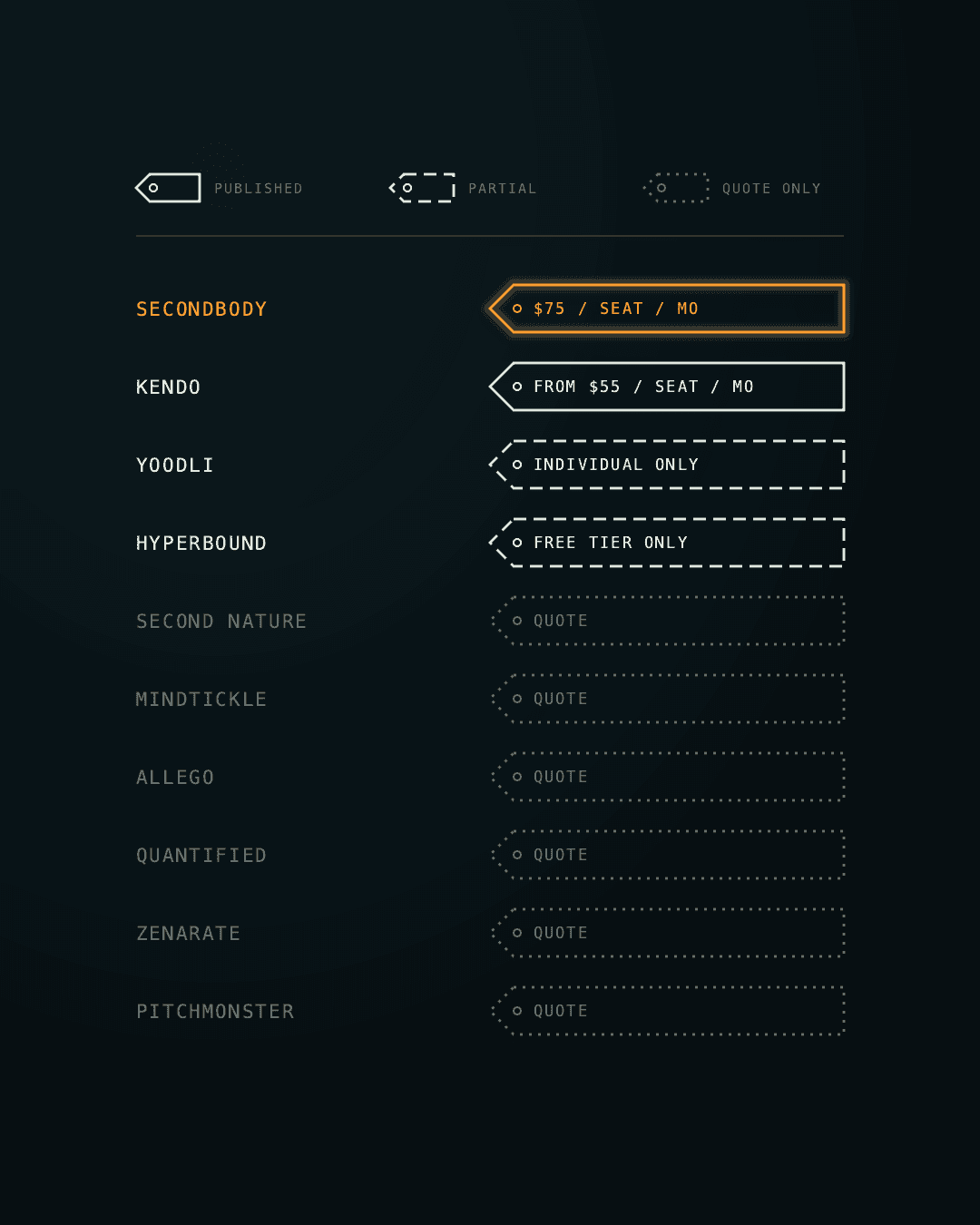
Only three tools on this list publish a team-usable price: SecondBody, Kendo and Yoodli (individual plans only). Everything else is a quote. Here is what we could verify on 16 October 2026, with second-hand numbers flagged.
Tool | Published price | What we could find otherwise |
|---|---|---|
Second Nature | None | Reported 19,000 to 27,000 dollars a year median contracts (Vendr). Reported credit model of about 50 dollars per user per month (competitor source) |
SecondBody | $75 a month or $750 a year per seat; 120 roleplay minutes and 60 coaching minutes a month | Custom team and enterprise packages |
Hyperbound | Free tier only | Practice and Perform quoted per user |
Mindtickle | None | Median contract around 44,000 dollars a year (third-party procurement data) |
Allego | None | Per user per month, billed annually, three-year terms typical |
Quantified | None | Enterprise only |
Zenarate | None | Per product, demo required |
Yoodli | Individual: 8 and 20 dollars a month (annual) | Team and Enterprise quoted |
PitchMonster | None on its page | One guide reports from about 1,200 dollars a quarter |
Kendo | 55 and 100 dollars per seat per month | Custom enterprise |
How to read this table. Do not compare headline contracts. Compare the cost per rep who actually practised. A 20,000 dollar contract where 12 of 50 reps practise each month costs you far more per useful rep than a bigger contract with 40 active. Our guide to measuring sales training ROI shows how to build that number.
A note on the money-back question. The first objection we hear on almost every sales call is some version of "how do we prove we make our money back?" The honest answer is that nobody can promise revenue in a pilot. What you can measure in two weeks is whether reps practise without being chased, whether their scores move, and whether managers spend less time running roleplays themselves. Revenue shows up later. Leading indicators show up first.
How do you choose the right Second Nature alternative?
Start with where your reps sell and what you need to prove, not with features. This table maps common situations to the tool that fits best. We have been honest about where we do not win.
Your situation | Best fit | Also consider |
|---|---|---|
Field reps who drive, walk or travel between meetings | SecondBody | Quantified (pharma only) |
Regulated team (medtech, financial services) needing SOC 2, SSO, retention control | SecondBody | Quantified, Allego |
Pharma launch needing MLR-aware certification | Quantified | SecondBody |
You want daily practice, not a quarterly event | SecondBody | Hyperbound |
Managers have no time to run roleplays | SecondBody (pre-1:1 briefings) | Mindtickle |
You need public pricing to get budget approved | SecondBody | Kendo |
Hiring cohort starting in weeks, need a fast pilot | SecondBody | Kendo, PitchMonster |
Methodology scoring (SPIN, MEDDIC, Sandler) | SecondBody | Hyperbound |
High-volume SDR cold calling, tech | Hyperbound | SecondBody |
One suite for content, training and readiness | Mindtickle | Allego |
Formal certification inside your LMS | Second Nature | Mindtickle, Allego |
30+ languages across global teams | Second Nature | PitchMonster, Hyperbound |
Contact centre onboarding and QA | Zenarate | Second Nature |
Pitch delivery and presentation skills | Yoodli | SecondBody |
Small startup, swipe a card today | Kendo | SecondBody, Yoodli |
Pick Second Nature (stay) if you are a large inside sales or service organisation, your programme is certification-led, you need many languages, and you have a content owner. That is a real profile and it is well served.
Pick SecondBody if your reps are in the field or in a regulated industry, your managers cannot hear the conversations that matter, practice keeps dying after the launch week, or you need a price you can put in a business case today.
Pick a suite (Mindtickle, Allego) if the real goal is consolidating content, training and coaching vendors, and you accept that roleplay will be one part of it.
Pick a specialist (Hyperbound, Quantified, Zenarate, Yoodli) if your problem is narrow and matches theirs exactly: SDR cold calls, pharma launches, contact centres, delivery.
What should you ask Second Nature, or any vendor, before you renew or sign?
Ask questions that predict month four, not day one. These come straight from the objections enablement leaders raise on our own sales calls. Use them on us too.
1. "Show me usage by month for a customer like us, from month one to month twelve." Not the best customer. A typical one. The slope after week six tells you more than any feature.
2. "Who on our side needs to own the content, and how many hours a month is that?" One buyer told us a previous tool was cancelled because nobody owned the scenarios. If the answer is "your enablement team will build everything", cost that time in.
3. "What is the scorer calibrated against, and what happens when a rep disputes a score?" If it is the vendor's generic rubric, ask how they adapt it to your methodology. If scoring drift is a known complaint (it is, in Second Nature's public reviews), ask what changed in the last six months.
4. "How exactly is pricing counted?" Per seat, per credit, per minute. What a credit buys. Whether unused credits roll over. What happens when a rep leaves in March. Whether you pay for inactive users.
5. "What gets recorded, where is it stored, and for how long?" Then ask for the DPA, the SOC 2 Type II report, SSO setup and data retention controls. In regulated teams, this list decides deals. Our trust centre is public for exactly this reason, and our answer to the first question is short: we never record customer conversations.
6. "How does a rep practise if they are not at a desk?" Watch the answer closely if you have field reps. "They can use the mobile browser" is not the same as "the tool calls them."
7. "What does a manager get each week, and how long does it take to read?" If the honest answer is "a dashboard", ask how many managers at a comparable customer open it.
8. "Can we run a two-week pilot with ten new joiners and one number to move?" The deals we have seen close fastest started exactly like that: ten people, two weeks, one metric everyone agreed on before day one. Any vendor confident in adoption should say yes.
9. "What does proof beyond a pilot look like?" Ask for a reference customer at month nine or later, in your industry, who will take a call.
10. "What leading indicators will we see before revenue?" Confidence scores, practice minutes, readiness by rep. You need something to show your CRO in week three, not month nine.
If your Second Nature renewal answers these well, renew with confidence. If it does not, you have your negotiating points.
What mistakes do teams make when they switch?
These are the patterns we have watched on calls and in rollouts. None are specific to Second Nature.
Switching tools to fix an ownership problem. If nobody owned the content on the old platform, nobody will own it on the new one. Name a content owner on your side before you sign anything. That person matters more than the vendor.
Copying every old scenario across. Teams move all 60 legacy scenarios and wonder why nothing improved. Start with the five conversations that cost you the most deals. Build those well. Add more once reps ask for them.
Running the pilot on your best reps. Top performers practise anyway. Pilot on new joiners or the middle of the pack, where you can see the difference.
Measuring revenue in week two. Revenue lags. Measure practice frequency, score movement and manager time saved first. Set the revenue checkpoint at one full sales cycle.
Choosing on avatar realism. Avatars demo beautifully. But a rep who practises five minutes daily on a voice call beats a rep who did one beautiful video session in March. Frequency beats fidelity.
Forgetting the manager. If managers are not part of the loop, reps read the tool as optional. Give managers something useful (a briefing, three moments to replay) rather than another dashboard.
Ignoring the field team. Many companies pilot with inside sales because it is easy, then roll out to field reps and watch usage collapse. If field reps are part of the plan, put them in the pilot.
How do you switch without losing a quarter?
Run the new tool next to the old one for one cohort, prove it on one number, then move the rest. Here is the shape we recommend, whether or not you pick us.
Weeks 1 and 2: scope. Pick ten reps, ideally a new cohort or a region. Choose one number to move (cold call score, discovery quality, time to first meeting). Name the content owner. Load the five conversations that matter most, plus your objection library and methodology. Get security and procurement started now, not later.
Weeks 3 and 4: pilot. Reps practise daily in short bursts. Managers read weekly summaries and coach from them. Do not pull reps off the road or the phones for this. At Rentokil Terminix, reps logged 16 hours of roleplay each in under three weeks without losing a single field day, because practice fit around the work. Some reps went at it hard enough that caps were added. Plan for that problem; it is a good one.
Weeks 5 and 6: read the numbers. Practice minutes per rep, score movement, manager hours, and what reps say. Compare with what you saw on Second Nature at the same point.
Weeks 7 to 12: expand or stop. If the pilot moved the number, expand by team, not by mandate. Keep the old tool running until the new one has a full cohort through. Time the switch to your renewal date so you are never paying twice for longer than a month.
At renewal: take the pilot data into the conversation. Even if you decide to stay with Second Nature, you will negotiate from facts.
The deeper reason this works: practice tools fail when they are treated like courses, assigned once and checked off. We wrote about that pattern in why LMS-style training fails field sales.
Frequently asked questions
What are the best alternatives to Second Nature for sales role-play?
SecondBody (field and regulated teams, daily voice practice, public pricing), Hyperbound (SDR cold calling), Mindtickle and Allego (enablement suites), Quantified (pharma certification), Zenarate (contact centres), Yoodli (delivery coaching), PitchMonster and Kendo (smaller teams). The right one depends on where your reps sell and what you need to prove.
Who are Second Nature's main competitors?
The tools buyers most often compare it with are Hyperbound, Mindtickle, Allego, Yoodli, Quantified and, increasingly, enablement suites and conversation intelligence vendors adding roleplay. Gong added guided AI roleplay to Gong Enable in its February 2026 launch, so expect conversation intelligence vendors to show up in more evaluations.
How much does Second Nature cost?
Second Nature does not publish pricing. Third-party procurement data suggests median contracts around 19,000 to 27,000 dollars a year, and a competitor reports a credit model of about 50 dollars per user per month. Ask Second Nature for a written quote that states what a credit buys and how inactive users are counted.
Does Second Nature have a free trial?
It does not advertise a self-serve free trial. Access starts with a demo and a quote.
How do Synthesia and Second Nature compare?
They started from opposite ends. Synthesia is an AI video platform that launched Roleplay Sessions on 22 July 2026, letting employees practise with interactive avatars, in four languages at launch. Second Nature has been a dedicated roleplay and certification platform for years, with 30+ languages, LMS integration and sales-specific scenarios. If roleplay is your main job, Second Nature (or a dedicated alternative) is more mature. If you already use Synthesia for training video, its roleplay add-on may be enough for light practice.
How does Reddy compare to Second Nature?
Reddy is built for contact centres: training simulations, live call assistance and post-call QA for customer service agents. Second Nature covers sales and service, with more emphasis on B2B sales roleplay and certification. For a contact centre, compare Reddy with Zenarate. For B2B sales, compare Second Nature with the sales-specific tools above.
Is Second Nature good for small teams?
Usually not the best fit. There is no self-serve tier, contracts are quoted, and reported minimums are in the tens of thousands of dollars. Small teams are better served by tools with published pricing.
Is Second Nature good for field sales?
It is not built around field sales. Practice happens on a screen, which suits reps at a desk. Field reps who are driving, walking a store or sitting in a car park between meetings need practice that comes to them, by phone or message, in short bursts.
What do Second Nature reviews say?
Second Nature holds a rating of about 4.6 to 4.7 out of 5 on G2 (the figure varies by page and date). Reviewers praise skill improvement, ease of use and the interactive avatar. The recurring complaints are inconsistent AI scoring, voice recognition issues, scripted or robotic conversations, a learning curve, and language or accent limits.
Is AI roleplay actually effective?
It works when reps practise often, close to the real call, with feedback they trust. It fails when it is assigned once and forgotten. Look at practice frequency per rep after month three before you judge any tool's effectiveness, including the vendor's case studies.
What is the difference between AI roleplay and conversation intelligence?
Conversation intelligence (Gong, Chorus) records and analyses calls after they happen. AI roleplay lets reps rehearse before the call. One looks backward, the other trains forward. Most teams need practice first, because analysis cannot help a rep who never got the reps in.
How long does it take to switch from Second Nature?
A focused pilot takes two to four weeks. A full switch usually takes one renewal cycle, running both tools in parallel for one cohort. Rebuild your top five scenarios first rather than migrating everything.
How is SecondBody different from Second Nature?
Second Nature is a structured enterprise roleplay and certification platform, mostly screen-based. SecondBody is a voice-first coach. On team plans, Rory calls reps on WhatsApp or by phone with no login, and managers get a pre-1:1 briefing on who to coach and on what. SecondBody publishes its price. Second Nature is quote-only. The detailed table is on our comparison page.
How much does SecondBody cost?
$75 a month or $750 a year per seat, including 120 minutes of roleplay and 60 minutes of coaching with Rory each month. Team and enterprise plans add custom minute packages, Rory trained on your playbook, Rory calling reps on WhatsApp or phone, enterprise SSO, SOC 2 Type II, 12+ languages and a dedicated customer success manager.
Does SecondBody work for regulated industries?
Yes. That is one of the reasons it exists. SecondBody never records customer conversations. Rory does not listen in on live calls or visits; reps practise before and debrief after, and real calls are only coached if you choose to upload calls you already own. On team plans you also get SOC 2 Type II, enterprise SSO and custom data retention, and Rory is trained on your approved playbook and objection library, so practice stays inside what reps are allowed to say. Customers include medical device teams like GBUK.
How we know this
Everything here was checked on 16 October 2026. We read the live Google results for "second nature alternatives" in the US, Second Nature's own site, each alternative's product and pricing pages, and the third-party pricing and review sources linked above. Competitor-reported numbers about other competitors are labelled as reported. We also drew on our own Search Console data (the exact questions buyers type, quoted in the headings) and on twenty of our own sales calls with enablement and sales leaders between January and September 2026, anonymised. Where we could not verify something, we said so. If a vendor here thinks we got a fact wrong, tell us and we will fix it.
So, should you leave Second Nature?
Maybe not. If your reps sit at desks, your programme runs on certifications, you need thirty languages and someone owns the content, Second Nature is doing its job. Renew, and use the questions above to get a better deal.
But if you are reading this because the practice numbers fell off a cliff after week six, the problem probably was not the avatars. It was the distance between the tool and the moment that matters. The rep in the car park, five minutes before the meeting, stomach tight, rehearsing the first objection out loud. That rep is not going to open a laptop and log in. They will answer a call.
That is the gap we built SecondBody to close. On team plans, Rory reaches reps where they already are, on WhatsApp or the phone, every day, for a few minutes, so practice becomes a habit instead of a module. Managers get a one-page briefing instead of another dashboard. And the price is on the page.
If you want to see every option side by side first, our guide to sales training software alternatives maps the whole field. When you are ready, put ten reps on Rory for two weeks and pick one number to move.
Good luck out there.
Omid
By Omid, founder of SecondBody
Key answers, up front
Second Nature is a good product for a specific team. Enterprise, inside sales, LMS-heavy, certification-driven, multilingual (30+ languages). If that is you and your reps actually use it, renewing may be the right call.
The friction buyers report is consistent. Quote-only pricing with a reported per-user credit model, AI scoring that reviewers call inconsistent, conversations that can feel scripted, and setup effort before anything useful happens.
The best alternatives by job: SecondBody for field and regulated teams who need daily voice practice (on team plans, Rory calls reps on WhatsApp or phone, no login), manager briefings, no recording of customer conversations, and public pricing. Hyperbound for high-volume SDR cold calling. Mindtickle or Allego if you want one enablement suite. Quantified for pharma launch certification. Zenarate for contact centres. Yoodli for delivery and presentation skills. PitchMonster and Kendo for smaller teams that want a quick start.
Pricing: Second Nature does not publish prices. Third-party data puts typical contracts around 19,000 to 27,000 dollars a year, and one competitor reports a credit model of about 50 dollars per user per month. SecondBody is $75 a month or $750 a year per seat, published.
Before you renew anything, ask who owns the content on your side, what the scoring is calibrated against, and what usage looked like in month four. Those three answers predict year two better than any demo.
Here is the moment that sends people searching for this page.
It is renewal season. You open the usage report. The certification module looks great, because it was mandatory. The practice numbers look like a ski slope. Week one, everyone. Week six, the keen ones. Month four, three reps and a manager who logs in to check the dashboard. Now someone in finance wants to know what the company is paying per useful minute.
So you type "second nature alternatives" into Google. And page one is a parade. Kendo ranks Kendo first. Mindtickle ranks Mindtickle first. Whatfix ranks Whatfix first. Growthspace, Easygenerator, Virti, PitchMonster, ReflexAI. Every vendor wrote the list, and every vendor won it. We checked the live results on 16 October 2026 and could not find a single page-one result that tells you when to keep Second Nature.
We build one of these tools, so read this with that in mind. But we are going to do the thing the other lists skip. We will tell you who Second Nature is genuinely good for, where its buyers report friction, and what each alternative is honestly bad at, ourselves included. If you want the wider view across every category of sales training tool, our main guide to sales training software alternatives covers the whole field. This page goes deep on one decision: stay with Second Nature, or move.
What is Second Nature, and what kind of teams use it?
Second Nature (secondnature.ai) is an AI roleplay platform for enterprise sales and service teams. Reps practise conversations with AI avatars that play prospects or customers, get scored, and work through certification programmes their enablement team builds. It was founded in 2018 and raised a 22 million dollar Series B in October 2025, led by Sienna VC. It is an independent company.
Here is what that looks like in practice, based on what Second Nature publishes on its own site today:
Avatar roleplay. Reps talk to an AI persona on screen. The newer "moving avatar" and video-avatar scenarios nod, react and hold eye contact. Multi-persona meetings let a rep face a buying committee rather than a single buyer.
Scenario builder. Enablement teams build scenarios from templates or uploaded content. One customer quoted on their site says a scenario takes about 15 minutes.
Certifications. Gamified certification programmes with completion tracking. This is a real strength and it shows up in their case studies.
LMS and enterprise plumbing. Any LMS via SCORM or LTI, SAML single sign-on, CRM integrations, conference tools.
30+ languages. Wider than most tools in this category, including ours.
Deal Coach. AI coaching on live deals, flagging risks and gaps.
What kind of teams use Second Nature for sales training and onboarding? That exact question shows up in our own Search Console data, typed by buyers word for word. The honest answer from their customer list: large inside sales and service organisations. Named customers include Oracle NetSuite, GoHealth, iQor, Calix, United Rentals and Zoom. Their industry pages focus on insurance, technology, telco, banking and education, with use cases across sales, L&D, customer support, HR and call centres. That is a company built for scale, structure and standardised onboarding.
Their own headline claims are 34% faster ramp, 6x more practice and 46% more deals closed. Treat those the way you would treat any vendor's best number (ours included). They come from the customers who used the product well, measured by the vendor, against a baseline the vendor chose. The more useful question is what happened in the accounts that did not make the case study.
Who is Second Nature genuinely good for?
Second Nature is a strong fit if most of these are true for you. Do not switch for the sake of it.
You run a large, structured enablement programme. If your world is learning paths, certification gates, completion reports and an LMS that HR already owns, Second Nature plugs into that. SCORM and LTI support means practice can sit inside the system your L&D team already reports from. Most AI-native roleplay tools, ours included, are lighter on this.
Certification is the outcome you are buying. Some teams need a defensible record that every rep passed the new pitch before launch day. Second Nature's certification programmes are built for exactly that, and their customer quotes about 100% certification completion are believable precisely because certification is mandatory.
Your reps sell in many languages. 30+ languages is a genuine advantage. If you are rolling one programme across Brazil, Germany, Japan and the US, that coverage matters more than almost any other feature.
Your reps sell on video, at a desk. The avatar experience makes most sense when the real conversation also happens on a screen. A rep who lives on Zoom practising against a face on Zoom is a good match.
You have a content owner. This is the one nobody puts on the feature list. Second Nature, like every scenario-based tool, is only as good as the scenarios someone keeps building. If you have an enablement person whose job includes owning that library, the platform gets better every quarter.
If you ticked four of those five, you probably do not need an alternative. You need a better adoption plan. Skip to the section on questions to ask before you renew.
Why do teams look for a Second Nature alternative?
Teams look for alternatives for five reasons: price opacity, scoring trust, conversations that feel scripted, setup effort, and practice that fades once the mandatory part is done. The first four come from public reviews. The fifth comes from our own sales calls.
1. Pricing you cannot see until you are deep in a sales cycle. Second Nature does not publish prices. You get a number after a demo. Third-party reports describe a credit model where one credit covers one user for one month. More on the numbers in the pricing section, but the practical complaint is simple: a credit costs the same whether a rep practises once that month or thirty times. If adoption dips, you are still paying for the seat-month.
2. Scoring that reviewers do not fully trust. Across G2 and Capterra, the recurring complaints include inaccurate or inconsistent AI scoring. One independent review site reports users getting different scores for the same response. Mindtickle's own roundup (a competitor, so weigh it) lists the five themes reviewers cite most: rigid AI conversations, heavy script dependency, inconsistent scoring, limited live-call coaching, and trouble with some languages and accents. Here is why this matters more than it sounds. Once a rep catches the scorer being wrong twice, they stop believing it the third time, even when it is right. A scorer reps do not trust becomes a quiz they game.
3. Conversations that can feel scripted. Branching scenarios are great for consistency and bad for surprise. Real buyers go off script. The rep who has practised the happy path forty times still freezes the first time a procurement lead says "we already have something for this" in a tone they have never heard. G2 reviewers mention robotic voices and voice recognition issues, and one reviewer said the moving avatars are not perfect yet. To be fair, Second Nature has been shipping fast on exactly this, and the July 2026 video avatars are a clear attempt to fix it.
4. Setup effort before value. Reviewers mention a learning curve and time-consuming onboarding. One third-party estimate puts implementation at about two months. That is not a scandal. Enterprise tools take enterprise time. But if you bought it to ramp a hiring cohort that starts in three weeks, two months is a long time.
5. The practice that dies after week six. This is the one we hear on our own calls, not on G2. Over twenty sales conversations between January and September 2026, the objection we heard most from enablement leaders was a variation of "another tool nobody opens." One team that had tried another platform told us they cancelled because nobody owned the content. Another said the reps did the assigned certification, then never came back. When practice requires a rep to remember to log in, find a scenario and sit at a desk, it competes with every other thing on their calendar. And it loses.
Does Second Nature work? The effectiveness question. "Second nature ai sales training effectiveness" is a query we see too. The honest answer is that AI roleplay works when reps do enough of it, close enough to the real call, with feedback they believe. Second Nature can deliver all three for desk-based teams with a strong content owner. Where those conditions break, any tool fails, including the alternatives below.
How much does Second Nature cost?
Second Nature does not publish pricing. You get a quote after a demo. Every number below is second-hand, so treat it as a starting point for negotiation, not a fact.
Source | What it reports | How much to trust it |
|---|---|---|
Vendr marketplace (procurement data) | Median buyer about 19,000 dollars a year, range shown roughly 19,000 to 26,700 dollars | Real contract data, small sample, no seat count shown |
Outdoo (a competitor's review, updated 30 Sep 2026) | Credit model: about 50 dollars per credit, one credit = one user for one month. A 12,000 dollar proposal bought 240 credits, which covers 50 people for about 4.8 months. Continuous access for 50 reps is about 600 credits, roughly 30,000 dollars a year | Specific, but written by a competitor. Ask Second Nature to confirm or correct it |
Several third-party reviews | No self-serve tier, annual minimums often estimated around 20,000 dollars | Estimates, unconfirmed by Second Nature |
Second Nature's own site | "Book a demo" | The only official answer |
What the credit model means for your budget, if the reports are right. Credits behave like seat-months. Fifty reps practising all year is fifty times twelve, so 600 credits. If you buy fewer credits than that, you are either rationing who gets access or running out partway through the year. If usage is uneven (and it always is), you pay for reps who did not practise. Neither is unusual in enterprise software. It just means the number to compare across vendors is cost per active rep per month, not the headline contract.
Is there a Second Nature free trial? People search for it. Second Nature does not advertise a self-serve free trial. One competitor reports that customers get a bundle of free video-avatar minutes, which is a perk inside a contract, not a trial before one.
What we do instead. SecondBody publishes the price: $75 a month or $750 a year per seat, which includes 120 minutes of roleplay and 60 minutes of coaching with Rory each month. Teams and enterprise get custom minute packages and volume pricing. We put it on the pricing page because the first question every enablement leader gets from finance is "what does it cost", and you should not need three calls to answer it.
What should a Second Nature alternative actually do better?
A good alternative should beat Second Nature on the specific thing that is failing for you, not on a feature grid. Most teams need to judge six things.
1. Where does practice happen? Desk and browser, or wherever the rep already is. If your reps drive between hospitals, sit in a van between pest-control jobs, or walk retail floors, a tool that needs a laptop and a login will see its usage drop.
2. Who starts the session? If the rep has to remember, usage depends on discipline. If the tool reaches out (a call, a message, a scheduled warm-up), usage depends on habit. The second one scales.
3. What is the scorer calibrated against? A generic rubric, the vendor's rubric, or your playbook and methodology (SPIN, MEDDIC, Sandler, your own). Ask to see the rubric. Ask what happens when a rep disputes a score.
4. What does the manager get? A dashboard they must open, or a briefing that tells them who to coach this week, on what, with which moment to replay. Managers are the bottleneck in every enablement programme we have seen. Anything that adds to their admin will get ignored.
5. How is pricing structured? Published or quoted. Per seat, per credit, or per minute. What happens when a rep leaves mid-year. Whether you pay for inactive users.
6. What do you need for procurement? SOC 2 Type II, SSO, a DPA, what gets recorded and for how long. In regulated industries (medtech, pharma, financial services), this is often where deals really get decided.
Hold those six up against each tool below.
What are the best alternatives to Second Nature for sales role-play?
The best alternatives to Second Nature for sales role-play in 2026 are SecondBody, Hyperbound, Mindtickle, Allego, Quantified, Zenarate, Yoodli, PitchMonster and Kendo. They do different jobs. Here is each one, with who it fits and what is genuinely annoying about it. Facts were checked on each vendor's site on 16 October 2026.
1. SecondBody: daily voice practice for field and regulated teams
What it is. An AI sales coaching and roleplay platform built around Rory, a voice-first AI coach. Reps practise cold calls, discovery, objection handling and closing against AI buyers. On team plans, Rory is trained on your own playbook and objection library, and Rory calls reps on WhatsApp or by phone: a morning warm-up, an end-of-day debrief, a quick run-through in the car park before a big meeting. No login, no app to find. Managers get a one-page briefing before each 1:1: who to coach this week, on which skill, and which practice moments to replay.
Who it fits. Field sales teams, regulated industries (medtech, pharma, financial services), and any team where reps are not sitting at a desk waiting to practise. Also inside sales teams who want daily reps, not quarterly certifications. Scoring is methodology-native (SPIN, MEDDIC, Sandler). Team plans add SOC 2 Type II, enterprise SSO, custom data retention and 12+ languages. SecondBody never records customer conversations: Rory does not listen in on live calls or visits, reps practise before and debrief after, and the only real calls coached are ones a customer chooses to upload. That is why it runs in pharma, medical devices and financial services. Integrations include Salesforce, HubSpot, Microsoft Dynamics 365, Gong, Slack and Outlook.
Proof. At Rentokil Terminix in the US, reps did 16 hours of roleplay each in under three weeks, with zero days off the road, and every manager backed it. Some reps practised so much that usage caps were added to keep it sustainable, which is the opposite of the usual adoption problem. At GBUK, a UK medical device supplier, reps who practised consistently scored 8 to 10 out of 10 on cold calls, against about 6 for reps who practised intermittently, and managers got back about a week a month. At Allwyn, reps at coaching standard went from 1 in 5 to 4 in 5 in a quarter, and reps grew 3.5% while their market fell 4%. Parkingeye closed 415 contracts against a 380 target.
Pricing. $75 a month or $750 a year per seat, published. Custom team and enterprise packages.
What's annoying. We are practice-first, not an LMS. If your programme depends on formal certification paths, SCORM tracking and completion gates inside your LMS, Second Nature does more of that today, and you should weigh it honestly. Our language coverage (12+, on team plans) is also narrower than Second Nature's 30+.
The full side-by-side lives on our Second Nature vs SecondBody comparison.
2. Hyperbound: high-volume cold-call practice for SDR teams
What it is. A voice-first AI roleplay platform with two products. Practice is AI buyer roleplays built around your sales process, and Hyperbound says it can build buyer bots from your real calls. Perform scores real calls against AI scorecards and adds deal coaching, with live call coaching in private preview. Integrations include Salesforce, HubSpot, Slack, Zoom, Gong and Microsoft Teams. Hyperbound lists 25+ languages, SOC 2 Type II and ISO 27001, and names LinkedIn, Amazon, Vanta, Notion and Klaviyo as customers.
Who it fits. SDR and BDR teams that live on the phone and need cold-call reps by the hundred. Strong for tech companies with a dialer-heavy motion.
Pricing. Hyperbound no longer shows prices. There is a free tier with 45 prebuilt roleplays, then Practice and Perform are sold per user on custom quotes, with volume and multi-year discounts. Older articles (including one of ours) quoted per-user prices that are no longer on the site, so get a fresh quote.
What's annoying. Built for inside sales. Nothing on its site speaks to field or face-to-face selling. The good stuff (real-call scoring, CRM intelligence) sits in the pricier Perform licence. And the rep still has to open the app to practise. We go deeper in our guide to Hyperbound alternatives.
3. Mindtickle: roleplay inside a full enablement suite
What it is. A revenue enablement platform covering content, training, readiness scores, conversation intelligence and AI roleplay in one place. It ranks itself first on its own list of Second Nature alternatives, which tells you what it is: a suite that wants to replace several tools at once.
Who it fits. Large revenue organisations that want one vendor for content, onboarding, certification and coaching, and have an enablement team big enough to run it.
Pricing. Not published. Third-party procurement data puts the median contract around 44,000 dollars a year, with a wide range depending on modules and seats. Treat that as a ballpark.
What's annoying. Roleplay is one module among many, so you are buying a platform to get a practice tool. Suites take time to configure and need an owner. If your problem is "reps do not practise enough", adding a bigger system rarely fixes it. See our Mindtickle comparison if you are weighing both.
4. Allego: enablement suite with an AI roleplay add-on
What it is. A sales enablement platform covering learning, conversation intelligence, content management, digital rooms and AI roleplay. Products are priced separately.
Who it fits. Teams already standardising on an enablement suite who want video coaching and roleplay inside it.
Pricing. Not published. Allego's pricing page says it charges per user per month, billed annually upfront, with three-year terms typical and one and two-year options available. AI roleplay is its own line item.
What's annoying. Three-year terms are a big commitment for a practice habit you have not proven yet. Like Mindtickle, it is a suite, and the roleplay is a feature inside it rather than the whole point.
5. Quantified: AI roleplay and certification for life sciences
What it is. An AI roleplay and certification platform aimed at pharma, medical devices, insurance and financial services. Reps practise against AI healthcare personas (oncologists, pharmacists, payer reviewers) and are scored against approved criteria, with a compliance layer that fails off-label language. Integrates with Salesforce, Veeva and LMS platforms. Named customers include Novartis, Sanofi, Bayer and Johnson & Johnson.
Who it fits. Pharma and biotech launch teams that need audit-ready certification of field forces before a product launch, with MLR-aware content.
Pricing. Not published. Demo required.
What's annoying. It is deep in one vertical. If you are a medtech distributor or a financial services team without an MLR process, a lot of the machinery is not for you. It is also certification-shaped, which is the same habit problem Second Nature has: great for launch week, less proven for the Tuesday after.
6. Zenarate: simulation and coaching for contact centres
What it is. A "frontline performance platform" for contact centres, with AI simulation and coaching (Perform), interaction analysis (Analyze) and AI agents (Evolve). Targets financial services, BPO, healthcare and insurance, telecoms and travel. SOC 2, with PCI, HIPAA and GDPR support.
Who it fits. Large customer service and inbound sales floors where QA, training and coaching need one shared definition of a skill. If your Second Nature use is mostly call-centre onboarding, look here.
Pricing. Not published. Each product is sold separately.
What's annoying. It is a contact centre tool first. B2B field reps and account executives will find it built for a different job.
7. Yoodli: delivery and presentation coaching
What it is. AI roleplay and communication coaching focused on how you sound: pace, filler words, clarity, confidence. Individuals can buy it directly.
Who it fits. Teams that care about presentation and pitch delivery, and individuals who want to practise on their own dime.
Pricing. Partly published. Individual plans are cheap (Pro is listed at 8 dollars a month and Advanced at 20 dollars a month, billed annually). Team and Enterprise plans, which add custom scenarios, dashboards, SSO and LMS integrations, are quote-only.
What's annoying. Delivery is not selling. A rep can speak beautifully and still miss the buying signal. For B2B sales skill (discovery, objections, qualification), you need more than speech coaching. Our Yoodli comparison covers the split.
8. PitchMonster: roleplay plus call analysis for mid-sized teams
What it is. AI roleplays, scorecards, certifications and analytics, with a higher plan that adds call analysis, an AI coach, speech coaching, Gong and LMS integrations. It lists roleplays in 29 languages.
Who it fits. Mid-sized inside sales teams that want roleplay and real-call scoring without buying a suite.
Pricing. Per seat but not published on its pricing page. Standard contracts are 12 months, with 3 and 6-month options for some buyers, and seats can be swapped when reps leave. One buying guide reports plans starting around 1,200 dollars a quarter.
What's annoying. Desk and browser shaped like most of the category. Check which plan the languages and integrations actually sit in before you sign.
9. Kendo: self-serve roleplay with published prices
What it is. AI roleplay, live call scoring and an "AI Sales Manager", sold per seat with usage pooled across the team.
Who it fits. Small teams and startups that want to swipe a card and start this week.
Pricing. Published: Pro at 55 dollars per seat per month (180 roleplay minutes, 25 hours of call scoring), a 100 dollar tier with more minutes, and custom enterprise pricing.
What's annoying. A young company (third-party data says founded in 2025), so check the security paperwork your procurement team will ask for. And, like most tools on this list, it lives in a browser.
Second Nature vs Hyperbound: which one should you pick?
Pick Second Nature if you need structured certification, LMS integration and many languages for a large team. Pick Hyperbound if you need SDRs doing high volumes of cold-call practice and want real-call scoring in the same tool. Pick neither if your reps are in the field.
This comparison earns almost 150 impressions a month in our own Search Console across three spellings ("second nature vs hyperbound", "hyperbound vs second nature", "second nature ai vs hyperbound"). People are clearly stuck between the two. Here is the split.
Second Nature | Hyperbound | |
|---|---|---|
Core shape | Avatar roleplay, certification programmes, LMS | Voice roleplay, real-call scoring, deal coaching |
Best for | Enterprise enablement and L&D, inside sales, service | SDR and BDR teams, tech, dialer-heavy |
Practice format | On-screen avatars, video avatars, multi-persona meetings | Voice calls with AI buyers, bots built from real calls |
Real calls | Deal Coach on live deals | Perform licence scores recorded calls |
Languages | 30+ | 25+ |
LMS | SCORM and LTI | LMS integration not a headline feature |
Pricing | Quote only; credit model reported by third parties | Quote only; free tier with 45 prebuilt roleplays |
Field sales | Not a stated focus | Not a stated focus |
Here is what nobody says out loud about this matchup. Both tools are built for a rep who is already at a desk with a headset on. They disagree about whether that rep should see a face or hear a voice. That matters, but it is a smaller difference than it looks in a demo. The bigger question is whether your reps will open either tool after week six.
Mindtickle vs Second Nature for sales readiness and coaching: which fits?
Mindtickle fits if you want one platform for content, training, readiness scoring and roleplay. Second Nature fits if you already have the enablement stack and want a specialist roleplay and certification layer on top.
We rank on page one for this exact question ("mindtickle vs second nature for sales readiness and coaching", average position 5.7), so people are asking it. The trade-off is breadth versus depth.
Mindtickle gives you a readiness index across content, quizzes, certifications, call recordings and roleplay. Roleplay is one input. You buy it to consolidate tools.
Second Nature gives you deeper conversation practice, with more avatar realism and more scenario options. You buy it to make practice better, not to replace your content system.
Both are enterprise contracts, both are quote-only, both reward a team with a full-time enablement owner. And both share the same weak spot: they measure readiness at the moment of certification, not on the Tuesday afternoon when the rep is about to walk into a hospital procurement meeting.
How do Second Nature alternatives compare on price?
Only three tools on this list publish a team-usable price: SecondBody, Kendo and Yoodli (individual plans only). Everything else is a quote. Here is what we could verify on 16 October 2026, with second-hand numbers flagged.
Tool | Published price | What we could find otherwise |
|---|---|---|
Second Nature | None | Reported 19,000 to 27,000 dollars a year median contracts (Vendr). Reported credit model of about 50 dollars per user per month (competitor source) |
SecondBody | $75 a month or $750 a year per seat; 120 roleplay minutes and 60 coaching minutes a month | Custom team and enterprise packages |
Hyperbound | Free tier only | Practice and Perform quoted per user |
Mindtickle | None | Median contract around 44,000 dollars a year (third-party procurement data) |
Allego | None | Per user per month, billed annually, three-year terms typical |
Quantified | None | Enterprise only |
Zenarate | None | Per product, demo required |
Yoodli | Individual: 8 and 20 dollars a month (annual) | Team and Enterprise quoted |
PitchMonster | None on its page | One guide reports from about 1,200 dollars a quarter |
Kendo | 55 and 100 dollars per seat per month | Custom enterprise |
How to read this table. Do not compare headline contracts. Compare the cost per rep who actually practised. A 20,000 dollar contract where 12 of 50 reps practise each month costs you far more per useful rep than a bigger contract with 40 active. Our guide to measuring sales training ROI shows how to build that number.
A note on the money-back question. The first objection we hear on almost every sales call is some version of "how do we prove we make our money back?" The honest answer is that nobody can promise revenue in a pilot. What you can measure in two weeks is whether reps practise without being chased, whether their scores move, and whether managers spend less time running roleplays themselves. Revenue shows up later. Leading indicators show up first.
How do you choose the right Second Nature alternative?
Start with where your reps sell and what you need to prove, not with features. This table maps common situations to the tool that fits best. We have been honest about where we do not win.
Your situation | Best fit | Also consider |
|---|---|---|
Field reps who drive, walk or travel between meetings | SecondBody | Quantified (pharma only) |
Regulated team (medtech, financial services) needing SOC 2, SSO, retention control | SecondBody | Quantified, Allego |
Pharma launch needing MLR-aware certification | Quantified | SecondBody |
You want daily practice, not a quarterly event | SecondBody | Hyperbound |
Managers have no time to run roleplays | SecondBody (pre-1:1 briefings) | Mindtickle |
You need public pricing to get budget approved | SecondBody | Kendo |
Hiring cohort starting in weeks, need a fast pilot | SecondBody | Kendo, PitchMonster |
Methodology scoring (SPIN, MEDDIC, Sandler) | SecondBody | Hyperbound |
High-volume SDR cold calling, tech | Hyperbound | SecondBody |
One suite for content, training and readiness | Mindtickle | Allego |
Formal certification inside your LMS | Second Nature | Mindtickle, Allego |
30+ languages across global teams | Second Nature | PitchMonster, Hyperbound |
Contact centre onboarding and QA | Zenarate | Second Nature |
Pitch delivery and presentation skills | Yoodli | SecondBody |
Small startup, swipe a card today | Kendo | SecondBody, Yoodli |
Pick Second Nature (stay) if you are a large inside sales or service organisation, your programme is certification-led, you need many languages, and you have a content owner. That is a real profile and it is well served.
Pick SecondBody if your reps are in the field or in a regulated industry, your managers cannot hear the conversations that matter, practice keeps dying after the launch week, or you need a price you can put in a business case today.
Pick a suite (Mindtickle, Allego) if the real goal is consolidating content, training and coaching vendors, and you accept that roleplay will be one part of it.
Pick a specialist (Hyperbound, Quantified, Zenarate, Yoodli) if your problem is narrow and matches theirs exactly: SDR cold calls, pharma launches, contact centres, delivery.
What should you ask Second Nature, or any vendor, before you renew or sign?
Ask questions that predict month four, not day one. These come straight from the objections enablement leaders raise on our own sales calls. Use them on us too.
1. "Show me usage by month for a customer like us, from month one to month twelve." Not the best customer. A typical one. The slope after week six tells you more than any feature.
2. "Who on our side needs to own the content, and how many hours a month is that?" One buyer told us a previous tool was cancelled because nobody owned the scenarios. If the answer is "your enablement team will build everything", cost that time in.
3. "What is the scorer calibrated against, and what happens when a rep disputes a score?" If it is the vendor's generic rubric, ask how they adapt it to your methodology. If scoring drift is a known complaint (it is, in Second Nature's public reviews), ask what changed in the last six months.
4. "How exactly is pricing counted?" Per seat, per credit, per minute. What a credit buys. Whether unused credits roll over. What happens when a rep leaves in March. Whether you pay for inactive users.
5. "What gets recorded, where is it stored, and for how long?" Then ask for the DPA, the SOC 2 Type II report, SSO setup and data retention controls. In regulated teams, this list decides deals. Our trust centre is public for exactly this reason, and our answer to the first question is short: we never record customer conversations.
6. "How does a rep practise if they are not at a desk?" Watch the answer closely if you have field reps. "They can use the mobile browser" is not the same as "the tool calls them."
7. "What does a manager get each week, and how long does it take to read?" If the honest answer is "a dashboard", ask how many managers at a comparable customer open it.
8. "Can we run a two-week pilot with ten new joiners and one number to move?" The deals we have seen close fastest started exactly like that: ten people, two weeks, one metric everyone agreed on before day one. Any vendor confident in adoption should say yes.
9. "What does proof beyond a pilot look like?" Ask for a reference customer at month nine or later, in your industry, who will take a call.
10. "What leading indicators will we see before revenue?" Confidence scores, practice minutes, readiness by rep. You need something to show your CRO in week three, not month nine.
If your Second Nature renewal answers these well, renew with confidence. If it does not, you have your negotiating points.
What mistakes do teams make when they switch?
These are the patterns we have watched on calls and in rollouts. None are specific to Second Nature.
Switching tools to fix an ownership problem. If nobody owned the content on the old platform, nobody will own it on the new one. Name a content owner on your side before you sign anything. That person matters more than the vendor.
Copying every old scenario across. Teams move all 60 legacy scenarios and wonder why nothing improved. Start with the five conversations that cost you the most deals. Build those well. Add more once reps ask for them.
Running the pilot on your best reps. Top performers practise anyway. Pilot on new joiners or the middle of the pack, where you can see the difference.
Measuring revenue in week two. Revenue lags. Measure practice frequency, score movement and manager time saved first. Set the revenue checkpoint at one full sales cycle.
Choosing on avatar realism. Avatars demo beautifully. But a rep who practises five minutes daily on a voice call beats a rep who did one beautiful video session in March. Frequency beats fidelity.
Forgetting the manager. If managers are not part of the loop, reps read the tool as optional. Give managers something useful (a briefing, three moments to replay) rather than another dashboard.
Ignoring the field team. Many companies pilot with inside sales because it is easy, then roll out to field reps and watch usage collapse. If field reps are part of the plan, put them in the pilot.
How do you switch without losing a quarter?
Run the new tool next to the old one for one cohort, prove it on one number, then move the rest. Here is the shape we recommend, whether or not you pick us.
Weeks 1 and 2: scope. Pick ten reps, ideally a new cohort or a region. Choose one number to move (cold call score, discovery quality, time to first meeting). Name the content owner. Load the five conversations that matter most, plus your objection library and methodology. Get security and procurement started now, not later.
Weeks 3 and 4: pilot. Reps practise daily in short bursts. Managers read weekly summaries and coach from them. Do not pull reps off the road or the phones for this. At Rentokil Terminix, reps logged 16 hours of roleplay each in under three weeks without losing a single field day, because practice fit around the work. Some reps went at it hard enough that caps were added. Plan for that problem; it is a good one.
Weeks 5 and 6: read the numbers. Practice minutes per rep, score movement, manager hours, and what reps say. Compare with what you saw on Second Nature at the same point.
Weeks 7 to 12: expand or stop. If the pilot moved the number, expand by team, not by mandate. Keep the old tool running until the new one has a full cohort through. Time the switch to your renewal date so you are never paying twice for longer than a month.
At renewal: take the pilot data into the conversation. Even if you decide to stay with Second Nature, you will negotiate from facts.
The deeper reason this works: practice tools fail when they are treated like courses, assigned once and checked off. We wrote about that pattern in why LMS-style training fails field sales.
Frequently asked questions
What are the best alternatives to Second Nature for sales role-play?
SecondBody (field and regulated teams, daily voice practice, public pricing), Hyperbound (SDR cold calling), Mindtickle and Allego (enablement suites), Quantified (pharma certification), Zenarate (contact centres), Yoodli (delivery coaching), PitchMonster and Kendo (smaller teams). The right one depends on where your reps sell and what you need to prove.
Who are Second Nature's main competitors?
The tools buyers most often compare it with are Hyperbound, Mindtickle, Allego, Yoodli, Quantified and, increasingly, enablement suites and conversation intelligence vendors adding roleplay. Gong added guided AI roleplay to Gong Enable in its February 2026 launch, so expect conversation intelligence vendors to show up in more evaluations.
How much does Second Nature cost?
Second Nature does not publish pricing. Third-party procurement data suggests median contracts around 19,000 to 27,000 dollars a year, and a competitor reports a credit model of about 50 dollars per user per month. Ask Second Nature for a written quote that states what a credit buys and how inactive users are counted.
Does Second Nature have a free trial?
It does not advertise a self-serve free trial. Access starts with a demo and a quote.
How do Synthesia and Second Nature compare?
They started from opposite ends. Synthesia is an AI video platform that launched Roleplay Sessions on 22 July 2026, letting employees practise with interactive avatars, in four languages at launch. Second Nature has been a dedicated roleplay and certification platform for years, with 30+ languages, LMS integration and sales-specific scenarios. If roleplay is your main job, Second Nature (or a dedicated alternative) is more mature. If you already use Synthesia for training video, its roleplay add-on may be enough for light practice.
How does Reddy compare to Second Nature?
Reddy is built for contact centres: training simulations, live call assistance and post-call QA for customer service agents. Second Nature covers sales and service, with more emphasis on B2B sales roleplay and certification. For a contact centre, compare Reddy with Zenarate. For B2B sales, compare Second Nature with the sales-specific tools above.
Is Second Nature good for small teams?
Usually not the best fit. There is no self-serve tier, contracts are quoted, and reported minimums are in the tens of thousands of dollars. Small teams are better served by tools with published pricing.
Is Second Nature good for field sales?
It is not built around field sales. Practice happens on a screen, which suits reps at a desk. Field reps who are driving, walking a store or sitting in a car park between meetings need practice that comes to them, by phone or message, in short bursts.
What do Second Nature reviews say?
Second Nature holds a rating of about 4.6 to 4.7 out of 5 on G2 (the figure varies by page and date). Reviewers praise skill improvement, ease of use and the interactive avatar. The recurring complaints are inconsistent AI scoring, voice recognition issues, scripted or robotic conversations, a learning curve, and language or accent limits.
Is AI roleplay actually effective?
It works when reps practise often, close to the real call, with feedback they trust. It fails when it is assigned once and forgotten. Look at practice frequency per rep after month three before you judge any tool's effectiveness, including the vendor's case studies.
What is the difference between AI roleplay and conversation intelligence?
Conversation intelligence (Gong, Chorus) records and analyses calls after they happen. AI roleplay lets reps rehearse before the call. One looks backward, the other trains forward. Most teams need practice first, because analysis cannot help a rep who never got the reps in.
How long does it take to switch from Second Nature?
A focused pilot takes two to four weeks. A full switch usually takes one renewal cycle, running both tools in parallel for one cohort. Rebuild your top five scenarios first rather than migrating everything.
How is SecondBody different from Second Nature?
Second Nature is a structured enterprise roleplay and certification platform, mostly screen-based. SecondBody is a voice-first coach. On team plans, Rory calls reps on WhatsApp or by phone with no login, and managers get a pre-1:1 briefing on who to coach and on what. SecondBody publishes its price. Second Nature is quote-only. The detailed table is on our comparison page.
How much does SecondBody cost?
$75 a month or $750 a year per seat, including 120 minutes of roleplay and 60 minutes of coaching with Rory each month. Team and enterprise plans add custom minute packages, Rory trained on your playbook, Rory calling reps on WhatsApp or phone, enterprise SSO, SOC 2 Type II, 12+ languages and a dedicated customer success manager.
Does SecondBody work for regulated industries?
Yes. That is one of the reasons it exists. SecondBody never records customer conversations. Rory does not listen in on live calls or visits; reps practise before and debrief after, and real calls are only coached if you choose to upload calls you already own. On team plans you also get SOC 2 Type II, enterprise SSO and custom data retention, and Rory is trained on your approved playbook and objection library, so practice stays inside what reps are allowed to say. Customers include medical device teams like GBUK.
How we know this
Everything here was checked on 16 October 2026. We read the live Google results for "second nature alternatives" in the US, Second Nature's own site, each alternative's product and pricing pages, and the third-party pricing and review sources linked above. Competitor-reported numbers about other competitors are labelled as reported. We also drew on our own Search Console data (the exact questions buyers type, quoted in the headings) and on twenty of our own sales calls with enablement and sales leaders between January and September 2026, anonymised. Where we could not verify something, we said so. If a vendor here thinks we got a fact wrong, tell us and we will fix it.
So, should you leave Second Nature?
Maybe not. If your reps sit at desks, your programme runs on certifications, you need thirty languages and someone owns the content, Second Nature is doing its job. Renew, and use the questions above to get a better deal.
But if you are reading this because the practice numbers fell off a cliff after week six, the problem probably was not the avatars. It was the distance between the tool and the moment that matters. The rep in the car park, five minutes before the meeting, stomach tight, rehearsing the first objection out loud. That rep is not going to open a laptop and log in. They will answer a call.
That is the gap we built SecondBody to close. On team plans, Rory reaches reps where they already are, on WhatsApp or the phone, every day, for a few minutes, so practice becomes a habit instead of a module. Managers get a one-page briefing instead of another dashboard. And the price is on the page.
If you want to see every option side by side first, our guide to sales training software alternatives maps the whole field. When you are ready, put ten reps on Rory for two weeks and pick one number to move.
Good luck out there.
Omid
Compare it on a real call.
Bring your hardest objection. Watch Rory handle it live, then decide whether you need to switch.


SecondBody is the AI sales roleplay and coaching platform built for reps who sell in the field and in regulated industries: voice-first practice with Rory, your AI coach, public pricing, and nothing recorded unless you upload it. Explore pricing or book a demo.
Related reading: What Are the Best Sales Training Software Alternatives in 2026, and Which Job Is Each One Built For?, What Are the Best Hyperbound Alternatives, and Which Teams Actually Need One?.
Share this article