Back
What Are the Best Sales Training Software Alternatives in 2026, and Which Job Is Each One Built For?
An honest sales training software comparison: Second Nature, Hyperbound, Mindtickle, Seismic, Showpad, Allego, Gong and Yoodli, sorted by the job each does.

By Omid, founder of SecondBody
Key answers, up front
There is no single "best" alternative, because sales training software is four different products wearing one label. Enablement suites store and govern content. LMS tools teach and certify. Conversation intelligence reviews calls after they happen. AI practice and coaching tools rehearse the call before it happens. Most bad switches happen when a team replaces one category with another and expects the same result.
Teams are switching in 2026 for four reasons: renewal quotes that grew faster than usage, low adoption ("another tool nobody opens"), the Seismic and Highspot merger (announced February 2026, closed August 2026) leaving buyers mid-evaluation, and call-analysis tools that tell managers what went wrong without changing what reps do next time.
Pick by the job, not the brand. Need governed content and buyer rooms? Look at Seismic, Showpad or Allego. Need courses and certification at scale? Mindtickle or an LMS. Need call recordings and forecasting? Gong. Need reps to actually say the thing better on Monday? An AI practice tool: SecondBody, Second Nature, Hyperbound or Yoodli, each with a different centre of gravity.
Every "alternatives" page on page one of Google is written by a vendor that ranks itself first. This one is too, in the sense that we build an AI coach. So we show the trade-offs, link our head-to-head pages, and tell you when to pick someone else.
Do not switch cold. Run the new tool alongside the old one for one cohort, move one number, then cut over at renewal. Our switching plan below does it in about 90 days without losing a quarter.
Here's a moment most enablement leaders know.
Renewal email lands. The number has gone up. You open the usage dashboard to build your case for keeping it, and the dashboard tells you something you already suspected. A third of the reps logged in last month. Half of those clicked one module and left. The managers? They never opened it. They coach in the car park, between meetings, from memory.
So you start searching for sales training software alternatives. And you find a wall of lists. "10 best Mindtickle alternatives." "14 Second Nature alternatives." "7 best Seismic competitors." Read three of them and you notice the trick. The company that wrote the list is always number one.
We build one of these tools, so read on with that in mind. We'll be harder on the category, including ourselves, than any list you've read this week. And we'll give you the thing those lists skip: which job each tool actually does, so you stop replacing a hammer with a screwdriver and wondering why the nail is still sticking out.
This is the main guide in our competitor alternatives series. If you are already set on AI roleplay and just want to see who competes with the two names that come up most, go straight to our deep dives on Second Nature alternatives and Hyperbound alternatives. If you are earlier than that, and still asking "what kind of tool do we even need?", stay here.
Why are so many teams looking for sales training software alternatives in 2026?
Because four things broke at once: prices, adoption, a merger and a promise. Any one of them would push a team to look around. In 2026 a lot of teams got hit by two or three.
Renewal surprises
The first trigger is the boring one. The quote went up.
Enablement suites and conversation intelligence tools are mostly priced per seat, billed annually, often on multi-year terms, and almost never published. That means the price you pay is the price you negotiated, and the price you renew at is the price they think you will tolerate. Third-party pricing guides put Gong's typical renewal uplift at around 5 to 15% a year unless you negotiate a cap. Those numbers come from competitors and buyer marketplaces, not from Gong, so treat them as a direction, not a fact. But the direction matches what we hear. Reddit threads in r/sales through 2026 are full of people asking whether their Gong renewal is normal.
Here's what nobody says out loud. A renewal increase is only painful when usage is flat. Nobody fights a price rise on a tool their reps would riot to keep. The price is the symptom. The adoption is the disease.
Adoption: "another tool nobody opens"
On our own sales calls this year, the most common objection was not price. It was a version of: "We already have a tool nobody opens. Why would yours be different?"
That objection is earned. Most sales training software was designed for the person who buys it, not the person who has to use it. The buyer wants dashboards, completion rates, certifications. The rep wants to not look stupid in front of a buyer on Thursday. Those are different products. When the tool serves the buyer and ignores the rep, you get a beautiful report about training that did not happen.
One customer of ours cancelled a while back for exactly this reason. Not because the product failed. Because nobody on their side owned the content, so nothing new went in, so reps stopped coming back. We learned more from that loss than from most wins. Which is why "who owns the content?" is on our renewal checklist further down.
The Seismic and Highspot merger
Seismic and Highspot, the two biggest names in sales enablement content, signed a merger agreement on 12 February 2026. The deal closed on 18 August 2026, and the combined company runs under the Seismic name, with Highspot's product now carrying "Highspot by Seismic" branding, according to GeekWire's report on the close. The company says it serves around 2,500 customers and 3.5 million users.
If you were mid-evaluation between the two in March, you were suddenly evaluating one company with two products and an integration plan nobody had published. If you are renewing either one now, you are renewing into a roadmap that is still being merged. That does not make either product bad. It does mean six months of uncertainty for buyers, and a lot of them used that window to ask whether they needed a content platform at all, or whether their real problem was somewhere else.
We cover what to ask in that situation in the Seismic section below.
Tools that analyse calls but do not change behaviour
The fourth trigger is the one that matters most, and the one the listicles skip.
A lot of teams bought conversation intelligence expecting it to make reps better. It did make managers better informed. Every call recorded, transcribed, tagged, scored. And then what? The manager knows the rep fumbled the pricing question on Tuesday. The rep fumbles it again on Friday, because knowing you fumbled is not the same as having a better answer ready when your stomach drops.
That's the gap. Reps do not lack knowledge. They lack execution under pressure. A tool that looks backwards at a call can diagnose the problem. It cannot rehearse the fix. Teams who figured that out in 2026 started looking for alternatives, or more often, for a second tool that works on the other side of the call.
What are the four kinds of sales training software, and which job does each do?
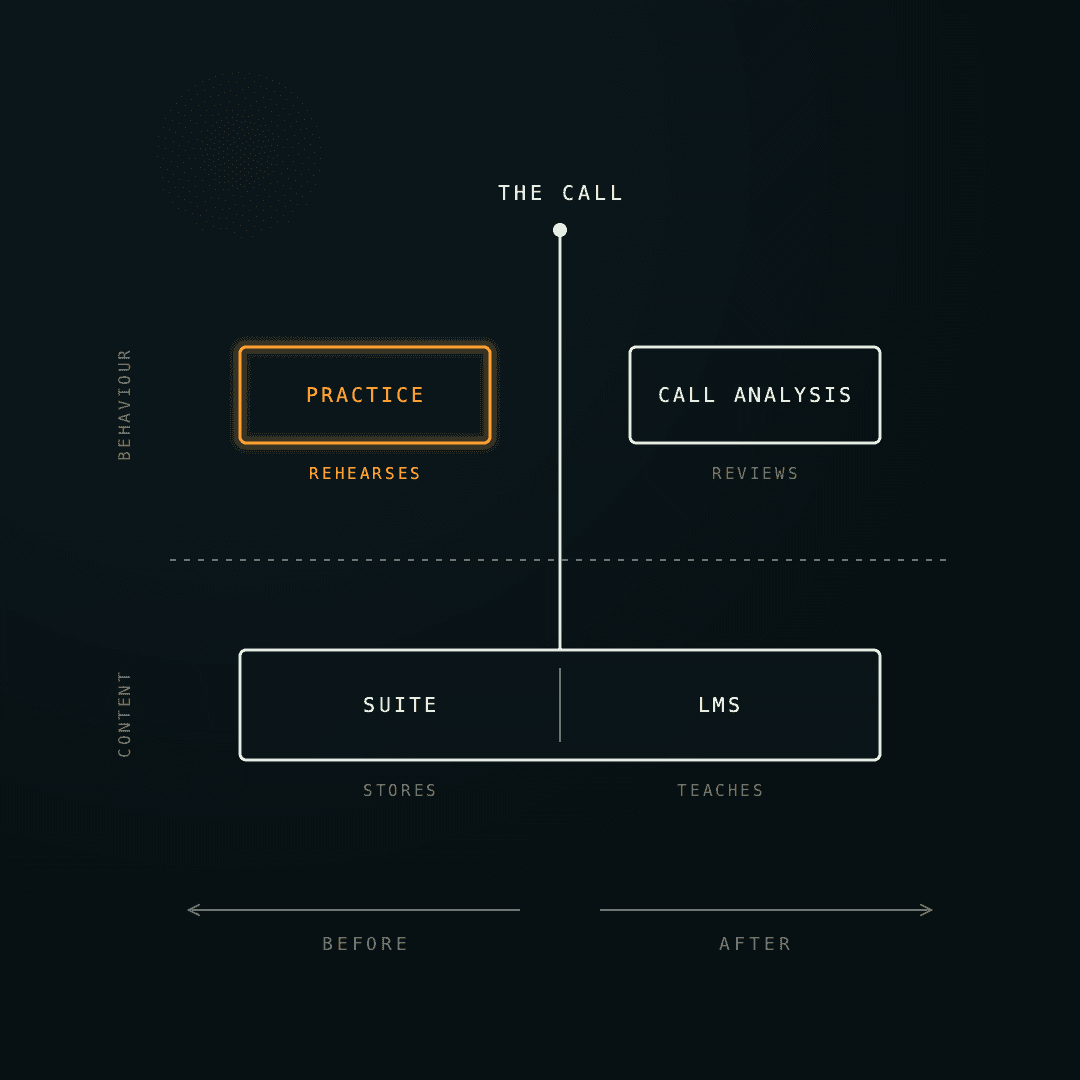
Sales training software comes in four categories: enablement suites, learning management systems, conversation intelligence, and AI practice and coaching. Each does one job well. Problems start when you buy one expecting the job of another.
Think of a football team. You need a playbook (the suite), a classroom where players learn the plays (the LMS), match footage you review on Monday (conversation intelligence), and training sessions where players run the plays until they are automatic (practice). Nobody thinks the match footage replaces training. In sales software, people make that mistake every day.
1. Enablement suites: Seismic, Highspot, Showpad, Allego, Mindtickle
The job: store, govern and distribute content. Pitch decks, battle cards, case studies, product sheets, approved messaging. Track which content gets used and which content shows up in deals that win. Many now add buyer-facing rooms, learning paths and, since 2025, AI roleplay modules.
What they are good at: making sure the rep in Lyon and the rep in Leeds send the same approved deck. Version control. Compliance on content. Reporting on what content gets used.
What they are not built for: making a rep better at the conversation itself. Practice is usually one module among many, added late. Seismic announced its AI Role-Play Agent in its Spring 2025 release. Showpad's Roleplay AI shows up in its help centre in March 2026. Allego launched its video-avatar Live Dialog Simulator in 2025. All real features. All bolted onto platforms whose centre of gravity is content.
2. Learning management systems: Mindtickle (in part), Docebo, TalentLMS, 360Learning, Lessonly (now inside Seismic)
The job: courses, learning paths, quizzes, certification, completion tracking.
What they are good at: proving people have been taught something. Compliance training. Product launches. Onboarding curricula.
What they are not built for: proving people can do something under pressure. A rep can score 100% on the objection-handling quiz and still freeze when a real buyer says "we're happy with our current supplier." We wrote a whole piece on why the LMS model breaks down for field sales. Short version: you cannot learn to swim by reading about water.
3. Conversation intelligence: Gong, Chorus (ZoomInfo), and the call recorders built into CRMs and dialers
The job: record real calls, transcribe them, analyse them, surface deal risk, feed forecasting.
What they are good at: visibility. A manager with fifty reps cannot listen to every call. CI tools let them find the five that matter. Forecasting and deal inspection are genuinely strong here.
What they are not built for: the moment before the call. They need a recorded conversation to work. No recording, no data. That is a problem for field sales (the conversation happens in a hospital corridor or a car park), for regulated industries (some calls cannot be recorded), and for new hires (who have no calls yet). Gong has started to close the gap. Its February 2026 release, Mission Andromeda, added guided AI role-play to Gong Enable, built from your past customer conversations, according to Gong's own release page. Useful, if you have the recordings.
4. AI practice and coaching: SecondBody, Second Nature, Hyperbound, Yoodli, and a long tail
The job: let reps rehearse real conversations against an AI buyer, get scored, try again, and build the reflex before the stakes are real. The better ones add a coach that follows up, and give managers a short view of who needs help on what.
What they are good at: repetitions. A rep can run the same tough pricing conversation ten times in a week without a manager in the room. Nobody else in this list gives you that.
What they are not built for: governing your content library, running a 40-module certification programme, or forecasting your pipeline.
Within this category the tools differ a lot. Second Nature leans on video avatars and structured certification. Hyperbound leans on cold-call volume for SDR teams. Yoodli started in delivery and presentation coaching. SecondBody is voice-first, built for reps who live on the phone and on the road, with an AI coach (Rory) who, on team plans, calls the rep on WhatsApp or the phone rather than waiting for them to log in.
The sentence to remember: suites store, LMS teaches, conversation intelligence reviews, practice rehearses. If your problem is behaviour on live calls, only one of those four touches it directly.
Can you trust a "best alternatives" list?
Trust it for the names. Do not trust it for the ranking.
On 16 October 2026 we checked the live Google results in the US for the alternatives terms our buyers use. The pattern was the same every time. For "second nature alternatives," page one had lists from Kendo, Growthspace, Whatfix, Mindtickle, PitchMonster, Easygenerator, Virti and ReflexAI, plus two Reddit threads. For "hyperbound alternatives," Kendo, Mindtickle, PitchMonster, GTM Buddy, ReflexAI, Paradiso, ZoomInfo and GetSkylar. For "mindtickle alternatives," the top results include Outdoo (which ranks Outdoo first) and ZoomInfo (which ranks ZoomInfo first). Mindtickle's own "Seismic competitors" page ranks Mindtickle first.
Every vendor ranks itself first. That is not a scandal. It is marketing. But it means the list tells you more about the author's positioning than about your problem.
The other thing we noticed: the lists mix categories without saying so. A "sales coaching software" roundup will put Gong (call analysis), Mindtickle (suite), and Hyperbound (AI practice) side by side as if they were three flavours of the same thing. They are not. It is like comparing a dashcam, a driving manual and a driving instructor and asking which one is the best car.
How to read any list, including ours:
Check who wrote it. If the author is in the list, discount their ranking and keep their trade-off notes on competitors (vendors are often accurate about each other's weaknesses, if a bit generous about their own).
Check the date. In 2026 alone, two big enablement vendors merged, Gong shipped roleplay, and Showpad absorbed Bigtincan. A 2024 list is describing companies that no longer exist in that shape.
Check whether pricing is real or "contact sales." Most of this market does not publish prices. Any list quoting precise figures for those vendors is quoting a third party, a guess, or one buyer's negotiation.
Check the category. If the list does not tell you which job each tool does, it cannot tell you which one you need.
What are the best Second Nature alternatives for sales roleplay?
The main alternatives to Second Nature are SecondBody (voice-first, with Rory on WhatsApp and phone on team plans, built for field and regulated teams), Hyperbound (SDR cold-call volume), Yoodli (delivery and presentation), and the roleplay modules inside suites like Mindtickle, Allego and Showpad. Which one fits depends on why Second Nature isn't working for you.
What Second Nature is. An AI roleplay platform with video avatars, multi-persona meetings, a "Deal Coach" for live deals, certifications, and support for 30+ languages, according to its own site. It plugs into LMS platforms via SCORM and LTI, and lists customers like Oracle NetSuite, GoHealth, iQor, Calix and United Rentals. It is independent. (Some old internal notes, ours included, once claimed otherwise. They were wrong.)
What it claims. Its site says customers see 34% faster ramp, 6x more practice and 46% more deals closed on average. Those are vendor averages across hand-picked customers. Our skeptic's read: the practice number is the believable one, because any AI practice tool beats "one roleplay at the sales kick-off." The deals-closed number needs a control group nobody publishes.
What's annoying. Pricing is not published. One review site reports deals starting around $20,000 a year, and a competitor reported a credit-based model in 2026. Both second-hand. G2 reviews rate it well (around 4.7 out of 5) but recurring complaints mention inconsistent AI scoring, conversations that feel scripted, a learning curve, and avatars that one reviewer said "are not perfect yet."
Pick Second Nature if you want avatar-based, desk-based roleplay tied into an existing LMS with certification workflows, and you are fine with a sales process before you see a price.
Pick an alternative if your reps are in the field or on the phone, if nobody is going to sit at a desk and book a session, or if you need to see pricing before the first meeting.
Our head-to-head page puts it in one line: SecondBody practises, Second Nature onboards. Read the full Second Nature vs SecondBody comparison, or the complete list of Second Nature alternatives, which covers more tools and the "compare Synthesia and Second Nature" question we see a lot in our search data. (Short answer to that one: Synthesia makes AI presenter videos for training content. It does not roleplay a buyer with your rep. Different job.)
What are the best Hyperbound alternatives?
The main Hyperbound alternatives are SecondBody (full-cycle and field sales, with a coach that calls the rep on team plans), Second Nature (avatar roleplay and certification), Mindtickle (suite with roleplay inside), and Gong (if you mostly want real-call scoring). Which one depends on whether your team does more than cold calls.
What Hyperbound is. A voice-first AI roleplay tool that grew up on SDR cold calling. Its pricing page, checked today, lists a free tier with 45 prebuilt AI roleplays, then two enterprise plans sold per user: Practice (roleplay packs, a buyer-bot builder, custom scorecards, LMS and SSO integration) and Perform (adds real-call scoring, deal-level coaching and CRM and call-recorder integrations). No dollar figures are published, as you can see on Hyperbound's pricing page. You may see per-seat prices quoted around the web. We could not find one that comes from Hyperbound.
What it does well. Fast to try. Strong on the realism of a cold-call buyer, interruptions included. Leaderboards that SDR teams actually like.
What's annoying. Its gravity is outbound. Our comparison page and several reviewers say complex, multi-stakeholder deal roleplay is not where it shines. It is a desk tool for people who sit at desks. And the free tier is a free tier: the features most enablement teams need sit behind an enterprise conversation.
Pick Hyperbound if 80% of your training problem is SDR call volume and your reps sit at a dialer all day.
Pick an alternative if you also need to train AEs, account managers, or field reps who sell face to face, or if you want a coach that follows up with the rep rather than a bot the rep has to remember to open.
The head-to-head is on our Hyperbound vs SecondBody page. The wider field, including "is Hyperbound worth it" and the Solidroad comparison that shows up in our search data, is in Hyperbound alternatives.
Who are Mindtickle's competitors, and when should you replace it?
Mindtickle's direct competitors are the other enablement suites: Seismic (now including Highspot), Allego, Showpad and SalesHood. Its indirect competitors, which teams increasingly use instead of or alongside it, are AI practice tools (SecondBody, Second Nature, Hyperbound) and Gong for call coaching.
What Mindtickle is. A sales readiness suite: onboarding paths, certification, content, coaching, roleplay, call analysis and readiness scoring in one platform. It is one of the most complete products in the category and has a large G2 review base. Our own comparison page calls it out honestly: "SecondBody Practices. Mindtickle Certifies."
Why teams replace it. From the reviews, the competitor pages, and the buyers we talk to, three reasons come up again and again.
Cost at scale. Mindtickle does not publish prices. Third-party roundups citing buyer-marketplace data put typical contracts anywhere from about $11,000 to well over $100,000 a year depending on seats, modules and term. Sources disagree a lot, which is itself the point: you won't know until you're in the room.
Complexity. One G2 reviewer quoted on a competitor's page said you need a "mental map" to find your way around. That is the price of breadth. A suite that does everything has a menu for everything.
LMS bones. Even critics who like it say it still behaves like a learning platform at heart. Reps go to it. It does not come to them. For field teams that is the whole problem.
When to keep it. If your enablement team runs a real certification programme, needs readiness scores tied to deal outcomes across many cohorts, and has an admin to run it, Mindtickle earns its keep. Don't rip that out for a roleplay tool. Add one.
When to replace or supplement it. If reps complete modules but managers still say "they can't handle the pricing conversation," the gap is practice, not content. That is the job an AI coach does.
Read Mindtickle vs SecondBody for the full side-by-side.
Is there a Seismic alternative now that Seismic and Highspot have merged?
Yes. The closest like-for-like Seismic alternatives are Showpad (now combined with Bigtincan), Allego and Mindtickle. But the better question for most teams is whether you need a content platform at all, or whether the problem you are trying to solve is reps not handling conversations well. If it is the second, the alternative is not another suite.
What Seismic is now. The biggest content and enablement company in the market, after closing its merger with Highspot in August 2026. It owns Lessonly (acquired in 2021, now its learning and coaching layer) and added an AI Role-Play Agent in mid-2025. Our comparison page frames it as "Seismic is where content goes to be governed. SecondBody is where reps go to practice." We stand by that.
What changed for buyers. Before February 2026, if you disliked Seismic you looked at Highspot, and vice versa. That option is gone. You now have one vendor, two product lines, and a consolidation that will take a while. Analysts and competitors (Dock's CEO wrote a widely shared piece) argue integration will absorb engineering time for years. That's opinion from a competitor, so weigh it. But the questions it raises are fair:
What ships on my product line in the next 24 months, and what gets frozen?
Where does my price land when two price books become one?
Who owns my account after the close, and how often will that change?
We see "highspot with gong vs seismic alone: which stack lowers total cost of ownership?" in our own search data. Honest answer: neither stack fixes rehearsal. One gives you content plus call analysis. The other gives you content plus a learning layer. The cost comparison only matters once you know which job you are paying for.
Pick Seismic if content governance, audit trails and a single approved message across a large, regulated sales force is your main problem. Few products do it better.
Look elsewhere if your reps have the right deck and still lose the room. More content does not fix that.
Full comparison: Seismic vs SecondBody.
Who are Showpad's competitors after the Bigtincan deal?
Showpad's competitors are Seismic (with Highspot), Allego and Mindtickle on the content and enablement side, and AI practice tools like SecondBody and Second Nature on the coaching side. If you came to Showpad for coaching, the practice tools are where to look.
What Showpad is now. Vector Capital took Bigtincan private in 2025, then agreed to buy Showpad in August 2025 and combine the two under the Showpad brand, according to Showpad's announcement. Bigtincan had bought Brainshark in 2021. So one company now holds three products that used to compete with each other. Showpad's strengths are real: a governed content library, offline access for field reps (a genuinely useful feature in a hospital with no signal), buyer-facing Shared Spaces, and a coaching module. Its Roleplay AI is documented in its help centre from March 2026.
Why teams look around. On our comparison page we say it plainly: in Showpad, "coaching is a module, not the core product." Video pitch review (record yourself, a manager scores it later) is useful. It is not the same as live back-and-forth with a buyer who pushes back. And after two mergers in a year, buyers reasonably ask which product line gets the investment.
Pick Showpad if your field team needs approved content in their bag, offline, across many markets.
Look elsewhere if the content is fine and the conversation isn't.
Full comparison: Showpad vs SecondBody. Our line there: SecondBody practises, Showpad distributes.
Who are Allego's competitors, and what happened to Lessonly, Brainshark and Rehearsal?
Allego competes with Mindtickle, Seismic, Showpad and SalesHood as an enablement suite, and with SecondBody, Second Nature and Hyperbound on AI roleplay. Lessonly is now part of Seismic. Brainshark is now part of Showpad, through Bigtincan. Rehearsal, the video roleplay tool, was bought by eLearning Brothers (now ELB Learning) in early 2022.
That last answer exists because one of the most interesting queries in our Search Console this quarter was this one, typed in full: "ai sales coaching tools competitors 2026 gong allego lessonly brainshark rehearsal saleshood hyperbound." We rank around position 2 for it. Read that list again. It mixes a conversation intelligence tool (Gong), a suite (Allego), two products that no longer exist as independent companies (Lessonly, Brainshark), a video roleplay tool absorbed into an e-learning company (Rehearsal), an independent enablement platform (SalesHood), and an AI roleplay startup (Hyperbound). That is the market in one search. Buyers are confused because the market merged under them.
Here's the map as of 16 October 2026:
Name in the query | What it is today |
|---|---|
Gong | Independent. Conversation intelligence, now with AI role-play in Gong Enable (Feb 2026). |
Allego | Independent. Enablement suite with content, learning, coaching and a video-avatar roleplay simulator (2025). |
Lessonly | Part of Seismic since 2021. Seismic is now merged with Highspot. |
Brainshark | Part of Bigtincan since 2021, which is now part of Showpad. |
Rehearsal | Bought by eLearning Brothers (now ELB Learning), announced January 2022. |
SalesHood | Independent enablement platform. |
Hyperbound | Independent. AI roleplay, strongest on SDR cold calls. |
What Allego is. A broad suite: content management with AI search, Digital Rooms for buyers, learning, coaching, conversation intelligence, and the Live Dialog Simulator, a video-avatar roleplay engine announced in 2025. Allego says it was named a Leader in Gartner's 2025 Magic Quadrant for Revenue Enablement Platforms. Enterprise references include big names in pharma and finance.
What's annoying. It is a suite, so setup is client-managed and takes weeks. Its roleplay is video and desktop-first. Coaching often means recording a pitch for later review, which is useful but slow. And the conversation intelligence layer needs recorded customer calls, which regulated field teams often cannot provide.
Pick Allego if you want one platform for content, learning and buyer rooms, and roleplay is a nice extra.
Look elsewhere if roleplay is the main event.
Our line: SecondBody practises, Allego hosts. Full comparison: Allego vs SecondBody.
Are there Gong alternatives for coaching, or do you need both?
If you want coaching from recorded calls, the alternatives to Gong are other conversation intelligence tools (Chorus, the recorders in your dialer or CRM, Hyperbound's Perform plan). If you want coaching that changes behaviour before the next call, Gong is not really the right comparison. You want a practice tool, and many teams run one next to Gong.
What Gong is. The category leader in conversation intelligence. Records, transcribes and analyses calls, flags deal risk, and feeds forecasting. Since February 2026, Gong Enable includes guided AI role-play built from your own past conversations. Third-party pricing guides put it at roughly $1,200 to $1,600 per seat per year plus a platform fee, on multi-year terms. Gong does not publish pricing, so treat those as reported ranges.
What Gong does better than anyone in this article. Visibility on live deals. Forecasting. Finding the five calls out of five hundred a manager should listen to.
Where it runs out. Gong is a rear-view mirror. A very good one. It needs a recorded call to say anything. That creates three blind spots:
Field sales. The conversation happened face to face. Nothing to record.
Regulated calls. Some medtech, pharma and finance conversations cannot be recorded, or the compliance team will not let you.
New hires. A rep in week two has no calls to analyse. Gong's new roleplay helps here, but it learns from your recordings, so it is strongest where you already have a big library.
Do you need both? Often, yes. They are not rivals so much as two halves. Gong tells you what happened. A practice tool lets the rep fix it before it happens again. The test: if your managers have Gong and still say "I know what's wrong, I just can't get them to do it differently," you need the other half. SecondBody integrates with Gong for that reason.
Full comparison: Gong vs SecondBody.
When is Yoodli the right alternative, and when is it not?
Yoodli is the right alternative when your problem is how reps sound: pacing, filler words, confidence, presence. It is less of a fit when the problem is what reps say: discovery depth, objection handling, pricing pushback.
What Yoodli is. It calls itself "the AI platform for human skills," with AI roleplays for sales, onboarding, certification, leadership and communication. It names customers like Google Cloud, Snowflake, RingCentral and Salesforce on its site, and lists SOC 2 Type 2, GDPR, SSO and SCIM. Individual plans are published (third-party sites report roughly $8 to $20 a month for individual tiers); team and enterprise pricing is quote-only.
What it does well. Delivery feedback. Breadth across use cases. Multi-persona roleplay for buying committees. A free way to try it.
What's annoying. For sales teams, the critique from reviewers and from our own comparison is the same: it coaches delivery more than content. A rep can sound confident and still miss the buyer's real objection.
Pick Yoodli if you want reps to sound better, especially in presentations and demos.
Pick a sales-specific practice tool if you want reps to sell better when the buyer goes off script.
Full comparison: Yoodli vs SecondBody.
Where does SecondBody fit in a sales training software comparison?
SecondBody is an AI practice and coaching platform. It sits in category four. It is not a content library or an LMS, and it never records your customer conversations. Rory does not listen in on live calls or visits. Reps practise before and debrief after, and the only real calls Rory coaches on are ones you choose to upload yourself. It trains forward: before the meeting, not after it.
Here's what it does in practice.
Rory, the AI coach, calls the rep. On team plans, Rory reaches reps on WhatsApp or the phone. A morning warm-up, a debrief at the end of the day, on-demand practice before a big meeting. The rep does not log in to anything. That matters more than any feature on this page, because "another tool nobody opens" is the number one reason training software dies.
Voice-first roleplay. Cold calls, discovery, objections, pricing, negotiation, compliance-sensitive conversations. Rory plays the buyer, then scores the rep on your methodology (SPIN, MEDDIC, Sandler). Every plan lets you build custom buyer personas and upload your objection library; on team plans Rory is also custom-trained on your playbook.
A one-page brief for managers. Before each 1:1: who to coach this week, on which skill, and which practice moments to replay. Managers who cannot hear their reps' field conversations finally get a window into them.
Built for field and regulated teams. Medtech, pharma, finance, as well as inside sales. Because nothing from the customer conversation is recorded, it runs in pharma, medical devices and financial services. Team plans add SOC 2 Type II, enterprise SSO, custom data retention and 12+ languages.
Published pricing. $75 per seat per month, or $750 a year, including 120 minutes of roleplay and 60 minutes of coaching with Rory each month, on web and mobile. Teams and enterprises get custom packages, which is where the WhatsApp and phone coaching, playbook training and enterprise security sit. See pricing.
What we are not. We are not a content management system and we do not run formal certification programmes. If governed content or a 40-module certification path is your main problem, buy a suite and keep it. Plenty of our customers run us next to one.
Proof, from teams that use it.
Rentokil Terminix (US): reps did 16 hours of roleplay each in under three weeks, with zero days taken off the road, and every manager backed it. Read the Rentokil Terminix story.
Allwyn: reps at coaching standard went from 1 in 5 to 4 in 5 in a quarter, with 65% faster ramp and 3 in 4 of 200 reps practising. Their reps grew 3.5% while their market fell 4%. See the Allwyn story.
Parkingeye: 415 contracts against a 380 target in 2025, 33% over year-to-date target.
GBUK (UK medical devices): reps who practised consistently scored 8 to 10 out of 10 on cold calls, against about 6 for reps who practised only now and then, and managers got back about a week a month.
Cyera is a named customer, alongside others under NDA.
Same skeptic's rule we applied to everyone else: these are our customers' numbers, reported by us. The ones we trust most are the boring ones. Sixteen hours of practice per rep in three weeks is a usage fact. Usage is the thing most training software never gets.
Sales training software comparison: which tool covers which use case?
The table below compares the eight tools in this guide plus SecondBody across the use cases buyers bring to us. "Yes" means it is a core strength. "Partial" means it exists but is not where the product's weight sits. "No" means it is not what the product does.
Use case | SecondBody | Second Nature | Hyperbound | Mindtickle | Seismic / Highspot | Showpad | Allego | Gong | Yoodli |
|---|---|---|---|---|---|---|---|---|---|
Daily voice practice reps actually do | Yes | Partial | Yes | Partial | Partial | Partial | Partial | Partial | Partial |
Field sales (calls not recorded) | Yes | Partial | No | Partial | Partial | Partial | Partial | No | Partial |
No-login coaching (WhatsApp or phone) | Yes (team plans) | No | No | No | No | No | No | No | No |
SDR cold-call ramp | Yes | Yes | Yes | Partial | Partial | Partial | Partial | Partial | Partial |
Full-cycle AE practice (discovery to negotiation) | Yes | Yes | Partial | Partial | Partial | Partial | Partial | Partial | Partial |
Manager pre-1:1 coaching brief | Yes | Partial | Partial | Partial | Partial | Partial | Partial | Yes | No |
Methodology scoring (SPIN, MEDDIC, Sandler) | Yes | Yes | Partial | Yes | Partial | Partial | Partial | Partial | No |
Regulated industries (medtech, pharma, finance) | Yes | Partial | No | Yes | Yes | Yes | Yes | Partial | Partial |
Published per-seat pricing | Yes | No | No | No | No | No | No | No | Partial |
Live in about two weeks | Yes | Partial | Yes | No | No | No | No | Partial | Yes |
Content governance and version control | No | No | No | Yes | Yes | Yes | Yes | No | No |
Buyer-facing deal rooms | No | No | No | Partial | Yes | Yes | Yes | No | No |
Formal certification programmes | No | Yes | Partial | Yes | Yes | Partial | Yes | No | Yes |
Recorded-call analysis and forecasting | Partial (uploaded calls only) | Partial | Yes | Partial | Partial | No | Yes | Yes | No |
How to read it:
If your rows are the top half (practice, field, ramp, manager coaching, pricing you can see), you are shopping in category four, and SecondBody covers more of it than anyone else on this list.
If your rows are the bottom half (content, deal rooms, certification, forecasting), you need a suite or Gong. Buy one. Then decide whether you also need practice.
If you have rows in both halves, you need two tools. That is normal. The mistake is buying one and pretending it covers both.
We built this table from each vendor's own site and our comparison pages, checked on 16 October 2026. Vendors ship fast. If a "Partial" has become a "Yes" by the time you read this, tell us and we'll fix it.
What do buyers ask us on sales calls before they switch?
They ask how to prove the money comes back, what gets recorded, whether reps will actually use it, and how much setup it takes. We went through twenty of our own sales calls from January to September 2026 to pull these out. Names stay private. The questions don't.
Who is asking. Heads of Sales Enablement and Sales Development. Retail capability managers. Regional sales directors. Commercial leaders running field teams. Companies between 200 and 10,000 people. Usually with a trigger: a hiring cohort, a regional rollout, reps moving into sales from clinical or operations roles who know the product cold and freeze on the call, or managers who simply cannot hear the conversations because they happen face to face.
"How do we prove we make our money back?" The honest version of this question is about time. Every hour a rep spends training is an hour off the phone or off the road. So the bar is not "is training good?" It is "is this better than another hour of selling?" Our answer: pick one number before you start (time to first deal, cold-call scores, conversion on one stage), measure it on a small group, and judge it on that. Rentokil Terminix got 16 hours of practice per rep without taking a single day off the road, which is the ROI argument in one line. We go deeper on this in our piece on sales coaching software pricing.
"We need proof beyond a pilot." Fair. A pilot proves the tool works on ten keen people. It does not prove it works on two hundred tired ones. Ask any vendor, including us, for a customer at your size who has been live for more than a year.
"What exactly is recorded?" Compliance and procurement ask this early, and they should. Recorded practice sessions are not the same as recorded customer calls. Ask every vendor: what is stored, where, for how long, who can see it, and whether it trains their models. Ask for the DPA before the demo, not after the pilot. Our answer is short: SecondBody never records customer conversations. Rory is not on the live call or in the visit. What gets stored is the practice, plus any call a customer chooses to upload. Details are on our trust centre.
"Is this another tool nobody opens?" The question we respect most. Ask every vendor what share of licensed reps were active last month, not at launch. Then ask what the rep has to do to start a session. If the answer starts with "log in," expect the usual curve.
"How much setup is this?" Suites take months and an admin. Practice tools should take weeks. Ask who builds the first scenarios, you or them.
"The minutes pricing confuses me." We hear this about our own pricing, so here it is plainly: $75 a seat a month includes 120 minutes of roleplay and 60 minutes of coaching with Rory. Most reps do short sessions, a few minutes each, so that is a lot of repetitions. Teams that need more buy a custom minute package.
What actually closed deals. Not features. Four things: a small, scoped pilot (ten new joiners, two weeks, one number to move); Rory being reachable on WhatsApp or the phone with no login (a team-plan feature); Rory sounding like a real person, not a bot reading a script; and early signals the manager could see (confidence, readiness scores) before the revenue numbers arrived. Plus one thing on the customer's side: a named person who owns the content.
What should sales training software cost in 2026?
It depends entirely on the category, and most vendors will not tell you until you are in a sales process. As a rough guide, from published prices and third-party reports:
Tool | Published price? | What we could find (16 Oct 2026) |
|---|---|---|
SecondBody | Yes | $75 per seat per month or $750 a year, with 120 roleplay minutes and 60 coaching minutes a month. Custom team packages. |
Second Nature | No | Reported by one review site to start around $20,000 a year. Second-hand. |
Hyperbound | Partly | Free tier with 45 prebuilt roleplays. Practice and Perform plans are per user, quote-only. |
Mindtickle | No | Third-party reports range from about $11,000 to over $100,000 a year depending on seats and modules. |
Seismic / Highspot | No | Quote-only. One roundup reports Highspot averaging around $91,000 a year for enterprise. Second-hand. |
Showpad | No | Per user, billed annually, quote-only. |
Allego | No | Per user, billed annually, modular. One roundup reports $50,000 to $100,000+ a year. Second-hand. |
Gong | No | Reported around $1,200 to $1,600 per seat per year plus a platform fee. Second-hand. |
Yoodli | Partly | Individual tiers reported around $8 to $20 a month. Teams quote-only. |
Three warnings about any price table, including this one:
The seat price is not the cost. Setup fees, platform fees, admin time, and the hours your managers spend building content all count. One roundup we read said effective per-seat cost often runs two to three times the quote once those are in.
Multi-year terms change the maths. A 20% discount for three years is only a discount if you still want the tool in year three.
The cheapest tool is the one people use. A $50,000 suite with 20% adoption costs more per active rep than almost anything else on this list.
How do you switch sales training software without losing a quarter?
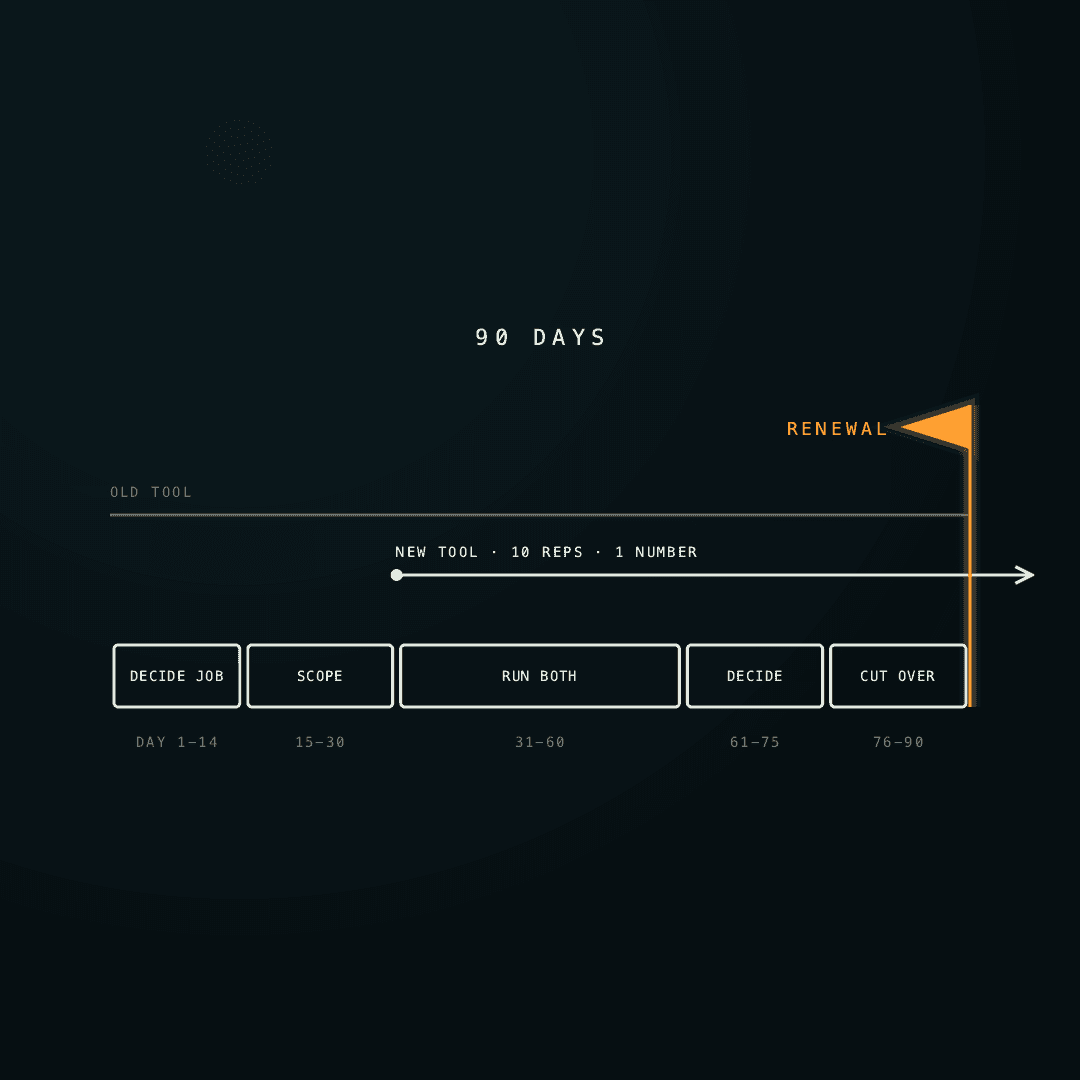
Run the new tool next to the old one for one cohort, prove one number, then cut over at renewal. Never switch everything on day one. Here's the 90-day version we have watched work.
Days 1 to 14: decide what you are actually replacing. Write down the job the old tool does that you still need (content governance, certification, call recording) and the job it was supposed to do but doesn't (usually: changing behaviour on calls). If the first list is empty, you are replacing. If it isn't, you are adding. Most teams are adding, and that is fine. Check your notice period now. Many enablement contracts auto-renew with 60 to 90 days' notice. Put the date in your calendar in red.
Days 15 to 30: scope a pilot that can fail. Ten reps. Ideally new joiners or a team with a clear gap. Two weeks of active use. One number to move: cold-call score, time to first meeting booked, discovery-stage conversion, or a manager's readiness rating. Name the content owner on your side before kick-off. This is the step teams skip, and it is the one that decides whether the tool is alive in month four.
Days 31 to 60: run both, change nothing else. Keep the old tool running. Don't launch a new methodology at the same time. Don't change comp. You want to know whether the tool moved the number, not whether six things moved it together. Ask the managers in the pilot one question each week: "Did this change any conversation you coached?"
Days 61 to 75: decide with evidence. If the number moved and reps kept using it without being chased, expand to the next cohort. If adoption dropped after week two, that is your answer, whatever the scores say. Export what you need from the old tool: content, completion records, certification history. Ask for the export format in writing before you give notice.
Days 76 to 90: cut over at renewal, not before. Give notice. Move the next cohort. Keep any content you still need in your shared drive or CRM, because most of it lived there before the suite anyway. Do not run a big-bang launch event. Let the managers from the pilot tell the others what changed. Reps trust their manager more than your launch deck.
The point of this plan is that no quarter depends on the switch. Your forecast never rests on a tool you installed last month.
What should you ask before you renew a sales training contract?
Ask what is actually used, what has changed, and who owns it. These seven questions take an hour and will save you a year.
What share of licensed reps were active in each of the last three months? Not logins. Sessions completed. If the vendor can't tell you, that is the answer.
Which features did we pay for and never turn on? Most suites are sold in modules. Many teams pay for three and use one.
What changed in the product since we signed, and what is on the roadmap for our product line? Ask this twice if your vendor merged this year. Seismic, Highspot and Showpad customers should get it in writing.
Where does our price land at renewal, and is there a cap? Ask before they send the quote, not after.
Who owns the content on our side, and when did they last update it? If nobody, no tool will save you. Fix that first.
What do our managers do with it each week? If the answer is "nothing," the tool is a library, not coaching.
What would we lose if we switched off tomorrow? Make a list. If it is short, you have your decision.
What mistakes do teams make when they replace a training tool?
These are the ones we have watched, more than once.
Replacing a category with a different category. A team leaves a suite for an AI practice tool and is surprised they no longer have a content library. Or leaves a practice tool for Gong and is surprised reps don't practise. Know which job you are buying.
Buying for the dashboard, not the rep. The demo that wins the steering committee is the one with the best reports. The tool that wins the reps is the one that takes thirty seconds to start. Those are rarely the same tool. Test with reps before you test with executives.
Launching big. Two hundred licences on day one, a kick-off event, a Slack channel. Week three, usage halves. Week eight, it's a line on a budget. Start with ten. Expand on evidence.
No content owner. Every tool, ours included, dies when scenarios go stale. If nobody owns refreshing them, reps practise last quarter's objections against last quarter's competitor.
Treating managers as viewers. If the manager never looks at the practice, the rep learns it doesn't matter. The fix is giving the manager something small and useful every week, which is why we built a one-page brief, not a dashboard.
Measuring completions. Completion rates measure attendance. Measure a behaviour on real calls or one stage of the pipeline.
Signing three years to save 20%. In a market where two of the biggest vendors merged and another absorbed two competitors inside eighteen months, flexibility is worth more than the discount.
Frequently asked questions
What is the best sales training software in 2026?
There is no single best tool, because sales training software covers four jobs: content (Seismic, Showpad, Allego), courses and certification (Mindtickle, LMS tools), call analysis (Gong), and practice (SecondBody, Second Nature, Hyperbound, Yoodli). The best one is the one that does the job your team is failing at. For most teams that complain reps "know it but can't say it," that is practice.
How do I compare AI sales coaching solutions?
Ask four things. Does it train before the call or analyse after it? Do reps have to log in, or does it reach them? Does it score on your methodology and playbook, or a generic one? And what share of licensed reps were active last month at a customer your size? The last question cuts most shortlists in half.
Who are Mindtickle's main competitors?
Seismic (including Highspot), Allego, Showpad and SalesHood as full suites. For specific jobs, Gong (call coaching) and AI practice tools like SecondBody, Second Nature and Hyperbound. See Mindtickle vs SecondBody.
What is a good Seismic alternative after the Highspot merger?
For content governance, Showpad or Allego. For readiness and certification, Mindtickle. If your real problem is reps handling live conversations, an AI practice tool, often alongside your existing content platform. See Seismic vs SecondBody.
Who are Showpad's competitors?
Seismic, Allego and Mindtickle for content and enablement. SecondBody and Second Nature for practice-led coaching. Note that Showpad now owns Bigtincan and Brainshark, so those are no longer separate options.
Who are Allego's competitors?
Mindtickle, Seismic, Showpad and SalesHood as suites. SecondBody, Second Nature and Hyperbound for AI roleplay. Allego's own roleplay uses video avatars and is desktop-first.
Who are Lessonly's competitors, and does Lessonly still exist?
Lessonly was acquired by Seismic in 2021 and now forms part of Seismic's learning and coaching layer. If you are looking for a Lessonly-style tool today, the comparable options are Mindtickle, Allego, SalesHood, LMS tools like TalentLMS or 360Learning, and AI practice tools for the coaching side.
Which AI sales coaching tools compete with Gong, Allego, Lessonly, Brainshark, Rehearsal, SalesHood and Hyperbound in 2026?
That list now covers fewer companies than it looks. Lessonly is part of Seismic, Brainshark is part of Showpad, and Rehearsal belongs to ELB Learning. The independent names are Gong, Allego, SalesHood and Hyperbound. The AI coaching tools competing with all of them on practice are SecondBody, Second Nature, Yoodli, and the roleplay modules inside Mindtickle, Seismic and Showpad.
Are there Gong alternatives for coaching?
Yes, but decide which coaching you mean. For coaching from recorded calls, look at Chorus or your dialer's built-in recorder. For coaching that changes behaviour before the next call, use an AI practice tool. Many teams run both. See Gong vs SecondBody.
How does Sales Labs compare to other sales training platforms?
We see this question in our search data, but we could not find enough public information on a product by that name to compare it fairly. Use the same test as for any tool: which of the four jobs it does, whether reps need to log in, whether it scores on your methodology, and its active usage at a customer your size.
How does Evous compare to Mindtickle?
Evous, from its Software Advice listing, turns existing documents and videos into courses with AI avatars and translation, and sits next to an existing LMS. Mindtickle is a full readiness suite. They overlap on the learning side. Neither is primarily a voice practice tool. We found no independent reviews or pricing for Evous, so run a pilot.
Should we compare Synthesia and Second Nature?
Only if you are unsure what each does. Synthesia makes AI presenter videos, mostly for training content. Second Nature runs AI roleplay where the rep talks to an avatar buyer. One produces content to watch. The other produces practice to do. More in Second Nature alternatives.
How long does it take to switch sales training software?
Plan on about 90 days if you run the new tool alongside the old one: two weeks to scope, a month-long pilot with one cohort, two weeks to decide, and a cut-over timed to your renewal date. Suites can take three to six months to roll out fully. AI practice tools are usually live in weeks.
How is SecondBody different from Second Nature and Hyperbound?
Second Nature leans on video avatars and certification. Hyperbound leans on SDR cold-call volume. SecondBody is voice-first and built for reps on the phone and on the road: on team plans Rory calls the rep on WhatsApp or the phone with no login, scores them on your methodology, and gives managers a one-page brief before each 1:1. It never records customer conversations. Compare them directly on Second Nature vs SecondBody and Hyperbound vs SecondBody.
How much does SecondBody cost?
$75 per seat per month, or $750 per seat per year, including 120 minutes of roleplay and 60 minutes of coaching with Rory each month. Teams and enterprises get custom packages with volume minutes, plus WhatsApp and phone coaching, playbook training, SSO and SOC 2 Type II. See pricing.
How we know this
We built SecondBody and sell it against every tool on this page, so we hear these comparisons every week. For this guide we went through twenty of our own sales calls from January to September 2026, our Search Console data from 14 September to 11 October 2026 (around 90 competitor-alternative queries, with a median position near 10), and the live Google results for the main alternatives terms on 16 October 2026. Every competitor fact here was checked on the vendor's own site or in a dated public source that day. Where a number came from a third party or a competitor, we said so. Where we could not verify something, we left it out. If anything here is out of date, email us and we will fix it.
So which sales training software alternative should you pick?
Pick the one that does the job you are failing at.
If your reps can't find the right deck, buy a suite. If they haven't been taught the product, buy an LMS. If your managers can't see what is happening on calls, buy Gong. And if your reps know exactly what to say and still lose the room when the buyer pushes back, none of those will fix it, because that is not a knowledge problem. It is a reflex problem. Reflexes come from repetitions, and repetitions come from a coach that shows up where the rep already is.
Most "alternatives" are the same tool with a different logo. The real alternative is a different job: training before the call instead of reviewing after it.
That's the problem SecondBody was built to solve. On team plans Rory calls your reps, runs the hard conversation with them until it is automatic, and tells their manager who needs help on what. Start with ten reps and one number. If it doesn't move, you'll know in two weeks.
Good luck out there.
Omid
By Omid, founder of SecondBody
Key answers, up front
There is no single "best" alternative, because sales training software is four different products wearing one label. Enablement suites store and govern content. LMS tools teach and certify. Conversation intelligence reviews calls after they happen. AI practice and coaching tools rehearse the call before it happens. Most bad switches happen when a team replaces one category with another and expects the same result.
Teams are switching in 2026 for four reasons: renewal quotes that grew faster than usage, low adoption ("another tool nobody opens"), the Seismic and Highspot merger (announced February 2026, closed August 2026) leaving buyers mid-evaluation, and call-analysis tools that tell managers what went wrong without changing what reps do next time.
Pick by the job, not the brand. Need governed content and buyer rooms? Look at Seismic, Showpad or Allego. Need courses and certification at scale? Mindtickle or an LMS. Need call recordings and forecasting? Gong. Need reps to actually say the thing better on Monday? An AI practice tool: SecondBody, Second Nature, Hyperbound or Yoodli, each with a different centre of gravity.
Every "alternatives" page on page one of Google is written by a vendor that ranks itself first. This one is too, in the sense that we build an AI coach. So we show the trade-offs, link our head-to-head pages, and tell you when to pick someone else.
Do not switch cold. Run the new tool alongside the old one for one cohort, move one number, then cut over at renewal. Our switching plan below does it in about 90 days without losing a quarter.
Here's a moment most enablement leaders know.
Renewal email lands. The number has gone up. You open the usage dashboard to build your case for keeping it, and the dashboard tells you something you already suspected. A third of the reps logged in last month. Half of those clicked one module and left. The managers? They never opened it. They coach in the car park, between meetings, from memory.
So you start searching for sales training software alternatives. And you find a wall of lists. "10 best Mindtickle alternatives." "14 Second Nature alternatives." "7 best Seismic competitors." Read three of them and you notice the trick. The company that wrote the list is always number one.
We build one of these tools, so read on with that in mind. We'll be harder on the category, including ourselves, than any list you've read this week. And we'll give you the thing those lists skip: which job each tool actually does, so you stop replacing a hammer with a screwdriver and wondering why the nail is still sticking out.
This is the main guide in our competitor alternatives series. If you are already set on AI roleplay and just want to see who competes with the two names that come up most, go straight to our deep dives on Second Nature alternatives and Hyperbound alternatives. If you are earlier than that, and still asking "what kind of tool do we even need?", stay here.
Why are so many teams looking for sales training software alternatives in 2026?
Because four things broke at once: prices, adoption, a merger and a promise. Any one of them would push a team to look around. In 2026 a lot of teams got hit by two or three.
Renewal surprises
The first trigger is the boring one. The quote went up.
Enablement suites and conversation intelligence tools are mostly priced per seat, billed annually, often on multi-year terms, and almost never published. That means the price you pay is the price you negotiated, and the price you renew at is the price they think you will tolerate. Third-party pricing guides put Gong's typical renewal uplift at around 5 to 15% a year unless you negotiate a cap. Those numbers come from competitors and buyer marketplaces, not from Gong, so treat them as a direction, not a fact. But the direction matches what we hear. Reddit threads in r/sales through 2026 are full of people asking whether their Gong renewal is normal.
Here's what nobody says out loud. A renewal increase is only painful when usage is flat. Nobody fights a price rise on a tool their reps would riot to keep. The price is the symptom. The adoption is the disease.
Adoption: "another tool nobody opens"
On our own sales calls this year, the most common objection was not price. It was a version of: "We already have a tool nobody opens. Why would yours be different?"
That objection is earned. Most sales training software was designed for the person who buys it, not the person who has to use it. The buyer wants dashboards, completion rates, certifications. The rep wants to not look stupid in front of a buyer on Thursday. Those are different products. When the tool serves the buyer and ignores the rep, you get a beautiful report about training that did not happen.
One customer of ours cancelled a while back for exactly this reason. Not because the product failed. Because nobody on their side owned the content, so nothing new went in, so reps stopped coming back. We learned more from that loss than from most wins. Which is why "who owns the content?" is on our renewal checklist further down.
The Seismic and Highspot merger
Seismic and Highspot, the two biggest names in sales enablement content, signed a merger agreement on 12 February 2026. The deal closed on 18 August 2026, and the combined company runs under the Seismic name, with Highspot's product now carrying "Highspot by Seismic" branding, according to GeekWire's report on the close. The company says it serves around 2,500 customers and 3.5 million users.
If you were mid-evaluation between the two in March, you were suddenly evaluating one company with two products and an integration plan nobody had published. If you are renewing either one now, you are renewing into a roadmap that is still being merged. That does not make either product bad. It does mean six months of uncertainty for buyers, and a lot of them used that window to ask whether they needed a content platform at all, or whether their real problem was somewhere else.
We cover what to ask in that situation in the Seismic section below.
Tools that analyse calls but do not change behaviour
The fourth trigger is the one that matters most, and the one the listicles skip.
A lot of teams bought conversation intelligence expecting it to make reps better. It did make managers better informed. Every call recorded, transcribed, tagged, scored. And then what? The manager knows the rep fumbled the pricing question on Tuesday. The rep fumbles it again on Friday, because knowing you fumbled is not the same as having a better answer ready when your stomach drops.
That's the gap. Reps do not lack knowledge. They lack execution under pressure. A tool that looks backwards at a call can diagnose the problem. It cannot rehearse the fix. Teams who figured that out in 2026 started looking for alternatives, or more often, for a second tool that works on the other side of the call.
What are the four kinds of sales training software, and which job does each do?
Sales training software comes in four categories: enablement suites, learning management systems, conversation intelligence, and AI practice and coaching. Each does one job well. Problems start when you buy one expecting the job of another.
Think of a football team. You need a playbook (the suite), a classroom where players learn the plays (the LMS), match footage you review on Monday (conversation intelligence), and training sessions where players run the plays until they are automatic (practice). Nobody thinks the match footage replaces training. In sales software, people make that mistake every day.
1. Enablement suites: Seismic, Highspot, Showpad, Allego, Mindtickle
The job: store, govern and distribute content. Pitch decks, battle cards, case studies, product sheets, approved messaging. Track which content gets used and which content shows up in deals that win. Many now add buyer-facing rooms, learning paths and, since 2025, AI roleplay modules.
What they are good at: making sure the rep in Lyon and the rep in Leeds send the same approved deck. Version control. Compliance on content. Reporting on what content gets used.
What they are not built for: making a rep better at the conversation itself. Practice is usually one module among many, added late. Seismic announced its AI Role-Play Agent in its Spring 2025 release. Showpad's Roleplay AI shows up in its help centre in March 2026. Allego launched its video-avatar Live Dialog Simulator in 2025. All real features. All bolted onto platforms whose centre of gravity is content.
2. Learning management systems: Mindtickle (in part), Docebo, TalentLMS, 360Learning, Lessonly (now inside Seismic)
The job: courses, learning paths, quizzes, certification, completion tracking.
What they are good at: proving people have been taught something. Compliance training. Product launches. Onboarding curricula.
What they are not built for: proving people can do something under pressure. A rep can score 100% on the objection-handling quiz and still freeze when a real buyer says "we're happy with our current supplier." We wrote a whole piece on why the LMS model breaks down for field sales. Short version: you cannot learn to swim by reading about water.
3. Conversation intelligence: Gong, Chorus (ZoomInfo), and the call recorders built into CRMs and dialers
The job: record real calls, transcribe them, analyse them, surface deal risk, feed forecasting.
What they are good at: visibility. A manager with fifty reps cannot listen to every call. CI tools let them find the five that matter. Forecasting and deal inspection are genuinely strong here.
What they are not built for: the moment before the call. They need a recorded conversation to work. No recording, no data. That is a problem for field sales (the conversation happens in a hospital corridor or a car park), for regulated industries (some calls cannot be recorded), and for new hires (who have no calls yet). Gong has started to close the gap. Its February 2026 release, Mission Andromeda, added guided AI role-play to Gong Enable, built from your past customer conversations, according to Gong's own release page. Useful, if you have the recordings.
4. AI practice and coaching: SecondBody, Second Nature, Hyperbound, Yoodli, and a long tail
The job: let reps rehearse real conversations against an AI buyer, get scored, try again, and build the reflex before the stakes are real. The better ones add a coach that follows up, and give managers a short view of who needs help on what.
What they are good at: repetitions. A rep can run the same tough pricing conversation ten times in a week without a manager in the room. Nobody else in this list gives you that.
What they are not built for: governing your content library, running a 40-module certification programme, or forecasting your pipeline.
Within this category the tools differ a lot. Second Nature leans on video avatars and structured certification. Hyperbound leans on cold-call volume for SDR teams. Yoodli started in delivery and presentation coaching. SecondBody is voice-first, built for reps who live on the phone and on the road, with an AI coach (Rory) who, on team plans, calls the rep on WhatsApp or the phone rather than waiting for them to log in.
The sentence to remember: suites store, LMS teaches, conversation intelligence reviews, practice rehearses. If your problem is behaviour on live calls, only one of those four touches it directly.
Can you trust a "best alternatives" list?
Trust it for the names. Do not trust it for the ranking.
On 16 October 2026 we checked the live Google results in the US for the alternatives terms our buyers use. The pattern was the same every time. For "second nature alternatives," page one had lists from Kendo, Growthspace, Whatfix, Mindtickle, PitchMonster, Easygenerator, Virti and ReflexAI, plus two Reddit threads. For "hyperbound alternatives," Kendo, Mindtickle, PitchMonster, GTM Buddy, ReflexAI, Paradiso, ZoomInfo and GetSkylar. For "mindtickle alternatives," the top results include Outdoo (which ranks Outdoo first) and ZoomInfo (which ranks ZoomInfo first). Mindtickle's own "Seismic competitors" page ranks Mindtickle first.
Every vendor ranks itself first. That is not a scandal. It is marketing. But it means the list tells you more about the author's positioning than about your problem.
The other thing we noticed: the lists mix categories without saying so. A "sales coaching software" roundup will put Gong (call analysis), Mindtickle (suite), and Hyperbound (AI practice) side by side as if they were three flavours of the same thing. They are not. It is like comparing a dashcam, a driving manual and a driving instructor and asking which one is the best car.
How to read any list, including ours:
Check who wrote it. If the author is in the list, discount their ranking and keep their trade-off notes on competitors (vendors are often accurate about each other's weaknesses, if a bit generous about their own).
Check the date. In 2026 alone, two big enablement vendors merged, Gong shipped roleplay, and Showpad absorbed Bigtincan. A 2024 list is describing companies that no longer exist in that shape.
Check whether pricing is real or "contact sales." Most of this market does not publish prices. Any list quoting precise figures for those vendors is quoting a third party, a guess, or one buyer's negotiation.
Check the category. If the list does not tell you which job each tool does, it cannot tell you which one you need.
What are the best Second Nature alternatives for sales roleplay?
The main alternatives to Second Nature are SecondBody (voice-first, with Rory on WhatsApp and phone on team plans, built for field and regulated teams), Hyperbound (SDR cold-call volume), Yoodli (delivery and presentation), and the roleplay modules inside suites like Mindtickle, Allego and Showpad. Which one fits depends on why Second Nature isn't working for you.
What Second Nature is. An AI roleplay platform with video avatars, multi-persona meetings, a "Deal Coach" for live deals, certifications, and support for 30+ languages, according to its own site. It plugs into LMS platforms via SCORM and LTI, and lists customers like Oracle NetSuite, GoHealth, iQor, Calix and United Rentals. It is independent. (Some old internal notes, ours included, once claimed otherwise. They were wrong.)
What it claims. Its site says customers see 34% faster ramp, 6x more practice and 46% more deals closed on average. Those are vendor averages across hand-picked customers. Our skeptic's read: the practice number is the believable one, because any AI practice tool beats "one roleplay at the sales kick-off." The deals-closed number needs a control group nobody publishes.
What's annoying. Pricing is not published. One review site reports deals starting around $20,000 a year, and a competitor reported a credit-based model in 2026. Both second-hand. G2 reviews rate it well (around 4.7 out of 5) but recurring complaints mention inconsistent AI scoring, conversations that feel scripted, a learning curve, and avatars that one reviewer said "are not perfect yet."
Pick Second Nature if you want avatar-based, desk-based roleplay tied into an existing LMS with certification workflows, and you are fine with a sales process before you see a price.
Pick an alternative if your reps are in the field or on the phone, if nobody is going to sit at a desk and book a session, or if you need to see pricing before the first meeting.
Our head-to-head page puts it in one line: SecondBody practises, Second Nature onboards. Read the full Second Nature vs SecondBody comparison, or the complete list of Second Nature alternatives, which covers more tools and the "compare Synthesia and Second Nature" question we see a lot in our search data. (Short answer to that one: Synthesia makes AI presenter videos for training content. It does not roleplay a buyer with your rep. Different job.)
What are the best Hyperbound alternatives?
The main Hyperbound alternatives are SecondBody (full-cycle and field sales, with a coach that calls the rep on team plans), Second Nature (avatar roleplay and certification), Mindtickle (suite with roleplay inside), and Gong (if you mostly want real-call scoring). Which one depends on whether your team does more than cold calls.
What Hyperbound is. A voice-first AI roleplay tool that grew up on SDR cold calling. Its pricing page, checked today, lists a free tier with 45 prebuilt AI roleplays, then two enterprise plans sold per user: Practice (roleplay packs, a buyer-bot builder, custom scorecards, LMS and SSO integration) and Perform (adds real-call scoring, deal-level coaching and CRM and call-recorder integrations). No dollar figures are published, as you can see on Hyperbound's pricing page. You may see per-seat prices quoted around the web. We could not find one that comes from Hyperbound.
What it does well. Fast to try. Strong on the realism of a cold-call buyer, interruptions included. Leaderboards that SDR teams actually like.
What's annoying. Its gravity is outbound. Our comparison page and several reviewers say complex, multi-stakeholder deal roleplay is not where it shines. It is a desk tool for people who sit at desks. And the free tier is a free tier: the features most enablement teams need sit behind an enterprise conversation.
Pick Hyperbound if 80% of your training problem is SDR call volume and your reps sit at a dialer all day.
Pick an alternative if you also need to train AEs, account managers, or field reps who sell face to face, or if you want a coach that follows up with the rep rather than a bot the rep has to remember to open.
The head-to-head is on our Hyperbound vs SecondBody page. The wider field, including "is Hyperbound worth it" and the Solidroad comparison that shows up in our search data, is in Hyperbound alternatives.
Who are Mindtickle's competitors, and when should you replace it?
Mindtickle's direct competitors are the other enablement suites: Seismic (now including Highspot), Allego, Showpad and SalesHood. Its indirect competitors, which teams increasingly use instead of or alongside it, are AI practice tools (SecondBody, Second Nature, Hyperbound) and Gong for call coaching.
What Mindtickle is. A sales readiness suite: onboarding paths, certification, content, coaching, roleplay, call analysis and readiness scoring in one platform. It is one of the most complete products in the category and has a large G2 review base. Our own comparison page calls it out honestly: "SecondBody Practices. Mindtickle Certifies."
Why teams replace it. From the reviews, the competitor pages, and the buyers we talk to, three reasons come up again and again.
Cost at scale. Mindtickle does not publish prices. Third-party roundups citing buyer-marketplace data put typical contracts anywhere from about $11,000 to well over $100,000 a year depending on seats, modules and term. Sources disagree a lot, which is itself the point: you won't know until you're in the room.
Complexity. One G2 reviewer quoted on a competitor's page said you need a "mental map" to find your way around. That is the price of breadth. A suite that does everything has a menu for everything.
LMS bones. Even critics who like it say it still behaves like a learning platform at heart. Reps go to it. It does not come to them. For field teams that is the whole problem.
When to keep it. If your enablement team runs a real certification programme, needs readiness scores tied to deal outcomes across many cohorts, and has an admin to run it, Mindtickle earns its keep. Don't rip that out for a roleplay tool. Add one.
When to replace or supplement it. If reps complete modules but managers still say "they can't handle the pricing conversation," the gap is practice, not content. That is the job an AI coach does.
Read Mindtickle vs SecondBody for the full side-by-side.
Is there a Seismic alternative now that Seismic and Highspot have merged?
Yes. The closest like-for-like Seismic alternatives are Showpad (now combined with Bigtincan), Allego and Mindtickle. But the better question for most teams is whether you need a content platform at all, or whether the problem you are trying to solve is reps not handling conversations well. If it is the second, the alternative is not another suite.
What Seismic is now. The biggest content and enablement company in the market, after closing its merger with Highspot in August 2026. It owns Lessonly (acquired in 2021, now its learning and coaching layer) and added an AI Role-Play Agent in mid-2025. Our comparison page frames it as "Seismic is where content goes to be governed. SecondBody is where reps go to practice." We stand by that.
What changed for buyers. Before February 2026, if you disliked Seismic you looked at Highspot, and vice versa. That option is gone. You now have one vendor, two product lines, and a consolidation that will take a while. Analysts and competitors (Dock's CEO wrote a widely shared piece) argue integration will absorb engineering time for years. That's opinion from a competitor, so weigh it. But the questions it raises are fair:
What ships on my product line in the next 24 months, and what gets frozen?
Where does my price land when two price books become one?
Who owns my account after the close, and how often will that change?
We see "highspot with gong vs seismic alone: which stack lowers total cost of ownership?" in our own search data. Honest answer: neither stack fixes rehearsal. One gives you content plus call analysis. The other gives you content plus a learning layer. The cost comparison only matters once you know which job you are paying for.
Pick Seismic if content governance, audit trails and a single approved message across a large, regulated sales force is your main problem. Few products do it better.
Look elsewhere if your reps have the right deck and still lose the room. More content does not fix that.
Full comparison: Seismic vs SecondBody.
Who are Showpad's competitors after the Bigtincan deal?
Showpad's competitors are Seismic (with Highspot), Allego and Mindtickle on the content and enablement side, and AI practice tools like SecondBody and Second Nature on the coaching side. If you came to Showpad for coaching, the practice tools are where to look.
What Showpad is now. Vector Capital took Bigtincan private in 2025, then agreed to buy Showpad in August 2025 and combine the two under the Showpad brand, according to Showpad's announcement. Bigtincan had bought Brainshark in 2021. So one company now holds three products that used to compete with each other. Showpad's strengths are real: a governed content library, offline access for field reps (a genuinely useful feature in a hospital with no signal), buyer-facing Shared Spaces, and a coaching module. Its Roleplay AI is documented in its help centre from March 2026.
Why teams look around. On our comparison page we say it plainly: in Showpad, "coaching is a module, not the core product." Video pitch review (record yourself, a manager scores it later) is useful. It is not the same as live back-and-forth with a buyer who pushes back. And after two mergers in a year, buyers reasonably ask which product line gets the investment.
Pick Showpad if your field team needs approved content in their bag, offline, across many markets.
Look elsewhere if the content is fine and the conversation isn't.
Full comparison: Showpad vs SecondBody. Our line there: SecondBody practises, Showpad distributes.
Who are Allego's competitors, and what happened to Lessonly, Brainshark and Rehearsal?
Allego competes with Mindtickle, Seismic, Showpad and SalesHood as an enablement suite, and with SecondBody, Second Nature and Hyperbound on AI roleplay. Lessonly is now part of Seismic. Brainshark is now part of Showpad, through Bigtincan. Rehearsal, the video roleplay tool, was bought by eLearning Brothers (now ELB Learning) in early 2022.
That last answer exists because one of the most interesting queries in our Search Console this quarter was this one, typed in full: "ai sales coaching tools competitors 2026 gong allego lessonly brainshark rehearsal saleshood hyperbound." We rank around position 2 for it. Read that list again. It mixes a conversation intelligence tool (Gong), a suite (Allego), two products that no longer exist as independent companies (Lessonly, Brainshark), a video roleplay tool absorbed into an e-learning company (Rehearsal), an independent enablement platform (SalesHood), and an AI roleplay startup (Hyperbound). That is the market in one search. Buyers are confused because the market merged under them.
Here's the map as of 16 October 2026:
Name in the query | What it is today |
|---|---|
Gong | Independent. Conversation intelligence, now with AI role-play in Gong Enable (Feb 2026). |
Allego | Independent. Enablement suite with content, learning, coaching and a video-avatar roleplay simulator (2025). |
Lessonly | Part of Seismic since 2021. Seismic is now merged with Highspot. |
Brainshark | Part of Bigtincan since 2021, which is now part of Showpad. |
Rehearsal | Bought by eLearning Brothers (now ELB Learning), announced January 2022. |
SalesHood | Independent enablement platform. |
Hyperbound | Independent. AI roleplay, strongest on SDR cold calls. |
What Allego is. A broad suite: content management with AI search, Digital Rooms for buyers, learning, coaching, conversation intelligence, and the Live Dialog Simulator, a video-avatar roleplay engine announced in 2025. Allego says it was named a Leader in Gartner's 2025 Magic Quadrant for Revenue Enablement Platforms. Enterprise references include big names in pharma and finance.
What's annoying. It is a suite, so setup is client-managed and takes weeks. Its roleplay is video and desktop-first. Coaching often means recording a pitch for later review, which is useful but slow. And the conversation intelligence layer needs recorded customer calls, which regulated field teams often cannot provide.
Pick Allego if you want one platform for content, learning and buyer rooms, and roleplay is a nice extra.
Look elsewhere if roleplay is the main event.
Our line: SecondBody practises, Allego hosts. Full comparison: Allego vs SecondBody.
Are there Gong alternatives for coaching, or do you need both?
If you want coaching from recorded calls, the alternatives to Gong are other conversation intelligence tools (Chorus, the recorders in your dialer or CRM, Hyperbound's Perform plan). If you want coaching that changes behaviour before the next call, Gong is not really the right comparison. You want a practice tool, and many teams run one next to Gong.
What Gong is. The category leader in conversation intelligence. Records, transcribes and analyses calls, flags deal risk, and feeds forecasting. Since February 2026, Gong Enable includes guided AI role-play built from your own past conversations. Third-party pricing guides put it at roughly $1,200 to $1,600 per seat per year plus a platform fee, on multi-year terms. Gong does not publish pricing, so treat those as reported ranges.
What Gong does better than anyone in this article. Visibility on live deals. Forecasting. Finding the five calls out of five hundred a manager should listen to.
Where it runs out. Gong is a rear-view mirror. A very good one. It needs a recorded call to say anything. That creates three blind spots:
Field sales. The conversation happened face to face. Nothing to record.
Regulated calls. Some medtech, pharma and finance conversations cannot be recorded, or the compliance team will not let you.
New hires. A rep in week two has no calls to analyse. Gong's new roleplay helps here, but it learns from your recordings, so it is strongest where you already have a big library.
Do you need both? Often, yes. They are not rivals so much as two halves. Gong tells you what happened. A practice tool lets the rep fix it before it happens again. The test: if your managers have Gong and still say "I know what's wrong, I just can't get them to do it differently," you need the other half. SecondBody integrates with Gong for that reason.
Full comparison: Gong vs SecondBody.
When is Yoodli the right alternative, and when is it not?
Yoodli is the right alternative when your problem is how reps sound: pacing, filler words, confidence, presence. It is less of a fit when the problem is what reps say: discovery depth, objection handling, pricing pushback.
What Yoodli is. It calls itself "the AI platform for human skills," with AI roleplays for sales, onboarding, certification, leadership and communication. It names customers like Google Cloud, Snowflake, RingCentral and Salesforce on its site, and lists SOC 2 Type 2, GDPR, SSO and SCIM. Individual plans are published (third-party sites report roughly $8 to $20 a month for individual tiers); team and enterprise pricing is quote-only.
What it does well. Delivery feedback. Breadth across use cases. Multi-persona roleplay for buying committees. A free way to try it.
What's annoying. For sales teams, the critique from reviewers and from our own comparison is the same: it coaches delivery more than content. A rep can sound confident and still miss the buyer's real objection.
Pick Yoodli if you want reps to sound better, especially in presentations and demos.
Pick a sales-specific practice tool if you want reps to sell better when the buyer goes off script.
Full comparison: Yoodli vs SecondBody.
Where does SecondBody fit in a sales training software comparison?
SecondBody is an AI practice and coaching platform. It sits in category four. It is not a content library or an LMS, and it never records your customer conversations. Rory does not listen in on live calls or visits. Reps practise before and debrief after, and the only real calls Rory coaches on are ones you choose to upload yourself. It trains forward: before the meeting, not after it.
Here's what it does in practice.
Rory, the AI coach, calls the rep. On team plans, Rory reaches reps on WhatsApp or the phone. A morning warm-up, a debrief at the end of the day, on-demand practice before a big meeting. The rep does not log in to anything. That matters more than any feature on this page, because "another tool nobody opens" is the number one reason training software dies.
Voice-first roleplay. Cold calls, discovery, objections, pricing, negotiation, compliance-sensitive conversations. Rory plays the buyer, then scores the rep on your methodology (SPIN, MEDDIC, Sandler). Every plan lets you build custom buyer personas and upload your objection library; on team plans Rory is also custom-trained on your playbook.
A one-page brief for managers. Before each 1:1: who to coach this week, on which skill, and which practice moments to replay. Managers who cannot hear their reps' field conversations finally get a window into them.
Built for field and regulated teams. Medtech, pharma, finance, as well as inside sales. Because nothing from the customer conversation is recorded, it runs in pharma, medical devices and financial services. Team plans add SOC 2 Type II, enterprise SSO, custom data retention and 12+ languages.
Published pricing. $75 per seat per month, or $750 a year, including 120 minutes of roleplay and 60 minutes of coaching with Rory each month, on web and mobile. Teams and enterprises get custom packages, which is where the WhatsApp and phone coaching, playbook training and enterprise security sit. See pricing.
What we are not. We are not a content management system and we do not run formal certification programmes. If governed content or a 40-module certification path is your main problem, buy a suite and keep it. Plenty of our customers run us next to one.
Proof, from teams that use it.
Rentokil Terminix (US): reps did 16 hours of roleplay each in under three weeks, with zero days taken off the road, and every manager backed it. Read the Rentokil Terminix story.
Allwyn: reps at coaching standard went from 1 in 5 to 4 in 5 in a quarter, with 65% faster ramp and 3 in 4 of 200 reps practising. Their reps grew 3.5% while their market fell 4%. See the Allwyn story.
Parkingeye: 415 contracts against a 380 target in 2025, 33% over year-to-date target.
GBUK (UK medical devices): reps who practised consistently scored 8 to 10 out of 10 on cold calls, against about 6 for reps who practised only now and then, and managers got back about a week a month.
Cyera is a named customer, alongside others under NDA.
Same skeptic's rule we applied to everyone else: these are our customers' numbers, reported by us. The ones we trust most are the boring ones. Sixteen hours of practice per rep in three weeks is a usage fact. Usage is the thing most training software never gets.
Sales training software comparison: which tool covers which use case?
The table below compares the eight tools in this guide plus SecondBody across the use cases buyers bring to us. "Yes" means it is a core strength. "Partial" means it exists but is not where the product's weight sits. "No" means it is not what the product does.
Use case | SecondBody | Second Nature | Hyperbound | Mindtickle | Seismic / Highspot | Showpad | Allego | Gong | Yoodli |
|---|---|---|---|---|---|---|---|---|---|
Daily voice practice reps actually do | Yes | Partial | Yes | Partial | Partial | Partial | Partial | Partial | Partial |
Field sales (calls not recorded) | Yes | Partial | No | Partial | Partial | Partial | Partial | No | Partial |
No-login coaching (WhatsApp or phone) | Yes (team plans) | No | No | No | No | No | No | No | No |
SDR cold-call ramp | Yes | Yes | Yes | Partial | Partial | Partial | Partial | Partial | Partial |
Full-cycle AE practice (discovery to negotiation) | Yes | Yes | Partial | Partial | Partial | Partial | Partial | Partial | Partial |
Manager pre-1:1 coaching brief | Yes | Partial | Partial | Partial | Partial | Partial | Partial | Yes | No |
Methodology scoring (SPIN, MEDDIC, Sandler) | Yes | Yes | Partial | Yes | Partial | Partial | Partial | Partial | No |
Regulated industries (medtech, pharma, finance) | Yes | Partial | No | Yes | Yes | Yes | Yes | Partial | Partial |
Published per-seat pricing | Yes | No | No | No | No | No | No | No | Partial |
Live in about two weeks | Yes | Partial | Yes | No | No | No | No | Partial | Yes |
Content governance and version control | No | No | No | Yes | Yes | Yes | Yes | No | No |
Buyer-facing deal rooms | No | No | No | Partial | Yes | Yes | Yes | No | No |
Formal certification programmes | No | Yes | Partial | Yes | Yes | Partial | Yes | No | Yes |
Recorded-call analysis and forecasting | Partial (uploaded calls only) | Partial | Yes | Partial | Partial | No | Yes | Yes | No |
How to read it:
If your rows are the top half (practice, field, ramp, manager coaching, pricing you can see), you are shopping in category four, and SecondBody covers more of it than anyone else on this list.
If your rows are the bottom half (content, deal rooms, certification, forecasting), you need a suite or Gong. Buy one. Then decide whether you also need practice.
If you have rows in both halves, you need two tools. That is normal. The mistake is buying one and pretending it covers both.
We built this table from each vendor's own site and our comparison pages, checked on 16 October 2026. Vendors ship fast. If a "Partial" has become a "Yes" by the time you read this, tell us and we'll fix it.
What do buyers ask us on sales calls before they switch?
They ask how to prove the money comes back, what gets recorded, whether reps will actually use it, and how much setup it takes. We went through twenty of our own sales calls from January to September 2026 to pull these out. Names stay private. The questions don't.
Who is asking. Heads of Sales Enablement and Sales Development. Retail capability managers. Regional sales directors. Commercial leaders running field teams. Companies between 200 and 10,000 people. Usually with a trigger: a hiring cohort, a regional rollout, reps moving into sales from clinical or operations roles who know the product cold and freeze on the call, or managers who simply cannot hear the conversations because they happen face to face.
"How do we prove we make our money back?" The honest version of this question is about time. Every hour a rep spends training is an hour off the phone or off the road. So the bar is not "is training good?" It is "is this better than another hour of selling?" Our answer: pick one number before you start (time to first deal, cold-call scores, conversion on one stage), measure it on a small group, and judge it on that. Rentokil Terminix got 16 hours of practice per rep without taking a single day off the road, which is the ROI argument in one line. We go deeper on this in our piece on sales coaching software pricing.
"We need proof beyond a pilot." Fair. A pilot proves the tool works on ten keen people. It does not prove it works on two hundred tired ones. Ask any vendor, including us, for a customer at your size who has been live for more than a year.
"What exactly is recorded?" Compliance and procurement ask this early, and they should. Recorded practice sessions are not the same as recorded customer calls. Ask every vendor: what is stored, where, for how long, who can see it, and whether it trains their models. Ask for the DPA before the demo, not after the pilot. Our answer is short: SecondBody never records customer conversations. Rory is not on the live call or in the visit. What gets stored is the practice, plus any call a customer chooses to upload. Details are on our trust centre.
"Is this another tool nobody opens?" The question we respect most. Ask every vendor what share of licensed reps were active last month, not at launch. Then ask what the rep has to do to start a session. If the answer starts with "log in," expect the usual curve.
"How much setup is this?" Suites take months and an admin. Practice tools should take weeks. Ask who builds the first scenarios, you or them.
"The minutes pricing confuses me." We hear this about our own pricing, so here it is plainly: $75 a seat a month includes 120 minutes of roleplay and 60 minutes of coaching with Rory. Most reps do short sessions, a few minutes each, so that is a lot of repetitions. Teams that need more buy a custom minute package.
What actually closed deals. Not features. Four things: a small, scoped pilot (ten new joiners, two weeks, one number to move); Rory being reachable on WhatsApp or the phone with no login (a team-plan feature); Rory sounding like a real person, not a bot reading a script; and early signals the manager could see (confidence, readiness scores) before the revenue numbers arrived. Plus one thing on the customer's side: a named person who owns the content.
What should sales training software cost in 2026?
It depends entirely on the category, and most vendors will not tell you until you are in a sales process. As a rough guide, from published prices and third-party reports:
Tool | Published price? | What we could find (16 Oct 2026) |
|---|---|---|
SecondBody | Yes | $75 per seat per month or $750 a year, with 120 roleplay minutes and 60 coaching minutes a month. Custom team packages. |
Second Nature | No | Reported by one review site to start around $20,000 a year. Second-hand. |
Hyperbound | Partly | Free tier with 45 prebuilt roleplays. Practice and Perform plans are per user, quote-only. |
Mindtickle | No | Third-party reports range from about $11,000 to over $100,000 a year depending on seats and modules. |
Seismic / Highspot | No | Quote-only. One roundup reports Highspot averaging around $91,000 a year for enterprise. Second-hand. |
Showpad | No | Per user, billed annually, quote-only. |
Allego | No | Per user, billed annually, modular. One roundup reports $50,000 to $100,000+ a year. Second-hand. |
Gong | No | Reported around $1,200 to $1,600 per seat per year plus a platform fee. Second-hand. |
Yoodli | Partly | Individual tiers reported around $8 to $20 a month. Teams quote-only. |
Three warnings about any price table, including this one:
The seat price is not the cost. Setup fees, platform fees, admin time, and the hours your managers spend building content all count. One roundup we read said effective per-seat cost often runs two to three times the quote once those are in.
Multi-year terms change the maths. A 20% discount for three years is only a discount if you still want the tool in year three.
The cheapest tool is the one people use. A $50,000 suite with 20% adoption costs more per active rep than almost anything else on this list.
How do you switch sales training software without losing a quarter?
Run the new tool next to the old one for one cohort, prove one number, then cut over at renewal. Never switch everything on day one. Here's the 90-day version we have watched work.
Days 1 to 14: decide what you are actually replacing. Write down the job the old tool does that you still need (content governance, certification, call recording) and the job it was supposed to do but doesn't (usually: changing behaviour on calls). If the first list is empty, you are replacing. If it isn't, you are adding. Most teams are adding, and that is fine. Check your notice period now. Many enablement contracts auto-renew with 60 to 90 days' notice. Put the date in your calendar in red.
Days 15 to 30: scope a pilot that can fail. Ten reps. Ideally new joiners or a team with a clear gap. Two weeks of active use. One number to move: cold-call score, time to first meeting booked, discovery-stage conversion, or a manager's readiness rating. Name the content owner on your side before kick-off. This is the step teams skip, and it is the one that decides whether the tool is alive in month four.
Days 31 to 60: run both, change nothing else. Keep the old tool running. Don't launch a new methodology at the same time. Don't change comp. You want to know whether the tool moved the number, not whether six things moved it together. Ask the managers in the pilot one question each week: "Did this change any conversation you coached?"
Days 61 to 75: decide with evidence. If the number moved and reps kept using it without being chased, expand to the next cohort. If adoption dropped after week two, that is your answer, whatever the scores say. Export what you need from the old tool: content, completion records, certification history. Ask for the export format in writing before you give notice.
Days 76 to 90: cut over at renewal, not before. Give notice. Move the next cohort. Keep any content you still need in your shared drive or CRM, because most of it lived there before the suite anyway. Do not run a big-bang launch event. Let the managers from the pilot tell the others what changed. Reps trust their manager more than your launch deck.
The point of this plan is that no quarter depends on the switch. Your forecast never rests on a tool you installed last month.
What should you ask before you renew a sales training contract?
Ask what is actually used, what has changed, and who owns it. These seven questions take an hour and will save you a year.
What share of licensed reps were active in each of the last three months? Not logins. Sessions completed. If the vendor can't tell you, that is the answer.
Which features did we pay for and never turn on? Most suites are sold in modules. Many teams pay for three and use one.
What changed in the product since we signed, and what is on the roadmap for our product line? Ask this twice if your vendor merged this year. Seismic, Highspot and Showpad customers should get it in writing.
Where does our price land at renewal, and is there a cap? Ask before they send the quote, not after.
Who owns the content on our side, and when did they last update it? If nobody, no tool will save you. Fix that first.
What do our managers do with it each week? If the answer is "nothing," the tool is a library, not coaching.
What would we lose if we switched off tomorrow? Make a list. If it is short, you have your decision.
What mistakes do teams make when they replace a training tool?
These are the ones we have watched, more than once.
Replacing a category with a different category. A team leaves a suite for an AI practice tool and is surprised they no longer have a content library. Or leaves a practice tool for Gong and is surprised reps don't practise. Know which job you are buying.
Buying for the dashboard, not the rep. The demo that wins the steering committee is the one with the best reports. The tool that wins the reps is the one that takes thirty seconds to start. Those are rarely the same tool. Test with reps before you test with executives.
Launching big. Two hundred licences on day one, a kick-off event, a Slack channel. Week three, usage halves. Week eight, it's a line on a budget. Start with ten. Expand on evidence.
No content owner. Every tool, ours included, dies when scenarios go stale. If nobody owns refreshing them, reps practise last quarter's objections against last quarter's competitor.
Treating managers as viewers. If the manager never looks at the practice, the rep learns it doesn't matter. The fix is giving the manager something small and useful every week, which is why we built a one-page brief, not a dashboard.
Measuring completions. Completion rates measure attendance. Measure a behaviour on real calls or one stage of the pipeline.
Signing three years to save 20%. In a market where two of the biggest vendors merged and another absorbed two competitors inside eighteen months, flexibility is worth more than the discount.
Frequently asked questions
What is the best sales training software in 2026?
There is no single best tool, because sales training software covers four jobs: content (Seismic, Showpad, Allego), courses and certification (Mindtickle, LMS tools), call analysis (Gong), and practice (SecondBody, Second Nature, Hyperbound, Yoodli). The best one is the one that does the job your team is failing at. For most teams that complain reps "know it but can't say it," that is practice.
How do I compare AI sales coaching solutions?
Ask four things. Does it train before the call or analyse after it? Do reps have to log in, or does it reach them? Does it score on your methodology and playbook, or a generic one? And what share of licensed reps were active last month at a customer your size? The last question cuts most shortlists in half.
Who are Mindtickle's main competitors?
Seismic (including Highspot), Allego, Showpad and SalesHood as full suites. For specific jobs, Gong (call coaching) and AI practice tools like SecondBody, Second Nature and Hyperbound. See Mindtickle vs SecondBody.
What is a good Seismic alternative after the Highspot merger?
For content governance, Showpad or Allego. For readiness and certification, Mindtickle. If your real problem is reps handling live conversations, an AI practice tool, often alongside your existing content platform. See Seismic vs SecondBody.
Who are Showpad's competitors?
Seismic, Allego and Mindtickle for content and enablement. SecondBody and Second Nature for practice-led coaching. Note that Showpad now owns Bigtincan and Brainshark, so those are no longer separate options.
Who are Allego's competitors?
Mindtickle, Seismic, Showpad and SalesHood as suites. SecondBody, Second Nature and Hyperbound for AI roleplay. Allego's own roleplay uses video avatars and is desktop-first.
Who are Lessonly's competitors, and does Lessonly still exist?
Lessonly was acquired by Seismic in 2021 and now forms part of Seismic's learning and coaching layer. If you are looking for a Lessonly-style tool today, the comparable options are Mindtickle, Allego, SalesHood, LMS tools like TalentLMS or 360Learning, and AI practice tools for the coaching side.
Which AI sales coaching tools compete with Gong, Allego, Lessonly, Brainshark, Rehearsal, SalesHood and Hyperbound in 2026?
That list now covers fewer companies than it looks. Lessonly is part of Seismic, Brainshark is part of Showpad, and Rehearsal belongs to ELB Learning. The independent names are Gong, Allego, SalesHood and Hyperbound. The AI coaching tools competing with all of them on practice are SecondBody, Second Nature, Yoodli, and the roleplay modules inside Mindtickle, Seismic and Showpad.
Are there Gong alternatives for coaching?
Yes, but decide which coaching you mean. For coaching from recorded calls, look at Chorus or your dialer's built-in recorder. For coaching that changes behaviour before the next call, use an AI practice tool. Many teams run both. See Gong vs SecondBody.
How does Sales Labs compare to other sales training platforms?
We see this question in our search data, but we could not find enough public information on a product by that name to compare it fairly. Use the same test as for any tool: which of the four jobs it does, whether reps need to log in, whether it scores on your methodology, and its active usage at a customer your size.
How does Evous compare to Mindtickle?
Evous, from its Software Advice listing, turns existing documents and videos into courses with AI avatars and translation, and sits next to an existing LMS. Mindtickle is a full readiness suite. They overlap on the learning side. Neither is primarily a voice practice tool. We found no independent reviews or pricing for Evous, so run a pilot.
Should we compare Synthesia and Second Nature?
Only if you are unsure what each does. Synthesia makes AI presenter videos, mostly for training content. Second Nature runs AI roleplay where the rep talks to an avatar buyer. One produces content to watch. The other produces practice to do. More in Second Nature alternatives.
How long does it take to switch sales training software?
Plan on about 90 days if you run the new tool alongside the old one: two weeks to scope, a month-long pilot with one cohort, two weeks to decide, and a cut-over timed to your renewal date. Suites can take three to six months to roll out fully. AI practice tools are usually live in weeks.
How is SecondBody different from Second Nature and Hyperbound?
Second Nature leans on video avatars and certification. Hyperbound leans on SDR cold-call volume. SecondBody is voice-first and built for reps on the phone and on the road: on team plans Rory calls the rep on WhatsApp or the phone with no login, scores them on your methodology, and gives managers a one-page brief before each 1:1. It never records customer conversations. Compare them directly on Second Nature vs SecondBody and Hyperbound vs SecondBody.
How much does SecondBody cost?
$75 per seat per month, or $750 per seat per year, including 120 minutes of roleplay and 60 minutes of coaching with Rory each month. Teams and enterprises get custom packages with volume minutes, plus WhatsApp and phone coaching, playbook training, SSO and SOC 2 Type II. See pricing.
How we know this
We built SecondBody and sell it against every tool on this page, so we hear these comparisons every week. For this guide we went through twenty of our own sales calls from January to September 2026, our Search Console data from 14 September to 11 October 2026 (around 90 competitor-alternative queries, with a median position near 10), and the live Google results for the main alternatives terms on 16 October 2026. Every competitor fact here was checked on the vendor's own site or in a dated public source that day. Where a number came from a third party or a competitor, we said so. Where we could not verify something, we left it out. If anything here is out of date, email us and we will fix it.
So which sales training software alternative should you pick?
Pick the one that does the job you are failing at.
If your reps can't find the right deck, buy a suite. If they haven't been taught the product, buy an LMS. If your managers can't see what is happening on calls, buy Gong. And if your reps know exactly what to say and still lose the room when the buyer pushes back, none of those will fix it, because that is not a knowledge problem. It is a reflex problem. Reflexes come from repetitions, and repetitions come from a coach that shows up where the rep already is.
Most "alternatives" are the same tool with a different logo. The real alternative is a different job: training before the call instead of reviewing after it.
That's the problem SecondBody was built to solve. On team plans Rory calls your reps, runs the hard conversation with them until it is automatic, and tells their manager who needs help on what. Start with ten reps and one number. If it doesn't move, you'll know in two weeks.
Good luck out there.
Omid
Compare it on a real call.
Bring your hardest objection. Watch Rory handle it live, then decide whether you need to switch.


SecondBody is the AI sales roleplay and coaching platform built for reps who sell in the field and in regulated industries: voice-first practice with Rory, your AI coach, public pricing, and nothing recorded unless you upload it. Explore pricing or book a demo.
Related reading: What Are the Best Second Nature Alternatives in 2026, and Who Should Actually Switch?, What Are the Best Hyperbound Alternatives, and Which Teams Actually Need One?.
Share this article