Back
Automated Sales Coaching: What to Automate, What to Keep
Automated sales coaching should run practice, scoring, skill gaps, nudges and CRM logs. Keep 1:1s and judgement human. Weekly rhythm, vendor tests, pilot.

Automated sales coaching should take over the volume work a manager never has time for: running practice reps, scoring them against your rubric, spotting skill gaps, picking each rep's next drill, sending nudges and logging it all. The human work stays human: the 1:1 conversation, judgement on live deals, motivation and calibrating the rubric. The trap is automating reports nobody reads instead of practice. Below: the split as a table, how automated assessment works and stays fair, a weekly rhythm for a manager of 10 to 50 reps, how to judge vendors, and a two-week pilot.
Key answers, up front
Automate the reps, not the relationship. Practice, scoring, gap-spotting, the next drill, nudges and CRM logging are machine work. The 1:1, deal calls, morale and the rubric itself are manager work.
The trap is the weekly report. A scorecard email automates reading, which nobody does. Practice automates doing.
A skill gap is a pattern, not a score. Trust a gap when the same rubric line fails on most recent attempts across more than one scenario.
Fairness is a manager job. Blind-grade sessions against the AI before trusting it, and never tie scores to pay.
CRM logging and under $50: honest answers. CRM write-back usually sits on higher tiers, and we found no published team plan with CRM integration under $50 a seat. SecondBody is $75 a month or $750 a year per seat.
We build one of these tools, so read this with that in mind. We will also say what should never be automated.
What is automated sales coaching, and what does it actually automate?
Automated sales coaching is software that runs the repetitive parts of coaching without a manager in the room: the AI plays the buyer, scores the rep, explains the fix, decides what to practise next and tells the manager who needs attention. Virtual sales coaching is the same idea from the rep's side. The coach is reachable from wherever the rep is.
Most "coaching" in a sales org was never coaching. It was a manager hearing one call a fortnight and saying "slow down on price". That is a lottery ticket, not a system.
Real coaching has five parts: the rep tries the hard moment, hears what went wrong, tries again, someone spots the pattern across weeks, and someone decides what comes next. Automation is good at four. It is bad at the fifth, where a person decides this rep needs a push, not a plan.
Still choosing a kind of tool? Start with our main guide to AI sales coaching software. This piece is about how far to let the machine go.
What should you automate in sales coaching, and what should stay human?
Automate anything that has to happen often, the same way, for every rep. Keep anything that needs context the software cannot see, or trust it has not earned.
Coaching task | Automate it? | Why |
|---|---|---|
Running practice reps (the AI buyer) | Yes | A manager cannot play the buyer fifty times a week |
Scoring each attempt against your rubric | Yes, after calibration | Instant and consistent, once managers have checked it |
Spotting skill gaps and trends | Yes | Patterns across hundreds of attempts are invisible to a human |
Picking the next drill | Yes | The trend already says what to practise |
Nudges and reminders | Yes, with caps | A call or message at the right time beats a portal nobody opens |
Logging practice and debriefs to the CRM | Yes, if IT agrees | Nobody should retype what the system already knows |
The 1:1 conversation | No | The rep needs to be heard by someone who decides their future |
Judgement on a live deal | No | The AI has not met the buyer. Your manager might have |
Motivation after a bad week | No | A score cannot tell a rep they belong here |
Writing and calibrating the rubric | No | The rubric is your sales method. Software follows it, never sets it |
The bottom four rows are about trust and context. That is not a gap in today's AI. It is what management is. The top six are jobs managers promise and then skip because the forecast call ran long. Automation fills the space where the manager was supposed to be.
Why do so many coaching automations end up as reports nobody reads?
Because reporting is the easiest thing to automate, so it goes first. A dashboard is cheap and great in a demo. Practice is hard to build and pays off three weeks later.
The tool sends managers a Monday email: talk ratios, filler words, a traffic-light grid. Week one, they open it. Week six, it goes to a folder. Reps never see it. That is Sales Training Theatre with better graphics.
When a buyer on a sales call tells us they fear "another tool nobody opens", the history behind it is nearly always the same: they bought analysis when the problem was practice. One customer of ours cancelled for a cousin of that reason: nobody on their side owned the scenarios, so practice went stale.
The test: does this feature make a rep do something, or make a manager read something? Favour the first. Allow a little of the second, if it fits on one page and arrives before the 1:1.
Our team is fully remote and managers can't review every call. What should coaching software automate?
Automate practice and first-round feedback, so every rep gets coached daily without a manager listening. Then automate the shortlist, so managers spend their few hours on the three or four reps who need them.
That query sits at position 5 in our Search Console data, next to "best sales coaching software for teams where managers can't review every call" at 7. The buyer has accepted they cannot review more calls. They want to know what replaces the review.
Practice before the call instead of review after it. If a manager cannot hear the conversation, make sure the rep has already had it, with an AI buyer, five times this week.
Feedback in seconds. Reviewing a recording three days later is archaeology. A score and a fix ten seconds after the attempt is coaching.
A short list, not a full review. Who has gone quiet, who keeps missing the same line, who is ready for harder scenarios.
Field teams have the same problem, because their calls are never recorded. Our guide to field sales coaching covers that version.
For remote teams, where the practice lives decides whether it happens. The coach waits in a portal, and nobody visits portals. SecondBody was built so the coach goes to the rep: on team plans, Rory, our AI coach, calls reps on WhatsApp or phone for a morning warm-up and an end-of-day debrief, with no login.
How do automated rep assessments and skill gap identification work?
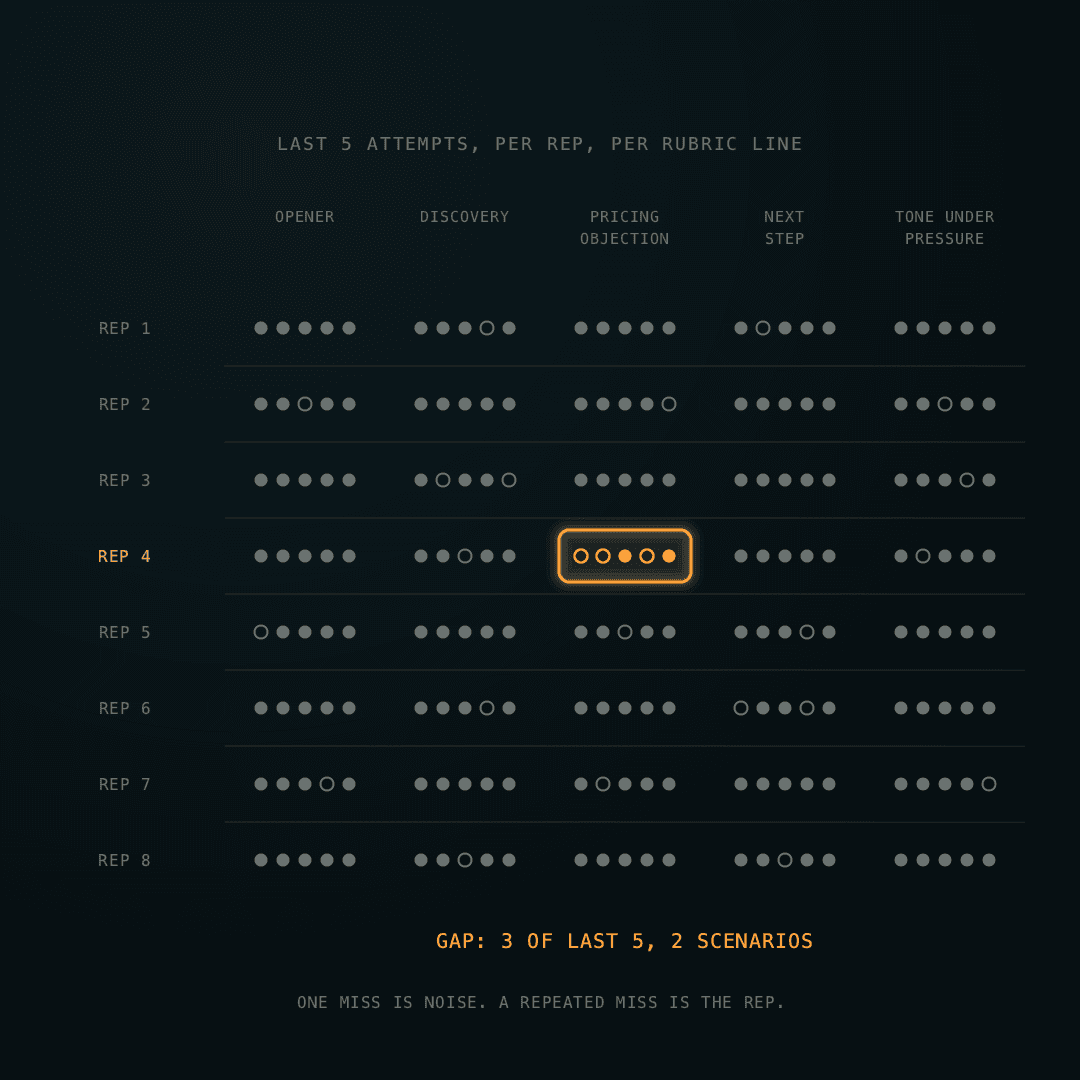
The software marks every practice attempt against each line of your rubric, stores the result per line, and flags a gap when the same line keeps failing across recent attempts and more than one scenario. The single score is a by-product. The pattern is the product.
Your rubric becomes a checklist. Each line is observable: did the rep confirm the problem before pitching, quantify the cost, hold price before discounting, ask for a dated next step? If you run SPIN, MEDDIC or Sandler, the lines come from that method.
Each attempt is marked line by line, with the moment that earned or lost the mark. "Missed: offered 10% off before asking what the budget was for" is useful. "Objection handling: 6/10" is not.
Results stack up per rep, per line. Two weeks of daily practice gives you dozens of data points per rep, not the one call a manager remembers.
A gap is a repeated miss. Our rule of thumb: flag it when a line fails on at least 3 of the last 5 attempts, across at least 2 scenarios. One scenario might be badly written. Two scenarios is the rep.
The gap picks the next drill. If pricing keeps failing, tomorrow's session leans on pricing, with a buyer the rep has not met.
That is what "top sales coaching software with automated rep assessments and skill gap identification" (position 11 for us) is really asking for: a diagnosis that updates itself. How the major platforms score is compared in our AI sales coaching software guide.
How do you keep automated scoring fair?
Calibrate it against your managers before anyone sees a score, keep scores out of pay decisions, and show reps their results first. Scoring is fair when it is consistent, explainable and used for practice, not punishment.
1. Blind-grade before you trust. Take ten sessions. Have two or three managers score them without seeing the AI's marks. Where managers agree with each other and the AI does not, fix the rubric line or the scenario. Where managers disagree with each other, the line itself is undefined. Fix that first.
2. Test the curveball. Ask your best rep to answer well but off-script. If the score drops because the answer was unexpected, reps will learn to perform for the grader. Reviews of practice tools complain about uneven scoring more than anything else.
3. Never tie scores to pay. Once a practice score touches a bonus or a performance plan, reps stop practising hard scenarios and farm easy ones. Beautiful charts, worse calls.
4. Show the rep first. Seen first by the rep, scores are a mirror. Seen first by the manager, they are a camera.
5. Version the rubric. When a line changes, mark the date and judge trends from there.
Hard scoring only works if reps believe it is fair, and they only believe it once managers have checked it with their own ears. Calibration is not admin. It is what makes reps listen.
What does AI coaching for sales managers giving rep feedback look like?
The AI gives instant, line-by-line feedback on every attempt. The manager gives the slower feedback in the 1:1: why this skill matters for this rep's deals, and what to work on this week. The AI does the marking. The manager does the meaning.
"AI coaching for sales managers giving rep feedback" sits at position 3.5 in our data; "coaching tools for sales managers" at 52. Same buyer, same question: how do I give better feedback without spending my week on it?
What happened. "You offered a discount before asking about budget." The AI says this seconds after every attempt.
Why it matters. "Procurement here anchors on your first number." Only someone who knows the territory can say this.
What next. "Run the pricing scenario three times before Thursday, and we'll listen to your best one together." The manager sets it. The software makes sure it happens.
With the first layer automated, managers open 1:1s with a question, not a list of mistakes. (Our main guide has a 15-minute 1:1 format.) What the manager needs is one page before the 1:1. In SecondBody that is the pre-1:1 briefing: who to coach, on which skill, which moments to replay. If a manager tool needs a filter and a date picker, it is a reporting tool wearing a coaching badge.
What does a coaching week look like for a manager of 10 to 50 reps?
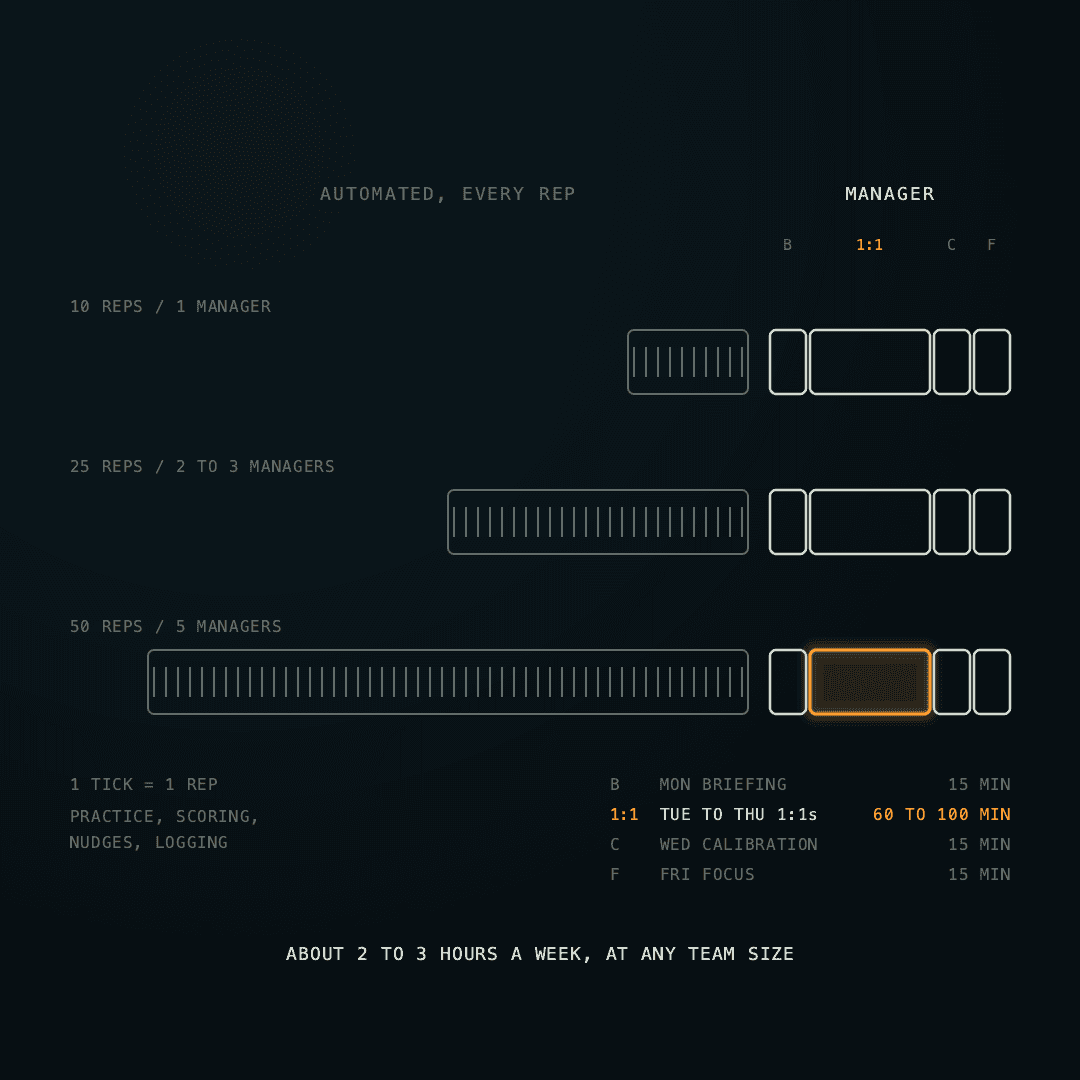
Automation handles daily practice, scoring, nudges and logging for every rep. The manager spends roughly two to three hours a week on coaching at any team size: a Monday briefing, short 1:1s with flagged reps, a midweek calibration check and a Friday focus decision. As you grow, the number of managers changes, not how much each one reviews.
One query that found us: "we're scaling from 10 to 50 AEs and our current coaching process doesn't scale." It never does. At 10 reps, a manager knows every weak spot by instinct. At 50, you have five managers, two of them new. A shared rubric and an automated loop replace instinct.
The rhythm we would run. The minutes are our planning numbers, not a benchmark.
Day | What automation does | What the manager does | Manager time |
|---|---|---|---|
Monday | Builds the week's briefing from last week's practice | Reads it, picks 3 to 5 reps and one skill each | 15 minutes |
Tuesday to Thursday | Runs daily practice, scores it, picks the next drill, nudges anyone who skipped | 15 to 20 minute 1:1s with the flagged reps | 60 to 100 minutes |
Wednesday | Surfaces two scored sessions for spot-checking | Listens, checks the scores match their own ear | 15 minutes |
Friday | Logs the week's debriefs and next steps | Sets next week's team focus skill; credits whoever moved most | 15 minutes |
How it scales:
Team size | Managers | Who gets a 1:1 each week | What must be shared |
|---|---|---|---|
10 reps | One | Nearly everyone, short | The rubric, written down for the first time |
25 reps | Two or three | 3 to 5 flagged per manager; everyone every 2 to 3 weeks | One rubric, calibrated across managers |
50 reps | Five or six, some new | Flagged reps only; the system covers the rest daily | One rubric, one scenario owner, monthly calibration |
Two things break at 50. New managers coach the way they were coached, usually not at all, so give them the briefing before the team. And five managers drift into five rubrics within a quarter, so monthly, score the same three sessions together until the scores match.
What does it buy? At GBUK, managers got back about a week a month, and consistent users scored 8 to 10 out of 10 on cold-call assessments against about 6 for intermittent users.
How do automated refresher paths shorten ramp?
They bring a skill back just before it fades. A new rep who passed the pricing scenario in week two will lose some of it by week six unless they meet it again. A refresher path schedules that meeting, so ramp does not leak.
The query behind this (position 9) asks for "automated refresher paths to shorten ramp". New reps cram in onboarding, pass a certification, then lose half of it before their first negotiation.
A good refresher works like a language app: what you miss comes back tomorrow.
Refresh on evidence, not a calendar. Bring a skill back when recent attempts slip, not because thirty days passed.
Change the buyer. The same persona tests memory. A new persona with the same objection tests skill.
Keep it short. Five minutes in the car beats a 45-minute module.
The way we built it, Rory uses each rep's trend to choose the next scenario, so a skill that slips comes back in tomorrow's session. At Allwyn, new starters ramped 65% faster on Allwyn's own measure, and reps at coaching standard went from 1 in 5 to 4 in 5 in a quarter. One customer, measured their way.
Which platforms offer automated sales coaching and CRM logging for remote teams?
Several practice platforms integrate with a CRM, but logging usually sits on a higher tier, and "integration" ranges from reading deal context to writing debriefs back to the record. Ask exactly what gets written, where, and who approves it.
Position 2 for us this month. What vendors' own pages said on 16 October 2026:
Platform | Automated practice and scoring | CRM logging, per the vendor's page |
|---|---|---|
SecondBody | Daily practice with Rory, scoring, manager briefings | Salesforce and HubSpot: deal context in, debriefs and next steps back to the record. Dynamics 365: read-only. See integrations |
Hyperbound | Roleplay and custom scorecards | CRM integration and "Conversation Auto-Fill" on the Perform licence only, not Practice (pricing) |
Kendo | Roleplay plus live call scoring | Lists "Integrations" on paid seats; no CRM named on the pricing page (pricing) |
Amotions | Roleplay and real-time coaching | "Integrations" on Enterprise; Salesforce and HubSpot not named (pricing) |
Three questions for every vendor, us included:
What exactly gets written? Completion, scores, debriefs, next steps? Practice scores on a deal record get read out of context.
Read, write or both? Some IT teams approve read-only and nothing else. GBUK's setup reads Dynamics 365 through Microsoft's MCP protocol, read-only, with nothing written back.
What is recorded? Procurement will ask. SecondBody never records customer conversations. Rory does not listen in on live calls or visits; reps practise before and debrief after, and a real call is only coached if you upload a recording you already own. Our trust centre has the rest.
Can you get automated sales coaching software with CRM integration for under $50 a month?
Not on any published team plan we could verify. A couple of tools publish prices under $50 a seat, but none names Salesforce or HubSpot integration at that price.
The query, at position 6 for us: "help me find automated sales coaching software with crm integration for under $50 monthly". From vendors' own pages on 16 October 2026:
Amotions Starter: $49 a seat a month billed annually ($59 monthly). No CRM named on that plan.
Kendo Pro: $55 a seat a month, 180 pooled roleplay minutes. "Integrations" listed, no CRM named.
Yoodli: individual plans at $8 and $20 a month on annual billing; team plans with rubrics and manager dashboards are custom (pricing).
Hyperbound: free tier, but CRM integration sits on Perform, which has no published price.
SecondBody:$75 a month or $750 a year per seat (about $62.50 a month on annual), with 120 minutes of roleplay and 60 minutes of coaching with Rory a month. Not under $50. We would rather say so.
A $40 tool nobody opens costs $40 for nothing. Full cost picture in our sales coaching software pricing guide.
How do you pilot automated sales coaching in two weeks?
Pilot the automation, not just the reps. In two weeks you want to know four things: do reps practise without chasing, do scores match your managers, do flagged gaps look right, and does the manager's week get shorter.
The shape that has closed deals for us is ten new joiners, two weeks, one number to move. Add four checks:
Check | How to run it | Pass mark (our suggestion) |
|---|---|---|
Practice without chasing | Count reps who practised most working days with no manager reminders | 8 of 10 reps |
Score agreement | Days 3 to 5: two managers blind-grade ten sessions against the AI | Agreement on most rubric lines; every disagreement explained |
Gap accuracy | Day 10: show managers the flagged gaps before revealing names. Would they have picked these? | Managers recognise most gaps |
Manager time | Log coaching minutes in week two against the week before | Less time, fewer reps, named skills |
Pick new joiners, not keen volunteers, and name one scenario owner before day one. If score agreement fails, do not roll out. Fix the rubric and rerun the check.
What mistakes do teams make when they automate sales coaching?
Six, nearly every time. We have watched all of them.
Automating the report instead of the reps. The Monday scorecard email.
Automating the manager out. If the 1:1 disappears because "the AI handles coaching now", reps feel managed by software and usage drops within a month.
Skipping calibration. The first time a strong rep gets a bad score for a good answer, the team stops trusting the tool.
Turning nudges into nagging. Three reminders a day make practice feel like debt. At Rentokil Terminix, usage caps were added because some reps practised more than was sustainable. Caps protect selling time in both directions.
Logging everything to the CRM. Scores on a deal record get read as performance data. Log debriefs and next steps instead.
Letting scenarios go stale. If nobody updates the objections, reps rehearse last year's buyer.
Each is a human decision handed to software. The fix is a manager owning the part that was always theirs.
Frequently asked questions about automated sales coaching
What is virtual sales coaching?
Coaching delivered remotely by video, phone or software. Done well, reps rehearse with an AI buyer, and managers coach the patterns in short remote 1:1s.
What are the best coaching tools for sales managers?
Ones that give a manager a short list before each 1:1 and run daily practice for every rep without supervision. If it needs a filter to show who to coach, it is a reporting tool.
Can AI replace sales managers as coaches?
No. AI runs the practice, marks it and spots patterns. It cannot judge a deal it has never seen, or tell a rep after a bad week that they will make it.
How often should automated coaching nudge reps?
Once or twice a working day, timed to natural gaps like before the first call or the drive home, and capped.
Should automated coaching scores go into performance reviews?
No. Use them to choose what to practise, not to rank people. Once scores affect pay, reps avoid the hard scenarios.
Does SecondBody log coaching to the CRM?
The Salesforce and HubSpot integrations pull deal context into the brief and send debriefs and next steps back to the record. Dynamics 365 is read-only. SecondBody never records customer conversations.
How does SecondBody automate coaching for remote reps?
On every plan, reps practise with Rory on web and mobile, scored against your method. On team plans, Rory calls reps on WhatsApp or phone for a morning warm-up and end-of-day debrief, with no login, and managers get a one-page briefing before each 1:1.
How we know this
Written by Omid, founder of SecondBody. The queries quoted come from our own Google Search Console data for the four weeks to 11 October 2026, with average positions. The objections, the pilot shape and the content-owner lesson come from twenty of our sales calls between January and September 2026, anonymised. Customer results are from our published stories. Every competitor price and CRM detail was checked on the vendor's own pricing page on 16 October 2026; where a page did not say something, we say so. The weekly minutes and the gap rule are our planning numbers, not a benchmark. Spot something out of date? Tell us.
So what should you automate first?
The practice. Not the report, not the CRM field, not the leaderboard. Scoring, gaps, the next drill, the nudge and the log only matter once reps rehearse the hard moment every day.
Then protect the human part on purpose: the 1:1, the call on a deal, the Friday word to the rep who moved most. No software earns those.
Reps do not freeze because nobody sent them a scorecard. They freeze because they have never had the conversation before the one that counts. That is what SecondBody automates. Rory runs the reps, marks them against your method and picks tomorrow's drill, and your managers get one page that says who needs them this week. Book a demo and bring your rubric. We will show you what Rory does with it.
Good luck out there.
Omid
Automated sales coaching should take over the volume work a manager never has time for: running practice reps, scoring them against your rubric, spotting skill gaps, picking each rep's next drill, sending nudges and logging it all. The human work stays human: the 1:1 conversation, judgement on live deals, motivation and calibrating the rubric. The trap is automating reports nobody reads instead of practice. Below: the split as a table, how automated assessment works and stays fair, a weekly rhythm for a manager of 10 to 50 reps, how to judge vendors, and a two-week pilot.
Key answers, up front
Automate the reps, not the relationship. Practice, scoring, gap-spotting, the next drill, nudges and CRM logging are machine work. The 1:1, deal calls, morale and the rubric itself are manager work.
The trap is the weekly report. A scorecard email automates reading, which nobody does. Practice automates doing.
A skill gap is a pattern, not a score. Trust a gap when the same rubric line fails on most recent attempts across more than one scenario.
Fairness is a manager job. Blind-grade sessions against the AI before trusting it, and never tie scores to pay.
CRM logging and under $50: honest answers. CRM write-back usually sits on higher tiers, and we found no published team plan with CRM integration under $50 a seat. SecondBody is $75 a month or $750 a year per seat.
We build one of these tools, so read this with that in mind. We will also say what should never be automated.
What is automated sales coaching, and what does it actually automate?
Automated sales coaching is software that runs the repetitive parts of coaching without a manager in the room: the AI plays the buyer, scores the rep, explains the fix, decides what to practise next and tells the manager who needs attention. Virtual sales coaching is the same idea from the rep's side. The coach is reachable from wherever the rep is.
Most "coaching" in a sales org was never coaching. It was a manager hearing one call a fortnight and saying "slow down on price". That is a lottery ticket, not a system.
Real coaching has five parts: the rep tries the hard moment, hears what went wrong, tries again, someone spots the pattern across weeks, and someone decides what comes next. Automation is good at four. It is bad at the fifth, where a person decides this rep needs a push, not a plan.
Still choosing a kind of tool? Start with our main guide to AI sales coaching software. This piece is about how far to let the machine go.
What should you automate in sales coaching, and what should stay human?
Automate anything that has to happen often, the same way, for every rep. Keep anything that needs context the software cannot see, or trust it has not earned.
Coaching task | Automate it? | Why |
|---|---|---|
Running practice reps (the AI buyer) | Yes | A manager cannot play the buyer fifty times a week |
Scoring each attempt against your rubric | Yes, after calibration | Instant and consistent, once managers have checked it |
Spotting skill gaps and trends | Yes | Patterns across hundreds of attempts are invisible to a human |
Picking the next drill | Yes | The trend already says what to practise |
Nudges and reminders | Yes, with caps | A call or message at the right time beats a portal nobody opens |
Logging practice and debriefs to the CRM | Yes, if IT agrees | Nobody should retype what the system already knows |
The 1:1 conversation | No | The rep needs to be heard by someone who decides their future |
Judgement on a live deal | No | The AI has not met the buyer. Your manager might have |
Motivation after a bad week | No | A score cannot tell a rep they belong here |
Writing and calibrating the rubric | No | The rubric is your sales method. Software follows it, never sets it |
The bottom four rows are about trust and context. That is not a gap in today's AI. It is what management is. The top six are jobs managers promise and then skip because the forecast call ran long. Automation fills the space where the manager was supposed to be.
Why do so many coaching automations end up as reports nobody reads?
Because reporting is the easiest thing to automate, so it goes first. A dashboard is cheap and great in a demo. Practice is hard to build and pays off three weeks later.
The tool sends managers a Monday email: talk ratios, filler words, a traffic-light grid. Week one, they open it. Week six, it goes to a folder. Reps never see it. That is Sales Training Theatre with better graphics.
When a buyer on a sales call tells us they fear "another tool nobody opens", the history behind it is nearly always the same: they bought analysis when the problem was practice. One customer of ours cancelled for a cousin of that reason: nobody on their side owned the scenarios, so practice went stale.
The test: does this feature make a rep do something, or make a manager read something? Favour the first. Allow a little of the second, if it fits on one page and arrives before the 1:1.
Our team is fully remote and managers can't review every call. What should coaching software automate?
Automate practice and first-round feedback, so every rep gets coached daily without a manager listening. Then automate the shortlist, so managers spend their few hours on the three or four reps who need them.
That query sits at position 5 in our Search Console data, next to "best sales coaching software for teams where managers can't review every call" at 7. The buyer has accepted they cannot review more calls. They want to know what replaces the review.
Practice before the call instead of review after it. If a manager cannot hear the conversation, make sure the rep has already had it, with an AI buyer, five times this week.
Feedback in seconds. Reviewing a recording three days later is archaeology. A score and a fix ten seconds after the attempt is coaching.
A short list, not a full review. Who has gone quiet, who keeps missing the same line, who is ready for harder scenarios.
Field teams have the same problem, because their calls are never recorded. Our guide to field sales coaching covers that version.
For remote teams, where the practice lives decides whether it happens. The coach waits in a portal, and nobody visits portals. SecondBody was built so the coach goes to the rep: on team plans, Rory, our AI coach, calls reps on WhatsApp or phone for a morning warm-up and an end-of-day debrief, with no login.
How do automated rep assessments and skill gap identification work?
The software marks every practice attempt against each line of your rubric, stores the result per line, and flags a gap when the same line keeps failing across recent attempts and more than one scenario. The single score is a by-product. The pattern is the product.
Your rubric becomes a checklist. Each line is observable: did the rep confirm the problem before pitching, quantify the cost, hold price before discounting, ask for a dated next step? If you run SPIN, MEDDIC or Sandler, the lines come from that method.
Each attempt is marked line by line, with the moment that earned or lost the mark. "Missed: offered 10% off before asking what the budget was for" is useful. "Objection handling: 6/10" is not.
Results stack up per rep, per line. Two weeks of daily practice gives you dozens of data points per rep, not the one call a manager remembers.
A gap is a repeated miss. Our rule of thumb: flag it when a line fails on at least 3 of the last 5 attempts, across at least 2 scenarios. One scenario might be badly written. Two scenarios is the rep.
The gap picks the next drill. If pricing keeps failing, tomorrow's session leans on pricing, with a buyer the rep has not met.
That is what "top sales coaching software with automated rep assessments and skill gap identification" (position 11 for us) is really asking for: a diagnosis that updates itself. How the major platforms score is compared in our AI sales coaching software guide.
How do you keep automated scoring fair?
Calibrate it against your managers before anyone sees a score, keep scores out of pay decisions, and show reps their results first. Scoring is fair when it is consistent, explainable and used for practice, not punishment.
1. Blind-grade before you trust. Take ten sessions. Have two or three managers score them without seeing the AI's marks. Where managers agree with each other and the AI does not, fix the rubric line or the scenario. Where managers disagree with each other, the line itself is undefined. Fix that first.
2. Test the curveball. Ask your best rep to answer well but off-script. If the score drops because the answer was unexpected, reps will learn to perform for the grader. Reviews of practice tools complain about uneven scoring more than anything else.
3. Never tie scores to pay. Once a practice score touches a bonus or a performance plan, reps stop practising hard scenarios and farm easy ones. Beautiful charts, worse calls.
4. Show the rep first. Seen first by the rep, scores are a mirror. Seen first by the manager, they are a camera.
5. Version the rubric. When a line changes, mark the date and judge trends from there.
Hard scoring only works if reps believe it is fair, and they only believe it once managers have checked it with their own ears. Calibration is not admin. It is what makes reps listen.
What does AI coaching for sales managers giving rep feedback look like?
The AI gives instant, line-by-line feedback on every attempt. The manager gives the slower feedback in the 1:1: why this skill matters for this rep's deals, and what to work on this week. The AI does the marking. The manager does the meaning.
"AI coaching for sales managers giving rep feedback" sits at position 3.5 in our data; "coaching tools for sales managers" at 52. Same buyer, same question: how do I give better feedback without spending my week on it?
What happened. "You offered a discount before asking about budget." The AI says this seconds after every attempt.
Why it matters. "Procurement here anchors on your first number." Only someone who knows the territory can say this.
What next. "Run the pricing scenario three times before Thursday, and we'll listen to your best one together." The manager sets it. The software makes sure it happens.
With the first layer automated, managers open 1:1s with a question, not a list of mistakes. (Our main guide has a 15-minute 1:1 format.) What the manager needs is one page before the 1:1. In SecondBody that is the pre-1:1 briefing: who to coach, on which skill, which moments to replay. If a manager tool needs a filter and a date picker, it is a reporting tool wearing a coaching badge.
What does a coaching week look like for a manager of 10 to 50 reps?
Automation handles daily practice, scoring, nudges and logging for every rep. The manager spends roughly two to three hours a week on coaching at any team size: a Monday briefing, short 1:1s with flagged reps, a midweek calibration check and a Friday focus decision. As you grow, the number of managers changes, not how much each one reviews.
One query that found us: "we're scaling from 10 to 50 AEs and our current coaching process doesn't scale." It never does. At 10 reps, a manager knows every weak spot by instinct. At 50, you have five managers, two of them new. A shared rubric and an automated loop replace instinct.
The rhythm we would run. The minutes are our planning numbers, not a benchmark.
Day | What automation does | What the manager does | Manager time |
|---|---|---|---|
Monday | Builds the week's briefing from last week's practice | Reads it, picks 3 to 5 reps and one skill each | 15 minutes |
Tuesday to Thursday | Runs daily practice, scores it, picks the next drill, nudges anyone who skipped | 15 to 20 minute 1:1s with the flagged reps | 60 to 100 minutes |
Wednesday | Surfaces two scored sessions for spot-checking | Listens, checks the scores match their own ear | 15 minutes |
Friday | Logs the week's debriefs and next steps | Sets next week's team focus skill; credits whoever moved most | 15 minutes |
How it scales:
Team size | Managers | Who gets a 1:1 each week | What must be shared |
|---|---|---|---|
10 reps | One | Nearly everyone, short | The rubric, written down for the first time |
25 reps | Two or three | 3 to 5 flagged per manager; everyone every 2 to 3 weeks | One rubric, calibrated across managers |
50 reps | Five or six, some new | Flagged reps only; the system covers the rest daily | One rubric, one scenario owner, monthly calibration |
Two things break at 50. New managers coach the way they were coached, usually not at all, so give them the briefing before the team. And five managers drift into five rubrics within a quarter, so monthly, score the same three sessions together until the scores match.
What does it buy? At GBUK, managers got back about a week a month, and consistent users scored 8 to 10 out of 10 on cold-call assessments against about 6 for intermittent users.
How do automated refresher paths shorten ramp?
They bring a skill back just before it fades. A new rep who passed the pricing scenario in week two will lose some of it by week six unless they meet it again. A refresher path schedules that meeting, so ramp does not leak.
The query behind this (position 9) asks for "automated refresher paths to shorten ramp". New reps cram in onboarding, pass a certification, then lose half of it before their first negotiation.
A good refresher works like a language app: what you miss comes back tomorrow.
Refresh on evidence, not a calendar. Bring a skill back when recent attempts slip, not because thirty days passed.
Change the buyer. The same persona tests memory. A new persona with the same objection tests skill.
Keep it short. Five minutes in the car beats a 45-minute module.
The way we built it, Rory uses each rep's trend to choose the next scenario, so a skill that slips comes back in tomorrow's session. At Allwyn, new starters ramped 65% faster on Allwyn's own measure, and reps at coaching standard went from 1 in 5 to 4 in 5 in a quarter. One customer, measured their way.
Which platforms offer automated sales coaching and CRM logging for remote teams?
Several practice platforms integrate with a CRM, but logging usually sits on a higher tier, and "integration" ranges from reading deal context to writing debriefs back to the record. Ask exactly what gets written, where, and who approves it.
Position 2 for us this month. What vendors' own pages said on 16 October 2026:
Platform | Automated practice and scoring | CRM logging, per the vendor's page |
|---|---|---|
SecondBody | Daily practice with Rory, scoring, manager briefings | Salesforce and HubSpot: deal context in, debriefs and next steps back to the record. Dynamics 365: read-only. See integrations |
Hyperbound | Roleplay and custom scorecards | CRM integration and "Conversation Auto-Fill" on the Perform licence only, not Practice (pricing) |
Kendo | Roleplay plus live call scoring | Lists "Integrations" on paid seats; no CRM named on the pricing page (pricing) |
Amotions | Roleplay and real-time coaching | "Integrations" on Enterprise; Salesforce and HubSpot not named (pricing) |
Three questions for every vendor, us included:
What exactly gets written? Completion, scores, debriefs, next steps? Practice scores on a deal record get read out of context.
Read, write or both? Some IT teams approve read-only and nothing else. GBUK's setup reads Dynamics 365 through Microsoft's MCP protocol, read-only, with nothing written back.
What is recorded? Procurement will ask. SecondBody never records customer conversations. Rory does not listen in on live calls or visits; reps practise before and debrief after, and a real call is only coached if you upload a recording you already own. Our trust centre has the rest.
Can you get automated sales coaching software with CRM integration for under $50 a month?
Not on any published team plan we could verify. A couple of tools publish prices under $50 a seat, but none names Salesforce or HubSpot integration at that price.
The query, at position 6 for us: "help me find automated sales coaching software with crm integration for under $50 monthly". From vendors' own pages on 16 October 2026:
Amotions Starter: $49 a seat a month billed annually ($59 monthly). No CRM named on that plan.
Kendo Pro: $55 a seat a month, 180 pooled roleplay minutes. "Integrations" listed, no CRM named.
Yoodli: individual plans at $8 and $20 a month on annual billing; team plans with rubrics and manager dashboards are custom (pricing).
Hyperbound: free tier, but CRM integration sits on Perform, which has no published price.
SecondBody:$75 a month or $750 a year per seat (about $62.50 a month on annual), with 120 minutes of roleplay and 60 minutes of coaching with Rory a month. Not under $50. We would rather say so.
A $40 tool nobody opens costs $40 for nothing. Full cost picture in our sales coaching software pricing guide.
How do you pilot automated sales coaching in two weeks?
Pilot the automation, not just the reps. In two weeks you want to know four things: do reps practise without chasing, do scores match your managers, do flagged gaps look right, and does the manager's week get shorter.
The shape that has closed deals for us is ten new joiners, two weeks, one number to move. Add four checks:
Check | How to run it | Pass mark (our suggestion) |
|---|---|---|
Practice without chasing | Count reps who practised most working days with no manager reminders | 8 of 10 reps |
Score agreement | Days 3 to 5: two managers blind-grade ten sessions against the AI | Agreement on most rubric lines; every disagreement explained |
Gap accuracy | Day 10: show managers the flagged gaps before revealing names. Would they have picked these? | Managers recognise most gaps |
Manager time | Log coaching minutes in week two against the week before | Less time, fewer reps, named skills |
Pick new joiners, not keen volunteers, and name one scenario owner before day one. If score agreement fails, do not roll out. Fix the rubric and rerun the check.
What mistakes do teams make when they automate sales coaching?
Six, nearly every time. We have watched all of them.
Automating the report instead of the reps. The Monday scorecard email.
Automating the manager out. If the 1:1 disappears because "the AI handles coaching now", reps feel managed by software and usage drops within a month.
Skipping calibration. The first time a strong rep gets a bad score for a good answer, the team stops trusting the tool.
Turning nudges into nagging. Three reminders a day make practice feel like debt. At Rentokil Terminix, usage caps were added because some reps practised more than was sustainable. Caps protect selling time in both directions.
Logging everything to the CRM. Scores on a deal record get read as performance data. Log debriefs and next steps instead.
Letting scenarios go stale. If nobody updates the objections, reps rehearse last year's buyer.
Each is a human decision handed to software. The fix is a manager owning the part that was always theirs.
Frequently asked questions about automated sales coaching
What is virtual sales coaching?
Coaching delivered remotely by video, phone or software. Done well, reps rehearse with an AI buyer, and managers coach the patterns in short remote 1:1s.
What are the best coaching tools for sales managers?
Ones that give a manager a short list before each 1:1 and run daily practice for every rep without supervision. If it needs a filter to show who to coach, it is a reporting tool.
Can AI replace sales managers as coaches?
No. AI runs the practice, marks it and spots patterns. It cannot judge a deal it has never seen, or tell a rep after a bad week that they will make it.
How often should automated coaching nudge reps?
Once or twice a working day, timed to natural gaps like before the first call or the drive home, and capped.
Should automated coaching scores go into performance reviews?
No. Use them to choose what to practise, not to rank people. Once scores affect pay, reps avoid the hard scenarios.
Does SecondBody log coaching to the CRM?
The Salesforce and HubSpot integrations pull deal context into the brief and send debriefs and next steps back to the record. Dynamics 365 is read-only. SecondBody never records customer conversations.
How does SecondBody automate coaching for remote reps?
On every plan, reps practise with Rory on web and mobile, scored against your method. On team plans, Rory calls reps on WhatsApp or phone for a morning warm-up and end-of-day debrief, with no login, and managers get a one-page briefing before each 1:1.
How we know this
Written by Omid, founder of SecondBody. The queries quoted come from our own Google Search Console data for the four weeks to 11 October 2026, with average positions. The objections, the pilot shape and the content-owner lesson come from twenty of our sales calls between January and September 2026, anonymised. Customer results are from our published stories. Every competitor price and CRM detail was checked on the vendor's own pricing page on 16 October 2026; where a page did not say something, we say so. The weekly minutes and the gap rule are our planning numbers, not a benchmark. Spot something out of date? Tell us.
So what should you automate first?
The practice. Not the report, not the CRM field, not the leaderboard. Scoring, gaps, the next drill, the nudge and the log only matter once reps rehearse the hard moment every day.
Then protect the human part on purpose: the 1:1, the call on a deal, the Friday word to the rep who moved most. No software earns those.
Reps do not freeze because nobody sent them a scorecard. They freeze because they have never had the conversation before the one that counts. That is what SecondBody automates. Rory runs the reps, marks them against your method and picks tomorrow's drill, and your managers get one page that says who needs them this week. Book a demo and bring your rubric. We will show you what Rory does with it.
Good luck out there.
Omid
Coach before the call, not after it.
Daily voice practice for reps. A one-page briefing for managers before every 1:1.


SecondBody is the AI sales coaching platform that coaches before the call: daily voice practice with Rory for reps, and a one-page briefing for managers before every 1:1. Explore pricing or book a demo.
Related reading: AI Sales Coaching Software: 10 Platforms Compared (2026), Sales Coaching Software Pricing: What Teams Really Pay.
Share this article